|
|
October 1st, 2009
The 2009 F-Class Nationals are underway right now at Camp Butner, NC. While riflescopes are allowed in both F-Open and F-TR classes, many competitors use a spotting scope as well. With a low-mounted spotting scope placed near the shooter, you can keep your riflescope trained on the target, then quickly check wind flags or mirage by looking through the spotter.
Here’s a smart product from Ray-Vin.com that lets F-Class and prone shooters mount their spotting scopes in the ideal viewing position. Ray-Vin’s patented MKII F-Stand is solid and sturdy, and “floats” the scope close to the shooter’s head without interfering with the placement of a front pedestal rest or ultra-wide bipod. The base can sit off the shooter’s mat.

How much? The entire F-Stand package costs $310.00, including 8″ bottom for prone, two 24″ extensions, Ray-Vin 360 Head, and Take-Off Knob. But if you don’t need the extensions, you can purchase components separately.
 The F-Stand is shown with Ray-Vin’s $85.00 Scope Head. This head allows the shooter to adjust scope height, rotation (around the stand shaft), scope angular elevation, and eyepiece orientation, all with one control. Some other scope heads, though more expensive, require you to use multiple knobs or friction adjusters. Conveniently, most of the adjustments can be done easily with one hand, using the black adjusting handle. Smart engineering we’d say. The F-Stand is shown with Ray-Vin’s $85.00 Scope Head. This head allows the shooter to adjust scope height, rotation (around the stand shaft), scope angular elevation, and eyepiece orientation, all with one control. Some other scope heads, though more expensive, require you to use multiple knobs or friction adjusters. Conveniently, most of the adjustments can be done easily with one hand, using the black adjusting handle. Smart engineering we’d say.
You can see that the F-Stand places the spotting scope right where the shooter wants it, yet the legs do not interfere with the shooting position. A heavy-duty milled metal bracket clamps the base stud and scope rod securely. The F-stand will hold even heavy 80mm spotting scopes without flexing.

CLICK HERE to Read Reports from F-Stand Owners.
September 27th, 2009
 Forum Member Dave B., aka “Gunamonth”, is a chemist/physicist with decades of experience working with the ultrasound process. He has achieved great results cleaning cases via ultrasound. Dave tried a variety of solutions and he favors a mix of water and Citranox®. This achieved the best results, and did not require a separate neutralizing step if you rinse the cases thoroughly after. Citranox, mixed 1:75 or 1:100 with water (distilled H20 is best), is inexpensive to use. Phospate-free Citranox® contains a blend of organic acids, anionic and non-ionic surfactants and alkanolamines. For more information on using Citranox®, check out THIS FORUM THREAD. Forum Member Dave B., aka “Gunamonth”, is a chemist/physicist with decades of experience working with the ultrasound process. He has achieved great results cleaning cases via ultrasound. Dave tried a variety of solutions and he favors a mix of water and Citranox®. This achieved the best results, and did not require a separate neutralizing step if you rinse the cases thoroughly after. Citranox, mixed 1:75 or 1:100 with water (distilled H20 is best), is inexpensive to use. Phospate-free Citranox® contains a blend of organic acids, anionic and non-ionic surfactants and alkanolamines. For more information on using Citranox®, check out THIS FORUM THREAD.
Dave notes: “I had a lot of communication with the technical VP of Alconox about trying to clean fired cases with an ultrasonic unit. He sent me a copy of his ultrasonic cleaning manual and recommended a product called Citranox®. So far I’ve been very impressed. With once- or twice-fired brass they clean up very quickly. The worst cases I tried were 6 Dashers that had been fired ten times with Varget and never cleaned. The worst fouling was in the bottom of the case around the flash hole. They took longer and I used a more concentrated cleaning solution but they did come out clean. The price is reasonable. I paid $35 a gallon and for once- or twice-fired cases I dilute the cleaner 100 to 1. There is much less chemical reaction with the brass than there is with vinegar. No weird colors, just shiny bright. I even used it with hot water, which speeds up the cleaning process. No need to neutralize. Just rinse in running water and they’re squeaky clean. The cleaner is mostly detergents with a little citric acid. Even at a 1:75 ratio my $35 worth of cleaner will make 75 gallons of solution. It doesn’t seem to be reusable but 75 gallons is a whole lot of solution when I only use about two cups at a time.”
The price has gone up a bit since Dave acquired his Citranox, but Amazon.com sells Citranox for $40.00 per gallon, or you can buy a gallon of Citranox from LabSafety Supply for $46.40.
September 26th, 2009
 We live in a digital, electronic era. The very story you’re reading right now consists of digital data packets transmitted electronically around the globe. Because of cost factors, 99+% of shooting matches in the USA still rely on old-fashioned manual scoring methods. However, target scoring can be done faster and more precisely with electronic scoring systems. Olympic and international CISM shooting competitions now employ electronic target systems. And electronic scoring is widely used in Europe already. We live in a digital, electronic era. The very story you’re reading right now consists of digital data packets transmitted electronically around the globe. Because of cost factors, 99+% of shooting matches in the USA still rely on old-fashioned manual scoring methods. However, target scoring can be done faster and more precisely with electronic scoring systems. Olympic and international CISM shooting competitions now employ electronic target systems. And electronic scoring is widely used in Europe already.
Below is a video showing an electronic scoring system developed by Norway’s Kongsberg Mikroelektronikk AS. Watch as a prone shooter puts five rounds on a 300m target. You can see the group form on the video screen at his shooting station. He’s a good shooter (with an accurate rifle). The first three shots are touching.
As you can see from the video, viewing shots on the monitor is easier than using a spotting scope and waiting for targets to be marked. The electronic target eliminates the need for a crew of target pullers in the pits.
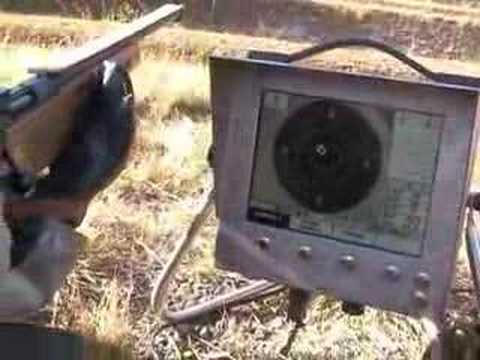
The Kongsberg system, like the electronic systems produced by Sius Ascor of Switzerland, do more than just display shot locations to the shooter. The target units automatically calculate scores, which are transmitted to a central computer. This can provide updated competitor rankings, and can even display the results to event spectators on large view screens.


CLICK HERE for a longer streaming Flash VIDEO showing how electronic target systems work. This video, produced by Sius Ascor, shows olympic target systems in action.
September 24th, 2009
North Carolina-based gunsmith Nat Lambeth is one of the gurus of the Savage world. He has built many highly competitive match rifles using Savage actions, employing his special accurizing methods. Nat recently built up a 6 BRX prone rifle using Gary Eliseo’s new S1 Savage Chassis. The 6 BRX, a 6BR improved with 30° shoulder, can be a very accurate cartridge, as demonstrated by Nat’s new rifle. Right out of the gate, this gun shot an 0.290 five-shot group during barrel break-in.

The rifle features a Savage Target action, factory Accutrigger, and a very accurate 32.5″, 8-twist Broughton 5C™ barrel. The load was Lapua 6BR brass hydraulically formed to 6 BRX, 32.5 grains of Hodgdon Varget, Wolf (Russian) SRM primers, and a Berger 105gr VLD bullet.
Nat really likes the 6 BRX chambering in a long-range prone rifle: “The 6mm BRX is like a 6mmBR on steroids. The whole purpose of the 6mm BRX and 6mm Dasher is to make the 6mmBR a better round for 600-1000 yard shooting. The have the advantages of the 6mmBR with a little more velocity. Most folks who shoot a 6mm BRX fire-form their 6mmBR brass by seating the bullets in the rifling and loading the 6mmBR case with a 90% load. The case expands into the larger chamber making a 6mmBR case now a 6mm BRX. [For this gun] I used my new Hornady Hydraulic Forming Die. [Editor: the hydraulic die will form the cases to about 95% of final shape using just the die, a water-filled case, and a mallet.] As you can see, the hydraulic die allowed me to start off with a standard 6mm BRX load from the get go. For optimum accuracy, barrel life, and case life the 6mm BRX seems to have an accuracy node between 3000 fps and 3080 fps.
Another factor is that the Broughton barrels seem to give about 100-150 fps more velocity. Almost every Broughton barrel that I have chambered seem to gain a little velocity after the first 200 rounds. I have chambered the 6mm BRX with most other barrel manufacturers and they all have shot well. This is a very sweet round.”

If you want to check out this rifle, head to the 2009 F-Class Nationals at Camp Butner, Sept. 30 – October 4. Nat explains: “This rifle will be at Butner for the F-Class Nationals and future matches and practices. I will have it and ammo available for those who would like to shoot it during the practice sessions both as a 6mm BRX and .308 Win.” For more info, call Nat Lambeth at (919) 556-0554 (Home/shop — evenings and weekends), (919) 662-6848 (cell), or email NLambeth [at] embarqmail.com.
September 16th, 2009
Readers often ask: “What priming tool should I use?” There is no simple, clear-cut answer. Different tools have different advantages and disadvantages. Many short-range benchresters like the Sinclair one-at-a-time priming tool. They believe this unit has the best “feel” for seating primers.
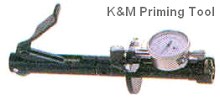 Others prefer the K&M tool, another “single-loader”, because it can be fitted with a seating depth gauge, for the ultimate in precision. On the other hand, one top shooter with a couple National Championships under his belt favors the modest $19.00 Lee Autoprime tool: “It’s simple, efficient and has served me well for years–I’m not convinced the fancy, expensive tools do a better job.” Others prefer the K&M tool, another “single-loader”, because it can be fitted with a seating depth gauge, for the ultimate in precision. On the other hand, one top shooter with a couple National Championships under his belt favors the modest $19.00 Lee Autoprime tool: “It’s simple, efficient and has served me well for years–I’m not convinced the fancy, expensive tools do a better job.”
This editor has tried all of these tools, and personally I favor the RCBS APS hand priming tool. It has two important advantages. Number one, primers are held in color-coded plastic strips so you never have to touch the primers. If you buy the pre-loaded strips, there is no chance of getting an upside-down primer, and you never have to fool with flipping primers in a tray. Second, the APS tool has a “universal” shell-holder. This employs spring-loaded jaws so it can fit any size cartridge, from a 17 Fireball to large magnums. The unit has a comfortable grip and plenty of leverage. Each time you seat a primer, the strip automatically advances. (NOTE: If you like the universal shell holder but don’t like strips, RCBS offers a new m90201 Universal Hand Priming Tool with a universal shell-holder that uses a conventional primer tray.)
 
Currently, only CCI primers can be purchased pre-loaded into strips. But there is an inexpensive tool that allows you to load Federal, Winchester, or Wolf primers into the strips. The strips come in a variety of colors (Red, White, Blue, Orange, Yellow, and Black), so you can sort your primers by color.

The RCBS APS hand primer is ideal when doing primer comparison testing. You can slide one strip of 25 primers in the tool, seat 5 or 10, then easily remove the strip with the remaining primers, and slide in a second strip with another primer type. You can slip the first strip back in a storage box and the primers remain ready to use.
As contained in the strips, primers can also be used in an RCBS 2000 progressive press, a bench-mounted priming unit, and a special device that fits into the top of a Rockchucker or similar press. I have loaded over 20,000 pistol rounds with an RCBS progressive press and I have had not a single flipped primer. Not one. The strip-priming system also makes it easy to switch from small to large primers on the progressive–this can literally be done in under 20 seconds.

The bench-mounted unit is ideal for priming large quantities of cases. The long handle provides plenty of leverage, and you can work fast, as the primers automatically feed through the system. When I load large quantities of varmint rounds, I use the bench-mounted APS system. The only gripe I have concerns the small plastic bushing that guides the primer seating rod. This bushing breaks easily and is easy to lose.
September 2nd, 2009
Phoenix Precision, based in Elk River, MN, crafts precision target sights for long range target shooters. Known for their outstanding reliability and repeatability, Phoenix rear sights are gaining popularity among competitors in prone, Palma, and High Power disciplines. Some of the top “sling and irons” shooters in the country have switched to Phoenix sights.
Gary LaValley, owner of Phoenix Precision, crafts his rear sights using advanced CNC machinery. The sight housings are anodized, aircraft-grade aluminum. For precise repeatability, the sights feature stainless guide pins and lead screws, plus oil-impregnated bronze guide and thread bushings. The sights offer 70 MOA of elevation, 60 MOA of windage, with 1/4-MOA clicks. Knob rotations for elevation and windage are either NRA match rifle (Counter-CW) or service rifle (CW). Quarter-minute clicks are standard, but on request for the Palma shooters, 1/2-MOA windage detent plates are available at no extra charge. Phoenix sights accept both Anschutz and Gehmann accessories.
 |
 |
Phoenix Precision micrometer rear sights are offered in two basic models: top mount ($380.00), and side mount ($355.00). Both types are available in either right- or left-hand configuration (no extra charge for lefties). Top mount models are designed for use on rail-equipped AR flattops, tube guns, Tubb 2000s, and Gary Eliseo stocks. Side mount models are most commonly used on bolt action rifles, but they also work on Picatinny or Weaver-style rails with the use of an adaptor. So, if you have both an older-style Palma rifle and a new, rail-topped tube-gun, you can use the sight on both rigs. Many shooters do use the same Phoenix rear sight on multiple rifles, as shown in the video below. In the video, when real competitors talk about their Phoenix sights, you hear two things time and again: “quality” and “repeatability”.
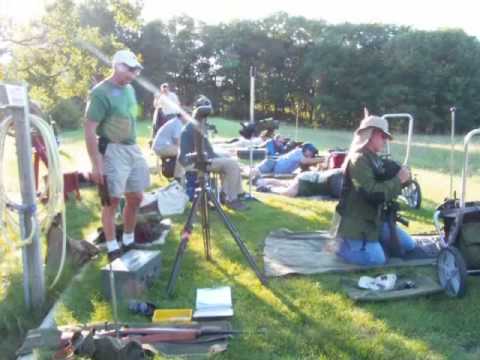
For more information about Phoenix Target Sights and Scope Rails, visit www.PhoenixPrec.com, or call Gary LaValley at (763) 263-3327.
August 30th, 2009
Many reloaders are now using precision digital scales that can measure down to a single kernel of powder. These scales, such as the Denver Instrument MXX-123, are remarkable measuring systems, but you can’t expect them to perform optimally with inconsistent electrical output from a wall socket. We’ve seen the line voltage in some houses vary from 95 to 160 volts. That kind of fluctuation can damage sensitive electronics. A line conditioner can help you get the most from your digital scales and electronic powder dispensers. The line conditioner takes the “juice” from the outlet and actively corrects the voltage to provide a constant 120 volts AC to your machines.
Forum member Danny Reever explains: “We have talked before about the need for surge protection and line conditioning for sensitive electronic equipment like scales and powder dispensers. However the price of said equipment is perhaps a turn-off for a lot of guys.”
Thanks to Danny, now our readers can afford a heavy-duty, high-performance line conditioner/surge protector. Reever has found a quality line conditioner from APC, a well-known manufacturer, at a bargain price — Just $99.99. The APC H10, 1000VA unit is rated for 1000 Watts (continuous). The APC device automatically steps up low voltage and steps down high voltage to levels that are suitable for your equipment. The APC H10 also provides noise filtering and industrial-grade surge protection. Selling elsewhere for $275.00, the APC H10 1000VA is now available for just $99.99 from Tiger Direct.
CLICK HERE for $99.99 APC Line Conditioner (on Sale for Limited Time).
Danny tells us: “This is a real deal for 4900 joules surge protection. The unit weighs a hefty 16.1 pounds and measures 17″ wide X 9.5″ deep. I received mine yesterday and all I can say is $99.99 buys you one nice piece of equipment. It’s built like a tank for worry free and better component performance.”

August 19th, 2009
Savage spotlights ultra-long-range accuracy in an impressive new video clip. Most rifle manufacturers might show a one-inch, 3-shot group at 100 yards and brag about it. Not Savage. In its new TV spot, Savage moves the target way out to 1169 yards (two-thirds of a mile) to demonstrate true long-range accuracy. After a Savage Palma rifle makes the shot twice in a row, Savage Chairman and CEO Ron Coburn comments: “If you think this is the same old Savage… think again.” You tell ‘em Ron. We love it.

In the video, Savage Team Captain Stan Pate, firing prone from bipod, makes back-to-back shots on steel plates set at 1169 yards. You see the plates fall, then the camera zooms all the way back to the shooter, so you can see there’s no fakery. In fact, according to Bill Dermody of Savage: “Stan nailed this shot four takes in a row while we adjusted camera angles and sound levels”. Stan was shooting a Savage Model 12 Palma® rifile chambered in .308 Winchester. This gun features a RBRP Savage Target Action with Accutrigger, 30″ barrel, and laminated stock fitted with accessory rail and adjustable cheekpiece and butt-plate.
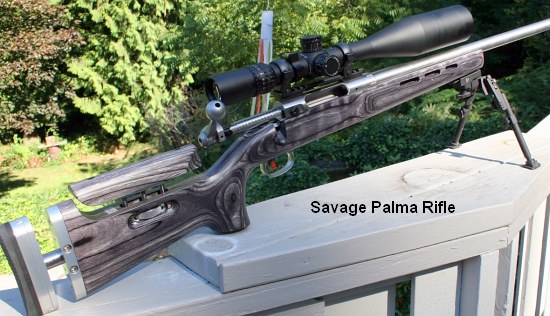
Rifle photo courtesy Darrell Buell, a member of Team Savage.
August 18th, 2009
Here’s a cool video created by Ed Cole and Roy Cole, twin brothers from Texas. In the video, the Coles demonstrate two Eliseo prone rifles, a bright green/orange Savage-actioned S1 and a pumpkin-colored R1 with Stiller Predator (Rem footprint) action. Both rifles are chambered for .223 Remington, and fitted with 31″ Brux cut-rifled barrels. In the video, the Coles shoot with slings and iron sights at targets 600 yards away. We have to say the day-glo colors on the Eliseo S1 will get anyone’s attention. WARNING: Loud music track and shooting sounds — turn the volume down if you are at work.

Roy Cole reports: “My orange ‘Longhorn’ R1 is a superb shooter. After breaking-in the Brux barrel, I took it to the Panola County 600-yard range. The first round was a low 9 on the target. A simple sight adjustment yielded a 10-shot string with eight Xs. With no load development the R1 just ate up the X-Ring. The most amazing thing is how the gun simply falls into your shoulder and fits! One of the greatest surprises of the gun is how nice the Timney tactical trigger is. It is not the most expensive trigger around but it performs as if it is! The Stiller Predator action works right out of the box. Put a barrel and a trigger on it and slip it into the tube stock and have the most fun that you have ever had. My brother Ed’s two S1 guns shoot just as well as my R1 does. His guns use Savage target actions with factory-issue Accutriggers.” Shown below is Ed Cole with another one of his Savage-actioned, Eliseo S1 match rifles. This example is a more ‘sedate’ Candy-Apple red.

To learn more about the Eliseo B1, R1, S1, R5, RT10, and RTS rifle chassis kits, or other products from Gary Eliseo, visit CompetitionShootingStuff.com or call Gary at (714) 630-5734.
August 14th, 2009
Many readers already have a gunsafe, but if you’re like most gunowners, your safe is completely filled with guns, scopes, and personal valuables. Wouldn’t it be nice to have additional secure storage for items such as shooting rests, barrels, tripods, and expensive tools? Here’s a useful item that can safeguard your tools, outdoor gear, and shooting accessories. In a pinch, it can augment the storage capacity of your gun safe, though we recommend a conventional gun safe with UL-rated locking mechanism for long-term firearms storage.
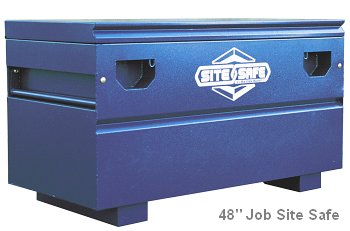
The Better Built® 48″ Steel Job Site Safe is now on sale at Lowe’s for $249.00, marked down from $288.00. Offering 17.5 cubic feet of storage space, the Site Safe (Lowe’s item # 195894) will hold tools, barrels, tripods etc. up to 48″ in length. It is 25″ high, 24″ front to back, and is built of powder-coated 14 gauge steel. The design includes recessed lift handles to assist in installation. In the front are two lock ports which can be secured with padlocks.
This unit can be very handy in your garage or workshop to secure expensive tools and other equipment. Also, its low, horizontal design allows it to fit in places where a conventional, vertical style safe will not fit. Better Built® also offers 36″-wide (item 37224145), and 60″-wide (item 37224142) Site Safes, but these products are not currently sold at Lowe’s.
|


