Shown are funnel with ultra-long drop tube (which helps get more kernels in the cases), RCBS Chargemaster (in wood box), and Hood Press (similar to Harrell’s Combo press).
Loading at the range remains important in the Benchrest for Group discipline. In a Special Report below, past IBS President Jeff Stover explains how loading methods (and hardware) have evolved over the years. The advent of accurate, affordable electronic powder dispensers, such as the RCBS ChargeMaster and Frankford’s new Intellidropper, have changed the game and made it easier to load efficiently at the range. And quality manual powder measures are fast and can be very consistent, with a little practice. Loading at the range permits competitors to tune their load to the conditions, change seating depths, or even choose different bullets to suit the barrel’s preferences on any given day.
Although pre-loading is not uncommon, most 100/200-yard group shooters usually load at the match, often between relays. The goal is to shoot smaller groups by staying “in tune”. In a game where 5-shot groups “in the 1s and Zeros” is the goal, tuning loads for the conditions helps deliver match-winning accuracy. Nearly all competitors in this short-range discipline shoot the 6mm PPC cartridge, or a PPC variant.
Loading at the Range — Then and Now
In benchrest shooting for group, loading at the range has been de rigueur for decades. In the Score discipline, preloading is usually the custom. The main reason is that, in Score competition, only one Aggregate (warm-up match and five record targets) per day is usually shot. That would be less than 50 shots, assuming a few sighter shots. Also, the 30BR, the dominant Benchrest-for-Score cartridge, is very amenable to pre-loading.
By contrast, the Group discipline includes 21 targets (two warm-ups and twenty record targets) over a weekend, usually shot with 6PPC-chambered rifles. Many times, the 6PPC shooters may tweak their loads through the day given changing atmospheric conditions or simply trying to find the correct tune to “dot up”. This term, “Dot up”, means the shots are essentially going through the same hole, or closely so.
Loading at the range was a bit different when benchrest competition was in its infancy. The 1951 book, Modern Accuracy by Bob Wallack, is the best of the early benchrest books. Copies can be found, from time to time, on eBay or Alibris. It is a fascinating survey of benchrest as it existed more than six decades ago. There’s even coverage of a controversial target that was argued over at the time. In it, there is a photo of Wallack using the rear bumper of a car at the bench to clamp his reloading tools. Things have come a long way compared to the range loading set-ups of modern shooters. Here you can see Bob Wallack way back in 1950:
Modern loading bench set-ups shown in this Special Report belong to top shooters Howie Levy, Bob Hamister, and Kent Harshman.
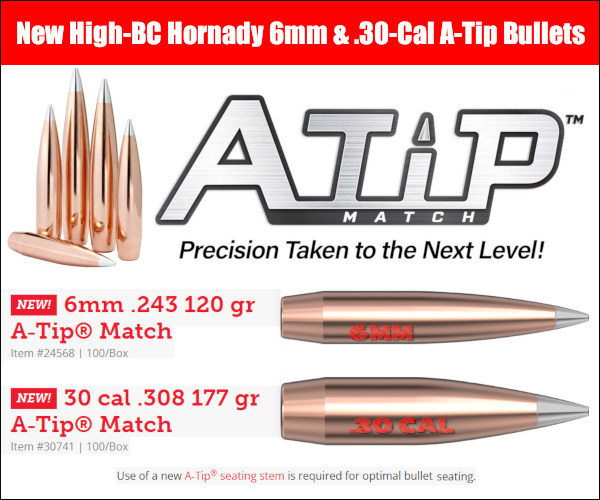
Hornady recently added TWO new A-Tip® Match bullets to its High-BC A-Tip lineup for competitive shooters. First is a very impressive 6mm (.243 Cal) 120-grainer, and second is a slick, new .30-Caliber 177-grainer. Both these new A-Tips offer very good consistency and high-BC ratings for their size/weight. The 120gr 6mm A-Tip can work in many disciplines, while the 177gr .30 Cal A-Tip was optimized for the PRS Tactical Division. Videos showing both new bullet types are included below, and you can click on these links for more information:
The new 6mm 120gr A-Tip Match bullet delivers an exceptional ballistic coefficient of 0.675 G1 BC and a 0.340 G7 BC, making it the highest-BC big brand 6mm bullet currently on the market. For comparison, the 6mm Berger 120gr Long Range Hybrid Target Bullet has a 0.328 G7 ballistic coefficient (BC). Designed for shooters seeking max aerodynamic efficiency and outstanding long-range performance, Hornady’s mew 120gr A-Tip brings impressive capability to the 6mm category. Optimal barrel twist rate is 1:7″ inches.
.30 Cal 177gr A-Tip Match, 0.565 G1 BC, 0.285 G7 BC
The other new A-Tip is Hornady’s .30 Cal. 177gr A-Tip Match. This boasts good ballistic coefficients for its size — a 0.565 G1 BC, and a 0.285 G7 BC. Purpose-built with the competitive shooter in mind, the new 177gr A-Tip is optimized for PRS Tactical Division, combining the consistency and precision of A-Tip technology with a weight/ballistic profile well suited to PRS Tactical competition.
Design Features of Hornady A-Tip Bullets
Precision-Machined Aluminum Tips: Longer than standard polymer tips, the aluminum design shifts the center of gravity forward. This provides enhanced in-flight stability, resulting in higher BC and claimed reduced drag variability. Drag Variability Reduction Technology (DVRT): These A-Tip bullets have a refined flat meplat on the tip to increase drag uniformity and shrink long-range group sizes. Sequential Packaging: Bullets come straight off the press consecutively into individual slots and are not bulk-tumbled, ensuring ultimate lot-to-lot consistency (each box includes a polishing bag)
Here’s an inexpensive product that can make your case prep and loading tasks easier. We use and recommend the cleverly-designed Lyman Bleacher Blocks. These multi-level (stepped) cartridge holders save space on your bench AND make it easier to select a particular case/cartridge from a full block. Each row is a different height for convenience. With Bleacher Blocks it’s also easier to check for powder levels, or place bullets before the seating process.
Lyman’s Bleacher Block cartridge holders have many advantages over conventional, single-level blocks. Use the different levels for sorting brass. Or, migrate the brass from top to bottom as you proceed through case prep stages. If you are assembling loads with different bullets for load testing, you could arrange the loaded rounds on different levels for easy recognition. For example put V-Max loaded rounds on the top tier, and Berger Hybrid loaded rounds on the bottom tier. Or, if you are experimenting with neck tension, you can use different rows for cases processed with different bushings.
Made of durable orange polymer, Lyman Bleacher Blocks are now molded in five sizes — small pistol, large pistol, and three rifle sizes. The smallest rifle block (with 0.388″-diam holes) fits .223 Rem-size case heads. The middle size rifle block (with 0.485″-diam holes) fits .308 Win-size case heads. That works for 6mmBR/Dasher sized cases perfectly. The biggest rifle Bleacher Block has 0.565″-diameter recesses for magnum-size cases. There are also two pistol blocks — .445″ hole size for 9mm/.357 size and .565″ diameter for larger .44/.45 pistol cartridges.
Here’s what Lyman says about its innovative cartridge block design: “Our [stepped] loading blocks allow for easier handling of cases in and out of the loading block. Our stepped design allows you to easily grip a single case without jamming your fingers down into a group of cases like in traditional loading blocks, and allows for a smaller ‘footprint’ on your bench.”
Lyman Bleacher Blocks are among the Reloading Tools reviewed in this helpful video:
At the request of our readers, we provide select “Deals of the Week”. Every Sunday afternoon or Monday morning we offer our Best Bargain selections. Here are some of the best deals on firearms, hardware, reloading components, optics, and shooting accessories. Be aware that sale prices are subject to change, and once clearance inventory is sold, it’s gone for good. You snooze you lose.
NOTE: All listed products are for sale to persons 18 years of age or older. No products are intended for use by minors.
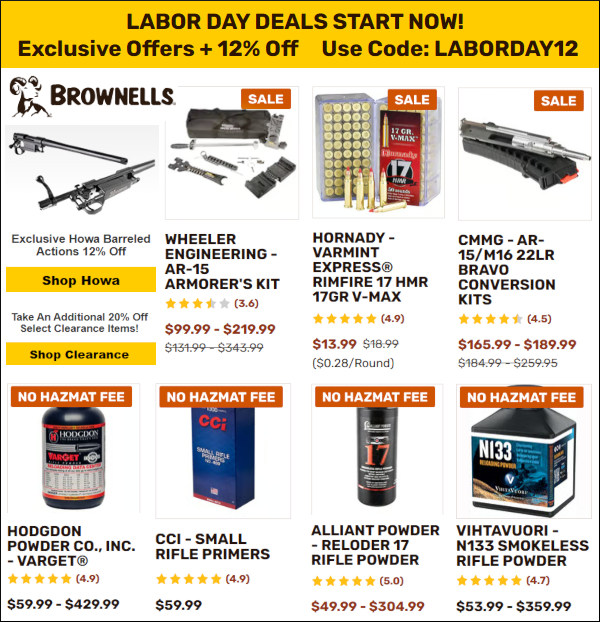
Brownells — Labor Day Sale + 12% OFF with Code LABORDAY12
⏺️ » Deals on guns, ammo, optics and gear plus 12% OFF Code
Get big savings with the Brownells Labor Day Sale. Along with the already discounted prices, on select clearance items you can save an additional 12% by using Code LABORDAY12 during check-out. Sale items include rifle scopes, Howa barreled actions, Reloading equipment, Hunting packs, Ammo (rifle, pistol, shotgun), powder and primers. Definitely check out this Clearance Sale. There are exceptional deals plus there are ZERO HazMat Fees on Powder and/or Primer purchases with no minimum!
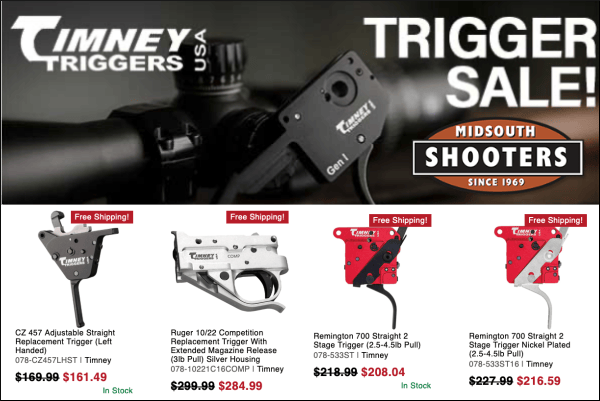
Midsouth Shooters — Timney Trigger Sale
⏺️ » Great prices on Timney triggers for many rifle types
If your factory trigger is holding you back, consider upgrading to a new one at the Timney Trigger Sale over at Midsouth. Here you can upgrade everything from a 10/22 to a Remington 700 or any number of other actions such as Sako and CZ. These are quality triggers offered at very attractive sale prices.
As an Amazon affiliate, this site can earn revenues through sales commissions.
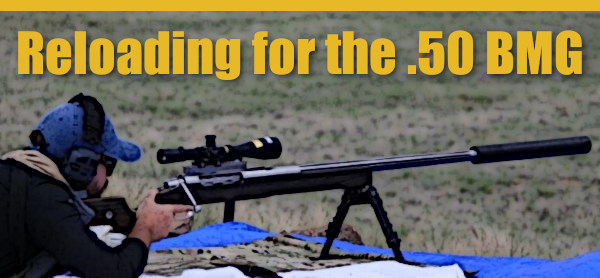
For today’s Sunday GunDay story we offer a short history of the legendary .50 BMG cartridge, tips on loading, and some fun photos from FCSA matches in the Western USA.
Fans of Heavy Artillery should visit Fifty Caliber Shooters Association (FCSA) website. There you’ll find range maps, photo collections and animated slide-shows On the FCSA photo gallery page, you’ll find a map. Click on any gray range link to see images from that venue. There are also a series of articles covering FCSA competition along with the “care and feeding” of the big 50-caliber rifles.
About the .50 BMG Cartridge
The .50 Browning Machine Gun (.50 BMG, aka 12.7×99mm NATO or 50 Browning) is a cartridge developed for the Browning .50 caliber machine gun in the late 1910s, entering official service in 1921. Under STANAG 4383, it is a standard cartridge for NATO forces as well as many non-NATO countries.
John Browning had the idea for this round during World War I in response to a need for an anti-aircraft weapon, based on a scaled-up .30-06 Springfield design, used in a machine gun based on a scaled-up M1919/M1917 design that Browning had initially developed around 1900. According to the American Rifleman: “The Browning .50 originated in the Great War. American interest in an armor-piercing cartridge was influenced by the marginal French 11 mm design, prompting U.S. Army Ordnance officers to consult Browning. They wanted a heavy projectile at 2700 FPS, but the ammunition did not exist. Browning pondered the situation and, according to his son John, replied, ‘Well, the cartridge sounds pretty good to start. You make up some cartridges and we’ll do some shooting’.”
Are you a died-in-the-wool .50 BMG fan? Got a hankerin’ for heavy artillery? Then visit the FCSA Photo Gallery page. There you’ll find hundreds of photos from Fifty Caliber Shooting Association (FCSA) matches and 50 Cal fun shoots in eleven states plus Australia, Switzerland, and the United Kingdom. To access the photos from the Gallery Page, start by selecting a shooting club and state with the brown buttons. After selecting the location, then click on the colored buttons for the event date.
Photo sets go all the way back to 2002, so you can see the evolution of the hardware over the years. Sample multiple archives to see the differences in terrain from one range to another — from Raton’s alpine setting to the hot, dry Nevada desert. This Gallery is really a treasure-trove of .50-Cal history. Here are a few sample images.
Reloading Powder and Special Tools for .50 BMG
Alliant’s Powder for 50-Caliber Applications
In 2009 Alliant unveiled Reloder 50, a slow-burn-rate powder designed primarily for long-range, .50-caliber rifle shooters. According to Alliant, the burn rate is “a little slower than Winchester 860″ and the powder is showing excellent lot-to-lot consistency. Load density is optimized for the 50 BMG and similar cases. Like Reloder 17, Reloder 50 employs a process which penetrates the kernels with the burn-rate-controlling chemical. This should allow a longer, flatter pressure curve, yielding more velocity than conventional powders can deliver. Alliant says that Reloder 50 offers “superior velocity and the ability to burn cleaner (with less residue)”. Reloder 50 comes in both 1-lb (#150527) and 8-lb (#150528) containers.
Forster and Lyman .50 BMG Trimmers
Big Fifty enthusiasts asked for a dedicated .50 BMG case trimmer, so Forster and Lyman created .50 Cal trimmers specifically for that cartridge. The cutter tip on the Forster .50 BMG Case Trimmer is much sharper than the cutter on the Lyman 50 Cal AccuTrimmer. However, the Forster tool is currently out of production, so it is harder to find than the Lyman .50 BMG trimmer, which is $92.93 on Amazon. Our advice is go ahead and get the Forster if you can find one — the cutter head is much sharper, and we prefer the Forster’s collet-style case-holder. The Forster gets the job done more quickly, with less effort. If you want the ultimate .50 BMG trimmer, check out the L.E. Wilson .50 BMG trimmer. But it is a hefty $268.40 at Midsouth.
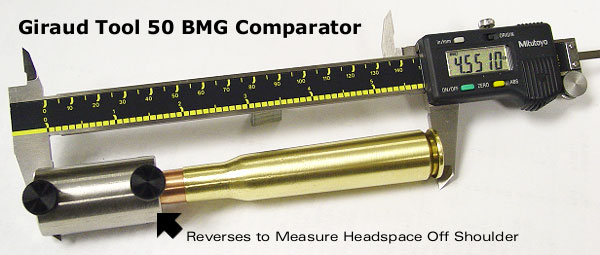
Giraud .50 BMG Case/Bullet Comparator Giraud Tool makes a comparator for 50-Cal cartridges. The double-ended comparator is quite versatile. In one orientation you can measure base-to-ogive bullet length and also measure cartridge OAL from rim to bullet ogive. When reversed, you can use the comparator to measure cartridge headspace. The $35.00 Giraud .50 BMG Comparator gauge is constructed of 303 stainless and fits most any vernier, dial, or digital caliper. CLICK HERE for more info.
This custom war wagon hauls varmint hunters around the Longmeadow Game Resort in Colorado. Bottom image by Forum member Randful, Big Horn Mountains, Wyoming.
Will you be heading to the varmint fields this summer? Proper planning is key to a safe, satisfying, and productive varmint holiday. Bring a variety of rifles if possible — you’ll need to switch off as one barrel gets hot, and the chambering that works best for your close shots may not be ideal for those longer shots out past 400 yards. Here’s one tip that can help you shoot more effectively on your varmint hunt — at your shooting station, put a strip of surveyor’s tape on a tall stake to show the wind direction. Then align to the wind direction, so that it is a direct headwind or tailwind. This will minimize the effect of cross-winds.
For fans of varmint hunting, we’ve assembled eight videos for this Saturday at the Movies Feature. You’ll see a variety of rifles being used in classic American varmint country — Montana, Oregon, and the Dakotas. We’ve also included an interesting video from South Africa.
Extreme Outer Limits — Oregon Adventure with .22 Creedmoor
This varmint safari video features the Extreme Outer Limits squad in Central Oregon. The host is shooting the .22 Creedmoor cartridge from a 22″ Benchmark barrel. The shooters benefit from a great operation, with elevated mobile shooting stations and benches. Watching this video made this Editor want to travel up to Oregon this summer, and try out a .22 Dasher that’s been sitting in the safe.
This video has plenty of action, with hits on small varmints (mostly ground squirrels) out to considerable distances. You can see the effectiveness of the .22 Creedmoor cartridge — it basically vaporizes some of the critters.
.22-250 Nails Ground Squirrels and Rock Hyraxes in South Africa
Here’s an interesting video from South Africa. The video maker starts with shots on ground squirrels. His .22-250 blasts them into little pieces. They he switches to more distant targets, a furry ground-hog size animal called the Rock Hyrax, Cape Hyrax, or Dassie. Mature Rock Hyraxes weigh 4-5 kilograms and have short ears and tail. These Rock Hyraxes are found at higher elevations in habitats with rock crevices, allowing them to escape from predators (but not skilled varmint hunters).
1125-Yard Rockchuck Hit with Extreme Outer Limits
Here a team from Extreme Outer Limits tests their skills at Extreme Long Range Varminting. The group set up benches and aim their rifles at a distant hillside over 1100 yards away. You can see a successful first-shot rockchuck hit at the 5:15 time-mark. On this episode of Extreme Outer Limits, Bob Beck, Tim Titus, and some MOA Rifles clients to put the .22 Creedmoor and other MOA-brand rifles to the test. At these long distances, Rockchucks are relatively small targets providing plenty of challenge.
Long Range Rockchuck Adventure with Gunwerks Crew
This Gunwerks video showcases varmint hunting in the Western USA. In this video Aaron Davidson and the Gunwerks crew try out some new rifles on some rockchucks. Most of the the rifles were suppressed but the host said the rockchucks took cover after the first shot, so this required good coordination among shooters and spotters. A 6XC varminter is featured at 2:44 and there’s some nice drone footage starting at 2:00.
Varminter.com — Great Resource for Varmint Hunters
Varminter.com is a great resource for serious varmint hunters. This site regularly reviews rifles, optics, and varmint ammunition. In addition, the site’s founder, Eric Mayer, often ventures out in the backcountry to film his varmint adventures.
Varminting with .17 HMR Savage A17 and Custom .17 WSM AR
On varmint excursions, we like to have a .17 rimfire for the closer shots, inside 150 yards. This video shows a successful Prairie Dog hunt with a .17 HMR. Watch and you’ll see hits out to 160 yards (00:50), proving the effective range of the .17 HMR cartridge. The host is shooting a Savage A17 semi-auto 17 HMR rifle in a Boyds laminated stock.
Varminters now enjoy three .17-caliber rimfire options. The .17 Mach 2, .17 HMR, and .17 WSM are all good choices, with the 17 Mach 2 being the cheapest and the .17 WSM the most powerful. With a rimfire you save on ammo costs and you don’t waste precious centerfire barrel life. Also the noise is reduced so you don’t spook the critters so much. We have shot ground squirrels with both the 17 HM2 and .17 HMR. And with a 3000 fps MV, the .17 WSM has some really impressive ballistics. As you can see, the .17 WSM has a much flatter trajectory than both the .17 HMR and .22 WMR:
Last but certainly not least, this video from Eric Mayer, founder of Varminter.com and AR15Hunter.com. This video features an innovative AR-platform rifle chambered for the potent .17 Winchester Super Magnum (aka .17 WSM) cartridge. Eric was able to have instant kills out to 200 yards. This rifle features a Franklin Armory F-17 V4 upper with a Franklin Armory 10-rd magazine. Eric was very impressed with the .17 WSM and he believes the 20gr bullet with 3000 fps MV will be very effective for most of his small varmint hunting out to considerable distances.
KILL Shots — BONUS Age-Restricted Videos
Linked below are a couple very good varminting videos that show explosive hits. However, YouTube has decided these can’t be posted on third-party websites so you’ll have to click the links below to see the Prairie Dogs going airborne. In the first video, the lady shooter nails THREE P-Dogs with one shot!
1. Eastman’s Hunting Journals. Great Video from Eastern Montana. This has nice Aerial Footage and an amazing shot with three P-dogs (in line) dropped with a single shot (at time-mark 9:28). One shot — THREE prairie dogs down! This prairie dog hunt features slow-motion kill shots, digiscope close-ups, and a rare prairie dog triple kill. A group of hunters works to remove prairie dog pests from private grazing lands in this episode of Beyond the Grid by Eastmans’ creators of Eastmans’ Hunting TV. You’ll have to CLICK HERE to watch this video. See Also Eastman’s Prairie Dog Armageddon video.
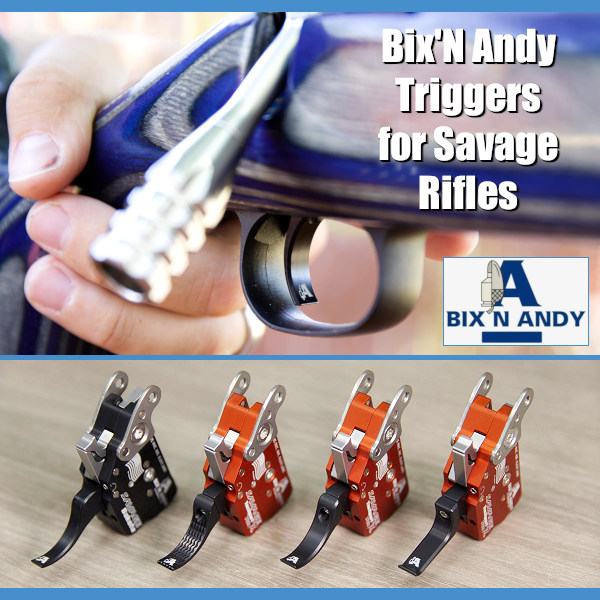
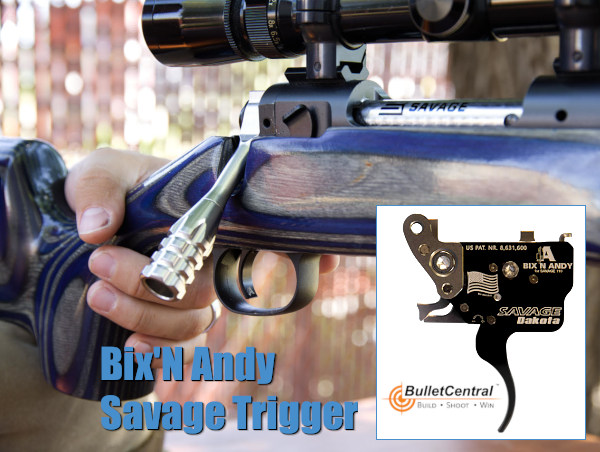
Bix’n Andy Savage TacSport Pro X and Savage Dakota Triggers
Article based on review by Les Voth
In 2012 benchrest shooter Chris Harris, owner of BulletCentral.com, brought Austrian gunsmith and engineer Andy Atzl’s Bix’n Andy triggers to America. Since then, their collaborative innovation has not slowed or stopped. Well known to the benchrest world, the Bix’N Andy Remington 700 Competition trigger with its frictionless ball trigger design, has broken records and surpassed previous trigger designs what came before The mechanism that replaced friction designs has gained favor among their shooters who have Bix’N Andy triggers on their rifles
Seeking to go beyond providing triggers for Remington 700s, Rem 700 clones, Tikkas, Sakos, and Barnards, BulletCentral.com now offers atop-quality, drop-in Bix’n Andy replacement triggers for the Savage 110 line of rifles. As these popular Savage rifles are offered in many configurations, including competition rifles, hunting rigs, and varmint rifles, it made sense to offer a top-quality Bix’N Andy trigger for Savage rifles.
Bix’N Andy Savage Trigger Review — UltimateReloader.com
In my association with Bullet Central, as their trigger repair and warranty guy, I’ve already seen these new Bix’N Andy Savage triggers installed on competition single shots, prairie dog rifles, truck guns, deer/hog hunting rifles, and varmint rifles. The appreciation shown by their new owners, for having access to the same technology as the most expensive ELR, PRS, F-Class rifles is great to witness.
Installation in Savage Action is Fast and Easy
Changing the trigger on a Savage 110 is as simple as removing the stock, pulling one pin to remove the stock trigger, and putting the new trigger in its place with the return of the pin.
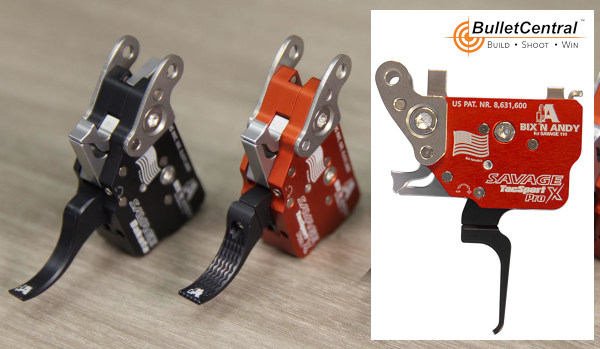
Savage Tacsport Pro X (3.5 oz to 2.2 lbs) | Savage Dakota (1 lb. to 4.4 lbs.)
The Savage TacSport Pro X trigger has a pull force weight range from 3.5 ounces to 2.2 pounds, and the Dakota model starts at one pound and goes up to 4.4 pounds. With the TacSport Pro X model you can change the shoe, from curved, to straight, to the Gator grip shoe, without disassembling the trigger.
When using a Bix’n Andy Savage trigger for the first time, you’ll instantly sense how it precise and smooth it feels. Because you are not trying to “overcome” something with the trigger force it is set at. You’ll note that the movement feels smoother than a friction-based trigger (with the same pull weight).
When you set a trigger to your desired pull force, whether it is under 10 ounces, or over two pounds, the Bix’n Andy trigger will feel lighter than the others because of its inner mechanism. You are not trying to “overcome” you are “setting off” the trigger, if that’s how to describe it.
Also, when some triggers release the cocking piece, they stop at a wall. Bix’n Andy triggers do not. They follow through with slight over-travel, so the rifle is not upset during that time the bullet has not yet exited the barrel. This is a feature that the Bix’n Andy Savage TacSport triggers and also the Dakota share with the original Benchrest triggers from the same company.
Benefits of Trigger Replacement in Savage Rifles
Why would you replace the stock trigger on a Savage 110? Well, it’s like Chuck said on Friday when he came to pick up a truckload of prairie dog pills – “If yer gonna git serious about shooting prairie dogs, yer gonna change triggers!” Who’s Chuck? He’s a retired Vietnam vet/volunteer NRA Range Officer. When asked how many prairie dogs he shot on his last trip, he said “…about 400.”
That many trigger pulls demand a trigger that works, one that doesn’t distract you from the job at hand, and one that allows you to shoot little targets a long ways away.
Are sound suppressors useful in competition shooting? In some disciplines, and in venues where sound “moderators” are permitted, the answer is “yes”. In a past edition of Shooting Sports USA eZine, you’ll find an interesting article about the use of sound suppressors (aka “cans”). The article explores the use of suppressors in Europe and in tactical matches in North America. You’ll also find an explanation of the rules and regulations governing suppressor ownership and use in the United States.
Shooting Sports Editor Chip Lohman tests three rifles from the bench and found that sound suppressors did not harm accuracy. In fact, all three test rifles (one each in .223 Rem, .308 Win, and .338 Lapua Magnum), shot slightly better 5-shot groups at 200 yards when a suppressor was fitted to the barrel. However, the suppressors did alter point of impact. Interestingly, velocity standard deviation (SD) values were lower with suppressors in place for all three test rifles. This observation calls for further study.*
So the use of suppressors in competition could be a good thing. However, in the United States, current NRA rules prohibit the use of sound suppressors. NRA Rule 3.16.1 subsection (a) states: “Sound Suppressors are not authorized for use in High Power competition.” In addition, there are some practical problems with suppressors — the heat rising off of a naked suppressor can create mirage problems (that’s why some shooters wrap their cans with a cover).
Despite such issues, now commonly see suppressors on rifles used in tactical matches and PRS/NRL events. For example, many competitors in the Steel Safari field challenge match use suppressors. The photo below shows our friend Zak Smith competing in the Steel Safari with his suppressed Accuracy International rifle.
Commentary — What Can We Conclude?
Obviously, this three-rifle SSUSA test was not definitive. One well might observe different results with different types of suppressors, fitted to different kinds of rifles. Mounting a suppressor to any barrel will certainly affect harmonics and “tune”. But this SSUSA study does suggest that tactical shooters, who are allowed to use suppressors in competition, may find that the benefits of suppressors (significantly reduced recoil and less noise) outweigh any meaningful accuracy loss, at least in PRS-type matches.
NOTE: The article cautions that one should not extrapolate too much from the SD numbers, given the low number of test shots. Chronograph-maker Ken Oehler, when asked to comment on the SD values stated: “[You should] report the observed SDs, but draw no conclusions until… you can do more testing with larger sample sizes.”
Qualifications to Obtain a Suppressor
With the recent passage of Federal legislation you no longer have to pay a $200 ATF fee when purchasing a suppressor. And a recent Federal court ruling held that it may no longer be necessary to pass BATFE background checks and otherwise comply with Federal and state laws. However, most suppressor sellers are still requiring paperwork. And states can regulate suppressor ownership or use, so be sure to check the laws in your area. On the federal level, the process to acquire a suppressor is regulated under the National Firearms Act of 1934.
PURCHASING TIP: New Legal Standards and NO $200 ATF Fee
With the passage of the One Big Beautiful Bill Act, Gun rights groups have pushed for the repeal of a 1934 law regulating suppressors and short-barreled firearms. The passage of the One Big Beautiful Bill Act paved the way for two lawsuits which culminated in a federal court order currently enjoining ATF enforcement of NFA registration requirements for suppressors and short-barreled firearms, and “any other weapons.”
This marks the first time since the NFA was enacted in 1934 that Americans lawfully acquired suppressors without federal registration — the first unregistered suppressor transfer in 92 years. As promising as this is… it remains unclear whether purchasers outside Texas will be allowed to buy without ATF paperwork.
The 2026 NRA F-Class Mid-Range and Long-Range National Championships will take place from October 25 to November 1, 2026 at the Ben Avery Shooting Facility in Phoenix, Arizona. Shooters can register with the Desert Sharpshooters Site. With this major F-Class event, we know many of our readers will be flying with their rifles in the months ahead. Here is a helpful article from Team Savage Shooter Stan Pate. This covers how to ship your rifle safely, and then re-establish zero properly when the gun is reassembled after transport. This is one of a series of Shooting Tips articles in the Savage Blog.
Looking down-range with F-TR rifle at Ben Avery Shooting Facility in Phoenix, Arizona.
Traveling with Firearms — Important Advice
Traveling with firearms can be stressful. You must comply with multiple regulations and then trust your expensive guns to airline baggage handlers. And after arrival you’ll need to put your rifles back together and confirm the zeros. This article offers helpful travel advice from Team Savage shooter Stan Pate. Pate has traveled the globe competing with match rifles. Here he shares his tips for making trips easier on you and your firearms.
Easier Air Travel With Firearms
TSA isn’t nearly as careful with your rifles as you are. Proper storage before sending your firearm up a conveyer belt and into the belly of a plane is critical. Stan Pate spends lots of time each year traveling the skies and has devised a system for keeping his rifle safe when going to and from.
“Never travel with your firearm completely assembled,” Pate cautions. “A fully assembled firearm is much heavier [as a total unit] than one that has been broken-down and stored [in separate sections]. More weight creates more in-the-case movement, which can result in damage. I learned this the hard way years ago. My rifle was actually broken in half when traveling to an international competition. Record your torque settings, use those settings during reassembly and your return to zero should be no problem.”
“Be sure to check on current TSA rules and regulations before travel to be aware of any changes that may effect how you pack your rifles,” says Pate.
Rifle Reassembly and Resetting Zero
The quicker you can reestablish your zero, the quicker you can relax and stop worrying about if your rounds are going to hit their mark during competition. Pate, over the years, has developed a system for rifle reassembly and getting back to zero as quickly as possible. While his torque settings may not be the same as yours, the process can still be used.
“The barreled-action goes back on the stock, and then I tighten all three receiver screws finger tight,” says Pate. “Next, I tighten the front two receiver screws down to 35-inch pounds. The rear receiver screws on this particular rifle likes 15-inch pounds. [Note: Proper torque settings will vary with your action and stock type. Most actions have TWO screws, not three.] Scope attachment comes next, and I follow manufacturer settings when tightening it down. All that’s left to do now is go zero your rifle.”
This video explains an efficient method to Re-Zero your rifles
Based on its external appearance, a modern riflescope may seem simple. It’s just a tube with two or three knobs on the outside right? Well, looks can be deceiving. Modern variable focal-length optics are complex systems with lots of internal parts. Modern scopes, even ‘budget’ optics, use multiple lens elements to allow variable magnification levels and parallax adjustment.
A few seasons back, we had a chance to look inside a riflescope thanks to a product display from ATK, now called Vista Outdoor, parent of Alliant Powder, CCI, Federal, RCBS, Speer, Weaver Optics. The Weaver engineers sliced open a Weaver Super Slam scope so you can see the internal lens elements plus the elevation and windage controls. We thought readers would like to see the “inner workings” of a typical modern rifle scope, so we snapped some pictures. The sectioned Super Slam scope was mounted inside a Plexiglas case, making it a bit hard to get super-sharp images, but you can still see the multiple lenses and the complex windage and elevation controls.
Check out the details of the focusing and magnification rings near the ocular (eyeball) end of the scope. There is very fine machining and threading to make everything work properly. The ocular lens is the piece of glass that faces the shooter while he aims.






 For today’s Sunday GunDay story we offer a short history of the legendary .50 BMG cartridge, tips on loading, and some fun photos from FCSA matches in the Western USA.



 Alliant’s Powder for 50-Caliber Applications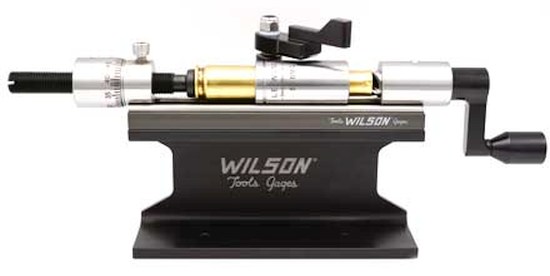

 This varmint safari video features the Extreme Outer Limits squad in Central Oregon. The host is shooting the .22 Creedmoor cartridge from a 22″ Benchmark barrel. The shooters benefit from a great operation, with elevated mobile shooting stations and benches. Watching this video made this Editor want to travel up to Oregon this summer, and try out a .22 Dasher that’s been sitting in the safe.