TEN Shots in 0.303″ (0.289 MOA) at 100 Yards
Look at that target showing TEN shots at 100 yards, with eight (8) shots in the main cluster at the top. The ten-shot group measures .303″ (0.289 MOA), as calculated with OnTarget Software. Not bad for a handgun — a very nice bolt-action XP-100 pistol! What do you think, can your best-shooting rifle match the 10-shot accuracy of this XP-100 pistol?
Report by Boyd Allen
This story goes back a few seasons… this remarkable XP-100 pistol belongs to Dan Lutke, a Bay Area benchrest shooter who publishes the results for the Visalia matches to the competitors and the NBRSA. He has been an enthusiastic competitor for an number of years, at various ranges, notably Visalia and Sacramento. The action is a Remington XP-100, to which a Kelbly 2 oz. trigger has been fitted. On top is an old Japanese-made Tasco 36X scope (these were actually pretty darn good). The Hart barrel (a cast-off from Dan’s Unlimited rail gun) was shortened and re-chambered for the 6x45mm, a wildcat made by necking-up the .223 Remington parent case. The custom stock/chassis was CNC-machined by Joe Updike from 6061 Billet Aluminum to fit the XP-100 action and mount a target-style AR grip with bottom hand rest. The gun was bedded and assembled by Mel Iwatsubu. In his XP-100 pistol, Dan shoots 65gr custom boat-tails with Benchmark powder.
This diagram shows the most common 6x45mm wildcat, which is a necked-up version of the .223 Remington parent cartridge. NOTE: The dimensions for Dan Lutke’s benchrest version of this cartridge may be slightly different.
ACAD drawing by Peter Gnanapragasam CC by SA 3.0, via Wikimedia Commons. Title Added.
Story tip from Boyd Allen. We welcome reader submissions.
Splatterburst 1″ circles, 62 per sheet, 10-pk $9.99. These can be pasted on other paper backers.
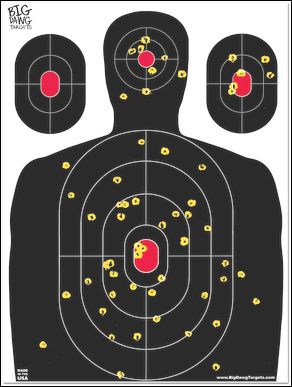
We’ve all seen conventional splatter targets with a single large black bullseye. When a shot hits the target, a halo (usually neon yellow) appears around the bullet hole. This makes it easier to see your shot placements indoors, or at long range outdoors. Today we feature a variety of other targets that also offer the cool halo/splatter effect. We’ve found grids, multiple bull targets, sheets with 62 one-inch circle pasters, handgun training targets, and even white background splatter targets (that produce black halos). Try out some of these targets for fun (kids love plinking with splatter targets).
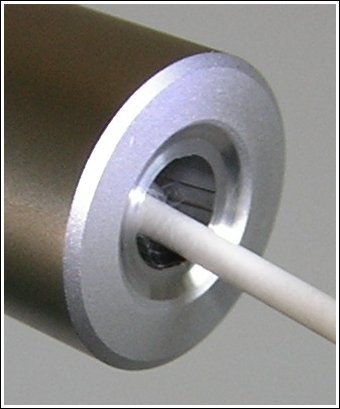
The last half-inch or so of your barrel is absolutely critical. Any damage (or abnormal wear) near the crown will cause a significant drop-off in accuracy. Here are ways you can check the end of your barrel, using a common Q-Tip.
Use Q-Tip for Barrel Inspection
To find out if you have a burr or damage to your crown, you can use an ordinary Q-tip cotton swab. Check the edges of the crown by pulling the Q-tip gently out past the edge of the crown. If you have a burr, it will “grab” the cotton and leave strands behind.
Larry Willis has another way to use a Q-Tip: “Here’s a neat trick that will surprise you with how well it works.” Just insert a Q-Tip into your barrel (like the picture below), and it will reflect enough light so that you can get a real good look at the last half inch of rifling and the crown of your barrel. In most cases you’ll find that this works much better than a flashlight. Larry tells us: “I’ve used this method about a jillion times. Q-Tips are handy to keep in your cleaning supplies anyway. This is a good way to judge approximately how well you are cleaning your barrel when you’re at the range. It’s also the best way to examine your barrel when you’re in the field.”
Whether you should from the bench, or from prone, it’s great to have your cartridges in a convenient, easy-to-reach position. This article explains how you can build your own height-adjustable ammo caddy for a very low price (likely under $10.00). Credit Martin Tardif for this great Do-It-Yourself (DIY) project. Martin’s flex-arm caddy design works great for F-Open competitors as well as anyone who shoots with a pedestal front rest, either on the ground or from a bench. The ammo caddy attaches, via a flexible arm, to your front rest. The flexy arm allows you to position your ammunition close to your rifle’s feeding port. That makes it easy to grab cartridges and load them into the chamber without shifting your shooting position.
Kudos to Martin Tardif for his clever use of inexpensive materials when he crafted this ammo-caddy a few seasons back. The total cost of the whole project, according to Martin, was just $8.00! (With inflation, materials could run a bit more these days, but the project would still be very inexpensive.)
Martin Explains How to Build the Ammo Caddy
Here are some pics of my DIY P.L.A.B. (Port Level Ammo Block). I cannibalized the goose neck from a Craftsman bendy-style utility light and bought a 3.5″x 1″ Acetal disk on eBay. I then drilled out the disk to accept twenty .284 Winchester rounds and screwed the disk to the bendy arm. The arm, by itself, wasn’t sturdy enough to support my fully loaded ammo block, so I inserted a 1/8″-diameter steel rod cut to length into the arm before I screwed it to the disk. On this Bald Eagle rest, I wasn’t using the windage adjustment cable. That allowed me to secure the bottom end of the arm to the unused 5/16″ x 18 bolt hole for the cable. [Editor’s Note: For other pedestal rest types/brands you may need to drill a hole for the base of the flexy arm.]
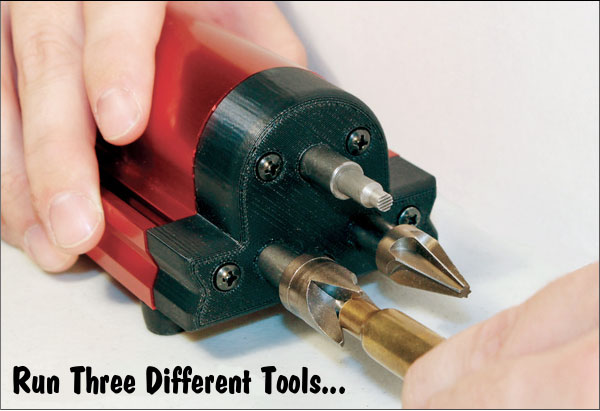
Nobody likes to spend hours manually chamfering cases and cleaning primer pockets. There are simple hand tools that will perform these tasks, but the process is time-consuming and tedious after a couple dozen cases. To speed up case prep duties, you can get one of the large, powered case prep centers. These function well, but frankly we didn’t want to give up that much precious space on our reloading bench. One good solution is Hornady’s compact Lock-N-Load Case Prep Trio (item 050160). This triple-threat tool packs a lot of functionality in a small package.
This cleverly-designed powered tool has a small footprint, yet it can perform three tasks as well as much more expensive, tower-style case prep units. The versatile Hornady Case Prep Trio is $139.99 at Brownells, $139.99 at Midsouth, and $155.95 on Amazon. We’ve used this machine and it works well. The only negative is that you will get metal shavings on your bench (unlike some of the larger case prep centers). We’ve seen some guys put a small pan under the power head — then you can just dump the shavings out of the pan.
With three active stations, you can chamfer, deburr and clean primer pockets without having to change tools. The Case Prep Trio ships with inside chamfer, outside chamfer, and deburr tools. You can also use the machine with other optional 8/32 threaded accessories such as primer pocket reamers, primer pocket uniformers, and case neck brushes. CLICK HERE to see all tool options. Conveniently, the Case Prep Trio has on-board storage for your tool-heads. User reviews have been very positive.
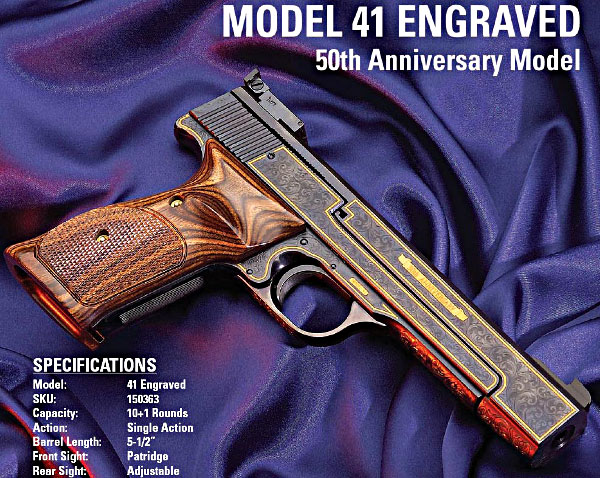
The Smith & Wesson Model 41 is a classic American rimfire target pistol. Beautifully crafted, the Model 41 boasts a superb trigger, comfortable grip, and excellent accuracy. New or used, a Model 41 is a fine addition to any firearms collection. We’ve shot a few Model 41s, and they will spoil you if you go back to a lesser rimfire pistol. First released commercially in 1957, a special 50th Anniversary Model (shown above top) came out in 2007 (hitting the market in 2008). Perhaps it should have been named the 60th Anniversary edition, as the first prototypes of the Model 41 were crafted way back in 1947. READ American Rifleman article about Model 41.
The Model 41 is one of those classic American designs that has stood the test of time. Many feel the Model 41 represents the apex of American .22 LR pistol design, much like the Colt Python is the “crown jewel” of double-action revolvers. One YouTube poster noted: “After [65] years the Model 41 is still near the top of the game in precision .22s. Very few if any of the current day pistols can match the workmanship, fit, and balance that makes having a Model 41 so enjoyable to own. S&W blew the center out of the 10 Ring with this one when they introduced it and continue to do so today.”
The Stunning 50th Anniversary Edition Model 41
Probably the most sought-after Model 41 is the handsome, machine-engraved 50th Anniversary Model, released in 2007. This was offered in a hardwood, glass-covered case. This would be a prized addition to any gun collection:
The 50th Anniversary Model was machine-engraved with Class A+ coverage, 24 carat gold striping, and special serial number range FYA0001 – FYA0500.
Of course, if you want a superb trigger in a .22 LR semi-auto pistol, look no further than the S&W Model 41. For $2000.00 to $3700.00 you can find the fully engraved, 50th Anniversary Model 41 in presentation case on various auction sights. First released in 2007, the engraved model 41 combines superior accuracy with stunning appearance.
Smith & Wesson Model 41 — An American Classic Rimfire Pistol
The Smith & Wesson Model 41 is an American classic — one of the great, iconic .22 LR target pistols. Accurate, well-balanced and built-to-last, model 41s have been in production for over 50 years. The Model 41 remains one of the most accurate pistols ever produced by Smith & Wesson.
Model 41 photo by Mightymoo01, creative commons released CC BY-SA 3.0.
Beautifully crafted, the Model 41 boasts a superb trigger, comfortable grip, and excellent accuracy. Whether an older classic or a newer model, the S&W Model 41 is something every gun owner would prize for target shooting. And “like new” high-grade models are now appreciating in value!
Smith & Wesson historian Roy Jinks recounts the development of the Model 41: “It was a difficult task to develop a competitive pistol that would meet the various needs of the top shooters. The final design was decided upon in 1956 and the new .22 target pistol was announced in Smith & Wesson’s 1957 Annual Report, stating: ‘Its design includes many advanced features, such as stocks equally suitable for right or left-hand shooters- a clean, crisp, trigger pull that is adjustable to individual preferences. The distribution of weight, together with the angle of the stocks, permits extremely steady off-hand holding. The precise micrometer sights are rigidly mounted on a one piece forged barrel to avoid any possible misalignment even after long usage.’ The handgun featured a 7 3/8-inch barrel equipped with a muzzle brake to help control recoil. The underside of the barrel was grooved to allow the addition of adjustable Olympic Style Barrel Weights. The trigger pull could be adjusted to allow for a 2-pound pull to meet the NRA Gallery Course requirement or increased to 3 pounds to meet the needs of the ISU International rules.
Smith & Wesson Model 41 with two extra slide/barrel assemblies, plus custom holster and mag holders. This sold on Cowan’s Auctions for $2640.00 in 2019.
Sales began in December of 1957 and the Model 41 was first cataloged in 1958. The factory was soon heavily back-ordered and [the Model 41] became the most popular auto-loading pistol offered by the company. In May of 1959 Smith & Wesson introduced a 5-inch lightweight barrel for the handgun to meet the demand of hunters[.] The line of Model 41s was further expanded in September of 1960 with the introduction of the Model 41-1 which fired .22 shorts for the International Rapid Fire Shooters. [I]n August of 1963 the company introduced the 5.5 inch heavy barrel. The last of the major barrel changes occurred in 1965 when the company produced the 5.5-inch heavy barrel with an extendable front sight to provide the shooter a longer sight radius. During the last 50 years the Model 41 has … established many records around the world. Today it is one of the classic target handguns[.]” READ MORE Model 41 History.
Field Test of Current Generation S&W Model 41
So how do modern production Model 41s shoot? Very well indeed, based on the results from popular gun Vlogger 22Plinkster. He took a new Model 41 to his test range and tested it for handling and accuracy. Watch the 22plinkster video below:
22plinkster runs of the most popular gun-centric YouTube channels. His videos have been watched by hundreds of thousands of firearms fans. Some of 22plinkster’s videos involve trick shots, but he’s actually a very competent marksman who has shot a vast collection of .22 LR/22 WMR pistols and rifles, making him a qualified rimfire expert.
Hickok45’s 30-Year-Old Model 41
Hickok45, a popular YouTube host, has been a fan of the S&W Model 41 since it was first released. In fact, back in 2020, Hickok45 celebrated his 30th year of ownership of this classic American rimfire. In this “Celebrating 30 Years” video, Hickok 45 demonstrates the qualities that have made the Model 41 so popular. He notes that it balances well, has an excellent trigger, and delivers superb accuracy. He observed: “What a great .22 LR pistol!”
Performance Center “Optics-Ready” Model 41
Do you prefer shooting pistols with a modern optic? Well check out the fully “Optics-Ready” S&W Performance Center Model 41. This modernized Model 41 PC has an integral Picatinny Rail mount for optics, plus adjustable target sights with a special skeletonized and removable front blade sight.
The Performance Center Model 41 sports an integral Picatinny-style equipment rail for easy installation of optics. Other standard features include an external thumb safety on the left side of the frame, custom wood target grips, and a blued finish. This full-size, 10-shot .22 LR pistol features a carbon steel frame and slide along with a 5.5-inch barrel. Measuring 10.5 inches in overall length, the Model 41 PC has an unloaded weight of 41 ounces. MSRP is $1763.00.
The S&W Model 41 History from Wikipedia
From Wikipedia: The Smith & Wesson Model 41 is a semi-automatic pistol developed by Smith & Wesson after World War II as a competitive target pistol. It was designed with a 105-degree grip angle, the same as the Colt M1911 pistol, to maintain a consistent grip angle.
Prototype and Production Models
In July 1947, two prototypes, numbered X-41 and X-42, were produced, tested, and improved for the next 10 years. In 1957, the Model 41 was made available to the public for sale when Smith & Wesson produced 679 units. At the end of 1958, they had built 9,875 Model 41 pistols. A lighter 5-inch (130 mm) barrel was offered in 1958 for field use. The Model 41-1 was introduced in 1960 and was chambered in .22 Short for International Rapid Fire competition. Only 1000 were made using light aluminum slides necessary for function with the lower powered .22 Short.
In August 1963, the 5-inch heavy barrel version came into the market. Stoeger’s Shooter’s Bible of 1964 shows a 7 3⁄8″ (190 mm) barrel grooved for Olympic center weights. The cocking indicator and 7 3⁄8″ barrel were dropped in 1978. The 7-inch (180 mm) barrel was introduced in 1978 with no provision for a muzzle brake. A 6-inch (150 mm) barrel was offered for a few months in 1991. In 1992, the Model 41 was dropped from production. In 1994, Smith & Wesson returned it to production as the Model 41 “New Model”.
The Model 41 Military Variant — S&W Model 46
In 1957, Smith & Wesson offered a “no frills” version of the Model 41, designated the Model 46. In 1959, it was selected by the U.S. Air Force for basic marksmanship training. About 4000 units were made in total: 2500 with a 7-inch barrel, 1000 with 5-inch barrels, and 500 with 5.5″ barrels. The pistol lacked the checkering, polished blue finish, and other refinements of the Model 41. It proved to be a commercial failure with consumers who preferred the more costly Model 41, and production ceased in 1966.
Here’s a cool product that makes it easier to stow and/or transport your precious cleaning rods. Sure you can tuck a single rod in a gun case, but what if you want to carry a variety of rods to the range? This affordable MTM Gun Cleaning Rod Case (CRC) holds up to four (4) rods securely, and keeps solvent residues off your fine firearms. Click Here for Product Specs from MTM Case-Gard website.
MTM’s bright red Cleaning Rod Case (CRC) will hold four rifle or shotgun cleaning rods up to 47″ long. Each rod is held in an individual slot and there are foam inserts on either end, making transportation secure and rattle-free. You don’t have to worry about the rods banging into each other. We like the fact that MTM has cleverly included multi-sized “corrals” to hold patches from large to small. Plus there is plenty of room to hold jags and brushes.
We’ve used this cleaning rod case, now just $22.99 at Midsouth and can recommend it. Forum member TIMO agrees: “Just received one, 100% worth the investment. Got it from Midsouth Shooters Supply.”
MTM explains the benefits: “Long gun enthusiasts no longer have to fumble and search for miscellaneous cleaning equipment since it will all be in an easy to access container.”
MTM V.P. explains Gun Cleaning Rod Case Features:
MTM Cleaning Rod Case Features:
— Holds four rifle or shotgun cleaning rods up to 47.5″ long
— Padding holds rods in their own individual slots (Max handle diam. 1.4″)
— Compartments for storing patches, jags, and brushes
— Made of rugged polypropylene plastic
— Has hanging hole for wall storage
— Room for bore guides
If two barrels are better than one, then why not three? That’s the thinking behind the exotic Bockdriling BD14 from Blaser, unveiled at the 2014 IWA Show in Germany. This three-barrel Bockdrilling firearm works as a shotgun, large-caliber rifle, and small-caliber rifle all in one. Even with all those barrels, the BD14 is relatively light, at 3.3 kg (7.26 lbs) without optics. That makes this a nice, carry-around gun for stalking. As you’d expect from Blaser, the twin triggers are crisp and precise, with a pull weight of just 1.43 lbs (650 grams). The front trigger is for the large-caliber rifle barrel, while the rear trigger works both the shotgun and small-caliber barrels, via a tang-mounted selector. These firearms are rare in the USA — and quite expensive. The only Blaser BD 14 we could find on GunBroker had a $9099.95 asking price. That works out to over three grand per barrel.
Here’s what Blaser USA has to say about its unique three-barreled BD 14:
“The ‘Bockdrilling’ is, put simply, an over/under (O/U) rifle-shotgun combination with a smaller caliber rifle-barrel… on the side. The barrel arrangement [allows] for an extremely slender receiver, making the BD14 exceptionally huntable.
The [patent-pending] Vertical Block Lockup… combines an extremely compact and solid block lockup in a closed system within the monoblock with the comfortable handling of a classic break-action rifle.
The double lock permits, if needed, a rapid second shot, the front trigger always releasing the large rifle-caliber. The … barrel selector actives the shotgun barrel when in position ‘top’ and activates the smaller rifle caliber in position ‘bottom’.”
Why Does Anyone Need Three Barrels?
The Blaser website explains: “As hunters, we learn to expect the unexpected, whether in a blind or stalking, so it’s understandable that we dream of a firearm that will allow us to take advantage of any situation. With the Bockdrilling BD14, Blaser has developed the perfect blind and stalking firearm – compromises are finally a thing of the past.”
Design Features of the Bockdrilling BD 14 Tri-Barrel Gun
The BD14 has a double-lock system so that a second shot can be taken without having to recock the firearm. Blaser says: “Thanks to the free-floating barrels, point of impact remains constant even with a quick succession of shots, no matter which barrel was fired first. The extremely strong vertical block lock on the BD14 helps contribute to the high degree of precision.”
Story idea from EdLongrange. We welcome reader submissions.
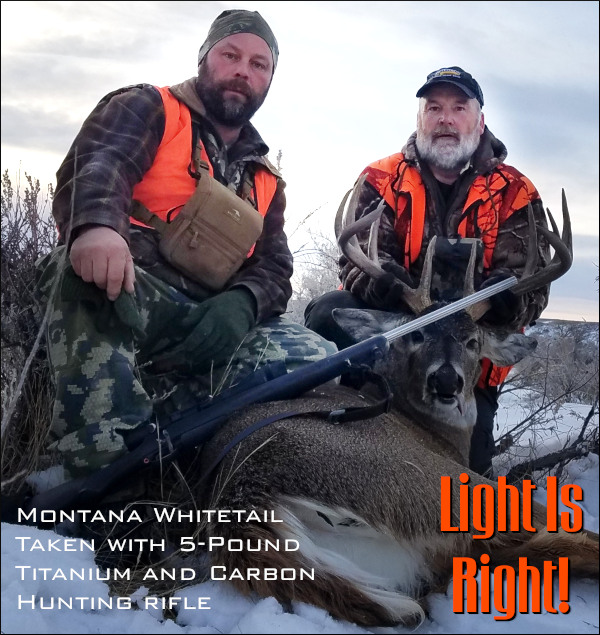
Here is Tom Mousel with Whitetail taken with his ultra-light hunting rifle fitted with 6mm Creedmoor Lilja barrel. Friend Cody (right) actually took the shot. This gun has a second barrel in 6.5 Creedmoor.
Hunting season is opening up soon across the country. In just three weeks, on 9/26/2026, the nation celebrates National Hunting & Fishing Day. This Sunday we feature an impressive state-of-the-art, ultra-light hunting rifle. This rig is very accurate AND very light, and features two barrels, one in 6mm Creedmoor and the other in 6.5 Creedmoor. With this Titanium-actioned rifle, owner Tom Mousel has successful taken Whitetail deer and other game.
“Light is Right” when it comes to carrying deer rifles long distances in the backcountry. A lighter rifle DOES make a difference when you’re hiking many miles and carrying other gear including binoculars, laser rangefinders, food/water, and packs. And then, if you are successful, you’ll be carrying out game meat, so a lighter rifle translates to a lighter overall load.
When Forum member Tom Mousel (a top 1000-yard competitor) considered a new hunting rifle, he wanted a very light-weight rig. What he got was a low mass masterpiece — an ultra-accurate, five-pound hunting rifle. Not only does this twin-barrel rifle, as built by Alex Wheeler, come in under five pounds (before optics), but it has produced some quarter-MOA 3-shot groups at 1000 yards. The 6mm Creedmoor version of this rifle has demonstrated truly stellar accuracy at long range. The 6.5 Creedmoor barrel also shoots well and packs more punch for hunting use.
CLICK HERE to view full-screen large version of photo.
Here is Tom’s rifle weighing in at 4 pounds, 14 ounces with 21″ Lilja #1 contour 6mm barrel. Tom says: “Here’s the rifle with full Titanium action, bolt, and lug, in a Tom Manners 17 oz. carbon fiber stock. It’s exactly one pound heavier fitted with my Leupold Mark AR 4-12x40mm scope in Talley rings.”
Tom has two barrels for the rifle, one chambered for 6.5 Creedmoor and the other for 6mm Creedmoor. Tom reports: “The 6.5mm is a bit lighter being fluted. But I won’t be switching back now that I’ve shot the 6mm version. Neither has too much recoil, but the 6mm CM just kills the 6.5mm at distance for groups.”
Tom tells us: “What I like about this rifle is there were no corners cut to make it light. On some other ultra-lights, the fore-end has no strength or they are cut down really short. This is a full-sized stock, pillar-bedded with aluminum-filled epoxy and free-floated barrel. The ignition is set up with a TON of firing pin fall to function in the coldest temps.”
Gunsmith Alex Wheeler of Wheeler Accuracy is pleased with how this project turned out: “Tom has shot a bunch of sub-5″ groups and a couple one-inchers back-to-back at 1K. He has the Berger 115gr VLD going about 3050 fps.” Tom noted the 6mm barrel picked up about 50-60 FPS after the first 50 rounds. He shoots 115gr Berger VLDs with CCI 450s and Reloder 16, with the Bergers about .005″-.008″ in the lands.
Groups at 1000 Yards with 6mm Creedmoor Barrel, 115gr Bergers
Here are two of Tom’s 1000-yard targets. This is with the 6mm Creedmoor barrel shooting 115gr Berger VLDs pushed by Alliant Reloder 16 at about 3050 FPS. The average of the two groups is 0.246 MOA. Pretty amazing for an ultra-light rifle shot off a bipod. Tom acknowledges that he can’t do this every day. He says that “shooting 871 yards at my home range, the rifle typically shoots 4″ to 5″ 3-shot groups”.
Q & A with Tom Mousel About his Ultra-Light Hunting Rifle
Q: Why did you choose to build this rig?
Tom: I just wanted to do it to see how light we could build an accurate, good-shooting rifle.
Q: What are your favorite things about the rifle, and is there anything you would change?
Tom: Definitely the light weight, and the overall size — it has a pretty short barrel (21″), so it’s just handy. I wouldn’t change anything about the rifle, now that I have the Titanium bolt. When I bought the action originally it had the steel bolt.
Q: How does this rifle handle?
Tom: It points well considering it is a light rifle. The 6mm Creedmoor version has very little recoil. On a good bipod I can sight in at 1000 without a spotter.
Q: What are your favorite accessories?
I use a Solo Hntr Mtn Lite stretchy cover. You can see it in the photo at right showing me on a hunt. I like this because you can roll it up like a sock and and use it for a rear support.
Q: Why did you choose Alliant Reloder 16 powder?
Tom: Lonnie Anderson, a fellow Deep Creek shooter, did a 6mm Creedmoor and he said RL16 was absolutely the most accurate. We have also found that Reloder 16 is really consistent on velocities through the seasons — from 90 above to teens below zero.
Q: Could this ultra-light set-up work for a bigger caliber also?
Tom: I’ve tried bigger calibers, but I’ve never been satisfied with the consistency of the groups. There’s a cut-off — there’s too much torque and recoil. We see a limit — you don’t want “too much gun” for the platform. Even here, the 6.5 barrel just doesn’t shoot as well as the 6mm.
Q: What advice do you have for hunters considering ultra-light rifles?
Tom: Be careful about falling in love with ballistics and trying to build too much bang for too small a platform. If I built a 7mm WSM for example, I’d want to rifle to weigh at least two pounds more.
Full Titanium Action from Pierce Engineering
This photo shows the Pierce Engineering Titanium Featherweight short action featuring Titanium (Ti) receiver, Ti bolt, and Ti lug. This unit is a mere 15.90 ounces complete. (NOTE: with Titanium body and STEEL bolt the weight is 18.5 ounces). The long action version is 17.4 ounces for the complete Titanium action with Ti bolt and Ti lug.
Jud at Pierce Engineering tells us: “Both the Ti action body and Ti bolt are DLC-coated. This action also has an anti-bind rail for added smoothness and ease of functioning. This really is one of the lightest actions on the market. If you’re looking into building an ultra-light rifle I would seriously check one out! We make these with the highest level of detail, pride, and machining tolerances. They’re just sweet actions… and our Ti Featherweight short action is roughly half the weight of a Remington Model 7. So there’s a significant weight savings with the Pierce Ti Featherweight over a Model 7.”
Owner Profile — Tom Mousel, Hunter AND Long-Range Benchrest Ace
Tom Mousel knows a few things about accurate rifles. He is a top 1000-yard competitor at IBS matches and at the Deep Creek range near Missoula, Montana. In 2016 Tom set a remarkable 6-match Light Gun Group World Record, with a 2.9540″ group size Aggregate for SIX matches. And a year later, in 2017, Mousel set a 10-Match Heavy Gun World Record with a 5.3376″ Aggregate. NOTE: that is for TEN-shot groups in Heavy Gun. That’s an average ten-shot group under 6 inches for 10 matches! Over the past decade, Tom has remained at the top of the 1000-yard game, with many match wins at Deep Creek and other ranges.
When shooting targets, the closer to the center the better the result. But this is not necessarily true when it comes to using jags and patches. There are some good reasons to try spiking your patches away from the center. This Creedmoor Sports Tech Tip explains why you may want to spike (puncture) your patch away from the center. CLICK HERE to order patches and Swab-Its cleaning bore tips from Creedmoor Sports.
You begin to push your first patch down the barrel and you notice it is extremely tight and then it jams! How can this be? A commonly overlooked solution to remedy the frustrating occurrences of overly tight or jammed patches is what we like to call “Side-Spiking”. Side-Spiking is super simple and works!
“Side-Spiking”, as the words suggest, refers to moving your patch spiking position from the center of the patch towards the corner of a square patch or the edge of a round patch.
Moving From Center-Spiking To Side-Spiking
The closer toward the edge of the patch you spike your jag, the looser the patch will be when pushed down the bore.
Important: Be careful to not go to the very edge of the patch. Leave enough patch material to fully cover the first set of rings on your jag as this insures your jag is properly centered in the bore and that no contact with the rifling will occur.
Proper Side-Spiking Location Creedmoor Sports recommends side spiking all wet patches. This allows for a looser patch in the bore which removes gross powder fouling and leaves more cleaning solution behind to start working on the remaining fouling.
When a tighter patch is needed, simply move your spike closer toward the center of the patch. The closer to the center of the patch you get, the tighter the patch will become in the bore. The objective is to have a snug-fitting patch that allows you to smoothly push your rod down the bore. Remember you do not need to end up in the center of the patch!
Bore-Tech Patch Size Selection Chart Recommends Patch Sizes by Caliber:


 The last half-inch or so of your barrel is absolutely critical. Any damage (or abnormal wear) near the crown will cause a significant drop-off in accuracy. Here are ways you can check the end of your barrel, using a common Q-Tip.



 Of course, if you want a superb trigger in a .22 LR semi-auto pistol, look no further than the S&W Model 41. For $2000.00 to $3700.00 you can find the fully engraved,


 The Performance Center Model 41 sports an integral Picatinny-style equipment rail for easy installation of optics. Other standard features include an external thumb safety on the left side of the frame, custom wood target grips, and a blued finish. This full-size, 10-shot .22 LR pistol features a carbon steel frame and slide along with a 5.5-inch barrel. Measuring 10.5 inches in overall length, the Model 41 PC has an unloaded weight of 41 ounces. MSRP is $1763.00.




 Q: Why did you choose to build this rig?



 “Side-Spiking”, as the words suggest, refers to moving your patch spiking position from the center of the patch towards the corner of a square patch or the edge of a round patch.


