What type of handguns, holsters, and gear do female shooters prefer? That question was answered by a survey of lady shooters at SHINE 2024, the Annual Conference of the “A Girl & A Gun” organization. The SHINE 2024 event took place this past May at the Cameo Shooting and Education Complex near Grand Junction, Colorado. The 706 lady attendees ranged in age from 17 to 78 and hailed from 45 different states. The 700+ lady shooters included both novices and seasoned shooters — 28% of the attendees were relatively new shooters, 41% were intermediates, and 31% were advanced. The annual event sold out last September and had more than 500 women on the waiting list.
All the participants were required to go through a ‘Gear Check’ process where their handguns, belts, holsters, and mag pouches were all reviewed and function checked. In total, the 706 women brought 976 handguns for training. For today’s article, we reveal the favored handguns, holsters, sights/optics, and other accessories. Glock was the #1 gun choice with 22.75% with Walther a close second at 20.29%. CLICK HERE for complete gun/product survey results.
Handgun Choices by Lady Shooters
Leading Pistol Brands
GLOCK / 22.75%
SIG Sauer / 20.29%
Walther / 17.01%
Smith & Wesson / 9.63%
Heckler & Koch / 5.94%
CZ / 5.33%
Springfield / 4.51%
Canik / 4.41%
Staccato / 3.48%
Ruger / 0.82%
Beretta / 0.61%
Shadow Systems / 0.61%
Kimber / 0.51%
STI / 0.51%
Wilson Combat / 0.51%
Taurus / 0.41%
FN / 0.31%
Favorite Pistol Models
Walther PDP-F / 17.23%
GLOCK 19 / 11.56%
Sig Sauer P365XL / 5.44%
GLOCK 34 / 4.54%
GLOCK 43X / 4.31%
HK VP9 / 4.31%
Sig Sauer P320 / 4.31%
Sig Sauer P365 / 3.85%
GLOCK 17 / 3.40%
Walther PDP / 3.40%
GLOCK 48 / 2.49%
GLOCK 45 / 2.27%
Smith & Wesson M&P Shield EZ / 2.27%
Smith & Wesson M&P 2.0 / 1.81%
Shooting Gear and Accessories Choices
Holster Brands
Comp Tac / 17.16%
Haven Defense / 7.59%
BladeTech / 6.27%
We The People / 5.83%
Black Scorpion / 5.72%
Safariland / 4.40%
PHLster / 3.52%
Dara / 3.19%
Alien Gear / 2.42%
Blackhawk / 1.98%
Hearing Protection
Walker / 36.09%
Howard Leight / 13.00%
Axil / 11.62%
AKT1 Sport / 5.96%
Peltor / 4.28%
Iron Sights Vs. Pistol-Mounted Optics
While there are more pistol-mounted optics each year, they still have not yet surpassed iron sights among women. 54.4% of the ladies’ pistols had iron sights compared to 45.6% of the handguns which were fitted with Red Dot-type slide-mounted optics.
Training Sessions at AG & AG SHINE Conference
During this shine event, training sessions were run at the Cameo Shooting and Education Complex. With 28 live-fire bays, 25 field classrooms, a 5-Stand course, and 2,003-yard rifle range, 3D archery loops, and natural terrain for other training options, AG & AG was able to provide training classes on a wide variety of shooting and self-defense topics.
The 2024 F-Class National Championships is just one month away. The event will be held in Lodi, Wisconsin from August 10th through the 17th, 2024 at the Winnequah Gun Club. The Mid-Range Championships run August 10-13, while the Long Range Championships run August 14-17.
We know many of our readers will be attending the F-Class National Championships, and a good percentage of them will be flying in from around the country. For these F-Class competitors, and other readers who will be flying with firearms this summer, we provide this article with practical tips for transporting your rifles.
Traveling with Firearms — Important Advice
Savage Arms offers a series of Shooting Tips in the Savage Blog. Here is a helpful article from Team Savage Shooter Stan Pate. This covers how to ship your rifle safely, and then re-establish zero properly when the gun is reassembled after transport.
Traveling with firearms can be stressful. You must comply with multiple regulations and then trust your expensive guns to airline baggage handlers. And after arrival you’ll need to put your rifles back together and confirm the zeros. This article offers helpful travel advice from Team Savage shooter Stan Pate. Pate has traveled the globe competing with match rifles. Here he shares his tips for making trips easier on you and your firearms.
Easier Air Travel With Firearms
TSA isn’t nearly as careful with your rifles as you are. Proper storage before sending your firearm up a conveyer belt and into the belly of a plane is critical. Stan Pate spends lots of time each year traveling the skies and has devised a system for keeping his rifle safe when going to and from.
“Never travel with your firearm completely assembled,” Pate cautions. “A fully assembled firearm is much heavier [as a total unit] than one that has been broken-down and stored [in separate sections]. More weight creates more in-the-case movement, which can result in damage. I learned this the hard way years ago. My rifle was actually broken in half when traveling to an international competition. Record your torque settings, use those settings during reassembly and your return to zero should be no problem.”
“Be sure to check on current TSA rules and regulations before travel to be aware of any changes that may effect how you pack your rifles,” says Pate.
Rifle Reassembly and Resetting Zero
The quicker you can reestablish your zero, the quicker you can relax and stop worrying about if your rounds are going to hit their mark during competition. Pate, over the years, has developed a system for rifle reassembly and getting back to zero as quickly as possible. While his torque settings may not be the same as yours, the process can still be used.
“The barreled-action goes back on the stock, and then I tighten all three receiver screws finger tight,” says Pate. “Next, I tighten the front two receiver screws down to 35-inch pounds. The rear receiver screws on this particular rifle likes 15-inch pounds. [Note: Proper torque settings will vary with your action and stock type. Most actions have TWO screws, not three.] Scope attachment comes next, and I follow manufacturer settings when tightening it down. All that’s left to do now is go zero your rifle.”
This video explains an efficient method to Re-Zero your rifles
Good news from MDT — it now offers its popular Field Stock Chassis System for CZ 455, Savage MKII, and Tikka T1X rimfire barreled actions. These stocks allow for free-floating barrel, and have adjustable cheek height and length of pull. These Field Stock Chassis Systems are polymer with aluminum V-Blocks precisely machined for particular actions. The fore-ends fit M-LOK accessories. Bolt right-hand bolt and left-bolt configurations are offered, with polymer stocks in black or flat dark earth (FDE) colors.
The new CZ 455, Savage MKII, and Tikka T1X variants of the MDT Field Stock Chassis System are available now for $299.95. For more details, visit the MDT Sporting Goods Website.
Key Features of MDT Rimfire Field Stock Models
Tailored Fit for CZ 455, Savage MKII, and Tikka T1X: Ensures perfect integration with the CZ 455, Savage MKII, and Tikka T1X rimfire rifles, enhancing their performance and ergonomics. Adjustable Buttstock: Offers an adjustable cheek riser and adjustable length of pull, providing a custom fit for improved ergonomics. Free-Floating Barrel Design: Maximizes accuracy by minimizing contact interference from the chassis. V-Block Bedding System: Stabilizes the action and improves shot consistency. The V-block is crafted to precisely fit CZ 455, Savage MKII, and Tikka T1X rimfire rifles.
Durable Materials: Built with quality materials designed to withstand varied environmental conditions while maintaining comfort. Fore-end Attachment Options: M-LOK fore-end accepts accessories for hunting and competition.
In recognition of Father’s Day, Savage Arms launched a rebate program for its Axis and Axis II rifles. You can SAVE $75.00 on Savage Axis and Axis II purchases made between 6/1/2024 and 7/31/2024. So there are 21 more days (3 weeks) to take advantage of this promotion. DEADLINE for mail-in or online submission is 8/31/2024.
Savage Axis and Axis II rifles are a reliable, budget-priced rigs for hunting/varminting. These rifles are currently offered in a variety of configurations, starting at $429.00 MSRP. Both right-hand and left-hand actions are offered, with both polymer and wood stocks in a variety of colors, including many camo options. NOTE: The XP models include a mounted and boresighted 3-9x40mm optic. That makes the Axis XP and Axis II XP very affordable ready-to-go options for hunters.
Savage currently offers 39 Axis and Axis II model rifles. There are many choices of stock colors and the Axis XP and Axis II XP models come with a mounted scope. Here are 7 popular Savage Axis and Axis II models. CLICK HERE to see ALL 39 current offerings.
At the request of our readers, we provide select “Deals of the Week”. Every Sunday afternoon or Monday morning we offer our Best Bargain selections. Here are some of the best deals on firearms, hardware, reloading components, optics, and shooting accessories. Be aware that sale prices are subject to change, and once clearance inventory is sold, it’s gone for good. You snooze you lose.
NOTE: All listed products are for sale to persons 18 years of age or older. No products are intended for use by minors.
1. EuroOptic — Sako S20 Hunter, 6.5 PRC, $999.99
⏺ Excellent hunting rifle now with $699 price reduction
Need a quality deer rifle with outstanding accuracy and reliability — plus a great factory trigger and a smooth-running action? Consider the Sako S20 Hunter. Chambered in the popular 6.5 PRC with a 24″ barrel, this Sako S20 rifle is $999.99 on sale — a $699.01 discount from the original $1699.00 list price. Along with the 6.5 PRC other chamberings are available with this close-out sale: 6.5 Creedmoor, .30-06 Springfield, and .300 Win Magnum. NOTE: This rifle can accept a Sako S20 Precision stock for target shooting, so you can have two rifles in one.
2. Graf & Sons — Leupold Optics Sale and $200 VX-5HD Savings
⏺ Great savings — Up to 30% on scopes, spotters, and more
Leupold produces a wide variety of quality optics, most made-in-USA. With the current Leupold Optics Sale at Graf’s you can save on riflescopes, spotting scopes, and rangefinders. Leupold SX-2 spotting scopes are $100 Off. The Leupold RX-1400i Rangefinder is now just $159.99 (20% OFF). You can also save $200 on VX-5HD rifle scopes from a 1-5x24mm to a 4-20x52mm. This $200 savings is built into the price at Graf’s and other participating dealers and is offered through 7/13/2024. CLICK Here for Leupold Deal details.
3. Bullet Central — Bix’N Andy Dakota Trigger Sale
⏺ Save 20% on fine adjustable triggers for popular action types
If you’re looking for a new trigger check out the Bix’N Andy Dakota Trigger Line. With a crisp, adjustable trigger pull from 14 oz. to 4.4 lbs. and options for many popular action types, Bix’N Andy Dakota triggers work great for everything from Hunting rigs to F-Class and ELR rifles. Right now save 20% on Dakota triggers with code FCDAKOTA20.
4. Creedmoor Sports — Berger Bullet Sale
⏺ Significant discounts on very popular, top-quality Berger bullets
We’re in the heart of competition season and if you’re needing more bullets check out the Berger Bullet Sale over at Creedmoor sports. There’s a wide range of bullet calibers and weights on sale, with savings up to 20%. For example, the popular 180gr 7mm Match Hybrid target bullets are marked down from $76.95 to $61.95 per hundred/ That’s a $15 discount, nearly 20%.
5. Midsouth — Unix Large Rifle Primers Case of 5000, $499.99
⏺ If you need Large Rifle Primers, this is a good option given current shortages
Quality large rifle primers have been hard to find recently. But Midsouth has obtained a big shipment of good quality Unis Ginex Large Rifle Primers. Get 5000 primers for only $499.99 — that’s $100.00 per thousand, a very decent price these days. European-made Ginex Primers are made to high standards good materials and consistent quality. NOTE: Powder Valley also has these same quality Unis Ginex LR Primers for a few dollar less — $494.99 for 5000-ct case.
6. Amazon — Birchwood Casey Auto-Reset Plates with Plate Rack and Folding Target Stand, $148.50
⏺ Good high-quality steel, with three self-resetting 6″ plates
For a shooting experience you can see and hear, shoot the Birchwood Casey Spring Target Plates with Rack. These auto-resetting Steel targets use springs to auto-reset after impacts. The 6″-diameter target plates are 3/8″ thick AR500 steel which makes them extremely rugged. All metal components feature a durable powder-coated finish. This 3-target plate rack system features a folding target stand for easy transport.
Here’s a double-duty gun vise that serves both for maintenance chores and for shooting at the range. The Hyskore Cleaning and Sighting Vise can hold your rifle for repairs and maintenance while it can also serve as a shooting rest for sight-in sessions. This Hyskore Vise is fully adjustable for any length gun. It offers precision elevation adjustment with 4-point leveling and an adjustable fore-end support. This vise is constructed from welded steel with a powder coat finish.
⏺ Very useful product — buy one caliber gauge or multi-caliber kit
Proper neck tension is critical for precision loading. These Burstfire Neck Tension Case Mouth Gauges accurately measure the exact diameter inside the necks of your cases, ensuring consistent and precise neck tension. You can get a single caliber gauge plus handle for just $24.87 on Amazon. There are seven caliber options. If you shoot multiple calibers, we recommend the full Burstfire gauge kit which includes handle, carry case, and inserts for SEVEN calibers: .224, .243 (6mm), .264, .277, .284 (7mm), .308, and .338. The full kit costs $83.87 on Amazon, a good deal compared to other neck gauge kits on the market.
9. Amazon — The ABCs of Reloading, 10th Edition, $17.54
⏺ Excellent, comprehensive reloading resource at bargain price
Now in its 10th edition, the ABCs of Reloading is a well-respected print resource for persons getting starting in hand-loading. This latest edition covers all the key steps in reloading — case prep, case body sizing, powder dispensing, bullet seating, and measuring loaded rounds. The book also explains how to select and adjust dies, and it reviews popular presses, die options, and reloading tools. This excellent resource is now just $17.54 at Amazon, a 47% savings.
⏺ Great price for 100 targets good for sight-in and load development
Here are quality printed paper targets, useful for Sight-In, Load Development, and Precision Practice. Right now you can get 100 of these red/white grid Redfield Precision Sight-In Targets for just $11.98 at CDNN. That price — just 12 cents per target — is a bargain! A 10-pack of this same target is $4.49 on Amazon.
——————– As an Amazon affiliate, this site can earn revenues through sales commissions.
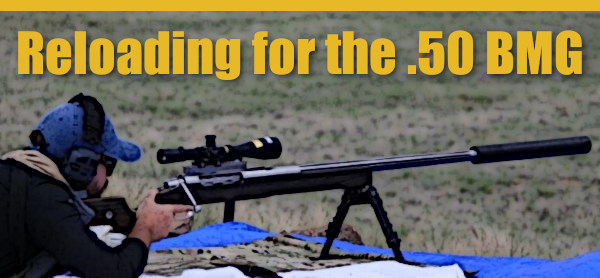
For today’s Sunday GunDay story we offer a short history of the legendary .50 BMG cartridge, tips on loading, and some fun photos from FCSA matches in the Western USA.
Fans of Heavy Artillery should visit Fifty Caliber Shooters Association (FCSA) website. There you’ll find range maps, photo collections and animated slide-shows On the FCSA photo gallery page, you’ll find a map. Click on any gray range link to see images from that venue. There are also a series of articles covering FCSA competition along with the “care and feeding” of the big 50-caliber rifles.
About the .50 BMG Cartridge
The .50 Browning Machine Gun (.50 BMG, aka 12.7×99mm NATO or 50 Browning) is a cartridge developed for the Browning .50 caliber machine gun in the late 1910s, entering official service in 1921. Under STANAG 4383, it is a standard cartridge for NATO forces as well as many non-NATO countries.
John Browning had the idea for this round during World War I in response to a need for an anti-aircraft weapon, based on a scaled-up .30-06 Springfield design, used in a machine gun based on a scaled-up M1919/M1917 design that Browning had initially developed around 1900. According to the American Rifleman: “The Browning .50 originated in the Great War. American interest in an armor-piercing cartridge was influenced by the marginal French 11 mm design, prompting U.S. Army Ordnance officers to consult Browning. They wanted a heavy projectile at 2700 FPS, but the ammunition did not exist. Browning pondered the situation and, according to his son John, replied, ‘Well, the cartridge sounds pretty good to start. You make up some cartridges and we’ll do some shooting’.”
Are you a died-in-the-wool .50 BMG fan? Got a hankerin’ for heavy artillery? Then visit the FCSA Photo Gallery page. There you’ll find hundreds of photos from Fifty Caliber Shooting Association (FCSA) matches and 50 Cal fun shoots in eleven states plus Australia, Switzerland, and the United Kingdom. To access the photos from the Gallery Page, start by selecting a shooting club and state with the brown buttons. After selecting the location, then click on the colored buttons for the event date.
Photo sets go all the way back to 2002, so you can see the evolution of the hardware over the years. Sample multiple archives to see the differences in terrain from one range to another — from Raton’s alpine setting to the hot, dry Nevada desert. This Gallery is really a treasure-trove of .50-Cal history. Here are a few sample images.
Reloading Powder and Special Tools for .50 BMG
Alliant’s Powder for 50-Caliber Applications
In 2009 Alliant unveiled Reloder 50, a slow-burn-rate powder designed primarily for long-range, .50-caliber rifle shooters. According to Alliant, the burn rate is “a little slower than Winchester 860″ and the powder is showing excellent lot-to-lot consistency. Load density is optimized for the 50 BMG and similar cases. Like Reloder 17, Reloder 50 employs a process which penetrates the kernels with the burn-rate-controlling chemical. This should allow a longer, flatter pressure curve, yielding more velocity than conventional powders can deliver. Alliant says that Reloder 50 offers “superior velocity and the ability to burn cleaner (with less residue)”. Reloder 50 comes in both 1-lb (#150527) and 8-lb (#150528) containers.
Forster and Lyman .50 BMG Trimmers
Big Fifty enthusiasts asked for a dedicated .50 BMG case trimmer, so Forster and Lyman created .50 Cal trimmers specifically for that cartridge. The cutter tip on the Forster .50 BMG Case Trimmer is much sharper than the cutter on the Lyman 50 Cal AccuTrimmer. However, with the Forster tool you will pay more for that superior cutting ability — the Forster .50 BMG trimmer is $125.18 at Precision Reloading compared to $85.21 on Amazon for the Lyman .50 BMG trimmer. Our advice is go ahead and pay the extra money for the Forster — the cutter head is much sharper, and we prefer the Forster’s collet-style case-holder. The Forster gets the job done more quickly, with less effort. NOTE: Grab the Forster while you can — we believe Forster has halted production (but it is still in stock at Precision Reloading and some other vendors).
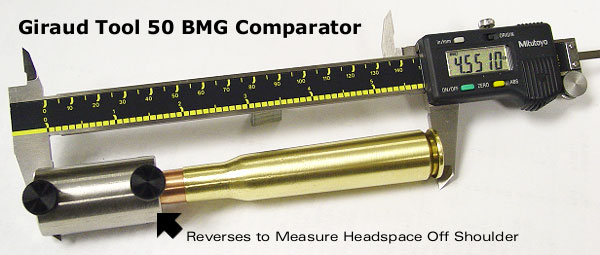
Giraud .50 BMG Case/Bullet Comparator Giraud Tool makes a comparator for 50-Cal cartridges. The double-ended comparator is quite versatile. In one orientation you can measure base-to-ogive bullet length and also measure cartridge OAL from rim to bullet ogive. When reversed, you can use the comparator to measure cartridge headspace. The $33.00 Giraud .50 BMG Comparator gauge is constructed of 303 stainless and fits most any vernier, dial, or digital caliper. CLICK HERE for more info.
Forum member Nodak7mm has discovered an ideal way to store your rifle cleaning rods in your garage or loading room. Using inexpensive Berkley Horizontal Fishing Rod Racks, Nodak7mm has secured a half-dozen Dewey rods on the back of a door. You could also mount the racks along a wall or on the side of a storage cabinet. This installation takes up minimal space and the Berkley Racks cost $16.99 at Amazon (select “6 Rod Rack”). There is also a similar Mezoom 6-Rod Rack Pair for just $9.99 at Walmart. If you prefer wood, Amazon also sells a pine 6-rod wall rack for $29.99.
Nodak7mm explains: “I was moving some fishing poles around and ended up with an extra pair of Fishing Rod wall racks. I said to myself, ‘I bet this would hold my Dewey cleaning rods’. I mounted the pair on the inside of a closet door in my man cave and put my cleaning rods in it. It works like a charm and is far cheaper than a specially-made rack that only lets the rods hang. One can even slam the door with the rods mounted and they stay put. This rod rack set… is made by a nationally recognized name and does a great job of holding the cleaning rods securely and safely.” These are inexpensive and are easy to mount to a door or wood cabinet.
Stow Your Cleaning Rods on Your Gun Safe
Another option is to make a rod set with a magnetic backing strip. This can be affixed to the sides of your gun safe or steel storage cabinet. Here is a home-made, magnet-affixed cleaning rod holder made by Forum Member “BobM”. This smart installation works great. CLICK HERE for more information.
Summer is coming soon, and temperatures are starting to heat up. We are already seeing unseasonably hot conditions in many areas of the country. You never want your barrels to get too hot, which can happen more quickly in summertime. Accuracy suffers when barrels over-heat, and excessive heat is not good for barrel life. So how do you monitor your barrel’s temperature? You can check if the barrel is “warm to the touch” — but that method is not particularly precise. There is a better way — using temperature-sensitive strips. McMaster.com (an industrial supply house) offers stick-on temp strips with values from 86° F to 140° F. A pack of ten (10) of these horizontal strips (item 59535K13) costs $14.49. That’s a mere $1.40 per barrel for strips — cheap insurance for your precious barrels. For best barrel life, you should try to keep your barrels under 120 degrees F.
NOTE: On the McMaster.com website, you’ll need to scroll down to the multi-use “Temperature Indicating Labels”. Then click on the horizontal label and select item 59535K13, as shown below.
Forum member Nomad47 says: “I have temperature strips (bought at McMaster-Carr) on all my barrels. I try not to shoot when the barrel gets to 122 degrees or higher[.]” Here are photos of the McMaster-Carr temp strips on Nomad47’s customized Savage.
Creedmoor Sports now offers handy Temp Strips, with 3-packs for $12.95. These have colored temp range markers so you can quickly see if your barrel is getting too hot. Creedmoor Sports notes: “The temperature range of 30-160° spaced in 10° increments fit most … shooting situations. The 1″-wide 6″-long LCD strip will provide many years of service. In general, we recommend that if a barrel begins to reach 140°, it is too hot and continuing to shoot at these temperatures accelerates barrel wear These barrel temperature strips use a 3M® adhesive and will stick to blued, parkerized and stainless barrels.”
Bad things can happen if your barrel gets too hot. First, with some barrels, the point of impact (POI) will shift or “walk” as the barrel heats up excessively. Second, even if the POI doesn’t change, the groups can open up dramatically when the barrel gets too hot. Third, if the barrel is very hot, the chamber will transfer heat to your loaded cartridge, which can lead to pressure issues. Finally, there’s considerable evidence that hot barrels wear out faster. This is a very real concern, particularly for varmint shooters who may shoot hundreds of rounds in a day. For this reason, many varminters switch among various guns, never letting a particular barrel get too hot.
Neconos.com offers BAR-L Temp Strips that visually display heat readings from 86 to 140 degrees. Think of these strips as compact, unbreakable thermometers that monitor barrel heating.
Put a strip on the side of the barrel and the barrel’s temp will be indicated by a stripe that changes from black to green. There is also a “general purpose” strip that reads to 196 degrees (see bottom row). The Benchrest model strip (86°F to 140°F) is in the middle. These Bar-L temp strips cost $9.00 each, or $25.00 for a 3-pack.
NOTE: These strips can be permanently fixed to the barrel with the heavy-duty clear plastic tape strip provided with the BAR-L Temp strip.
Mike Kurtz’s Competition Machine F1 “Pro-Mod” F-Open Rifle
Today’s Sunday GunDay article showcases a modern F-Open Rifle built on a Competition Machine Aluminum Chassis. This is quite a bit different than a typical F-Open rifle with a laminated wood or wood/carbon stock. But the rifle shoots extremely well, and has already won some mid-range F-Open matches.
The rifle’s owner, a highly respected vehicle mechanic, explained his objective with this rifle: “I wanted to build a second F-Open rifle to shoot primarily 600-yard Mid-Range and also serve as my back-up long range rifle. That way I can use the same brass, bullets, and primers. So it would be chambered in 7mm-6.5 PRC, the same as my other F-Open rifle. That rig is a 7mm-6.5 PRC with Cerus XR stock, BAT Neuvo action, and Bartlein 1:9-8.7″ gain-twist barrel. I absolutely love that rifle and it has achieved several top honors. But for this project, I wanted to try some different rifle components to see how they performed in this same caliber. So I decided to go with Brux barrels, BAT Neuvo aluminum action (but see below), and an Eliseo Competition Machine F1 aluminum alloy chassis.”
BARREL SPECIFICATIONS: I ordered two Brux 7mm x 33″ barrels with 1:8.5″ twist. The contour was supposed to be 1.350″ diameter for 5″, tapered-down to 1.150″ diameter at the muzzle end. However, when the barrels arrived they were tapered down to 1.050″, a bit smaller. The folks at Brux admitted the work order was mis-read and offered to take back the barrels and make me two more. Or, I could keep the barrels with nice discount. I contacted my gunsmith, Omar Alonzo, for his advice and he said to keep them, they would shoot just fine. That turned out to be a blessing because the total rifle weight is now just three ounces under 22 pounds with one of these barrels. Omar chambered it with his 7mm-6.5PRC “no-turn” reamer that was used on my Cerus rifle. The Brux barrel was finished at 32″ with the muzzle end threaded for a V2 tuner.
ACTION and TRIGGER: I intended to use an aluminum BAT Neuvo action because I anticipated weight may be a concern, but they were on back-order with no lead time in sight. So for now I went with a used steel BAT Model M, 1.47 Octagon action that I acquired via the AccurateShooter Forum marketplace. This is a RBLP Right Eject action with magnum bolt face and 20 MOA integral Picatinny rail. The trigger is a Bix’N Andy Competition also scored on the Forum, set at 3 ounces. [NOTE: I now have an aluminum Neuvo AL in my possession. However, the F1 rifle is shooting so well, I’ll save the aluminum Neuvo for a future build.]
STOCK and FINISH: When I was planning my second F-Open 7mm-6.5 PRC rifle build, Gary Eliseo’s F1 aluminum chassis was my immediate choice. I was already familiar with Gary’s products since I started out three years ago with a used 6BR-chambered R1 tube gun. I purchased it from a Forum member and I adapted it for Mid-Range F-Open very successfully. Being a long-time drag racer and fabricator piqued my interest in these aluminum chassis combos. I contacted Gary Eliseo at Competition Machine and ordered his F1 F-Open Chassis System with one of his custom-machined bedding blocks for the Bat M action I acquired off the Forum.
Video of F1 Chassis Rifle in Action
Turn-around time was just about eight weeks, including aligning and epoxying the action bedding block into the chassis. Gary Eliseo offers full custom Cerakote services for his customers but I had something else in mind so I had the chassis sent to me “raw”, i.e. with a bare aluminum finish. At first I thought about polishing some or all the entire chassis but that would be too high maintenance. I decided to go with anodizing as I have done in the past with many race car components. Anodizing is an electrochemical process that converts the metal surface into a decorative, very durable, corrosion-resistant, anodic oxide finish that’s pretty tough and looks great!. This finish is available in many colors and in clear.
While I was surfing the internet looking for some color/combo ideas I stumbled on a local custom anodizer who had dozens of some really wild and crazy anodizing patters and color mash-ups. I messaged Stephen @ Caustic Customs and told him about my project. He replied that his specialty is paint-ball guns and this would be his first long gun but, hey, it’s aluminum! I gave him all the pieces of my F1 chassis. There were a couple of his patterns I really liked so I asked his opinion which he thought might look best for my project. He replied why not both? So I instructed him take both patterns and “run with it”. The end result is the Icy-Hot blue/red finish as seen in the pictures.
It all came together at Alonzo’s Custom Rifles in Pasadena, Texas. Omar hand-lapped the action bedding block surface to smooth-out some tiny high spots. He then skim-bedded the action with an epoxy filler to make sure the action made 100% contact with the bedding block. Barrel chambering, action fitting, trigger tuning, and final assembly was performed by Omar.
I finished the rifle with a hydraulic recoil pad from Falcon Strike and Anarchy Outdoor’s Penguin Precision Grip. Gary designed the F1 to utilize AR15-style grips. The Falcon Strike pad is not as sexy as the R.A.D. unit I have on my Cerus-stocked rifle, but I think its recoil-absorbing performance is up there with the R.A.D. unit. So, if a RAD is not in your budget or if weight is a concern, you can’t go wrong with a Falcon Strike recoil pad.
SCOPE/RINGS: My intention was to switch my March-X 8-80x56mm Majesta High Master scope between my two rifles. However the hefty stainless Bat M action nixed that idea. So to ensure the new rifle would be F-Open legal weight I went with a used March-X 10-60x56mm High Master scope that I acquired through the AccurateShooter Forum Marketplace. That 10-60X March, shown in the video, is almost 11 oz. lighter that my 8-80X March-X Majesta HM. NOTE: In some of the photos here, the rifle is fitted with an older March 8-80X scope (NOT the latest Majesta). The rings are March Superlight Titanium Ghost Rings — under 5 oz. for the set, the lightest I could find.
F-Open F1 Chassis Rifle Specifications
Chambered for: 7mm-6.5 PRC Wildcat
Stock: Competition Machine F1, F-Open Chassis, Falcon Strike Recoil Pad, Anarchy Outdoors Penguin Grip. Custom anodizing by Caustic Customs.
Trigger: Bix’N Andy Competition trigger
Action: Bat Model M — Right Bolt, Left Port, Right Eject with 20 MOA scope rail
Barrel: Brux 7mm, 1:8.5″ twist, 32″ overall, 1.350″ x 5″, tapering down to 1.050″, V2 Tuner
Scope: March-X 10-60 High Master, MTR-1 reticle. March Ultra-Lite Titanium Ghost scope rings.
Gunsmith: Alonzo Custom Rifles
CARTRIDGE COMPONENTS and LOADING METHOD: I use Lapua 6.5 PRC brass, Berger 180gr Hybrid bullets and Federal 210M primers. New brass necks are expanded to 7mm and skim-turned to get a consistent .014″ neck thickness. I use a 35-degree cutter and go just a slight bit into the shoulder to ward off donuts. I then chamfer the flash holes, uniform the primer pockets, full-length size the cases, then expand and trim/chamfer the necks. My fired brass gets annealed, wet-tumble cleaned, full-length sized/expanded, and trimmed in that order. Bullets are pointed and then sorted by OAL. Primers are sorted by height and then by weight. I apply Neo-Lube to the inside of the necks with a foam Q-Tip for consistent seating psi.
This is from a 600-yard match shot with the F1 rifle a few months ago. Despite a strong wind from behind constantly switching right to left, I scored a 200-12X — good enough for Second Place.
LOAD DEVELOPMENT PROCESS: Thanks to some good 7mm-6.5 PRC load data posted on AccurateShooter.com, it helped me with a starting point to find a nice velocity node at 2865 fps using Hodgdon H4350. I did this by shooting some 2-shot groups seated .010″ off the lands. my focus was to find a node where the velocity leveled-out in at least two 0.5 grain increments in the 2850-2880 fps range. I then did a seating depth test at 100 yards to find my ideal seating depth which ended up at .024″ jumped. Next, I did some 3-shot groups at 100 yards to dial-in he barrel tuner until I got at least two consecutive ultra-tight groups. I verified that setting with a one-hole, three-shot group.
About Mike Kurtz
Michael Kurtz is owner/operator of Century Automotive & Transmission. An ASE Master L1 Technician since 1983, Mike has been an avid drag racer over the last 40 years. Mike notes: “I never owed any kind of rifle until I retired from racing. Got bit by the accuracy bug and learned about F-Class in 2021. I read several reloading and long range shooting books while I scoured the AccurateShooter Forum Marketplace for a rifle, scope, rests, and reloading equipment for my first F-Open rig. Most all of my major components I acquired via online Forums. I have to attribute the early success of my F-Open accomplishments to the vast content found on AccurateShooter.com.
I am also a member at Bayou Rifles Inc. in Houston Texas where I’ve learned from some of the best shooters in the country. The competition here is fierce but the camaraderie is second to none!”
We note there are regular threads in our Shooter’s Forum asking about the new compact radar chronographs — especially the hot-selling Garmin Xero C1 and the new small LabRadar LX. Members want to know how well each works. Today’s video showcase can help answer those questions. After the hugely successful release of the compact Garmin Xero C1 Pro chronograph, two competitors are now playing “catch-up” with all-new compact radar chronographs. LabRadar has an impressive new unit, the LX Compact, while Caldwell introduced its midsized VelociRadar which employs innovative Chirp Radar technology. For today’s Saturday Video Showcase, we feature video reviews of these three notable Compact Radar Chronographs.
Garmin Xero C1 Pro Chronograph
The Garmin Xero® C1 Pro chronograph has already been a big success. After great initial test reports, this compact $599.99 chronograph has been selling out at vendors nationwide. With the performance and quality of the Xero C1 Pro, many LabRadar owners are putting their older orange radar chronos up for sale. Check out the features of this new compact radar chrono in this official product launch video from Garmin:
Introduced in late 2023, the Xero C1 Pro radar chronograph has been an instant hit. Measuring just 3.03″ x 2.38″ x 1.36″, the Xero C1 Pro is compact and easy to transport. Using Doppler radar, the Xero C1 Pro accurately records projectile velocities from 100 fps to 5,000 fps, so it works with all kinds of projectiles. Setup is simple and intuitive, thanks to the button-operated design. SEE FULL RecoilWeb Review.
Garmin offers a modern ShotView™ smartphone app and lets you compare velocities for all shots fired, track ES/SD, and record total sessions. The rugged Xero C1 Pro chrono has a IPX7 water-resistant rating and boasts up to 6 hours of battery life. The unit ships with a compact tripod mount, and the screen is described as “sunlight-visible, transflective, monochrome” so it is easy to view in all conditions.
Above is a recent video review from our friends at Area 419. This review confirms that the Garmin is very reliable, extremely easy to set-up, and the provided Smartphone App works great. User reports have been very positive, and our testers note that the Garmin works better on air rifles than the original LabRadar.
LabRadar LX Compact
LabRadar announced its new LabRadar LX compact Doppler radar chronograph at the 2024 SHOT Show. This is a truly compact unit, measuring just 2.5″ X 2.75″ X 2.75″. The LabRadar LX comes with a tough metal case, lifetime battery, and ships with a tripod. The unit has a velocity range of 65 to 5000 FPS and it can display Average, ES, SD, Min, and Max Velocity.
Observers at SHOT Show noted the LabRadar LX has a very bright, high-contrast LCD Screen for outdoor viewing. Overall, the exterior design and specs are impressive. Definitely watch both videos to understand the difference in features between the Garmin and this ultra-compact new LabRadar LX. If you’re shopping for a compact chrono it’s worth looking at all the options. The Garmin Xero C1 Pro is currently $599.99, while the new Labradar LX is $599.95.
Caldwell VelociRadar
Caldwell showcased its all-new VelociRadar chronograph at SHOT Show 2024. This is quite a bit bigger than the Garmin Xero C1 Pro or the new LabRadar LX compact. But it is still relatively small compared to the original orange LabRadar unit.
Notably, the Caldwell VelociRadar uses a different mode of radar (Chirp Radar vs. Doppler) than other chronos, which offers some advantages. Caldwell states: “The Caldwell VelociRadar Chronograph is precision redefined with cutting-edge Chirp radar technology. This is no standard chronograph, while most chronographs stop at only providing muzzle velocity the VelociRadar tracks bullets downrange offering the full picture of ballistic performance. Using these downrange velocity measurements, the VelociRadar calculates true muzzle velocity, the bullet’s ballistic coefficient, and downrange energy.” Note that point about BCs — Caldwell says this new machine will let you calculate the true Ballistic Coefficients of your bullets as fired from your rifle.
BONUS Video: Garmin vs. Large LabRadar vs. Magnetospeed
This interesting video features a head-to-head comparison with the Garmin Xero C1 Pro chronograph, the Magnetospeed barrel-attached chrono, and the full-size LabRadar chrono. The Primal Rights team tested the three chronos with a dozen different cartridge/bullet combinations. NOTE: We have used the Magnetospeed with considerable success. However, the placement of the device on your barrel can affect accuracy, so you may have to finalize load development with the unit removed. With a Garmin or LabRadar, you can tune for accuracy while monitoring your ES and SD.


 For today’s Sunday GunDay story we offer a short history of the legendary .50 BMG cartridge, tips on loading, and some fun photos from FCSA matches in the Western USA.



 Alliant’s Powder for 50-Caliber Applications
 Forum member Nodak7mm has discovered an ideal way to store your rifle cleaning rods in your garage or loading room. Using inexpensive


 I am also a member at


