If two barrels are better than one, then why not three? That’s the thinking behind the exotic Bockdriling BD14 from Blaser, unveiled at the 2014 IWA Show in Germany. This three-barrel Bockdrilling firearm works as a shotgun, large-caliber rifle, and small-caliber rifle all in one. Even with all those barrels, the BD14 is relatively light, at 3.3 kg (7.26 lbs) without optics. That makes this a nice, carry-around gun for stalking. As you’d expect from Blaser, the twin triggers are crisp and precise, with a pull weight of just 1.43 lbs (650 grams). The front trigger is for the large-caliber rifle barrel, while the rear trigger works both the shotgun and small-caliber barrels, via a tang-mounted selector. These firearms are rare in the USA — and quite expensive. The only Blaser BD 14 we could find on GunBroker had a $9099.95 asking price. That works out to over three grand per barrel.
Here’s what Blaser USA has to say about its unique three-barreled BD 14:
“The ‘Bockdrilling’ is, put simply, an over/under (O/U) rifle-shotgun combination with a smaller caliber rifle-barrel… on the side. The barrel arrangement [allows] for an extremely slender receiver, making the BD14 exceptionally huntable.
The [patent-pending] Vertical Block Lockup… combines an extremely compact and solid block lockup in a closed system within the monoblock with the comfortable handling of a classic break-action rifle.
The double lock permits, if needed, a rapid second shot, the front trigger always releasing the large rifle-caliber. The … barrel selector actives the shotgun barrel when in position ‘top’ and activates the smaller rifle caliber in position ‘bottom’.”
Why Does Anyone Need Three Barrels?
The Blaser website explains: “As hunters, we learn to expect the unexpected, whether in a blind or stalking, so it’s understandable that we dream of a firearm that will allow us to take advantage of any situation. With the Bockdrilling BD14, Blaser has developed the perfect blind and stalking firearm – compromises are finally a thing of the past.”
Design Features of the Bockdrilling BD 14 Tri-Barrel Gun
The BD14 has a double-lock system so that a second shot can be taken without having to recock the firearm. Blaser says: “Thanks to the free-floating barrels, point of impact remains constant even with a quick succession of shots, no matter which barrel was fired first. The extremely strong vertical block lock on the BD14 helps contribute to the high degree of precision.”
Story idea from EdLongrange. We welcome reader submissions.
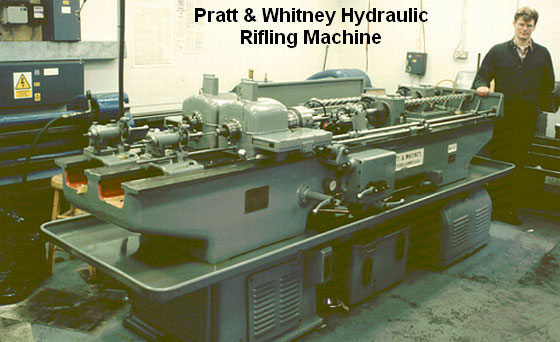
This video shows the process of cut-rifled barrel-making by Krieger Barrels, one of the world’s best barrel manufacturers. Krieger cut-rifled barrels have set numerous world records and are favored by many top shooters. The video show the huge, complex machines used — bore-drilling equipment and hydraulic riflers. You can also see how barrels are contoured, polished, and inspected.
For anyone interested in accurate rifles, this is absolutely a “must-watch” video. Watch blanks being cryogenically treated, then drilled and lathe-turned. Next comes the big stuff — the massive rifling machines that single-point-cut the rifling in a precise, time-consuming process. Following that you can see barrels being contoured, polished, and inspected (with air gauge and bore-scope). There is even a sequence showing chambers being cut.
Click Arrow to Watch Krieger Barrels Video:
Here is a time-line of the important barrel-making processes shown in the video. You may want to use the “Pause” button, or repeat some segments to get a better look at particular operations. The numbers on the left represent playback minutes and seconds.
Krieger Barrel-Making Processes Shown in Video:
00:24 – Cryogenic treatment of steel blanks
00:38 – Pre-contour Barrels on CNC lathe
01:14 – Drilling Barrels
01:28 – Finish Turning on CNC lathe
01:40 – Reaming
01:50 – Cut Rifling
02:12 – Hand Lapping
02:25 – Cut Rifling
“At the start of World War Two, Pratt & Whitney developed a new, ‘B’ series of hydraulically-powered rifling machines, which were in fact two machines on the same bed. They weighed in at three tons and required the concrete floors now generally seen in workshops by this time. Very few of these hydraulic machines subsequently became available on the surplus market and now it is these machines which are sought after and used by barrel makers like John Krieger and ‘Boots’ Obermeyer. In fact, there are probably less of the ‘B’ series hydraulic riflers around today than of the older ‘Sine Bar’ universal riflers.” — Geoffrey Kolbe, Border Barrels.
Have a good look at the photos below — this may be one of the most noteworthy target strings we’ve ever published. What you can see is the effect of barrel tuner position on point of impact (POI). You can clearly see that the tuner position alters the up/down POI location in a predictable fashion.
This remarkable 15-shot sequence was shot by French benchrester Pascal Fischbach using his 6 PPC fitted with a CG (Carlito Gonzales) action and a Bukys barrel tuner.
Pascal reports: “After [bullet] seating and load validation, I put the Bukys tuner on, screwing it out 10 turns. According to Carlito, the CG’s super stiff action-to-barrel fit gives a faster vibration modulus that is detrimental below 10 turns [position of the tuner].” Pascal’s procedure was to screw out the tuner 1/4 turn progressively from one shot to the next. He shot one bullet at each tuner position, with a total of 15 shots.
Left Half of Target Strip (shots with 1/4 rotation change of tuner in sequence)
Right Half of Target Strip (shots with 1/4 rotation change of tuner in sequence)
Pascal observed: “Note the point of impact displacement [from shot to shot] tracks clearly along a sinusoide (sine wave curve).” This is indeed notable and significant! This shows how the tuner’s ability to change barrel harmonics can alter the position of the muzzle as each bullet exits, resulting in a higher or lower POI. Pascal sent his results to Carlito Gonzales in Argentina for analysis.
Pascal poses this question to readers: “Guess which three positions Carlito recommends to try?”
Editor’s Note: While this target sequence clearly shows how tuner position can alter bullet point of impact, this, by itself, does not tell us which tuner position(s) are best for accuracy. That will require further multi-shot group testing, involving careful experimentation with tuner position (and powder charge weights). But for those folks who doubt that a tuner can make a difference on a short, fat barrel, just take another look at the photos. The up/down changes are undeniable, and noteworthy in the wave pattern they follow.
Shooting Set-up and Test Conditions:
Pascal did this test at an outdoor range under very good conditions: “This was shot at my home range, outdoors, with four Smiley flag. The range is a narrow cut in high woods. Wind was consistent with readable flags. I started testing the tuner from 10 turns out and on to 15. I recently… found a sweet spot very close to the rearmost position of the tuner, so the rigidity provided by this super long tenon (just short of 70mm) was not a reason to overlook the recommended Bukys tuning procedure.”
NRA publication Shooting Sports USA (SSUSA) has thousands of articles online, all free for the reading. Many of these stories have been written by top competitors, including National and Olympic Champions. You will find SSUSA articles spotlighted every week on the NRA Competitive Shooting Facebook page. We recommend you bookmark that page as a valuable resource. Here are four notable SSUSA articles that have been featured on Facebook this month. Go to SSUSA.org to see even more current articles, with new content every day.
Here is an insightful, fairly lengthy 1850-word article about the phenomenon we call mirage. The article explains how and why mirage appears, how it can best be monitored, and how mirage can indicate both wind velocity and direction. Top competitors follow the adage “Mirage is your friend”, because mirage can often be the most important indicator of wind variables — sometimes even more important than wind flags. “The mirage is more sensitive than the flags since it has less inertia and momentum”, wrote Desmond T. Burke, in his book, Canadian Bisley Shooting, an Art and a Science.
Well worth reading, this SSUSA article talks about the properties of mirage. Here is a sample:
“Mirage — can make all the difference between a shot landing squarely in the X-ring or being victimized by an undetected downrange breeze. The true power of mirage is found in its ability to betray the subtlest of breezes downrange. Its fluid movement… can not only provide wind direction, but speed as well.
Typically, the ability to detect mirage is maximized on warm, sunny and sultry days. Expect mirage to be most pronounced in mid-morning or early afternoon, although it ignores these rules with regularity[.]
Mirage is extremely powerful at identifying winds of less than 12 mph, particularly those gentle breezes subtle enough to not even bother moving the flags.
When there is no wind, or a gentle head or tail wind, mirage will appear to be ‘bubbling’ directly up from the ground. Many call this ‘boiling’, and it is probably the easiest of all to detect.
As a general rule of thumb, when wind speed increases, overall height of the waves produced by the mirage is reduced. Large peaks and valleys in the waves mean that particular mirage is being driven by a very slight breeze. Conversely, crest size is reduced with wind speed, making it harder and harder to detect, until the mirage disappears entirely at somewhere around 12 miles per hour. In other words, the taller mirage’s waves appear, the slower the breeze.”
Authored by the late Glen Zediker, this article covers barrel break-in procedures. It is particularly useful for dealing with factory barrels. We CAUTION readers — with outstanding, hand-lapped custom barrels from top barrel-makers, you may want to do very little break-in — clean sparingly and keep barrel heat low. Do NOT use abrasives aggressively. On our Krieger and Brux barrels, we simply wet-patched every 2-3 rounds for 20 rounds and the barrels shot superbly from the start with minimal fouling. But for factory barrels, a moderate break-in process may prove beneficial.
Zediker explains: “Lesser, lower-cost barrels are going to have more pronounced … imperfections within the bore[.] These imperfections are largely tool marks resulting from the drilling and rifling processes. And if it’s a semi-automatic, like an AR-15, there might be a burr where the gas port was drilled. The goal of break-in is to knock down these imperfections, thereby smoothing the interior surface.”
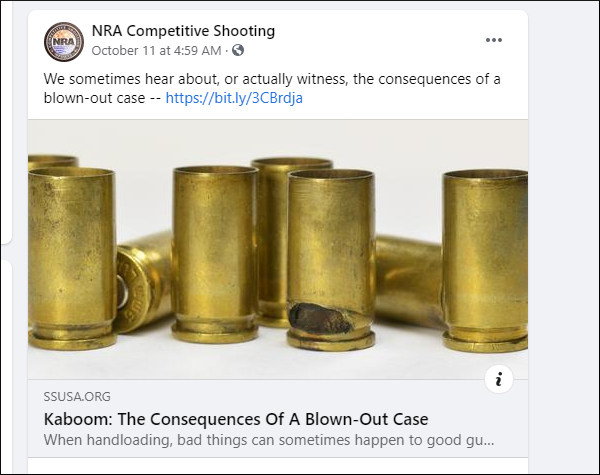
As one who has experienced a cartridge case-head blow-out with a 9mm pistol, this Editor is very conscious of the risks involved and the damage a blow-out can do to the pistol, to the magazine, and (worst of all) to the shooter. Even with new brass, the possibility of a case failure is always present. And even if the case remains intact, we’ve seen primer failures that create a dangerous jet back towards the pistol shooter. That’s why shooters should always employ protective eyewear whenever they shoot.
We love our wheelguns, but there’s no doubt that forcing cone damage can occur, particularly with hot loads and if your cylinder-to-barrel gap is excessive. This article explains how to inspect your revolvers, and how to mitigate the likelihood of forcing cone damage. The article also explains how to clean your revolvers properly. This is very important to avoid build-up of lead and powder residues.
What would you do if you had a LIVE Round stuck in a chamber? Well, don’t hammer a wood dowel in the barrel, that’s for sure. Here is a tale of stupidity that could have injured the rifle owner. This account appeared on the Facebook Page of Brock & Norris Custom Rifles, a gunsmith shop in the United Kingdom.
Live, Loaded Round Stuck in Chamber — What NOT to Do!
Commentary by gunsmith Mike Norris
Here is a cautionary tale. A client came into the workshop with a problem which could have had very serious [even deadly] consequences. And it is not the first time we have seen this. Firing neck-sized-only ammunition, the client attempted to load a round which then jammed solid in the chamber. The bolt would not close and the round was unable to be extracted.
The problem was compounded by various attempts to push the loaded round from the chamber with cleaning rods and the assistance of a hammer (I kid you not!). All of which damaged the bore and the crown, culminating in a wooden dowel being hammered into the barrel which subsequently broke off in the bore. The end result was a barrel that was totally wrecked.
One Facebook friend posted: “Fortunate avoidance of a ‘Darwin Award’. I can hear it: ‘Go on hammer the bolt, she’ll go!’. We’re missing a ‘face palm’ emoji here.”
The Problem Started with a Neck-Sized Case
The moral of this story is DO NOT NECK SIZE cases. Mike advises: “Full-length size cases correctly. You only move the shoulder back 1 to 1.5 thousandths and the case will feed and extract EVERY TIME. Yes you will have to trim cases occasionally but it is one hell of a site cheaper and safer than jamming a live round in the barrel and wrecking the barrel trying to remove it. Not to mention the risk to life and limb!”
What Should Have Been Done in this Situation?
Mike was asked the best method for removing a stuck round. He stated: “The Grease Gun Method on a threaded barrel works*. However, in this case, this was not remotely possible due to 20 inches of wooden dowel being broken off in the bore as well. The live round (yes it was live!) was attempted to be removed by hammering on a brass cleaning rod (an actual hammer was used) to try to dislodge it. That brass rod broke, so then a wooden dowel was employed, and THAT broke as well.”
Mike cautions that, when a live, loaded round is involved you must be very careful: “Do not be taking chances with your own safety or others around you. When it is safe to do so, get the rifle to a professional. By the way he WILL [chide you] for being daft in the first place and then bringing the problem into his premises. Expect to be charged for the expertise to remove said obstruction, In the past I even had a client send me a loading die with a live .338 Lapua round in it through the Post no less!”
* This YouTube Video shows the successful removal of a jammed FIRED (not live) case from an AR15 barrel. You can see the fired case eject at 15:35 time-mark, after the primer pops out first. But note, this was NOT a live, loaded round. Extreme caution must be excercised with live rounds.
The Legal Brief is a feature of TheGuncollective.com that focuses on firearms rules and regulations. In this Legal Brief video, Attorney Adam Kraut explains key State and Federal regulations governing firearms, and explains how to ensure compliance with all applicable laws.
This five-minute video explains barrel length rules for rifles and shotguns, and also explains the best (and most fool-proof) methods to measure your barrel. In addition, the video explains how to measure firearm overall length. A rifle or shotgun which is less than 26 inches overall can also be classified as a “Short-barreled” rifle/shotgun subject to the NFA. NOTE: Under federal law “If the rifle or shotgun has a collapsible stock, the overall length is measured with the stock EXTENDED”.
Highlights of LEGAL BRIEF Discussion of Barrel Length and Firearm Overall Length
The ATF procedure to measure the length of a barrel is to measure from the closed bolt or breech face to the furthest end of the barrel or permanently attached muzzle device. ATF considers a muzzle device that has been permanently attached to be part of the barrel and therefore counts towards the length.
How to Measure Barrel Length: Drop [a] dowel or rod into the barrel until it touches the bolt or breech face, which has to be closed. Mark the outside of the rod at the end of the muzzle crown (if you don’t have a permanently attached muzzle device) or at the end of the muzzle device if it is permanently attached. Remove the rod and measure from the mark to the end of the rod. That is your barrel length[.]
Remember, if the barrel length is less than 16 inches, it is possible that the firearm could be a short barrel rifle (if you are building a rifle or it is already on a rifle) and if the barrel length is less than 18 inches, it is possible the firearm could be a short barrel shotgun (again if you are building a shotgun or it is already a shotgun). Both of these firearms would be subject to the purview of the National Firearms Act and would require the firearm to be registered accordingly.
How to Measure Overall Length:The overall length of your rifle or shotgun may also classify it as a Short Barrel Rifle or Short Barrel Shotgun. The overall length of a firearm is the distance between the muzzle of the barrel and the rearmost portion of the weapon measured on a line parallel to the axis of the bore. … If the rifle has a permanently attached muzzle device, that is part of the overall length. … If the rifle or shotgun has a collapsible stock, the overall length is measured with the stock extended.
The late Bill Myers was recognized as one of greatest rimfire smiths who ever lived. Myers crafted many match-winning, record-setting rimfire benchrest rigs. Here we feature one of Bill’s most interesting creations — a clamping action that allows a rimfire barrel to be indexed (rotated) around the bore axis.
Bill was a creative thinker, and his own exhaustive testing has convinced him that barrel indexing can enhance accuracy in rimfire benchrest guns. Myers did acknowledge that, particularly with a very good barrel, the advantages of indexing may be subtle, and extensive testing may be required. Nonetheless, Myers believed that indexing could improve rimfire accuracy.
Indexing with the Myers’ Clamping Action
To index the barrel, Myers simply loosens the three clamping-bolts and rotates the barrel in the action. Because there is no thread to pull the barrel in or out, the headspace stays the same no matter how much the barrel is rotated. In other words you can rotate the barrel to any position on the clockface and the headspace remains unchanged.
The Challenge of Barrel Indexing With a conventional barrel installation, employing a shoulder with a threaded tenon, it is difficult to index the barrel. Even with a cone breech (photo right) that eliminates the problem of extractor cuts, you’d have to use shims to alter the barrel index position, or otherwise re-set the shoulder each time you screwed the barrel in further.
Clamping Action Allows Barrel to Be Rotated to Any Position
Bill has come up with a masterful solution to barrel indexing. He designed and built his own prototype custom action that clamps the barrel rather than holding it with threads. The front section of the action is sliced lengthways, and then clamped down with three bolts. A special bushing (the gold-color piece in photos) fits between the barrel and the action. By using bushings of different inside diameters, Bill can fit any barrel up to an inch or so diameter, so long as it has a straight contour at the breech end. To mount the barrel, Bill simply places the fitted bushing over the barrel end-shank, then slips the “sleeved” barrel into the front end of the action. Tighten three bolts, and the barrel is secure.
Today we feature a top-flight tactical .22 LR rig belonging to Jonathan Ocab. A talented Highpower marksman with the Distinguished Rifleman Badge, Jonathan also enjoys rimfire tactical disciplines which he features on his Youtube Channel. Jonathan has run a monthly NRL22 match in California. His interest in the NRL22 game started with a CZ 455, but soon he stepped up to the impressive rig you see here. This boasts all top-tier components: Vudoo V-22 mag-fed action, Bartlein barrel, MPA Chassis, and Kahles K525i scope. Jonathan carefully selected all this hardware and assembled the rifle himself.
My Vudoo/MPA Rifle for NRL22 and Long Range Rimfire Report by Jonathan Ocab,Ocabj.net.
I became interested in rimfire shooting due to not having as much access to longer distance ranges, and the emergence of NRL22 matches. Back in 2017 I had acquired a CZ 455 and ran it in NRL22 club matches. It worked well, but as I started spending most of my time on my club’s rimfire range, I focused on getting a Vudoo Gun Works V-22. The Vudoo V-22 appeared to offer a true repeater that had the feel of a full-sized centerfire rifle along with high accuracy/precision potential.
After a lot of research, I decided to put in an order for a barreled action and acquired a Vudoo Gun Works V-22 action with a 20″ Bartlein barrel, 1-16″ twist, and MTU contour, all in Flat Dark Earth Cerakote (along with a +30 MOA base). I then acquired the TriggerTech Diamond Trigger Pro Curved, Masterpiece Arms BA Comp chassis (in Flat Dark Earth), American Rifle Company M10 34mm rings (28mm height), and Kahles K525i 5-25x56mm SKMR3 LSW scope.
CZ as a Starter NRL22 Option — The CZ 450-series is a solid family of .22 LR rifles, but I wanted to see what existed beyond the CZ level of rimfire rifles. One of my complaints with the CZ 455 is that the trigger leaves much to be desired even with the trigger kits available. Since the Vudoo V-22 action has a Remington 700 footprint and can accept most Rem 700-compatible triggers, I can actually run a top-tier trigger that would exceed anything available for the CZ.
Component Selection for the Ultimate NRL22 Competition Rifle
My choices in components were biased due to my prior experience — I went with quality hardware I knew and trusted…
Barrel Choice — I chose the Bartlein barrel over Vudoo’s in-house Ace barrels because I run a Bartlein barrel on my 6mm Creedmoor rifle and I have become a big Bartlein fan. Secondly, I chose the Masterpiece Arms BA Competition chassis because I also run the MPA BA Comp on my 6mm Creedmoor rifle. You can see the two rifles side-by-side below:
You are not seeing double. There are two rifles, both with an MPA Comp BA chassis, and both weighing about 15 pounds. In front is the featured Vudoo-action .22 LR rimfire rig with 20″ barrel, while behind is Ocab’s ARC Mausingfield 6mm Creedmoor PRS/NRL centerfire rig with 24″ barrel.
After running this rifle build for over a year now, I can say that I am more than happy with this platform as I have it configured. Having a .22 LR rifle in the same chassis as my 6mm Creedmoor rifle makes me feel right at home behind either rimfire or centerfire platform. My Vudoo V-22 weighs 15.2 lbs with Atlas CAL bipod while my 6mm Creedmoor rifle build weighs right at 15.0 lbs with the same Atlas CAL bipod. The “feel” and handling of my Vudoo V-22 MPA is as close to a centerfire gun as you can get.
Scope and Rings — I chose the 5-25x56mm Kahles K525i SKMR3 LSW because I was interested in running the Kahles after handling a few K624i and K525i scopes and hearing about how great they tracked. I run ARC M10 rings on several rifles because I think they are superbly designed.
Trigger Choice — I chose the TriggerTech Diamond because I already have a TriggerTech on one of my centerfire platforms and I wanted to try their Diamond trigger on a gun.
Outstanding Accuracy with Multiple .22 LR Ammo Types — Lapua and SK
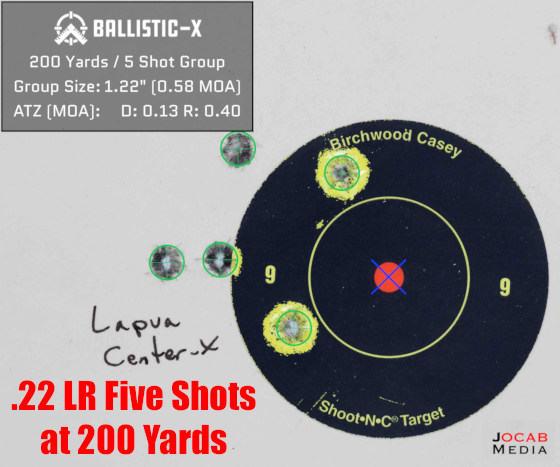
My .22 LR ammo of choice is Lapua Center-X. This is the most commonly-chosen ammunition among Vudoo V-22 shooters. I also had good results with SK Rifle Match and Lapua Midas+ in casual 50-yard and 100-yard testing but have stayed with Lapua Center-X because my rifle shot all the lots of Center-X I put into it equally well out to 200 yards.
SUMMARY — The Vudoo V-22 and MPA Package Is Outstanding
I can hands down recommend the Vudoo Gun Works V-22 for anyone who is interested in getting one. The “full-sized” rimfire rifle segment is not a one-horse race anymore and there are other options out there, but I feel very few will regret going with a Vudoo V-22 over another alternative. If you do not have a centerfire rifle designed for NRL/PRS style of shooting, you could probably just opt to go with a CZ 457 or Tikka T1x and have a lot of room to modify and tailor those rifles to your own tastes and still have an accurate rifle for NRL22. But if you also run a precision centerfire rifle, you should seriously consider a Vudoo V-22 or other 700-pattern rimfire action if purchasing a new .22 LR rimfire rig.
My Vudoo Gun Works V-22 build is an all-purpose gun for me. It is setup for NRL22-style matches but can be utilized for (extreme) long range .22 LR shooting (300 yards and beyond). For that rimfire ELR Game, I am seriously considering getting a Vudoo V-22S (single-shot) action to put in an F-Class stock to have a dedicated ELR .22 LR gun. While I built my Vudoo Gun Works V-22 with NRL22 in mind, I realized this gun could do more so I took it out to shoot 300 yards. After that, I stretched it out to 400 yards and then 500 yards in subsequent range visits. Now I am intrigued by extreme long range .22 LR shooting and often shoot 400 yards and beyond with the Vudoo V-22 when I can.
Long Range .22 LR Rimfire — Out to 500 Yards
Jonathan shoots his competition rifle in Long Range Rimfire matches with targets out to 500 yards. That’s definitely Extreme Long Range for the little .22 LR cartridge, requiring 27.8 MILs of up elevation! Jonathan notes: “I originally had a +30 MOA base on my rifle and it worked fine to 400 yards, but I ran out of adjustment on the K525i to get to 500 and had to hold over. I ended up getting a +40 MOA base.”
NRL22 Competition — Tactical Rimfire Matches
The NRL22 match format is a great shooting discipline. NRL22 offers a high fun factor at relatively low cost. You don’t have to reload match ammo. A couple of 50-round boxes of .22 LR ammo will get you through the match. While some people bring lots of gear to matches, that’s by choice and not by necessity. You can keep it simple and still be competitive (and win).
Tips for NRL22 Competitors
I am a match director at my gun club and run our local NRL22 matches. People often ask me for tips for competing in NRL22. First, I recommend getting the course of fire for the month in advance and practicing those stages at the range. Here are other specific tips that should help NRL22 competitors improve their gun-handling and match results.
1. Dry Fire Practice — If you are not able to do live fire practice at the range, I encourage shooters to practice their shooting positions at home via dry fire. Setup props or barricades with pasters or other faux targets on a wall in the garage or inside the house and run through each stage.
2. Scope Magnification Level — The most common issue I see with newer shooters in NRL22 is the tendency to maximize their scope magnification. The timer will start, and the shooter gets into position on a target, but the scope is set to 15x or higher and the shooter can’t find the target. The shooter lowers the magnification, locates the target, and then increases the magnification again, takes the shot, transitions to another target, and repeats the process of decreasing magnification, locating target, etc. Novice NRL22 shooters should try using the mid-range magnification. Try shooting 7x-12x and learn to balance field of view and target image.
The author at NRL22 Match at West End Gun Club in San Bernardino, CA.
3. Support Side Shooting — NRL22 matches often include support-side shooting stages. This requires you to shoot with your opposite (non-dominant) hand and eye. I often hear people complain about shooting support-side. My only real tip for this is to actually spend time at the range shooting this way. Practice makes perfect. It’s all a question of learning how to shoot again and using fundamentals. Learn to get a consistent cheek weld and consistent eye relief. If necessary, figure out if you need to set your scope’s diopter for your opposite eye and mark it on the scope.
4. Tripod Practice — Even though tripods are not used in the NRL22 courses of fire, I practice shooting off of a tripod often. I will often setup targets at various distances and spaced far apart to run drills firing shots on each target with the goal of speeding up transitions and target acquisitions. Target acquisition after transition from target to target is where time is lost, so it is good to become efficient in this area.
BONUS Video — Modern NRL22 Hardware, Optics, and Ammo
Released on October 5, 2024, this recent Pursuit of Accuracy channel video reviews some of the latest and greatest equipment options for NRL22 and Precision rimfire disciplines. The host covers action and stock options at 1:10 time mark. Then at the 4:00 minute mark, he explains popular scope options. At 7:02 in the video he explains how he selects and tests .22 LR ammunition (he favors ELEY). Finally, at 11:52 he explores barrel options while including suggestions on efficient barrel maintenance. This video includes excellent Shooter’s POV footage shot with a video camera mounted on the rifle.
Sometimes you’ll get a barrel that doesn’t stabilize bullets the way you’d anticipate, based on the stated (or presumed) twist rate. A barrel might have 1:10″ stamped on the side but it is, in truth, a 1:10.5″ twist or even a 1:9.5″. Cut-rifled barrels, such as Kriegers and Bartleins, normally hold very true to the specified twist rate. With buttoned barrels, due to the nature of the rifling process, there’s a greater chance of a small variation in twist rate. And yes, factory barrels can be slightly out of spec as well.
After buying a new barrel, you should determine the true twist rate BEFORE you start load development. You don’t want to invest in a large supply of expensive bullets only to find that that won’t stabilize because your “8 twist” barrel is really a 1:8.5″. Sinclair International provides a simple procedure for determining the actual twist rate of your barrel.
Sinclair’s Simple Twist Rate Measurement Method
If are unsure of the twist rate of the barrel, you can measure it yourself in a couple of minutes. You need a good cleaning rod with a rotating handle and a jag with a fairly tight fitting patch. Utilize a rod guide if you are accessing the barrel through the breech or a muzzle guide if you are going to come in from the muzzle end. Make sure the rod rotates freely in the handle under load. Start the patch into the barrel for a few inches and then stop. Put a piece of tape at the back of the rod by the handle (like a flag) or mark the rod in some way. Measure how much of the rod is still protruding from the rod guide. You can either measure from the rod guide or muzzle guide back to the flag or to a spot on the handle.
Next, continue to push the rod in until the mark or tape flag has made one complete revolution. Then re-measure the amount of rod that is left sticking out of the barrel. Use the same reference marks as you did on the first measurement. Next, subtract this measurement from the first measurement. This number is the twist rate. For example, if the rod has 24 inches remaining at the start and 16 inches remain after making one revolution, you have 8 inches of travel, thus a 1:8″-twist barrel.
Determining Barrel Twist Rate Empirically
Twist rate is defined as the distance in inches of barrel that the rifling takes to make one complete revolution. An example would be a 1:10″ twist rate. A 1:10″ barrel has rifling that makes one complete revolution in 10 inches of barrel length. Rifle manufacturers usually publish twist rates for their standard rifle offerings and custom barrels are always ordered by caliber, contour, and twist rate. If you are having a custom barrel chambered you can ask the gunsmith to mark the barrel with the twist rate.
Here is Tom Mousel with Whitetail taken with his ultra-light hunting rifle fitted with 6mm Creedmoor Lilja barrel. Friend Cody (right) actually took the shot. This gun has a second barrel in 6.5 Creedmoor.
Hunting season is opening up soon across the country. Next Saturday, 9/28/24, is National Hunting and Fishing Day. This Sunday we feature a state-of-the-art, ultra-light hunting rifle. This rig is very accurate AND very light, and features two barrels, one in 6mm Creedmoor and the other in 6.5 Creedmoor. With this Titanium-actioned rifle, owner Tom Mousel has successful taken Whitetail deer and other game.
“Light is Right” when it comes to carrying deer rifles long distances in the backcountry. A lighter rifle DOES make a difference when you’re hiking many miles and carrying other gear including binoculars, laser rangefinders, food/water, and packs. And then, if you are successful, you’ll be carrying out game meat, so a lighter rifle translates to a lighter overall load.
When Forum member Tom Mousel (a top 1000-yard competitor) considered a new hunting rifle, he wanted a very light-weight rig. What he got was a low mass masterpiece — an ultra-accurate, five-pound hunting rifle. Not only does this twin-barrel rifle, as built by Alex Wheeler, come in under five pounds (before optics), but it has produced some quarter-MOA 3-shot groups at 1000 yards. The 6mm Creedmoor version of this rifle has demonstrated truly stellar accuracy at long range. The 6.5 Creedmoor barrel also shoots well and packs more punch for hunting use.
CLICK HERE to view full-screen large version of photo.
Here is Tom’s rifle weighing in at 4 pounds, 14 ounces with 21″ Lilja #1 contour 6mm barrel. Tom says: “Here’s the rifle with full Titanium action, bolt, and lug, in a Tom Manners 17 oz. carbon fiber stock. It’s exactly one pound heavier fitted with my Leupold Mark AR 4-12x40mm scope in Talley rings.”
Tom has two barrels for the rifle, one chambered for 6.5 Creedmoor and the other for 6mm Creedmoor. Tom reports: “The 6.5mm is a bit lighter being fluted. But I won’t be switching back now that I’ve shot the 6mm version. Neither has too much recoil, but the 6mm CM just kills the 6.5mm at distance for groups.”
Tom tells us: “What I like about this rifle is there were no corners cut to make it light. On some other ultra-lights, the fore-end has no strength or they are cut down really short. This is a full-sized stock, pillar-bedded with aluminum-filled epoxy and free-floated barrel. The ignition is set up with a TON of firing pin fall to function in the coldest temps.”
Gunsmith Alex Wheeler of Wheeler Accuracy is pleased with how this project turned out: “Tom has shot a bunch of sub-5″ groups and a couple one-inchers back-to-back at 1K. He has the Berger 115gr VLD going about 3050 fps.” Tom noted the 6mm barrel picked up about 50-60 FPS after the first 50 rounds. He shoots 115gr Berger VLDs with CCI 450s and Reloder 16, with the Bergers about .005″-.008″ in the lands.
Groups at 1000 Yards with 6mm Creedmoor Barrel, 115gr Bergers
Here are two of Tom’s 1000-yard targets. This is with the 6mm Creedmoor barrel shooting 115gr Berger VLDs pushed by Alliant Reloder 16 at about 3050 FPS. The average of the two groups is 0.246 MOA. Pretty amazing for an ultra-light rifle shot off a bipod. Tom acknowledges that he can’t do this every day. He says that “shooting 871 yards at my home range, the rifle typically shoots 4″ to 5″ 3-shot groups”.
Q & A with Tom Mousel About his Ultra-Light Hunting Rifle
Q: Why did you choose to build this rig?
Tom: I just wanted to do it to see how light we could build an accurate, good-shooting rifle.
Q: What are your favorite things about the rifle, and is there anything you would change?
Tom: Definitely the light weight, and the overall size — it has a pretty short barrel (21″), so it’s just handy. I wouldn’t change anything about the rifle, now that I have the Titanium bolt. When I bought the action originally it had the steel bolt.
Q: How does this rifle handle?
Tom: It points well considering it is a light rifle. The 6mm Creedmoor version has very little recoil. On a good bipod I can sight in at 1000 without a spotter.
Q: What are your favorite accessories?
I use a Solo Hntr Mtn Lite stretchy cover. You can see it in the photo at right showing me on a hunt. I like this because you can roll it up like a sock and and use it for a rear support.
Q: Why did you choose Alliant Reloder 16 powder?
Tom: Lonnie Anderson, a fellow Deep Creek shooter, did a 6mm Creedmoor and he said RL16 was absolutely the most accurate. We have also found that Reloder 16 is really consistent on velocities through the seasons — from 90 above to teens below zero.
Q: Could this ultra-light set-up work for a bigger caliber also?
Tom: I’ve tried bigger calibers, but I’ve never been satisfied with the consistency of the groups. There’s a cut-off — there’s too much torque and recoil. We see a limit — you don’t want “too much gun” for the platform. Even here, the 6.5 barrel just doesn’t shoot as well as the 6mm.
Q: What advice do you have for hunters considering ultra-light rifles?
Tom: Be careful about falling in love with ballistics and trying to build too much bang for too small a platform. If I built a 7mm WSM for example, I’d want to rifle to weigh at least two pounds more.
Full Titanium Action from Pierce Engineering
This photo shows the Pierce Engineering Titanium Featherweight short action featuring Titanium (Ti) receiver, Ti bolt, and Ti lug. This unit is a mere 15.90 ounces complete. (NOTE: with Titanium body and STEEL bolt the weight is 18.5 ounces). The long action version is 17.4 ounces for the complete Titanium action with Ti bolt and Ti lug.
Jud at Pierce Engineering tells us: “Both the Ti action body and Ti bolt are DLC-coated. This action also has an anti-bind rail for added smoothness and ease of functioning. This really is one of the lightest actions on the market. If you’re looking into building an ultra-light rifle I would seriously check one out! We make these with the highest level of detail, pride, and machining tolerances. They’re just sweet actions… and our Ti Featherweight short action is roughly half the weight of a Remington Model 7. So there’s a significant weight savings with the Pierce Ti Featherweight over a Model 7.”
Owner Profile — Tom Mousel, Hunter AND Long-Range Benchrest Ace
Tom Mousel knows a few things about accurate rifles. He is a top 1000-yard competitor at IBS matches and at the Deep Creek range near Missoula, Montana. In 2016 Tom set a remarkable 6-match Light Gun Group World Record, with a 2.9540″ group size Aggregate for SIX matches. And a year later, in 2017, Mousel set a 10-Match Heavy Gun World Record with a 5.3376″ Aggregate. NOTE: that is for TEN-shot groups in Heavy Gun. That’s an average ten-shot group under 6 inches for 10 matches! Over the past decade, Tom has remained at the top of the 1000-yard game, with many match wins at Deep Creek and other ranges.



 Have a good look at the photos below — this may be one of the most noteworthy target strings we’ve ever published. What you can see is the effect of barrel tuner position on point of impact (POI). You can clearly see that the tuner position alters the up/down POI location in a predictable fashion.




 With a conventional barrel installation, employing a shoulder with a threaded tenon, it is difficult to index the barrel. Even with a cone breech (photo right) that eliminates the problem of extractor cuts, you’d have to use shims to alter the barrel index position, or otherwise re-set the shoulder each time you screwed the barrel in further.




 Sometimes you’ll get a barrel that doesn’t stabilize bullets the way you’d anticipate, based on the stated (or presumed) twist rate. A barrel might have 1:10″ stamped on the side but it is, in truth, a 1:10.5″ twist or even a 1:9.5″. Cut-rifled barrels, such as Kriegers and Bartleins, normally hold very true to the specified twist rate. With buttoned barrels, due to the nature of the rifling process, there’s a greater chance of a small variation in twist rate. And yes, factory barrels can be slightly out of spec as well.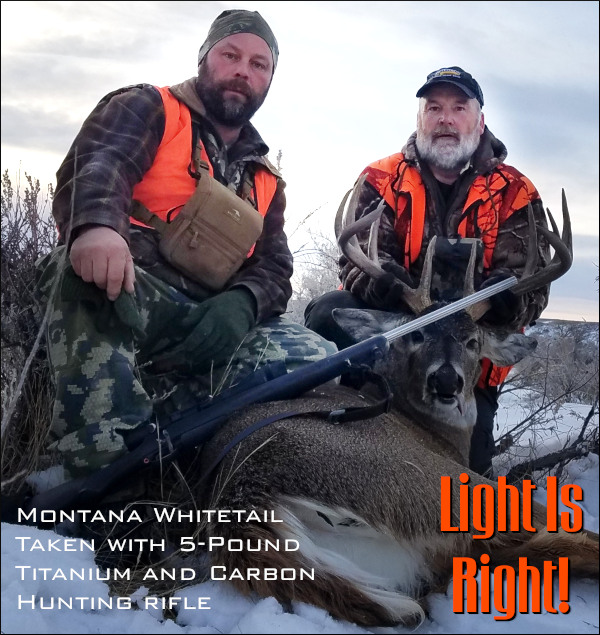


 Q: Why did you choose to build this rig?


