Ever wonder how rifles, actions, stocks, optics, suppressors, and ammo components are produced in factories around the world? Today’s Saturday at the Movies installment features fascinating videos filmed inside major firearms industry factories including BAT Machine, ZEISS, Norma, SAKO, Nosler, CCI and Federal.
BAT Custom Rifle Actions — Factory Tour and Owner Interview
BAT Machine Co. makes some of the finest custom actions you can buy. Numerous national and world records have been set with BAT actions. To create this video, Ultimate Reloader’s Gavin Gear visited the BAT Machine production center in Post Falls, Idaho. Gavin talked with BAT’s founder Bruce Thom. The video features extensive footage of advanced CNC machines used to produce the superb BAT actions. If you own a BAT action, or hope to acquire one some day, definitely watch this video. CLICK HERE for Full Story.
Norma Ammunition Factory — Cartridge Creation Start to Finish
Norma has released a fascinating video showing how bullet, brass, and ammunition are produced at the Norma Precision AB factory which first opened in 1902. You can see how cartridges are made starting with brass disks, then formed into shape through a series of processes, including “hitting [the cup] with a 30-ton hammer”. After annealing (shown at 0:08″), samples from every batch of brass are analyzed (at multiple points along the case length) to check metal grain structure and hardness. Before packing, each case is visually inspected by a factory worker.
The video also shows how bullets are made from jackets and lead cores. Finally, you can watch the loading machines that fill cases with powder, seat the bullets, and then transport loaded rounds to the packing system. Guys, watch this video! You won’t be disappointed. The camera work and editing are excellent — there are many close-ups revealing key processes such as annealing and head-stamping.
SAKO Factory Tour in Finland
SAKO produces some of the best hunting rifles you can buy. SAKO, along with its sister company Tikka, operates sophisticated production facilities in Finland. In the video below, Canadian journalists visit the SAKO factory where rifles are made. It is interesting to see how stocks are made and barrels are bored and contoured. SEE More HERE.
Nosler Bullet Manufacturing
Ever wanted to see how Nosler bullets and cartridges are made? Here’s your opportunity. The Rocky Mountain Elk Foundation (RMEF) has produced a video (“Quality First”) that offers a behind-the-scenes look inside Nosler’s Oregon factory that produces bullets, brass, and ammunition. RMEF representatives visited Nosler’s famously-guarded manufacturing plant to show the technology used by Nosler to produce bullets and ammunition. After the intro, this video illustrates Nosler’s bullet construction techniques with a cool animation sequence. The video then showcases the Nosler ballistics lab, inspection room, and packaging line. SEE more HERE.
Video Showcases Nosler Production Facility and Ballistics Lab
ZEISS Sport Optics
ZEISS is a world leader in lens and optics technology. Along with ultra-high quality lenses used in production of computer chips and special optics for high-tech medical equipment, ZEISS produces great optics for hunters and shooters. ZEISS lenses are renowned for their sharpness, clarity, and high light transmission. ZEISS has a new series of LRP S3 and LRP S5 First Focal Plane scopes which promise to be favorites among PRS/NRL competitors and long-range hunters.
Silencerco Suppressor Fabrication Start to Finish
Here’s a cool video that shows the entire production process for a SilencerCo Octane pistol suppressor start to finish. Beginning with the raw materials, this video shows a wide variety of cutting, milling, drilling, burnishing, fitting, metal bathing, surface finishing, and laser etching processes. If you have any interest in production methods you’ll want to watch this video all the way through, and maybe a second time.
Rimfire Ammo Production at CCI/Speer and Federal Factories
YouTube host 22Plinkster got a chance to tour the CCI/Speer production facility in Lewiston, Idaho. This large plant produces both rimfire and centerfire ammunition. While touring the plant, 22Plinkster was allowed to capture video showing the creation of .22 LR rounds from start to finish. This is a fascinating video, well worth watching.
This revealing video shows all phases of .22 LR ammo production including cupping, drawing, annealing, washing, drying, head-stamping, priming, powder charging, bullet seating, crimping, waxing, inspection, and final packaging.
Field & Stream Tours Federal Ammo Plant in Minnesota
A while back Field & Stream toured the Federal ammunition production facility in Anoka, Minnesota. This large plant produces both rimfire and centerfire ammunition. While touring the plant, the reporter was allowed to capture video showing the creation of .22 LR rounds from start to finish. This is a fascinating video, well worth watching. Click speaker icon for sound.
Note to Viewers — After Starting Video, Click Speaker Icon to HEAR audio!
The Manufacturing Process for .22 LR Rimfire Ammunition Shooting Sports USA explains: “Rimfire cartridge cases are the oldest self-contained cartridge in existence, having been in continuous production since the mid-1850s. Rimfire cases are drawn from a thin piece of brass and formed with a hollow rim. A priming compound is then forced into the case using centrifugal force, where it is charged with powder and a bullet is seated in the mouth of the case. The case is then crimped around the bullet to ensure sufficient push and pull when the round is fired. When the firing pin strikes the thin brass rim of the case, the hollow rim is crushed and the primer is ignited.” Source: SSUSA.org 9/2/2017.
Our friend Robert Whitley of ARX Enterprises LLC has learned, through careful measurement and testing, that some barrels threaded 5/8″ x 24 TPI at the muzzle may not deliver optimal accuracy. The reason is that the end of the barrel can bell out slightly, like a trombone, because too much steel has been removed. This is particularly true with .30-caliber barrels, but it can also be a problem with smaller caliber barrels (even 6mm). Robert demonstrates this phenomenon in the video below. All gunsmiths, and anyone considering threading a barrel, should watch the video. At 1:00 – 1:30 Robert gauges a 5/8″ x 24-threaded .30-Caliber barrel. You can see the belling effect clear as day.
“When setting up a commercial barrel in the lathe, we noticed that the maximum-sized bushing that would fit in the bore at the chamber end was almost .0015” smaller [than what would fit] at the muzzle. That precipitated my pin-gauging of a number of different commercial barrels that were threaded for 5/8” x 24 TPI. What I found is what’s shown on the video.” – R. Whitley
Solve Problem with a Larger Thread Diameter
If 5/8″ x 24 threading is potentially harmful to accuracy, is there a solution? Yes, you simply need to leave a little more steel on the barrel. (See Video starting at 02:40.) Frank Green of Bartlein barrels states: “We get these questions all the time. I say run the largest thread diameter that is possible.” Robert Whitley has found that a 3/4″ x 28 TPI threading does not cause the “belling effect”. Accordingly Robert recommends 3/4″ x 28 if you need to thread your barrel for a muzzle brake or suppressor. Robert explains: “We only make 3/4” x 28 TPI muzzle brakes and that’s what we recommend to customers.”
“See how much meatier the 3/4″ threading is vs. the 5/8″. The 3/4″ threading offers a lot more metal around the bore. There’s a lot less opportunity for the bore to become bell-mouthed…” – Robert Whitley
Barrel Threading Diameter — What’s Important to Know
By Robert Whitley
In truth, the 5/8″ x 24 TPI threading never came out of any accuracy-based think tank or set-up, it’s a military .30-Cal threading for barrels that someone has to carry around (they needed to keep the barrel weight down so it was smaller in diameter and the threading had to work with that situation). People have somehow assumed because the military uses that threading for certain things that it must mean that it’s also fine for a highly accurate rifle too, but that’s not really correct.
I don’t think there is any better and realistic option than the 3/4″ muzzle threading, and we also do it so there is no relief cut behind the threads on the barrel (i.e. put the relief cut on the brake or jam nut, don’t chop down on the muzzle of the barrel). For some reason many have a hard time grasping that the metal at the muzzle end of a rifle is “sacred” and you should not cut it down any more than absolutely necessary. A little threaded pencil diameter nub on the end of a barrel is not ideal for accuracy especially if it’s threaded and you need to torque on it. I cringe when I see a barrel with something like an MTU or Heavy Varmint contour, only to have an itty-bitty pencil thin threaded nub right at the muzzle so someone can “screw on a can” or a muzzle brake.
Lessons Learned Over the Years
A number of years ago I did a 30BR rifle project with Craig Kostyshyn who was big in the 30BR game and he made some of the best 30BR rifle barrels for benchrest competition. When I did the project I wanted a medium-heavy Palma type contour barrel I could use and also have a muzzle turndown for a front sight band. When he found out I was going to have the muzzle turned down he said “whoa, I need to provide for that when I make the barrel because if you turn the front down later you’ll be shooting a trombone” (i.e. the muzzle bore dimension would open up).
What he did was rough contour the barrel with the turndown (about .010” oversize) before he lapped the barrel, then when he lapped the barrel he took it easy in the muzzle area and worked the back of the barrel more. I thought he was a little bit excessive in his concerns but the barrel shot great and I wasn’t going to argue with him, after all he was shooting groups in the ones. I kind of just filed that away and never thought about it until recently when I went to have Fred from Sabreco do some chamber re-work on a commercial .30-caliber barrel I had. When setting up the barrel in the lathe and indicating things Fred noticed that the maximum-sized bushing that would fit in the bore at the chamber end was almost .0015″ smaller [than what would fit] at the muzzle and he mentioned it to me. That precipitated my pin-gauging of a number of different commercial barrels I had that were threaded for 5/8” x 24 TPI. What I found is what’s shown on the video.
NOTE: This is a copyrighted article. Do not reproduce or re-link more than 75 words without written permission from AccurateShooter.com.
Today, AR-platform rifles are hugely popular. Dozens of manufacturers sell AR-type rifles, in a wide variety of configurations and calibers. But before there were M16s and AR-15s, ArmaLite produced a 7.62×51 caliber rifle, the AR-10. Yes before there were millions of 5.56 black rifles, there was a .30-caliber big brother with reddish-brown furniture. Invented by Eugene (‘Gene’) Stoner for the Armalite company in the late 1950s, this is the father of all of today’s AR-platform rifles. Way ahead of its time, this remarkable, select-fire battle rifle weighed just 7.25 pounds as first developed.
If you’re curious about the AR-10, in this video, Jerry Miculek puts an original 1957-vintage AR-10 through its paces on the range. This extremely rare, early-production rifle was provided by Mr. Reed Knight and the Institute of Military Technology. (The gun in the video was actually produced in the Netherlands under license, see video at 4:40.) This AR-10 is the direct ancestor of the AR-15, M16, and many of the modern sporting rifles that we use today.
The AR-10 was slim and light, weighing around 7 pounds. Some folks might argue that the original “old-school” AR-10 is actually better than some of today’s heavy, gadget-laden ARs. The AR-10’s charging “lever” was under the carry handle — that made it easier to manipulate with the gun raised in a firing position.
You’ll notice there is no “forward assist”. Inventor Gene Stoner did not believe a separate “bolt-pusher” was necessary. The forward assist was added to solve problems encountered in Viet Nam. Some critics say the forward assist “only takes a small problem and makes it a big problem.” For today’s competition ARs (that are never dragged through the mud) the forward assist probably is superfluous. It is rarely if ever needed.
Note also that the handguards are fairly slim and tapered. Today, six decades after the first AR-10 prototypes, we are now seeing these kind of slim handguards (made from aluminum or lightweight composites) used on “full race” ARs campaigned in 3-gun competition.
History of the AR-10
The AR-10 is a 7.62 mm battle rifle developed by Eugene Stoner in the late 1950s at ArmaLite, then a division of the Fairchild Aircraft Corporation. When first introduced in 1956, the AR-10 used an innovative straight-line barrel/stock design with phenolic composite and forged alloy parts resulting in a small arm significantly easier to control in automatic fire and over one pound lighter than other infantry rifles of the day. Over its production life, the original AR-10 was built in relatively small numbers, with fewer than 9,900 rifles assembled.
In 1957, the basic AR-10 design was substantially modified by ArmaLite to accommodate the .223 Remington cartridge, and given the designation AR-15. ArmaLite licensed the AR-10 and AR-15 designs to Colt Firearms. The AR-15 eventually became the M16 rifle.
AR-10 3D Model Shows Internal Parts
If you want to see more close-up details of the AR-10, computer artist Stefan Engdahl has created a very detailed 3D model of the AR-10 for use in computer simulations. This computer model features 18 separate objects so you can look at details of frame, barrel, trigger, sights and more.
Here are some additional images of early AR-10 models, with various configurations. Multiple handguard and muzzle options were employed during early development.
Color AR-10 photos from Arms Izarra, a Spanish company specializing in de-militarized, collectible firearms. Interestingly, this particular AR-10 was produced in the Netherlands under license.
A while back, the Precision Rifle Blog conducted a fascinating study of Muzzle Brakes. PRB figured out a way to show the actual “blast pattern” of gasses ejecting from the ports of muzzle brakes. The result was a fascinating (and eye-catching) series of images revealing the distinctive gas outflows of 20+ different types of muzzle brakes. If you are considering buying and installing a muzzle brake on your rifle, you should definitely review this important PRB Muzzle Brake Test.
For a prone shooter, particularly on dusty, dirty or sandy ground, muzzle blast is a major bummer. Muzzle blast can be very disturbing — not just for the trigger-puller but for persons on either side of the gun as well. Some muzzle brakes send a huge shockwave back towards the shooter, and others send blast towards the ground, kicking dirt and debris into the prone shooter’s face. If there was a way to illustrate those factors — shockwave and debris — that might help shooters select one brake design over another.
Cal Zant at PrecisionRifleBlog.com applied a unique blend of creativity and resourcefulness to try to answer that question for 20+ muzzle brakes. Using high-speed photography and household products, he captured the blast pattern of 20+ different brake designs for easy side-by-side comparison. Can you figure out how Cal managed to show muzzle brake blasts so clearly? His “hi-viz” solution, revealed in the article, is very clever. See the eye-opening results for 20+ brakes, with illustrative photos, by visiting the Precision Rifle Blog Muzzle Brake Ground Signature Test Page.
409,000,000 views! Today’s five feature videos have, collectively, been viewed 372 million times on YouTube. Today’s Saturday special features five remarkable animated firearms videos from Matt Rittman, a very talented computer graphic artist. Matt employs multiple software programs to create these incredibly detailed animations. His software tools of the trade include Cinema 4D, Substance Painter, and Corona renderer. Don’t think this is easy. Some of these videos took over 500 man-hours to create. Enjoy!
AR-15 Full Animation — Components and Function
While there are other AR-15 animations on YouTube, we think this is the most accurate and creative, showing the function of a wide variety of components, including the bolt carrier, extractor, trigger, stock buffer, safety system, forward assist, and mag release. It also shows modes of a military M16, showing 3-round burst fire, and full-auto, employing disconnectors and auto sear. If you are planning to assemble/disassemble an AR, this is definitely worth watching start to finish. This video has recorded over 2 million views in just three weeks!
4:00 Auto Fire
4:58 Burst Fire
6:22 Bolt Catch
6:40 Sights
7:33 Adjustable Stock
7:50 Ejection Port Cover
Mauser Kar-98K Bolt Action Rifle video
This elaborate 3D animation shows how a Mauser-type Karabiner 98 Kurz (aka Kar-98K) bolt-action rifle works. Substance Painter was used to create the wood stock texture. Creator Matt Rittman states that this 3.7 minute video took over 500 man-hours to create. You have to admire the dedication involved in that kind of hard work.
This 3D animation video shows the popular Glock 19 (Gen 4) pistol. This modern, polymer-framed, striker-fired pistol has constant trigger pull for all shots. Some folks call this a DAO (double-action-only) trigger but that’s not really correct. Unlike the Model 1911, on a Glock there is no external safety on the frame or slide. The trigger “shoe” (the part that contacts finger) includes a central blade. This prevents the gun from firing unless the trigger is depresses normally. Glock calls this the “safe action”. The creator, Matt Rittman states: “Cinema 4D was used to create each individual part, as well as animating everything. Substance Painter was used to create the main textures. Corona renderer was used to render everything. This animation [with 84.6 million views] took me over 500 hours to create.”
Elements of Video:
0:11 Basic Function
0:39 Case Extraction
0:47 Cartridge Loading
1:02 Trigger Reset
1:28 Trigger Safety
Pump shotguns are essential firearms for hunting and home defense. The clever design of pump-action shotguns make them reliable even when feeding large diameter, blunt-ended 12 gauge shot-shells.
With 233 million views, this AK-47 video might just be the most-watched firearms tech video on YouTube. The video highlights the design features the account for the AK’s legendary reliability. For viewers with an eye to detail Matt adds this clarification: “The firing pin does NOT puncture the bullet primer. It just strikes it against the anvil, initiating the firing sequence.”
As a Labor Day Weekend bonus for our readers, we thought we’d celebrate the beauty of highly-figured wood with a collection of custom rifles. In our Shooters’ Forum, there is a long-running Gun Glamour thread that showcases many beautiful wood-stocked rifles. Today we feature some very handsome rifles from that Forum Thread as well as other rifles we’ve featured in the Daily Bulletin.
Two F-Open Beauties with Walnut Laminates
Cerus-stocked Special from Cigarcop
Forum member Keith W. (aka “Cigarcop”) of KW Precision LLC is a talented riflesmith whose projects display outstanding finish work and attention to detail. Keith does some of the best bedding work we’ve ever seen. Back in 2018, Keith built a stunning .284 Win F-Class rig for a shooter in Delaware. It’s a beauty, that’s for sure.
Check out the stunning Cerus F-Open stock. This features multiple laminations with highly-figured Walnut on the sides. This certainly ain’t your “off-the-shelf” laminated stock. This just shows the beauty that can be achieved with carefully-chosen lamination layers (plus 12 coats of clear).
This beautiful F-Open rig features a laminated wood stock with stunning figured walnut on the outside.
A Beauty for the Boss (of Grizzly.com)
This F-Class rifle belongs to Shiraz Balolia, Chairman/CEO of Grizzly Industrial. Shiraz finished the stock himself: “I installed the bottom wider track for my rear bag and also carved out the finger grooves in the grip. The blank was quite long so I cut off approximately two inches from the front end of each stock and also deepened the large tracking cavity under the fore-end. I went ahead and inlaid my name in Mother-of-Pearl on the Walnut stock.” The stock was then sent to Sims Guitar Finishing for clear coating with “wet look” finish. This rifle is chambered for the .300 Shiraz wildcat, an improved .300 WSM.
F-0pen Stock made of highly-figured Walnut with Curly Maple inner laminations.
Beautiful Rifles from our Forum Gun Glamour Thread
Here are a variety of handsome wood-stocked rifles from our Forum Gun Glamour thread. In that thread, member Kurz posted a dream gun owned by a friend in England. Kurz included a quote from a book created by the rifle’s owner: “There, with my father’s words ringing in my ears, I shall take that ‘step forward’ and order a perfect machine based on the Mauser ’98 action, built from metal and wood by master craftsmen who truly understand that ‘reliable’ and ‘mechanical integrity’ have as much relevance today as they did all those years ago.”
A gun can “shoot dots” and still be handsome. Here is a short-range benchrest rifle with a stunning, exhibition-grade Walnut stock. Forum member Josh B found this beauty.
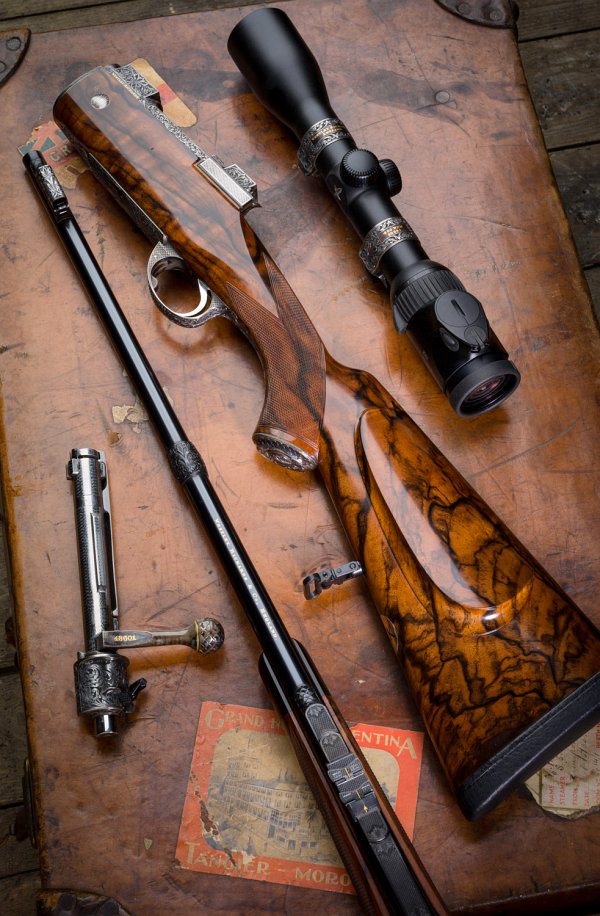
Forum member JRS submitted a stunner from Europe. This beauty features a truly exquisite piece of wood with elaborately engraved receiver. It also has escutcheons and special metal work on the grip.
Lever-action Falling Block rifles can be beautiful too. This one features a color case-hardened receiver and handsome two-piece fancy wood stock. This was submitted by Forum member Kurz who notes: “Besides exhibition grade walnut, I like the variations available in spalted maple for rifle stocks.”
Here is member Oldduc’s Stevens 44 1/2, .38-55 Black Powder Cartridge Rifle, with an extra .218 Mashburn Bee barrel. Very nice blueing along with the figured wood stocks and fore-arms.
A competition rifle must be “performance first”. But that doesn’t mean they can’t be handsome too. Forum member XTR’s rifle, an F-TR rig, features Maple wood with Bubinga tips.
Here is “something completely different” — a classic lever-activated Martini Martini Cadet chambered in .20 Vartarg (rimmed). Look at the figure on that fore-end. Remarkable!
And wood can work for Benchrest rifles too, when cleverly fashioned in thin carbon-reinforced laminates. Photo from member mdman352.
“Wood is Good” — as demonstrated by all the rifles showcased above. In the photo below, master stock-builder Doan Trevor handcrafts a highly-figured wood stock.
Credit our buddy Joe Friedrich for this simple yet effective accessory for your benchrest rifle. Joe shoots a .22 LR benchrest rig with a barrel tuner. When he added weights to his tuner, he found his rifle no longer balanced well. He wanted to add some weight in the rear without drilling holes in the stock. He also wanted the weight to be removable, and easily placed on another rifle in his stable. He wanted a weight that could be moved from gun to gun as needed.
At a local sporting goods shop Joe found a 1.5-lb ankle weight that comes in a padded, tubular elastic cover. It’s like a 1.5-lb sausage in a soft, stretchy nylon cover. (Imagine a really fat, heavy bungee cord). Joe simply attached a plastic zip tie at the end to make a loop that fits perfectly over his buttstock. CLICK HERE for full-screen photo.
To “tune” the rifle’s balance, Joe just slides the ankle weight fore and aft on the stock. We have tried this moveable ankle weight on a variety of different BR stocks (including a McMillan Edge) and it worked perfectly. This is a great invention, and would work with sporter rifles and ARs just as well.
NOTE: Obviously, this ring will increase the measured weight of your rifle. So, if you are competing in a registered match with weight restrictions, you have to ensure that your rifle still makes class weight limits with the ankle weight ring in place.
Today’s Saturday video showcase is a wheelgun extravaganza. We offer eight videos covering some of the most famous double-action revolvers in existence. Check out reviews of Colt, Smith & Wesson, Korth, Dan Wesson, Ruger, and other models, in a variety of chamberings, both centerfire and rimfire. We think every serious gun enthusiast should have at least two revolvers in his collection — one centerfire and one rimfire. This Editor owns a stainless, 10-shot .22 LR Smith & Wesson Model 617. It has probably shot more rounds than all my other pistols combined, and it is still performing flawlessly after 25 years.
Multiple Revolver Line-up: S&W, Colt, Ruger, Taurus, Dan Wesson, Chiappa, Charter Arms, Webley and More
This 12-minute video provides a quick introduction to eleven interesting wheelguns: Smith & Wesson Model 29 (00:22), Colt Python (1:22), Ruger GP100 (2:25), Taurus Model 66 (3:40), Smith & Wesson Model 686 (4:38), Charter Arms Bulldog (5:41), Chiappa Rhino (6:32), Webley Revolver (7:27), Dan Wesson 715 (8:21), H&R Model 929 (9:59), Taurus Judge Public Defender (10:52). NOTE: This video also includes a review of the Bersa .380 which is NOT a revolver, so the video title is a little misleading. There are 12 handguns, but only 11 revolvers.
Colt Python .357 Mag 1000-Round Test
How well do modern wheelguns hold up to extended use? This video provides an answer. Honest Outlaw’s testers put 1000 rounds through a new-generation Colt Python chambered for the legendary .357 Magnum round. The Python showed outstanding accuracy, and the tester praised the trigger. Testing was done indoors and outdoors, both rapid-fire and slow-fire. After a couple hundred rounds, the Python needed a thorough cleaning of cylinder and barrel, but otherwise the revolver performed really well.
Hickok45 Shoots the New Colt Anaconda in .44 Magnum
Hickok45 is a respected YouTube video reviewer. In this detailed 19.5-minute video, Hickok45 reviews and tests a new generation Colt Anaconda revolver, chambered for the powerful .44 Magnum cartridge. This Hickok45 review is one of the most popular wheelgun videos on YouTube, having logged over 1.4 million views in three years.
Colt King Cobra Target .22 LR Revolver
This TFB Showtime episode examines the new .22 LR rimfire Colt King Cobra Target. The King Cobra Target .22 LR features a 10-shot cylinder, and the same adjustable target sights as the .357 Magnum version.
At the NRA Annual Meetings in 2022, Colt Manufacturing introduced an impressive new rimfire revolver — the King Cobra Target .22 LR. Colt states: “From competition to plinking and small game hunting, this baby Cobra does it all and packs 10-rounds of .22 LR in its cylinder”. The King Cobra Target 22 LR is available with 4.25-inch and 6-inch barrel lengths, both with 1:16″ RH rifling twist. MSRP is $999.00.
The Massive Smith & Wesson 500 Magnum X-Frame
If bigger is better, then a Smith & Wesson 500 Magnum should be in your collection. This jumbo-size wheelgun shoots a huge 50-caliber cartridge, the .500 S&W Magnum. Even with compensator slots on the end of the barrel, the recoil is massive — enough so that we would NOT recommend this big revolver to novice shooters.
In 2003 the engineers at Smith & Wesson wanted to deliver maximum power for serious handgun hunters. The power they sought required an entirely new frame, the massive “X-Frame”. That became the basis for the new Model S&W 500, the most powerful production revolver in the world.
Colt vs. Smith & Wesson
Here’s a pretty informative video, with two qualified experts, Bill Wilson and Ken Hackathorn. This covers the basic differences between Smith & Wesson and Colt revolvers. This video explores the classic “Ford vs. Chevy debate” of the revolver world. Both S&W and the Colt revolvers have their die hard loyalists. In this episode, the Gun Guys weigh the merits of Bill’s Colt Shooting Master and Ken’s S&W Registered Magnum.
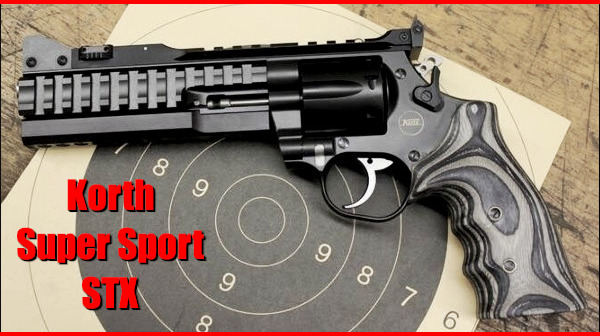
Korth Super Sport STX Revolver — $4,393.00 Wheelgun
Germany’s Korth Arms makes some of the best revolvers on the planet. Korth’s machining tolerances are second to none. The triggers are superb and the accuracy is excellent. At the 2022 IWA Outdoor Classics Expo, Korth featured a “badass” black heavy-barreled wheelgun, the Super Sport STX Revolver. This features a full-length scope rail and slab sides, for use in Bianchi Cup-type competitions.
Korth states: “In addition to the National Standard Super Sport STX, we present the weight-reduced ALX version. Both weapon types are equipped with a 4-position rear sight”. You’ll need serious bucks to buy a Korth Super Sport STX. Currently the 8-shot STX model in .357 Magnum sells for €4,077.00 Euros (about $4,393.00 U.S.). Below are a trio of blued Korth revolvers:
Smith & Wesson Model 648 in .22 WMR
We love Smith & Wesson rimfire revolvers. We have put thousands of rounds through S&W Model 617 revolvers, with 4″ and 6″ barrels. These stainless .22 LR handguns are accurate, superbly reliable, and they hold their value. In general we’ve found that Smith & Wesson rimfire revolvers may be less fussy with ammo, and more trouble-free than typical semi-auto rimfires. Bottom line, we feel that everyone should have an S&W rimfire wheelgun in their collection.
Along with its .22 LR wheelguns, S&W now offers another very impressive Rimfire Revolver option — the “revived” Model 648 in .22 WMR (Winchester Magnum Rimfire). This stainless Model 648 brings a more powerful cartridge to S&W rimfire revolver fans.
Competition Note:This past week the 2024 F-Class National Championships have been running in Lodi, Wisconsin with competition in both F-Open and F-TR divisions. F-TR is shot with a bipod and cartridge types are limited to .223 Rem (5.56 NATO) and .308 Win (7.62×51). The 2024 Mid-Range Championship ran August 10-13 while the 2024 Long-Range Championship ran August 14-17, concluding late yesterday. CLICK HERE for 2024 Championship Results.* We will soon have a full report on the 2024 event, but for today’s Sunday GunDay story, we look back at a Mid-Range winning F-TR rifle from a few years back.
Story based on Report by Bryan Blake, Blake Machine Company
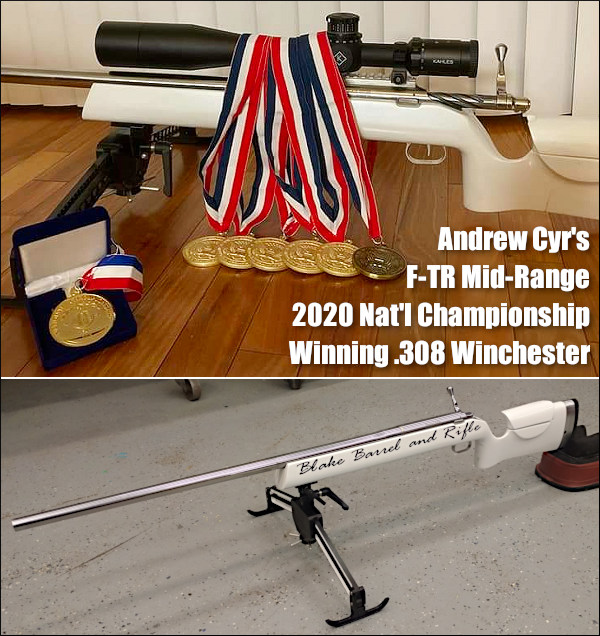
Here’s the gold medal-winning .308 Win rifle of the 2020 F-TR National Mid-Range Champion, Andy Cyr. Arizona native Cyr won the F-TR Mid-Range Championship with an impressive score of 1761-72X out of a possible 1800 points. At this three-day Mid-Range event at Ben Avery in Phoenix, all 180 rounds were shot at 600 yards. Andrew delivered a convincing victory, winning by NINE points over runner-up James Crofts, a past national champion himself. We congratulate Andrew on his impressive win. And today’s Sunday GunDay feature examines the details of Andrew’s impressive .308 Win F-TR rifle.
Cyr Overcame Incredibly Tough Conditions at Ben Avery
After Day One of the Mid-Range Nationals, Andy was in 5th place. Andy made up some serious ground on the next two days despite winds that were well into the 20 MPH+ range. In fact, many experienced shooters took misses (not hitting the scoring ring) because the winds were so fierce. Interestingly, Andy’s 1761-72X score beat all but eight F-Open shooters.
Andrew Cyr’s .308 Win F-TR rifle during load development and accuracy testing.
F-TR Mid-Range Championship-Winning .308 Win Rifle Specifications:
Blake Barrel and Rifle 32″ .30 Caliber, 1:11″-twist barrel with custom specs
McMillan XIT Stock (lightened with ports on butt area)
Borden BRM Action
Kahles K1050 10-50x56mm Scope
Phoenix Bipod with F-Class Products lowering kit and skeleton legs
Andrew Cyr’s Championship-winning F-TR rifle was built by Phoenix-based Blake Barrel and Rifle (BBR) in 2018. Interestingly, this rifle was originally built for Andy’s daughter Jessica. The rifle was used by Andy a few months later. The rifle features a severely-lightened XIT stock with the grip smoothed out. Andy was actually the first customer of Blake Barrel and Rifle back in 2018. He has always been willing to try out new rifling profiles, twist rates, and barrel configurations as recommended by BBR.
Bryan Blake tells us: “Many customers demand exact specs and there is no way of changing their mind, even if it is factual-based. With Andy he was always willing to try new things, some things didn’t work well, but some things worked very well, just like the barrel used to win the Nationals.” Andy preferred a heavier barrel in the chamber area than most TR shooters. The shank diameter is 1.350″ rather than 1.250″. What this does is keep as much material around the chamber, which is the hottest area of the barrel. That way the barrel is less affected by heat over a string of fire, since the heat can be dissipated into a larger area.
Andy used a 32″ barrel, a length not commonly used in F-TR anymore. Most are running 30″ or even 28″ now. Many folks think a shorter barrel is more accurate so these competitors do not use a 32″ barrel. Well as you can see by his results, Andrew’s 32″ tube shot great. The extra length was NOT a handicap. We should remember that longer barrels can normally produce higher velocities than shorter barrels or deliver equivalent speeds with less pressure.
Many people also believe that a 1:9-10″ twist is needed to shoot 200-grain class bullets out of a .308 Win accurately. However, Andy took the advice of Blake Barrel and Rifle, and went with a 1:11″-twist Blake cut-rifled barrel. Many would say this twist is too slow, and some online calculators say a 1:11″-twist won’t fully stabilize 200-grain bullets. Obviously this is also not the case. Andy’s 11-twist and Berger 200-grain Hybrid bullets (NOT 200.20X bullets) work very well with this combination. NOTE: Andy uses an F-Class Products barrel tuner to tune his load. He will sometimes even alter tune between relays to compensate for changing barometric conditions.
Winning .308 Win Load — Lapua Palma Brass, VV N550, CCI 450s, Berger 200gr Hybrids
Andy Cyr took the Mid-Range title loading Vihtavuori N150 powder, CCI 450 primers, Berger 200gr Hybrids, and Lapua .308 Win Palma brass. Andy does not push his bullets very fast and finds a big accuracy node at the mid-2600 FPS range. He jumps his bullets .015″ off the lands. One thing Andy consistently does is test, test, test. He will test different powders, charge weights, seating depths nearly every time he is at the range. He will shoot a different load for each string to see what works best.
Profile of 2020 F-TR Mid-Range National Champion — Andrew Cyr
Father and Daughter Compete Together
Andy started shooting F-Class in 2012 to help him shoot better in the PRS series. He hoped to learn to read the wind better and get more experience in long-range shooting in general. After shooting F-Class he was hooked and found he enjoyed it more than PRS. Andy and his daughter Jessica have shot many state matches together, with both of them shooting F-TR. Jessica owned the Mid-Range 20-shot woman’s Aggregate record for years with a score of 200-11X. Interestingly Andy shot his very first clean at 1000 yards at the Nationals in Raton, NM in 2018 with a score of 200-11X also. This year Andy started using a spotting scope to help read mirage and it has helped him tremendously he reports.
The “Master” Beat the “High Masters”
Andy is currently classified in Mid-Range as a Master for F-Class, not yet High Master. Even after winning the F-Class Mid-Range Nationals, the most prestigious F-Class match of the year, he is still classified as a Master. Andy’s 1761-72X score works out to 97.8% of a perfect 1800. But the requirement for F-Class High Master is 98%. That just shows you how tough the conditions were at Ben Avery this year. But still the Master beat ALL the High Masters — if you look at the score sheet above, all the other Top 10 F-TR competitors were High Masters. Impressive. And we believe Andy is the first Arizona resident to ever win a national F-Class Championship in either F-Open or F-TR.
About Blake Barrel and Rifle Blake Barrel and Rifle (BBR) has been in business since 2018. BBR built the rifle that Brian Bowling used to win the 2019 F-Open National Championship. And now another ultra-accurate BBR-built rifle has won the 2020 F-TR Mid-Range Championship. Bryan Blake tells us that Blake Barrel and Rifle has recently upgraded BBR’s rifle barrel building equipment. There are advanced CNC lapping machines, CNC bore-honing machines, and all-new, proprietary rifling cutter designs that no one else in the barrel business uses.
Blake Barrel and Rifle produces cut-rifled, 6-groove barrels with a unique rifling profile no other barrel manufacturer is using. Blake barrels have an impressive winning record in recent major competitions — earning National Championships, plus many match wins and podium performances. Bryan Blake tells us that “The time and quality control spend on Blake barrels is second to none and the proof in the results.” For more information, visit Blakebarrel.com.
* We believe that Alan Kulcak won 2024 Long-Range F-Open while Randy Littleton won 2024 Long-Range F-TR Division. We believe Johnny Ingram is the 2024 Mid-Range Champ in F-Open and Tom Hubbard won the 2024 Mid-Range F-TR title.
AR owners know that their black rifles require regular cleaning and maintenance. And this modular platform allows many options for stocks, fore-arms, and optics mounting. That ability to customize is one of the AR’s major attractions, but customization requires solid understanding of the AR’s design and components.
To help AR owners optimize and maintain their rifles, Gun Digest Media has a 320-page illustrated book: AR-15 Setup, Maintenance and Repair. Authored by Patrick Sweeney, this paperback book is a “one-stop guide to repairing, maintaining and modifying America’s favorite rifle.” The current price for the book is $29.99 from Gun Digest, or $32.34 on Amazon. Gun Digest also offers a $29.99 Digital Download version.
GET FREE 40-Page AR-15 Book Sample
Note, if you are interested in the book, there is a substantial 40+ page FREE sample available on the Amazon site. You can see the entirety of the first two chapters from the Kindle digital version. CLICK HERE to visit Amazon.com and then click on the button labeled “Read Sample” below the cover image.
AR Set-Up and Maintenance
If you need to disassemble and maintain your AR rifle, swap barrels or handguards, add optics, or customize the stock, Gun Digest’s AR-15 Setup, Maintenance and Repair book tells you what you need to know. From field-stripping to barrel mounting and trigger installations, the book covers a wide range of topics. The book provides step-by-step instructions for set-up and maintenance, with hundreds of detailed photos. The book also includes AR gunsmithing chapters with reviews of recommended tools.
Author Patrick Sweeney is a certified master gunsmith and armorer instructor for police departments. Sweeney has also authored the notable 4-volume Gunsmithing the AR-15 series (Vol. 1, Vol. 2, Vol. 3, and Vol. 4) and 20+ other titles for Gun Digest Books.
Whether you want to learn about disassembling your AR for regular maintenance, field-stripping, swapping out parts, adding optics or customizing a stock, AR-15 Setup, Maintenance and Repair guides you through everything you need to know to keep your AR-platform rifle running well. There are also tips on how to improve accuracy, and maintain your bolt carrier group properly.
Authored by Patrick Sweeney
Published by Gun Digest Books
ISBN-13: 978-1951115470
320 pages, softcover, 8 ¼ x 10 7/8 inches
Editor’s NOTE: The key to keeping an AR running reliably is proper lubrication (in the RIGHT places), and regular cleaning of the bolt carrier and bolt, including ejector recess and extractor recess. The majority of non-functioning ARs we’ve seen had gunk, lube, carbon, and brass shavings in those recesses.
Other AR Books by Patrick Sweeney
Bonus Video — AR15 Maintenance with Jerry Miculek
In this helpful video, legendary shooting Jerry Miculek explains how he cleans and maintains his AR-platform rifles. Miculek shoots ARs in three-gun competitions.


 Norma has released a fascinating video showing how bullet, brass, and ammunition are produced at the Norma Precision AB factory which first opened in 1902. You can see how cartridges are made starting with brass disks, then formed into shape through a series of processes, including “hitting [the cup] with a 30-ton hammer”. After annealing (shown at 0:08″), samples from every batch of brass are analyzed (at multiple points along the case length) to check metal grain structure and hardness. Before packing, each case is visually inspected by a factory worker.







 Credit our buddy Joe Friedrich for this simple yet effective accessory for your benchrest rifle. Joe shoots a .22 LR benchrest rig with a barrel tuner. When he added weights to his tuner, he found his rifle no longer balanced well. He wanted to add some weight in the rear without drilling holes in the stock. He also wanted the weight to be removable, and easily placed on another rifle in his stable. He wanted a weight that could be moved from gun to gun as needed.


 If bigger is better, then a