Brownells just made it easier to get product questions answered, and to find the items you want on the Brownells website at Brownells.com. Customers can now consult live with a Brownells Gun Guru Product Expert. In addition to giving product advice, the Gun Gurus can help customers with account issues, give information about previous orders, and handle most customer concerns.
Starting Monday, September 9, customers can click on the CHAT icon at the top of the website to be connected with a Gun Guru Product Expert.
Pop-Up Gun Guru Chat Window
There is also a floating chat button on the right side of the page (see photo at right). And, after 30 seconds or so a Gun Guru invitation window will pop up. NOTE: We found that if you click on the CHAT icon at the top of the page you must fill in your name and address. However, if you respond to the floating pop-up Chat Window you do NOT have to enter name and email. We think it’s easier to just use the pop-up window.
Gun Guru Product Expert Chat is available on Brownells.com Monday through Friday, 7:30 am until midnight (CT), and on weekends 8:00 am until 5:00 pm (CT).
When you start a chat, a chat window opens with a small photo of the Gun Guru. This person will be either a Brownells Gun Tech (an actual trained gunsmith) or a vetted firearms enthusiast who can offer advice on product categories for which they are most familiar.
“The mission of the Gun Guru Product Experts will be to help educate customers on products and give recommendations, so customers can make informed decisions,” said Ted Somers, Brownells Director of Customer Experience.
Telephone Customer Service is Still Available at 1-800-741-0015
While Brownells Gun Techs will participate in Gun Guru Product Expert chat online, customers with more technical questions can still call 1-800-741-0015 and ask to speak with a Brownells Gun Tech during regular business hours.
Trigger images from PrimaryArms.com, which sells all the triggers reviewed here: Geissele, Elftmann, Timney, and ALG Defense.
Are you thinking of upgrading the trigger system for your AR-platform rifle? There are dozens of options available, from $45 up to $300. Thankfully, Brownells has created video reviews of some of the more popular AR trigger options from Timney, Geissele, and ALG Defense. And we included a video review of the highly-regarded Elftmann Match Trigger. If you want the best solution for Service Rifle competition, you might favor the Geissele. For ease of installation, it’s hard to beat the Timney, a “drop-in” module. Like the Timney, the super-smooth Elftman is a drop-in module. At $249.00 it’s pricey, but it is one of the best AR triggers out there. If you’re on a tight budget, the best “bang for your buck” may be the “Perfected Mil-Spec” ALG which starts at around $45.00.
Multiple AR Triggers, including the Elftmann and Geissele, Are Reviewed in this Video
Though pricey ($249.00 at PrimaryArms.com), we really like the Elftmann AR trigger. It combines the best of both worlds — the precision and smoothness of the Geissele with the Timney’s ease of installation. This single stage trigger is user-adjustable from 2.75 to 4 pounds pull weight. It is offered with either straight or curved trigger blade. Primary Arms says: “The amazingly short take-up, glass-rod crisp break and [near-zero] over-travel can be compared to the finest custom 1911 triggers.”
Geissele Enhanced Two-Stage Trigger
Geissele makes a variety of quality AR trigger sets both single-stage and two-stage. Many High Power competitors like the two-stage Geissele trigger. This delivers a repeatable, controlled pull through the first stage with a very clean break in the second stage. The Super Dynamic Enhanced Trigger, shown above, features a distinctive, trigger blade. Reviewer Thomas Conroy says: “The flat surface is very easy to press against. Both stages are light and very distinct.”
Timney Drop-In Trigger Module
This trigger module is available for both the AR15 and the AR10 platform (see above video). Timney triggers are easy to install and come with multiple pin size and pull-weight options. Reviewer Thomas Conroy confirms that the single-stage Timney “breaks cleanly and crisply. This trigger is modular, meaning that the trigger, sear, hammer, and spring are all encased in a bright, shiny yellow aluminum housing.”
ALG Defense Trigger — Higher-Quality Basic AR Trigger
According to Thomas Conroy, ALG triggers “are the perfected version of the standard, non-adjustable mil-spec original trigger. They have the same geometry, but are made to higher quality standards, and come with … hardened and smoothed-out sear contact surface to eliminate all grittiness.” These are also offered in a nickle-boron coated version. Available for under $45.00, the ALG is a well-made, low-cost option for shooters who want a better factory-type trigger system.
For More Information about These Triggers
Learn more about Geissele, Timney and ALG triggers, plus two more AR trigger options (CMMG and Rock River Arms) in a Trigger Comparison Review by Thomas Conroy on Ammoland.com.
A couple seasons back, Bill did a fascinating barrel cut-down test on a .338 Lapua Magnum rifle. Bill, a skilled gunsmith who runs 782 Custom Gunworks, cut down the barrel from 30″ to 17″ in one-inch increments. During the cut-down process, Marr measured velocities at each barrel length, shooting four rounds after each cut. As you’d expect, there was a huge change in velocity from long to short. Speeds were measured at the muzzle with a Magnetospeed barrel-mounted chronograph.
If you’re looking for max velocity with the .338 LM, go long. With 250-grain Sierra MK bullets, the peak velocity Bill measured was 2942 FPS at the full, 30-inch length. This decreased pretty steadily down to 2547 GPS at the shortest 17″ length. That’s an average decrease of 30.4 FPS per inch from 30″ to 17″.
Bill also tested 300-grain Sierra MatchKings. This is interesting because Randy Wise ran 300-grain bullets (Berger Hybrids) in a 26″ factory barrel for his ELR record. Peak velocity was 2833 FPS at 30″, 2799 FPS at 26″, and 2492 FPS at the shortest 17″ length. Interestingly, velocity at 29″ was higher than at 30″ for the 300-grainers. Bill notes: “The 300 SMK load showed a slight increase from 30 to 29″. I’ve recorded this in other tests and it seems to be more common with a heavier load. I suspect it is primarily due to the small sample sizes being used along with the relative proximity of muzzle velocities in adjacent lengths.”
At each new (shorter) barrel length, velocity was measured with a MagnetoSpeed chronograph using two different loads, 250gr SMKs with H4831sc and 300gr SMKs with Retumbo. Four shots were fired at each length with each load, a total of 112 rounds.
Load #1: 250gr Sierra MK, Lapua brass, CCI #250 primer, H4831SC, OAL 3.720″.
Load #2: 300gr Sierra MK, Lapua brass, Win WLRM primer, Retumbo, OAL 3.720″.
.338 LM Barrel Cut-Down Test Results Summary
.338 Lapua Magnum with 250gr Sierra MatchKings
After shortening the barrel from 30″ to 17″, total velocity reduction for the 250-grainers was 395 FPS, an average loss of 30.4 FPS per 1″ cut. The amount of velocity loss per inch rose as the barrel got shorter, with the biggest speed reduction, a loss of 55 FPS, coming with the cut from 18″ to 17″.
Start Velocity: 2942 FPS | End Velocity: 2547 FPS | Average Loss Per Inch: 30.4 FPS
The AR15 is America’s rifle, right? Well it is apparently China’s rifle too, at least when it comes to replacement stocks, buffers, hand-guards and other spare parts/accessories. It seems China’s factories have been churning out plenty of Black Rifle components. Only one problem — U.S. Federal government policies ban importation of many types of gun parts from China. Washington has an embargo on Chinese-made gun components.
Because of these import restrictions, U.S. Customs and Border Protection (CBP) agents recently seized over 52,000 illegal gun parts. ABC News reported: “U.S. Customs and Border Protection announced Thursday that [it] seized a total of $378,225 worth of firearms parts in violation of the Chinese Arms Embargo. [Seized items] included sights, stocks, muzzles, brakes, buffer kits, and grips which arrived in three shipments from China.” Many of the seized items were for AR-platform Modern Sporting Rifles (MSRs), but other types of gun parts and accessories were seized also.
“This seizure is an exceptional example of CBP officers and import specialists vigilance, commitment and keen focus in enforcing complex arms embargo regulations,” said Carlos C. Martel, CBP Field Operations Director in Los Angeles.
Three Shipments of Gun Parts Were Seized at the Port of Long Beach in California:
The products were seized at the Port of Long Beach in the Los Angeles metropolitan region. This is a major entry point for a wide variety of products from China, Japan, and other Pacific Rim countries.
Our friend Gavin of UltimateReloader.com has a new tool — the second generation Lyman Borecam. This upgraded version features higher-resolution 300K output so you can better see details inside your barrel. This digital borescope can also be used to inspect the interior of dies and other tools. Illumination, via LED, is adjustable. Record still images with the push of a button. The screen resolution for the latest Lyman Borecam is now 640×480, roughly 300,000 pixels (300K).
Gavin created a very thorough 15-minute video putting the Lyman Borecam through its paces. He uses it to scope a number of firearm barrels as well as some reloading dies. If you are considering buying a Borecam or other borescoping device, you should definitely watch this video. We have included time references to make it easier to “fast forward” to the subjects you want to see:
Lyman Borecam Video Timeline
1. 1:15 — Lyman Borecam Unboxing (All Components)
2. 4:00 — Shilen Match Barrel Blank Inspection (Brand New Barrel)
3. 6:16 — Thompson Center Compass .223 Rem Barrel Inspection (Used Barrel)
4. 9:08 — Smith & Wesson 686 .357 Mag Barrel Inspection (Used Barrel)
5. 10:30 — Glock 20 Polygonal Rifling Barrel Inspectino (Used Barrel)
6. 11:45 — M1911 Barrel Inspection (Defective Barrel with Bulge in Chamber)
7. 13:12 — Sizing Die Internal Inspections (Lee .223 Rem, Redding 300 BLK)
The Lyman Borecam comes complete with everything you need. Shown in photo are:
1. Borecam Wand (includes handle, rod, mirror, and digital lens/camera) with length indication scale. An inch scale runs the full length of the rod. That tells you where the lens is positioned inside the bore. Note the wand scale marks when recording screen captures. 2. Borecam Digital Display. The 600×480 display can record stills with included 128MB SD Card. A USB SD Card adapter is included. 3. Borecam Mirror Protector and cleaning kit. 4. AC Power Adapter (not shown, international plug adapters included).
UltimateReloader offers Three Key Tips for the Lyman Borecam:
— First, before you start, make sure the mirror is clear and free of dirt, lint, or solvents.
— Use the Up and Down Arrows to adjust the illumination to suit your barrel.
— Experiment with how close you hold the mirror to the bore wall. This affects both brightness and focus.
YouTube Viewer Comments on UltimateReloader Lyman Borecam Video:
“Great review, Gavin. Your video capture of the display looks better than what they show in Lyman’s own product video.”
“Price is getting low enough to think I need one on the short ‘To Buy’ list. Have some milsurp rifles with horrid bores that should be very interesting to view. Don’t waste $$ on those $20 things on Amazon, I did and thoroughly wasted my money.”
We bet you’ve never seen anything quite like this before — a rimfire rifle with an integrally suppressed barrel assembly. Ruger offers this technology with its Silent-SR ISB, a multi-baffle integrally suppressed barrel (ISB) for Ruger 10/22 takedown models. This system reduces sound levels to an average of 113.2 dB with standard velocity ammunition. That’s very impressive — consider that an unsuppressed .22 LR firearm can produce noise levels as high as 140 dB with standard velocity ammunition. That’s well above the threshold where irreversible hearing damage begins. (Source: NC Silencers).
Available only as an aftermarket accessory and subject to an NFA tax stamp, the ISB is an integrally suppressed replacement barrel designed for use with any of the company’s numerous takedown-capable rimfire models (the 10/22 Takedown and 10/22 Takedown Lite rifles and the 22 Charger Takedown pistol) MSRP for the Silent-SR ISB is $629.00.
Watch Integrally Suppressed Barrel in Action. CLICK HERE to View Video on Ruger Site. To get to video, scroll to bottom of Ruger page after jump!
How well does the ISB work? The system was tested by American Rifleman in May 2019. The testers noted that sound reduction varied considerably with ammo types. Also: “Point-of-impact shift between the factory barrel and the ISB was considerable … so plan for some re-zeroing when switching between the two”.
Even if you are not interested in a suppressed rimfire rifle (or live in a state where suppressors are forbidden) we think you’ll be interested in Ruger’s technology. Here’s what Ruger says about its ISB (Integrally Suppressed Barrel) for the 10/22 Take-down:
The Silent-SR ISB quickly and easily assembles to any Ruger 10/22 Takedown or 22 Charger Takedown, and features an induction-hardened breech with cold hammer-forged barrel that provide easy takedown and accurate return-to-zero.
Reducing sound pressure levels of .22 LR to an average of 113.2 dB with standard velocity ammunition, a 10/22 Takedown rifle equipped with the Silent-SR ISB is as quiet as a bolt-action rifle with a thread-on silencer. The relatively long barrel of the Silent-SR ISB (compared to other integral suppressors) means the bullet generates energy near that of a 16″ gun for consistent, accurate and effective performance on target. The pushed-cone baffle geometry has been stretched to utilize the volume under the barrel maximizing suppression of the gunshot without disturbing the travel of the bullet.
New Cartridge, New Rifle for the King
Paul Phillips is the reigning King of 2 Miles. The founder of the Global Precision Group, Paul is one of the top ELR marksmen on the planet. He has also been a team-mate of past K02M winners.
Paul recently put together a new rifle for the 25-lb max, .338 caliber-or-under ELR Class. This is chambered for the 33XC, an efficient new cartridge devised by 11-time National HP Champion David Tubb. With promising initial testing at 500 yards, it looks like Paul’s 33XC project will be a success. The rifle’s first match will be the NRA Extreme Long Range Championship, to be held August 21-23, 2019 at Camp Atterbury, Indiana.
Paul reports: “The 33XC is ready for the NRA ELR Nationals. I have tested loads from 3100-3450 FPS and and will settle on a load around 3250 FPS [which is] my most accurate load so far. The Peterson Cartridge brass is really working well.”
Paul states he would like to look for a higher node from 3300-3400 GPS: “Next stop is with the Applied Ballistics LLC mobile labratory and radar testing with a PDM for the Nationals.” Paul cautions: “I encourage everyone to start low and work up. Every chamber, barrel, and components are a little different.”
During initial testing, Paul’s 33XC put three shots in 0.27″ at 100. Then, at 500 yards, the rifle produced a 3-shot group around 1/3-MOA with just 1.22 inches of vertical. That’s pretty impressive for early testing. Paul will also be trying some Berger bullets soon. When he determines the most accurate load, Phillips will stretch the rifle’s legs, shooting out to 2500 yards and beyond.
Quote: “The Cutting Edge Bullets are not the highest BC but they are very stable and consistent at ELR (sub-sonic) ranges and that’s the most important factor in finding the best ELR bullet. I actually test all my bullets at sub-sonic speeds to make sure they are consistent and stable. Finding a good load at 500 yards is just the first part. The real test is shooting them at sub-sonic speeds and see how consistently they group. This is what gives you the highest percentage to impact at 2 miles and beyond.”
This rifle features a BAT action mated to a 34″ Bartlein barrel chambered for David Tubb’s new 33XC cartridge. Paul Phillips is currently running Cutting Edge 275gr Lazer solid bullets. Paul notes: “I also have a .338 Lapua Magnum barrel and 300gr Berger bullets for the restricted class in France.” Paul gave special thanks to Alex Wheeler for doing the metal work and Alex Sitman for doing the bedding.
Rifle Component List
Action: BAT Machine CTH dual-port action
Trigger: Bullet Central Bix’N Andy
Barrel: Bartlein 1:8″-twist barrel (34″)
Chambering: 33XC for Peterson brass
Stock: McMillan A6 Super Mag, Bedding Alex Sitman
Scope: Nightforce Optics 7-35x56mm F1 ATACR.
Bipod: Duplin Rifles
Paul Phillips notes: “Alex Sitman has been bedding rifles stocks for most of his life. I believe that [bedding] is a very important … to keep consistent accuracy and repeatable zeros after traveling all over the globe.”
Even with the TacomHQ Charlie Tarac scope prism in place, the rifle makes the 25-pound weight limit with Duplin Rifles bipod. Paul says: “I love it when a plan comes together!! I’m under by 2 ounces!”
About the 33XC (eXtra Capacity) Cartridge
David Tubb invented the 33XC cartridge because he thought the CheyTac cases were too much trouble — requiring a larger action, oversize presses, and ultra-expensive dies. The 33XC was designed to fit .338 Lapua Magnum-size actions and use normal reloading presses.
The 33XC (eXtra Capacity) has 137.5 grains of H2O capacity with over 125 grains of usable powder capacity while leaving the 0.393″ neck unfilled for bullet seating.
The 33XC has a .338 Lapua Magnum lineage. Think of it as a better, 35°-shoulder .338 LM. David explains: “The 33XC uses standard reloading dies along with a 7/8″ x 14 TPI reloading press. There is no fire-forming — all case ‘improving’ has already been done with a production case that has 20 grains more powder capacity, 35-degree shoulder, and longer neck compared to a .338 Lapua Magnum. This puts the various .338 Lapua wildcats and the Rem Ultra Mag Improved into the ‘also ran’ category. They simply can’t compete with the velocities attainable with the 33XC.”
The 33XC is based off of a .580″ bolt head. Tubb states that “A fired case will extract with little effort when using a properly-polished chamber with a maximum powder charge after resizing with the Superior Shooting Systems FL sizing die.” Tubb’s 33XC die reaches the case head which is important for accuracy. Peterson Cartridge produces the 33XC brass for Superior Shooting Systems. This high-quality brass costs $115 for 50 cases (or $2.30 per case), and can be purchased directly from Superior Shooting Systems.
You may have heard the phrase “blueprinting an action”, but do you know what that really means? Do you know what operations are done to an action during the blueprinting process? To help you understand, gunsmith Bill Marr of RifleShooter.com has created a helpful article showing a Rem 700 blueprinting job start to finish. This article spotlights how the procedures can be done with manual tools. Bill, who runs 782 Custom Gunworks Ltd., can also perform many of these operations with modern automated machinery. In fact, Bill has written a follow-up article on Truing a Rem 700 receiver with a Lathe.
Bill explains: “Blue-printing, or truing a rifle action, ensures the receiver face, threads, lugs, bolt lugs, and bolt face are square to the center line of the receiver.” In Bill’s informative article, Bill shows how he blueprints a Remington 700 short action receiver with .308 Win bolt face. He covers the following procedures step by step:
Action Disassembly
Ream Minor Diameter of Receiver Threads
Square the Receiver Lugs
Square the Face of the Receiver
Lap the Bolt Lugs
Square the Bolt Face
We use the bushings to guide the receiver tap. This chases the threads and ensures they are square.
2. Truing the Receiver Face
Using the receiver facing tool, the front of the receiver is trued. The tool is placed over the tap and turned by hand. We used Do Drill to lubricate it.
3. Lapping the Lugs
The bolt lapping tool screws into the front of the action and applies rearward pressure on the bolt face. A little bit of lapping compound is placed on the front of the receiver lugs. The bolt handle is then raised and lowered repeatedly. Note — it is critical that we do not get any lapping compound on any other surfaces.
4. Truing the Bolt Face
On this bolt, the central part of the bolt face was low. After the truing operation, this Rem 700 bolt face is now completely square to the action.
IMPORTANT: Rifleshooter.com states: “This article highlights our project and is presented for information purposes only. This provides an overview of the process and should not be attempted without the guidance and supervision of an experienced gunsmith“.
Craters may look interesting on the moon, but you don’t want to see them on your primers. Certain mechanical issues that cause primer craters can also cause primer piercing — a serious safety problem that needs to be addressed. If you have a gun that is cratering primers (even at moderate pressure levels), there is a solution that works with many rifles — send your bolt to Greg Tannel to have the firing pin hole bushed.
Shooters who convert factory actions to run 6BRs, 6PPCs or other high-pressure cartridges should consider having the firing pin bushed. These modern cartridges like to run at high pressures. When running stout loads, you can get cratering caused by primer flow around the firing pin hole in the bolt face. The reason is a little complicated, but basically the larger the hole, the less hydraulic pressure is required to crater the primer.
A limited amount of cratering is normally not a big issue, but you can reduce the problem significantly by having a smith fit a bushing in the firing pin hole. In addition to reduced cratering, bushing the firing pin often produces more consistent ignition.
This is a highly recommended procedure that our editors have had done to their own rifles. Greg Tannel (Gre-Tan Rifles) is an expert at this procedure, and he does excellent work on a wide variety of bolts. Current price for a bushing job, which includes turning the firing pin to .062″, is $92.00, or $100.00 with USPS Priority Mail return shipping.
If you have a factory rifle, a bushed firing pin is the way to go if you are shooting the high-pressure cartridges such as 6PPC, 6BR, 6-6.5×47 and 6.5×47. This is one of the most cost-effective and beneficial upgrades you can do to your factory rifle. For more info on the Firing Pin Bushing process, visit GreTanRifles.com, or email greg [at] gretanrifles.com. After clicking the link for GreTanRifles.com, Click on “Services” > “Shop Services” and you’ll see a listing for “Bush Firing Pin Hole & Turn Pin”. CLICK that Box.
Firing Pin Hole Bushing by Greg Tannel
Work Done: Bush firing pin hole and turn pin
Functions: Fixes your cratering and piercing problems
Price: $92.00 + $8.00 return shipping Total Price: $100.00
Actions for which Bushing is Offered: Remington, Winchester, Savage multi-piece pin, Sako, Kimber, Nesika, Stiller, BAT Machine, Kelbly, Lawton, Surgeon, Borden, Wichita, Hall, Ruger, Howa, Weatherby, Dakota, Pacific Tool, Phoenix, and Defiant bolt action rifle or pistol.
Actions for which Bushing is NOT Available: Case hardened receivers, ARs, Accuracy International (AI), Barnard, Big Horn, Cooper, Desert Tactical Arms, Kimber, Rosenthal, New Savage single piece pin, Rim fires, Falling block, Break open, Lever, Pump rifles, 1903-A3, CZ, Mauser.
How to send your bolt in to be bushed:
Send your bolt and firing pin assembly via snail mail, priority mail, or UPS. Please do not use FEDEX as it sometimes has delivery delays.Include your name, phone number, and return shipping address, and a note as to what you want done. Pack your bolt carefully and ship to: Gre’-Tan Rifles, 24005 Hwy. 13, Rifle CO 81650.
Due to the high volume of work, turn-around time for bolt bushing jobs can be 12 weeks (though it usually is faster). Customers can pay by check, money order, or credit card. For more information visit GretanRifles.com.
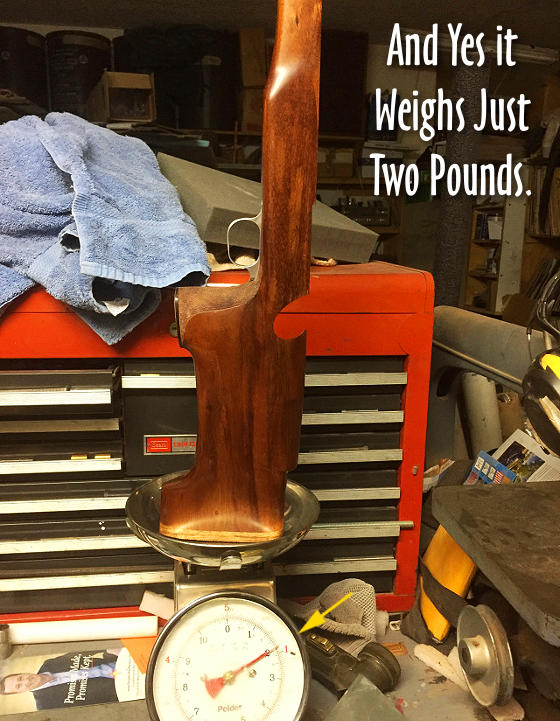
Gunsmith/stockmaker Doan Trevor created a lovely, one-of-a-kind silhouette stock for an Anschutz rimfire action. Built as a true custom design, this stock combines ideal standing position ergonomics with light weight — the entire stock weighs a mere two pounds. This project really showcases Doan’s remarkable skills with wood. Read the full story about this project (with more photos) at DoanTrever.com.
Doan explains his design process: “A customer came to me wanting to know if I could build a silhouette stock that was 2 pounds or less. I used the Koa wood because it is a lower specific gravity than Walnut (which makes it lighter) and stronger. I was still able to use pillar bedding and keep the weight down. The fore-end could be shortened to reduce the weight even more.
Since the drops on a silhouette rifle are different than a prone rifle, I kept the pistol grip from the prone rifle which is comfortable and tried to come up with a higher cheek piece and more drop to the buttplate. All of this required lots of hand carving.”


 Pop-Up Gun Guru Chat Window
 Trigger images from


 The AR15 is America’s rifle, right? Well it is apparently China’s rifle too, at least when it comes to replacement stocks, buffers, hand-guards and other spare parts/accessories. It seems China’s factories have been churning out plenty of Black Rifle components. Only one problem — U.S. Federal government policies ban importation of many types of gun parts from China. Washington has an embargo on Chinese-made gun components.


 New Cartridge, New Rifle for the King


 Craters may look interesting on the moon, but you don’t want to see them on your primers. Certain mechanical issues that cause primer craters can also cause primer piercing — a serious safety problem that needs to be addressed. If you have a gun that is cratering primers (even at moderate pressure levels), there is a solution that works with many rifles — send your bolt to
  Firing Pin Hole Bushing by Greg Tannel