Here is the BEMIS-SC (Small Caliber) Barrel Inspection Machine. This laser system captures thousands of precise data points over the full length of a .22-.50 caliber bore
Do you think your digital borescope is a state-of-the-art bore inspection device? Well think again. There is now something way more advanced than any optical or electro-optical borescope. A new laser-equipped scanning device can map the entire interior surface of a barrel bore. With this new technology you can now examine every land and every groove, millimeter by millimeter, from the chamber to the tip of the muzzle. The most minute flaw in a barrel can now be revealed.
The new device is called the BEMIS-SC™ (for Barrel Inspection Machine Small Caliber). Operated by NTS Chesapeake Testing, BEMIS-SC performs non-destructive laser-based mapping of gun bores. The BEMIS-SC currently works with .22 caliber to .50 caliber (5.56 – 12.7 mm) barrels. The BEMIS captures thousands of highly accurate data points over the full length of a barrel. The inspection can be completed in mere minutes, with scan results displayed in graphical, tabular, and 3D visual formats. Here is a barrel cross-section, as scanned by the BEMIS-SC:
Click for Full-Screen Version
Until the 1980s, gun tube inspection had to be conducted by hand using a manual “star” gauge, a process that would take hours and provide minimal data. Electronic gauges were eventually developed along with the video bore scope, but these systems were still limited to very few, low-resolution data points. That has all changed with the BEMIS™, a huge leap forward in technology that is capable of rapidly capturing thousands of precise data points.
Chesapeake Testing commenced BEMIS-SC barrel inspection services in September 2014. Testing is performed in Chesapeake’s commercial barrel inspection laboratory, located in Belcamp, MD, minutes from the U.S. Army Aberdeen Proving Ground. While testing is currently limited to .22 to .50 caliber barrels, Chesapeake Testing will accommodate both smaller and larger calibers in the future.
“We have always focused on building our company around very unique technologies. BEMIS™ has changed the industry in regards to the inspection of weapon systems. We are excited to be an exclusive partner with LTC in this industry and look forward to contributing to the future of this technology,” says Jim Foulk, founder and president of Chesapeake Testing.
This video shows the process of cut-rifled barrel-making by Krieger Barrels, one of the world’s best barrel manufacturers. Krieger cut-rifled barrels have set numerous world records and are favored by many top shooters. The video show the huge, complex machines used — bore-drilling equipment and hydraulic riflers. You can also see how barrels are contoured, polished, and inspected.
For anyone interested in accurate rifles, this is absolutely a “must-watch” video. Watch blanks being cryogenically treated, then drilled and lathe-turned. Next comes the big stuff — the massive rifling machines that single-point-cut the rifling in a precise, time-consuming process. Following that you can see barrels being contoured, polished, and inspected (with air gauge and bore-scope). There is even a sequence showing chambers being cut.
Click Arrow to Watch Krieger Barrels Video:
Here is a time-line of the important barrel-making processes shown in the video. You may want to use the “Pause” button, or repeat some segments to get a better look at particular operations. The numbers on the left represent playback minutes and seconds.
Krieger Barrel-Making Processes Shown in Video:
00:24 – Cryogenic treatment of steel blanks
00:38 – Pre-contour Barrels on CNC lathe
01:14 – Drilling Barrels
01:28 – Finish Turning on CNC lathe
01:40 – Reaming
01:50 – Cut Rifling
02:12 – Hand Lapping
02:25 – Cut Rifling
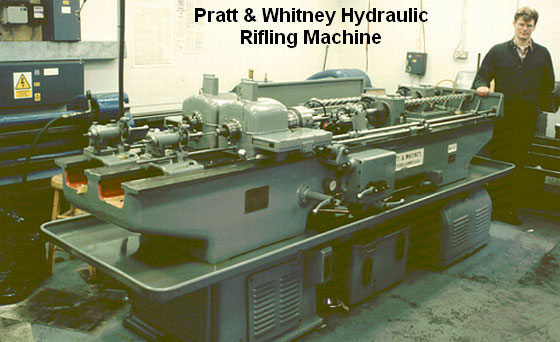
“At the start of World War Two, Pratt & Whitney developed a new, ‘B’ series of hydraulically-powered rifling machines, which were in fact two machines on the same bed. They weighed in at three tons and required the concrete floors now generally seen in workshops by this time. Very few of these hydraulic machines subsequently became available on the surplus market and now it is these machines which are sought after and used by barrel makers like John Krieger and ‘Boots’ Obermeyer. In fact, there are probably less of the ‘B’ series hydraulic riflers around today than of the older ‘Sine Bar’ universal riflers.” — Geoffrey Kolbe, Border Barrels.
Can sustained rapid-fire shooting with no cool-down period wear out a quality barrel more quickly? The answer is “Yes” according to Forum member LCazador, who did an interesting comparison test with two .243 Winchester barrels. He started off with two, identical, match-grade HV taper stainless barrels. Both were NEW at the start of testing, and LCazador shot the same load through each: 95gr match bullets with 38 grains of Hodgdon Varget. After giving both barrels the same, gentle 20-round break-in, 300 rounds were then fired through each barrel — in very different ways. Barrel condition and wear were monitored with a borescope.
Barrel One — Slow Fire, Cool Down Periods, Cleaning Every 50 Rounds
At the end of the 300-round test, Barrel One looked brand new. There was none of the severe fire cracking found in Barrel Two. This barrel was shot no more than 10 times without a cool down and firing was done at a much slower pace. Cleaning for this barrel was done every 50 shots.
Barrel Two — Fast Firing, No Waiting, Cleaning Every 100 Rounds
The second barrel, which received hard use and minimal cleaning, was severely damaged with severe fire cracking at the leade and throat. As a result, the barrel had to be re-chambered. This barrel was shot 100 rounds at time without cleaning and was shot up to 20 times in succession without a cool down.
LESSON LEARNED — Heat Kills Barrel Life
Don’t let your barrel get too hot, and keep it clean. One afternoon can ruin a barrel!
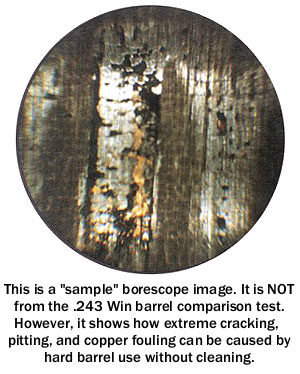
Monitoring Barrel Wear with Borescope
Some folks worry too much about what their borescopes reveal — many barrels do not have to be “squeaky clean” to perform well. In fact some barrels run better after ten or more fouling shots. However, a borescope can be very helpful when your barrel starts losing accuracy for no apparent reason. Forum member FdShuster writes:
“A borescope is a positive way of backing up your suspicions when the rifle starts to throw an occasional (soon followed by more frequent) wild shot. Using the scope is also an excellent way to determine that the cause is barrel wear and not simply a need for a concentrated cleaning session to remove built up copper and more importantly, carbon fouling.
I’ve had a few barrels that gave every indication of being shot out. But I ‘scoped them out and found the cause to be nothing more than requiring a good cleaning. They then returned to their usual performance. There’s no guessing involved when you are able to get ‘up close and personal’ using the scope. The borescope also provides an excellent view of the all-important condition of the crown. My borescope is one of the most valuable investments I’ve ever made.”
Chris Nichols with potential world record (1.297″ 4-Target Agg) Heavy Gun Targets!
Report by Bart Sauter, Bart’s Custom Bullets
Chris Nichols is one of the best 600-yard shooters in the game. This 2019 season he compiled one of the most impressive mid-range benchrest seasons ever. Check out the stats — Chris’s nine-match, Two-Gun Group Aggregate (Agg) for the year is 1.983″! That’s under two inches average at 600 for 72 record targets fired in competition. Many 600-yard shooters aspire to shoot a single, 4-target Agg that measures 1.983″, but doing that for 72 targets is amazing!
And of the nine matches Chris shot, he took SIX Overall Two-Gun wins — a 67% win ratio. And in the process Chris also shot what is possibly the smallest 4-target Heavy Gun Agg ever recorded — 1.297 inches. Hey readers — that Agg works out to 0.206 MOA average group size — well under quarter-MOA for four, 5-shot groups at 0.34 MILES (600 yards)!
Chris with 0.665″ group at 600 yards. This is the smallest HG group fired in the IBS in 2019.
The Equipment: 6mm Dasher Light Gun and Heavy Gun
Chris likes to run 1.550 stainless steel Bat “B” actions, Jewell triggers, Brux or Bartlein barrels. He prefers wooden stocks as he feels they produce a better resonance for Long Range rifles. Chris has his own stock design crafted by Johnny Byers. Imagine a Wheeler LRB stock front half mated with an McMillan ST 1000 rear section and you have Chris’ stock! It features a Wheeler-type, 4″-wide fore-end with an ST 1000 low-comb profile in the back. Both Light Gun and Heavy Gun sport Vortex 15-60x52mm Golden Eagle scopes mounted with Harrell’s double screw tall rings. Chris does NOT use either muzzle brake or tuner.
Here is Chris at his home range with his Light Gun (17 lbs. max).
Chris Nichols’s Heavy Gun is a true heavy coming in at around 42 pounds. It was responsible for the HG Agg of 1.297″ (potential new world record). His season-long aggregate with his Heavy Gun was 1.861″ for 36 targets! This rifle has similar components as his Light Gun, except the barreled action rides in a barrel block in a McMillan HBR 50 BMG stock.
Both rifles ride a top of a Sinclair competition rest with a Protector DR Flat Top rear bag. When Chris goes to HG gun he simply switches tops (made by Daniel Greenlaw) on his front rest to accommodate the larger forend. As Chris says ,” This keeps things simple and exactly the same. ” Just the way he likes it.
Reloading for the 6mm Dasher
Chris’s load choice for both LG and HG is Hodgdon Varget pushing 105gr Berger VLDs. He uses CCI 450 primers, seated with an old Lee hand primer. When it comes to reloading, Chris likes to keep things as simple as possible. “If people saw me reloading they’d probably laugh!” Chris revealed that he doesn’t anneal or clean his cases. He just sprays them down with Hornady One Shot Case Lube, resizes, then runs a brush down the necks, and cleans the primer pockets. The only cleaning his cases get is when he wipes the lube off of them. Chris WILL trim and chamfer as needed.
Chris says seating consistency is critical — he uses a K&M Arbor press with force dial indicator. I asked if there were certain numbers he looks for when seating. Chris replied, “I’m only concerned with consistency and not a certain number, 5 pounds or 60 pounds. It doesn’t matter as long as they are the same. I take what the brass gives me.”
Tuning the 6mm Dasher for Record-Setting Accuracy
I asked Chris what was special about his Dasher and how he kept it tuned and so competitive? His reply is something all shooters should pay careful attention to: “[Success] starts with having a good reamer, bullets and barrels. But more than that, it’s KNOWING your Cartridge, KNOWING your bullets, and KNOWING your barrels! I’ve shot it so much I just know what to do. I’m comfortable with it. I know how to get it to shoot and when it’s not, I have a pretty good idea how to get it back in tune. Once you know your equipment, then you can learn how to get the most out of it.”
Chris has a range at his house and he tunes at 300 yards. He looks for consistent, 300-yard 5-shot groups of 0.600″ or less! He wants to see nice round groups! Not groups with four in and one out or vertical strings. Chris starts by finding “touch” (to the lands) then he moves the bullets .002″ off the lands and begins tuning. Chris has found that usually somewhere around .008-.012″ off the lands is where his Berger 105gr VLDs shot best. I asked Chris what’s the biggest factor contributing to his success? He said, one big thing was that he can do his own work. That’s a huge advantage.
Look for Accuracy First, Velocity Second
Early on Chris had it in his mind that for a 6mm Dasher to shoot best he needed to achieve a certain velocity range — 2990 to 3030 FPS. The problem was he wasn’t paying attention to what the target was telling him. He’d get to the speed he was looking for but the accuracy wasn’t there. Once he started slowing the speeds down and giving the barrel what it wanted, then the accuracy came! Also with the slower speeds came better consistency.
Chris Nichols’s Tuning Tips for 6mm Dasher:
• Take consistency over speed.
• Only change one thing at a time and run it to the ground.
• Every barrel is a little different, so give it what it wants.
• Pay attention to what your target is telling you.
• Don’t be afraid to REDUCE your powder load.
Chris Nichols’s Advice for New Shooters
Chris says the best thing a new shooter can do is align themselves with knowledgeable people, and if they will talk, listen! Next, be ready to buy the best equipment or be ready to buy it twice. Chris also says: “Don’t cheap-out on sighters. Sighters need to be just as good as your record rounds.”
In the Beginning — Learning the 600-yard Benchrest Game
Chris’s shooting career began in 2012. His first win came in 2014. He was shooting beside guys like Sam Hall, Larry Isenhour, Mike Hanes, Jeff Godfrey James Coffey, and Chad Jenkins, who are very tough competition indeed. He said when he won he was ecstatic and he’ll never forget it! That first trophy had him feeling like he’d just won the Nationals! Chris shot a 6BR for the first two years of his career, before switching to the 6 Dasher. I asked him why he switched? He said, “guys were starting to shoot the Dasher and winning with it!”
I asked Chris if he had a mentor and he said, “not really”. He learned by watching the guys who consistently finished Top 5 at matches and occasionally asked them a question. Not two questions, just one! Chris didn’t want to push his luck by asking too much. Then Chris would take that information and test it and apply it to his own shooting. Chris says, “he learned mainly by the ‘school of hard-knocks’. The good thing about learning that way is it sticks with you!”
Chris Nichols 2019 600-Yard Win List and Statistics
How is a modern, metal-chassis rifle built? This very cool video from Masterpiece Arms answers that question. The nicely-edited video shows the creation of a Masterpiece Arms tactical rifle from start to finish. All aspects of the manufacturing process are illustrated: 3D CAD modeling, CNC milling of the chassis, barrel threading/contouring, chamber-reaming, barrel lapping, laser engraving, and stock coating. If you love to see machines at work, you will enjoy this video…
Kevin Muramatsu’s black rifle book, the Gun Digest Guide to Customizing Your AR-15, is a great resource for fans of AR-platform rifles. All the AR options you can imagine are covered: suppressors, premium barrels, adjustable stocks, free-float handguards, ergonomic grips, buffer systems, tactical lights and much more. Those planning an AR rifle build will find application-specific suggestions for 3-Gun, Service Rifle, High Power (Space Gun), Hunting, and Self-Defense use.
Firearms expert Muramatsu offers advice on choosing the right stock/barrel/optics configuration for your particular game. He also discusses the wide variety of options for slings, grips, magazines and other accessories. With over 520 photos, the book includes a large photo gallery of customized ARs, and includes bonus coverage of the FAL and other “tactical” firearms. The Gun Digest Guide to Customizing Your AR-15 is available from Amazon.com for $20.13, and a Kindle eBook version is offered for $14.99. The book is also sold by Barnes & Noble, and most other major booksellers.
In today’s economy, Free is good. Here’s a list of classic, older shooting books that can be downloaded for FREE from Google Books. This list includes many classic treatises on marksmanship that still have value for today’s competitive shooters. In addition, we’ve included illustrated firearm histories, such as Townsend Whelen’s fascinating book, The American Rifle, and The Gun and its Development (9th Ed.), by William Wellington Greener.
In the list below, the title link will take you to the Google Books page for each book. You can read the entire book online, or you can download it to your computer as a PDF file* and save it (or print it). You can also create your own Google Library and save the books there for access from any computer.
*To download a book, first click the title from the list above. Then, once you’re at the Google book site, look for the icon that looks like a gear in the upper right-hand corner. Click that and a pull-down menu will appear. Select “Download PDF” from the menu — this will bring up a security question to make sure you are a human. Respond to the security question correctly and your normal download prompt will appear. Choose a location to hold your new e-book, and click “save”.
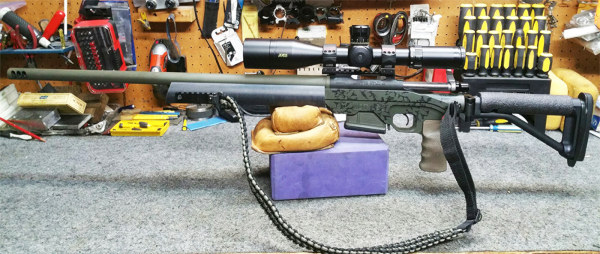
What’s a “Frankengun”? Well it’s a one-of-a-kind rifle that has been pieced together from a variety of different parts and components. It might be a little bit Bolt Gun mixed with a little bit AR-15. Or it might feature some home-made components unlike anything you’ve seen before.
We’ve selected these four Frankengun rifles from a current thread in our Shooters’ Forum.
Frankengun #1 — The EXO (as in Exo-Skeleton)
Forum member jm850 calls this tube-framed wonder the EXO (as in “exo-skeleton”). He says: “This is a prototype I designed around a few core concepts that stick out to me on a traditional configuration. Eliminating stresses, lowering recoil moment, and improved barrel cooling. I’m really happy with it so far.”
The EXO is a very unique rifle. We’ve never seen anything like this since the late Shelley Davidson’s famous Tinkertoy Rifle, a brilliantly innovative 30BR that actually won matches. (Sadly Shelley has passed away). The Tinkertoy, shown below, was truely radical, but it worked ! Could this have been an inspiration for jrm850’s EXO rifle?
Frankengun #2 — Mossberg MVG in LSS Stock with BipodeXt
Forum member BallisticXLR has created something very weird to say the least. It started out as a basic, bone-stock Mossberg MVP Varmint in .223 Rem. Then the transformation began: “I replaced everything except the receiver. It now has an LSS stock, PSG-1 grip from DPMS, XLR butt stock, PT&G lug and barrel nut, Columbia River Arms 26″ barrel with Sonoran coral snake Cerakote, A2 flash hider, Timney and Jard triggers (depending on what I’m doing), and a USO B17 which is now a USO 3.8-22×44.” That long extension tube under the chassis is a BipodeXt from Accuracy Solutions.
Frankengun #3 — A Chassis Rig in 25 Creedmoor
This Frankengun belongs to Forum member Geraldgee. This “black and blue” rig features a mag-fed Kelbly Atlas action in a McCree’s Precision G10 Chassis. The barrel is a Bartlein Rem Varmint Contour, 1:7.5″-twist 4 Groove, chambered for the 25 Creedmoor. There are some interesting .25-Cal bullets coming on the market now. You can make the brass by expanding 6mm Creedmoor, or necking down 6.5 Creedmoor.
Frankengun #4 — MDT Chassis, Fore-end Whittled by Spook
Here’s a real collection of odds and ends, but Forum member Spook says it shoots well, and is a great example of “Left-over parts made useful again”. This mix-n-match Frankengun features a Remington M7 action with PT&G bolt. The barrel is a stainless Pac-Nor chambered in 6mm SLR. The barreled action is carried in an MDT Chassis with rear folding buttstock. Up front is something unusual, a Delrin fore-end that owner Spook “whittled in the mill”.
Frankengun #5 — 6.5×47 in Accuracy Int’l Stock
CLICK photo for full-screen version.
Forum member CT10Ring kicked off the Frankengun thread with this rifle. It’s actually not that shocking, but you rarely see a BAT action in an Accuracy International stock. The BAT VR action is mated to an AI Mag and set up in an AI folding stock. On top is an “old school” Nightforce Benchrest scope. The barrel is a very heavy Krieger chambered for the 6.5×47 Lapua. CT10Ring say the barrel alone weighs about 9 pounds, and the gun “shoots better than [he] can”.
Post Pictures of Your Frankenguns in our Forum
So do you have a favorite Frankengun resting in your gun safe? If you do, visit our Shooters’ Forum and post a description and some photos in the Frankengun thread.
by James Mock
After owning three different rifles with BAT actions, I have become a loyal fan of BAT Machine quality and customer service. Back in 2009, I traded my BAT/Scoville for the BAT/Leonard that I currently shoot. This rifle has a long history and Terry Leonard told me that “Old 87″ (as I have named it) was one of the earlier BATs that he stocked. He wrapped the stock in fiberglass and used 2-part epoxy back then. I must say that this rifle has held up remarkably well since it dates back to the 1990s. The action is a RB/LP/RE octagon Model B with .308 bolt-face.
Rifle Has Multiple Barrels for Multiple Disciplines
With this gun, I have shot several barrels of different calibers (.22 PPC, .22 PPC-short .095, 6mm PPC, 6XC, 6mm Dasher, .30BR, and will soon have a 6 BR-AI). It has been an exceptionally accurate rifle in several disciplines. In the hands of previous owners, it earned several Hall-of-Fame (HOF) points, and a “middle-of-the-pack” shooter (me) even received a HOF point with this rifle.
For most of its life, Old 87 served as a short range benchrest rifle, but I have used it for the last few years as a 600-yard rifle with the 6mm Dasher barrel. I was lucky enough to earn the Shooter of the Year award at the Prince Memorial Range in Louisiana for 2016.
After shooting my two Dasher barrels for last eight years, I have noticed a drop-off in accuracy at 600 yards. A decision had to be made — get a new barrel or sell the rifle and retire from competition. I will be 74 years old in six months and my competition days are limited due mainly to a chronic neck problem. After mulling over the decision to retire or not, I decided to give Old 87 one more year. Here is the story of how we upgraded the old war-horse.
Old 87 REBORN — Upgrading with New Components
I prefer cut-rifled barrels with four lands and grooves and have had success with .236 bore diameters and 1:8″ twist in long range rifles. I searched for barrels meeting those parameters and found a suitable BRUX at Bugholes.com (Southern Precision Rifles).
The 6BR-AI Option — Easy Fire Forming
I thought about having Billy Stevens chamber it for the Dasher, but decided to try something new. There seems to be a lot of interest in the 6BR-AI and I said, “Why not?” Well, I bought a shortened Dasher die from Harrell’s and will use my Wilson Dasher seating die. Bart Sauter was kind enough to let me use his reamer for chambering.
Fitting a New Roller-Type Cocking Piece on Older BAT Action
Since I was into the project this deep, I called Mike Ezell and ordered one of his Tungsten powder-dampened tuners. Since Old 87 had thousands of rounds since the firing pin spring has been replaced, I decided that it was probably needed. Well, I got to thinking (very dangerous) and asked Daryle Thom if it would be feasible to put a roller-type cocking piece and a new firing pin spring on such an old action.
The folks at BAT are very accommodating and they said that it would be no problem with such a conversion. While my bolt was in Idaho, the barrel with Ezell tuner arrived and I could not shoot it. However, my friend Jeff Turner loaned me his BAT bolt to see if it would work. Although the rifles differ in age by 15 or more years, the borrowed bolt worked perfectly in my rifle. This is a testimony to the great machine work performed at BAT Machine.
New Bolt Roller Tail-Piece Makes a Big Difference in Cocking Effort
With the borrowed bolt I managed to fire-form 50 rounds and get them ready for our 600-yard match on September 16. The folks at BAT quickly fixed my bolt by replacing the mainspring and ejector spring, polishing the ejector, and replacing the tail-piece with their roller type. Pictured below is this tail piece that makes a remarkable difference in the force needed to cock the action. It is amazing what this little wheel can do… even when placed in a 20+ year old action.
Working with the Ezell Barrel Tuner — Small Increments Work Best
Also, I would like to congratulate Mike Ezell on his new tuner which contains powdered Tungsten. It is easy to set up and Mike will help a buyer get maximum effectiveness from the unit. Just give him a call. Below is a picture of the tuner. I was lucky enough to have some time to “play” with it before the match.
Talking about the tuner, Mike writes: “Our new barrel tuners…
PDT stands for particle dampening technology. The science is there, we just applied it to a barrel tuner. The advantages are a wider tune window and more efficient control of barrel harmonics…in a tuner design that actually looks good.”
Mike advised me to set the tuner by turning it all the way into the shoulder and then come out to zero or the second time zero comes up if there is not at least half of a turn between the shoulder and the first zero. It is best to start with a proven load and adjust the tuner from that load. As unlikely as it seems, a rifle can go from a good tune to a very poor tune with only 5 marks (.005”) and vice versa.
Mike cautions those who use his tuner to NOT make adjustments which are too large. As a matter of fact, he recommends adjustments of .001 inch at a time. Ezell’s tuners are screwed onto the barrel with .900” by 32 threads per inch and has 32 marks on the circumference of the tuner. Therefore, each mark moves the tuner in or out by .001 inch. There are three set screws with Teflon tips which provide friction for the tuner on the threads. Do not tighten the screws so tight as they damage the fine threads.
If you want the smoothest bolt possible for your BAT, call or e-mail Daryle or Bruce Thom at BAT Machine and discuss your needs with them. I am sure glad that I did. If you want a state-of-the-Art tuner for your barrel, give Mike Ezell a call or visit his Ezell Custom Rifles Facebook Page.
— Good shooting, James Mock
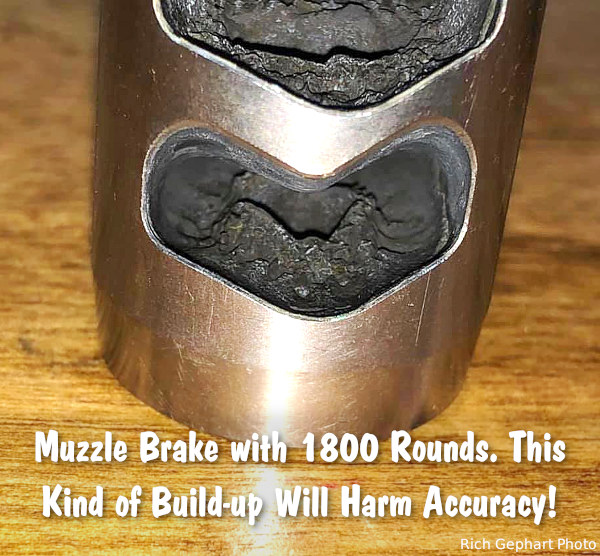
Many hunters and precision rifle competitors use muzzle brakes because these ported devices reduce felt recoil significantly. That make s real difference getting back on target for quick follow-up shots. While many rifle owners appreciate the benefits of muzzle brakes, they may also neglect their brakes, allowing hard carbon and powder residue to build up. Not good. You should regularly clean your muzzle brake to remove fouling and carbon build-up.
As Mark Edgreen posted: “Carbon build up on the crown and in the brake is a recipe for poor accuracy.” And another gunsmith reported that customers complained about guns that “shot out way too early” but they only needed to have the brakes cleaned.
Gunsmith and PRS/NRL competitor Jim See recently reminded his Facebook Fans about the importance of cleaning muzzle brakes: “How many times do I have to say it? You need to maintain your rifles. Clean your muzzle brakes people!”. Jim, who runs Elite Accuracy LLC, notes that hard carbon build-up in brakes can definitely harm accuracy. Look at this example:
Muzzle Brake Cleaning Methods
There are various methods for cleaning a brake, we list a variety of techniques, but we would start with NON-corrosive ultrasound. You’ll want to remove the muzzle device before doing these tasks.
1. Use Ultrasonic Cleaning Machine with cleaning solution. This may be the most efficient method: “I place my brake in the ultrasonic cleaner. Shiney as new.” (Jim Moseley).
2. Spray with commercial Carb Cleaner and brush. Then apply anti-corrosion coating.
3. Soak in half hydrogen peroxide and half vinegar. Suggestion: “Let sit over night and carbon melts off. Brush remaining carbon off, rinse and put the brake back on.” Apply anti-corrosive before mounting.
4. Soak in 50/50 solution of water and white vinegar and brush. (Be sure to apply anti-corrosion coating, such as Eezox, after soaking).
5. Tumble in liquid solution with stainless pins. Comment: “Comes out slightly faded, but perfectly clean on stainless, non-painted brakes though.” Warning — extended tumbling could affect threads of screw-on brakes. Also, tumbling can possibly harm painted or Cerakote finishes.
Gunsmithing Tip: By fitting the muzzle brake so that the barrel crown is slightly forward, it is easier to wipe carbon fouling off the end of the barrel. See photo:


 The new device is called the BEMIS-SC™ (for Barrel Inspection Machine Small Caliber). Operated by NTS Chesapeake Testing, BEMIS-SC performs non-destructive laser-based mapping of gun bores. The BEMIS-SC currently works with .22 caliber to .50 caliber (5.56 – 12.7 mm) barrels. The BEMIS captures thousands of highly accurate data points over the full length of a barrel. The inspection can be completed in mere minutes, with scan results displayed in graphical, tabular, and 3D visual formats. Here is a barrel cross-section, as scanned by the BEMIS-SC: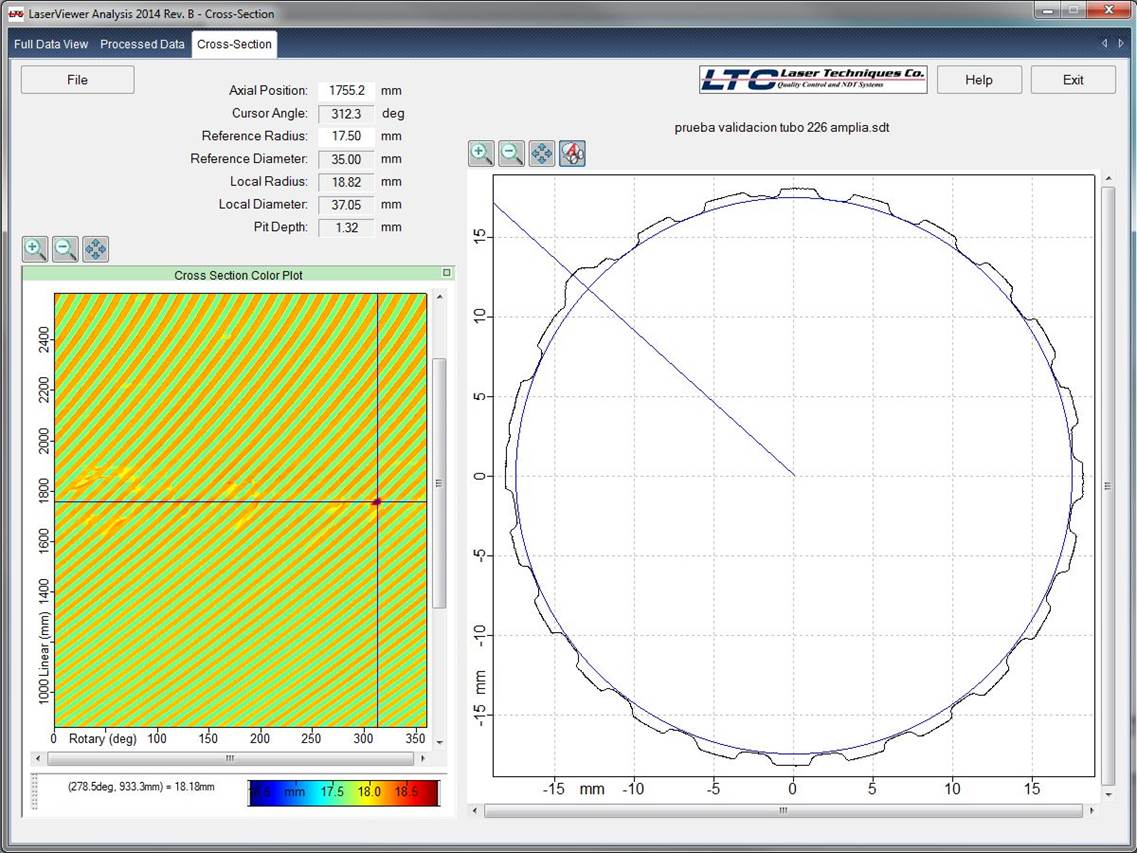



 Monitoring Barrel Wear with Borescope


 In today’s economy, Free is good. Here’s a list of classic, older shooting books that can be downloaded for FREE from Google Books. This list includes many classic treatises on marksmanship that still have value for today’s competitive shooters. In addition, we’ve included illustrated firearm histories, such as Townsend Whelen’s fascinating book, The American Rifle, and The Gun and its Development (9th Ed.), by William Wellington Greener.