|
|
November 17th, 2010
Russian arms-maker Baikal has a new mag-fed rimfire repeater chambered in .22 LR, .22 WMR, and .17 HMR. The new Baikal MP-161K “Small-bore Magazine Carbine” combines Russian reliability/simplicity of operation with modern styling and ergonomics. The fiberglass-reinforced polymer outer shell copies the design of recent Beretta carbines — that’s not a bad thing. The MP-161K features a modern thumbhole stock configuration with a comfortable hand grip and adjustable cheekpiece.

The MP-161K comes with standard iron sights or you can attach a Weaver-type rail to the top of the receiver for mounting telescopic optics. Standard magazine capacity is 10 rounds, and the curved magazine “disappears” completely into the receiver housing. That’s a nice feature for someone carrying the gun in the field — one less projection to snag. The gun is light-weight. Without scope the MP-161K weighs just 5.72 lbs. (2.6 kg).

The Baikal MP-161K will be sold in the USA by European American Armory (EAA Corp.), which has recently resumed importation of the Baikal line of firearms. EAA does not expect to have MK-161Ks in stock before mid-December, if then. Price has not yet been set. We’ll try to give you a hands-on report from SHOT Show 2011 in January.

Specs and More Info
November 10th, 2010
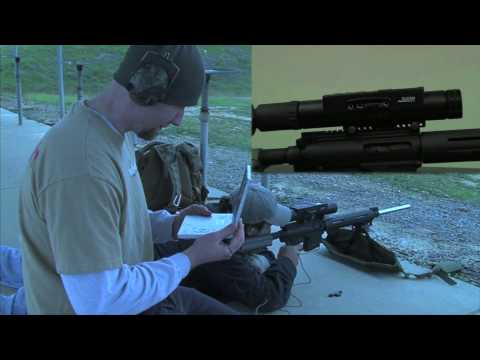
Elcan ushers in the age of digitally-enhanced scopes with its amazing Digital Hunter. It’s about time digital features were added to consumer rifle scopes. In many respects a $150.00 point and shoot camera is much more sophisticated than a $2600.00 Schmidt & Bender. Adding a digital image sensor and digital “crosshairs” to a telescopic lens system unlocks an amazing realm of possibilities. First, you can eliminate moving parts, including the reticle itself, avoiding the possibility of reticle movement that could alter your zero. With digital crosshairs “informed” by a ballistics calculator, the reticle’s aimpoint can automatically display the correct hold-over at any target distance. For low-light shooting, you can boost the brightness and contrast of the image. You can even hook up the scope to a remote monitor so an instructor or spotter can see exactly what the shooter is seeing. Last but not least, everything viewed through the scope can be digitally recorded for later playback and analysis. This way a hunter can record, for posterity, the moment he bagged a trophy buck. Or, a military sniper can record a complete target engagement, for later review by his commander and fellow marksmen.
The $1199.00 Elcan Digital Hunter offers a 2.5-16.5X digital zoom, four field-selectable reticles, and built-in video capture. Reticles can be changed ‘on the fly’ and you can output the video to an external monitor, or simply pop out the SD flash memory card to play back video files on your computer.

Electronic Zoom with No Moving Parts
There are no moving parts in the Digital Hunter except for the diopter adjustment. Magnification is accomplished electronically, and the aiming point does not change at all during magnification. The electronic magnification is parallax-free and the exit pupil remains constant, allowing easy target acquisition, even at high power. Elcan claims that resolution does not change significantly from wide field of view to narrow field of view.
Electronic Ballistic Compensation
One of the most useful features of the Digital Hunter is electronic ballistic compensation. Here’s how that works. The scope has a USB port to connect with a computer. Using Elcan-provided PC ballistics software, you input Bullet BC, Muzzle Velocity, and even wind speed and angle. The scope’s processor automatically calculates drift and drop for various distances and then positions the digital aim point for the correct holdover, based on the target distance you select. All the critical calculations are handled automatically. Watch the video below to see how this all works.
Day-Night Digital Hunter
 In addition to the standard Elcan Digital Hunter, Elcan offers a version for low-light shooting. The Day/Night Digital Hunter, priced at $1399.00, can be combined with IR (infrared) “flash-lights” to provide full night-hunting capability. Low Light mode displays all the available visible light and the near infrared light (that can be “seen” by the scope’s image sensor, but not by the human eye). Utilizing the near infrared means more light energy is available to the scope for better, brighter imaging. After dark, active night vision enables covert surveillance and varmint hunting (where legal). The effective range of the active night vision depends on the power of the IR Flashlight(s). In addition to the standard Elcan Digital Hunter, Elcan offers a version for low-light shooting. The Day/Night Digital Hunter, priced at $1399.00, can be combined with IR (infrared) “flash-lights” to provide full night-hunting capability. Low Light mode displays all the available visible light and the near infrared light (that can be “seen” by the scope’s image sensor, but not by the human eye). Utilizing the near infrared means more light energy is available to the scope for better, brighter imaging. After dark, active night vision enables covert surveillance and varmint hunting (where legal). The effective range of the active night vision depends on the power of the IR Flashlight(s).
Remote Viewing Capability Helps Disabled Shooters
When the Elcan Digital Hunter was first introduced a couple years ago, Outdoors writer Ray Sasser of the Dallas Morning News field-tested it with Ray Mauldin, Elcan Products Manager. Sasser wrote: “There’s a new rifle scope technology on the horizon, a spin-off from military developments made by the Raytheon Company [parent company of Elcan]. The software calculated bullet drop… and the information was stored in a computer chip inside the scope. The only two drawbacks I could find were price and weight. The digital scope weighs 26 ounces, nearly seven ounces heavier than Leupold’s LPS 3.5-14x50mm, my personal favorite traditional scope. Mauldin said physically challenged hunters are particularly excited about the Digital Hunter. It can be used with a video monitoring screen so the rifle can be sighted without your eye to the scope. That’s a huge advantage for a quadriplegic, one-armed or no-armed shooter.”
Digital Enhancements for Target Scopes?
Traditionalists may scoff at digital scope technology, thinking that something like the digital Elcan could never be used in a match because it is too big and heavy. But consider this — all you really need on top of the rifle is the lens system with light sensor. All the other controls and the display could be moved off the rifle and built into a benchtop display/control/processing unit (which could be wireless). In fact, the control functions and display could even performed by an iPod or smartphone. With the iPod you could select the reticle, input ballistics data (Velocity, Bullet BC, Wind direction), and select the magnification level. (Fitting longer focal-length lenses would allow higher magnification than the Digital Hunters’ 2.5-16.5X.) And with a finger-tap on the screen you can record the entire match you are shooting. When mass-produced, such a unit could be sold for considerably less than the $1199.00 price of the Elcan Digital Hunter, as the iPod does the processing and replaces most of the hardware.
November 5th, 2010
 Berger Bullets has released a brand new bullet designed to work in 6mm rifles with a 1:10″ or faster twist. This new bullet borrows its basic design from the very accurate 95gr VLD, but it is shorter so it can fully stabilize in a 10-twist barrel. Berger Bullets has released a brand new bullet designed to work in 6mm rifles with a 1:10″ or faster twist. This new bullet borrows its basic design from the very accurate 95gr VLD, but it is shorter so it can fully stabilize in a 10-twist barrel.
This thin-jacket hunting bullet has been confirmed in testing to work in a 1:10” twist or faster barrel, and was specifically designed for those who want to hunt with factory rifles. Berger Ballistician Bryan Litz field-tested the new 87gr bullet. Here is his report:
For the new 87gr VLD, the G1 BC is .412, and the G7 BC is .211. Prior to this bullet, our lightest Hunting VLD was the 95 grainer, which requires a 1:9″ twist. This left many shooters with no option from Berger for a 6mm hunting bullet because the fastest common twist for many 6mm factory barrels is 1:10″. The 87 grain VLD was designed specifically to fill the gap, and it squeezes the most performance possible out of the common 1:10″ twist barrel. As with all Berger Hunting VLDs, this is the standard J4 (thin) jacket. There is not a Target (thick-jacket) version planned for this design.


L to R – Berger 6mm 87 gr, 95 gr, 105 gr, and 115 gr Match Grade Hunting VLD.
87gr VLDs are In Stock and Ready to Ship
Eric Stecker tells us: “We are excited to announce that our 6mm 87gr Hunting VLD bullets are now available. They are on the shelves now and ready to ship. We have made several shipments to dealers and have more bullets in stock at our shop now. We also have enough jackets ready to make more if we run out quickly. Currently the 87gr VLD is only available in 100-ct boxes.”
October 22nd, 2010
Many gun industry insiders report that sales are soft this year. However, a recent poll by HunterSurvey.com indicates that most hunters and shooters have not cut back significantly on their gun-related expenditures over the last year. When asked by HunterSurvey.com if they were buying more, less, or about the same amount of gun gear this year (compared to 2009), 40.0 percent of hunters said they were spending “about the same” amount of money this year. That is consistent with 2009, when 40.1% of shooters said their spending levels would stay the same.
No Big Change in Actual Spending Habits
The number of hunters expecting to spend more in 2010 dropped only slightly to 19.8 percent from 21.6 percent in 2009. Of those anticipating fewer purchases, 35.7 percent said they would be spending less compared to 33.5 percent in 2009. Considering the natural variation common to any poll, the differences are not considered significant.
 Pollster Rob Southwick, president of Southwick Associates, says: “This is decent news for sporting goods manufacturers and retailers who have been uncertain about the effects of the soft economy. While it appears a slow economic recovery is preventing some sportsmen from rushing out and spending at levels seen in 2007, it appears sales in 2010 will fair rather well, given the softness seen in other retail sectors.” Southwick Associates conducts the surveys at HunterSurvey.com and AnglerSurvey.com. Pollster Rob Southwick, president of Southwick Associates, says: “This is decent news for sporting goods manufacturers and retailers who have been uncertain about the effects of the soft economy. While it appears a slow economic recovery is preventing some sportsmen from rushing out and spending at levels seen in 2007, it appears sales in 2010 will fair rather well, given the softness seen in other retail sectors.” Southwick Associates conducts the surveys at HunterSurvey.com and AnglerSurvey.com.
Big Sale on Hunting Gear Now at Cabela’s
If you’re looking for some excellent deals on hunting gear and accessories, Cabela’s is running a big Fall Hunting Sale right now. You’ll find savings of up to 50% on hunting apparel, knives, boots, ammunition, optics and more…

October 17th, 2010
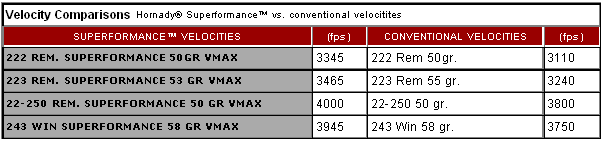
In early 2011, Hornady will start shipping its new, “enhanced velocity” Superformance™ Varmint ammunition for four chamberings: 222 Remington, .223 Remington, 22-250, and .243 Winchester. This ammo uses proprietary, blended powder formulations to achieve faster velocities that most other factory-loaded ammo (for these cartridge types). In addition, the propellant burns more completely in the barrel, reducing the amount of ejecta (i.e. powder residue that exits the muzzle). By burning the powder more completely in the barrel, Hornady claims the Superformance ammo delivers higher velocities without increased recoil.

New 53gr V-Max for .223 Rem Ammo
All four types of Superformance Varmint ammo are loaded with polymer-tipped V-Max bullets. The .223 Rem ammo features a new 53-grain V-Max bullet with a decent 0.290 G1 Ballistic Coefficient. Hornady claims that: “This new bullet… enables this load to produce trajectory and wind drift equaling that of a conventional 22-250″. Well, it may come close to factory loaded 22-250 rounds from other manufacturers, but any competent hand-loader can produce 22-250 or 22-6XC loads that easily outrun Hornady’s 53gr V-Max load. As with any advertising claims, run the numbers yourself. The chart below shows Hornady’s claimed velocities for its Superformance Varmint ammo:
Hot-Rod Ammo?
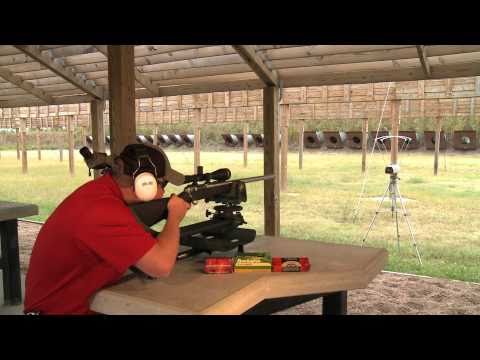
Hornady released a somewhat “over the top” video touting its Superformance Varmint Ammo. We chuckled at the drag-racing animation, but you will find some useful info in the second half of the video:
October 1st, 2010
 The 4R Rifle Club’s Team Hunting Challenge is one of the only matches in the country to mimic a long range hunting scenario. The match is held in central Oklahoma and has evolved over the last thee years to challenge not only the competitors’ marksmanship but also their ability to handle stress in the field. The 4R Rifle Club’s Team Hunting Challenge is one of the only matches in the country to mimic a long range hunting scenario. The match is held in central Oklahoma and has evolved over the last thee years to challenge not only the competitors’ marksmanship but also their ability to handle stress in the field.
A strict time limit puts pressure on the two-man shooter/spotter teams. In the 13-minute alloted time, the shooters attempt to find and range 12 wooden animal silhouettes and then score hits on the steel vital areas.
Shooters and spotters must work together and communicate well to get through all the targets in the given time. Plus, this year a Speed Shoot was added to the Hunting Challenge. This timed stage gave teams just 40 seconds to engage five (5) known-distance targets with one shot each. That works out to just 8 seconds per target, requiring the trigger pullers to be ultra-fast, AND accurate.
Surgeon Rifles Duo Tops Field
The Hunting Challenge was well-attended, with competitors coming from Missouri, Tennessee, and Utah, to join the usual group of shooters from Oklahoma and Texas. Small targets, improvised shooting positions, and constantly-switching winds made this a tough event, demanding high levels of skill and rifle accuracy. Preston Pritchett of Surgeon Rifles and his ace spotter Wade Stuteville came out on top with 65 out of 89 points. Preston and Wade put on a clinic, beating the second-place team, Dean Morris and Rick Jensen, by 15 points (equivalent to five first round hits). Finishing third was the team of Jeff Badly and Chase Tressler.

Hunting Challenge Teams Snag $30K Worth of Gear
This year’s Hunting Challenge prize table held over $30,000 worth of merchandise. Preston and Wade were each awarded a fully-outfitted Savage 10 Precision Carbine rifle, complete with Harris bipod, and 3.5-15x50mm NightForce NXS scope. Dean and Rick each took home a Vortex Razor HD rifle scope with rings. Two Swarovski SLC HD 10×42 binos were handed out to the third-place team. There were prizes for 24 of the 30 teams and the top 15 teams received a prize with a value that equaled or exceeded the $400 match entry fee. Full results, photos, and a sponsor list are posted on the Snipers’ Hide Forum.
Credit B.J. Bailey for this match report and photos.
September 19th, 2010
If you’re looking for some pre-loaded .223 Rem ammo for a Prairie Dog hunt, give MidwayUSA a call. Right now, Midway USA is running a clearance sale on Black Hills Remanufactured .223 Rem Ammo. This is good ammo loaded with 36gr Barnes Varmint Grenade HPFB bullets. Barnes’ Varmint Grenades employ a lead-free design. That may be useful when hunting in areas (such as parts of California) with restrictions on lead bullets. The price for a 1000-round case (20 Boxes of 50) is $579.38, marked down from $747.99, item # 785740. That’s a $168.61 savings. Act quickly, as quantities are limited.

September 10th, 2010
Here’s a simple procedure that lets you get a solid zero for a hunting rifle in just four shots. Of course you probably want to fire a few more rounds to confirm your zero before you head off to your hunting grounds, but this will let you get on-target with a minimum amount of time and ammo expended. (This assumes your scope is securely mounted, and the bases are not drastically out of alignment.)
1. First, remove the bolt and boresight the rifle. Adjust the position of the rifle so that, looking through the bore, you can see the center of the target with your eyes. Secure the rifle in the rests to maintain its position as boresighted. Then, without moving the rifle, center the reticle. That should get you on paper. With the rifle solidly secured in front and rear rests or sandbags, aim at the center of a target placed at your zeroing distance (50 or 100 yards). Confirm there are no obstructions in the barrel! Then load and fire one shot. Then, return the gun to the exact position it was when you pulled the trigger, with the cross-hair centered on the target as before.
2. Locate, in the scope, where your first bullet landed on the target. Now, while you grip the rifle firmly so it doesn’t move, have a friend adjust the turrets on your scope. While you look through the scope, have your friend turn the windage and elevation turrets until the cross-hairs, as viewed through the scope, bisect the first bullet hole on the target. In other words, you use the turrets to move the center of the reticle to the actual position of shot number one. Dial the crosshairs to the hole — don’t move the rifle.
3. After you’ve adjusted the turrets, now re-aim the rifle so the cross-hairs are, once again, positioned on the target center. Keep the rifle firmly supported by your rest or sandbag. Take the second shot. You should find that the bullet now strikes in the center of the target.

4. Take a third shot with the cross-hairs aligned in the center of the target to confirm your zero. Make minor modifications to the windage and elevation as necessary.
5. Now shoot the rifle from a field rest (shooting sticks, bipod, or rucksack) as you would use when actually hunting. Confirm that your zero is unchanged. You may need to make slight adjustments. Some rifles, particularly those with flexy fore-arms, exhibit a different POI (point of impact) when fired from a bipod or ruck vs. a sandbag rest.
If you recently cleaned your rifle, you may want to fire two or three fouling shots before you start this procedure. But keep in mind that you want to duplicate the typical cold bore conditions that you’ll experience during the hunt. If you set your zero after three fouling shots, then make sure the bore is in a similar condition when you actually go out hunting.
August 24th, 2010
A Texas shooter put together a great video covering the East Texas Championship Benchrest Shootout, held August 20-21 in Huntsville, TX. This match, the first at the new Huntsville Range, was co-sponsored by the Pine Valley Benchrest Shooters Association and S&S Precision Rifles of Argyle, TX. On the Friday before the main match, there was also a 500-yard Egg Shoot.
In the video you can see Don ‘Stick’ Starks of S&S piloting a 6.5×47 Lapua long-range varminter he built on a candy-red Robertson Composites ‘Speedy’ F-Class stock. Stick and other competitors were shooting at large (120mm), medium (90mm), and small (60mm) clay birds at 400 yards. Over the course of the day, competitors fired 50 record rounds at the targets. Each shooter came to the line five times to shoot 10 rounds per stage in seven minutes or less. The ‘top shot’ who nailed the most birds took home $600.00 in cash. There was also a team challenge with a $430.00 winning payout.

Thirty-six competitors attended this fun match with $1300.00 in total prize pay-outs for the top four bird-busters. Jason Leavelle won the $600 first-place prize with an 810 score, while Dr. Darrel Martin earned $400 for his second-place finish, 50 points behind Leavelle. Tymn Combest was third, earning $200, and Arthur McMeans took home $100 for fourth place. Pudge Morris was the Junior Division winner. We congratulate all the money winners — it wasn’t easy. According to Mike Cockcroft, who helped run the match, “it was 100 degrees, the winds were strong, and the mirage heavy.” The only wind indicators are range flags at the targets and a couple of standard benchrest flags out at about 100 yards.
Match Winner Used a 6.5×284
Forum member Joe Duke reports: “Jason Leavelle shot a nice 810 out of 1000 (possible) points. He is the winningest shooter on our circuit (fondly known as the ‘Redneck Circuit’) and is always tough to beat. He shoots a 6.5-284 crafted by Sam Duke. Jason’s rifle is built on a Stainless Steel Viper action and sports a Krieger 8.5-twist barrel. I can’t think of one of our shoots that was won with anything other than a 6.5-284 in the last three or four years.”
Rules were fairly “wide-open” for the Saturday Shoot-Out, so you saw everything on the line from varmint rifles to 40-pounders. Most guns are custom bench rigs weighing 17 to 30 pounds. All shooters competed in the same class with these basic rules:

- NO RAIL GUNS OR RETURN TO BATTERY GUNS
- 40 POUND MAX WEIGHT LIMIT
- NO SIGHT OR SCOPE RESTRICTIONS
- NO CALIBER OVER .30
- NO ONE-PIECE RESTS OR GUN-VISES
- NO Shooter-Supplied WIND FLAGS
- NO SPOTTING EXCEPT DURING SITE-IN ROUND
- NO TANK OR CLAM TYPE MUZZLE BRAKES
You should definitely watch the video. It is extremely well made and there are some seriously nice rifles on display. Plus it sure looks like the new Huntsville facility is a beautiful range (even if the Texas winds did blow in the afternoons). CLICK HERE to download Match Rankings and Scores (PDF File).
August 21st, 2010
Here’s a great deal on a versatile, multi-purpose pack that should suit the needs of tactical guys as well as game hunters. Right now Cabelas.com has genuine CamelBak® UpRoar packs on sale for just $29.88. The regular price on these packs is $99.99, so you save over seventy bucks.

With a 1,710 cu.-in. cargo capacity, the Uproar pack (Cabela’s item OG-580060) can carry enough for a full day in the field. And of course, since it’s a CamelBak®, the pack totes plenty of H20 via a 24 oz. fitted water bottle (NOT a bladder with sipping hose). Other features include: goggles pocket, organizer pocket, laptop sleeve, and gear-attachment lash points. The discounted UpRoar pack is offered in either olive drab with black accents, or black with blue piping (the Coyote tan color shown at right is NOT on sale). This pack is well-designed, with a comfortable surface next to your back, and ergonomically curved shoulder straps (complete with sternum bridge strap). NOTE: This pack carries H20 in a plastic water bottle in a fitted side pocket. Unlike most other CamelBaks, there’s no internal bladder or hose, so you’ll have to reach around to get your water.
|


