Springfield Armory has taken the M1A into the 21st Century with an adjustable modular stock that makes this classic semi-auto rifle more versatile than ever. The adjustable stock on this Loaded M1A (MP9826, MSRP $2,021) offers many cool features. You can raise/lower the cheek-piece with a handy rotary knob. Likewise the buttplate can be moved in and out with a quick-adjusting knob, allowing length-of-pull adjustment up to 1.3 inches. The toe of the stock features a bag-rider section, making the gun more stable on a sandbag. Up front you’ll find an accessory rail plus a forward-angled swivel stud allowing easy bipod mounting. The included iron sights feature half-minute adjustments for windage and 1-MOA adjustments for elevation. The 22″ stainless steel barrel has a 1:11″ twist. Rifle weight with an empty magazine is 11.25 lbs.
At the 2015 SHOT Show, Rob Leatham runs through Springfield Armory’s new Loaded M1A Series rifle with an adjustable stock (MP9826, MSRP $2,021).
Click Image to See Full-Size Photo
MIA Match at Camp Perry is Popular
In 1974, Springfield Armory began offering a civilian-legal, semi-automatic version of the M14 known as the M1A™. M1As have enjoyed some success in Service Rifle and High Power Competition but today most Service Rifle shooters use the lighter-recoiling AR-platform black rifles. Nonetheless the M1A remains popular with American shooters and the annual M1A Match at Camp Perry offers serious, big-time prize money, thanks to Springfield Armory. In 2014 over $25,000 worth of cash and gear was awarded to Camp Perry M1A competitors, making the M1A Match the richest single rifle event at the NRA National Championships.
Nick Till in 2009 M1A Match. Nick was the 2007 Service Rifle Nat’l Champion. Photo courtesy NRA Blog.
At SHOT Show 2015, SIG Sauer showcased a host of new optics products. SIG’s new Electro-Optics division will market a complete line of riflescopes, battle sights, red dot/reflex sights, rangefinders, binoculars, and spotting scopes. For ALL the new Electro-Optics products, SIG will be offering a lifetime transferable warranty. That’s impressive. SIG’s new electro-optical offerings, which are named after radio alphabet words (such as “Bravo” and “Tango”), are revealed in this video:
The “Whiskey” riflescope series is marketed as a rugged, affordable optical solution for hunters. Designed for law enforcement and tactical shooters, the “Tango” series of riflescopes feature 6X zoom ratios and meet MILSPEC requirements. Shown below is the 3-18x44mm Tango.
The “Bravo” series of prismatic battle sights (illustration below) are pretty remarkable. An innovative new lens design provides an exceptionally wide field of view. SIG claims that Bravo battle sights offer a 50 percent greater field-of-view than similar battle sights.
The “Romeo” series of red dot sights are designed for tactical carbines. The miniature “Romeo1″ Reflex Sight is designed to be slide-mounted on a pistol, and SIG will offer several pistols with the Romeo1 pre-installed. For big game hunting or extreme long-range shooting, SIG developed the “Kilo” rangefinder series, the “Victor” spotting scope line and the “Zulu” binocular series. The “Kilo” rangefinder (bottom photo) can reach out to 1600 yards and features an auto-dimming display. It is about the same size as a Leica CRF, but it is easier to hold. There are molded, rubberized finger grooves on the top and the whole unit has a nice feel in the hand.
To learn more about other SIG Sauer products for 2015, visit the Shooter’s Log, presented by Cheaper than Dirt. For 2015, along with new handguns and rifles, SIG Sauer has rolled out a branded line of suppressors. SIG’s new cans should be popular with both tactical shooters and hunters (where suppressor use is allowed).
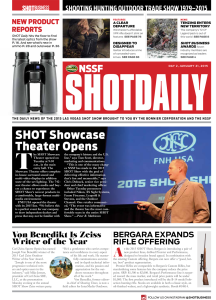
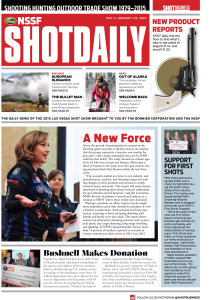
Digital editions of all four issues of SHOT Daily, the magazine printed each day of the SHOT Show, are available free in both Web eZine and downloadable PDF formats. You’ll find many product features plus articles that can benefit shooting club directors and range managers. SHOT Daily is produced for NSSF by Bonnier Corp., publishers of Outdoor Life, Field & Stream, and many other magazines.
Highlights Day 1: New Handguns Lead Story, Footwear, Legal Defense of Traditional Ammo, Women of Outdoor Channel, Midnight 3-Gun. Highlights Day 2: New Optics Lead Story, New Ammunition, Outerwear, Christensen Arms, Volquartsen Custom, CZ Factory, SilencerCo.
Highlights Day 3: New Knives Lead Story, Shooting Accessories, Hunting Rights, Women Shooters, Proof Research, Ultra Light Arms. Highlights Day 4 eZine: Walt Berger Profile, Steyr Scout, Lena Miculek, Sara Palin Q&A, New Remingtons.
Our friends Ed and Steve, aka the 6.5 Guys, were in Las Vegas last week, checking out new products at SHOT Show. On Day 2, Ed and Steve tracked down some cool products from Bushnell, McRee’s Precision, Timney, and TargetVision. Here are Ed and Steve’s Show product preview video reports. You can see more SHOT Show videos by Ed and Steve at 6.5Guys.com.
Bushnell
Laser RangeFinder with BlueTooth: Here Bushnell showcases the brand new Elite CONX Rangefinder. Using a Bluetooth connection, this “networkable” rangefinder can communicate with a smart-phone (and certain Kestrels). This allows you to push range/angle data directly into a ballistics App on your phone. We will certainly see more of this kind of inter-device connectivity in the future. The CONX can work with both iOS (Apple) and Android OS devises.
McRee’s Precision
Chassis Systems and Prefit Kits: The 6.5 guys interviewed Top Shot Season 2 Champion Chris Reed at the McRee’s Precision booth. McRee’s offers chassis systems as well as turn-key pre-fit barrel kits using Criterion barrels. Chris Reed reviews the “Remage” pre-fit barrel system for Remington actions at 5:25 in the video.
Timney Triggers
New Double-Sear Trigger: The 6.5 Guys checked out Timney’s new “Calvin Elite” double-sear trigger. This versatile trigger adjust from 8 ounces up to 2.5 pounds. It allows you to shoot a rifle with a low trigger pull weight for competition, then raise the pull weight to 2.5 pounds for field use or hunting.
TargetVision
Wireless Target Camera: If you want to see bullet holes reliably, in all conditions, past 400 yards, you need some kind of digital camera system, preferably wireless. TargetVision sells a reliable system that works through common WiFi technology, so you can view your shooting session on a smart-phone, iPad, or Android tablet. The TargetVision system includes proprietary software that can highlight the last shot fired. You can even take snapshots or record videos of your shooting sessions.
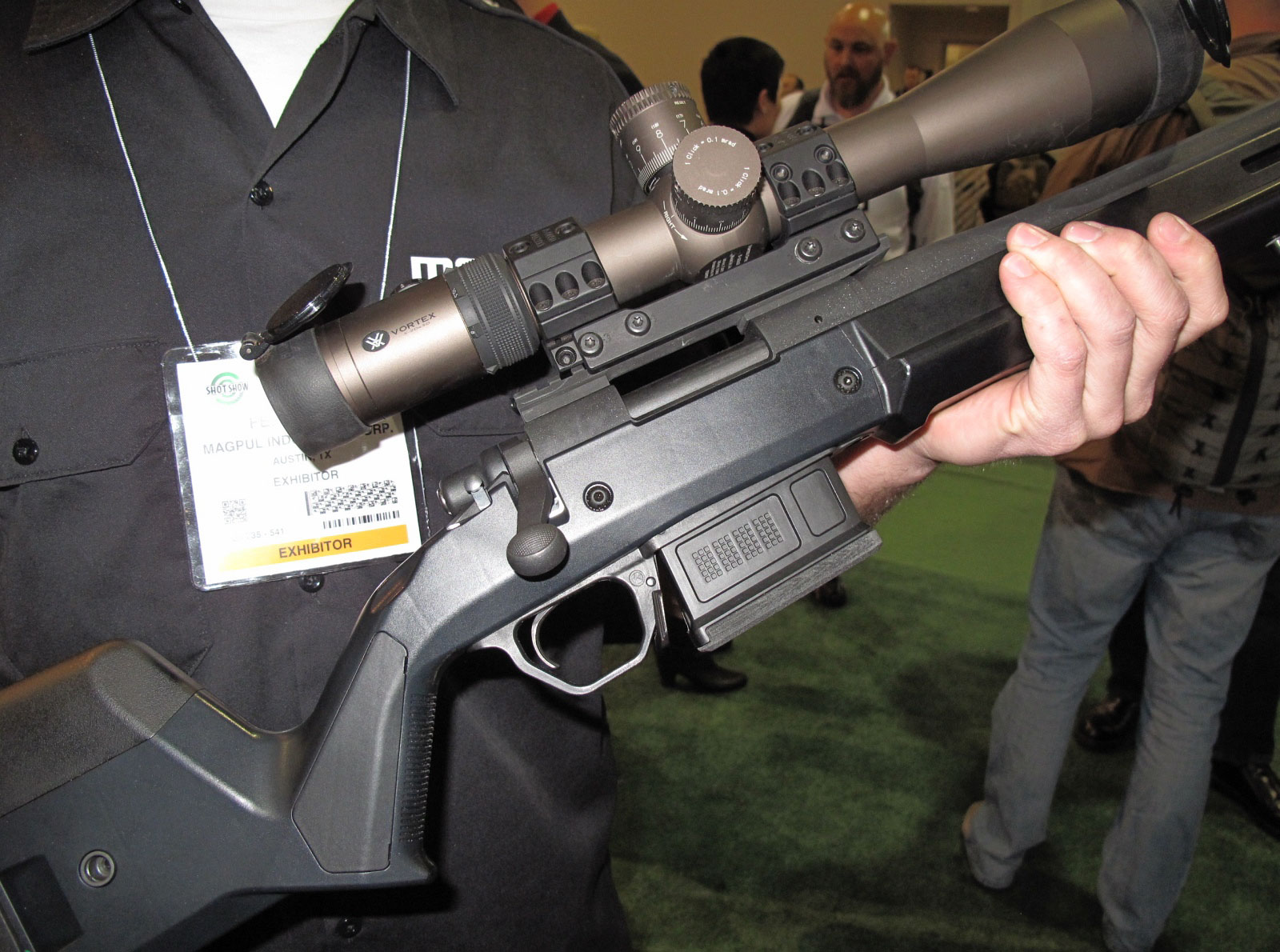
Our readers wanted more information on the $259.95 Magpul Hunter 700 stock, so here it is. We got our hands on the new product. The polymer shell is strong and stiff — not like the “Tupperware” plastic stocks you’ll find on some factory offerings. The stock comes standard with a flush bottom plate. However, for $70 more you can get a polymer magwell unit that allows use of new MagPul 5-round and 10-round magazines. The stock features an anodized aluminum V-block that allows easy installation of a Rem 700-footprint action.
CLICK Photo to See Full-Screen Image:
But perhaps the most important element of this stock can’t be shown in photos. INSIDE the stock is a metal “skeleton” that extends from the middle of the fore-end back into the grip. This skeleton, an important design innovation, gives the stock great strength and rigidity. It is sort of like a race car with a tube chassis under the body work. We suspect Magpul is working on a patent.
Forget flames — induction may be the future of cartridge annealing. Induction heating, using an electrical current passing through a coil, can be controlled with great precision (you can dial in the “dwell time” to a small fraction of a second). With a high-wattage power source, induction annealing is also very fast. A cartridge case can be done in two seconds or less. Combine that with an automatic case feeding system and you have a true assembly-line process capable of cranking out hundreds of precision-annealed cases per hour. Sound too good to be true? Well Giraud Tool recently announced its new Electro-Induction cartridge annealing system. This combines Giraud’s proven hopper-type case feeding system with a powerful Fluxeon Annealer. Watch the video below to see how it works.
Including case-shuttle time, a case is annealed and processed approximately every 4 seconds (rate based on the video demonstration). At that rate, if you keep the hopper full, you could anneal over 900 cases per hour. Even if you don’t need that production capacity, this system allows unattended annealing of your cartridge brass while you do other tasks — such as weighing powder charges or seating bullets.
We know some of you guys are now thinking “OK — I want one. What’s it going to cost?” Giraud has not listed a price yet for a complete induction annealing system. Giraud’s torch-equipped, hopper-fed annealing rig starts at $470.00. We expect that integrating the “Annie” induction unit by Fluxeon will add $500 to the price. By itself, the “Annie” induction annealer costs $449.00 on Fluxeon’s online store. But that $449.00 Fluxeon price does not include long-reach cables and adapters for the hopper feed.
Story Tip by EdLongrange. We welcome reader submissions.
Our friends Ed and Steve, AKA the 6.5 Guys were in Las Vegas this week, checking out new products at SHOT Show. Ed and Steve visited some of our favorite gear-makers, including Nightforce Optics, Manners Composite Stocks, David Tubb, and G.A. Precision. Here are Ed and Steve’s Show reports for these important vendors. You can see more SHOT Show videos by Ed and Steve at 6.5Guys.com.
Nightforce Optics
Highlights include Nightforce’s new F1 First Focal Plane scopes. Our readers will probably be most interested in the new ATACR™ 5-25x56mm F1™ riflescope. With a beefy 34mm maintube, the new 5-25x56mm F1 boasts an impressive 30 MOA (or 12 Mil-Rads) of elevation per revolution, with 120 MOA (or 35 mils) of total elevation adjustment.
Manners Composite Stocks
There are about a half-dozen new stocks from Manners for 2015, both for precision long-range shooters as well as hunters. In the video Tom Manners shows a new tactical folder and the T7 Hybrid, an older design that Tom brought back by popular demand.
David Tubb
11-Time National High Power Champion David Tubb displayed his new T7T 2-stage trigger for Remington 700 actions. This is an impressive new component that is a major upgrade over the factory trigger. First stage and second stage are separately adjustable. Price is $350.00 for right- or left-hand versions at DavidTubb.com.
G.A. Precision
George Gardner, founder of G.A. Precision shows off the impressive new Tempest Action, and talks about trends in the world of tactical competition. Shown below is a black-finish Tempest in a rifle at G.A.P.’s booth.
Our friend Dennis Santiago found two interesting rifles at SHOT Show. At first glance, these look just like the legendary M1 Garand and the M1A (civilian version of the M14). The size is right and the stocks look authentic. But take a closer look and you see these are NOT chambered for .30-06 (Garand) or 7.62×51 (M1A) cartridges. Rather, these Baby Battle Rifles are rimfire clones, chambered for the .22 LR. We like the concept — this gives Garand Match and M1A Match competitors the ability to cross-train with low-cost rimfire ammo. Plus, who wouldn’t want a rimfire Garand for a little low-recoil plinking fun? We bet these will produce smiles when folks at the range see them for the first time. And a .22 LR Garand is definitely going to be softer on the ears (and your shoulder)!
Dennis tells us: “These were kind of neat. The form factors and ergonomics are accurate. The weight is a pound or two lighter than the real deal. Trigger is Ruger’ish. It might be fun to show up with one of these at a CMP .22 Sporter match.”
The two Baby Battle Rifles are sold by Kingston Armory. You can visit KingstonArmory.com, but there’s really nothing to see yet — Kingston’s website is still “under construction. If you have questions you can call Kingston at 845-292-3222.
Gear Report by Kip Staton
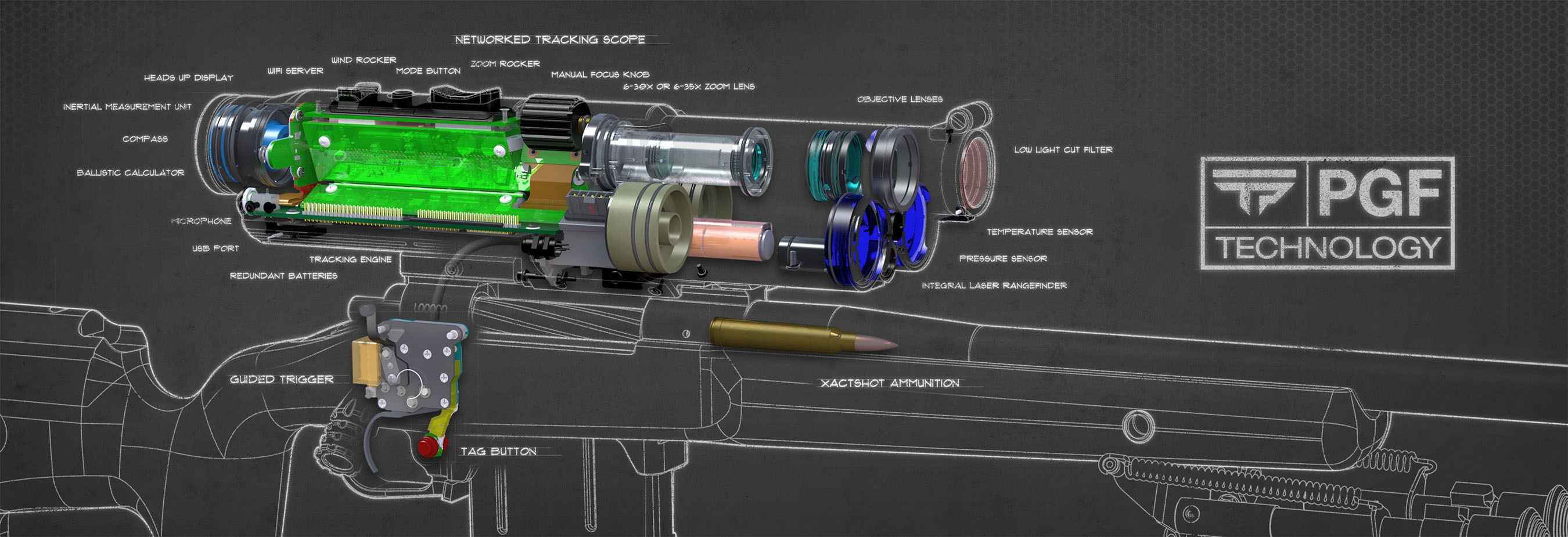
TrackingPoint’s innovative technology has been on the market for a number of years now, and has proven to be a valuable long-range shooting tool. TrackingPoint is a Texas-based, Austin-area applied technology company that developed a unique, precision-guided firearm (PGF) system in 2011. TrackingPoint’s ordinary rifles in common calibers, designated with the XS prefix, are equipped with high-tech “networked tracking” rifle scopes.
CLICK to view full-screen image:
These advanced optics are the heart of the company’s tag-and-shoot technology, and the entire setup is remarkably similar to the systems found in cutting-edge fighter jets. So, how does it work in the real world?
Pretty darn well, as it turns out. The shooter simply finds his or her target, centers his “X” reticle on it, and presses a “tag” button, which is usually integrated into the firearm’s trigger guard. This puts a digital “mark” on the target, and the optic remembers where that particular tag was placed for the duration of the shot. At this point, the system has already automatically performed all necessary distance and environmental calculations. The only other manual inputs needed on the shooter’s part are to enter the wind call, and press the trigger. And, the rifle even helps out with that part.
Because the tag was placed on a unique target, and is remembered by the system, the rifle won’t actually let the shot break until the shooter has lined up the crosshairs with the original tag. So the user may press the trigger, and nothing will happen… until the reticle is placed on the original tag. The rifle will then fire. For each Tracking Point shot, the elevation should be dead on. However the wind can still come into play — the TrackingPoint system does not sense the wind speed or direction. Wind values must be detected by the shooter and entered manually. Once wind speed/angle are entered, the TrackingPoint automatically calculates the needed windage correction (left or right).
The firing process (with the rifle’s brain doing the elevation calculation) can be somewhat disconcerting for shooters new to a PGF. But, this system holds promise, and can help shooters make difficult shots with greater confidence. In particular, the built-in ballistics solver means the trigger-puller no longer needs to worry about elevation clicks and/or hold-overs at any distance. The system calculates bullet drop at any rangeable distance and plots the correct point of aim. “X marks the spot”:
The TrackingPoint system does much more than make long range shots easier to accomplish. The networked tracking scope is also a WiFi server. This means that the image seen through the ocular lens (by the shooter) can be beamed to an Apple iPad, which is included with the rifle. Hunting guides can then see exactly what their clients are viewing through the optic, and make suggestions or provide pertinent advice to the shooter.
If that wasn’t enough, TrackingPoint recently integrated the high-tech Google Glass hardware into their shooting system. By using eyewear with built-in displays linked to the TrackingPoint optic, shooters can make successful shots without looking directly through a rifle-mounted scope. The eyewear has a small display that shows the target(s) “seen” by the rifle’s optic. The operator can then take the shot from any position. You can shoot around a corner, or keep your head and torso out of view. The possibilities for hunters, competitors and real-world tactical shooters are nearly endless.
TrackingPoint’s unique rifle systems are available in both semi-automatic and bolt-action formats, ranging in calibers from .223 (5.56 NATO) to a proprietary .338 of the company’s own design. What do these systems cost? Well high technology does not come cheap. Rifle systems range in price from $7,495 to a staggering $49,995. But, for the right client and the right mission, perhaps no price for this technology is too high. That’s what Tracking Point is counting on….
Gear Report by Kip Staton
Shooters in the market for an accurate anemometer that doesn’t break the bank need to take a hard look at the WeatherFlow Wind Meter, which retails on Amazon.com for just $34.95. Even though it is inexpensive, owner reviews have been overwhelmingly postive (so long as the software is compatible with your device). One Amazon reviewer says the WeatherFlow measures wind velocity as accurately as his expensive Kestrel.
A big part of the reason the WeatherFlow Wind Meter is so inexpensive is that you’ve probably already got the brains of the system in your pocket. Yes, it connects to and communicates with any standard smartphone or tablet, in either iOS or Android flavors. Users simply download the free WeatherFlow Wind Meter app to their smart device, insert the anemometer into the headphone jack, and can immediately start measuring the wind.
Of course, the first question any serious shooter will ask is “How accurate is this thing?” Pretty dang accurate, as it turns out. The device was calibrated by the University of Florida’s Aerospace Engineering Department, and the unique design allows it to consistently report to within a half a percentage point of the true wind value, even if the breeze is up to 15 degrees off-axis to the meter.
Wind speeds are measurable from as slow as two miles per hour to as high as 125 MPH. The Wind Meter outputs average, lull, and gusts windspeed data to your phone, with velocities indicated in 0.1 MPH increments. Furthermore, a hard-sided protective case is included for safe transportation.
Naturally, since the WeatherFlow Wind Meter is App-based, it’s connectable to a variety of social media websites and distribution sources. This makes saving and sharing information about climate conditions a breeze.
About the Writer
Kip Staton is a freelance gun writer based in North Texas, and loves to blog about news within the firearms industry and his perceptions on marksmanship at KipStaton.com. He served as the weekend range manager of the North Texas Shooter’s Association from 2010-2012, at which point he began performing sales consultations for a major online firearms retailer. Currently, Kip is a content marketer, copywriter and digital strategist for an award-winning Dallas marketing agency.
To read more gear reviews by Kip, visit KipStaton.com.









 Of course, the first question any serious shooter will ask is “How accurate is this thing?” Pretty dang accurate, as it turns out. The device was calibrated by the University of Florida’s Aerospace Engineering Department, and the unique design allows it to consistently report to within a half a percentage point of the true wind value, even if the breeze is up to 15 degrees off-axis to the meter.
  About the Writer


