Roy Hunter’s Brace of Two 30 Dashers by Jeff Stover, IBS President
Short range benchrest at 100 and 200 yards is the domain of the 6PPC. Since 1978 that has been the case. Yes, an occasional 30BR, the King of Score Benchrest, will sometimes punch with the 6PPC in group competition. But a .30-caliber benchrest rifle will put you at a disadvantage in group shooting over the long haul — that’s certainly the conventional wisdom. Apparently, no one told Roy Hunter.
6PPC Group vs 30 Dasher Group at 200 yards — the “Fat Dasher” is definitely competitive.
Roy brought two rifles to the 2015 Group Nationals. Both were 30 Dashers. He did not even go with the milder 30 BR. The Dasher boasts more case capacity and, thus, more velocity. (The 30 Dasher is a 6mmBR improved with the neck expanded to .30 caliber and the shoulder blown forward). Speed comes at a price. That price is recoil, especially in a 10.5-pound rifle, such as Light Varmint and Sporter (same as LV but with at least a 6mm bore). Roy can handle the Dasher even in a 10.5-lb gun. The target above shows a sub-.300” group at 200 yards compared to a 6PPC group at the same distance. The larger cartridge and .308 bore CAN compete with a 6PPC – at least in the hands of a benchrest ace like Roy.
Roy’s 30 Dasher in 10.5-lb trim boasts a 1:17″-twist Pac-Nor barrel. Roy shoots Euber 116gr .30-Cal bullets over 38 grains of H4198. That load is good for nearly 3300 fps. This rifle, shown above, has a distinctive stained Butternut finish.
The stocks on Roy’s rifles are his own, made in his shop near Gettysburg, PA. Before Roy Hunter was a premier benchrest stockmaker he built museum-quality 18th Century-style furniture, following Chippendale patterns and the like. Now he just makes benchrest-style stocks (benchrest only — there’s no time to make hunting stocks). The fit and finish are as good as it gets. Roy’s stocks combine old world craftsmanship with high-tech construction. Roy uses Butternut wood, English Walnut, and other woods laminated with carbon fiber. His 10.5-lb rifle is Butternut, while his 13.5-lb rifle is Walnut — and they both shoot superbly! If you are interested in a Roy Hunter stock, the best way to reach Roy is by phone: 410-259-7944.
Report by IBS President Jeff Stover
The ancient benchrest alchemists once predicted a perfect storm for small groups. The recipe is: one part near ideal shooting conditions, 90 of the best benchrest shooters in North America and mix with the shooters’ best barrels and bullets. Place the entire concoction at the shooting benches for seven minutes at time. The result in Heavy Varmint (13.5-lb rifles) at 100 yards, for example, was that the top 17 shooters averaged under .200 for their five targets! Yes, nearly the entire Top 20 in HV100 shot a “teen agg”. Ten or fifteen years ago, that would have been unthinkable. Sure, the winners or top two or three would be in that rarefied air, but not half of an entire relay of 40 shooters. Remarkable.
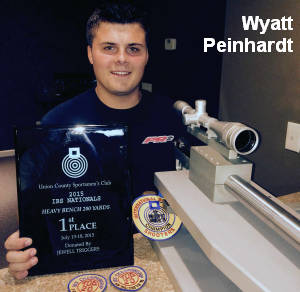
Another landmark of the 2015 IBS Nationals was that 17-year-old Wyatt Peinhardt of Quarryville, PA won the 200-yard stage of Heavy Bench. That meant he earned his first point toward the U. S. Benchrest Hall of Fame (HOF). You need ten to get in, but young Wyatt has plenty of time to get the other nine. He is no ‘flash in pan’. The young Mr. Peinhardt has been shooting since 2009 and now runs full speed with the big dogs of the sport. He was in the Top 20 in this year’s Super Shoot 2-gun results. Frequently he battles his dad, Jeff for supremacy at the bench. Strangely enough, here at Weikert in the Sporter Grand Aggregate (average of five targets at both 100 and 200 yards) Wyatt and his father tied right down to four decimal places: 0.2317!
Six Days of Competition with Four Classes
Some say that the Group Nationals are a marathon — six long days of competition at both 100 and 200 yards with four classes of rifles: Light Varmint (10.5 lb); Sporter (10.5 lb – 6mm minimum caliber); Heavy Varmint (13.5 lb) and Heavy Bench (known as ‘Unlimited’ in NBRSA-land). The first three are simply known as the “bag guns”. Most competitors use a 10.5-lb rifle in 6PPC and compete in all three classes. The Heavy Bench (HB) class requires 10-shot groups as opposed to the 5-shot ones for the bag guns. There is no prohibition to shooting your 10.5-pound rifle in HB, but a shooter is simply outclassed by the rail guns, especially for 10-shot groups.
As mentioned, the week’s weather was very good. After what seemed like weeks of on and off rain, the central Pennsylvania weather gods smiled on what is considered one of the most beautiful ranges in the USA. The shooters had nice sunshine and instead of the usual Weikert blow, they were treated to light zephyrs. It was a glorious week to be at a rifle match.
Course of Fire — First 100, then 200
The sequence of competition groups has 100-yard targets shot the first three days followed by three days at 200 yards. It is done this way to require only one change of wind flags. Nationals competition requires ‘full rotation’. That means that every time a shooter goes to the line for the next match target, he or she must move a requisite number of benches to the right. At the end of the day a shooter will shoot across the full width of the line. Some ranges offer unique properties that render some parts of the range harder or easier to shoot small groups. Bench rotation is important to even out those factors.
Monday morning saw the Heavy Bench (HB) shooters hauling the big rail guns to the line. Old pro Jack Neary led the way at 100 yards with .2186 Aggregate. The 200-yard stage for HB would not be held until Saturday morning. The winner there, of course, was Wyatt Peinhardt with his .2993 (MOA conversion for 200-yard scores). On Tuesday the bags guns came out for Light Varmint (LV) and Sporter (SP). Conditions allowed for quite a few very good groups. The top thirteen shooters in Sporter shot ‘teen aggs’ with Bart Sauter leading the way at a .1666. In Light Varmint, Wayne Campbell shot a tiny .1556. Both his warm-up and first record target were in the ‘zeroes’ (.096 and .088)!
Wednesday’s 100-yard Heavy Varmint match enjoyed what were probably the best conditions of the week. You needed to average under .200 for five targets to finish in the Top 20 or nearly so. Harley Baker won with a .1616. The talk in the loading area was Baker’s fourth record target — a tiny 0.050 bughole centered right in the center ring (usually called the ‘mothball’). It was probably the prettiest target most had ever seen. Better yet, the standing IBS HV 100 record is a 0.052 shot way back in 1980. Harley’s target is being submitted to the IBS Measuring Committee as a potential IBS record.
Wednesday afternoon saw the moving of flags for the 200-yard stage of the competition. The SP and LV 200-yard targets were Thursday’s course of fire. In LV, Andy Shifflett shot a .1966 Aggregate to pick up a HOF point. At 200 yards, Aggregates are logged in MOA units. Therefore, Andy’s .1966 Aggregate translates to an average 200-yard target measurement of slightly less than .400″. The afternoon was reserved for SP targets. Billy Stevens shot a .2060 to win the afternoon’s contest.
Powderpuff Event at the IBS Group Nationals
For decades IBS has hosted an exhibition shoot on the afternoon of a day when only one Aggregate is contested instead of two. It is called the Powderpuff and is intended to allow family members and others that do not shoot competitively to give benchrest shooting a try. Each shooter is assisted by a coach who instructs the shooter. World-class shooters such as Gene Bukys and Lester Bruno give their time and talents to assist novice shooters. There is no time limit to rattle the inexperienced shooters.
2015 Powderpuff Winners Jaydin Johnson (left) and Pam Campbell (right)
Barbara Hottenstein continued as the Powderpuff chair and assembled a large array of awards and prizes. The competition is financially supported by the IBS President’s Fund. This year we had 12 youth and adult competitors. Pam Campbell won the adult category while Jaydin Johnson (shown above with coach Nancy Scarbrough) won the youth division.
On Friday, a single Aggregate of five record targets were shot-for Heavy Varmint (HV) at 200 yards. Harley Baker had his mojo working with a .1896 Aggregate. That performance, coupled with Harley’s .1616 at 100 yards meant that his average in the HV class was a .1756 Grand Aggregate. That is small. Really small.
On Friday afternoon, many of the awards for bag guns were given out. Saturday was reserved for HB 200. Since some of the bag gun shooters do not shoot a rail gun, a number of competitors left Friday afternoon. The rail guns came out to contest 200 yards on the last day of the Nationals. The winner was Wyatt Peindardt. His .2993 was the only Aggregate under .300. Wayne Campbell was second with a .3028. Winning the HB Grand Aggregate was two-time Super Shoot winner, Larry Costa.
IBS recognizes Aggregate performances as follows: Grand (100 + 200) Aggregates in each of four classes; Two-Gun (all HV and LV targets in 100 + 200); Three-gun (HV, LV, SP in 100 + 200) and 4-gun (HV, LV, SP and HB in 100 + 200). In the multi-guns, Harley Baker won the Two-Gun. Gene Bukys added more HOF points by winning the Three-Gun. In the Four-Gun, Virginia’s Wayne Campbell who took the overall four-class Agg with an excellent .2326.
Praise for the Range Crew and Sponsors
The IBS Group Nationals requires a ton of work to run smoothly. The Weikert range’s sparkplugs are Mark Trutt and Dale Boop. This shoot does not happen without those two. This year’s registration and general admin fell to Nancy Scarbrough, who ran a flawless operation. She was assisted by Will Baylor in the scoring and by Stacy Hynes. Steve Dodge oversaw the entire target crew while Larry Hertzog alternated with Mark Trutt as Range Officer.
The benchrest cottage industry should be commended for giving back to the shooters. This year’s sponsors included: BAT actions, Black Hills Shooters Supply, Boops Sporting Goods, Bruno Shooters Supply, Hart Rifle Barrels, Jewel Triggers, JDS Bullets, K&M Precision Shooting, Krieger Rifle Barrels, L. E. Wilson, Pacific Tool & Gauge, and Shilen Rifle Barrels.
Parting Shot — Some Competitors tried to keep up with work while reloading …
What we now know as the “6mm Remington” was originally called the .244 Remington. The cartridge was renamed because it was not a commercial success initially, being eclipsed by the .243 Winchester. The .244 Remington and the 6mm Remington are identical — only the name was changed. Why was the .244 Remington an “also-ran” to the .243 Win? Sierra Bullets Ballistics Technician Paul Box provides some answers…
The year was 1955. A time of carhops, drive-in movies, and Buffalo Bob. It was also the year that Winchester introduced the .243 Win and Remington counter-punched with the .244 Remington (now more commonly known as the 6mm Remington). The .243 Win was based off the time-proven .308 Win case while Remington chose the old war horse, the 7×57.
We’ve all read countless times how Winchester chose the 1:10″ twist, while Remington adopted the 1:12″ twist for their .244 Rem rifles. The first complaint in the gun magazines of that era was how the faster twist Winchester could handle 100 grain bullets, while Remington’s [12-twist factory rifles were supposedly limited to 90 grain bullets].
The first complaint I remember reading was that the 100-grainer was better suited for deer-sized game and the 1:12″-twist wouldn’t stabilize bullets in this weight range. Now, let’s look at this a little closer. Anybody that thinks a 100-grainer is a deer bullet and a 95-grainer isn’t, has been drinking too much Kool-aid. In all honesty, it’s all about bullet construction and Remington had constructed the [90s] with light game in mind. In other words, Remington got it right, but due to a lack of knowledge at the time on both bullet construction and stability, the .244 never gained the popularity it deserved. At that time, Sierra had the 100gr SMP and Hornady offered a 100gr RN that would both stabilize in the slower 1-12″ twist. The .244 Remington provides another classic example of how the popularity of a cartridge suffered due to a lack of knowledge.
.244 Rem vs. .243 Win — What the Experts Say
Respected gun writer Chuck Hawks says the .244 Remington deserved greater acceptance: “The superb 6mm Remington started life in 1955, the same year as the .243 Winchester. It was originally named the .244 Remington. Although the 6mm lost the popularity contest to the .243, it is one of my favorite rifle cartridges, and much appreciated by reloaders generally. The .244 Rem and 6mm Rem cartridges are completely interchangable, and anyone with a .244 Rem rifle can shoot [6mm Rem] ammunition in complete safety (or vice-versa). Remington .244 rifles made from 1958 on can stabilize all 6mm bullets, while those made in 1955 through 1957 are limited to loads using spitzer bullets not heavier than 90 grains for best accuracy.”
Nathan Foster, author of The Practical Guide to Long Range Hunting Cartridges, states: “In 1963 Remington attempted to regain ground by releasing .244 rifles with a new 1:9″ twist to handle heavier bullets. The cartridge was renamed the 6mm Remington and new ammunition was loaded giving the hunter the choice of either an 80gr bullet for varmints or a 100gr bullet for deer. In comparison to the .243 Win, factory loads for the .244/6mm Remington are slightly more powerful while hand loads increase this margin further.”
Was the .244 Remington Actually Better than the .243 Winchester?
The .244 Remington (aka “6mm Remington”) has a velocity advantage over the .243 Winchester due to a slightly larger case capacity. The longer case neck of the .244 Remington is considered desirable by handloaders. We like the added capacity and long neck of the original .244 Remington. As renamed the “6mm Remington”, the cartridge HAS developed a following, particularly with varmint hunters looking for a high-velocity 6mm option. But it never achieved the success of the .243 Winchester for many reasons. As a member of the .308 family of cartridges, the .243 Winchester has certain obvious advantages. First, you can simply neck down .308 Win brass, which was available at low cost from many sources. Moreover, a .308 Win or 7mm-08 full-length sizing die could be used for body sizing. Still the .244 Remington (6mm Remington) presents an interesting “what if?” story…
Story Based on Report by NSSF
American shooters, along with Brownells and Redding, are providing help to the South African Palma (Target Rifle) team members, who will be competing at the Long Range World Championships at Camp Perry in early August, 2015. The ability of the South Africans to compete has been jeopardized by the unexpected seizure of their pre-shipped match ammo by U.S. Customs and ATF. We don’t know why the Feds seized the South Africans’ match ammo, but without it, the South African Team’s ability to participate in the Long Range World Championships has been threatened.
To rectify this situation, American F-TR and Palma shooters, backed by Brownells and Redding, have secured reloading equipment (presses, dies) and ammo components (brass, bullets, powder) so that the South Africans can assemble the needed .308 Win ammo on their arrival in the USA at the end of July.
According to industry sources, the shipment of match ammo for the South African Palma team was seized at the U.S. port of entry by U.S. Customs and ATF agents. When Ray Gross, captain of the U.S. F-TR rifle team, learned about this, Ray contacted Geoff Esterline, Product Category Manager at Brownells. Esterline immediately turned to Robin Sharpless, Executive VP of Redding Reloading, for help.
“I won’t go into the full list of presses and accessories we’ve gathered up, but I can say it’s extensive,” Sharpless told NSSF. “A member of the U.S. F-TR team who lives near Camp Perry has agreed to take our shipment and those from Brownells and the other companies providing brass, powder and bullets so that, when the South African team arrives in the U.S. during the last days of July, they can get started immediately on hand-loading. The U.S. team is even building benches for the press setups, so the South African team should be able to knock this out and get to the more important task at hand, and that is shooting at Camp Perry.”
The 2015 Palma Match and Long Range World Championships will be held August 3-15, in conjunction with the annual NRA National Matches at Camp Perry, Ohio.
Ray Gross reports: “The folks who deserve credit for this are the members of the U.S. Palma Team, Ryan Henning, Geoff Esterline of Brownells, and the folks at Redding. Members of the Palma team had donated much of the needed equipment within hours of U.S. Palma Team Captain Dennis Flaharty putting the word out.
My contribution was limited to a few emails to Brownells. They coordinated with Redding to provide the remaining equipment. This is a great example of international shooting camaraderie, but my part in it was very small.”
High-quality loading blocks precisely sized for your cartridge types make the reloading process easier. Bullets.com now offers acrylic loading blocks that set new standards for this kind of product. Precision CNC-machined from solid acrylic, these beautiful loading blocks were designed by a member of the U.S. Shooting Team. Dimensions are ultra-precise and these blocks even have a primer recess in each hole so the cases sit perfectly. You can order blocks for a variety of rifle cartridge types: .223 Rem Family, .308 Win Family, .308 Tall (.30-06), RSAUM and WSM Magnum, Magnum Tall, .338 LM Family, .50 BMG. In addition, there are blocks for most popular pistol cartridges: .380/9mm, .38 SPL, .38 Super, .40 SW, .44 Magnum, .45 ACP. These blocks are affordable, starting at just $10.95.
Click photo to view full-screen image:
Tech Insight — Acrylic Machining Process
The folks at Bullets.com tell us that machining acrylic is not as easy as it seems. Making precision blocks is a multi-stage process involving special equipment. Solid slabs are first machined flat so they are parallel. Then several custom cutters are employed to craft precisely-arranged holes with nice chamfers on each hole as well as the outside edge. Every hole bottom has a secondary primer pocket milled in so the primers do not contact the bottoms. The see-through blocks are finished to a nice sheen.
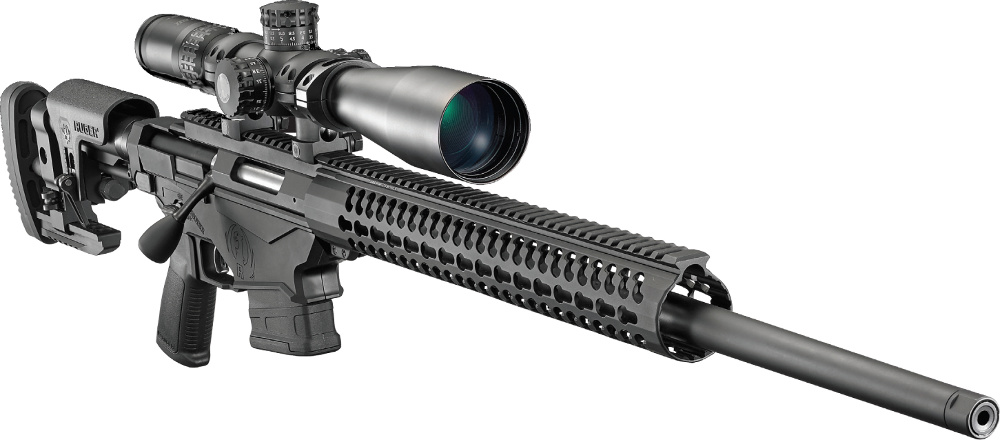
Ruger has introduced one of the most important factory rifles in years — the new Ruger Precision Rifle (RPR). The new RPR features the three-lug (70° bolt throw) action from the Ruger American Rifle mounted in a modular chassis system with many innovative features, such as cam-lock buttstock adjustments, and a “universal” mag well. Even with a hammer-forged barrel, the gun is very accurate. Everybody who has shot this gun so far has been impressed. This is a smart design, well executed. We predict Ruger will sell a ton of these guns. The new RPR is logical step up for AR owners seeking better long-range accuracy (and easier maintenance).
The RPR is currently offered in three chamberings with three different barrel lengths: .308 Win (20″ bbl, 1:10″-twist, 9.7 lbs); 6.5 Creedmoor (24″ bbl, 1:8″ twist, 10.6 lbs); and .243 Win (26″ bbl, 1:7.7″-twist, 11.0 lbs). All barrels are hammer-forged with 5R rifling, and are threaded 5/8″-24 at muzzle for brakes and suppressors. MSRP for all three models is $1399, so expect street price to be under $1200. You could pay that much for some tactical chassis systems by themselves, and then you’d still have to purchase action, barrel, and trigger!
So how does it shoot? Ruger designed the RPR to deliver sub-MOA 5-shot groups. At the media preview, using Hornady 6.5 Creedmoor factory ammo, test rifles shot well under 1 MOA, and in many cases closer to half-MOA. Frank Galli of Snipers’ Hide had a few three-shot groups in the twos. We would like to test this rifle with .308 Win hand-loads and a custom barrel — now THAT would be interesting…
Video Shows Features of Ruger Precision Rifle Receiver:
The lower receiver is CNC-machined from a 7075-T6 aluminum forging, Type III hard-anodized. The mag well front is contoured for bracing against shooting supports. The rifle even comes with a built-in +20 MOA tapered Picatinny scope rail. The trigger, unique to this gun, adjusts from 2.25 to 5 lbs. using a special tool that stows in the bolt shroud. The trigger has a Savage-type safety insert.
The buttstock is fully adjustable with quick-adjust cams. But if you prefer a different style of buttstock, that’s do-able — the left-folding stock hinge is attached to an AR-style buffer tube, so the MPR will accept any AR-style stock. Likewise, you can attach any AR-compatible forearm to the RPR.
Seven Patents Pending for RPR
Notably, Ruger has seven patents pending for this new rifle — that shows the design innovation packed into the RPR. Ruger is pursuing patents on the universal magazine latch system, dual barrel nut system, trigger system, dual-action stock cam levers, bolt body design and other features.
The RPR boasts a Universal Mag Well that works with front-latch AND side-latch mags.
Forum member Steven Blair notes the barrel attachment system is different than an AR: “It doesn’t incorporate a barrel extension, the bolt locks in the receiver. It does have a shoulder larger than the main barrel diameter that would require turning the full barrel length.”
Sniper’s Hide Boss Tests Ruger Precision Rifle
Frank Galli, head honcho of Snipers’ Hide, recently tested the 6.5 Creedmoor version of the RPR. Galli says the rifle offers excellent accuracy and an impressive feature set. Galli believes the RPR offers great value compared to a custom-built tactical rifle that could cost $3500 or more. Read Galli’s detailed review on the Sniper’s Hide website.
Click image to read Snipers’ Hide RPR Review…
Sniper’s Hide Boss Frank Galli reports:
This is a full-featured, precision rifle with an entry-level price tag. The feature list of this rifle is huge. I could probably write 1800 words and still not explain everything packed into this rifle. But suffice to say, it’s customizable. If you wanted to change the stock, use any AR15-capable stock, Magpul PRS, no problem. Want to change the fore-end, same thing, you can add any AR15 fore-end…. The only feature you cannot change is the trigger.
At distance, it’s easy to say, this rifle performs, in the video we [show] a 1/2 MOA Group at 850 yards on steel. The muzzle velocity with factory 140gr AMAX is 2810 fps out of this rifle.
This is the entry-level precision rifle that can put you in the mix of any precision rifle competition held anywhere in the US for under $2500 with scope. What is your excuse now?
Here’s a great YouTube video that shows the creation of a high-end, 22-250 varmint rifle from start to finish. The rifle was crafted by Chad Dixon for O’Neill Ops. Once the build is complete, the video shows the rifle being tested at 440 yards. With the camera filming through the scope, you can even watch the trace, starting at the 2:36″ time mark (this is very cool).
Watch this Video in HD!
Any person with an interest in gunsmithing should watch this video. It shows barrel profiling, tenon-thread cutting, chambering, CNC stock inletting, bedding, and stock painting. This is one of the best short videos of its kind on YouTube.
For this build, Chad Dixon of LongRifles, Inc. teamed up with O’Neill Ops. The video shows the “Coyote Rifle” build, step by step, from the cutting of the tenon threads, to the 440-yard field test at the end of the build. To learn more about this rifle’s components and its performance in the field, contact James O’Neill, www.oneillops.com, (605) 685-6085.
Chad Dixon of LongRifles, Inc.
Chad Dixon’s introduction to firearms began in 1991 as a marksmanship instructor and competitive shooter in the U.S. Marine Corps. Chad began building rifles in 2000 at the Anschutz National Service Center, where he worked with U.S. Olympic shooters. In 2003 Chad took a position with Nesika Bay Precision/Dakota Arms. After leaving Nesika, Chad deployed to the Middle East as a security contractor for the U.S. Dept. of State. On his return to the USA, Chad started LongRifles Inc., a custom rifle-building company.
Dixon-built rifles combine modern CNC manufacturing methods with traditional expert craftsmanship. Chad’s rifles have won major int’l and national level competitions in Smallbore, Smallbore Silhouette, High Power, and Long Range Palma disciplines.
“Après moi, le déluge.” Watch this video from rain-soaked Indiana. Yikes, that’s a lot of water coming down… with lightning bolts to boot. Major thunderstorms delayed shooting earlier this week at the NRA National Smallbore Championships in Bristol, Indiana. This year the Smallbore Championships were moved to Bristol to accommodate the World Fullbore Championships being held at Camp Perry. (Some competitors may be wishing the Smallbore events had been sent to a dryer venue.)
Click arrow to see one heck of a downpour (with lightning flashes) on July 13th…
Thankfully, weather conditions have improved during the course of the week, and competition proceded. Here are the scheduled matches for the remainder of the Smallbore Championships:
July 17 — Randle, Dewar, Fired Team Matches, Whistler Boy, and Mentor Match
July 18-19 — Conventional Any Sight Championship
July 20 — Metric Prone Practice
July 21-22 — Metric Prone Championship
There is one subject as to which we should all be in agreement — the need to wear quality, protective eyewear whenever one uses a firearm. Sadly, it’s not uncommon, at the range, to see shooters wearing no eye protection, or wearing cheap, “dime-store” glasses that can shatter on impact.
This video from Luckygunner Labs shows what can happen with low-quality eyewear. When hit with pellets, the left lens came out and the right lens entered the eye socket!
Read Our Guide to Protective Eyewear
We’ve created a comprehensive Guide to Protective Eyewear. Forum member ChuckW2 told us: “That was the most important article that has ever been posted on this site. I am amazed how many people do not wear glasses while shooting or hunting. Great read….” If you haven’t done so already, read the story. We guarantee you’ll learn something new.
The Eyewear Guide explains the safety standards that apply to protective eyewear and reviews the best lens materials currently available including Polycarbonate, Trivex™, and SR-91. You may not have heard of Trivex, but it is probably the best material out there right now — it’s tough, lightweight, and has better optical properties than Polycarbonate. SR-91 is a good choice for those who need a polarized lens. Our Eyewear Guide also includes a section by Danny Reever on Prescription Shooting Glasses. Danny discusses the available options in lens materials and has many helpful recommendations.
Along with our reviews of lens materials, tint properties, and frame design, we highlight a study done by the NRA’s American Hunter magazine. 10 popular brands of eyewear were tested, with some very interesting results. The testers observed that price does not necessarily assure quality. Relatively inexpensive Bollé VX and Pyramex eyewear both worked better than some expensive brands.
On the other hand, don’t select eyewear simply because it’s cheap or easy to find. American Hunter editor Jeff Johnston observed: “It’s a mistake to assume that any plastic-lens sunglasses off the rack at the local 7-11 are made of polycarbonate and therefore are effective as shooting glasses—cheap plastics are not polycarbonates; in fact, wearing them could be worse than wearing nothing, as they can introduce sharp shards of plastic to your eyes in addition to the projectile(s) that caused them to break.”
This Friday, July 17th, the CMP hosts the Vintage Sniper Rifle Match at Camp Perry. One of the most popular vintage rifle matches held each summer at Perry, this is a two-man team competition using scoped rifles of WWI and WWII Vintage. Many competitors use some version of the M1903 Springfield, but you’ll also see scoped M1 Garands, K31s, Mausers, and even a Lee-Enfield or two.
Two-person teams will fire 10 rounds in 20-second intervals from scoped vintage military rifles set on sand bags. One team marksman shoots from the prone position at 300 and 600 yards, while the other serves as a spotter to relay shot position. Marksman and spotter switch positions on the firing lines, allowing each teammate to play both roles. Scores are then combined for an Aggregate team total.
Two M1 Garands, fitted with scopes and lace-on cheekpads.
Who can identify this rifle, with its unusual scope mount?
Our friends at Criterion Barrels have written an interesting article about last year’s Vintage Sniper Rifle Match. It you want an “insider’s perspective” on the 2014 Match, plus Vintage Sniper gunsmithing tips, read this article. Here are some highlights:
About the Match and the Rifles
The Vintage Sniper Match was the brainchild of Hornady’s Dave Emary. The competition was inspired by his father, a World War II scout sniper, who carried a rifle similar to the 1903A4 rifle builds that can be found today on the Camp Perry firing line. Bob Schanen worked alongside Dave and the CMP staff in establishing the various competition rules prior to the first official Vintage Sniper Match in 2011. The match developers made a point to offer some level of flexibility in rifle configuration, allowing specific types of non-issue optics and rifle rebuilds. This helped make the match more inclusive.
Hornady’s Dave Emary and “Gunny” R. Lee Ermey (right):
Bob Shanen has two vintage sniper competition rifles. Both builds are based off of the USMC Model 1941 sniper rifle, a design similar to the M1903A1 National Match rifle. Bob’s rifles both carry 8x Lyman Junior Target Spotter scopes with a thin crosshair reticle. Bob attributes a large part of his rifle’s accuracy to the Criterion M1903 match-grade barrels installed on each rifle by Rick Humphreys, a Milwaukee area gunsmith. These tack-driving barrels are capable of half-MOA accuracy.
Camp Perry — The Venue
The hallowed grounds of Camp Perry have hosted some of the nation’s finest shooters each summer for more than a century. Some of the world’s greatest marksmen have accomplished remarkable feats on the ranges of this lakeside military outpost. Located on the coast of Lake Erie, Camp Perry is positioned just outside of the scenic town of Port Clinton, Ohio. It is our firm belief that every shooter should make the pilgrimage to the Camp Perry at least once in their lifetime. If not participating in an event, visitors should at least make an attempt to meet the competitors, witness the wide selection of firearms used by participants, and pay a visit to the various vendors on base.


 Another landmark of the 2015 IBS Nationals was that 17-year-old Wyatt Peinhardt of Quarryville, PA won the 200-yard stage of Heavy Bench. That meant he earned his first point toward the U. S. Benchrest Hall of Fame (HOF). You need ten to get in, but young Wyatt has plenty of time to get the other nine. He is no ‘flash in pan’. The young Mr. Peinhardt has been shooting since 2009 and now runs full speed with the big dogs of the sport. He was in the Top 20 in this year’s Super Shoot 2-gun results. Frequently he battles his dad, Jeff for supremacy at the bench. Strangely enough, here at Weikert in the Sporter Grand Aggregate (average of five targets at both 100 and 200 yards) Wyatt and his father tied right down to four decimal places: 0.2317!




 According to industry sources, the shipment of match ammo for the South African Palma team was seized at the U.S. port of entry by U.S. Customs and ATF agents. When Ray Gross, captain of the U.S. F-TR rifle team, learned about this, Ray contacted Geoff Esterline, Product Category Manager at Brownells. Esterline immediately turned to Robin Sharpless, Executive VP of Redding Reloading, for help.




 Here’s a great YouTube video that shows the creation of a high-end, 22-250 varmint rifle from start to finish. The rifle was crafted by Chad Dixon for O’Neill Ops. Once the build is complete, the video shows the rifle being tested at 440 yards. With the camera filming through the scope, you can even watch the trace, starting at the 2:36″ time mark (this is very cool).


