Many precision-oriented shooters are discovering that the “middle ground” in cartridge size is optimal for the 100gr to 115gr match bullets. With a mid-sized cartridge, you can run these pills faster than a 6BR or Dasher, without giving up much, if any, accuracy to a 6BR or BR Improved. The most accurate 600-yard rifle at this Editor’s local club is a 6-6.5×47. It can shoot as tight as a 6BR past 300 yards, plus it offers better ballistics, pushing 105 Bergers at 3140 fps.
If you’re considering a mid-sized 6mm cartridge for your next rifle, you’re probably wondering WHICH mid-size 6mm cartridge is best. We are often asked “what’s the difference between the 6×47 Swiss Match, the 6XC, and the 6.5×47 Lapua necked down to 6mm?” All three cartridges have 30° shoulders and fit a .308-sized boltface. However, alone among the three, the 6mm-6.5×47 has a small primer pocket and small flash hole. The 6×47 Swiss Match (made by RUAG), and the 6XC (produced by Norma), have a large primer pocket and large flash hole, just like a .308 Winchester.
Forum member DesertLefty has provided a line-up photo, with 6mmBR and .260 Rem cases provided for comparison. As you can see, the three mid-sized cases (6x47SM, 6.5×47 Lapua, and 6XC) are very similar. The Swiss Match has the longest neck, while the 6XC enjoys the highest capacity. But performance is very similar among the three cartridges (with the 6.5×47 necked down to 6mm). The same powders, (particularly H4350, Reloder 17, and IMR 4007SSC) work well in the 6×47 SM, the 6XC, and the 6-6.5×47 Lapua. The parent 6.5×47 Lapua case is rated at 63090 psi, while the new CIP rating for the 6XC is 63844 psi (4400 BAR). Both the necked-down Lapua brass and the Norma-brand 6XC brass can hold stout loads. Though the 6mm-6.5×47 has slightly less powder capacity than the 6XC, max velocities with 105-108gr bullets are quite similar. However, you should not substitute loads from the 6XC directly to the 6mm-6.5×47 or vice-versa. Because of the different case capacities and primer sizes, you should work up loads separately for each cartridge.
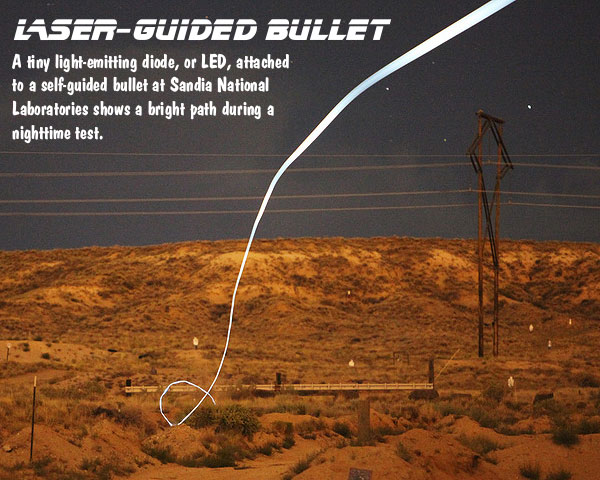
Two Sandia National Laboratories engineers, both hunters, have developed a patented design for a laser-guided bullet. The 4″-long laser-guided projectile has made hits at ranges up to 2000 meters. No this is NOT an April Fools’ joke. The projectile shoots from a smooth-bore rifle and uses small, movable fins to adjust its trajectory. The fins are controlled by micro-sized actuators in response to signals from a tiny, onboard laser-sensor. Plastic sabots provide a gas seal and protect the delicate fins while the projectile is in the firearm’s barrel.
Click Here for Video News Report on Sandia-developed Guided Bullet
Sandia researchers Red Jones and Brian Kast (and colleagues) have invented a dart-like, self-guided bullet for small-caliber, smooth-bore firearms that could hit laser-designated targets at distances of more than a mile. “We have a very promising technology to guide small projectiles that could be fully developed inexpensively and rapidly,” Jones said. Researchers have had initial success testing the design in computer simulations and in field tests of prototypes, built from commercially available parts, Jones said. While engineering issues remain, “we’re confident in our science base and we’re confident the engineering-technology base is there to solve the problems,” he said.
Sandia’s design for the four-inch-long bullet includes an optical sensor in the nose to detect a laser beam on a target. The sensor sends information to guidance and control electronics that use an algorithm in an eight-bit central processing unit to command electromagnetic actuators. These actuators steer tiny fins that guide the bullet to the target.
Fin-Stabilization — Like on a Guided Missile
The guided projectile is shot from smooth bore barrel with no rifling. While conventional bullets are spin-stabilized, Scandia’s guided bullet doesn’t spin in flight. To enable the guided bullet to adjust its trajectory toward a target and to simplify the design, the spin had to go, Jones said. As on most guided missiles, fins both stabilize and steer the projectile. But on this projectile, the fins are tiny — just a few millimeters tall.
The bullet flies straight due to its aerodynamically stable design, which consists of a center of gravity that sits forward in the projectile and tiny fins that enable it to fly without spin, just as a dart does, he said. The four-inch-long bullet has actuators that steer tiny fins that guide it to its target.
Projectile Flies at 2400 fps — More Speed Is Possible
Testing has shown the electromagnetic actuator performs well and the bullet can reach speeds of 2,400 feet per second, or Mach 2.1, using commercially available gunpowder. The researchers are confident it could reach standard military speeds using customized gunpowder.
Sub-MOA Accuracy at 1000m — No Matter What the Wind Does
Computer aerodynamic modeling shows the design would result in dramatic improvements in accuracy, Jones said. Computer simulations showed an unguided bullet under real-world conditions could miss a target more than a half mile away (1,000 meters away) by 9.8 yards (9 meters), but a guided bullet would get within 8 inches (0.2 meters), according to the patent.
The prototype does not require a device found in guided missiles called an inertial measuring unit, which would have added substantially to its cost. Instead, the researchers found that the bullet’s relatively small size when compared to guided missiles “is helping us all around. It’s kind of a fortuitous thing that none of us saw when we started,” Jones said.
As the bullet flies through the air, it pitches and yaws at a set rate based on its mass and size. In larger guided missiles, the rate of flight-path corrections is relatively slow, so each correction needs to be very precise because fewer corrections are possible during flight. But “the natural body frequency of this bullet is about 30 hertz, so we can make corrections 30 times per second. That means we can over-correct, so we don’t have to be as precise each time,” Jones said.
Projectile Becomes More Stable After Launch
Researchers also filmed high-speed video of the bullet radically pitching as it exited the barrel. The bullet pitches less as it flies down range, a phenomenon known to long-range firearms experts as “going to sleep.” Because the bullet’s motions settle the longer it is in flight, accuracy improves at longer ranges, Jones said. “Nobody had ever seen that, but we’ve got high-speed video photography that shows that it’s true,” he said. (See below)
Freedom Group Inc., owned by private holding company Cerberus Capital Management, has swallowed up another medium-sized gun manufacturer. This time the target (or victim, depending on your perspective), was Para USA, Inc., (Para). This is Freedom Group’s first acquisition of a pistol-only manufacturer.
Para is best known for a high-capacity pistol based generally on the 1911 design but with options such as a Light Double Action (LDA) Trigger and double-stack mags (though it makes traditional single action, single-stack 1911s also). Freedom Group acquired control of Para through an asset purchase agreement. For the time being, Para will continue day-to-day operations at its Pineville, NC-based factory, but we would not be surprised if the Para plant is eventually shuttered and Para production is moved to other Freedom Group facilities.
Founded in 1985, Para has a solid but not stellar reputation for handgun performance and design innovation. There are numerous fans of Para pistols, with many shooters attracted to a 1911-style design with a higher capacity (up to 14+1 in .45 ACP and 18+1 in 9mm). In recent years, Para’s designs have moved out of the the spotlight, as other manufacturers have produced 1911-style pistols in large numbers. Major 1911 builders now include: Kimber, Springfield Armory, Sig Sauer, Smith & Wesson. Remington Arms, another Freedom Arms company, successful launched its own 1911 last year.
What Are Freedom Group’s Real Intentions?
“We welcome Para into the Freedom Group Family of Companies,” stated E. Scott Blackwell, Freedom Group’s Chief Sales and Marketing Officer. “Para USA… is a perfect complement to our industry-leading family of brands[.] We look forward to deploying both human and financial resources to continue to develop and supply current and future handguns for consumers and our channel partners.”
Will Para-USA Production Be Moved?
“Deploying both human and financial resources” — well, that phrase could be read two ways. It may mean that the Freedom Group will pump resources into Para-USA. On the other hand, the Freedom Group may be contemplating moving jobs, machinery, and production assets. Mr. Blackwell concluded by saying: “We also wish to thank all [Para’s] employees for their continued dedication….” Notably, he did not say those employees will retain their jobs. Time will tell. It will be interesting to see if Para USA remains a viable brand in five years time, or whether it simply becomes the Remington pistol division. Think of the evolution of Bushmaster. After being acquired by the Freedom Group, all Bushmaster’s production was moved to Remington’s Ilion, NY factory.
How well do you know the key provisions of Federal firearms regulations? If you want to play the game, you better know the rules. Thankfully, you can access most important Federal firearms laws in one convenient PDF document, the Federal Firearms Regulations Reference Guide. The Bureau of Alcohol, Tobacco, Firearms and Explosives (ATF) has collected and published key federal firearms statutes in this 242-page, downloadable Reference Guide. The actual statutes and rulings are collected in the front of the document. There is an index on page 169 that will help you get answers to specific questions. NOTE: this Reference Guide came out in 2005. If you have serious concerns about compliance with Federal law you should check with the ATF directly to obtain the latest versions of federal statutes.
Important Topics in the Q&A Section include:
Building of Firearm for personal use
Transfers of firearms
Out of state purchases of firearms
Rules for Shipment of firearms
Mailing firearms via U.S. Postal Service
Residency Rules
Curio and Relic Firearms
NFA Firearms Rules
FFL Sales at Gunshows
Special Rules for Gunsmiths, Pawn-brokers, and Auctioneers
Ammunition Manufacturing Rules
NICS Procedures
ATF Guide to State Gun Laws
Along with the Guide to Federal Regulations, the ATF offers a free downloadable guide to State Laws and Published Ordinances. The latest version we found online was the 30th Edition, drafted in 2009 and revised in 2010. This 526-page PDF guide covers all 50 states, and provides a “Ready Reference Table” to assist gun dealers and FFLs comply with all state laws when selling or transferring arms.
This is a very useful resource, but we remind all readers that they should check for updates or changes in state laws since this document was published four years ago. To aid in that task, the ATF’s State Law Guide has a complete list of state Attorneys General Offices with contact information. The ATF also provides answers to Frequently Asked Questions on its website. CLICK HERE for ATF FAQ. Other ATF Publications are available at http://www.atf.gov/publications/firearms/.
Many readers will be driving across multiple states this spring and summer to attend competitions. Other shooters will be heading out of state for a game hunt or to spend a week in the prairie dog fields. For $13.95 you can purchase a state-by-state Traveler’s Guide to firearms laws. Written by a lawyer, this 68-page guide covers all firearms types and all 50 states. It even has info for Canada and Mexico. The latest edition of the Traveler’s guide, updated with 85 changes for 2012, has just been released.
The Traveler’s Guide to the Firearm Laws of the Fifty States has sold more than 900,000 copies since it was first released in 1996. The book’s author, Attorney J. Scott Kappas, has written numerous magazine articles and has appeared on television, explaining the unexpected pitfalls that shooters may encounter when traveling with firearms. Along with being an attorney, Mr. Kappas serves as a director on the Board of the Kentucky Firearms Foundation, and Kappas is a Class III firearms dealer.
The Traveler’s Guide is especially useful for shooters traveling in RVs and motorhomes. The American Rifleman Magazine declared: “This book is a must-have for truck drivers, motor home enthusiasts, campers and other travelers…easy to read and understand, well-organized and concise….” One reader from Texas adds: “I used to think that my RV was the same as my home when it came to gun carry….the Traveler’s Guide set me straight. Now I know my motorhome is subject to the same laws as any vehicle when it comes to guns.”
MidwayUSA’s Master Catalog has been the “magnum opus” of gun gear catalogs. Over 1,000 pages long, the Master Catalog includes more than 100,000 products. This year, the 35th Annual MidwayUSA Master Catalog is available is a convenient PDF Digital Edition. There are over 1,040 pages in this new digital edition, complete with color photographs, firearm schematics, reference charts, detailed product information, and an extensive index to help you find exactly what you need. You can even download these files to your tablet, laptop, or smartphone.
Download the 200mb digital edition by visiting MidwayUSA’s Catalog Center. Scroll down the page until you see Click to Download the Entire Catalog in the lower left. We’ve tried out the 35th Annual Master Catalog loaded on an iPad and it’s very handy. It’s nice to have it on the iPad drive, so you can access the complete inventory of gear and reloading components even without an active web connection.
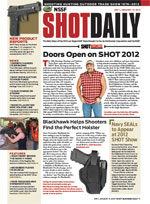
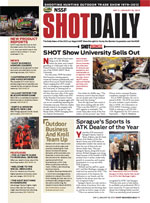
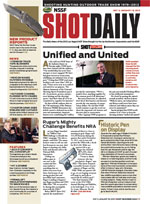
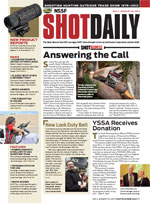
If you weren’t able to attend SHOT Show last week, you can still read the Digital editions of all four issues of SHOT Daily, the magazine printed each day of the SHOT Show. You’ll find some interesting product announcements in the SHOT Dailies, plus late-breaking gun industry news.
The DAY 1 edition features the annual round-up of new firearms, while the DAY 2 edition highlights new-for-2012 optics. On Pages 20-23 of the Day 3 edition, you’ll find an interesting article by John Snow on a 6mm Creedmoor wildcat (6.5 Creedmoor necked down — see below). The final Day 4 edition includes a guide to .375-Caliber big game cartridges, along with coverage of the latest Air Gun technologies.
The 2012 SHOT Show Dailies are available online at Shotbusiness.com and the SHOT Show Blog, or just click the links below. You can read the Digital Editions online, or download PDF versions to your computer. NOTE: The PDFs are very large files, slow to download.
We ran into Dustin Ellermann of ‘Top Shot’ fame at the Volquartsen booth at SHOT Show. Dustin is Top Shot’s Season 3 Champion. Dustin demonstrated his shooting abilities with a totally dominating performance on the Season 3 Final episode. And before that Dustin made what was probably the most difficult rifle shot ever on Top Shot — hitting a golf ball with a .22LR rifle at 100 yards — with no sighter shots and no windflags. That’s not easy, even with a rimfire benchrest rifle and $15/box ammo.
In the video interview above, Dustin explains how he made his now-famous golf ball shot, and he also talks about some of the more extreme marksmanship challenges on Top Shot — such as shooting at plates while being attached to a giant rotating wheel suspended off the ground.
In winning the Top Shot Season 3 title, Dustin, a self-taught shooter in his first-ever real competition, beat 15 other skilled marksman, most with much more impressive “shooting resumes”. Displaying poise, speed, and superior accuracy, Dustin proved he had the “right stuff”. Time and time again, Dustin sent “big name” shooters (with years of competition experience) packing. And throughout the Top Shot season, Dustin, a Christian Camp Director, kept a positive attitude and exhibited good sportsmanship.
Dustin is a “natural” — a born marksman. But he’s not just a “gun guy”. In real life he serves as a minister, accountant, lumberjack, husband, father of two and foster father of three. Dustin lives in the middle of the Angelina National Forest and considers himself a Renaissance man.
From Fellow Top Shot Competitor Kelly Bachand (Season 1)
On an NRA radio segment before Top Shot Season 3 got underway, Colby Donaldson said that in Season 3 we would see one of the most talented shooters Top Shot has ever had, while not using Dustin’s name for obvious reasons. Colby went on to say that the performance was nearly unbelievable. When the season was complete, and Dustin was crowned champion, Colby declared: “Dustin may be the best shooter we ever had. He surprised everybody, it was across the board”.
I watched Dustin surprise the other competitors and America over and over again on Top Shot Season 3. I grew to respect him as I saw that his deep faith in God encouraged humility and sincerity that was lacking in many other competitors. Whether watching twelve hits in a row while spinning upside down, or watching Dustin hit a golf ball at 100 yards with no practice shots, he impressed us all at some point. To me, however, even more impressive was the way Dustin always remained humble and showed good sportsmanship towards those he had out-shot. I congratulate Dustin on his win, and was glad to be able to meet him recently. — Kelly B.
Though it is a 20-year-old design, the Oehler Model 35P Chronograph remains one of the best chronographs on the market. By employing three screens instead of two, the 35P takes two (2) measurements of each shot — adding an extra measure of reliability. It has very simple controls, so you don’t need to bring a 100-page manual to the range. The Model 35P features an integrated printer that conveniently records every shot and calculates Average Velocity, SD and ES for your strings. We like having the “hard-copy” output from our tests. This way we can simply staple the our paper record to the target and nothing gets lost.
Model 35P is Back in Production Oehler Research decided to phase out the model 35P Proof Chronograph a few years back. But consumer demand never abated. In fact, the prices of used units started to climb. So Ken Oehler decided to bring back the model 35P, and we’re glad he did. In the video below Ken explains that the Model 35P is back in regular production, now that his company has found a source for printer components. The Model 35P, complete with printer, skyscreens, and mounting rail costs $575.00. Ken told us “If we knew how to make them cheaper, we would … but we make ‘em so they work.”
If you already own or use a Model 35P, be sure to watch the video through to the end. In the last minute, Ken Oehler demonstrates how to position the metal support that holds the paper roll. Putting this support in place can be tricky to say the least. But the video shows how to accomplish the task quickly, without losing your temper.
Another helpful tip, provided by Ken’s wife, will help you feed the paper into the machine. Simply take the end of the paper and fold both left and right sides in toward the middle, forming a ‘V’ (like the nose of a paper airplane). This will then advance much easier through the printer’s internal spools when you load new paper.
Before the largest crowd ever to watch a 3-gun match, and with the largest payday in the history of the sport on the line, on the evening of January 18th, eight of the country’s top 3-gunners stepped to the firing line at the Clark County Range outside Las Vegas. With the famous Las Vegas strip illuminating the desert sky as the backdrop, the sport of 3-Gun formally announced its arrival to the shooting industry, major media outlets and a national television audience.
Photo by Tim Walsh www.seanchaicom.com
Team FNH USA’s Tommy Thacker defeated teammate Mark Hanish in the final round of the 3-Gun Nation Championship Finale, sponsored by Brownells, to become the 2012 3-Gun Nation Champion, winning an unprecedented $50,000 from Leupold Tactical Optics and NBC Sports Network.
“Unbelievable,” Thacker said, trying to put the enormity of the moment into words. “The only thing I could think is I am so blessed and everything happens for a reason. The only thing I could think is to thank God. When you think about everything that happened, I don’t know how else to describe it. Coming into this, I knew everything was right. I was in the zone more than I’ve ever been, and after the first run, I knew I was going to win this thing.”
For finishing second, Hanish was awarded a Barrett MRAD rifle fitted with a Leupold scope and BORS system, along with a check for $2,500 from Brownells.
Counting prizes awarded to other finals competitors, the Las Vegas payouts totaled $67,500, with an additional $15,000 in product value. In all, 3-Gun Nation paid out more than $150,000 in cash prizes on the 2011-2012 3GN Tour.
Champion’s Profile: Tommy Thacker is Director of Product Management for Law Enforcement & Commercial Sales with FNH USA. He is also a nationally-ranked competitive shooter, certified firearms instructor, and small business owner. He served as the inaugural Captain of FNH USA’s award winning shooting team.
The 3GN Championship Finale, sponsored by Brownells and sanctioned by NRA Sports, was the culminating event of the 2011-2012 FNH USA 3-Gun Nation Tour, Presented by SureFire. Spanning ten major 3-gun events all across the country, more than 1,500 competitors earned scores toward the 3GN Standings. From there, the top 50 competitors qualified to the 3-Gun Nation Championship in November, a one-day Tactical Optics-only match that comprised the deepest field of 3-gun talent ever assembled. The top 16 shooters then battled in an elimination Shoot-Off, with the Final 8 advancing to the Las Vegas Rumble On the Range.


 If you’re considering a mid-sized 6mm cartridge for your next rifle, you’re probably wondering WHICH mid-size 6mm cartridge is best. We are often asked “what’s the difference between the 6×47 Swiss Match, the 6XC, and the 6.5×47 Lapua necked down to 6mm?” All three cartridges have 30° shoulders and fit a .308-sized boltface. However, alone among the three, the 6mm-6.5×47 has a small primer pocket and small flash hole. The 6×47 Swiss Match (made by RUAG), and the 6XC (produced by Norma), have a large primer pocket and large flash hole, just like a .308 Winchester.



 The Traveler’s Guide to the Firearm Laws of the Fifty States has sold more than 900,000 copies since it was first released in 1996. The book’s author, Attorney J. Scott Kappas, has written numerous magazine articles and has appeared on television, explaining the unexpected pitfalls that shooters may encounter when traveling with firearms. Along with being an attorney, Mr. Kappas serves as a director on the Board of the Kentucky Firearms Foundation, and Kappas is a Class III firearms dealer.
 MidwayUSA’s Master Catalog has been the “magnum opus” of gun gear catalogs. Over 1,000 pages long, the Master Catalog includes more than 100,000 products. This year, the 35th Annual MidwayUSA Master Catalog is available is a convenient
  If you weren’t able to attend SHOT Show last week, you can still read the Digital editions of all four issues of SHOT Daily, the magazine printed each day of the SHOT Show. You’ll find some interesting product announcements in the SHOT Dailies, plus late-breaking gun industry news.

 In winning the Top Shot Season 3 title, Dustin, a self-taught shooter in his first-ever real competition, beat 15 other skilled marksman, most with much more impressive “shooting resumes”. Displaying poise, speed, and superior accuracy, Dustin proved he had the “right stuff”. Time and time again, Dustin sent “big name” shooters (with years of competition experience) packing. And throughout the Top Shot season, Dustin, a Christian Camp Director, kept a positive attitude and exhibited good sportsmanship.
 If you already own or use a Model 35P, be sure to watch the video through to the end. In the last minute, Ken Oehler demonstrates how to position the metal support that holds the paper roll. Putting this support in place can be tricky to say the least. But the video shows how to accomplish the task quickly, without losing your temper.


