Mark your calendars, gents. The IBS 600-yard Nationals are slated for the weekend of September 30th through October 2nd. The event will be held at the Midwest Benchrest Range in Yukon, Missouri. The 2011 600-yard Nationals consist of an 8-target Aggregate match in Light Gun (LG), plus an 8-target Aggregate match in Heavy Gun (HG). There will be a total (LG + HG) of 16 record targets (5 record shots each [80 total]). After a safety meeting, the match begins at 9:00 am on FRIDAY September 30th, and continues on SATURDAY, October 1st. Sunday October 2nd is a reserve day if needed due to weather delays.
Sight-In and Practice Times on Thursday
Thursday, September 29 will be the last day to register. The range is also open on Thursday 9:00 am to 6:00 pm for sight-in and set-up. NOTE: Due to the nature of this event, practice/sight-in will not be available on match days (9/30 – 10/2) prior to the start of the matches.
Norma has announced a recall of certain lots of Norma 217 powder, product # 20932175 (500gr cannister). According to Norma: “The present batch of 217 powder is recalled as it can give high pressure under some circumstances. We hope to have a good batch available later this autumn.” Norma 217 is commonly used for magnum cartridges. Norma describes 217 as a “flexible magnum powder, suitable where there is relatively large case volume in relation to the bore size.” Norma has not yet published the lot number(s) of the affected 217 powder batch.
If you have some 217 powder and are concerned whether it is subject to recall, contact Norma at:
Norma Precision AB
670 40 Åmotfors Sweden
Tel: +46 (0) 571 315 00
Fax: +46 (0) 571-315 40
Web: www.norma.cc
California maintains some of the toughest firearms laws in the country. In most California counties, it is virtually impossible to get a permit for concealed carry. Handguns are subject to long waiting periods, and many perfectly reliable handguns are banned from sale in California.
Each year the situation gets worse, with new laws enacted that further restrict the rights of Californians to defend themselves and their homes. Recently, the California State Senate approved AB 144, a bill that would dismantle Californian’s long-standing right of “open carry”. If AB 144 is signed by Governor Jerry Brown, this will make open carry a crime — even when camping or hiking.
What will happen to California gun owners if current trends continue? Will citizens of the Golden State be able to protect themselves in their own homes? Well this video answers those questions. The video is a dramatization, but it shows what could happen if California’s anti-gun legislators continue to hold sway. Watch the video to see a chilling preview of gun ownership in California.
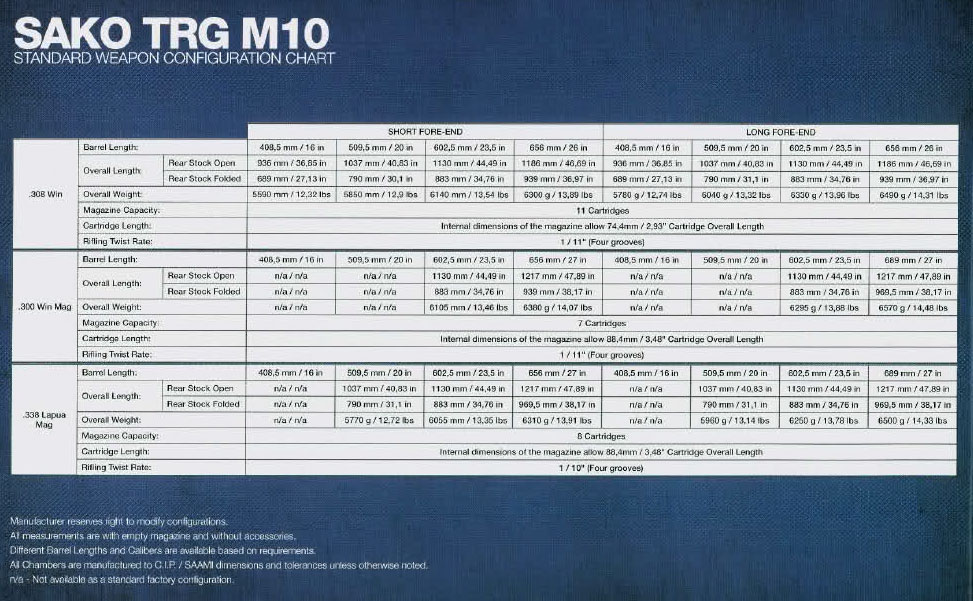
Last week, at the DSEi trade show in London, UK, Sako unveiled an all-new tactical rifle, designed from the ground up as a modular system, which can be user-configured in the field to shoot multiple calibers. By changing bolts and barrels, Sako’s new TRG M10 can be switched from a 7.62×51 NATO round to the .300 Win Mag, or the even larger .338 Lapua Magnum. With the capability of the TRG M10 to shoot both standard and magnum cartridges, Sako now has a product that can compete with other multi-caliber sniper rifles such as the Barrett MRAD, released last year. CLICK HERE for TRG M10 Spec Sheet.
Sako Breaks TRG Mold with New M10
The TRG M10 represents quite a departure from Sako’s current TRG models which use a composite shell over a metal chassis which holds the barreled action. There is no outer shell or “skin” on the TRG M10. The action bolts into a rigid, exposed metal chassis to which a rail-equipped metal forearm/handguard is attached. Bipods can mount directly to a bottom Picatinny-style rail or to a metal block clamped to the rail on the underside of the forearm (See Photos).
TRG M10 Previewed in London CLICK HERE to view more photos of the new TRG M10. These images, taken at DSEi in London, show the rifle both fully assembled as well as pulled apart into its major sections: action/barrel, folding stock, forearm, bolt assemblies, magazines. As the TRG M10 is designed to shoot multiple calibers, it employs two different bolt assemblies to fit both standard and magnum cases (of course this requires a barrel interchange as well).
For Military and Law Enforcement Only — for Now
Currently, the TRG M10 is marketed for “military and law enforcement only.” It will be interesting to see if Sako eventually decides to sell the TRG M10 to American civilian shooters. If Sako changes its mind about the civilian market, we would not be surprised if an announcement to that effect would be made at SHOT Show 2012 (to be held Las Vegas, NV, January 17-20, 2012). The TRG M10 system will next be displayed at the Milipol trade show in Paris, France on October 18-21, 2011.
There is an extensive discussion of the new Sako TRG M10 on the Snipers’ Hide Forum. Overall, the initial reaction of ‘Hide members has been positive. Quite a few of those who commented on the rifle stated they would purchase a TRG M10 if it was offered to civilians. Hopefully Beretta, Sako’s parent company, will recognize that popular demand for the TRG M10 would be sufficient to justify its release to the civilian market. Only time will tell….
September 11-17, the Bald Eagles Rifle Club hosted the 2011 Spirit Of America rifle match, at the NRA Whittington Center in Raton, NM. This match serves as U.S. National Fullbore Championships, but there are also F-Class divisions. The match consists of conventional sling (TR) class, as well as F-Open and F-TR, and the event is shot at distances of 300, 500, 600, 800, 900 and 1000 yards. Approximately 80 shooters, including about 20 F-classer attended the event.
Bryan Litz won the Fullbore TR (sling) competition with a 1782-105X overall score, with runner-up Andrew Wilde (1780-101X), just two points behind. Sean Morris finished third with 1776-85X, and Jim O’Connell shot 1772-81X to claim the High Senior title.
Photo by Randy Pike
In F-Open Class, familiar names topped the leaderboard. Larry Bartholome earned his chair ride as F-Open winner, shooting an impressive 1776-98X. Second in F-Open, five points back at 1771-96X, was past F-Class National Champion Danny Biggs. In the F-TR division, Michael Smith topped the field with a 1738-69X, followed by John Killen, who shot a 1720-52X. NOTE: F-Open and F-TR competitors shoot a target with smaller-diameter scoring rings than the Fullbore Target.
Conditions Were Mild… Then Wild
Bryan Litz tells us the conditions weren’t so bad … until the final day: “We dodged some rain throughout the week, but wind conditions were easy to moderate for the most part. That is until the last 1000-yard string of the last day when Raton finally showed its evil side! The most wind I had used all week was just over 3 MOA. That last relay on Saturday, it was running between 7 and 12 MOA with very quick changes. There were many misses, and just keeping all shots in the black was an accomplishment.” Rick Hunt concurred that the conditions were arduous on the final 1K stage: “At 1000 yards, there was a 9:00 o’clock wind running between 9 1/2 and 13 1/2 MOA. As seen by the scores, two shooters really nailed it. Other than that, it was pretty disastrous for most shooters with the really fast velocity changes.”
When the smoke had cleared, the standings were all jumbled up compared to what they were the rest of the week. Litz added: “An experience like that really drives home the importance of wind shooting skills. To be honest, I had no particular strategy going in other than to stay calm and positive no matter what. A big part of shooting in adverse conditions is managing yourself mentally. I dropped 10 points that last relay, more than I’d lost in the entire tournament up to that point. But given the conditions, I felt good about it, knowing I’d done my best.”
Berger 155gr Hybrids Work Well in Fullbore Competition
Bryan Litz credits his 155gr Berger .308-cal Hybrids for his strong performance: “I was shooting the new Berger 155 grain Hybrid bullets which played a part in saving some points in that nasty wind (on the last day). Due to their length, these bullets require a 1:12″ twist to stabilize and have a higher BC than any other .30 caliber 155 grain bullet. The hybrid ogive makes them length tolerant (insensitive to seating depth) and as the results of this tournament show, they are very effective”.
Complete Final Scores On SOA Blog
You’ll find complete interim and final SOA Match Scores linked from the Bald Eagles Match Blog.
At the match the USA Young Eagles unveiled the new uniforms the American team will wear at the World Fullbore Championships in Australia next month. On opposite sleeves, the uniforms feature logos from both major bullet sponsors — Berger and Sierra. Bryan Litz observerd: “Historically teams have been sponsored by ‘one or the other’, but there’s no reason a team can’t enjoy sponsorship by multiple brands, and this is a very positive step in that direction.”
Get ready for a major new technology that could change the benchrest game. Carlos (Carlito) Gonzales, a benchrest shooter (and Professor of Engineering) from Argentina, has perfected a horizontal, external “floating” cartridge loader that can reliably feed PPC cartridges as fast as you can work the bolt.
We have received a report that Gonzales’s fast-feeding device has been approved by the NBRSA for use in benchrest matches. Pascal Fischbach told us: “I had an email September 17th from Gene Bukys, [stating] that the board of directors of the NBRSA approved the use of the ‘[Gonzales] manual cartridge feeder’ for use in NBRSA competitions.” [Editor’s note: We don’t yet know if the device is approved for all NBRSA benchrest matches, or just short-range matches.] Pascal added: “The device was presented at the delegates meeting of the WBC11 in France and approved for use during the World Championships. The next step for Carlito will be to market it. He is also willing to license the concept, plans, and methods to a machinist capable of manufacturing it in the USA.” See Discussion Thread.
External Horizontal Cartridge-Feeder
The Gonzales loading device is an open-ended, covered metal tray situated on the left side of the action (but it does not touch the gun — it is supported by an arm attached to the front rest). This feeds into the left-side loading port. The cases are gravity-fed, but the shooter has positive control over feeding. A cable with a push-button control runs from the magazine down to the rear foot of the pedestal rest. You just push the button to drop one cartridge from the magazine. We don’t know exactly how the cartridge is released in the magazine itself, but in the video below you can see how the push-button works.
You push the button as soon as a spent cartridge ejects (watch Carlito’s left hand in the video above). It is a clever set-up that works very, very fast. The video shows Carlos running five cartridges through his action in just 9 seconds (time marker 00:31 – 00:40). That’s fast! On a repeat viewing focus on Carlito’s left hand to see how he works the push-button cartridge dispensing control.
Credit to Pascale Fischbach for sourcing this story and video link.
Here’s a great way to be rewarded for joining the NRA, or renewing your existing NRA membership. If you go to a Cabela’s store during Cabela’s 50th Anniversary event this weekend, September 17 & 18, 2011, you can get your annual NRA membership for just $25.00 — that’s $10.00 off the regular fee.
But it gets even better. Cabela’s has sweetened the pot by giving a $25.00 gift card to everyone who joins or renews their NRA membership this weekend. This Cabela’s gift card can be used to purchase in-store merchandise, and other items sold online through Cabelas.com. You can’t go wrong with this promotion. Spend $25 on an NRA membership, and get every penny back in Cabela’s merchandise credit. Nice.
Already an NRA Life Member? You can take part in the celebration as well. The first 50 NRA Life Members to walk through the doors of each Cabela’s store will receive a free Cabela’s 50th Anniversary pistol case with the NRA logo on the handle.
Here’s a little known fact that may startle most readers, even experienced gunsmiths: your barrel wears out in a matter of seconds. The useful life of a typical match barrel, in terms of actual bullet-in-barrel time, is only a few seconds. How can that be, you ask? Well you need to look at the actual time that bullets spend traveling through the bore during the barrel’s useful life. (Hint: it’s not very long).
Bullet-Time-in-Barrel Calculations
If a bullet flies at 3000 fps, it will pass through a 24″ (two-foot) barrel in 1/1500th of a second. If you have a useful barrel life of 3000 rounds, that would translate to just two seconds of actual bullet-in-barrel operating time.
Ah, but it’s not that simple. Your bullet starts at zero velocity and then accelerates as it passes through the bore, so the projectile’s average velocity is not the same as the 3000 fps muzzle velocity. So how long does a centerfire bullet (with 3000 fps MV) typically stay in the bore? The answer is about .002 seconds. This number was calculated by Varmint Al, who is a really smart engineer dude who worked at the Lawrence Livermore Laboratory, a government think tank that develops neutron bombs, fusion reactors and other simple stuff.
On his Barrel Tuner page, Varmint Al figured out that the amount of time a bullet spends in a barrel during firing is under .002 seconds. Al writes: “The approximate time that it takes a 3300 fps muzzle velocity bullet to exit the barrel, assuming a constant acceleration, is 0.0011 seconds. Actual exit times would be longer since the bullet is not under constant acceleration.”
We’ll use the .002 number for our calculations here, knowing that the exact number depends on barrel length and muzzle velocity. But .002 is a good average that errs, if anything, on the side of more barrel operating life rather than less.
So, if a bullet spends .002 seconds in the barrel during each shot, and you get 3000 rounds of accurate barrel life, how much actual firing time does the barrel deliver before it loses accuracy? That’s simple math: 3000 x .002 seconds = 6 seconds.
Gone in Six Seconds. Want to Cry Now?
Six seconds. That’s how long your barrel actually functions (in terms of bullet-in-barrel shot time) before it “goes south.” Yes, we know some barrels last longer than 3000 rounds. On the other hand, plenty of .243 Win and 6.5-284 barrels lose accuracy in 1500 rounds or less. If your barrel loses accuracy at the 1500-round mark, then it only worked for three seconds! Of course, if you are shooting a “long-lived” .308 Win that goes 5000 rounds before losing accuracy, then you get a whopping TEN seconds of barrel life. Anyway you look at it, a rifle barrel has very little longevity, when you consider actual firing time.
People already lament the high cost of replacing barrels. Now that you know how short-lived barrels really are, you can complain even louder. Of course our analysis does give you even more of an excuse to buy a nice new Bartlein, Krieger, Shilen etc. barrel for that fine rifle of yours.
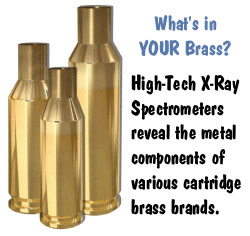
Are there significant metallurgical differences in the alloys used in various brands of cartridge brass? The answer is yes, and we have proof. Using a state-of-the-art X-Ray Fluorescence Spectrometer, some tech-savy Wisconsin shooters recently analyzed the alloys in seven different types of cartridge brass.
The test results revealed significant differences in the percentages of copper and zinc in the different brands. Copper content ranged from a low of 72% by mass (Winchester, S&B) to a high of 80% by mass (Remington). Zinc, which adds hardness to the alloy, ranged from a low of 20% by mass (Federal) to a high of 36% (‘brown box’ Lapua). Interestingly, the tests, as reported by Forum Member Fred Bohl, revealed that the alloy in the new ‘blue box’ 6mmBR Lapua brass is different than the alloy in Lapua’s older ‘brown box’ 6mmBR brass. Specifically, the ‘blue box’ 6mmBR brass has more copper and less tin (by mass). Here’s a summary of the X-Ray Fluorescence spectrometry tests:
This testing was done at major science laboratory, using high-grade X-Ray Spectrometry Analyzing equipment. Fred reports that: “The data was run by one of the club members with the permission of the test lab supervisor who is also a club member and shooter. The data in original output reports was far more detailed about trace elements at lower orders of magnitude primarily from surface contaminants (some were rerun after establishing a repeatable cleaning procedure)”. The testing process is discussed in this Shooters’ Forum thread.
We do NOT have the metallurgical expertise to infer that any particular alloy shown above is “better” than another. The alloy “blend” is merely one of many variables that can have an impact on the performance and quality of the finished product. Annealing times/methods differ and some cartridge brass is extruded while other cartridge brass is made with the traditional drawing process. Readers should not presume, on reading the above chart, that they can identify the “best shooting” brass simply based on the constituent metals in the various alloys.
General Observations about Cartridge Brass Alloys
With the cartridge brass X-Ray Spectrometry results in hand, Fred Bohl hoped to find out what “real world” conclusions (if any) we could draw from the raw data. Fred sent the test results to some knowledgeable metallurgists, soliciting their comments. Fred explains: “When I first posted this information [in the Shooters’ Forum], I had hoped to elicit replies from expert metallurgists and to initiate a useful discussion. From [their replies] I distilled the following ‘consensus’ comments”:
1. The range of Copper/Zinc ratios suitable for use in cartridge making by typical processes is 85/15 to 65/35 (% by weight or mass).
2. The range of Copper/Zinc ratios suitable for use in cartridges intended for reloading is 80/20 to 70/30. Above 80% copper, the resulting case would tend to be too soft and difficult to attain the distribution of hardness desired (harder at the base and softer at the neck). Below 70% copper the resulting case would tend to be too hard, would work harden too quickly and require frequent annealing. [Editor: That said, the ‘brown box’ 6mmBR Lapua brass, with 62% copper/36% zinc content, enjoys an unrivaled reputation for both accuracy and its ability to perform well after a dozen or more reloading cycles. We know 30BR shooters who have shot the same old-style Lapua brass (6mmBR parent case) more than 50 times. So maybe the “expert” view needs re-thinking.]
3. As the percentage of zinc increases, the tensile strength, yield strength and hardness tend to increase. However, above 35% zinc, while tensile strength will continue to tend to increase, both yield strength and hardness will tend to begin to decrease.
4. The trace additives of iron and/or silicon are used to control the processing characteristics of the alloy. Trace additions of chromium will improve corrosion resistance and give a shinier surface (both largely cosmetic).
5. Selection of the alloy and additives is a trade off among: end use desired properties; processing time and yield; and cost of materials. For example, the classic 70/30 cartridge brass was considered an optimum combination of corrosion resistance and hardness for single use by the military with good process yield at acceptable material cost.
6. All of my responding experts were surprised by the brown box Lapua alloy except for the oldest. He remembered using an almost identical alloy late in WWII when copper was in very short supply for military small arms ammunition.
Distribution of CH-Reticle Benchrest Scopes Will Be Limited
If you’re looking for a Nightforce 12-42×56 Benchrest model scope with a CH-series reticle, you may want to act soon. Nightforce is reducing production of these models and the limited runs will be strictly earmarked for Nightforce’s most active dealers. (NF Benchrest scopes with other reticle choices will continue to be widely available). Nightforce’s CH (i.e. cross-hair) reticles, are offered in three versions: CH-1 (fine cross-hair), CH-2 (fine cross-hair with 0.2 MOA inscribed dot), and CH-3 (fine cross-hair with 0.2 MOA “floating” dot). The CH reticles have always been popular with benchresters, as they provide an unobstructed view of mirage and windflags. The CH-2 reticle has been used by the USAMU for long-range and High Power competition. The CH-3 includes an open area around the 0.2 MOA dot, which makes the dot easier to see on dark backgrounds. On the CH-3, only the dot can be illuminated.
Where to Find Nightforce BR Models with CH Reticles
The CH-series reticles are no longer offered in the lower-power 8-32×56 BR model at all. If you want a CH reticle in a NF Benchrest scope, you’ll need to order the 12-42×56 scope. AND, you’ll now need to order from a major stocking dealer. EuroOptic.com currently has one of the largest inventories of 12-42×56 BR Nightforce scopes with CH Reticles — it has about 50 of these CH reticle Benchrest scopes in stock. To order, call (570) 220-3159, ask for Jason Baney and mention that you heard about these CH reticle scopes through the Daily Bulletin. Jason will make sure you get the right CH reticle version at the best possible price. Another large stocking dealer of Nightforce scopes is D&B Supply, found on the web at ScopeUsOut.com.


 Mark your calendars, gents. The IBS 600-yard Nationals are slated for the weekend of September 30th through October 2nd. The event will be held at the Midwest Benchrest Range in Yukon, Missouri. The 2011 600-yard Nationals consist of an 8-target Aggregate match in Light Gun (LG), plus an 8-target Aggregate match in Heavy Gun (HG). There will be a total (LG + HG) of 16 record targets (5 record shots each [80 total]). After a safety meeting, the match begins at 9:00 am on FRIDAY September 30th, and continues on SATURDAY, October 1st. Sunday October 2nd is a reserve day if needed due to weather delays.
 Norma has announced a recall of certain lots of Norma 217 powder, product # 20932175 (500gr cannister). According to Norma: “The present batch of 217 powder is recalled as it can give high pressure under some circumstances. We hope to have a good batch available later this autumn.” Norma 217 is commonly used for magnum cartridges. Norma describes 217 as a “flexible magnum powder, suitable where there is relatively large case volume in relation to the bore size.” Norma has not yet published the lot number(s) of the affected 217 powder batch.
 California maintains some of the toughest firearms laws in the country. In most California counties, it is virtually impossible to get a permit for concealed carry. Handguns are subject to long waiting periods, and many perfectly reliable handguns are banned from sale in California.
 Sako Breaks TRG Mold with New M10





 Gone in Six Seconds. Want to Cry Now?
 Are there significant metallurgical differences in the alloys used in various brands of cartridge brass? The answer is yes, and we have proof. Using a state-of-the-art X-Ray Fluorescence Spectrometer, some tech-savy Wisconsin shooters recently analyzed the alloys in seven different types of cartridge brass.