At the request of our readers, we provide select “Deals of the Week”. Every Monday morning we offer our Best Bargain selections. Here are some of the best deals on firearms, hardware, reloading components, optics, and shooting accessories. Be aware that sale prices are subject to change, and once clearance inventory is sold, it’s gone for good. You snooze you lose.
This week we celebrate a special milestone — our 200th Bargain-Finder Deals of the Week! That works out to 3.8 YEARS of bargains, promos, and discounts. To mark our 200th Week of Hot Deals, we are doubling the number of deals listed, for a total of TWENTY deals — all under $200.00.
TWENTY Deals for $200 or Less…
Frankford Arsenal’s new Intellidropper powder scale/dispenser has been a huge hit. It is FAST, and you could program your loads with a smart-phone App. Get it now for $199.99 from Midsouth.
Hodgdon Varget and H4350 remain two of the most popular powders for a wide variety of cartridges. The big 8-lb jugs of Varget and H4350 have been hard to find, but Powder Valley has both in stock, at $194.50 per jug for H4350 and $194.50 for Varget.
We like CCI Blazer Brass ammo and here’s a great deal from Brownells.com. Get 1000 rounds of CCI Blazer Brass 9mm pistol ammo for just $194.99. This brass is reloadable.
This MTM ammo crate has been very popular with our readers. It ships with four (4) rugged, lockable ammo boxes, all of which fit together in a convenient, stackable carry crate. This is on sale now at Amazon for $22.99.
Lyman’s Ideal compact press works great as a second, lighter-duty press. For loading at the range, it can easily be mounted to a bench. This cast-iron press is stronger than other small presses in its class. The Lyman Ideal C-Frame press costs just $79.99 at Midsouth. With good leverage in a compact size, this is a great press for the price.
The new Nikon Prostaff 1000i Laser Rangefinder features ID (incline/decline) technology with both horizontal distance and actual distance display modes. Choose single or continuous measurement (up to 8 seconds). Rated to 1000 yards on reflective objects, the PROSTAFF 1000i is a good, affordable option for hunters.
The Lyman BoreCam is an electro-optical borescope with a digital display. Our Forum members really like the BoreCam (although some wish the digital view-screen was larger). Midsouth now has the Lyman BoreCam for $199.99.
Here’s a quality AR15 lower, with nice FDE-color Magpul stock, at a very attractive price — just $159.99 at Palmetto State Armory (PSA). The adjustable stock is nice and PSA is one of the leading “Black Rifle” operations in the country.
Good mat, great price — $24.99. This NcStar Vism shooting mat has decent padding, and reinforced areas for elbows and knees. Full dimensions are: 69″ Long x 35″ Wide. When you’re done simply roll it up into a compact 19.50″ W x 8.50″ H package.
Varminters take note — here’s a great deal on a 500-round “brick” of Hornady-brand 17 HMR rimfire ammo. This reliable, accurate ammo is ultra-effective on small varmints out to 200 yards. Save now with this Midsouth special, 500 rounds for $89.99. That’s just $0.18/round.
You won’t find a better deal on Nikons anywhere. These are Nikon-certified, factory-refurbished Nikon scopes at deep discounts. Save up to 43% off retail. NOTE: all Nikon refurbs have been refurbished to factory specs by Nikon, Inc. and are covered by a 90-day warranty.
This is a VERY good tool with precise, adjustable depth control. In his product review, Jim See said: “The Frankford Arsenal perfect Hand-Priming Tool is legit — built heavy and strong. The [primer] seating depth adjustment is simple and accurate. Easy to operate.”
If you need an inexpensive front rest for field shooting and varminting, or as a back-up rest when shooting with friends, it’s hard to beat these Caldwell for the price — just $99.99 at Amazon. For under $100 you get a stable, durable rest. For just $9.58 more add a set of rubber foot pads.
Here is an affordable 24000mAh portable charge that has a VERY important feature — an LED read-out that display charge status and flow in/out. Priced at $30.99 on Amazon, this a good choice to charge your mobile devices and LabRadar.
Palmetto State Armory is selling the sub-compact Taurus 9mm with black frame for just $199.99 with FREE Shipping. This little gun has a comfortable grip and solid owner reviews. Despite its small size, the G2c has a 12-round magazine. We like the fact it has a left-side manual safety (unlike the Glock).
Fool would-be thieves with this guitar case gun carrier. This will hold a long gun up to 45″ overall. A carbine will easily fit inside, and a larger rifle will fit with stock separated from barreled action. This discrete carry case has wheels for transport and twin locking points.
Here’s a great combo deal. Graf’s is offering the Frankford Arsenal Case Prep & Trim PLUS the EZ Tumbler for only $179.99. That’s an amazing deal considering you could pay $199.99 or more for the Prep & Trim unit by itself, and the EZ Tumbler is regularly $50 or more.
When you’re at the shooting range — don’t forget the kids! These Amazon Basics ear muffs are sized for young girls and boys, and provide 20 dB NRR. We do recommend doubling up with plugs under muffs but these are a nice option, and very affordable at just $9.99 on Amazon.
This 12″x12″ Splatterburst Target combines splatter shot marking with a grid background. The bright neon shot circles make it easy to see shots. And the handy grid lets you quickly estimate group size. Get a 10-pack for $9.99, or a 25-pack for $17.99. This target has earned 87% FIVE-Star ratings.
Walkie-Talkies are “must-have” items for long-range shooting. The 22-CH Motorola T100 Two-Way Radio is an Amazon Best Seller in Handheld Radios. Priced at just $29.00 with Free Shipping, this set is a bargain.
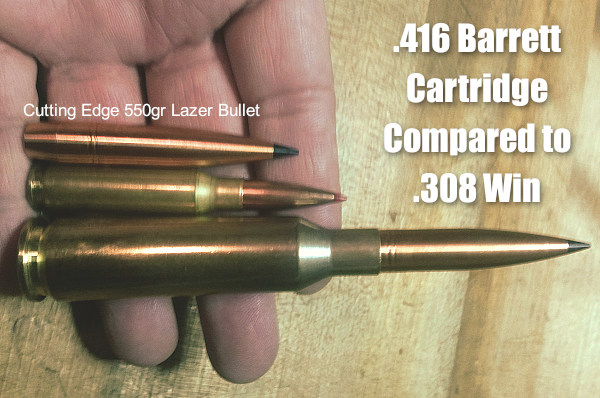
In the ELR game, particularly the King of 2 Miles (KO2M), it’s “go big or go home”. The top shooters run large-capacity cartridges that push large-caliber, ultra-high BC bullets at very high velocities. Bullets launched by cartridges such as the .416 Barrett can sustain supersonic velocities at Extreme Long Ranges — and that’s what it takes to win. The .416 Barrett can launch a 550-grain solid bullet at 3000+ FPS.
Photo from ELR Competitor Corbin Shell.
2018 and 2019 Kings of 2 Miles Loaded on RCBS Presses
So how do you load jumbo cartridges such as the .416 Barrett? It takes a big, heavy, super-strong reloading press. We’ve learned that the last two Kings of 2 Miles, Paul Phillips (2019) and Robert Brantley (2018) both loaded their KO2M ammo on RCBS AmmoMaster .50 BMG presses. Phillips loaded .416 Barrett ammo, while Brantley loaded custom .416 MCS rounds.
In 2018, Robert Brantley topped the field using his custom .416 MCS loads perfected on the AmmoMaster .50 BMG Press. The next year, Brantley took a close second to 2019 KO2M winner Paul Phillips. Both Phillips and Brantley use the AmmoMaster .50 BMG single stage press kit and RCBS .416 Barrett dies to hand-load for extreme long-range. “My ammo has been much more consistent after switching to the RCBS press and dies,” remarked Phillips, who runs the Global Precision Group. Brantley said he uses RCBS products for most of his reloading needs — from the dies and AmmoMaster, to the ChargeMaster and Brass Boss. His custom .416 MCS loads launch a 550-grain bullet more than 3,100 fps.
The KO2M competition is a two-day extreme long-range (ELR) match held at the NRA Whittington Center in New Mexico. Teams consist of one shooter and up to two wind coaches/spotters, who fire on steel targets ranging from about 1,500 to 3,500 yards. The photo below show 2019 Winner Phillips with the King’s crown at the NRA Whittington Center in Raton, NM.
Loading with RCBS AmmoMaster .50 BMG Press
This video shows reloading with the RCBS AmmoMaster .50 BMG press. While this video shows .50 BMG cases being loaded, the principles are the same for loading the .416 Barrett used by both Brantley and Phillips. Big cases need big presses!
RCBS is a leading manufacturer of ammunition reloading equipment for rifles and pistols, offering reloading equipment throughout the world. For more information, visit www.RCBS.com
Many thousands of hand-loaders, including this Editor, acquired the original RCBS ChargeMaster 1500 powder scale/dispenser. Mine has worked well for many years. Yes I do have to watch for scale drift, and I use a high-end Force-Restoration scale when loading for major matches, but the original ChargeMaster has served me well, throwing thousands of charges over the years.
RCBS ChargeMaster Lite Reviews
A couple years ago, RCBS introduced a new version of the ChargeMaster, the RCBS Chargemaster Lite. This newer unit has some features we really like. The new touch screen is easy to use and the powder tray cover slips off easily — no more hinges to fight. Most importantly the CM Lite has a redesigned, fluted dispensing tube which delivers powder kernels in a smooth flow with no clumps. The RCBS Rep told us “No more McDonald’s straw required”. We tested the unit and it does seem like the newly-designed dispensing tube is better. In fact, this new design will be adapted to the next generation of larger ChargeMasters. The ChargeMaster Lite ships complete with calibration check weights and cleaning brush. MSRP is $299.95 with “street price” around $238.00 at Amazon.
If you’re interested in the RCBS ChargeMaster Lite, here are three recent video product reviews. By watching these videos you can see all the features of the ChargeMaster Lite demonstrated. In the third video, the host also “compares and contrasts” the ChargeMaster Lite with the original ChargeMaster 1500, explaining the differences between the two units. Have at it:
Panhandle Precision ChargeMaster Lite Bench Test and Demo (Good Detailed Review):
Here is the RCBS Press Release: “The new RCBS ChargeMaster Lite packs unparalleled powder-measuring accuracy in a compact package. The one-piece unit features an LCD touchscreen display that ensures accurate data input. The hopper holds nearly a pound of smokeless powder, and can dispense anywhere between 2 to 300 grains with a +/-0.1-grain accuracy.”
UltimateReloader ChargeMaster Lite Unboxing:
Original ChargeMaster 1500 vs. ChargeMaster Lite:
Worth Considering Also — the Frankford Arsenal Platinum Series Intellidropper
Frankford Arsenal has a new electronic powder scale/dispenser, the Intellidropper. This unit dispenses quickly, loads can be controlled with a Mobile App. We recently did an in-depth Intellidropper Review. If you are in the market for a powder scale/dispenser, you should definitely consider the Intellidropper as well as the RCBS Chargemaster Lite. Watch this video to see how it works:
The Intellidropper is the latest automated powder scale/dispenser to hit the market. This new-for-2019 machine offers a unique powder calibration mode and the first-ever, mobile APP-controlled powder dispensing system. With a retail price under $200, the new Intellidropper is $30-$40 less than the ChargeMaster Lite.
At the request of our readers, we provide select “Deals of the Week”. Every Monday morning we offer our Best Bargain selections. Here are some of the best deals on firearms, hardware, reloading components, optics, and shooting accessories. Be aware that sale prices are subject to change, and once clearance inventory is sold, it’s gone for good. You snooze you lose.
1. Tombstone Tactical — Ruger Hawkeye LR Target Rifle, $924.39
If you thought the Ruger Precision Rifle was an impressive rifle for the money, then check out the new Ruger Hawkeye Long Range Target. It features a 2-stage target trigger, rugged one-piece stainless steel bolt, and ships with one AI-Style five-round magazine and a 26″ barrel. These rifles have earned high praise in early tests. You can also grab one in 300 Win Mag or 6.5 PRC for a little more. If you’re in the market for an affordable, long range rifle this deserves a good look.
2. March Optics — Retirement Sale, 35% Off All Scopes in Stock
March Optics delivers some of the most advanced (and unique) optics technology on the planet. But those top-of-the-line March scopes were always a big investment. But now, you can get superb, ultra-premium March scopes for 35% Off. Shiraz Balolia, President of March Optics USA, has decided to stop retailing optics. As a result, March scopes are now being discounted 35% — that’s a huge savings. This sale pricing applies to ALL March scopes, limited to stock in hand. Here are some of the deals:
1. Genesis Extreme Long Range Scope, $4517.50 (marked down from $6950.00) 2. 10-60x56mm High Master Tactical Turrets MTR-1, $2,567.50 (marked down from $4195.00) 3. 8-80x56mm Tactical Turrets MTR-4, $2,388.75 (marked down from $3675.00) 4. 5-50x56mm Tactical Turrets Illuminated MTR-1, $2,567.60 (marked down from $3,950.00) 5. 5-40x56mm FFP Tactical Turrets FMA-2, $2,388.75 (marked down from $3675.00) 6. 3-24x52mm FFP Tactical Turrets Illuminated FML-T1, $2,388.75 (marked down from $3675.00) 7. 2.5-25x52mm Tactical Turrets Illuminated MTR-3, $2,388.75 (marked down from $3675.00)
3. Brownells — Prime Time Blowout, Contest and Sale
Brownells is running a big Prime Time Blowout Sale this week, July 15-19, 2019. For 5 days, Monday through Friday, Brownells will give away a new rifle away each day. More importantly (since the chances of winning are slim), Brownells is offering huge savings on guns, barreled actions, tools, ammo and more. Here are just a few of the great deals:
Among dedicated case trimmers, Lyman’s impressive new Case Trim Xpress, delivers top-tier performance for the price. This well-designed machine comes with a host of bushings to fit most common calibers. The carbide cutter head precisely adjusts in .001″ increments using an easy-to-operate knurled adjustment wheel. Our tests comfirm this unit trims cases quickly and accurately. To see a video of the Case Trim Xpres action, check out our recent Lyman Case Trim Xpress Review.
5. Amazon — Chapman Tool Sets, $45-$109
If you shoot, then you need tools to fix, clean, or maintain your guns. And often you’ll need a combination of hex, phillips, and flat heads to do the job right. Whether you’re just starting out or have a bag full of odds and ends and want to start over, one of the best things you can buy is a Chapman Tool Set. These are quality made-in-USA tools that should last a lifetime. Our Deals Editor uses Chapman tools himself and recommends them. Pick any kit you like and the beauty is that you can add pieces later and it all fits inside a handy, compact case.
Vortex makes a great product and offers one of the best warranties in the business. So when we saw the Vortex Strike Eagle 4-24x50mm scope for only $299.99 we had to feature it. It has a great 6 times zoom range and features Vortex’s popular EBR-4 MOA reticle. If you are looking for a SFP MOA-based scope for varminting or practical matches, this is a very good offering for the price — a real bargain.
7. OpticsPlanet — Birchwood Casey Deluxe Cleaning Rod Sale
Shooters know that cleaning your guns properly is vital but many of us struggle with old, bent, or worn-out cleaning rods. Head over to OpticsPlanet and grab one of these Birchwood Casey Deluxe Cleaning Rods on sale for as low as $8.89! That’s 38% off the regular price. These rods are well made, coated for protection, and have free-floating handles. With these low prices, you don’t have any excuse for not cleaning your rifles. At under $9 per rod for the .22 and .27 Cal versions, you may want to buy 3 or 4 and keep a couple in your vehicle as spares.
8. Amazon — MTM Cleaning Rod Case, $22.89
With those Birchwood Casey Cleaning Rods on Sale for under $9 each you might as well grab 3 or 4 rods. And this nice bright, red MTM cleaning rod case with hold all those four rods, along with lots of cleaning supplies. There are special compartments inside the case for cleaning patches of various sizes. This case protects your rods both at home and while traveling. With this handy, durable case you can stop worrying about bending or breaking those important cleaning rods.
9. Amazon — Range Station for Pistol Shooters, $29.99
The Range Station combines an ammo compartment with a roll-out mat. Some gun ranges only have concrete benches, or shooting stations with horizontal surfaces covered with dirt, powder residues, and other debris. You don’t want to put your $2000 blued Colt Python on that mess. The 12″x24″ Padded Gun Mat stays put on the counter-top and holds guns and gear. The case snaps to either the right or left side of the mat. Interior trays are sized for standard ammo boxes and magazines. Separate compartments hold smaller range gear such as rulers, pens, target markers, and more. When finished, the mat can be rolled and stored neatly and compactly in the case. Buy now for $29.99 at Amazon.
10. Amazon — Browning Steady Ready Stool, $33.00
Portable stools are useful for just about any shooting activity. They are popular with hunters and varminters. They also make life so much easier at matches when you’re spotting for a buddy or team-mate. Though we all know how useful portable seating can be, at matches we still see many fellows asking to borrow a stool or just sitting on the ground. Don’t be that guy — grab one of these easy-to-transport Browning camping stools for under $35.00. It has a durable camo fabric with non-slip seat, and includes an insulated cooler beneath the seat to keep your beverages/lunch cool.
He who dies with the most toys wins — right? Well Sinclair has another interesting gadget you can add to your reloading bench. The Sinclair Case Neck Sorting Tool lets you quickly sort brass by neck-wall thickness. For those who shoot “no-turn” brass, this can improve neck-tension consistency. Large variances in neck-wall thickness can cause inconsistent neck “grip” on the bullet. Generally, we’ve found that more consistent neck tension will lower ES and (usually) improve accuracy. We know some guys who shoot no-turn 6mmBR brass in competition with considerable success — but their secret is pre-sorting their brass by neck-wall thickness. Cases that are out-of-spec are set aside for sighters (or are later skim-turned).
Watch Case Neck Sorting Tool Operation in Video
How the Case Neck Sorting Tool Works
Here’s how the Sinclair tool works. Cases are rotated under an indicator tip while they are supported on a case-neck pilot and a support pin through the flash hole. The unit has a nice, wide base and low profile so it is stable in use. The tool works for .22 through .45 caliber cases and can be used on .17- and .20-caliber cases with the optional carbide alignment rod. The MIC-4 pin fits both .060 (PPC size) and .080 (standard size) flash holes. Sinclair’s Case Neck Sorting Tool can be ordered with or without a dial indicator. The basic unit without dial indicator (item 749-006-612WB) is priced at $59.99. You can also buy the tool complete with dial indicator (item 749-007-129WB) for $89.99. IMPORTANT: This sorting tool requires caliber-specific Case Neck Pilots which must be ordered separately.
Editor’s Comment: The purpose of this Sinclair tool is rapid, high-quantity sorting of cartridge brass to ascertain significant case-neck-wall thickness variations. Consider this a rapid culling/sorting tool. If you are turning your necks, you will still need a quality ball micrometer tool to measure neck-wall thickness (to .0005) before and after neck-turning operations.
At the request of our readers, we provide select “Deals of the Week”. Every Monday morning we offer our Best Bargain selections. Here are some of the best deals on firearms, hardware, reloading components, optics, and shooting accessories. Be aware that sale prices are subject to change, and once clearance inventory is sold, it’s gone for good. You snooze you lose.
1. March Optics — Norma .284 Win Brass, $65 per 100 Cases
This could well be the best brass bargain in recent memory. This Norma .284 Winchester brass is outstanding. It is quite capable of winning F-Class matches right out of the box, and there’s no need to expand a 6.5-284 neck! This Norma .284 Win brass was commissioned by Shiraz Balolia for Bullets.com, a company he founded. Now that entity is closed, so this brass is being sold through MarchOptics.com. Shiraz tells us: “For those of you who shoot the Norma .284 Win F-Class brass, this is an amazing deal — well below cost. This is the last from the original Bullets.com lot. If you bought some of the original Norma .284 Win brass, this is the same lot.” NOTE: Quantities are limited — grab it while you can!!
2. Sightron USA — $100 SIII and $250 SV Factory Rebates
Sightron USA is offering HUGE rebates on SIII series and SV series scopes. Sightron calls this “Christmas in July”. Get a $100 rebate on an SIII optic or a whopping $250 rebate on a top-end SV scope. To qualify for the SIII Series $100 or SV Series $250 rebate program your scope must be purchased from 7/1/2019 through 7/31/2019 at an Authorized Sightron USA Re-seller, and this applies to USA customers only.
3. Grizzly Industrial — Bald Eagle Slingshot Rest, $129.97
Maybe you’re just getting into F-Class or just need a good stable front rest to shoot from and don’t want to spend a ton of money on one. Don’t worry because Grizzly now has the Bald Eagle BE1129 aluminum slingshot rest for an amazingly low $129.97 Closeout price. Just add your favorite front bag and you’re ready to go with a competition quality elevation adjustable rest. They also have the Bald Eagle BE1209 – Big Fifty Rest on sale now for $202.97, nearly 50% off. With a much wider span and cast-iron legs, the Big Fifty is designed for larger guns up to .50 caliber. Either way, these rests are a great value.
Ruger’s semi-auto 10/22 rimfire has become one of the best-selling rifles in history for good reason — it’s inexpensive and fun. Now you can have the best-looking 10/22 ever. Stocky’s Stocks has a beautiful series of EuroTarget™ 10/22 Stocks in six laminated colors for just $199.99. Or choose a plain hardwood model for $176.40, a “soft-touch” coated hardwood version for $183.60 (in black, green, or sand), or a handsome “EuroMatch” laminated version with adjustable cheek-piece for $299.99. We really like the looks and ergonomics of these stocks — they are a great upgrade for your Ruger 10/22.
Here’s the best deal we’ve found on an excellent product in high demand. The Lyman BoreCam is an electro-optical borescope with a digital display. You can record “stills” on a SD card. Our Forum members really like the BoreCam (although some wish the digital view-screen was larger). Midsouth now has the Lyman BoreCam for $199.99. Grab it while you can at that price. Other vendors are charging a LOT more. For example, Walmart is charging $269.75, while MidwayUSA is asking $299.99!
6. Precision Reloading — 10% Off All Orders Over $100
Precision Reloading offers three ways to save through today July 8th. First, you can get 10% Off All in-stock items for an order of $100.00 or more using Promo Code SAVE 10. You can also save on shipping (Code SHIP6) and HazMat (Code FREEHAZ), with orders over $75 and $150 respectively. But act quickly!! This sale is almost over — these promos end at 11:59 pm on July 8, 2019.
7. Midsouth — NEW Sierra 6th Edition Manual, $28.89
Yes you can get starting load data from friends (or websites) but official loading manuals help ensure you’re stay within safe margins. In addition, these printed manuals provide more data, more recipes, and more details than you can readily find online. We like Sierra Manuals because they cover a wide selection of powders (from all major propellant-makers) and Sierra’s max loads run on the conservative side. Midsouth now offers the new-for-2019 Sierra 6th Edition Loading Manual for just $28.89. This is the best price we’ve seen — save $8-$10 at Midsouth.
Looking for a new bipod that can work with a Picatinny rail? You’re in luck because we just found this 6″ – 9″ adjustable Carbon Fiber Bipod and M-Lok adapter combo for the amazingly low price of $25.99 including a handy adapter allowing you to securely attach the bipod to a standard Picatinny Rail. There are also versions with KeyMod or M-Lok Adapters for $27.99. Purchasers have given this unit high praise, with a 4.5-star rating. Here is an actual buyer review:
“Excellent bipod at an excellent price. It seems well-built and is far more rigid and sturdy than others like it. The bipod came with a Picatinny adapter [M-Lok or KeyMod optional]. Mounting was quick and easy. Overall I think this is by far the best bang-for-your-buck bipod.”
9. Amazon — Howard Leight MAX NRR33 Earplugs, $7.80/50 Pairs
20 Pairs
50 Pairs
These Howard Leight NRR33 Max plugs are your Editor’s favorite foam earplugs. Between shooting, motorcycling and mowing lawns, I probably have Max plugs in my ears 2-3 days a week. This is a very good price for a bulk pack of 50 pairs. And if you act soon, you can get free shipping to boot.
Well folks, it’s July 6th already — the means we’re moving into “peak heat” summer conditions. It’s vitally important to keep your ammo at “normal” temps during the hot summer months. Even if you use “temp-insensitive” powders, studies suggest that pressures can still rise dramatically when the entire cartridge gets hot, possibly because of primer heating. It’s smart to keep your loaded ammo in an insulated storage unit, possibly with a Blue Ice Cool Pak if you expect it to get quite hot. Don’t leave your ammo in the car or truck — temps can exceed 140° in a vehicle parked in the sun.
To learn more about how ambient temperature (and primer choice) affect pressures (and hence velocities) you should read the article Pressure Factors: How Temperature, Powder, and Primer Affect Pressure by Denton Bramwell. In that article, the author uses a pressure trace instrument to analyze how temperature affects ammo performance. Bramwell’s tests yielded some fascinating results.
For example, barrel temperature was a key factor: “Both barrel temperature and powder temperature are important variables, and they are not the same variable. If you fail to take barrel temperature into account while doing pressure testing, your test results will be very significantly affected. The effect of barrel temperature is around 204 PSI per F° for the Varget load. If you’re not controlling barrel temperature, you about as well might not bother controlling powder temperature, either. In the cases investigated, barrel temperature is a much stronger variable than powder temperature.”
Powder Heat Sensitivity Comparison Test
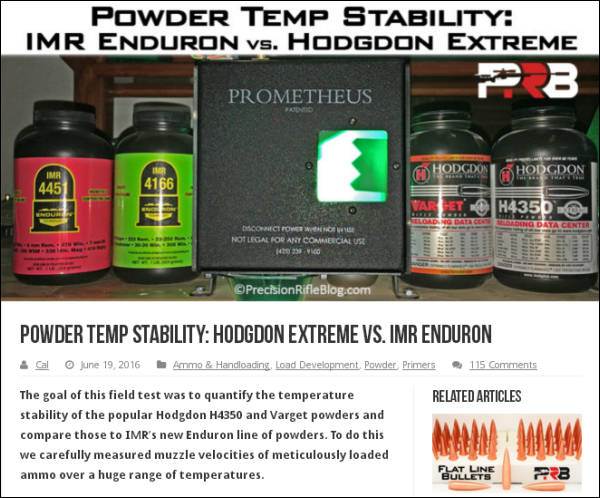
Our friend Cal Zant of the Precision Rifle Blog recently published a fascinating comparison test of four powders: Hodgdon H4350, Hodgdon Varget, IMR 4451, and IMR 4166. The first two are Hodgdon Extreme powders, while the latter two are part of IMR’s Enduron line of propellants.
The testers measured the velocity of the powders over a wide temperature range, from 25° F to 140° F. Hodgdon H4350 proved to be the most temp stable of the four powders tested.
At the request of our readers, we provide select “Deals of the Week”. Every Monday morning we offer our Best Bargain selections. Here are some of the best deals on firearms, hardware, reloading components, optics, and shooting accessories. Be aware that sale prices are subject to change, and once clearance inventory is sold, it’s gone for good. You snooze you lose.
1. Bud’s Gun Shop — Howa American Flag Chassis Rifle, $1100.99
What better way to celebrate the 4th of July this week than with a Stars and Stripes rifle? Legacy Sports offers a special American Flag Chassis Rifle with a USA flag-theme red, white, and blue Cerakote finish and 3-chamber muzzle brake. Components include APC modular chassis and Luth-AR adjustable butt-stock. This special edition is sold with a Nikko 4-16x50mm scope and shipped in a hard case. Choose either the 6.5 Creedmoor version ($1100.99 at GunPrime.com), or the .308 Win version ($1116.52 at Bud’s GunShop). Note: Act soon — these special editions with scope are almost sold out!
2. EuroOptic — Minox Scope Sale, Up to 56% off
Minox may not be a household name for riflescopes but make no mistake, Minox makes great scopes for the money. While Minox scopes are always attractively priced, right now they are a GREAT value over at EuroOptic. You can grab a variety of Minox scopes in popular zoom ranges for up to 56% Off. Heck of a bargain. A new Minox may just what you need to finish off that recent build. These German optics offer a great balance between performance and p;rice.
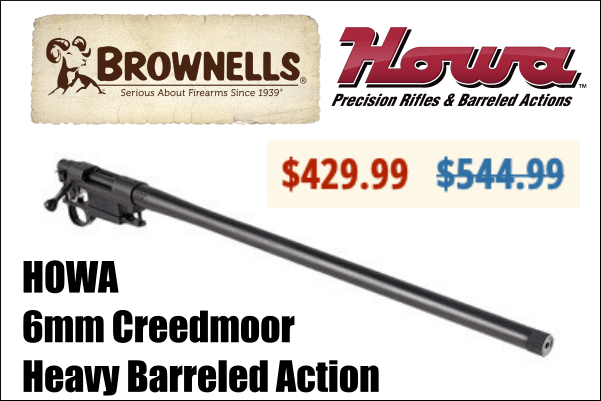
3. Brownells — HOWA 6mm Creedmoor barreled action, $429.99
Choosing the parts for a custom build can be a daunting process and it often requires having a gunsmith properly headspace and build a barreled action. Now you can skip that step by picking up one of these Howa barreled actions in 6mm Creedmoor for $429.99 (on Sale). Barreled actions in many other popular chamberings are also available including 6.5 Grendel for $349.99 (on Sale), 6.5 Creedmoor, .243 Win, .308 Win and more (SEE ALL). Howa barreled actions are sold in several barrel lengths/contours, and all come with an excellent HACT 2-stage trigger.
4. Midsouth — Nikon Special 4-12x40mm scope, $99.99
For you guys looking for a bargain scope for a hunting rifle (or maybe your son’s first rifle), here’s a great deal. Right now Midsouth is offering Nikon 4-12x40mm scopes with a BDC reticle for the crazy-low price of $99.99. This is a very good scope for the money. It comes with a solid guarantee and should offer years of reliable service on a hunting or varmint rifle. Put the money you save into brass and bullets.
5. Precision Reloading — Alliant Powder Sale, 15% Off
Dedicated hand-loaders should keep an ample supply of their favorite powders “for a rainy day” (or maybe new legislative regulations). If you’ve been waiting for a great sale, check this out. Precision Reloading is now offering 15% OFFall in-stock Alliant powders. This covers all Alliant powders on hand. But don’t wait long. This sale concludes July 2, 2019 at 11:59 pm.
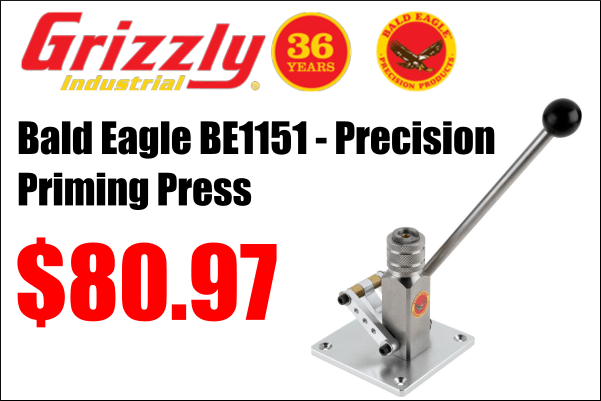
6. Grizzly — Bald Eagle Priming Press, $80.97
Any serious competitor will tell you that consistent primer seating is one of the most critical steps in reloading. There are lots of choices out there for bench and hand-held primers but NONE of then match the Grizzly priming press which can be found for $80.97. It features a beautifully-made system that is click adjustable to .002″ and incredibly repeatable. If you’re in the market for something that’s easy on the hands and works like units that cost hundreds more give this one a look.
7. Midsouth — NEW Sierra 6th Edition Manual, $28.89
Yes you can get starting load data from friends (or websites) but official loading manuals help ensure you’re stay within safe margins. In addition, these printed manuals provide more data, more recipes, and more details than you can readily find online. We like Sierra Manuals because they cover a wide selection of powders (from all major propellant-makers) and Sierra’s max loads run on the conservative side. Midsouth now offers the new-for-2019 Sierra 6th Edition Loading Manual for just $28.89. This is the best price we’ve seen — save $8-$10 at Midsouth.
8. Amazon — MTM Stackable Ammo Crate/Utility Box, $13.59
Good storage, whether for ammo, survival supplies or any other items, is something shooters and outdoorsmen need in abundance. With that in mind, consider grabbing a few of these MTM Ammo Crate/Utility Boxes. These stackable polymer storage crates cost just $13.59. They are LOCKABLE and they have great carry handles. Grab a couple of them at this price. We best you’ll quickly find many good uses.
9. Cabela’s — Ruger EC9S Carry Pistol, $219.97
Here’s a good little 9mm carry pistol for a crazy-low price. Right now, CDNN is selling the popular Ruger EC9S 9MM pistol for $219.97 — that’s $30 off the regular $249.99 price. This gun is light (17.2 ounces) and thin so it’s easy to carry discretely. The EC9S is 6″ overall with a 3.12″-long barrel. The EC9S features integral sights and ships with a single 7-round magazine.
10. Amazon — Two Rolls of 3″ Neon Target Stickers, $14.99
We like these bright, Neon 3″ target stickers. They are big enough to see easily at 600 yards, giving you a 1/2 MOA target center at that distance. For $14.99 at Amazon.com, you get 250 3″-diameter self-adhesive centers (125 targets per roll) that stick to almost any surface The high-contrast fluorescent red/orange color provides an excellent HI-VIZ aiming point, along with good contrast for bullet holes that fall within the 3″ circle. To help line up your reticle cross-hairs, the target centers feature black markers at 3, 6, 9, and 12 0’Clock. NOTE: These stickers may qualify for FREE Shipping with combined orders over $25.00.
Close-up of the Tri-Way Trimmer with clear plastic chip guard removed.
Giraud Tool offers a case trimmer/chamferer device that works with a power drill (or other power source). Giraud’s patented Tri-Way Trimmer is a self-contained unit powered by your drill or motor. Using a sharp carbide blade it will trim your cases to length, deburr, and cut both inside and outside chamfers — all in one pass. That’s pretty impressive for a $105.00 tool that fits in the palm of your hand.
Product Features
1. Fully adjustable for cartridge length (and depth of chamfer).
2. Carbide blade cuts a 15° inside case mouth chamfer and 45° outside chamfer.
3. Case holder supported by sealed ball bearing raceway.
4. Tool includes removable, transparent plastic chip guard.
5. Tool can work in any orientation (vertical, horizontal, or any angle).
The Giraud Tri-Way Trimmer is designed to be powered by a portable hand drill, drill press, or other dedicated rotating power source. The tool indexes off the shoulder of your cases, but the blade adjusts so that cartridge overall length (COAL) can be controlled with precision. Constructed out of 6061-T6 aluminum and 303 stainless steel, the Tri Way tool should last a lifetime. Note: This tool is not universal. The Tri Way is dedicated to a single cartridge and “related” cartridges with similar body dimensions. Thus you need a specific tool for each cartridge family. For example, the .308 Win tool will also trim .243 Win, .260 Rem, and 7mm-08.
Cartridge Sizes Available for Giraud Tri Way Trimmer:
.223 Remington (Also trims .17 Remington, .204 Ruger, .222 Remington, .222 Remington Magnum)
7.62 x 39mm (Russian)
.300 Blackout (Also trims .17 Rem Fireball, .20 Vartarg, .221 Fireball)
.308 Winchester (Also trims .243 Winchester, .260 Remington, 7mm-08)
.30-06 Springfield (Also trims .25-06, .270 Winchester, .280 Remington)
.300 Winchester Mag (Also trims .264 Winchester Magnum, 7mm Remington Magnum, .308 Norma Magnum)
Product Tip from EdLongrange. We welcome reader submissions.
At the request of our readers, we provide select “Deals of the Week”. Every Monday morning we offer our Best Bargain selections. Here are some of the best deals on firearms, hardware, reloading components, optics, and shooting accessories. Be aware that sale prices are subject to change, and once clearance inventory is sold, it’s gone for good. You snooze you lose.
1. March Optics — Retirement Sale, 30% Off All Scopes in Stock
March Optics delivers some of the most advanced (and unique) optics technology on the planet. But those top-of-the-line March scopes were always a big investment. But now, you can get superb, ultra-premium March scopes for 30% Off. Shiraz Balolia, President of March Optics USA, has decided to stop retailing optics. As a result, March scopes are now being discounted 30% — that’s a huge savings. This sale pricing applies to ALL March scopes, limited to stock in hand. Here are some of the deals:
1. Genesis Extreme Long Range Scope, $4865.00 (marked down from $6950.00) 2. 10-60x56mm High Master Tactical Turrets MTR-1, $2765.00 (marked down from $3950.00) 3. 8-80x56mm Tactical Turrets MTR-4, $2572.50 (marked down from $3675.00) 4. 5-40x56mm FFP Tactical Turrets FMA-2, $2572.50 (marked down from $3675.00) 5. 3-24x52mm FFP Tactical Turrets Illuminated FML-T1, $2572.50 (marked down from $3675.00) 6. 2.5-25x52mm Tactical Turrets Illuminated MTR-3, $2572.50 (marked down from $3675.00)
2. EuroOptic — Mauser M18 Rifles 30% Off (Great Deal)
A huge shipment of Mauser M18 rifles is en-route to EuroOptic from Germany. In preparation for this rifle influx, EuroOptic has slashed prices on all M18s. Expect to save $200 to $250 per rifle. For example, the 6.5 Creedmoor M18 is marked down from $699 to $499 (save $200) while the .243 Win M18 is discounted from $699 to $459 ($240 savings). Eight chamberings will be available including the new 6.5 PRC as well as hunting classics like the .270 Win, .308 Win, .30-06 Springfield, and 7mm Remington Magnum. The Mauser M18 is a fine European-crafted rifle with a 3-lug bolt, smooth 60° bolt lift, and quality hammer-forged barrel. NOTE: Pending arrival, EuroOptic is taking back-orders which are effectively “pre-orders”.
3. Midway USA — Norma 6.5 Creedmoor Brass, 250 for $99.99
The 6.5 Creedmoor is more popular than ever but like any super-trendy cartridge, supplies seem to be either out of stock or too expensive. If you have a 6.5 Creedmoor, check out this killer deal. You can get 250 Norma 6.5 Creedmoor cases for only $99.99. That works out to just forty cents per case — less than half what you’d pay for some other 6.5 Creedmoor brass. We can’t remember the last time we’ve seen such a great deal on quality brass for such a popular cartridge. But you better act soon — we expect this MidwayUSA deal to sell out quickly.
We love our .45 ACP pistols, and we regularly shoot CCI Blazer Brass .45 ACP ammo. It has proved accurate and super reliable. Right now Natchez is offering a great deal — 500 230gr FMJ rounds for just $144.99, a $35.00 savings. Add a box or two of rimfire ammo to put your order over $150.00, then use CODE FH190621 during checkout and and you’ll qualify for FREE HazMat!
5. Midsouth — Rock Chucker Reloading Kit and Free Die, $269.49
Everything you see above can be yours for just $269.49. Amazing Deal. Right now, Midsouth is selling the Rock Chucker Supreme Master Reloading Kit for $269.49, a fine price considering all the hardware you get: Press, Primer Tool, Scale, Powder Measure, Loading Tray, Reloading Manual and more. Heck, the Rock Chucker press alone is worth $165.00+. This is good starter kit for any reloader with sturdy items, such as the Rock Chucker, that will last a lifetime. And now through 7/7/2019 you’ll get a free RCBS FL die set as a bonus. NOTE: This FREE DIE set is offered through RCBS and will ship separately after you submit a form.
6. Amazon — Plano 52″ Double Rifle Case with Wheels, $99.99
This Plano Double Scoped Rifle Case is an Amazon #1 Best Seller for good reason. It offers the functionality and durability of an SKB-type hard case for HALF the money. This is just $99.99 with FREE Shipping, while the equivalent SKB is around $240.00, so you can buy two Planos for the price of one SKB. The 51.5″ interior will fit most scoped competition rifles up to about 29″ barrels (measure your own rifle to make sure). If you separate the barreled action from the stock you can transport even ultra-long ELR rifles. The handles are convenient and beefy and the wheels make this case easy to move. This is a very tough, roomy case for the money — plus there’s Free Shipping! There is also a smaller 42″ version for $64.99.
Exterior Dimensions: 53.5″ x 17″ x 7″
Interior Dimensions: 51.5″ x 14″ x 5.5″
Pluckable Interior Dimensions: 46″ x 10″
Features: Wheels, Secure Latches, O-Ring Seal, Pressure Relief Valve, Customizable Foam
7. Taurus G2c 9mm — $179.99 with Factory Rebate
This is a good little gun at a great price. Taurus has a factory Rebate through 7/7/19. Palmetto State Armory is selling the sub-compact Taurus 9mm with black frame and stainless steel slide for just $209.99 with FREE Shipping. But the Taurus $30 Factory Rebate lowers your price to just $179.99 for this G2c. Or, if you like the milspec look, you can also get an OD-Green G2c G2c for $184.99 after rebate, just $5.00 more. Despite its small size, the G2c has a 12-round magazine. We like the fact it has a left-side manual safety (unlike the Glock).
8. Graf’s — Platinum Case Prep & Trim + EZ Tumbler, $179.99
If you want to step up your brass preparation game, here’s a great deal. Graf’s is offering the Frankford Arsenal Case Prep & Trim PLUS the EZ Tumbler for only $179.99. That’s an amazing deal considering you could pay $199.99 or more for the Prep & Trim unit by itself, and the EZ Tumbler is regularly $50 or more. This Grafs.com combo deal represents a savings of nearly $70.00.
9. Powder Valley — Alliant and CCI Factory Rebates
Powder Valley notified us about some great Rebate offers from Alliant and CCI. If you need powder or primers, now is a great time to buy — this offer ends June 30, 2019! NOTE: These rebates are separate programs. To qualify for these rebates you need to buy at least 4 pounds of Alliant powder OR spend at least $100 on CCI components. You can’t mix and match to qualify — each program has its own minimums.
ALLIANT Powder — More Bang for your Buck$ Rebate
If you buy at least four (4) pounds of powder you get $2.00 back per pound, with a rebate limit of $20 (for ten pounds). Minimum purchase four (4) pounds required.
CCI — Primed for Action Rebate
Spend at least $100 on CCI® reloading primers to get 20% of the purchase price back. Rebate amount calculated on purchase price only, does not include taxes and/or shipping/handling fees. Maximum rebate $100 per person or household. Minimum spend $100 required.
10. Amazon — NcStar Vism Shooting Mat, $24.99
Looking for a good mat at a great price? For $24.99 now you can grab this NcStar Vism shooting mat. This has decent padding, and reinforced areas for elbows and knees. Full dimensions are: 69″ Long x 35″ Wide. This mat has straps for pre-loading your bipod. When you’re done simply fold in the edges, roll it up into a compact 19.50″ W x 8.50″ H package — about the same size as a sleeping bag. You can pay twice as much for a shooting mat and not get much more quality. Purchaser reviews have been very positive. This mat has earned 80% Five-Star buyer ratings on Amazon.




 He who dies with the most toys wins — right? Well Sinclair has another interesting gadget you can add to your reloading bench. The Sinclair


 Looking for a new bipod that can work with a Picatinny rail? You’re in luck because we just found this 6″ – 9″ adjustable


 To learn more about how ambient temperature (and primer choice) affect pressures (and hence velocities) you should read the article