Kirsten Joy Weiss has created a useful video about Dry-Fire practice. Dry-Fire is a method of training without a live round in the chamber. Dry-Firing is effective, Kirsten explains, because “it eliminates all the extra noise and messages that you get when you fire a live round. Without recoil, without the sound of a shot going off etc., all you hear is the click of the trigger. This allows you to focus on your sight picture and your trigger press.” This the lastest installment in Kirsten’s ‘How to Shoot Awesomely’ series. Kisten says: “I hope it helps you, and keep on aiming true!”
The Benefits of Dry-Fire Training
If you are not doing Dry-Fire practice yet, then it’s time to start. Dry-Fire training is essential to the sling disciplines, and very useful for F-Class. Dennis DeMille, a national Service Rifle Champion, told us that, for every minute he spent in actual competition, he would spend hours practicing without ammunition. While in the USMC, Dennis would practice in the barracks, working on his hold and dry-firing:
“The most important thing is to spend time off the range practicing. Most of what I learned as a High Power shooter I learned without ammunition — just spending time dry firing and doing holding exercises. Holding exercises will really identify the weak parts of your position. The primary purpose of dry firing is to get you used to shooting an empty rifle. If you can shoot a loaded rifle the same way you shoot an empty rifle then eventually you will become a High Master.”
Dry-Fire Training Can Benefit Benchrest Shooters
What about benchrest? Well, we’ve found that Dry-Fire sessions can even benefit benchresters — it can help reveal flaws in your trigger technique, or inconsistencies in the way you address the rifle from shot to shot. With the gun set up with your front rest and rear bag, if you see the scope’s cross-hairs wiggle a lot when you pull the trigger, you need to work on your technique. Also, dry-fire practice can help you learn to work the bolt more smoothly so you don’t disturb the gun on the bags.
This Gun Digest book has become a “go-to” resource for NRL22 and PRS Rimfire shooters. Key topics included in this 2021 Edition full-color Gun Digest book include: rimfire semi-autos and how they work; bolt-action accuracy; match shooting skills; DIY precision gunsmithing; hunting with rimfires; and the future of the rimfire market.
With the growth of rimfire tactical competition, the .22-Caliber rimfire rifle is more popular than ever. Every major gun manufacturer has brought at least one new .22 LR rimfire rifle to the market in the last two years. Gun Digest’s Rimfire Revolution has extensive coverage of new models from major manufacturers.
The .22 Long Rifle (.22 LR) is the planet’s most popular ammunition type and firearm chambering. The .22 LR is used in the Olympics by 3P marksmen, but it also serves benchrest competitors, NRL22 shooters, backyard plinkers, small-game hunters, and tactical trainers. With the expansion of NRL22 matches (and the PRS equivalent), the humble .22 LR is undergoing a major resurgence in the USA. And with centerfire reloading components being so costly and difficult to find, many folks are shooting less centerfire, but way more rimfire.
This 272-page book also covers .17-caliber rimfire cartridges: 17 HM2 (Mach 2), 17 HMR, and 17 WSM. These are all excellent varmint rounds, with the 17 WSM effective out to 250 yards. The 17 HM2 will run in a normal .22 LR action and feed from standard .22 LR magazines. So, for most rifles, all you need to do a .22 LR to 17 HM2 conversion is a barrel switch. That gives your rimfire rig twice the versatility. Shoot .22s and .17s with the same gun.
NRL22 — Challenging Practical Competition with .22 LR Rifles
The USA has seen a big growth in rimfire tactical matches over the last five years. Right now there are probably ten times as many rimfire tactical matches as sanctioned PRS and NRL centerfire matches. The reason is simple — rimfire ammo is much less costly, and clubs can run challenging rimfire tactical matches at nearly any outdoor gun range that allows shooting out to 200+ yards.
NRL22 Competition — Tactical Rimfire Matches
The NRL22 match format is a great shooting discipline. NRL22 offers a high fun factor at relatively low cost. You don’t have to reload match ammo. A couple of 50-round boxes of .22 LR ammo will get you through the match. While some people bring lots of gear to matches, that’s by choice and not by necessity. You can keep it simple and still be competitive (and win).
Tips for NRL22 Competitors by Jonathan Ocab
I am a match director at my gun club and run our local NRL22 matches. People often ask me for tips for competing in NRL22. First, I recommend getting the course of fire for the month in advance and practicing those stages at the range. Here are other specific tips that should help NRL22 competitors improve their gun-handling and match results.
1. Dry Fire Practice — If you are not able to do live fire practice at the range, I encourage shooters to practice their shooting positions at home via dry fire. Setup props or barricades with pasters or other faux targets on a wall in the garage or inside the house and run through each stage.
2. Scope Magnification Level — The most common issue I see with newer shooters in NRL22 is the tendency to maximize their scope magnification. The timer will start, and the shooter gets into position on a target, but the scope is set to 15x or higher and the shooter can’t find the target. The shooter lowers the magnification, locates the target, and then increases the magnification again, takes the shot, transitions to another target, and repeats the process of decreasing magnification, locating target, etc. Novice NRL22 shooters should try using the mid-range magnification. Try shooting 7x-12x and learn to balance field of view and target image.
Hunting season is coming up very soon, so it’s time to get your rifle squared away. You’ll want to zero that rifle before the hunt, and you need to know how your shots will impact with a cold barrel.
Commonly, hunters won’t have the ability to fire one or two fouling shots before heading out on a hunt. Therefore it’s important that a hunter understands how his rifle shoots with a “cold bore shot”. Both the point of impact (and possibly velocity), may be different with a cold bore than with a barrel that has been warmed and fouled with a series of shots. In this video from the U.S. Army Marksmanship Unit (USAMU), you’ll learn how to determine your cold bore point of impact (POI) for a rifle that just been cleaned, as well as the cold bore POI with a barrel that has already been “fouled in”.
SGT Joe Hein of the USAMU shows how to plot cold bore POI with both a clean bore and a fouled bore. Note that the “cold bore” shot from a fouled barrel was closer to the follow-up shots than the cold bore shot from a clean barrel. This is typical of many factory barrels. SGT Hein provides a simple way to understand your rifle’s cold bore performance. Hein’s advice can keep you from missing that long range shot at that big buck on opening day. A little time spent on the range before that critical first shot will help ensure you have meat in the freezer this season.
Erik Cortina is one of America’s top F-Class competitors. He has won major matches and is a member of Team Lapua-Brux-Borden. Erik, who produces his own line of EC Barrel Tuners and Tuner Brakes, also has a popular Believe the Target YouTube Channel which features interviews with top shooters, parts makers, and gunsmiths. For this Saturday Movie showcase, we feature videos created by Erik for his channel.
Interview with Bryan Litz of Applied Ballistics
Bryan Litz, head honcho of Applied Ballistics LLC, is arguably the leading ballistics expert on planet earth. A talented shooter who has won major F-Class, ELR, and Palma matches, Bryan is a high-IQ scientist who has developed the ballistics software many of us now use in Kestrels and other devices to calculate scope clicks with extreme precision. In this interview, Bryan explains basic ballistics principles and also corrects some popular misconceptions. This is a great interview that has received much praise from viewers, one of whom has noted: “Bryan is a walking science lab. He puts out amazing data-based info[.]” With 87,000 views, this is Erik’s second-most popular video ever.
Interview with 6-Time Nat’l Long Range Champion John Whidden
CLICK HERE for full 81-minute interview with John Whidden.
John Whidden of Whidden Gunworks is one of the greatest American marksman in history. Shooting sling rifles, John has won the U.S. Long Range National Championship a remarkable six times. He has also won a Palma World Championship, and this summer John won the 2022 Smallbore Prone U.S. National Championship. While a humble individual, John has superb shooting skills and unrivaled mental toughness. In this interview, John talks about the challenges of competition and what motivates him to excel. John also talks about the products he has developed for Whidden Gunworks.
Interview with NBRSA 3-Gun and Tackdriver Champ Bart Sauter
Bullet-maker Bart Sauter is one of the world’s best benchrest shooters. He won the 2022 NBRSA 3-Gun National Championship this year, and he also has won the multi-class Tack Driver event two years in a row. Plus he has set small-group world record at 600 yards. In this very informative interview, Bart talks about bullets, equipment selection, match preparation, and shooting techniques. We think every benchrest shooter should watch this video.
Master at Work — Sauter in Action
If you want to see how a world-class bench shooter runs his rifle, check out this short video showing Bart Sauter in action. He runs five shots in about 9 seconds.
Interview with Tod Hendricks, 2021 F-Open National Champion
A member of Team Lapua/Brux/Borden, Tod Hendricks has been one of the most talented and consistent F-Open competitors for many years. He used his mental toughness and wind-reading skills to capture a National Championship in 2021. In this wide-ranging interview with his team-mate Erik Cortina, Tod reveals what it takes to win in F-Open these days, covering equipment, ammo quality, and match preparation.
Brux Barrels is a machine tool company located in Lodi, Wisconsin, specializing in premium, custom, cut-rifled barrels. Brux barrels have set some impressive benchrest records, and have won championships in multiple disciplines. In this video Erik Cortina interviews Ken Clemens of Brux. They discuss the production process at Brux, from the selection of top-quality steel blanks to the final hand-lapping procedures.
Interview with Lanny Bassham, Olympic Gold Medalist and Author
Erik Cortina recently interviewed noted author and Olympic Gold Medal-winning shooter Lanny Bassham. Erik asked Lanny about his book With Winning in Mind. Lanny discussed the “mental game” in the shooting sports and Lanny’s program for visualization of a winning performance. Lanny explains that after you have mastered your rifle skills, and learned to read the wind, it is important to adopt a winning mentality and to visualize success. Lanny should know. He won a shooting Gold Medal in the Olympics along with 22 world individual and team titles.
Interview with Lindsey Paul, Queen of 2 Miles
Lindsey Paul is the only women to win the King of Two Miles ELR competition, becoming the first-ever QUEEN of Two Miles, shooting a .375 CheyTac. In 2021, the talented lady Texan beat a field of top competitors, including past KO2M Champions, all guys. Lindsey had a truly outstanding performance, including 3 hits in 5 shots at the max distance, 2.0 miles (3520 yards). In this interview, Lindsey, who works in the law enforcement field, talks about the Extreme Long Range (ELR) game, and she also explains what it’s like to shoot the heavy-recoiling .375 CheyTac.
Interview with Frank Galli — Founder of Sniper’s Hide
The founder of the popular Sniper’s Hide Forum, Frank Galli is an online pioneer and living legend in the tactical shooting sports world. A former U.S. Marine Scout-Sniper, Frank (aka “Lowlight”) runs a very active Forum with over 180,000 members. Along with moderating his Forum, Frank runs training clinics and hosts regular podcasts. Frank is also the author of the book Precision Rifle Marksmanship: The Fundamentals, an excellent resource for PRS/NRL competitors as well as tactical marksmen.
BONUS Videos — Two Great Tech and Reloading Videos
How to Find Jam Point on your Barrel
Loading for F-Class
Erik Cortina produces his own line of EC Barrel Tuners and Tuner Brakes. These have been used successfully by many top shooters. View the full line of Cortina Precision products at: ShootSmallGroups.com.
At AccurateShooter.com, our primary focus is precision target shooting with rifles. But it’s definitely fun to shoot pistols too, and we bet most of our regular readers own handguns. Here are six tips for shooting safely and accurately with handguns. These pointers will help you advance your skills and have more fun with your pistols and revolvers. Top image courtesy Sanctuary Gun Club.
1. Make Sure Safety Is Number One
Whether you own one gun or one hundred, gun safety must always be your main priority. In this video, Smith & Wesson Team Captain Julie Golob covers the basics of gun safety.
2. Start with a .22 LR Handgun
We strongly recommend that new pistol shooters start off with a .22 LR rimfire handgun. The .22 LR cartridge is accurate but has very low recoil, less “bark” than a centerfire, and very little smoke and muzzle flash. New shooters won’t have to fight muzzle flip, and won’t develop a flinch from the sharp recoil and muzzle blast common to larger calibers. With the .22 LR, the trainee can focus on sight alignment, breathing, and trigger pull. When he or she has mastered those skills, move on to a .38 Special or 9mm Luger (9x19mm).
What gun to use? We recommend the 10-shot Smith & Wesson Model 617. This is ideal for initial training, shooting single action, slow-fire. You want to focus on sight picture and holding steady. Shown above is the 4″-barrel Model 617 which balances well. There is also a 6″-barrel version. It has a longer sight radius, but is a little nose-heavy. Both are great choices. They are extremely accurate and they boast a very clean, precise trigger.
If you prefer a semi-auto .22 LR pistol, we recommend the Browning Buck Mark series. Buck Marks are very accurate and very reliable. This rimfire pistol is available in a variety of models starting at under $350.00. Like the S&W Model 617, a good Buck Mark will serve you for a lifetime.
3. Use Quality Targets with Multiple Aim Points
It’s common for new pistoleros to start shooting at cans or clay birds at a public range. That can be fun, but it’s better to start with proper targets, placed at eye level, at 7-10 yards. We like to use targets with large, brightly colored circles. Focus on putting 5 shots in a circle. We recommend targets that have multiple bullseyes or aiming points — that way you don’t have to constantly change your target. There are also special paper targets that can help you diagnose common shooting problems, such as anticipating recoil. EZ2C Targets offers many great target designs with bright, red-orange aim points. You can also use the bright orange Birchwood Casey stick-on Target Dots (right). These come in a variety of diameters. We like the 2″ dot at 10 yards.
4. Shoot Outdoors If You Can
We recommend that new pistol shooters begin their training at an outdoor range. There are many reasons. First, the light is better outdoors. Indoor ranges can be dark with lots of shadows, making it harder to see your target. Second, sound dissipates better outdoors. The sound of gunfire echoes and bounces off walls indoors. Third, an outdoor range is a more comfortable environment, particularly if you can get out on a weekday morning. Indoor ranges, at least in urban areas, tend to be crowded. Many also have poor ventilation. If you can make it to an outdoor range, you’ll be happy. Many outdoor ranges also have some steel pistol targets, which offer a fun alternative to paper. When shooting steel however, we recommend polymer encased or lead bullets to avoid ricochets.
Too many new pistol shooters try to move right to rapid fire drills. It’s better to start slow, practicing the basics, under the guidance of a good mentor. If you belong to a club, ask if there are certified instructors who will help out. This Editor learned pistol shooting from a seasoned bullseye shooter, who got me started with a .22 LR revolver and very close targets. Over the course of a few range sessions we progressed to farther targets and faster pace. But the fundamentals were never forgotten. When starting your pistol training, it’s wise to view some instructional videos. Top Shot Champion Chris Cheng hosts an excellent Handgun 101 Series produced by the NSSF. We’ve linked one of these Handgun 101 videos for Tip #6.
6. SLOW DOWN — This Is Not a Race
When you learned to ride a bicycle, you started slow — maybe even with training wheels. The same principle applies to pistol shooting. When you get started with handguns, we recommend you shoot slowly and deliberately. Start with the handgun unloaded — just work on your sight alignment and breathing. With snap caps in place, try some dry-firing drills. Then progress to live fire. But be deliberate and slow. With the target at 20 feet, see if you can get three successive shot-holes to touch. Believe it or not, many common pistols are capable of this kind of accuracy (but you won’t see many shooters at indoor ranges who pursue that kind of precision). Once you master your form and accuracy, then you can work on your speed.
Photo by Forum member GAT. Chambered in 6-6.5×47 Lapua, this rifle features a Stiller TAC30 action, Krieger barrel, Harrells brake, Konohawk Stock, and Sightron SIII 6-24x50mm scope.
Ryan Cleckner has created many good shooting videos for the NSSF, such as his excellent Understanding MOA Video. Ryan is noted for his ability to explain complex topics in an easy-to-comprehend manner. This video, covering the fundamentals of shooting, has been viewed over 3.7 million times! It’s worth watching, particularly for guys getting started in PRS/practical competitions.
In this video, Ryan Cleckner reviews proper technique for rifle shooters. A stable platform, sight alignment, sight picture, and trigger control are key fundamentals to shooting properly. This is basic stuff, but Cleckner presents it in a clear, logical fashion. This is a good video for novice shooters.
Tip on Viewing Your Reticle:
Cleckner: “Sometimes it can be difficult to focus between the target and the reticle, even with the parallax adjusted properly. I recommend you focus only on the reticle. Just like the front sight on a rifle or a handgun, that reticle is what you can control, and it’s what matters. Focus on a crisp, clear reticle, in a stable platform, and all that’s left is trigger control.”
Tip on Trigger Control:
Cleckner: “Trigger control is pretty straightforward, as long as you think about it as a continuous process, and not just one thing that happens. I like to think about it as drawing a line in the dirt. I like to think about this constant pressure that I’m adding as I draw this line straight back, and then… continuing to draw that line even as the rifle goes off. That’s the good follow-through you’ll need.”
Long Range Shooting Handbook — A Good Resource
Cleckner has authored a book, the Long Range Shooting Handbook, which expands on the topics covered in the above video. You can view Sample Chapters from Ryan’s Book on Amazon.com.
Ryan Cleckner’s LR Shooting Handbook is designed as an intro to important fundamental concepts such as MOA vs. Mils, External Ballistics, and Environmental Effects. Included are personal tips and advice based on Cleckner’s years of experience as a sniper instructor and special operations sniper.
The Long Range Shooting Handbook is divided into three main categories: What It Is/How It Works, Fundamentals, and How to Use It. “What It Is/How It Works” covers equipment, terminology, and basic principles. “Fundamentals” covers the theory of long range shooting. “How to Use It” gives practical advice on implementing what you’ve learned, so you can progress as a skilled, long range shooter.
As a long-range shooting expert, Ryan Cleckner has impressive credentials. Cleckner was a special operations sniper (1/75 RGR) with multiple combat deployments, and he has served a U.S. Army sniper instructor. Currently he works as a firearms industry executive and attorney.
3PAR’s most popular category is the Sporter Class where air rifles may not cost more than $700 now and where the use of special clothing/accessories is generally prohibited. The rifle is a Crosman CH2021.
Based on article By Gary Anderson, DCM Emeritus
Three-Position Air Rifle (3PAR) is the most popular junior rifle program in the USA with more than 2,000 high school JROTC programs, hundreds of 4-H Shooting Sports clubs, and several hundred junior rifle clubs. An estimated 250,000 to 300,000 American youths participate annually in 3PAR programs. The primary national governing body for this youth sports program is the National Three-Position Air Rifle Council [which] governs this discipline through its rulebook, the National Standard Three-Position Air Rifle Rules.
The newest version of official 3PAR rules, the 15th 2024-2026 Edition, has just been released. An electronic PDF version of the new rulebook is posted on the CMP website. And you can CLICK HERE for a “Summary of Changes in the 15th Edition 2024-2026 National Standard Three-Position Air Rifle Rules”. Printed copies of the new rulebook will be available in a few weeks.
Notable 3PAR Rule Changes
ISSF RULE COORDINATION
With many 3PAR precision class athletes also competing in USA Shooting competitions, which follow ISSF rules … the National Council has concluded that it must keep 3PAR Rules closely aligned with ISSF Rules. The new 3PAR Rules include several paragraphs that are adapted from recently revised ISSF rules. Recent ISSF rule changes regarding sight height, fore-end depth, and butt-plate measurements are included. An athlete’s visor can now touch the rear sight if it is made of “flexible material.” An ISSF change to the standing position rule is added.
POSITION FIRING ORDER
Recent 3PAR Rules offered the option of firing the positions in the original prone-standing-kneeling order or in the newer international standard kneeling-prone-standing order. The overwhelming share of 3PAR match sponsors are already using the kneeling-prone-standing order, so it made sense to bring 3PAR Rules in line with how the rest of the world is shooting three-position rifle competitions. The prone-standing-kneeling firing order has been deleted from the new rules.
JUNIOR EIC AWARD PROGRAM
This program is one of the most popular features of the entire 3PAR Program. It awards Junior Distinguished Badges and other distinctions to athletes who earn “EIC credit points” in EIC Cup Matches and National Championships. The provision allowing Virtual Cup Matches that could be conducted at multiple sites with electronic connections has been deleted. Virtual EIC Cup Matches were authorized during the COVID era when team travel was severely restricted.
PRINTED RULES AND DOWNLOADABLE SUPPORT DOCUMENTS
Previous editions of the 3PAR Rules included support documents that were not part of the rules. The following documents are no longer in the rulebook, but they are available on the CMP website: Summary of Rule Changes in the 2024-2026 Rulebook; Team Entry and Eligibility Declaration Form; Sanctioning Matches (Instructions and Forms); Range Officer Scripts.
Sporter Air Rifles and Implementation of Electronic Targets
Sporter Class Competition. The 3PAR Council seeks to make competition practical for as many schools, junior clubs, and individuals as possible by limiting rifle costs and not allowing expensive equipment such as pricey shooting jackets. The new rules raise the maximum air rifle cost from $650 to $700. A major 3PAR program advance has been the replacement of pneumatic, pump air rifles with compressed air sporter class air rifles. The new Crosman CH2021 (CA) now dominates Sporter Class competition.
Electronic Target Scoring. Visual Image (VIS, Orion) scoring has almost completely replaced manual scoring. The Council/CMP has sanctioned over 200 Cup/EIC matches so far in 2024; all those matches were either scored with Orion or were conducted on electronic targets. Scoring targets manually has become almost completely obsolete. Electronic targets are being installed in more and more 3PAR ranges. All 3PAR National Championships are now conducted on electronic targets on ranges at Camp Perry, Anniston, the CMP Mobile Range, or the Olympic Training Center. Scopos Athena targets have now been installed in 350 10-meter ranges in all parts of the USA.
Our friends, Ed Mobley and Steve Lawrence, aka the “6.5 Guys”, have written an excellent article on getting started in practical/tactical competition. If you are new to the game, these tips can help you save money, progress faster, and have more fun. Here are article highlights, but we recommend you read the full story,5 Tips for Attending Your First Precision Rifle Match, onwww.65guys.com.
We often meet people who are new to long range precision shooting, and want to improve their knowledge and skill level. However, they aren’t sure if they are ready to sign up to compete in a match. They often ask, “What knowledge or skills are necessary to compete in a match?” Others may state, “I need to purchase this gear or that gear before I can attend a match”. For those guys who have a strong interest in precision rifle shooting, and who wish to chec out a precision rifle match, below are Five Tips to make it a positive experience.
TIP ONE: Make Plans and Commit to Go
First you need to start by finding a match to attend. This may entail a little bit of research and investigative work on your part to find what matches are scheduled in the next few months. We recommend starting with any match that may be within a reasonable driving distance. This may likely be a local “club” match, many of which are held on a regular basis. These make great venues because it will provide an opportunity to meet some of the regular attendees as well as shooters that are from your geographic area. Additionally, most of the smaller matches are a little more relaxed in terms of level of competitiveness.
Once you decide on the match you want to attend, do your homework. This means finding out if you need to pre-register or pre-pay the match fee. Commit to going by registering for the match and putting it on your schedule. Be sure to find other useful information for questions such as:
— What time should I arrive?
— Is there a mandatory safety briefing for new shooters at that venue?
— What is the travel time required to get to the match site?
— How many stages will there be?
— Is there a description of the stages available before the match?
— How many rounds should you bring?
— Are there special equipment requirements? (E.g. do you need chamber flags, is there a pistol stage?)
TIP TWO: Bring What You Have
(Don’t Spend a Fortune at the Start)
Some new shooters often assume they need a custom match rifle or all of the miscellaneous shooting gear associated with long range precision shooting to compete in match. While having a Kestrel weather meter and a high quality laser range finder and other shooting accoutrements are invaluable kit, you will find other shooters at your first match that will provide you with the information and coaching you need to get on target.
In fact, the only gear you really need to bring is a scoped rifle with a bipod and ammo capable of consistently shooting within one MOA. Also, be sure to know the ballistic drops or have a ballistic drop table prepared for your rifle/ammo to dial the correct DOPE on your scope for different target ranges. Many of the other participants at the match will be willing to let you borrow a support bag, bipod, tripod or other gear if you need one — just ask. Don’t use the excuse of not having the right gear to delay getting out to a match!
One reason not to make a big initial investment in a new rifle and assorted gear before competing, is we’ve seen a number of people come into the sport and try it for a year and then make the decision to move on to something else.
TIP THREE: Be Prepared to Learn
As a new shooter at a match, there is no better opportunity to learn. We often look to our local club matches as a group ‘training’ session to prepare for the bigger matches. You will find competitors at all levels of skill and many of your fellow shooters will enthusiastically provide helpful advice once they learn you are new to the sport. Take advantage of the opportunity to ask questions if you would like ideas for how to engage a stage, but also be sure to do more listening than talking as you receive guidance and tips from more experienced competitors.
Watch and observe other shooters and how they approach and ‘game’ a specific stage or course of fire. You’ll begin to recognize which shooting positions work best for different scenarios, and maybe even come up with some new ones that no one has thought of before.
Seeing what the better shooters do is an invaluable instructional tool. You can use your smart phone’s video camera to record other shooters (with their permission). When you’re ready to shoot, ask another shooter to record your performance. Watching yourself will point out needed areas of improvement.
After each match conduct an informal after action review and summarize for yourself the things that went well and what you should continue to do. You should also identify the specific shooting skills you should develop and make a plan to integrate the appropriate practice drills into your practice sessions. Finally, if you maintain a shooter’s data book or journal you’ll want to note things such as:
After Action Review – How you did, what went well, things you need to work on in practice. Stage Observations – Successful methods used for specific courses of fire. Note barricades, positions used, specific gear used for stages. Gear Observations – How your rifle/gear performed, what new items you should add to your “buy list”.
TIP FOUR: Be Safe and Have Fun
You’ve all heard a parent or teacher say, “It’s all fun and games until someone loses an eye.” The same can be said of the shooting sports. Safe handling of firearms is the number one rule at any match, and comes before the FUN part in terms of importance.
Before all matches start there will always be some form of a mandatory safety briefing. Make sure you know, understand, and follow any unique safety protocols for the match you attend. Some matches require all rifles have chamber flags inserted and are stowed in bags/cases while not on the firing line — other matches may not. If you run afoul of any safety rules, you risk the chance of being disqualified from a stage or worse, the entire match.
The second rule is simply have fun. This starts with having a good attitude throughout the day. Keep in mind that as a new competitor you should think of a match as a solid day of practice and training. If you blow a stage, use it as an opportunity to diagnose what you could have done differently or what you need to improve on — then smile and drive on.
Any day at the range or shooting is a good day. A match is an opportunity to hang out with like-minded people who are passionate about shooting and impacting targets far-far away. Life is great when you are doing what you enjoy!
TIP FIVE: Make Friends
There is no better way to meet lots of precision rifle shooters and make friends than at a match. The people that attend the tactical precision matches on a regular basis are those that have ‘fallen into the deep end of the pool’ and are really into the sport. As a result, they have become part of the local precision shooting community. As you strike up conversations at the match, find out if your new-found friends visit specific forum boards or social media outlets, or if there are other matches they attend.
Precision shooters tend to congregate and share information in different corners of the Internet. It will serve you well to meet some of the guys in person at matches and be able to connect a face to a screen name. As you develop your friendships and develop a level of trust, you will find opportunities become available to shoot with others in your local area, or get ‘read-in’ on a secret honey-hole of a spot to shoot long distance. Additionally, the local shooting community will often find it more convenient to sell or trade gear and equipment locally than deal with buyers/sellers that are out of state.
Getting Started in PRS/NRL — One Man’s Story
My name is Jeff Cosgrove. I have shot for 20+ years but I found my interest in shooting was dwindling over time. I got somewhat bored with shooting paper at 100 yards or plinking cans out in the desert. About 3 years ago I decided I wanted to shoot long range. I picked up a used MPA in .300 Win Mag and started shooting long range with a new buddy. That day I fell in love with guns all over again.
With that new .300 WM I found my reloads were not up to my expectations (high ES/SD), so I purchased all new reloading hardware. One of my purchases was a used Benchsource Annealer. The guy I bought that from asked if I had ever tried PRS and he invited me to check out a match. So I went to a local PRS event as a spectator. I looked at many rigs and took notes. By the end of the day I knew this was something I really wanted to do. I then acquired a used chassis rifle that I thought would work well for PRS.
After working with that first PRS rifle, a 6.5 CM with Stiller Tac30 action, MDT chassis, and Proof Carbon-wrapped barrel, I quickly learned that gun did not handle and balance the way I hoped. It was too light in the front, the ergos were poor, and scope eye relief was not optimal. So I decided to build my own GEN 2 PRS rifle, a switch-barrel rig that I now use in competition. READ FULL Story HERE.
Load Development Using 6.5 Guys Custom Spreadsheet
To hold and analyze his load development data, Jeff uses the spreadsheet from 65Guys.com. this can really help identifying your best load. The Excel spreadsheet is detailed, yet makes it simple to analyze your data. You can even copy and paste your chronograph data if your chrono logs on to a SD card.
In this 6.5 Guys video Steve provides an overview and tutorial for using the Excel load development analysis model that he has developed. The Excel Load Development Analysis Spreadsheet version 2.0 is FREE. Download from the 6.5 Guys Load Development Page using this LINK for XLSM spreadsheet.
NOTE: If that direct link does not work, CLICK HERE to go to the 6.5 Guys website page, then look for the “Load Development Analysis Model Version 2.0″ link in the second paragraph.
In this video Steve explains some key statistical concepts for performing load data analysis. He also provides tips and guidance for determining the optimal load for your rifle as you analyze the load data you’ve collected.
Good Resource for PRS/NRL Newbies — Practical Shooter’s Guide
Marcus Blanchard, $19.98 Paperback, $9.99 Kindle
Thinking of getting started in the Practical/Tactical shooting game? Looking for ways to be more stable when shooting from unconventional positions? Then you may want to read Marcus Blanchard’s Practical Shooter’s Guide (A How-To Approach for Unconventional Firing Positions and Training). Unlike almost every “how to shoot” book on the market, Blanchard’s work focuses on the shooting skills and positions you need to succeed in PRS matches and similar tactical competitions. Blanchard provides clear advice on shooting from barricades, from roof-tops, from steep angles. Blanchard says you need to train for these types of challenges: “I believe the largest factor in the improvement of the average shooter isn’t necessarily the gear; it’s the way the shooter approaches obstacles and how they properly train for them.”
Hunting season has already started in some states, and is right around the corner in other locations. For readers who plan to hunt game this fall, we recommend you brush up on hunter safety and learn the laws in your jurisdiction. Here are some helpful resources for hunters: Safety Tips, Hunter Education, License Requirements, and Where-to-Hunt interactive map. Top photo courtesy Horn Fork Guides, Ltd., in Colorado.
Hunter Safety Tips NRAFamily.org has a good article listing seven salient safety tips for hunters. Anyone preparing for a fall hunt should read this article before heading into the field. Here are three key bits of advice:
1. Be Positive of Your Target before Shooting
This might sound overly simplistic, but the fact remains that, every year during whitetail season, farmers everywhere are forced to spray-paint their cattle or risk having them “harvested” by hunters who don’t bother confirming the species of the large ungulate in their sights. Why does this happen? The most likely explanation is “buck fever,” meaning that the hunter wants so badly to see a nice big buck that sometimes his eyes deceive him into thinking that there’s one there. When in doubt, don’t shoot.
2. Scopes Are Not Binoculars
Never use a riflescope as a substitute for binoculars. The temptation to do so is real, but when one does this, one is by definition pointing the muzzle of the gun at unknown targets.
3. Know When to Unload
When finished hunting, unload your firearm before returning to camp. You should also unload your gun before attempting to climb a steep bank or travel across slippery ground.
Visit WhereToHunt.org
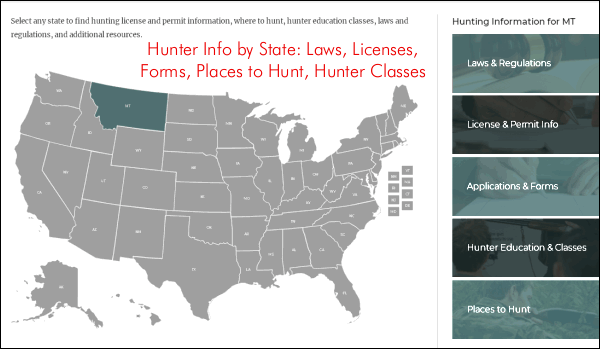
There’s a great online resource for hunters that will help you find game locations in your state and ensure you have all the proper permits and game tags. WheretoHunt.org features an interactive map of the country. For all 50 states, the NSSF has compiled information about hunting license and permits, where to hunt, hunter education classes, laws and regulations and more. For each state you’ll also find a link for required applications and license forms.
Click Map to Get State-by-State Hunting INFO
Hunting Affiliation Groups
There are many good organizations dedicated to promoting hunting and preserving our hunting habitats. These groups all offer valuable information for hunters:
Hunting season opens soon around the country. What better way to prepare the mind and spirit for your hunting adventure than to read a classic hunting book? We’ve found ten of the best hunting books every written and provided links below. The list of authors is impressive, including Ernest Hemingway and Theodore Roosevelt.
Recommended Books about Hunting
There’s no shortage of good hunting-related reading material. Here are some of the best books written about hunting. You can find all these titles on Amazon.com. Many are offered in eBook format as well as printed versions. Click on the link(s) below to preview a sample from each book.


 The Benefits of Dry-Fire Training


 It’s common for new pistoleros to start shooting at cans or clay birds at a public range. That can be fun, but it’s better to start with proper targets, placed at eye level, at 7-10 yards. We like to use targets with large, brightly colored circles. Focus on putting 5 shots in a circle. We recommend targets that have multiple bullseyes or aiming points — that way you don’t have to constantly change your target. There are also special paper targets that can help you diagnose common shooting problems, such as anticipating recoil.