Our friend Anette Wachter, aka “30CalGal”, stars in a smart video from NRAWomen.com. In this episode of Tips & Tactics, Anette talks about the “mental game” in competition. Specifically she explains how to “visualize success”:
I have found that a lot of my success in competition has come through what I call a ‘mental rehearsal’. I actually visualize every stage of the match and I visualize the success of the match and winning the match.
I actually visualize that round going downrange into the target, and the target coming up with a dead-center ‘X’. I visualize this over and over. If you visualize success you will achieve success.
Visualization is a process of mental preparation that is done before you get to the range. Many of the greatest shooting champions have used this technique to get ready for big matches, and to optimize their performance during record fire. If you want to enhance your “mental game” through pre-match visualization, we strongly recommend Lanny Bassham’s book, With Winning in Mind.
As a competitive smallbore 3P shooter, Bassham developed a mental management system. Using this system, Lanny Bassham won 22 world individual and team titles, set four world records, and captured an Olympic Gold Medal in Montreal in 1976. His techniques have been embraced by professional and Olympic athletes in many sports. With Winning in Mind covers a complete system of “mental management” techniques used by Olympians and elite champions.
About 30CalGal
Life is short. Go Shoot! — Anette Wachter
Along with being a talented competitive shooter, Anette created a popular Gun Blog, 30CalGal.com, and she has written for many gun publications including GunUp Magazine, Shooting Sports USA, Sure Shots Magazine, and Wide Open Spaces. CLICK HERE for a lengthy feature story about Anette’s impressive competition history, created for the Women’s Outdoor News. Among her many notable performances Anette remembered a big win in British Columbia: “My favorite, is of course, winning the BC Rifle Championships in 2011. [I was] the second woman and first US woman to win in its 127 year history.”
.009” Group Record Stood for 40 Years
In 1973 Mac McMillan shot an amazing 100-yard, .009″ five-shot group in a benchrest match. The .009″ group was measured with a 60x microscope for verification. Mac McMillan shot the group using a handbuilt prototype McMillan rifle with an early McMillan stock.
Mac’s .009″ group was the “Holy Grail” of rifle accuracy. This .009″ record was considered by many to be unbreakable, a record that would “stand for all time”. Well, it took 40 years, but someone finally broke Mac’s record with an even smaller group. In 2013, Mike Stinnett shot a .0077″ five-shot group using a 30 Stewart, a .30 caliber wildcat based on the 6.5 Grendel. Stinnett’s NBRSA record .0077″ group now stands as the smallest 100-yard group ever shot in registered benchrest competition.*
Stinnett’s success doesn’t diminish the significance of Mac McMillan’s .009″ group in the history of benchrest competition. For four decades Mac’s group stood as the ultimate standard of rifle accuracy*. For those of you who have never seen Mac McMillan’s .009″ group, here it is, along with the NBRSA World Record certificate. The target now hangs in the McMillan Family Museum.
*Somebody else might claim a smaller group, but unless moving backers or electronic targets were used, it cannot be verified. Moving target backers are used at registered benchrest matches to ensure that five (5) shots are actually fired in each group. That eliminates any doubt.
About Jerry Miculek… The Man, The Myth, The Legend
The video above begins: “My name is Jerry Miculek. Guns are what I do.” Jerry Miculek is a true legend in the firearms community. Acknowledged as the best wheelgun speed-shooter in history, Jerry is also an accomplished rifle and shotgun shooter with many class victories in 3-Gun competition. He also has been a prolific YouTube Video creator. For this Saturday Showcase, we feature seven notable Jerry Miculek videos. You will find over 500 more interesting videos on the Miculek “Trigger Tribe” YouTube channel Jerry shares with his daughter Lena Miculek.
How to Avoid Common Mistakes with Semi-Auto Rifles and Pistols
In this second video, Jerry explains common mistakes people make when handling and shooting three classic, semi-auto firearm types — the M1 Garand, the SKS carbine, and the M1911 pistol. Jerry shows handling faults that can cause out-of-battery detonation or early primer strikes, or cause jams in the Garand and SKS. Then Jerry explains why you should never release the slide on a M1911 pistol with a round already in the chamber. This is a must-watch video for Garand owners.
Hitting Target at 400 Meters with a Pistol
Could you hit an 18″ x 24″ target at a distance of 400 meters (437 yards)? Sure, you’re thinking, that would be easy with a good rifle fired from the bench or prone position. OK, now think about making that shot, OFF-HAND with a pistol. That’s something entirely different. We doubt many marksman would wager they could hit a plate 400 meters away with a handgun. That’s exactly the challenge legendary shooter Jerry Miculek undertakes in this interesting video. Shooting a Smith & Wesson 9mm M&P pistol with a red-dot optic, Jerry makes the 400m shot look easy, hitting the steel plate with his first shot. This takes good eyes, a solid grip, perfect trigger control (and a bit of luck).
Take-Down and Full Cleaning of AR-15
If you want to keep your black rifle running smoothly and reliably, you must clean it regularly and follow the correct maintenance procedures. In this video, Jerry Miculek takes down and cleans an AR-platform rifle belonging to his daughter Lena. This is a good video because Lena’s rifle was “run hard and packed up dirty” so you can see where carbon and grease build up. This 35-minute video is very thorough. Jerry is one of the nation’s top action carbine shooters, so listen carefully to his advice on cleaning and lubrication.
Ammo Types and Calibers — Jerry Miculek Explains the Basics
In this video, legendary shooter Jerry Miculek talks about popular types of pistol and rifle ammunition and the various bullet options used for plinking, competition, and self-defense. Jerry, one of the greatest pistol shooters on the planet, provides useful insights on cartridge selection and bullet choices. Jerry notes: “There are a TON of different types of ammunition” so he explains the basics. And Jerry answers common questions such as: “What is the difference between ball and hollow-point bullets?” and “What type of gun takes rimmed cartridge versus rimless?”.
Wheelgun Wisdom — How to Avoid Problem with Revolvers
Jerry Miculek has won multiple revolvers championships, and has set amazing records for revolver speed shooting (with reloads). Yes Jerry, “Mr. Revolver”, knows a thing or two about wheelguns. In this video, Jerry explains how you can damage your revolver by using the wrong methods to open and close the cylinder and extract ammo. Jerry shows what NOT to do, and then he very carefully explains the proper procedure to release the cylinder, and swing it out of the frame. In addition, Jerry shows how best to swing a loaded cylinder back into place.
80,000 Philippine M1 Garands in One Place
Back in 2020 Jerry Miculek visited the CMP’s HQ in Alabama. There he looked at the vast inventory of military rifles, including 80,000+ M1 Garands recently received from the Philippines. CMP tech staff showed Jerry some rare Garands that had never been issued. If you’re interested in classic military arms, you should definitely watch Jerry’s video. Gina Johnson, CMP’s general manager, told Guns.com that: “We have roughly 86,000 rifles from the Philippines and roughly 13,000 rifles from Turkey in our possession”.
Along with the 80,000+ Philippines Garands, the CMP received 13,000 from Turkey. The arrival of these 99,000 M1 Garands is great news for rifle collectors. Garands have been in short supply in recent years.
Erich Mietenkorte Wins 2025 Canadian Rifle Silhouette National High Power Championship.
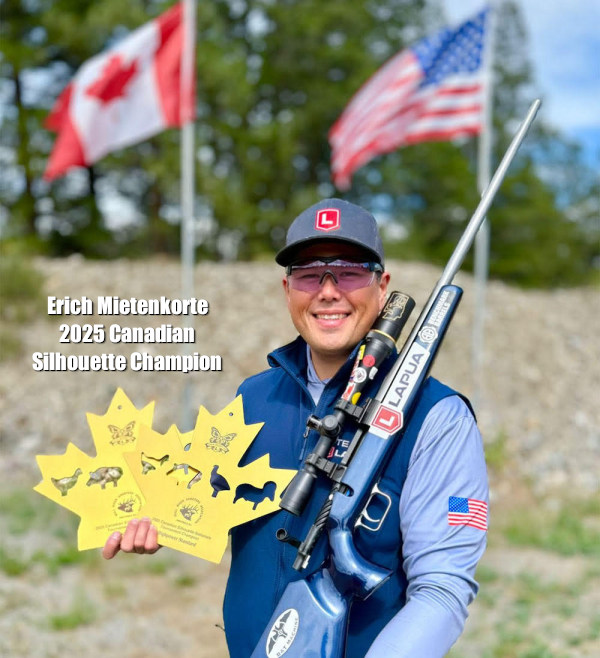
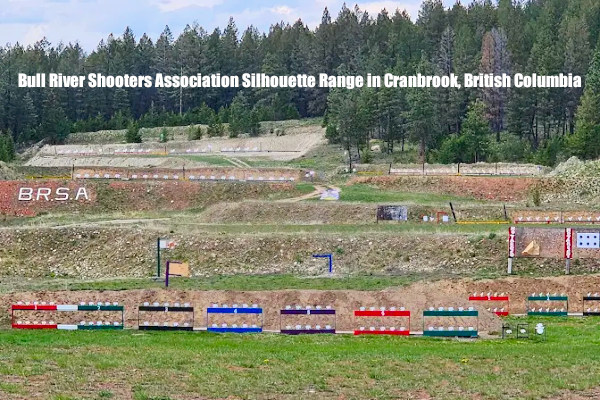
Team Lapua’s Erich Mietenkorte took top honors at the 2025 Canadian High Power Rifle Silhouette National Championships, winning the 240-shot High Power Aggregate with an impressive combined score of 195/240. Held at the Bull River Shooters Association range in Cranbrook, British Columbia, from June 29 to July 5, the national championship featured both Smallbore and High Power rifle disciplines, with competitors engaging steel silhouette targets from the standing offhand position at distances of 200, 300, 385, and 500 meters.
Mietenkorte competed in both High Power categories — Standard Rifle and Hunting Rifle — scoring 99/120 with his 6.5×47 Lapua in the Standard division, and 96/120 with his 6mm BR in the Hunting Rifle division. Mietenkorte’s combined performance earned him first place overall in the High Power aggregate and national titles in both rifle categories.
“Success in this discipline requires absolute confidence in your equipment. When it comes to consistency, reliability, and performance,?Lapua cases and bullets,?Vihtavuori powders, and?Berger bullets?are unmatched,” commented Mietenkorte. “I used Lapua 108gr and 139gr Scenar bullets in my 6.5×47, and Berger 95gr and 115gr bullets in my 6BR, all handloaded with Vihtavuori N140 powder. These components gave me the precision and consistency needed[.]”
What’s next? Mietenkorte will be competing at the U.S. NRA Rifle Silhouette National Championships at the NRA Whittington Center in Raton, NM, July 20-26, 2025.
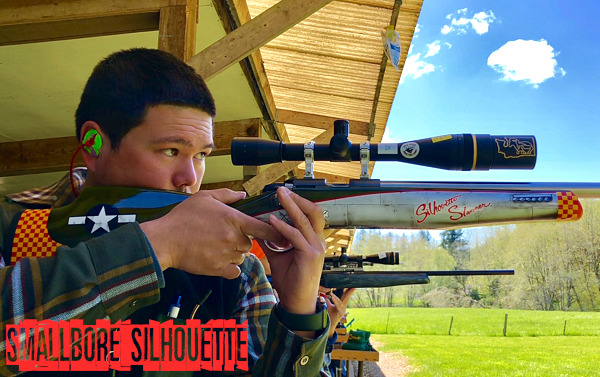
In addition to his success in the Canadian High Power competition, Mietenkorte finished 4th overall in the Smallbore Standard Rifle category. In the video below Eric demonstrates Smallbore Silhouette marksmanship skills.
Silhouette Champion Shares His Skills
In the video below, silhouette champion Eric Mietenkorte explains proper hold: “Consistency is key! Form a solid stance that is repeatable and allows you to have a natural point of aim. If you don’t come down on target adjust your feet, don’t rotate your body with your torso muscles.”
Erich explains his aiming method: “Pick a spot on the target and shoot for that. Try not to hesitate, if you’re on target, take the shot. It’s easy to get locked up by trying to make a great shot better. Make sure to follow through, keep that trigger pulled back. Don’t forget to have fun!”
Do you know someone who recently purchased his/her first handgun and is getting started in the shooting sports? Or do you need to brush up your own pistol skills? Then check out a new FREE video training series from the SIG Sauer Academy: Shooter’s Edge — Learning to Shoot.
Here is the Second Video from the Shooter’ Edge series, covering Basic Rules of Firearms Safety:
This video series features foundational handgun classes at the SIG Sauer Academy in New Hampshire. The ten-episode series takes viewers into the classroom and onto the range as the instructors walk through the fundamentals of handgun safety, shooting techniques, practice and training exercises, along with instruction in equipment options and handgun selection. The series was shot on location during several of the Academy’s introductory classes.
Click Below to Access Full Video Series on SigSauer.com:
The Shooter’ Edge Series includes the following episodes: Learn to Shoot at SIG Sauer Academy; Basic Rules of Safety; Types of Handguns and Ammunition; Foundational Shooting Techniques; How to Practice and Train Effectively; Choosing the Right Gun; Equipment and Its Purpose; Holsters — Presentation and Recovery; Magazines — Loading and Unloading; and What Happens After Learning to Shoot.
AccurateShooter.com offers a dozens of free, printable targets in our Target Collection. However, we know that sometimes shooters may prefer a commercially-printed specialty target. These may offer unique designs, hi-viz colors, splatter effect, or special functions (such as scope checking). Here are a variety of excellent commercial grid targets you can buy via Amazon or the target-maker’s website.
EZ-AIM 12″x12″ Grid with Orange Bullseyes — $6.99 for 13-pack
We like this EZ-Aim Sight-in Grid Target for sighting-in, load development. and general practice. The full 12″x12″ target is covered with a precise black-lined grid on white background. There is a large center orange bullseye, plus four additional bulls, one in each corner. Right now this target is a bargain. You can get a 13-pack of targets for just $6,99 (#ad) on Amazon.
Freedom Targets — Bullseye Sight-In Grid Target, 25 for $13.89
Here’s a great Bullseye Sight-in Grid Target. This target provides a central bull on a 1″ grid pattern. There 8 additional small orange dot aim points, plus helpful numbers on the central vertical and horizontal lines. The outer four orange aim points are set inside heavier black lines to help align your scope crosshairs. This target is nicely printed, with sharp lines and bright orange circles. You get a pack of 25 targets for $13.89 — that’s $0.56 per target.
Birchwood Casey Grid — Black on White Splatter, 5 for $8.69
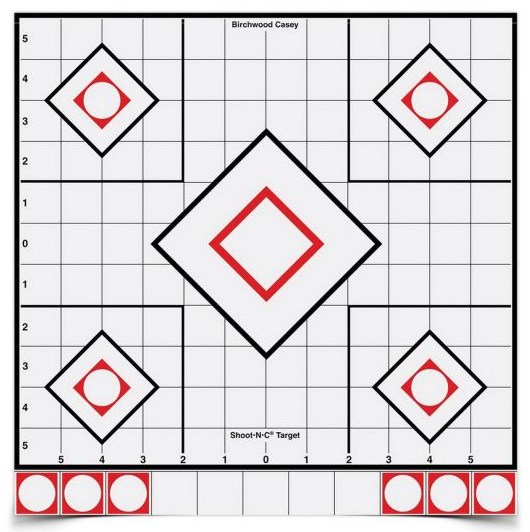
We’ve all seen conventional splatter targets with a black bullseye or grid. When a shot hits the target, a halo (usually neon yellow) appears around the bullet hole. Here is another kind of splatter target that creates a black circle on a white background. This can be very effective for spotting your hits at long range. Capture the same Shoot-N-C experience in white and black — the black “halo” can easily be seen at many distances. This Birchwood-Casey White Grid Target is $8.69 for a 5-pack. These Shoot-N-C Sight-In Targets have a self-adhesive backing, making for easy put up and take down. In addition, the target pack comes with corner pasters to cover holes or use as additional aim points.
High-Viz Option — Yellow on Black Grid with Yellow Halos
If you prefer seeing ultra-high-contrast yellow/green “halos” for your hits, Birchwood Casey also makes adhesive grid targets with five yellow-edged diamonds. Red circles provide precise aiming points in the middle of each box. You can quickly estimate group size or dial-in your zero using the hi-viz yellow 1″ grid lines. These yellow-on-black targets are available in three sizes: 8″ square, 12″ square, and 17.5″ square. These yellow-on-black grid targets start at $7.72 for an 8″ six-pack (#ad) on Amazon.
As an Amazon affiliate, this site can earn revenues through sales commissions.
This content Copyright 2025. Any republication on any other site is a violation of Federal Copyright laws and gives rise to penalties and damages.
Guest Article By Michelle Gallagher, Berger Bullets
Let’s face it. In the world of firearms, there is something for everyone. Do you like to compete? Are you a hunter? Are you more of a shotgun shooter or rifle shooter? Do you enjoy running around between stages of a timed course, or does the thought of shooting one-hole groups appeal to you more? Even though many of us shoot several different firearms and disciplines, chances are very good that we all have a favorite. Are we spreading ourselves too thin by shooting different disciplines, or is it actually beneficial? I have found that participating in multiple disciplines can actually improve your performance. Every style of shooting is different; therefore, they each develop different skills that benefit each other.
How can cross-training in other disciplines help you? For example, I am most familiar with long-range prone shooting, so let’s start there. To be a successful long-range shooter, you must have a stable position, accurate ammunition, and good wind-reading skills. You can improve all of these areas through time and effort, but there are other ways to improve more efficiently. Spend some time practicing smallbore. Smallbore rifles and targets are much less forgiving when it comes to position and shot execution. Long-range targets are very large, so you can get away with accepting less than perfect shots. Shooting smallbore will make you focus more on shooting perfectly center shots every time. Another way to do this with your High Power rifle is to shoot on reduced targets at long ranges. This will also force you to accept nothing less than perfect. Shoot at an F-Class target with your iron sights. At 1000 yards, the X-Ring on a long range target is 10 inches; it is 5 inches on an F-Class target. Because of this, you will have to focus harder on sight alignment to hit a center shot. When you go back to the conventional target, you will be amazed at how large the ten ring looks.
Also, most prone rifles can be fitted with a bipod. Put a bipod and scope on your rifle, and shoot F-TR. Shooting with a scope and bipod eliminates position and eyesight factors, and will allow you to concentrate on learning how to more accurately read the wind. The smaller target will force you to be more aggressive on your wind calls. It will also help encourage you to use better loading techniques. Nothing is more frustrating than making a correct wind call on that tiny target, only to lose the point out the top or bottom due to inferior ammunition. If you put in the effort to shoot good scores on the F-Class target, you will be amazed how much easier the long-range target looks when you return to your sling and iron sights. By the same token, F-Class shooters sometimes prefer to shoot fast and chase the spotter. Shooting prone can help teach patience in choosing a wind condition to shoot in, and waiting for that condition to return if it changes.
Benchrest shooters are arguably among the most knowledgeable about reloading. If you want to learn better techniques about loading ammunition, you might want to spend some time at benchrest matches. You might not be in contention to win, but you will certainly learn a lot about reloading and gun handling. Shooting F-Open can also teach you these skills, as it is closely related to benchrest. Benchrest shooters may learn new wind-reading techniques by shooting mid- or long-range F-Class matches.
Position shooters can also improve their skills by shooting different disciplines. High Power Across-the-Course shooters benefit from shooting smallbore and air rifle. Again, these targets are very small, which will encourage competitors to be more critical of their shot placement. Hunters may benefit from shooting silhouette matches, which will give them practice when shooting standing with a scoped rifle. Tactical matches may also be good, as tactical matches involve improvising shots from various positions and distances. [Editor: Many tactical matches also involve hiking or moving from position to position — this can motivate a shooter to maintain a good level of general fitness.]
These are just a few ways that you can benefit from branching out into other shooting disciplines. Talk to the other shooters. There is a wealth of knowledge in every discipline, and the other shooters will be more than happy to share what they have learned. Try something new. You may be surprised what you get out of it. You will certainly learn new skills and improve the ones you already have. You might develop a deeper appreciation for the discipline you started off with, or you may just discover a new passion.
This article originally appeared in the Berger Blog. The Berger Blog contains the latest info on Berger products, along with informative articles on target shooting and hunting.
Magnified 8X view looking down-range at bison (American buffalo) target.
Could You Hit a Steel Bison at 2240 Yards (1.27 miles) … with Iron Sights?
Impossible as that may seem, that’s exactly what Ernie Jimenez did some years back at the North Springs Shooting Range in Price, Utah (elevation 5,627′). Shooting a milsurp Swiss K31 rifle chambered for the 7.5×55 Swiss round, Jimenez placed four hits on a three-foot-high, bison-shaped steel target placed a staggering 2240 yards from the firing line. Not bad for a rifle which Jimenez acquired many years ago for just $99.00. Of course he did have plenty of misses along the way (and Ernie even managed to hit the plate shielding his camera).
This video is set to start half-way through, when the shooter starts making hits:
The whole process was recorded on video and posted on YouTube. The Long-Range Shooters of Utah say this is an official Guinness World Record for longest shot with iron sights. We can’t confirm that, but it still is an impressive feat. Jimenez had to compensate for a huge amount of bullet drop. His K31’s long-range military sights helped but he still had to aim well over the pink bison. To see how far that target is, watch the video at 14:30 — a camera at the firing line zooms all the way back until the bison is nothing but a tiny dot. The photo below show the target at 8X magnification, but it’s still barely visible.
Here’s the unmagnified, “naked-eye” view from the firing line. Can you see a pink buffalo at all?
Bullet Dropped Over 400 Feet along its Trajectory
To roughly gauge the bullet drop, we took a 7.5x55mm Swiss load from the Hodgdon Reloading Center. With max “book” load of H4350, a 168gr Sierra HPBT has a muzzle velocity of 2524 FPS. According to JBM Ballistics, that bullet will drop over 400 feet during its flight. That’s lot of hold-over! Assuming a 100-yard zero, 59° temp, and 5,600′ altitude, JBM calculates that the drop to 2250 yards is a stunning 210.9 MOA — that’s 4969.9 inches, or 414.15 feet!
In the first part of the video, shooter Ernie Jimenez talks about his hand-loads and his K31 rifle. Here is an example of the distinctive straight-pull K31 (Karabiner Model 1931). Image courtesy AIM Surplus.
With the New Year approaching, we thought our readers might enjoy some historical background on the National Rifle Association, an organization which has served American firearms owners and marksmen for over 150 years.
Shooting Sports USA (SSUSA) has a good article on the origins and history of the National Rifle Association. This feature story covers the first 36 years of NRA history from 1871 to 1907. The NRA was founded in 1871, and 1907 marked the first year of Matches at Camp Perry, Ohio.
SSUSA explains the NRA’s original mission: “The NRA’s program during its youthful years centered mainly on improving marksmanship among the military. Rifle tournaments at ranges in Creedmoor (NY), Sea Girt (NJ), and Camp Perry (OH) captured the country’s spirit of nationalism and resulted in key improvements in rifles and target scoring. NRA also set standards for military rifle training and even inspired the federal government to form its own segment within the War Department to focus on promoting rifle practice among soldiers as well as civilians.”
1871 — A group of New York National Guardsmen founded the National Rifle Association to promote marksmanship training. Figures such as Capt. George Wingate had called for better rifle marksmanship to support the nation’s defense.
1872 — The NRA acquires Creed’s Farm in Long Island, New York for $26,250. Renamed “Creedmoor”, this becomes the NRA’s first range. The first match was held in 1873.
1874 — The NRA hosts its first International Match, shot at the Creedmoor Range in New York.
The First-Ever Creedmoor Challenge Match in 1874
The Irish International Shooting team arrived in New York on the 16th of September and proceeded to “take in the sights”, which was understandable, before some practice at the Creedmoor range. On September 26th they presented themselves for the match with confidence and in high spirits. The crowds that day were reported to be between 5,000 and 10,000 strong, which showed the huge support already growing for the fledgling sport in America.
The course of fire was 15 shots to each man at 800, 900, and 1000 yards. Unfortunately, the details of each mans scores at the individual distances have been lost to time but we do know that the Americans were well ahead after the 800-yard shoot. The Irish then caught up after the 900-yard and finished the 1000-yard shoot ahead by 1 point. The Americans still had one man left to shoot and it came down to his very last shot with which he scored a 4 giving the American team the win over the Irish by 3 points.
1892 — The NRA moves its Annual Matches to the Sea Girt Range in New Jersey, which was less than 60 Miles from New York City, NY. The Sea Girt Range was maintained by the New Jersey State Rifle Association, founded in 1878.
1903 — The U.S. War Department sets up a National Board for the Promotion of Rifle Practice (NBPRP). In 1903, an amendment to the War Dept. Appropriations Bill established the NBPRP to promote both Military and Civilian marksmanship. This government advisory board became the predecessor to today’s Corporation for the Promotion of Rifle Practice and Firearms Safety that now governs the CMP.
1907 — The NRA commences National Matches at Camp Perry, Ohio.
History of Camp Perry
The National Matches have been held at Camp Perry since 1907. The range is located along the shores of Lake Erie in northern Ohio near Port Clinton. The site was first acquired in 1906, in response to the need for a larger facility for military training and the NRA’s shooting programs. In 1906 Gen. Ammon B. Crichfield, Adjutant General of Ohio, ordered construction of a new shooting facility on the shores of Lake Erie, 45 miles east of Toledo, Ohio. The original land for Camp Perry was purchased in 1906, and the reservation was named after Commodore Oliver Hazard Perry, the American naval commander who won the Battle of Put-in-Bay during the War of 1812.
On August 19, 1907, Cpl. L. B. Jarrett fired the first shot at the new Camp Perry Training Site. And that year, 1907, Camp Perry held its first National Pistol and Rifle Championship events. This location has hosted the annual NRA National Matches ever since. Today, over 4,000 competitors attend the National Matches each year, making it the most popular shooting competition in the western hemisphere.
Federal legislation originally launched the National Matches. The 1903 legislation also established the National Matches, commissioned the National Trophy and provided funding to support the Matches.
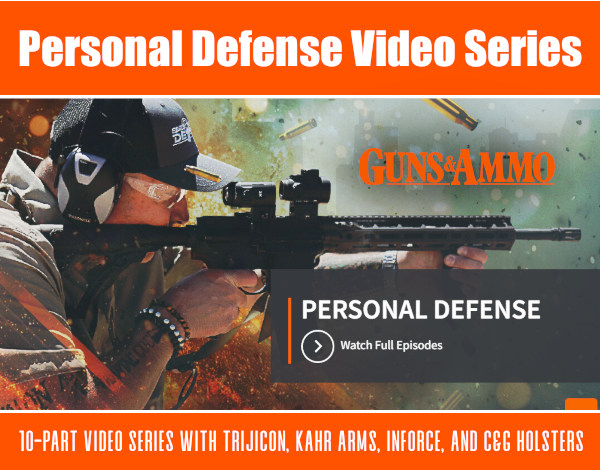
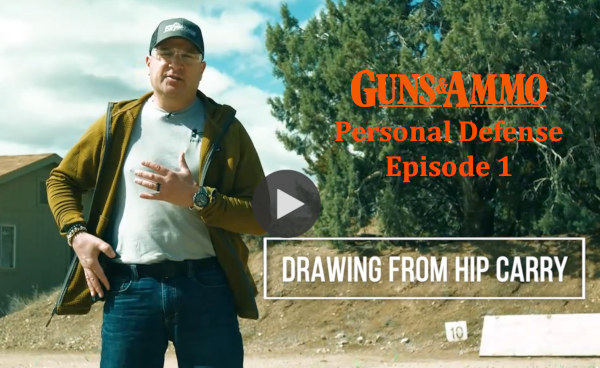
Guns & Ammo has launched a 10-part Personal Defense Video Series in cooperation with Kahr Arms, Trijicon, InForce, and C&G Holsters. The first episode, “Drawing from Hip Carry”, was released this week at: gapersonaldefense.com. Viewers can also now watch all 10 episodes online to learn more about personal defense equipment, tactics, and strategies.
Nine more Personal Defense videos are available online. Click these links to access all NINE other videos:
Designed for both new and experienced firearm owners, these videos cover both handgun and rifle use for for personal protection. The producers state: “By tackling myths, addressing tough questions, and providing actionable guidance, this series equips viewers with the knowledge they need to make informed decisions about self-defense and responsible gun ownership.”
“Guns & Ammo Personal Defense is more than just a series; it’s a resource for individuals committed to protecting themselves and their loved ones,” said Tim Cremin, Head of Programming and Production at Outdoor Sportsman Group. “We’re eager to work with industry leaders to bring this comprehensive and educational program to our audience.”


 Our friend Anette Wachter, aka “30CalGal”, stars in a smart video from NRAWomen.com. In this episode of Tips & Tactics, Anette talks about the “mental game” in competition. Specifically she explains how to “visualize success”:
 .009” Group Record Stood for 40 Years





 Position shooters can also improve their skills by shooting different disciplines. High Power Across-the-Course shooters benefit from shooting smallbore and air rifle. Again, these targets are very small, which will encourage competitors to be more critical of their shot placement. Hunters may benefit from shooting silhouette matches, which will give them practice when shooting standing with a scoped rifle. Tactical matches may also be good, as tactical matches involve improvising shots from various positions and distances. [Editor: Many tactical matches also involve hiking or moving from position to position — this can motivate a shooter to maintain a good level of general fitness.]