The National Rifle Association has distributed one million dollars to fund range development and improvement projects in 2022. Both public and private ranges have receive grants for a variety of projects including: construction of berms, range covers, lighting systems, and pavilions. Funds have also been provided for the purchase of trap machines. The funding was distributed via the NRA and NRA Foundation.
“To ensure a robust future for recreational target shooting and the shooting sports, gun owners need a place to learn, train, and compete,” said Joseph P. DeBergalis, Jr., executive director of NRA General Operations. “Thanks to the generosity of NRA members, NRA Foundation donors, and those who attend local Friends of NRA events, NRA is able to provide the resources sought after by clubs and public agencies to build, expand, and improve ranges in their communities.”
How Your Club or Facility Can Apply for NRA Grants
Range funds are available for request in a variety of ways. First, through the Range Development Committee, NRA-Affiliated Range Funding is offered to 100% NRA membership-affiliated clubs for the acquisition, development, and improvement of shooting facilities. Second, funding is made available through the NRA Public Range Grant Funding program to city, county, state, and federal units of government to improve, enhance, and build public ranges. Third, there is the NRA Foundation State Fund Capital Improvement Grants program, which offers funding to government agencies and non-profit entities.
NRA Range Services offers an online course to prospective and current range owners and operators detailing best practices in range development, safety, and environmental concerns. To complement the course, NRA has authored The NRA Range Source Book, a premier technical source book for planning, construction, design, and maintenance of shooting range facilities. On the public policy side, the NRA Institute for Legislative Action (NRA-ILA) has been instrumental in protecting access to shooting ranges by promoting and supporting Range Protection laws throughout the country, prohibiting anti-gun units of government from forcing the closure of shooting ranges through onerous regulations.
Links for More Information and Grant Applications
To learn more about NRA’s support for public and private ranges, please visit Rangeservices.NRA.org. Information about the NRA Foundation, a 501(c)(3) charitable organization, and its grant application process can be found at NRAfoundation.org/grants.
Rainy September Days in Vermont
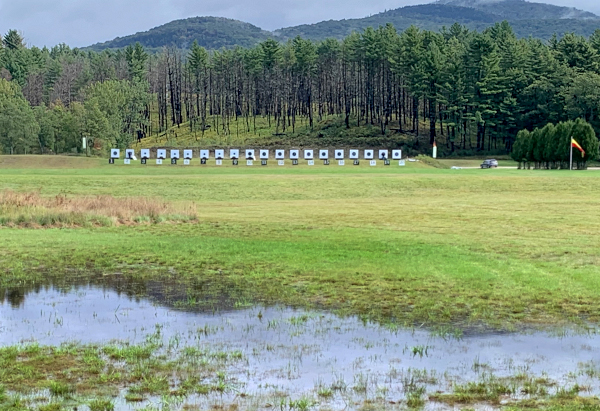
The Civilian Marksmanship Program’s New England Games Matches, held September 18-25, 2022, at the Camp Ethan Allen National Guard Training Site in Vermont, can be described in one word: WET.
Though suffering one of the toughest weather weeks in the event’s history through cold temperatures and steady rainfall, Pistol and Rifle competitors still managed to give outstanding performances on the firing line, with some new record scores being set.
The New England Games event features CMP’s full lineup of vintage and modern military rifle and pistol competitions. These matches are suitable for those just beginning in the sport of marksmanship while offering significant challenges for more experienced marksmen and markswomen.
Notable 2022 New England Games Results and New Records
In CMP Games rifle events, Brian Williams, 48, who is a current New England Games record holder in several events, set yet another record with a 383-6X in the Carbine Match. This topped the previous score he had set himself in 2016. Williams was also only two points away from setting a new record in the Modern Military event — he holds the current record in the match from his 2018 performance.
Maisey Loucks, 28, showed great talent in the Rimfire Sporter Rifle Match, finishing with 579-26X, just three points from the current TU class record. Earlier this year, at the Camp Perry National Matches in July, Maisey earned the High Woman title in the National Carbine Match, setting a record in the process.
Reaching a new New England Games record in the Vintage Sniper Match was Hard Leg #2 (James Horton, Jack Chomko), who beat the previous record set in 2018 by one x-shot, with a score of 397-16X.
Setting a New England Games record in the Vintage Sniper Match was team Hard Leg #2 (James Horton, Jack Chomko), who beat the previous record set in 2018 by one X, with a score of 397-16X.
Bettering a record in the EIC Match by X-Count was SSG Verne Conant, 26, who accumulated a score of 497-26X in his impressive win. Top competitors of the match earned EIC (Excellence-In-Competition) points toward a Distinguished Badge, including two junior athletes: Jack Marshall, 20, and Shannon Moriarty, 14. Marshall finished the match fourth overall while Shannon Moriarty took fifth.
Outside of the recreational Games Matches, the CMP hosted a series of High Power matches that included a team event, three days of 800 Aggregate shooting, and a culminating 2400 Aggregate. Individuals were recognized for their Service or Match Rifle use, scores at each position and Civilian or Military status.
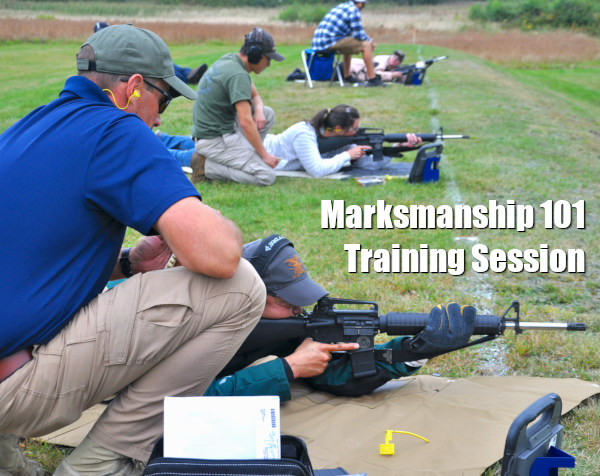
Along with the matches, a Rifle Marksmanship 101 clinic was held at Camp Ethan Allen.
Want to learn the basics of position shooting? Then you should check out an article by Gary Anderson, DCM Emeritus, in On the Mark digital magazine (Summer 2014, pp. 6-13). This article covers all the key elements: body position (prone, sitting, standing), sling use/adjustment, sight picture, aiming process, and trigger control. While this 8-page article was specifically written for Rimfire Sporter shooters, the techniques described by Anderson apply to all types of position shooting, whether you shoot air rifles, smallbore rifles, or centerfire rifles.
Here’s what Anderson says about aiming — how to keep your sights steady and get them centered on the middle of the target:
Trigger Contact and Center As soon as aiming at the target begins, the index finger must move from the trigger-guard to contact the trigger. It is important to get initial pressure on the trigger as soon as aiming begins. Then the shooter must focus on the sight picture and centering the sight picture movements over the aiming point. No one, not even champion shooters, can hold the aligned sights perfectly still. The sights are going to move a little bit or a lot, depending on the shooter’s skill level. The secret is to center those sight picture movements over the aiming point on the target (see trace illustration) before pulling the trigger.
When the sight picture movements on the target are centered, the last step in firing the shot is to add… smooth pressure on the trigger until the shot breaks.
Anderson also discusses the 5 Basics of Shot Technique:
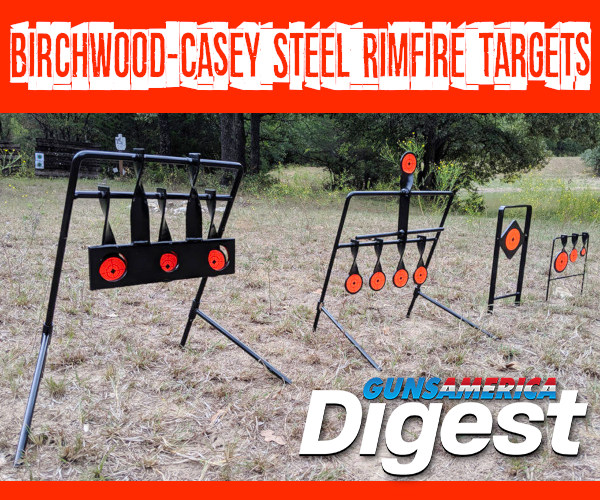
Rimfire plinking with reactive targets is FUN and affordable. We always like to include REACTIVE TARGETS during a trip to the range with our .22s. Decent .22 LR rimfire ammo is not expensive, and a wide variety of affordable steel targets are available. Rimfire-class steel is much less costly than the heavy AR500 steel plates used for centerfire rounds. In fact, Birchwood Casey makes a wide variety of reactive steel rimfire targets that retail for under $50.00. These offer great “Bang for the Buck”.
A fast-cycling, semi-auto .22 LR rifle like the Savage A22 is great for shooting reactive targets.
GunsAmerica Digest has reviewed a variety of reactive rimfire target systems from Birchwood Casey. We recommend you read this detailed article Little Targets, Big Fun, by Jordan Michaels. He acquired four different steel target systems and tested them at his Texas range. Michales was impressed: “At $30-$55 a pop, Birchwood-Casey’s targets are small enough to be challenging and cheap enough to buy four or five for the price of one centerfire-rated target. They’re also light, portable, reactive, and easy to set up.”
B/C Gallery
B/C Back Drop
B/C Qualifier Spinner
B/C King of Diamonds
Check out how these Birchwood Casey steel targets perform. These animated GIFs show actual shooting sessions with .22 LR rifles and pistols. The targets hold up well, though the black paint comes off. The reviewer notes: “You shouldn’t worry about durability as long as you stick to .22 LR. I shot the heck out of these targets with rifles and handguns using both standard and high-velocity cartridges, and I didn’t notice any denting or cracking. If the targets are going to be kept outside, however, keep an eye out for rust – the black paint comes off immediately.”
Safety Considerations with Steel Reactive Targets
The tester said the targets worked best with a .22 LR ammo with at least 1000 fps MV at the targets. He tested with .22 LR pistols as close as 7 yards, and .22 LR rifles out to 100 yards. Be advised — when shooting steel targets at relatively close ranges ALWAYS wear full-coverage eye protection because ricochets and splash-backs are definite risks. Also comply with all range rules.
You have probably watched one of the excellent shooting sports videos Ryan Cleckner has done for the NSSF. Ryan’s Understanding Minute of Angle (MOA) video (see below) has been viewed over 3.4 million times! Ryan is noted for his ability to explain complex topics in an easy-to-comprehend manner.
Cleckner has also authored a hugely popular book, the Long Range Shooting Handbook, which expands on the topics covered in his popular video series. This book is the #1 Best Seller on Amazon in its category. You can view Sample Chapters from Ryan’s book — just click “Look Inside” on the Amazon product page.
As a long-range shooting expert, Ryan Cleckner has impressive credentials. Cleckner was a special operations sniper (1/75 Rgr) with multiple combat deployments, and he has served a U.S. Army sniper instructor. Currently he works as a firearms industry executive and attorney.
The Long Range Shooting Handbook is divided into three main categories: What It Is/How It Works, Fundamentals, and How to Use It. “What It Is/How It Works” covers equipment, terminology, and basic principles. “Fundamentals” covers the theory of long range shooting. “How to Use It” gives practical advice on implementing what you’ve learned, so you can progress as a skilled, long range shooter.
Ryan Cleckner’s best-selling Long Range Shooting Handbook is designed as an introduction to important fundamental concepts such as MOA vs. MILs, External Ballistics, and Environmental Effects. Included are personal tips and advice based on Cleckner’s years of experience as a sniper instructor and special operations sniper.
Iain Harrison, editor of Recoil Magazine, said: “Whether you’re looking to dip a toe into the complex world of long range shooting, or you’re a seasoned shooter with years of trigger time, Ryan Cleckner’s book will prove to be excellent reference material. Well written and easy to understand, it covers all the essential topics that a well-rounded shooter needs to master.”
In this video, Ryan Cleckner reviews proper technique for rifle shooters. A stable platform, sight alignment, sight picture, and trigger control are key fundamentals to shooting properly.
The 2022 NRA F-Class National Championships commence this weekend at the Ben Avery range in Phoenix, Arizona. The Mid-Range F-Class Nationals commence this Sunday, October 16, with practice on Saturday, October 15. The 1000-yard Long Range match starts on October 20th.
How to Avoid “Train Wrecks” In Competition
In any shooting competition, you must try to avoid major screw-ups that can ruin your day (or your match). In this article, past F-TR National Mid-Range and Long Range Champion Bryan Litz talks about “Train Wrecks”, i.e. those big disasters (such as equipment failures) that can ruin a whole match. Bryan illustrates the types of “train wrecks” that commonly befall competitors, and he explains how to avoid these “unmitigated disasters”.
Urban Dictionary “Train Wreck” Definition: “A total @#$&! disaster … the kind that makes you want to shake your head.”
Success in long range competition depends on many things. Those who aspire to be competitive are usually detail-oriented, and focused on all the small things that might give them an edge. Unfortunately it’s common for shooters lose sight of the big picture — missing the forest for the trees, so to speak.
Consistency is one of the universal principles of successful shooting. The tournament champion is the shooter with the highest average performance over several days, often times not winning a single match. While you can win tournaments without an isolated stellar performance, you cannot win tournaments if you have a single train wreck performance. And this is why it’s important for the detail-oriented shooter to keep an eye out for potential “big picture” problems that can derail the train of success!
Train wrecks can be defined differently by shooters of various skill levels and categories. Anything from problems causing a miss, to problems causing a 3/4-MOA shift in wind zero can manifest as a train wreck, depending on the kind of shooting you’re doing.
Below is a list of common Shooting Match Train Wrecks, and suggestions for avoiding them.
1. Cross-Firing. The fastest and most common way to destroy your score (and any hopes of winning a tournament) is to cross-fire. The cure is obviously basic awareness of your target number on each shot, but you can stack the odds in your favor if you’re smart. For sling shooters, establish your Natural Point of Aim (NPA) and monitor that it doesn’t shift during your course of fire. If you’re doing this right, you’ll always come back on your target naturally, without deliberately checking each time. You should be doing this anyway, but avoiding cross-fires is another incentive for monitoring this important fundamental. In F-Class shooting, pay attention to how the rifle recoils, and where the crosshairs settle. If the crosshairs always settle to the right, either make an adjustment to your bipod, hold, or simply make sure to move back each shot. Also consider your scope. Running super high magnification can leave the number board out of the scope’s field view. That can really increase the risk of cross-firing.
2. Equipment Failure. There are a wide variety of equipment failures you may encounter at a match, from loose sight fasteners, to broken bipods, to high-round-count barrels that that suddenly “go south” (just to mention a few possibilities). Mechanical components can and do fail. The best policy is to put some thought into what the critical failure points are, monitor wear of these parts, and have spares ready. This is where an ounce of prevention can prevent a ton of train wreck. On this note, if you like running hot loads, consider whether that extra 20 fps is worth blowing up a bullet (10 points), sticking a bolt (DNF), or worse yet, causing injury to yourself or someone nearby.
[Editor’s Note: The 2016 F-Class Nationals will employ electronic targets so conventional pit duties won’t be required. However, the following advice does apply for matches with conventional targets.]
3. Scoring/Pit Malfunction. Although not related to your shooting technique, doing things to insure you get at least fair treatment from your scorer and pit puller is a good idea. Try to meet the others on your target so they can associate a face with the shooter for whom they’re pulling. If you learn your scorer is a Democrat, it’s probably best not to tell Obama jokes before you go for record. If your pit puller is elderly, it may be unwise to shoot very rapidly and risk a shot being missed (by the pit worker), or having to call for a mark. Slowing down a second or two between shots might prevent a 5-minute delay and possibly an undeserved miss.
4. Wind Issues. Tricky winds derail many trains. A lot can be written about wind strategies, but here’s a simple tip about how to take the edge off a worse case scenario. You don’t have to start blazing away on the command of “Commence fire”. If the wind is blowing like a bastard when your time starts, just wait! You’re allotted 30 minutes to fire your string in long range slow fire. With average pit service, it might take you 10 minutes if you hustle, less in F-Class. Point being, you have about three times longer than you need. So let everyone else shoot through the storm and look for a window (or windows) of time which are not so adverse. Of course this is a risk, conditions might get worse if you wait. This is where judgment comes in. Just know you have options for managing time and keep an eye on the clock. Saving rounds in a slow fire match is a costly and embarrassing train wreck.
5. Mind Your Physical Health. While traveling for shooting matches, most shooters break their normal patterns of diet, sleep, alcohol consumption, etc. These disruptions to the norm can have detrimental effects on your body and your ability to shoot and even think clearly. If you’re used to an indoor job and eating salads in air-conditioned break rooms and you travel to a week-long rifle match which keeps you on your feet all day in 90-degree heat and high humidity, while eating greasy restaurant food, drinking beer and getting little sleep, then you might as well plan on daily train wrecks. If the match is four hours away, rather than leaving at 3:00 am and drinking five cups of coffee on the morning drive, arrive the night before and get a good night’s sleep.”
Keep focused on the important stuff. You never want to lose sight of the big picture. Keep the important, common sense things in mind as well as the minutia of meplat trimming, weighing powder to the kernel, and cleaning your barrel ’til it’s squeaky clean. Remember, all the little enhancements can’t make up for one big train wreck!
We are now in the thick of the 2022 fall hunting season now. Here are two great books that can help make your fall hunt a success. If you are a serious hunter (or aspire to be) here are two resources you should definitely add to your library. These two excellent books are offered in both print and e-Book formats.
Written by a highly-skilled New Zealand hunter with decades of field experience, the Practical Guide to Hunting Cartridges tells you what you need to know about hunting cartridge performance. In no-nonsense terms, this book reveals how various rounds actually perform in a wide variety of game species. Nathan’s first book, The Practical Guide to Long Range Hunting Rifles, is a classic — one of the best books ever written on choosing and using a hunting rifle. We recommend both books highly. NOTE: You can also save 10% with a two-book bundle.
If you really want to learn about long-range hunting, listen to a pro like Nathan Foster who has spent decades in the wild, harvesting over 7500 head of game. His classic Guide to Hunting Rifles analyzes what you need in a hunting firearm and compares various action/stock/barrel/scope options. This book also provides some practical stalking and shooting tips for hunters. Nathan’s 415-page companion book on Hunting Cartridges guides you through the process of choosing cartridge and projectile(s) for your hunts. Nathan examines the pros and cons of various cartridges so that the reader can select the best cartridge and projectile to get the job done. This book represents years of first-hand research, testing scores of calibers/loads in the field.
Nathan is truly a hunting expert. Nathan has spent thousands of hours in the field and he knows the subject cold. Unlike some outdoor writers, Nathan doesn’t pull punches — he tells the unvarnished truth about what works and what doesn’t. Here’s what Nathan says about these two books:
For several years, I have received two types of email. The first question is which is the right rifle for me? The second question is which is the right cartridge? My first book dealt with the accurate rifle. This second book deals with long range hunting cartridge selection. I firmly believe that there has been a huge gap in education regarding optimal long range hunting cartridge performance. In many instances, both hunters and bullet manufacturers do not understand what’s required to achieve goals. Many times, the wrong tools are used for long range hunting. This book seeks to remedy these problems.
In the Practical Guide to Long Range Hunting Cartridges, I start with the fundamentals of game killing — but from the perspective of the long range hunter (also encountering close range shots). This section is not politically correct in any way, as after the study of anatomy, I explore worst case scenarios in as much depth as ideal shot placement.
The second section of the book is a study of projectile design. I wanted to get right down to the finer details of the long range hunting bullet in this section, exploring manufacturers, manufacturing techniques, and ways in which the end user can perform preliminary testing as well as bullet modifications.
The third section explains how to select a long range hunting cartridge. The system I have used here is based on a selection method I developed over the years to help clients worldwide. This method takes individual circumstances into consideration rather than a one-size-fits-all approach. It is a system that relies on plain common sense based on research. The fourth section of the book is the cartridge section. Cartridge information is presented in a set format with Pro/Con summary tables. In many instances I have included my own load notes.
About the Author: New Zealander Nathan Foster lives and breathes what he teaches. An expert in the field of terminal ballistics, Nathan has taken over 7500 head of game, and has field-tested a vast number of cartridges and projectiles. Nathan’s first book, The Practical Guide to Long Range Hunting Rifles, is widely recognized as one of the best books ever published on the subject. The new book goes into greater detail on specific cartridges. Nathan’s website includes an outstanding online cartridge knowledge base with over 100 detailed cartridge profiles. CLICK HERE for Cartridge INFO.
Nathan runs Terminal Ballistics Research, a small company in Taranaki, New Zealand, that conducts cartridge and projectile performance research. Nathan also operates a long-range shooting school. Nathan is also the creator of MatchGrade Bedding Products.
The 2022 United States F-Class National Championships commence Sunday, October 16, 2022 at the Ben Avery Shooting Facility (BASF) in Phoenix. There’s a “hybrid” format this year. (The range should be open for practice on Saturday 10/15/2022). For 2022, the Nationals combine both Mid-Range and Long-Range competitions in one extended mega-match. The Mid-Range U.S. F-Class Nationals take place October 16-19, 2022, with all shooting at 600-yard targets. The Long Range F-Class National Championships then run Thursday, October 20 through Sunday October 23, 2022. All Long Range matches are at 1000 yards. The competitions will have two different divisions: F-Open and F-TR (Target Rifle). Registration is now closed for both Mid-Range and Long-Range Championships.*
Located on 1,650 acres in north Phoenix, Ben Avery is one of the nation’s largest publicly operated shooting facilities. A City of Phoenix “Point of Pride,” the facility has received a five-star rating from the National Association of Shooting Ranges. A camping area is available for competitors. Contact Ben Avery Shooting Range Camping to reserve a camping spot.
Firing line at 2015 F-Class Nationals at Ben Avery Shooting Facility.
You’ll see some serious hardware on the firing line at Ben Avery. Here’s a modern F-Open rig with a handsome maple stock. The gun, belonging to David Mann of Texas, shoots as good as it looks.
RULES: Current NRA F-Class Rules shall apply. TARGETS: MR-1FC at 600 yards and LRFC at 1000 yards. TARGET SERVICE: Competitors will pull their own targets. SCORING: Competitors will score. Any competitor failing to perform his scoring duties may be disqualified. SQUADDING: All matches will be squadded. Squadding tickets for individual matches will be issued at the Stat. Office starting at 6:30 AM Sunday 16 October. Any competitor who fails to obtain his squadding ticket by 7:30 AM will only be squadded to fill up vacancies. CLASSIFICATION: NRA F-Class Classifications will be used. Those competitors unclassified or without proof of a lower classification, will be required to compete in the Master class. Please indicate classification on the registration and entry form. EMPTY CHAMBER INDICATOR (ECI): Approved NRA empty chamber indicators are required to be used at all times except during the preparation period time and firing.
* Registration officially ended on Monday, October 10, 2022. Entries after this time are considered late entries and may be accepted to fill vacancies on existing relays only. An additional $20.00 will be charged for late entries.
For hunters in a tree stand, SFC McPhail recommends a position with your weakside leg pulled up and firmly braced on the front rail of the treestand. You can then rest your support arm on your leg. This provides a rock-solid position when shooting from a stand.
Team USA Olympian and ISSF World Cup Winner SFC Michael McPhail is one of the world’s best smallbore rifle shooters. He is also an avid hunter, who enjoys harvesting game with centerfire rifles. In a USAMU video, McPhail shows how competition shooting positions can be adapted for hunters. McPhail shows how well-established positions can provide a more stable platform for hunters in the field. That can help ensure a successful hunt. McPhail demonstrates three positions: kneeling, supported prone, and sitting in a tree-stand.
Watch SFC McPhail Demonstrate Positions for Hunters (Good Video):
McPhail first demonstrates the kneeling position. Michael notes: “I like kneeling. It’s a little bit of an under-utilized position, but it’s almost as stable as prone. It allows you get up off the ground a little bit higher to [compensate for] vegetation. For kneeling start by taking your non-dominant foot and put that towards the target, while at the same time dropping down to a knee on the dominant leg. At the same time … wrap the sling around wrist and fore-arm, lean slightly into the target and take the shot.”
McPhail shows a nice “field expedient” use of your backpack. He shows how the basic prone position can be adapted, using the pack as a front rifle support. McPhail recommends pulling your dominant (strongside) leg forward, bent at the knee. According to Michael, this takes pressure off the abdomen, helps minimizes heart beat effects, and helps with breathing.
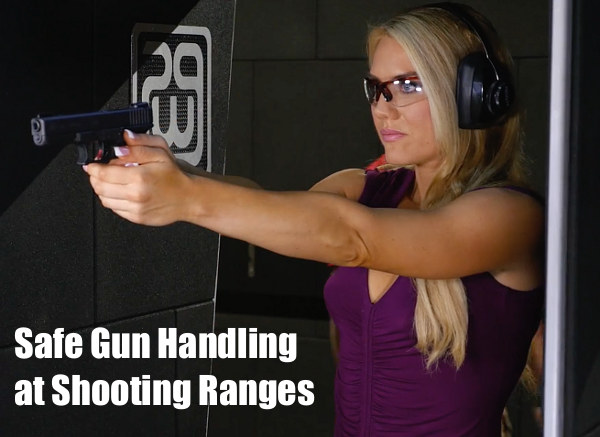
There has been a long, cold winter in many parts of the USA. So if you want to maintain your shooting skills, shooting indoors may be the only convenient option. When shooting indoors you should always be extra careful and follow all key gun safety practices and adhere to proper range “Etiquette”.
The NSSF (NSSF) offers a useful Range Safety and Etiquette video. This 8.5-minute video explains safe practices, especially at indoor ranges. In the video, the moderator list the basic rules of gun safety, before covering key range etiquette topics such as range officer commands, how to uncase your firearm on the range when you first arrive, and what to do if a firearm is accidentally dropped. There are also safety tips specific to handling both semi-automatic handguns and revolvers.
BAD RANGE BEHAVIOR — Five Things NOT to Do at the Range
Here are the five worst behaviors we’ve seen at indoor ranges. These behaviors are both dangerous and inconsiderate. Any one of these behaviors can get you permanently banned from an indoor range.
1. Sweeping other individuals after loading a weapon behind the firing line is very bad. All your weapons should be empty until you reach your shooting station.
2. Turning the handgun sideways while trying to clear a malfunction or insert/remove a magazine. This will point the muzzle at a fellow shooter. Or, after shooting a gun, the shooter fails to clear the weapon and then places the gun somewhere near the shooting station with the muzzle in an unsafe position.
3. Reacting unpredictably when firing a high recoil handgun. We’ve seen people take a second shot by accident with the muzzle way off target.
4. Not obeying range commands — in particular continuing to shoot during called cease-fires.
5. Poorly aimed shooting that hits target frames or carriers, causing ricochets.
Seven Types of People at the Gun Range — HUMOR
This video is satire, but with lots of truth in the characterizations. Laughter guaranteed.
Double-Up on Hearing Protection When Shooting Indoors
When shooting pistols indoors we recommend quality muffs with earplugs underneath, offering double protection. When inside an enclosed range, with other shooters blasting away right next to you, you really need effective hearing protection. But you also need to hear range commands and be able to communicate with your fellow shooters. That’s why we recommend electronic muffs with plugs underneath.






 As soon as aiming at the target begins, the index finger must move from the trigger-guard to contact the trigger. It is important to get initial pressure on the trigger as soon as aiming begins. Then the shooter must focus on the sight picture and centering the sight picture movements over the aiming point. No one, not even champion shooters, can hold the aligned sights perfectly still. The sights are going to move a little bit or a lot, depending on the shooter’s skill level. The secret is to center those sight picture movements over the aiming point on the target (see trace illustration) before pulling the trigger.


 Train Wrecks (and How to Avoid Them)
 4. Wind Issues. Tricky winds derail many trains. A lot can be written about wind strategies, but here’s a simple tip about how to take the edge off a worse case scenario. You don’t have to start blazing away on the command of “Commence fire”. If the wind is blowing like a bastard when your time starts, just wait! You’re allotted 30 minutes to fire your string in long range slow fire. With average pit service, it might take you 10 minutes if you hustle, less in F-Class. Point being, you have about three times longer than you need. So let everyone else shoot through the storm and look for a window (or windows) of time which are not so adverse. Of course this is a risk, conditions might get worse if you wait. This is where judgment comes in. Just know you have options for managing time and keep an eye on the clock. Saving rounds in a slow fire match is a costly and embarrassing train wreck.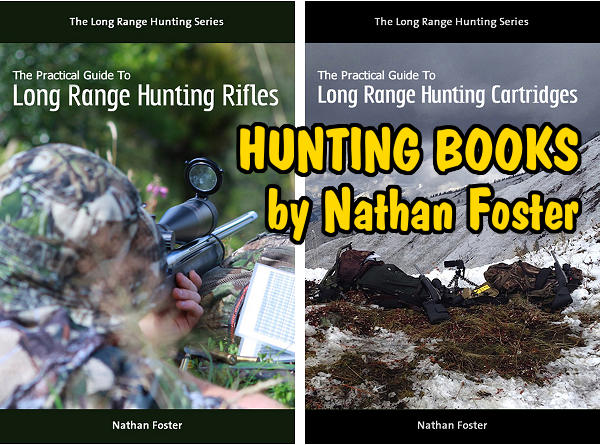

 For several years, I have received two types of email. The first question is which is the right rifle for me? The second question is which is the right cartridge? My first book dealt with the accurate rifle. This second book deals with long range hunting cartridge selection. I firmly believe that there has been a huge gap in education regarding optimal long range hunting cartridge performance. In many instances, both hunters and bullet manufacturers do not understand what’s required to achieve goals. Many times, the wrong tools are used for long range hunting. This book seeks to remedy these problems.
 About the Author: New Zealander Nathan Foster lives and breathes what he teaches. An expert in the field of terminal ballistics, Nathan has taken over 7500 head of game, and has field-tested a vast number of cartridges and projectiles. Nathan’s first book,


 Team USA Olympian and