To help serve America’s many millions of new gun owners, Winchester has created a good online information site for first-time ammunition and firearms buyers as well as those just getting started in the shooting sports. Winchester’s New Shooters Site has many helpful articles plus a series of videos.
A novice long-range competitor is now the first-ever USA King of 1 Mile. Clay Rhoden, the talented head honcho of Longshot (target cameras), won the match with a superb performance. Clay hit every single shot, without a miss, for the first five targets, all the way out to 1699 yards. There were two additional targets beyond one mile — Target 6 at 1909 yards and Target 7 at 2391 yards. Clay went 4 for 10 at these longer distances, but his perfect shooting out to 1699 yards still gave him a comfortable margin of victory.
Amazing FACT: Clay Won the 2022 USA Ko1M in only his sixth shooting match ever!
In winning the 2022 Ko1M match, Clay beat some living legends, including David Tubb, a 6-time NRA Nat’l Long Range Champion and 2019 NRA ELR HG Champ. Clay’s remarkable victory is doubly impressive if you consider that Clay had previously shot only five other rifle matches (at any distance) in his whole life. This was truly a stellar win for a new shooter. Huge congrats to Clay and his Global Precision Group (GPG) team. Clay’s GPG teammate Ray Gross took second overall.
Clay earned his one-mile Ko1M title shooting a very accurate 33XC rifle with BAT action, Bartlein barrel, Manners ELR Light stock, Bix’N Andy trigger, and a Nightforce ATACR 7-35x56mm scope. The ammo, which was developed and loaded by Paul Phillips, featured Berger 300gr Hybrid OTM bullets in Peterson brass pushed by Vihtavuori N565 powder and Federal 215 primers.
2022 King of 1 Mile USA Championship — The Winning Formula
Report by Clay Rhoden, Longshot Target Cameras
The 2022 (first ever) USA King of 1 Mile event is a match I will not soon forget! Before going any further, I want to thank Jay Monych and Alex Cordesman for putting this match together and for opening each day with prayer and the Pledge of Allegiance.
This was only my sixth match ever to shoot and boy was it a blast! I had no expectations going into the match and my focus was on trying to stay calm and collected. I didn’t shoot until the second day, but my teammate, Ray Gross, shot on the first day. I thought we did OK during his qualification run, but I felt that I let him down as a spotter by under-doping the wind calls on the first two targets. Regardless, it was enough to get him into the finals and gave him another shot at the win.
When it was my turn to shoot, I did my best to keep my heart rate down and keep from getting excited. I also prayed throughout the day and prior to shooting, asking the Lord to help me win if it was His will, and to help me gracefully accept the loss if it wasn’t. Additionally, I asked that If I won, He use the win to His glory, and He has and is! My wife and I are going through the beginning stages of the domestic adoption process and the first bit of real money will be due soon and what do you know, it just so happens to be $4,000, the exact amount of money that I won in the match!
The top 19 shooters advanced to the Ko1M FINAL (Targets 5,6,7). In 20th, Paul Phillips just missed out.
My prayers were answered, and I was the only shooter to pull off a flawless run during the qualifier, going 3 for 3 on Targets 1-4. That secured us the top spot going into the finals and after randomizing the list, I remained at the top as 1st shooter in the finals and Ray as the 3rd. Conditions during the finals were worse as it was later in the day and the mirage had really come out to play. I was able to continue my flawless run onto T5 going 5 for 5, then I got 1st, 3rd, and 5th round impacts on T6, and a 4th round on T7. Thankfully, that was enough to secure the win.
Rifle, Scope, and Ammo
I was shooting a brand new 33XC rifle that had about 30 rounds through the barrel from practicing before the match. The gun has a BAT Machine left-hand feed, right-hand eject action, Bartlein barrel, sitting in a Manners F-Class stock with a modified custom TCS weight-tuning butt system. On top was a Nightforce ATACR 7-35x56mm FFP MOAR scope with NF high rings. The BAT action was bedded by Alex Sitman with machine work by GA Precision. The stock allowed me to add a good bit of weight to the back of the gun. That combined with a Tubb 5-star muzzle brake created a smooth and predictable recoil that allowed me to stay on target and help spot my impacts.
Team GPG Captain Paul Phillips loaded all the Ammo for Clay Rhoden and other Team GPG members.
Equally important if not more important than the rifle is the ammunition, and I have to give credit where credit is due. Paul Phillips loaded all the ammunition for the whole team and it shot lights out. We used Peterson Brass, Federal 215M primers, Vihtavuori N565 powder, and Berger 300gr Hybrid OTM bullets. During the match we observed that the guns and ammo performed so consistently shot after shot, that if we got an impact, we just need to run the same hold because the gun is going to put the next round in the exact same spot as the last one.
I was asked “What did your wife and kids say when you put on your crown?” The first thing my wife said when I put it on was, “You look like a whitewalker from Game of Thrones.” I’m not sure what to think of that but she did have a point. My kids thought it was cool and I tried tell them that I was a King now and that they were going to have to listen better, but they saw straight through that.
Preparation for the King of 1 Mile Match
I received my rifle a few weeks before the match and shot it for the first time only a couple of days before the match during a team practice at the Kaian Vista Ranch, a central Texas ranch owned by GPG teammate James Devoglaer. Upon arriving at his ranch, we zeroed the guns, confirmed velocities, and checked to make sure that everything was level. After that, we practiced team communication and spotting on the KVR’s long-range hunter course with 6.5 Creedmoors and then did a couple simulated matches with our competition rifles on the KVR’s ELR course. This allowed us to practice communication between shooter and spotter, as well as verify the predictions from our Kestrels. This practice significantly boosted my confidence going into the match!
Wind Calls and Spotting
In ELR, this is where the team really comes into play, and thankfully, Team GPG just happens to have some of the best wind callers in the world. I shot on the second day of the match and while I was doing my best to stay calm before shooting, my teammates were discussing the wind and the anomalies they had experienced when they shot and factoring all of that into our starting wind calls. Once our time began, it was up to Ray and I to get it right and Ray was on top of it! We were able to make first-round impacts on Targets 1 (1263 yards) through Target 6 (1909 yards). On T7 (2391 yards) our assumption about what the wind was wrong and cost us a couple impacts but thankfully, we were able to parlay those learnings and capitalize on them when it was Ray’s turn to shoot. Ray and I were shooters 3rd and 1st respectively in the finals, which was good from the perspective of applying what we had just learned from when I shot, but bad for me because I was the wind guinea pig for everyone in the finals.
Becoming Part of Team GPG
I lucked into being part of Team GPG last year when I went to help Paul run our Longshot cameras during a team practice. After the practice Paul asked if I wanted to shoot his .416 Barrett and of course I couldn’t say no to that, so I got behind the gun and shot a 4″ group at 2000 yards. A few weeks later, Paul asked if I wanted to join the team and the rest is history. I was just fortunate enough, as a completely inexperienced shooter, to get on a team with some of the best shooters in the world!
Being part of a team and trusting your teammates is such a critical part of ELR and I couldn’t ask for a better team. Each one of us comes from a different background and has different specialties, and we do an excellent job of leveraging all of that to perform at the highest level. Paul and Ray have years of experience shooting competitively. James has years of experience with competitive shooting, hunting, and training, while I have experience with cameras and technology that helps to verify our impacts. Additionally, we are all shooting clone rifles and can instantly leverage what we learn during the match from one shooter to the rest of the team. Paul Phillips even also helped design the new Manners ELR Light stock we used.
Big Prize Table and Major Cash Awards
The sponsors really stepped up for this match and donated $65,000 – $70,000 worth of prizes plus $5,500 in cash! It was an awesome experience being called up first, getting a trophy, belt buckle, and giant check for first place. I also got to walk the prize table first and got an amazing custom lightweight hunting rifle in .30 Nosler from Alamo Precision Rifles (see photo). At this point, I think it’s definitely fair to say that I’m hooked!
Now it’s time to prepare for our next match, the King of 2 Miles. Hopefully, Lord willing, Team GPG will be able to pull off more podium finishes at the end of September.
Conclusion: Philippians 4:13 states “I can do all things through Christ, who gives me strength.” There is no way I could have done this without my faith in God and without my team! I am so blessed and grateful to be able to say that I won the King of 1 Mile!
Longshot Products — How They Are Employed for ELR
There is no way that I would have been in this sport or even aware of the sport if it weren’t for the products we make at Longshot. Originally, rather than buying a spotting scope or binoculars, I developed our long-range camera system to solve the problem of seeing my shots at 100 yards to help zero my first rifle. Shortly thereafter, I was introduced to the idea of 1000-yard shooting. Then, not too long after, I was introduced to Extreme Long Range (ELR) shooting.
For all these disciplines, our Longshot target cameras solve the problem of being able to see and confirm impacts, no matter the condition. And the “reach” of the system is great. The current Longshot LR-3 UHD camera has a guaranteed 2-mile range with open terrain.
As a relatively new shooter and novice long-range and extreme long-range shooter, Longshot cameras have played a critical role in my development as a shooter. With our cameras, I’m able to instantly and precisely associate environmental conditions or a breakdown in fundamentals to a specific result on the target. I truly believe that this along with the people that I have met while running this business have helped me to achieve so much so quickly.
Longshot Hawk Spotting Scope Cameras Used During Ko1M Match
While our long range UHD targets cameras can only be used for scoring during a match, Team GPG uses Longshot’s Hawk Spotting Scope Camera to take pictures of the targets prior to the match and create plot books for each shooter. We then use these to take notes and call corrections during the match. This process helped me get a fourth round impact on T7 during the match. We were able to see a super small poof of dust, plot it on our sheet and call a precise correction to bring us on target.
Click Arrow to Watch Hawk Spotting Scope Camera Video
Background Report from Paul Phillips, Team GPG Captain
Team GPG approached the 2022 inaugural USA King of 1 Mile event the same as we approached the 2019 King of 2 Miles where we finished 1st, 3rd, and 4th out of 80 shooters. This year, at the Ko1M in Texas, we had the same amazing results with first-place and second-place finishes out of 94 Ko1M competitors.
Our team GPG approach begins with making sure our rifles and ammunition are producing half-MOA or better accuracy along with single-digit SDs. We then make sure we have very accurate 100-yard zeros and our optics are plumb and level.
We then utilize a custom PDM (Personalized Drag Model) from Applied Ballistics and verify all of our ballistics with multiple Kestrels and Applied Ballistics analytics.
Once this all matches up, then we simply input all of the distances and environmentals and we are ready for competition. For wind calling we use the Kestrel for wind speed and direction and use analytics to get the values. Just before we shoot we register any last second pick-ups or let-offs to start shooting.
For team communications and team work we spent the day at the KVR ranch located in Lometa, TX owned by Team GPG member James Deboglaer. James put us through his hunter course and we used this as a way to communicate and make sure we were on the same page.
With good elevations and wind along with great team work and communications we were able to produce our first- and second-place results.
Paul Phillips Crafted All the Ammunition and Did Load Development
Paul told us: “I’m doing all of the load development, loading ammo, ballistics and initial wind estimations for my shooters. I also did all the ballistics solutions using AB Analytics.”
Rifle Specifications and Components
All the team’s guns and ammo were GPG spec 33XC builds, with ammunition loaded by Paul Phillips. Clay’s 33XC round has the 300gr Bergers running 3250 FPS MV. GPG team rifles feature these components:
BAT actions
Bartlein barrels
Bix’N Andy triggers
Manners ELR Light stock
Nightforce ATACR scopes
Accutac bipod
GA Precision Gunsmithing
Paul Phillips Load Dev
Alex Sitman bedding
Manson Reamers
Hollands level
Tubb brakes
Berger 300gr Hybrid OTM .338 Cal bullet
Peterson cartridge brass
Vihtavouri N565 powder
Fed 215 primer
Most bolt-action rifle shooters work the bolt with their trigger-pulling hand. This is because most rifles sold to right-handed shooters come with right-side bolts, while “lefty” rifles come with left-side bolts. This “standard” configuration requires the shooter to take his dominant, trigger-pulling hand off the stock to cycle the bolt, then re-position his hand on the stock, and “re-claim” the trigger. Often the shooter must lift or move his head to work the bolt, and that also requires him to re-establish his cheek weld after each and every shot. Not good.
This really doesn’t make much sense for precision shooting with fore-end support*. There is a better way. If you leave your trigger hand in position and work the bolt (and feed rounds) with the opposite hand, then you don’t need to shift grip and head position with each shot. All this requires is a weakside-placed bolt, i.e. a left bolt for a right-handed shooter or a right bolt for a left-handed shooter. The video below shows a “Lefty” working a right bolt. Note how efficient this is:
As our friend Boyd Allen explains: “If you think about it, if you are going to work with a factory action where your options are left bolt and left port or right bolt and right port, and you are building a rifle that will only be shot from a rest, using the left/left for a RH shooter or using a right/right for a LH shooter works better than the conventional configuration”.
Shoot Like a Champ and Work the Bolt with Your Weakside Hand
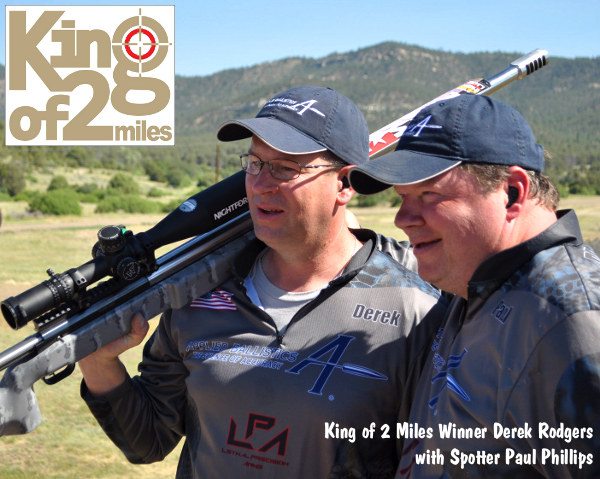
Derek Rodgers, the reigning F-TR World Champion and the only person to have won BOTH F-Open and F-TR U.S. National Championships plus the King of 2 Miles Match, runs this kind of “opposite” bolt set-up. Yep, Derek shoots right-handed with a left bolt. Though Derek is a right-hander, he shoots with a Left Bolt/Left Port (LBLP) action. He pulls the trigger with his right index finger, while working the left-side bolt with his left (weakside) hand. This allows him to stay in position, and maintain his cheekweld. He places his right hand on the grip, while manipulating the bolt (and feeding rounds) with his non-trigger-pulling hand.
Recent F-TR World Champion and King of 2 Miles Derek Rodgers
This is the rifle with which Derek won the 2013 F-TR National Championship.
*For true standing, off-hand shooting (whether in competition or on a hunt), a conventional strongside bolt placement makes sense, since the non-dominant arm must support the front of the rifle all the time. When shooting from bipod or rest, it’s a different story.
Hunting season has started in many parts of the country… or will very soon. Before you head out to the hunting fields, you may want to practice your shooting on specialty paper targets designed expressly for hunters. Here is a selection of game targets which can help you achieve success this hunting season.
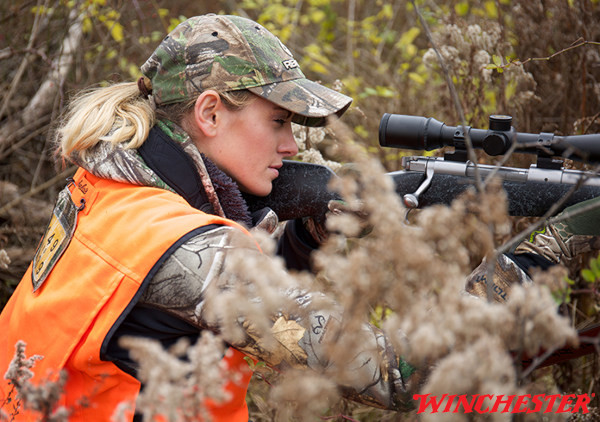
Fall Winchester Hunting photo with Nikki Boxler from Winchester Blog.
FREE Printable Game Targets from the NRA
To help you prepare for your fall hunts, NRABlog.com has created a set of color practice hunting targets. You can hone your skills on a trio of bucks, three wild hogs, or three turkeys. Each target features three red bullseyes, centered on the animals. You can print the targets in black and white, but they look best in color. Click on each image below to download a FREE printable PDF file.
Right-Click Each Image to Download Printable PDF File:
The second leg of the 2022 Lapua Monarch Cup kicks off this weekend, September 17-18 in Saltillo, CH, Mexico. Held at the Club De Tiro Saltillo Safari, this will be the second opportunity for silhouette competitors to accrue points in hopes of winning the coveted Lapua Monarch Cup Championship title.
In its inaugural year, the Lapua Monarch Cup is a series of smallbore silhouette shooting matches hosted in both the United States and Mexico. Competitors will earn points from each match within their respective classification (Master, AAA, AA, & A), giving all shooters an opportunity for over $100,000 in cash and prizes. Lapua’s Monarch Cup is recognized as the must-attend event of the silhouette shooting world.
“It is with much excitement and joy that the Lapua Monarch board members complete the second phase of the Monarch cup,” commented Daniel Salazar, Chairman of the Board. “The Saltillo Safari Club is putting extraordinary efforts into making this the event to remember. We can’t wait to celebrate the success of the Lapua Monarch Cup and see who the best Silhouette shooter is in the Hemisphere!”
About Smallbore Silhouette Competition
Smallbore silhouette shooting is a fun and challenging shooting discipline that has competitors taking aim at a variety of steel chickens, pigs, turkeys and rams. Shooters, both standing and unsupported, take aim at four banks of silhouettes at increasing distances shooting 40 targets in all. For every silhouette knocked down, the competitors earn one point. Smallbore shooters are shooting at distances of 40, 60, 77, and 100 meters. The Mexico competition will have competitors shooting 80 rounds on Saturday, followed by 40 rounds on Sunday, all within the Standard Rifle division.
For more information on the Lapua Monarch Cup visit lapuamonarchcup.com. The Lapua Monarch Cup board would like to thank all the sponsors who make the Cup the premiere Silhouette series.
Capstone Precision Group
Creedmoor Sports
Decot Hy Wyd Sport
Krieger Barrels
Leupold
Lilja
Lyman
McMillan
RCBS
Redding Reloading
Sightron
SK Ammunition
Are laser sights really useful on a handgun? Yes, and not just in low-light situations. That said, many folks who own laser-equipped handguns do not train effectively with the laser. For many gun-owners, the laser is just a toy, a gimmick that is used a few times and then ignored. Those gun-owners miss out on some of the most important advantages of a laser sights, benefits you can get from formal training with your laser-equipped pistol.
Crimson Trace has produced a series of TRAINING Videos that may change your mind about lasers. If you shoot a handgun you should watch these videos. They show how laser sights can help diagnose and correct common handgun-shooting errors (such as flinching and anticipating the shot). The videos also show how to improve sight alignment and get your sights on target quickly.
Training with Laser Sights, Full 12-minute Video
Covers Muzzle Awareness, Sight Alignment, Target Acquisition, Trigger Control
This video shows how training with laser sights can: 1) improve muzzle direction awareness; 2) aid with sight alignment; 3) speed up target acquisition; and 4) improve trigger control. The video also demonstrates the obvious advantage of laser sights in low light conditions. Numerous firearms experts are featured in this video filmed at Arizona’s Gunsight Academy.
Training With Lasers — Trigger Control
Training with laser sights helps diagnose and improve trigger control errors by showcasing the importance of “surprise break” and follow-through. Lasers quickly diagnose errors such as recoil anticipation, jerking the trigger, and breaking the wrist.
Training with Lasers — Sight Alignment
Training with laser sights can improve/correct alignment. The laser provides a visual indicator of proper sight alignment, allowing shooters to quickly see any errors before taking a shot. Additionally, lasers can enhance sight alignment on popular sub-compact carry guns with small, low-profile sights.
Muzzle Awareness — All-Important for Safe Shooting
Training with laser sights improves a shooter’s muzzle awareness. A daylight-visible laser shows the gun operator where his or her muzzle is pointing at all times. This helps teach proper safety practices.
On September 18-25, the CMP 2022 New England Games will take place in Jericho, Vermont. Hosted by the Vermont State Rifle and Pistol Association and the Burlington Rifle and Pistol Club, the New England Games will be conducted at the Camp Ethan Allen Training Site, a beautiful facility — as you can see below.
New England Games Registration is still open. Competitors are encouraged to register right away, though interested shooters will also be able to register for additional matches while attending the event. The CMP expects over 150 competitors this year. The New England Games have become extremely popular for the breathtaking views and serene environment, and the excellent electronic target system.
The 2022 New England Games will feature the CMP’s electronic High Power targets. The electronic target system is now well-sorted and provides accurate scoring. Shooters have monitors right at their shooting stations, providing instant scoring info — no more waiting for the targets to be marked manually. And with the elimination of pit duty allowed by the target system, matches are completed more quickly.
Here’s the view from the berm, looking back to the firing line…
Similar to the Eastern, Western, and Oklahoma CMP Travel games, the New England Games features a variety of competitive shooting matches. The CMP Highpower Rifle Matches include a 4-Man Team Match, two CMP 800 Aggregate Matches followed by an EIC Service Rifle Match. Following the CMP HP Matches will be the CMP Games Matches. The CMP Games Matches include Rifle Marksmanship 101 & M16 Match (formerly SAFS), Garand/Springfield/Vintage/Modern Military Matches, Carbine Match, Rimfire Sporter Match and Vintage Sniper Team Match. There are also several pistol matches for competitors to fire including CMP As-Issued 1911 Pistol Match, EIC Service Pistol Match, and .22 Rimfire Pistol EIC Match.
There will also be a GSM New Shooter Clinic and an M1 Maintenance Clinic during the event. CMP Sales will be at NE Games with a limited supply of rifles. They will also have ammo available for purchase.
IMPORTANT — Magazine Restrictions. To comply with a relatively new Vermont law, competitors may NOT bring 20-round magazines into Vermont. Competitors may use 10-round magazines during the New England Games to be compliant with the new Vermont State Law. Note, however, you may BORROW a 20-round magazine from a member of the Vermont State Rifle and Pistol Association after your arrival to Camp Ethan Allen. Contact a CMP associate during check-out process for magazine loans.
High Praise for Venue and Match
Competitors at past CMP New England Games were mightily impressed by Camp Ethan Allen, a beautiful venue. “I was blown away by the facilities at Camp Ethan Allen,” said Steve Cooper, CMP North general manager. “The grounds were neatly manicured, our offices for registration and sales were very convenient and the classrooms were perfect for our clinics.” Photos from past events are posted on the CMP’s Zenfolio website.
The CEATS Pistol Range hosted both centerfire and rimfire matches in a lovely, tree-lined setting.
Learn More about the CMP New England Games
For registration, travel, and housing information, visit the New England Games Page on the CMP website. If you have questions, Contact Vera Snyder at vsnyder@thecmp.org or call 888-267-0796, ext. 782. Competitors can also find more housing information here at Vermont.org/places-to-stay.
Hunting Season has already started in some states, and is right around the corner in other locations. For readers who plan to hunt game this fall, we recommend you brush up on hunter safety and learn the laws in your jurisdiction. Here are some helpful resources for hunters: Safety Tips, Hunter Education, License Requirements, and Where-to-Hunt interactive map. Top photo courtesy Horn Fork Guides, Ltd., in Colorado.
Hunter Safety Tips NRAFamily.org has a good article listing seven salient safety tips for hunters. Anyone preparing for a fall hunt should read this article before heading into the field. Here are three key bits of advice:
1. Be Positive of Your Target before Shooting
This might sound overly simplistic, but the fact remains that, every year during whitetail season, farmers everywhere are forced to spray-paint their cattle or risk having them “harvested” by hunters who don’t bother confirming the species of the large ungulate in their sights. Why does this happen? The most likely explanation is “buck fever,” meaning that the hunter wants so badly to see a nice big buck that sometimes his eyes deceive him into thinking that there’s one there. When in doubt, don’t shoot.
2. Scopes Are Not Binoculars
Never use a riflescope as a substitute for binoculars. The temptation to do so is real, but when one does this, one is by definition pointing the muzzle of the gun at unknown targets.
3. Know When to Unload
When finished hunting, unload your firearm before returning to camp. You should also unload your gun before attempting to climb a steep bank or travel across slippery ground.
Visit WhereToHunt.org
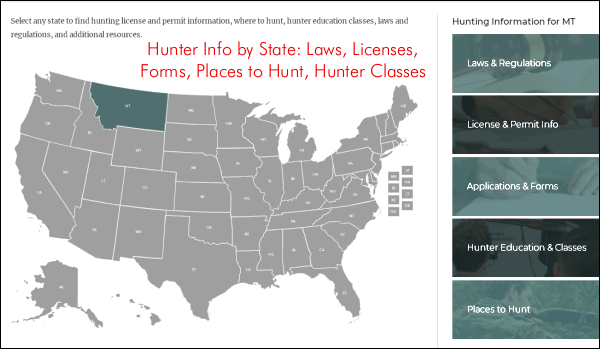
There’s a great online resource for hunters that will help you find game locations in your state and ensure you have all the proper permits and game tags. WheretoHunt.org features an interactive map of the country. For all 50 states, the NSSF has compiled information about hunting license and permits, where to hunt, hunter education classes, laws and regulations and more. For each state you’ll also find a link for required applications and license forms.
Click Map to Get State-by-State Hunting INFO
Hunting Affiliation Groups
There are many good organizations dedicated to promoting hunting and preserving our hunting habitats. These groups all offer valuable information for hunters:
“The pessimist complains about the wind; the optimist expects it to change; the realist adjusts the sails.” — William Arthur Ward
Readers often ask us: “Is there a decent, easy-to-comprehend book that can help my wind-reading?” Many of our Forum members have recommended The Wind Book for Rifle Shooters by Linda Miller and Keith Cunningham.
New Edition Released in May 2020
A NEW hardback edition of The Wind Book for Rifle Shooters was released a year ago in May 2020. This 144-page book, first published in 2007, is a great resource. But you don’t have to take our word for it. If you click this link, you can read book excerpts and decide for yourself. When the Amazon page opens, click the book cover photo (labeled “Look Inside”) and another screen will appear. This lets you preview chapters from the first edition, and view some illustrations. Along with the new hardback edition ($17.96), Amazon offers a Kindle (eBook) edition for $14.99.
Other books cover wind reading in a broader discussion of ballistics or long-range shooting, such as Applied Ballistics for Long-Range Shooting by Bryan Litz. But the Miller & Cunningham book is ALL about wind reading from cover to cover, and that is its strength. The book focuses on real world skills that can help you accurately gauge wind angle, wind velocity, and wind cycles.
All other factors being equal, it is your ability to read the wind that will make the most difference in your shooting accuracy. The better you understand the behavior of the wind, the better you will understand the behavior of your bullet. — The Wind Book for Rifle Shooters
The Wind Book for Rifle Shooters covers techniques and tactics used by expert wind-readers. There are numerous charts and illustrations. The authors show you how to put together a simple wind-reading “toolbox” for calculating wind speed, direction, deflection and drift. Then they explain how to use these tools to read flags and mirage, record and interpret your observations, and time your shots to compensate for wind.
I believe this is a must-have book if you are a long-range sport shooter. I compete in F-Class Open and when I first purchased this book and read it from cover to cover, it helped me understand wind reading and making accurate scope corrections. Buy this book, read it, put into practice what it tells you, you will not be disappointed. — P. Janzso
If you have one book for wind reading, this should be it. Whether you’re a novice or experienced wind shooter this book has something for you. It covers how to get wind speed and direction from flags, mirage, and natural phenomenon. In my opinion this is the best book for learning to read wind speed and direction. — Muddler
As part of NRA Women TV, hunting guide Kristy Titus hosts a series of videos that explain important strategies and shooting skills for hunters. Titus, co-host of the Team Elk TV show, is a certified instructor who has hunted around the globe. She grew up in the outdoors, running pack mules in Oregon with her father. In these videos, Kristy discusses demonstrates field positions that can be employed during a hunt. She also explains preparation for a hunt, including fitness training.
Click each link below to watch other Kristy Titus Hunting Videos.
“When it comes to bolt-action rifle fit, there is no ‘one size fits all’,” says Titus. “When picking out your rifle [consider options] after the purchase to ensure you are as comfortable as possible.”


 Being part of a team and trusting your teammates is such a critical part of ELR and I couldn’t ask for a better team. Each one of us comes from a different background and has different specialties, and we do an excellent job of leveraging all of that to perform at the highest level. Paul and Ray have years of experience shooting competitively. James has years of experience with competitive shooting, hunting, and training, while I have experience with cameras and technology that helps to verify our impacts. Additionally, we are all shooting clone rifles and can instantly leverage what we learn during the match from one shooter to the rest of the team. Paul Phillips even also helped design the new Manners ELR Light stock we used.






 The second leg of the