Geissele Automatics, respected maker triggers and firearm accessories, is offering some very attractive specials on Black Friday and Cyber Monday. On Friday 11/27 get 25% AR triggers. On Monday get a complete Geissele AR 2-Stage Trigger (GS2) for just $115.00. These normally retail for $165.00, so you save fifty bucks. In addition to these great deals, you can get 50% off Geissele gear, and 30% off Reaction Blocks (used for assembling AR platform rifles).
If you own a Ruger Precision Rifle (RPR), or are considering purchasing one, you should watch this short video from Sniper’s Hide. The Hide’s head honcho, Frank Galli (aka “LowLight”), added some upgrades to his RPR, to enhance looks and ergonomics. Frankly we think the RPR is pretty good right out of the box. Our friend Gavin Gear of UltimateReloader.com is seeing near-half-MOA accuracy with his “box-stock” RPR in .243 Winchester. Nonetheless we know some RPR owners will want to swap barrels or otherwise “hot rod” their rifle. Here’s how it’s done…
Video Shows New Barrel, Stock, Grip and Handguards Installed on Ruger Precision Rifle:
Galli unbolted quite a few factory parts, replacing them with proven aftermarket components. That’s one of the advantages of the RPR — it’s modular nature allows the owner to make changes with simple tools. Off came the handguards, stock, and grip. While we’ve been fairly impressed with the accuracy of some RPR factory barrels, Galli decided to fit a custom barrel, courtesy Chad Dixon of LongRifles Inc. (LRI). All totaled, the new components cost more than the original rifle. Galli figures he now has about $2400 in the gun. A new RPR (if you can find one) will run you about $1100-$1200.00.
The new barrel was a good investment, but the other items could be considered indulgences. But we like the fact that Galli demonstrated how easily the RPR can be modified by anyone with basic mechanical skills. (The Ruger’s barrel-mounting system allows you to run a “Pre-fit” barrel with headspace set by clamping nuts.) CLICK HERE for details of the build.
New Components for LowLight’s Ruger Precision Rifle
Magpul MOE Grip
Magpul PRS Stock
Seekins Precision “Triangle” Handguards
LongRifles Inc. (LRI) Aluminum Bolt Shroud
Custom K&P “Pre-Fit” Barrel from LRI (chambered in 6.5 Creedmoor)
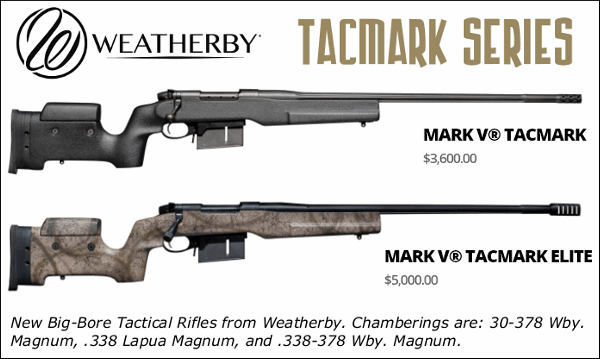
Weatherby’s new TacMark Rifles should be popular with long-range shooters (at least those with plenty of coin). We hope you like recoil — all three chamberings are powerful: .30-378 Wby. Magnum, .338 Lapua Magnum, and .338-378 Wby. Magnum. To handle these powerful cartridge types, TacMark series rifles have a beefy receiver with integral recoil lug, set in a CNC-machined aluminum bedding system. The bolt is interesting — it has nine (9) lugs and a 54-degree bolt throw.
The composite stocks are adjustable for length of pull (13¼ inches to 14¾ inches), drop at comb, and drop at heel. The stock also has a near-vertical pistol grip with a trigger finger depression and a wide, flat-bottom fore-end with a stud for bipod and/or sling. The TacMark (11.25 lbs w/o scope) comes in black while the TacMark Elite (11.75 lbs w/o scope) is finished in High Desert Camo with black accents.
The $5000.00 TacMark Elite features a hand-lapped 28″ Krieger cut-rifled barrel*, fitted with a large muzzle brake. The Range Certified (RC) TacMark Elite is accompanied by an Oehler Ballistic Imaging System printout signed and certified by Ed or Adam Weatherby, verifying the accuracy. The Elite is guaranteed to shoot sub-MOA for three shots (and we suspect it can do a lot better than that).
The less expensive ($3600.00) TacMark also boasts a 28″ barrel — one of the longest barrels currently available on a factory rifle. This should be good for a little extra velocity. Both the TacMark and the TacMark Elite feature Weatherby’s Mark V action and Weatherby’s new LXX trigger, which is user-adjustable for pull weight down to 2.5 pounds. The Mark V TacMark and TacMark Elite rifles will be available through the Weatherby Custom Shop.
* A features list on the Weatherby website shows 26″ barrel length for the Elite. However the actual specifications show the barrel to be 28″ for both TacMark and TacMark Elite. You should verify barrel length before ordering.
The prestigious GAP Grind tactical match took place 16-18 October, at the K&M Shooting Complex in Finger, Tennessee. Here’s a “sizzle reel” video showing highlights from this year’s match, which drew talented competitors from across the nation. Held in association with the Precision Rifle Series (PRS), this year’s Grind features a Pro/Am format with professional and amateur competitors aiming for individual and team honors.
Watch GAP Grind 2015 Video (Loud Soundtrack):
Lots of Action, with 20+ Stages
The GAP Grind is a challenging, “high tempo” match with minimal down-time between stages. This year, over the course of 20+ stages, competitors each fired 200+ shots at a variety of steel, paper, moving, and reactive targets out to 1,200 yards. Targets varied in size and difficulty based on distance and time allotted. Most stages included “stressors” — i.e. time limits or required movement(s).
Here’s something that should interest tactical and PRS shooters. Nick Gebhardt has written a detailed review of the KRG Whiskey 3 Chassis for Snipers Hide. The Whiskey 3 Chassis (W3C) from KRG is a modular system for a Rem 700, Tikka T3, or Badger 2008 barreled actions. Borrowing heavily from the SAKO TRG design, this chassis offers good ergonomics, with adjustable cheekpiece and buttplate. The W3C is affordable, letting you transform your Rem 700 or Tikka into a “Poor Man’s TRG”. The Whiskey-3 is available in both fixed ($939.00) and folding ($1299.00) versions.
Reviewer Nick Gebhardt Praises the KRG Whiskey-3 Chassis:
Kinetic Research Group (KRG) has been producing the W3 Chassis for several years, and it is a superb choice for anybody looking for an extremely high quality stock. The W3 chassis is machined out of 6061-type aluminum, which is aircraft-grade and quite durable. KRG utilizes a combination of extrusions for rough shape and CNC machining to final dimensions for the fore-end and backbone of the chassis. The remainder of the pieces are CNC-machined from solid block.
I have been using this stock on my business rifle for a couple months and have nothing but high praise for it. The adjustability of the stock without tools is a major advantage while allowing customers to test my rifle, as we can fit the stock to each individual shooter easily and rapidly. One of the nicest features on this stock is the excellent Limb Saver recoil pad which is very soft and absorbs recoil nicely. The butt pad is also adjustable up and down as well as for tilt, up to about 15 degrees to either side.
If you are in the market for a chassis system and appreciate high quality machining, fit, and finish then you would be well-served with the W3C stock from Kinetic Research Group. They also make a less costly chassis, called the X-Ray, which is a polymer non-folding version very similar to the W3C. For More information, visit KineticResearchgroup.com.
The prestigious GAP Grind tactical match runs this weekend, 16-18 October, at the K&M Shooting Complex in Finger, Tennessee. The 2014 GAP Grind drew a huge turn-out, and this year’s Grind promises to top that — with more competitors and even tougher challenges. Held in association with the Precision Rifle Series (PRS), this year’s Grind features a Pro/Am format with professional and amateur competitors aiming for individual and team honors.
Lots of Action, with 20+ Stages
The GAP Grind is a notoriously challenging, “high tempo” match with minimal down time between stages. Over the course of 20+ stages, competitors will fire 200+ shots at a variety of steel, paper, moving, and reactive targets out to 1,200 yards. Target vary in size/difficulty based on the shooter’s position, distance, and time allotted. Most stages include “stressors” — i.e. time limits or required movement(s).
2014 GAP Grind Highlights Video:
Want to see what a “GAP Grind Experience” is all about? Then watch this video from the 2014 Grind. You’ll see a lot of movement through a wide variety of shooting positions. This ain’t no benchrest match, that’s for sure…
GAP Grind Guns by Giddings
Shelley Giddings, a skilled shooter of both firearms and cameras, attended the 2014 GAP Grind last week. While there, Shelley snapped some cool images of state-of-the-art tactical rifles. Here is a Giddings Gallery of Grind Guns. You can find more GAP Grind pix on Shelly’s Facebook Page.
Click any photo below to see a full-screen version.
In this video Bryan Litz of Applied Ballistics offers tips on Big Bore shooting (i.e. .338 caliber and above). Bryan offers advice on bullet selection and he explains the challenge of handling the blast, noise, concussion, and recoil of big boomers such as the .416 Barrett and .50 BMG.
Bryan goes big … very big, shooting a monster .50 BMG bullpup.
Watch the recoil pulse shove Bryan backwards at 1:40 time-mark:
Big Bore Basics — Tips for Shooting Big Boomersby Bryan Litz
There are some unique things to consider with big-bore shooting. One is bullet design. For long-range shooting you want high-BC bullets. You get high BC from heavy bullets and bullets that have low drag. The interesting trade-off in big calibers is that there are a lot more lathe-turned solid bullets in copper and brass available than there are in the smaller calibers. You’ve got bullets that have slightly lower drag profiles but they are made of materials that are slightly less dense (than lead) so they are relatively light for their caliber. With that trade-off, the BCs might not be as high as you think for big calibers, although the bullets are heavy enough that they carry a lot of energy.
Energy really has a lot to do with shooting these big-caliber rifles. As with any kind of shooting, the fundamentals of marksmanship are the most important thing. However, it can be hard to maintain good fundamentals (e.g. trigger control and sight alignment) when you’re burning 100 grains of powder. There’s a lot of concussion (you want a muzzle brake no matter what your cartridge is above .338). It certainly can be challenging with all the muzzle blast and all the energy coming out of the barrel.
For long-range shooting with big bore rifles, you are still looking for the same things that you want with smaller-caliber rigs. You want a high-performance bullet, you want consistent ammunition, and you want a good fire solution to be able to center your group at long range. Basically you’re just dealing with the challenges that the high energy brings, and being smart about your bullet selection.
In the video above, Bryan is shooting the DesertTech HTI bullpup. This rifle can shoot four (4) big bore chamberings, with barrel conversion kits for: .375 CheyTac, .408 CheyTac, .416 Barrett, and .50 BMG. These can be quickly swapped in the HTI chassis, which employs an internal barrel-clamp system.
It seems like every manufacturer has a new “tactical precision” rifle these days, and Mossberg is no exception. Mossberg offers the MVP-LC, which combines the Mossberg MVP receiver with a sleek, modern MDT LSS metal chassis with an AR-type buttstock that adjusts for length (11.25″ – 14.5″ LOP). The light-weight, tan-finished aluminum chassis features a V-shapped bedding area for the Mossberg MVP action. The MVP-LC’s LBA trigger is user-adjustable from 3 to 7 pounds pull weight.
GunTalk TV Video Review of Mossberg MVP LC:
The new rifle features the MDT LSS chassis system, Magpul furniture and magazine and Silencerco Saker muzzlebrake/QD mount. The rifle is available with optional Vortex HS-T 4-16X rifle scope.
Available in either .223 Rem or .308 Win, the MVP LC rifle will accept standard AR-15 and AR-10 magazines. The barrels are pretty short, 16.25″ for .223 Rem, or 18.5″ for .308 Win, but they do come with threaded SilencerCo Muzzle Brakes installed. Weight, without optics, is 8 lbs. for the .223 Rem version, 8.5 lbs. for the .308 version. We think the lighter .223 Rem model would make a nice “carry-around” varmint rifle. The current “street price” is $1099.99.
MVP-LC Featured in Shooting Illustrated
If you want to learn more about this rifle, check out Shooting Illustrated this month. Mossberg’s MVP-LC is the “cover girl” of the October issue; you’ll find a full report on this new tactical rifle with complete specs and lots of big photos.
FEATURES: Mossberg MVP bolt-action design compatible with standard AR magazines (AR15, LR308/SR25). MDT LSS light chassis aluminum stock. Magpul CTR Adjustable LOP Stock with A-frame profile to reduce snagging for height adjustment. Either a 16.25″ (.223 Rem) or 18.5″ (.308 Win) barrel threaded with SilcencerCo Saker Muzzle Brake (thread cap included). Includes LBA adjustable trigger system (3-7 lbs.), oversized bolt handle, Picatinny rail, adjustable bipod.
Frank Galli, aka “Lowlight”, is the head honcho of Sniper’s Hide. In the video below, Galli offers a series of shooting tips he calls the “Long Range Shooting W.T.F”. No that’s not what you think it is — no cuss words are involved. “W.T.F.” stands for Wind, Trajectory, and Fundamentals of Marksmanship. To shoot well, Frank says, you first must gauge the wind correctly. Second, you must know the trajectory of your load in your rifle — i.e. know your ballistics. If you want to hit a target at long range, you must start with a rock-solid zero, determine an accurate muzzle velocity, and know the Ballistic Coefficient of the bullet. Plug all that into a good ballistic program (along with elevation, temp, and air pressure) and you should have your point of impact (within a click or two) out to 1000 yards.
Watch Video for Tips about Wind-Reading, Ballistics, and Shooting Fundamentals:
The third element of “W.T.F” is “F” for “Fundamentals of Marksmanship”. This actually involves multiple factors — body position (relative to the rifle), finding your natural point of aim, proper head alignment behind the scope, pre-loading the bipod, breathing modulation, trigger control, follow through, recoil management and more. Frank addresses all these “fundamentals” in the second half of the video, starting at the 3:40 time-mark.
For a prone shooter, particularly on dusty, dirty or sandy ground, muzzle blast is a major bummer. Muzzle blast can be very disturbing — not just for the trigger-puller but for persons on either side of the gun as well. Some muzzle brakes send a huge shockwave back towards the shooter, and others send blast towards the ground, kicking dirt and debris into the prone shooter’s face. If there was a way to illustrate those factors — shockwave and debris — that might help shooters select one brake design over another.
Cal Zant at PrecisionRifleBlog.com applied a unique blend of creativity and resourcefulness to try to answer that question for 20+ muzzle brakes. Using high-speed photography and household products, he captured the blast pattern of 20+ different brake designs for easy side-by-side comparison. Can you figure out how Cal managed to show muzzle brake blasts so clearly? His “hi-viz” solution, revealed in the article, is very clever. See the eye-opening results for 20+ brakes, with illustrative photos, by visiting the Precision Rifle Blog Muzzle Brake Ground Signature Test Page.






 MVP-LC Featured in Shooting Illustrated


