|
|
November 29th, 2014
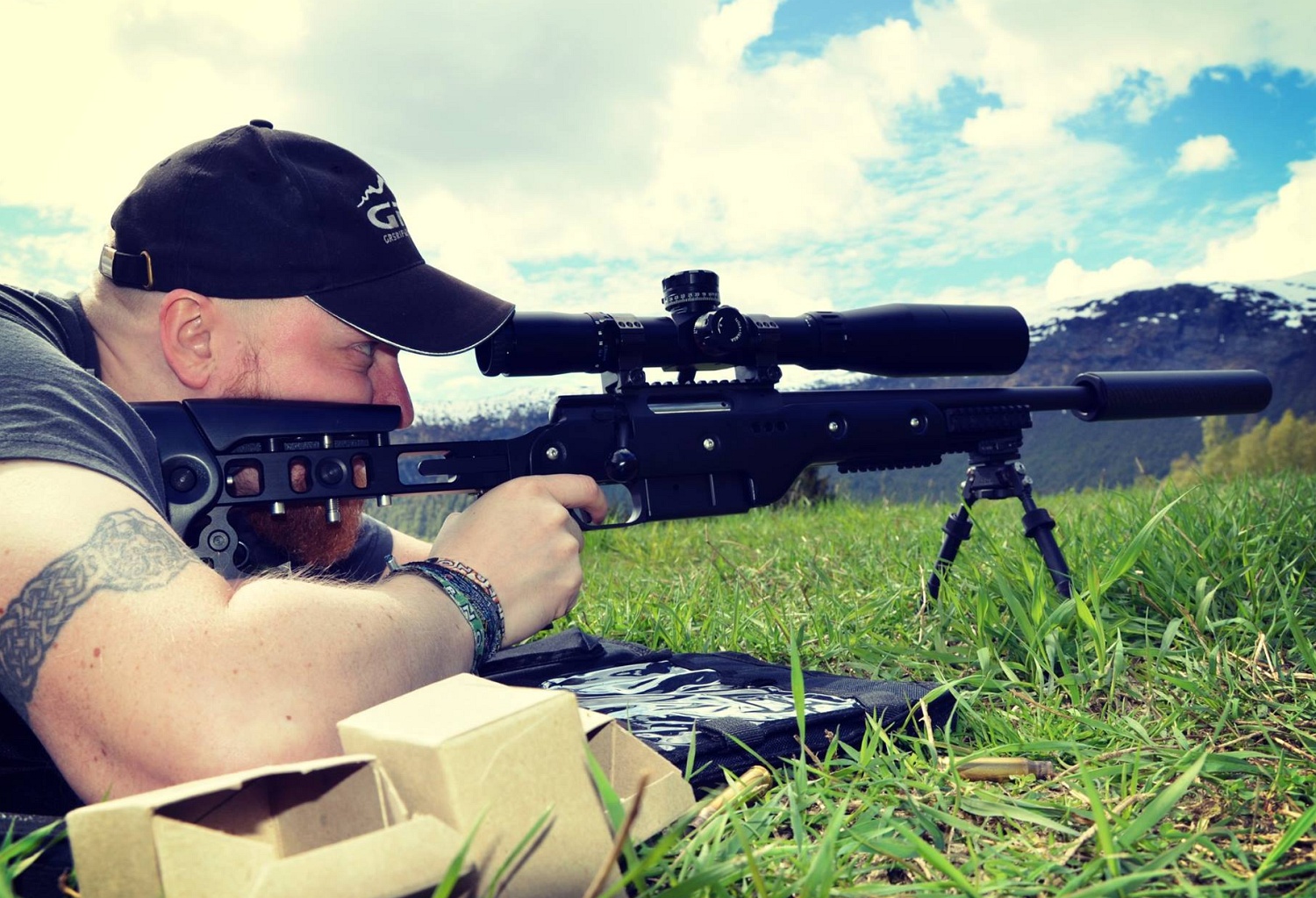
Can a budget-priced Savage shoot like a Sako TRG 22? Well, adding a custom “pre-fit” barrel and a state-of-the-art chassis system can transform a “Plain Jane” Savage into a serious tactical rifle. And now Kinetic Research Group (KRG) offers a new fully-adjustable chassis that’s just the ticket for a Savage tactical conversion. Just get a used Savage action, spin on a Criterion, Pac-Nor, or Shilen pre-fit barrel, and add the new 180-Alpha Chassis from KRG.

In 2015 KRG will introduce the NEW 180-Alpha Chassis for Savage rifles. This fully-adjustable, light-weight (3.4 lbs) chassis fits Savage short action rifles with 4.4″ action bolt spacing. If you like user-configurable stocks, you’ll love the 180-Alpha. It features tool-less cheek-piece height adjustment, spacer Length-of-Pull (LOP) adjustment, buttpad height adjustment, and plenty of accessory mounting positions. Suggested retail price for the 180-Alpha is $770.00 in either bottom bolt-release or side bolt-release action configuration.
CLICK HERE for Specifications of KRG 180-Alpha Stock for Savages.
Compare KRG’s 180-Alpha Chassis to the hardware on the real deal — a Sako TRG 22 with adjustable, folding stock (model JRSM416, shown below). This SAKO TRG22 rifle in .308 Winchester retails for $5,198.00. With KRG’s 180-Alpha chassis you can put together an ergonomically-similar tactical rifle for thousands less.

Using the KRG Chassis, a take-off Savage action, and a premium pre-fit barrel, you can build a similar system for under $1600.00. Here’s how we get that figure: $370.00 for Criterion pre-fit barrel, $400.00 for action (YMMV), and $770.00 for stock (Total $1540.00).
KRG produces other adjustable, modular chassis systems for bolt-action rifles. KRG’s popular Whiskey 3 Chassis system fits the Tikka T3, Remington® 700™, Sako M995, Badger M2008, and 700 Long Action. The value-priced KRG X-RAY Chassis fits the Rem 700 Short Action, and Tikka T3.

New Product Tip by EdLongrange. We welcome reader submissions.
November 14th, 2014
Got Bipod? If you’re in need of an adjustable two-legged friend for the front of your favorite rifle(s), Midsouth has you covered. Right now Midsouth Shooters Supply has a wide selection of Harris Bipods in stock at attractive prices. For example, the Harris 6″-9″ BR model with leg notch is just $69.68. That’s ten bucks cheaper than we’ve found elsewhere. From small to tall, Midsouth carries Harris bipods for your intended applications. Midsouth also sells a variety of authentic Harris mounting adapters, including rail adapters, and flat fore-end adapters.


October 23rd, 2014
Got fifty bucks? Well that’ll buy you an AR Lower this week. Quite simply, this is the best AR deal we’ve seen this year, and one of the best values on a firearm receiver we can remember. Right now, while supplies last, Brownells.com is offering Bushmaster-brand AR-15 stripped lower receivers for just $49.99. You read that right — you can get a major manufacturer AR lower for under fifty bucks. That’s a savings of $120.00 off the normal price. Get them while you can.

NOTE: Stripped lowers are considered the firearm, so this must be delivered to an FFL-holder. It is fairly easy to complete the lower with readily available parts and the trigger group of your choice.

Bushmaster Stripped Lower Receiver Product Description
Receiver is a rigid 7075 T6 aluminum forging with extra metal in the right places for added strength without unnecessary bulk. Features a beefy, M16A2-pattern reinforced area around the front pivot pin, a strengthening ridge over the receiver extension threads, and a ridge around the mag release button to guard against accidental magazine drop by preventing unintentional button activation. Bead blasted after machining to ensure a uniform, non-reflective surface before application of lusterless black military hardcoat A8625, Type III, Class 2 anodized finish that adds surface strength and resists abrasion. A final, nickel acetate seal coat provides extra protection against corrosion. Stripped lower is the perfect companion for Bushmaster Lower Receiver Parts Kit, available separately
October 18th, 2014
Frank Galli (aka “Lowlight”), the head honcho of Sniper’s Hide, has created a good 15-minute wind-reading video for the Scout web network. This video, a segment from the Sniper’s Hide Day One DVD, covers many of the important basics of wind reading. It’s a helpful introduction for those getting started in long-range rifle shooting.
Click Image to Go to Video Playback Page:

Quote 1: “On the range, people describe the wind as the Great Equalizer. Next to your drop, drift from wind is the second most important consideration for the long range precision rifle shooter. Unlike drop, which is predictable, the wind is a constantly changing factor.”
Quote 2: “Wind is like water. It’s important to understand how terrain will effect the wind, how it will change the direction, velocity and consistency. It’s responsible for turbulence, it’s responsible for unseen changes that will throw our shot off. Wind will ebb and flow just like waves crashing on the beach. We need to understand the frequency and velocity of each wave.”
CLICK HERE to Watch Wind-Reading Video.
October 7th, 2014
MIL or MOA — which angular measuring system is better for target ranging (and hold-offs)? In a recent article on his PrecisionRifleBlog.com website, Cal Zant tackles that question. Analyzing the pros and cons of each, Zant concludes that both systems work well, provided you have compatible click values on your scope. Zant does note that a 1/4 MOA division is “slightly more precise” than 1/10th mil, but that’s really not a big deal: “Technically, 1/4 MOA clicks provide a little finer adjustments than 1/10 MIL. This difference is very slight… it only equates to 0.1″ difference in adjustments at 100 yards or 1″ at 1,000 yards[.]” Zant adds that, in practical terms, both 1/4-MOA clicks and 1/10th-MIL clicks work well in the field: “Most shooters agree that 1/4 MOA or 1/10 MIL are both right around that sweet spot.”

READ MIL vs. MOA Cal Zant Article.
Zant does note that a whopping 94% of shooters in the Precision Rifle Series (PRS) used a mil-based reticle. However, Zant says: “This does NOT mean MIL is better. It just means MIL-based scopes are more popular.” Zant agrees with Bryan Litz’s take on the subject: “You can’t really go wrong with either (MIL or MOA). They’re both equally effective, it comes down to how well you know the system. If you’re comfortable with MOA, I wouldn’t recommend switching to MIL. I have a few MIL scopes but primarily because they’re on rifles used for military evaluation projects, and that community is now mostly converted to MILS, so when in Rome….”
We recommend you read Zant’s complete article which is very thorough and is illustrated with helpful graphics. Here are the key points Zant makes in his MIL vs. MOA analysis:
MIL vs. MOA — Key Points
There are a handful of minor differences/trade-offs between MIL & MOA, but there are no inherent advantage to either system. Most people blow the small differences WAY out of proportion….Here are the biggest differences and things to keep in mind:
- Whatever you decide, go with matching turret/reticle (i.e. MIL/MIL or MOA/MOA)
- 1/4 MOA adjustments are slightly more precise than 1/10 MIL.
- MIL values are slightly easier to communicate.
- If you think in yards/inches the math for range estimation is easier with MOA. If you think in meters/cm the math is easier with MIL.
- When your shooting partners are using one system, there can be some advantage to having the same system.
- Around 90% of the PRS competitors use MIL.
- There are more product options (with ranging reticles) in MIL.
Range Card Print-Outs
Zant makes an interesting practical point regarding range card print-outs. He suggests the MIL System may be easier to read: “You can see in the range card examples below, 1/4 MOA adjustments take up more room and are a little harder to read than 1/10 MIL adjustments.”

September 7th, 2014
The GAP Grind is a hugely popular tactical match held annually at the K&M Precision Rifle Training facility in Florida. Sponsored by G.A. Precision and Bushnell, the GAP Grind attracts top tactical shooters from around the country. Held 29 – 31 August, the 2014 GAP Grind saw 164 shooters and 82 teams battle it out. Watch the video from the 2013 Grind to see what all the fuss is about….


Watch GAP Grind 2013 Video
GAP Grind Guns by Giddings
Shelley Giddings, a skilled shooter of both firearms and cameras, attended the 2014 GAP Grind last week. While there, Shelley snapped some cool images of state-of-the-art tactical rifles. Here is a Giddings Gallery of Grind Guns. You can find more GAP Grind pix on Shelly’s Facebook Page.
Click any photo below to see a full-screen version.


August 13th, 2014
We know that quite a few hunters and tactical shooters read the Daily Bulletin. Here’s a product for you guys that need a multi-purpose padded support that can be easily carried and adapted to a variety of positions (such as on platforms, vehicle hoods, as well as flat ground). This versatile bag can be used on the front (supporting the fore-end), or in the rear (supporting the buttstock). Made in the USA, the Armageddon Brick costs $39.95. It is offered in three colors: Coyote Tan, Black, and Foliage Green.

Made by Armageddon Gear, and sold through the Sniper’s Hide Store, “The Brick” has unique features that make it ultra-handy in the field. First the “grippy” outer material is rubberized and textured so it can provide a firm grip on a support surface as needed. Overlapping Velcro-lined straps allow the bag to be attached to a rifle fore-end, buttstock, tripod head, shooting sticks, or pack. The square cross-section provides secure contact between the rifle stock and support surface. You can easily adjust the firmness of the bag by adding or subtracting filler material. (Some guys will fill their Brick with sand; others may prefer beads or other lighter media to save weight.) The panel under the strap is nylon to allow the shooter’s hand to easily slide underneath the strap when desired.
August 7th, 2014
GRS Riflestocks is a Norwegian company that has built its reputation on intelligently-designed, high-quality laminated wood stocks. GRS wood stocks, for competition and hunting, are distributed in the USA by Kelbly’s. Ergonomics have always been a key feature in GRS designs, making GRS stocks very comfortable for the shooter.
CLICK IMAGE for Full-size Photo

 GRS Aluminum Chassis Systems GRS Aluminum Chassis Systems
Now GRS is moving into a new product area — developing an aluminum chassis system for long range applications. The first GRS metal stocks should be ready this month for European delivery (though it could take longer to export to USA). The new GRS metal chassis system will be offered for many popular actions:
Remington Short Action & Long Action
Sig Sauer SSG 3000/Sauer 200 STR
Howa Short Action & Long Action
Tikka T3
Initially, these stocks will be right-hand only, though a left-hand version may be offered in 2015. GRS has not yet released any pricing details for its aluminum chassis systems.

Excellent Video Shows How GRS Stocks Are Made — Plus Shooting in Norway
Product Tip from EdLongrange. We welcome reader submissions.
July 10th, 2014
Which do you think is a better bullet-stopper — twenty-four (24) layers of drywall, or a $299 vest with 40 layers of Kevlar? Watch this video and you may be surprised. The makers of the BulletSafe vest fired a round from a .50-Caliber Desert Eagle pistol into the vest. The bullet did not penetrate the vest — not even close. If fact, the bullet only made it through seven of the 40 layers of Kevlar (see timeline 0:48″)
Would drywall be as effective? Surprisingly, the answer is “no”. A bullet fired from the .50-Cal Desert Eagle passed through all 24 sheets of drywall, exiting out the last sheet. Lesson learned? Don’t expect the drywall in your house to offer much protection. The makers of the video caution: “This video shows you how much damage your weapon can do….”

Bullet-Proof Vest Ratings
The BulletSafe vest tested is a Level IIIA model. Level IIIA is the thickest Kevlar laminated, flexible body armor available to the general public. Priced at $299.00, this Level IIIA vest is rated to stop most handgun rounds, buckshot, and shotgun slugs. You can get even more protection by adding a ballistic plate made from ceramic and/or metal. Fitted to a Level IIIA vest, BulletSafe’s $169.00 ballistic plates can stop some rifle rounds.
Plywood Stopping Power Test
The vest-makers also did a test with plywood. A box was constructed with 24 layers of 3/8″ plywood. The bullet from a .50-caliber Desert Eagle past through twelve layers of plywood before being halted by the thirteenth panel. So, you can say the BulletSafe vest is as effective at stopping this round as 13 layers of plywood. CLICK HERE for Plywood Stopping Test Video.

June 30th, 2014
Story based on After Action Report (AAR) by Jonathan Berry
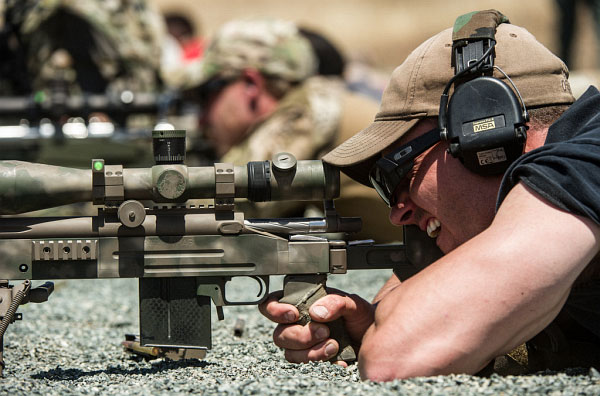
The 2014 NorCal TBRC is in the books and what another fabulous match put on by Vu Pham and the crew at the NorCal Practical Precision Rifle Club (NCPPRC). When you attend this match you truly appreciate the effort, planning, and execution carried out by the nation’s largest practical precision rifle club. The Tactical Bolt Rifle Challenge runs smoothly from beginning to end, even though the match offers plenty of challenge and variety. Vu Pham, match director, reports: “This year’s TBRC had four major evolutions, that encompassed 22 various stages of fire. Our competitors ended up firing more than 13,000 rounds over the match weekend.”
|
AUDIO FILE: Vu Pham Talks about the NorCal Tactical Bolt Rifle Challenge. |

CLICK HERE for 2014 NCPPRC Tactical Bolt Rifle Challenge Photo Gallery.
CLICK HERE for Full Match Report with Video Clips.
The match is broken up into three different segments: short range (25-200 yards); steel range (150-550 yards); and long range (800-1000 yards). The short range consisted of shots from 25-200 yards. It involved hostage targets, movers, little bitty dots, and my favorite stage, “The MGM Spinner”. This course of fire pitted competitor vs. competitor in a race to see who could spin the target, for 50 points, with a bonus of 20 points if you spun it first. On the 100-yard mover stage, Rockstar Regina Milkovich impressed the crowd by landing all six (6) shots on her moving target. Nice work, Regina!


The steel range runs from 150-550 yards with targets at 220, 330, 440, and 550 yards. Unusual shooting stations, time challenges, and other factors made these stages a real test of skill (and the ability to “adapt and overcome”). There was another head-to-head course of fire where you had to put six shots on a dueling tree with 6” flappers at 440 yards.

Yes, eye protection is mandatory at the TBRC. That’s a good safety rule.


 Long-Range Challenge Long-Range Challenge
The TBRC’s long range segment involved targets at 800, 900, and 1,000 yards. Five, 3-shot groups were fired at each yardage with one minute to fire the three shots. You really had to pay attention to the mirage, wind, and your gut instinct. Many times those three indicators lead you to three different conclusions!
Several amazing 3-shot groups were shot from the 1,000-yard line by TBRC competitors. These small groups demonstrate the accuracy of today’s bolt-action tactical rifles. Jeremy Bentham (photo right), who placed second in the match, had a sub-one-inch group from the 1,000-yard line, all in the 9-Ring no less. Nice shootin’ Jeremy!
Amazing $70,000 Prize Table at 2014 NorCal TBRC
The $70K prize table that Vu and team put together for this match was incredible. Each and every sponsor deserves recognition for contributing to the match. It never ceases to amaze me to see so many great prizes on the tables at a match like this. Thank you all for supporting the sport. We, as shooters, appreciate it and try hard to support those who support us.

Look inviting? Then maybe you should plan to join the NorCal clan at one of their regular matches. Vu Pham notes that unaffiliated new shooters are welcome at NCPPRC event: “You do not have to be a member of NCPPRC or FSC to shoot with us. For those of you that would like to shoot with us, please visit our website at www.ncpprc.com. Info about when, where, and how our matches are run are posted in the various forums for matches and practice sessions.”
The NCPPRC Crew Delivered Some Serious Bar-B-Q for Challenge Competitors.


|
About NorCal Practical Precision Rifle Club (NCPPRC)
NCPPRC was founded in 2006 by Vu Pham and Shawn Shaw in response to the growing demands of precision rifle shooters in Northern California. As of 2011, NCPPRC has a membership roster of 100 precision rifle shooters from all walks of life.
Our mission is to provide events where serious practical/tactical precision rifle shooters can test their skills in a safe and controlled environment. We provide competent mentoring for new shooters. NCPPRC offers clinics, monthly practice sessions, and an Internet forum. Our organization offers monthly competitions, monthly practice sessions, and an annual two-day event that attracts civilians, law enforcement, and military shooters from across the nation.
 |
|
|