The digital archives of Shooting Sports USA contain many interesting articles. A few seasons back, Shooting Sports USA featured a “must-read” expert Symposium on Eye Dominance, as it affects both rifle and pistol shooting. No matter whether you have normal dominance (i.e. your dominant eye is on the same side as your dominant hand), or if you have cross-dominance, you’ll benefit by reading this excellent article. The physiology and science of eye dominance is explained by Dr. Norman Wong, a noted optometrist. In addition, expert advice is provided by champion shooters such as David Tubb, Lones Wigger, Dennis DeMille, Julie Golob, Jessie Harrison, and Phil Hemphill.
EDITOR: We highly recommend you read this article, particularly if you think you may be cross-dominant — meaning your dominant eye is on the opposite side as your dominant hand. For example, this Editor is right-handed, but my left eye is dominant.
Larry Medler has come up with a smart little invention — a simple, inexpensive Empty Chamber Indicator for rimfire rifles. It is made from a section of plastic “weed-wacker” line and a wooden ball from a hobby shop. Larry says he was inspired by Juniors who used something similar for their 17-Caliber Air Rifles.
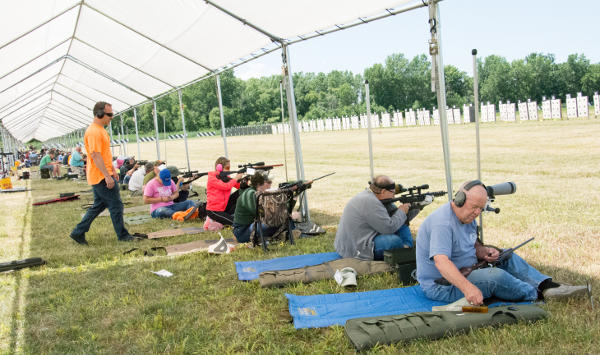
At a Rimfire Sporter match like this, all shooters must have an Empty Chamber Indicator.
Construction Method: First, drill a 7/64″ diameter hole all the way through the 1″-diameter wooden ball. Then enlarge half of that 1″-long hole using a 13/64” diameter drill. Next insert an 8″ piece of heavy duty (0.095″ diameter) weed wacker line through the ball, leaving about 2″ on the side with the bigger-diameter hole. Then, with the short end of the line, fold over the last half-inch so the line is doubled-over on itself. Then slide the line into the ball, stuffing the doubled-over section through the 13/64″ (large) hole. Finally, pull the longer end of the line until the doubled-over section is flush with the outside of the ball. This gives you a sturdy line attachment without messy adhesives. When the assembly’s complete, hold the ECI by the tail and dip the ball in yellow paint. If you’re making more than one ECI, you can drill horizontal holes in a spare block of wood and use that as a drying rack.
The Empty Chamber Indicator for Smallbore Rifles
Larry explains: “At all Highpower rifle matches, silhouette matches, and other shooting events I have attended, Open Bore Indicators (OBI), or what are now called Empty Chamber Indicators (ECI) have been mandatory. The NRA’s yellow ECI for Highpower rifles is easy to use and has been well-received by the shooters. However, I had not seen a truly workable ECI for 22 rimfire rifles — until I visited Michigan’s Washtenaw Sportsman’s Club where I saw juniors using ECIs for their 17 Caliber Air Rifles. Someone at the club made the empty chamber indicators by attaching an 8″ piece of weed wacker line to a 1″-diameter wooden ball, painted bright yellow. I now make similar ECIs for the 22 rimfire silhouette matches I run.”
Competitor Warren Dean has employed a hex-end barrel to permit rapid barrel changes on his F-Class rig. Warren wrote: “I have been running what is commonly known as a switch barrel on my F-T/R rifle. Basically it allows for removal and reinstallation of the barrel with basic hand tools and with no, or very minimal, shift in zero. The two gunsmiths that I trust, Larry Racine and John Whidden, both told me that the switch barrel system would return to a very close zero with no problems. [This system] can be a great benefit to the traveling shooter and a money-saver for the shooter wanting to shoot different calibers on the same chassis.” READ Dean Switch-Barrel Report.
Larry Racine Barrel Sytem
Larry Racine is a respected gunsmith based in New Hampshire. He is also a two-time member of the U.S. Palma Team, and a five-time New Hampshire State Highpower rifle champion. Larry, who runs LPR Gunsmithing, has developed a brilliantly simple means of switching rifle barrels with an ordinary spanner or open-end wrench. With this set-up you can switch barrels in the field in seconds without the need for a barrel vise.
For most barrels, Larry mills a hex with six flats on the end of the barrel. This allows a shooter to change barrels quickly at home or on the line with a simple box-head wrench or a socket wrench. Larry says: “You don’t even have to take the barreled action out of the gun. Just set the buttstock on the ground, between your feet, put a wrench on it, hit it with the palm of your hand — and off comes the barrel.” For barrels fitted with a muzzle brake, Larry has a slightly different system. He mills two flats behind the brake so you can use an open-end wrench to do the job.
With either a hex on the end, or two flats for a brake-equipped rifle, the system works with any medium- to heavy-contour barrel with a muzzle-diameter of at least 0.700″. This will even work for high-power rigs using clamp-on sights or bloop tubes. Larry explains: “A lot of us here in New England use clamp-on front sights. The barrel will be turned to 0.750 for the sight, with the hex on the end. A bloop tube can go right over the end, no problem.”
Larry has used this system over the past few years to win a number of matches. In one 600-yard 3 by 20 prone match, Larry used three different barrels, with three different chamberings, on the same Savage rifle. Larry changed the barrels on the line.
Larry was able to do this because the system has little to no loss of zero from one installation of a given barrel to the next installation of that barrel. This lets the shooter start the match with confidence that the first sighter will be on paper. Larry reports that the simple system works great: “To date we have used this system on Savage, Remington, Winchester, RPA, and Nesika actions.”
Varminters Take Note — This Is Great in the Field
If you are a varminter shooting hundreds of rounds in a day, consider this system. We know some guys who bring 3 or 4 rifles into the field because their barrels get hot during long days of prarie dog hunting. With this smart system, you can easily swap barrels in a couple minutes. And no special equipment or barrel vises are required.
Modifying Barrels is Affordable
Racine’s system for rapid barrel removal/changing is very affordable. If Larry does the chamber work on your barrel he charges $45.00 extra to mill a hex or two flats on your barrel. The customer chooses the configuration.
If you only want the hex or flats done, Larry may charge a higher fee — call for current rates. Note this can also work for barrels with muzzle brakes or threads for suppressors. For more info, visit LPRGunsmith.com or call Larry at (603) 357-0055.
Every serious shooter shoot have a borescope — whether an classic optical unit, or the newer type with digital camera and viewing screen, such as the Lyman Borecam.
A quality borescope or Borecam lets you look inside your barrel to check the effectiveness of your cleaning and determine how the barrel is wearing. To learn how a borescope can help you diagnose barrel issues, you should read a Rifle Shooter magazine feature story, What the Eye Can See.
In this article, writer Terry Wieland explains how to inspect for defects in new barrels, how to recognize different kinds of fouling (in both barrels and brass), and how to spot throat erosion in its early stages. Terry uses a Gradient Lens HawkEye BoreScope. The current generation of HawkEyes can be attached to a still or video camera to record digital images of your bore. The most interesting part of the article is on the second page. There, author Wieland provides photos of various types of internal flaws that can appear in barrels. This will help you spot pitting, excessive land wear, rust damage, and damage from corrosive primers.
Wieland notes that BoreScopes aren’t just for barrels: “The borescope has other uses as well. It can be used to examine the interior of a cartridge case to look for the beginnings of a case separation or to examine the interior of a loading die that is giving you trouble. When you consider the number of tubular objects that play such an important role in rifle shooting, it is a wonder we were ever able to function without such a method of studying bores.”
This Gradient Lens video shows how to correctly borescope your barrel:
Posting on the 6.5 Creedmoor Group Facebook Page, Russel T. complained that his AR magazine doesn’t like to feed that last few rounds. Russell asked: “Full magazine, no problem cycling. But with five (5) or less in the magazine… this happens. What can cause this?”
It sure looks like he could use a new magazine spring, but there may be buffer-related problems as well. Or maybe a gas system issue. What’s your call? Here are some responses posted by Facebook folks:
“Weak mag spring.” — Josh N.
“Weak mag spring or too heavy of a buffer spring.” — Justin G.
“Try a different mag, if it still jams it’s probably a gas problem, if not chuck the bad mag.” — Otto G.
“Weak mag spring or literally anything that would cause the Bolt Carrier Group to short cycle.” — Reggie W.
“I’ve had the same issue with my 300 BLK when my buffer tube came apart. It would still cycle cheap rounds fine but [not] the Hornadys. Took it apart and found the buffer tube was in pieces.” — Hunter R.
“Could be a weak mag spring or buffer spring, both at the same time.” — John S.
“As mentioned it could be a list of things. However, bolt velocity is too fast/hard and the usual (but not always) culprit is over-gassing.” — Bill F.
“Short cycle — clean and LUBRICATE the weapon.” — Mark H.
“Look to see where the brass is ejecting. That will tell if it’s an over or under gas issue. If that’s ok then look at the mag spring. See Diagram” — Teddy G.
“Weak magazine spring, I tossed four brand new ‘bargain mags’ [due to] that very problem.” — John V.E.
“May not be a weak spring or bad mag. Check out a Tubb Precision flatware spring. I swapped mine in a new rifle and solved the problem of short stroking and double feeds.” — Anthony T.
“It might be the follower as well, some designs will dip in the front/rear as rounds are expended. It’s the reason why we didn’t use some service mags with the green followers.” — Chris J.
“Weak spring… time for a new magazine…or add a 5-round block and make it a 25-round magazine. But I’m positive it’s a weak spring, which means it’s just a matter of time for failure.” — Steve M.
“Without the weapon in hand I would hate to guess….
Start with the simple stuff and go from there. Trying to diagnose a problem from a photo is just like when your wife or girlfriend tells you the car won’t start. LOL.” — Mark T.
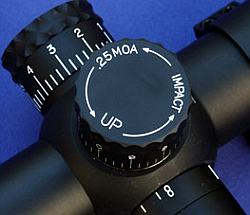
Let’s say you’ve purchased a new scope, and the spec-sheet indicates it is calibrated for quarter-MOA clicks. One MOA is 1.047″ inches at 100 yards, so you figure that’s how far your point of impact (POI) will move with four clicks. Well, unfortunately, you may be wrong. You can’t necessarily rely on what the manufacturer says. Production tolerances being what they are, you should test your scope to determine how much movement it actually delivers with each click of the turret. It may move a quarter-MOA, or maybe a quarter-inch, or maybe something else entirely. (Likewise scopes advertised as having 1/8-MOA clicks may deliver more or less than 1 actual MOA for 8 clicks.)
Reader Lindy explains how to check your clicks: “First, make sure the rifle is not loaded. Take a 40″ or longer carpenter’s ruler, and put a very visible mark (such as the center of an orange Shoot’N’C dot), at 37.7 inches. (On mine, I placed two dots side by side every 5 inches, so I could quickly count the dots.) Mount the ruler vertically (zero at top) exactly 100 yards away, carefully measured.
Place the rifle in a good hold on sandbags or other rest. With your hundred-yard zero on the rifle, using max magnification, carefully aim your center crosshairs at the top of the ruler (zero end-point). Have an assistant crank on 36 (indicated) MOA (i.e. 144 clicks), being careful not to move the rifle. (You really do need a helper, it’s very difficult to keep the rifle motionless if you crank the knobs yourself.) With each click, the reticle will move a bit down toward the bottom of the ruler. Note where the center crosshairs rest when your helper is done clicking. If the scope is accurately calibrated, it should be right at that 37.7 inch mark. If not, record where 144 clicks puts you on the ruler, to figure out what your actual click value is. (Repeat this several times as necessary, to get a “rock-solid”, repeatable value.) You now know, for that scope, how much each click actually moves the reticle at 100 yards–and, of course, that will scale proportionally at longer distances. This optical method is better than shooting, because you don’t have the uncertainly associated with determining a group center.
Using this method, I discovered that my Leupold 6.5-20X50 M1 has click values that are calibrated in what I called ‘Shooter’s MOA’, rather than true MOA. That is to say, 4 clicks moved POI 1.000″, rather than 1.047″ (true MOA). That’s about a 5% error.
I’ve tested bunches of scopes, and lots have click values which are significantly off what the manufacturer has advertised. You can’t rely on printed specifications–each scope is different. Until you check your particular scope, you can’t be sure how much it really moves with each click.
I’ve found the true click value varies not only by manufacturer, but by model and individual unit. My Leupold 3.5-10 M3LR was dead on. So was my U.S.O. SN-3 with an H25 reticle, but other SN-3s have been off, and so is my Leupold 6.5-20X50M1. So, check ‘em all, is my policy.”
From the Expert: “…Very good and important article, especially from a ballistics point of view. If a ballistics program predicts 30 MOA of drop at 1000 yards for example, and you dial 30 MOA on your scope and hit high or low, it’s easy to begin questioning BCs, MVs, and everything else under the sun. In my experience, more than 50% of the time error in trajectory prediction at long range is actually scope adjustment error. For serious long range shooting, the test described in this article is a MUST!” — Bryan Litz, Applied Ballistics for Long-Range Shooting.
Savage Arms has completed a major overhaul of the Savage website. Now the SavageArms.com site is more mobile-friendly and easier to navigate. Savage has expanded information on its rifle products, and also updated the Expert Advice area. This section of the website offers informative technical articles/videos, as well as numerous helpful tips for hunters.
You’ll find 30 informative topics in the Expert Advice section of the updated Savage Arms website. Below are FIVE of our favorites. Click each item to view the full text and linked VIDEOS. Even if you don’t own a Savage, these features are useful. And all new shooters should definitely check out the Advanced Optics selection. This features a good video covering mirage and light refraction.
1. Advanced Optics — Stan Pate
Light refraction can wreak havoc on your ability to connect with a target at extreme long range. Stan Pate offers some good advice concerning mirage and refraction.
This is a grim tale. A man almost lost the use of his right hand, and did suffer terrible injuries to his fingers. All because he picked the wrong bottle of powder off the shelf. We have run this story before, and we will continue to run it every year, as a caution to our readers. This mistake is easy to make, but the consequences can be dire. Always, always double-check your powder labels before you start the hand-loading process. If you don’t, you may not have a hand to load with next time…
Similar Labels, Disasterous Consequences
The shooter, Denny K., was assembling some rounds for his brand new 7mm-08 Savage hunting rifle. He thought he was loading with Hodgdon Varget. Instead he had filled his powder measure with Hodgdon TiteGroup, a fast-burning pistol powder. The labels are similar, so the mistake is understandable. But the results were devastating. Here’s what 41 grains of TiteGroup can do in a 7mm-08:
Posting on the Firing Line, in a thread entitled “Lucky to Be Alive”, Denny writes:
“This is the hardest post to post. I know if I had read it a week ago my comment would have been: ‘You have no business reloading’. I had everything perfect, except pouring the wrong powder in the powder measure. I type this slowly with my left hand, embarrassed but … possibly saving someone else a tragedy or, like me, a long drive to the Emergency Room and surgery to save my finger.”
The Still-Sealed Bottle of Varget
Denny did not initially comprehend exactly why the kaboom happened. He thought maybe his new Savage rifle was at fault. Then, on his return home, he discovered something…
Denny wrote: “The seven-hour period it took to go to ER, transport to Trauma Center and surgery made me think it was a Savage rifle issue. Brand new rifle, new brass, triple-checked loading data. The next day I was humbled when I realized the Varget powder was still sealed.
I knew what powder to use. I thought [Varget] was what I used. Not until the following day did I realize the Varget was still sealed.”
At that point, Denny realized what caused the accident — “operator error”. He knew he had to warn others about using the wrong powder: “I knew I needed to share my mistake, even though it is embarrassing, just to remind people. I’ve been reloading for 30 years…”
Editor’s Comment: Denny was not a novice reloader. His experience demonstrates that this kind of mistake can be made by any hand-loader, even one with decades of experience. Be safe guys, take your time when you load your ammo. Remove powders from measures after your loading sessions (pistol powders can look very similar to rifle powders). And by all means CHECK the LABEL on the jug. As the TiteGroup label says: “A little goes a long way.”
It’s not a bad idea to separate your pistol powders from your rifle powders, or perhaps even load for pistol in a separate part of your workshop.
In the benchrest game, both 100/200 yard disciplines and Long Range, it’s important that your rifle track smoothly and repeatably every time. You want the rifle to come straight back without twisting, rocking, or hopping on the bags. When you’re trying to drill your entire 5-Shot or 10-Shot string quickly, it’s also important that the gun returns to the same position after each shot. When the scope crosshairs return to virtually the exact point of aim, you can make successive shots with minimal aim adjustments.
For top “runners” who try to get five shots down-range in under 20 seconds, not having to make significant aiming corrections with your front rest controls can really speed up the process. Shooting quickly permits the competitor to “stay in the condition”, sending all his shots to the target before the wind direction or wind velocity changes.
TEN Shots in 20 Seconds at 1000-Yard Match
To see how rapid shooting works, watch this video of Tom Mosul, one of the USA’s best 1000-yard shooters. In a 10-shot Heavy Gun relay, Tom shoots his 17-lb Light Gun chambered for a 6mmBR Improved cartridge. He pulls the trigger for the first time at 00:20 and he fires his tenth (and last) shot at 00:40. Tom makes TEN SHOTS in 20 seconds, an average of just 2.0 seconds per shot!
TEN Shots in 31 Seconds at 1000-Yard Match
This second video, filmed from the side, shows Tom Mosel shooting a different 17-pounder. Again, note how smoothly the stock slides back and forth. Here Tom completes Ten Shots in 31 seconds, with the first shot at 00:13, and the tenth (last) at 00.44.
Adjustable Stock Rudder Through-the-Lens Video
Gunsmith Alex Wheeler sells stocks with an adjustable metal “rudder” or “keel” on the underside of the rear section of the stock. This rudder is the only part of the stock that contacts the rear bag. This aluminum rudder can adjust slightly left to right as well as adjust up/down for angle. Some guys want the keel nearly flat while others prefer the keel to be slightly lower in the rear.
This video shows how the cross-hairs stay on target once the stock rudder is adjusted properly. Alex adjusted this particular rudder by shimming the height* and moving the back of the rudder to the right.
The rudder’s horizontal adjustability allows benchrest shooters to correct for stock flaws that might adversely affect tracking. Essentially, by adjusting the rudder, you can achieve perfect alignment. Alex Wheeler explains: “If you pull your rifle back in the bags and the cross hair moves, your stock is not straight. The easiest fix is to use an adjustable rudder. They come standard on all my stocks.”
Wheeler explains: “The white box in the center of the 1000-yard target is four inches square. With a properly-adjusted rudder it’s easy to obtain less than one inch of cross-hair movement at 1000 yards.” You can see that, once Alex made the rudder adjustment, there’s hardly any detectable movement. Alex adds, “the more you play with it, the better you get it.”
*Initially Alex says he is going to shim the front. Later in the video Alex says he shimmed the rear. It can be a trial/error process. Credit Boyd Allen for finding these videos.
Mother’s Day is Sunday, May 12th, and Father’s Day is just a month away. Perhaps you’re thinking about giving your parent(s) a firearm for sporting use or self-protection. While gifting a gun is allowed in most jurisdictions, there are important state and Federal laws with which you must comply. And while Federal laws cover the whole country, the rules on firearms gift transfers vary significantly from state to state.
Bottom line here — you need to know the law BEFORE you deliver that shiny new firearm to a family member, close friend, or relative.
Image Courtesy NSSF. This story is based on an NSSF Article.
The first thing to remember if you’re thinking about giving someone a gun is that … it’s a gun! You already know that ownership of a firearm brings with it some serious legal and ethical obligations that other consumer products don’t. So let’s look at some questions you may have about giving a firearm as a gift.
The first question you have to ask is whether the intended recipient can legally own the firearm where he or she lives. With more than 20,000 different gun laws on the books, even the kinds of firearms that law-abiding citizens can own vary from place to place. For example, juveniles (under age 18) generally speaking are precluded by law from possessing a handgun. Check out the Bureau of Alcohol, Tobacco, Firearms and Explosives (ATF) website for an overview of local laws and, whatever you do, don’t forget that you can never under any circumstances transfer a firearm to someone you know — or have reasonable cause to believe — legally can’t own one. That’s a federal felony, so be careful.
There’s no federal law that prohibits a gift of a firearm to a relative or friend who lives in your home state. Abramski v. United States, a recent Supreme Court decision involving a “straw purchase” of a firearm did not change the law regarding firearms as gifts. The following states (California, Colorado, Connecticut, Delaware, New York, Oregon, Rhode Island, Washington State) and the District of Columbia require you to transfer a firearm through a local firearms retailer so an instant background check will be performed to make sure the recipient is not legally prohibited from owning the gun. Maryland and Pennsylvania require a background check for private party transfer of a handgun. There are exceptions, so it’s important to check the law of your state or ask your local firearms retailer.
Consider a Gift Card Instead of Direct Gift
The ATF recommends that if you want to give someone a new firearm, rather than going to a gun store and buying the gun on your own, consider instead purchasing a gift certificate/card from your favorite gun retailer. Then give that gift card as the present. That way the recipient can choose the exact gun he or she wants, and there’s no question about who is “the actual buyer of the firearm,” which is a question any purchaser must certify on the Federal Form 4473 at the time of purchase. The Gift Card option avoids any “straw purchaser” issues.


 The digital archives of Shooting Sports USA contain many interesting articles. A few seasons back, Shooting Sports USA featured a “must-read” expert Symposium on Eye Dominance, as it affects both rifle and pistol shooting. No matter whether you have normal dominance (i.e. your dominant eye is on the same side as your dominant hand), or if you have cross-dominance, you’ll benefit by reading this excellent article. The physiology and science of eye dominance is explained by Dr. Norman Wong, a noted optometrist. In addition, expert advice is provided by champion shooters such as David Tubb, Lones Wigger, Dennis DeMille, Julie Golob, Jessie Harrison, and Phil Hemphill.

 Larry Racine Barrel Sytem
 Modifying Barrels is Affordable

 Every serious shooter shoot have a borescope — whether an classic optical unit, or the newer type with digital camera and viewing screen, such as the


 Reader Lindy explains how to check your clicks: “First, make sure the rifle is not loaded. Take a 40″ or longer carpenter’s ruler, and put a very visible mark (such as the center of an orange Shoot’N’C dot), at 37.7 inches. (On mine, I placed two dots side by side every 5 inches, so I could quickly count the dots.) Mount the ruler vertically (zero at top) exactly 100 yards away, carefully measured.


 The first question you have to ask is whether the intended recipient can legally own the firearm where he or she lives. With more than 20,000 different gun laws on the books, even the kinds of firearms that law-abiding citizens can own vary from place to place. For example, juveniles (under age 18) generally speaking are precluded by law from possessing a handgun. Check out the
  Consider a Gift Card Instead of Direct Gift


