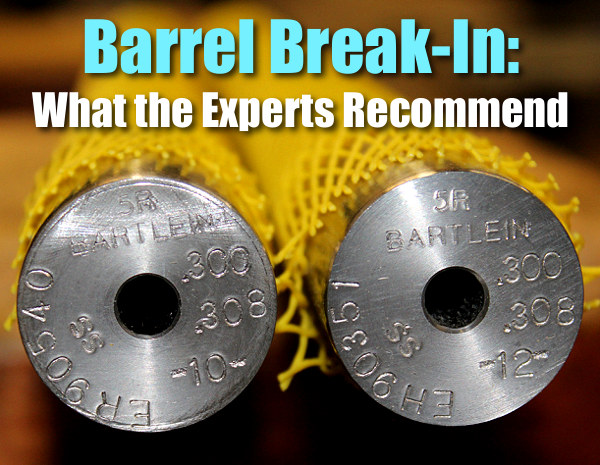
The question of barrel break-in is controversial. Some folks advocate an elaborate, lengthy cycle of shooting and brushing, repeated many times — one shot and clean, two shots and clean and so on. This, it is argued, helps barrels foul less and shoot more accurately. Others say minimal break-in, with patching and brushing after 10-15 rounds, is all you need. Still others contend that break-in procedures are a total waste of time and ammo — you should just load and shoot, and clean as you would normally.
We doubt if there will ever be real agreement among shooters concerning barrel break-in procedures. And one must remember that the appropriate break-in procedure might be quite different for a factory barrel vs. a custom hand-lapped barrel. This Editor has found that his very best custom barrels shot great right from the start, with no special break-in, other than wet patches at 5, 10, and 15 rounds. That said, I’ve seen some factory barrels that seemed to benefit from more elaborate break-in rituals.
What’s the best barrel break-in procedure? Well our friend Eric Mayer of Varminter.com decided to ask the experts. A while back Eric interviewed representatives of three leading barrel manufacturers: Krieger, Lothar-Walther, and Shilen. He recorded their responses on video. In order of appearance in the video, the three experts are:
Do I Need to Break-In a New Rifle Barrel?
Eric Mayer of Varminter.com says: “That is a simple question, [but it] does not necessarily have a simple answer. Instead of me repeating my own beliefs, and practices, on breaking-in a new rifle barrel, I decided to answer this one a bit differently. While we were at the 2016 SHOT Show, we tracked down three of the biggest, and most popular, custom barrel makers in the world, and asked them what they recommend to anyone buying their barrels, and why they recommend those procedures. We asked the question, and let the camera run!” Launch the video above to hear the answers — some of which may surprise you.
Long-Term Barrel Care — More Experts Offer Opinions
Apart from the debate about barrel break-in, there is the bigger question of how should you clean and maintain a barrel during its useful life. Some folks like aggressive brushing, other shooters have had success with less invasive methods, using bore foam and wet patches for the most part. Different strokes for different folks, as they say. In reality, there may not be one solution for every barrel. Different fouling problems demand different solutions. For example, solvents that work well for copper may not be the best for hard carbon (and vice-versa).
“Why worry about a little barrel fouling when the throat is subjected to a brutal 5,600° F volcano at 55,000 PSI? To investigate these and other questions about taking care of a match barrel, we spoke with a dozen experts and share their knowledge in this first of a series of articles.
After listening to folks who shoot, build barrels or manufacture cleaning solvents for a living, we concluded that even the experts each have their own unique recommendations on how to care for a match barrel. But they all agree on one thing — the gun will tell you what it likes best. Because the life expectancy of a match barrel is about 1,500 to 2,500 rounds, the objectives of cleaning one should include: preserve accuracy, slow the erosion, and remove fouling — all without damaging the gun. This article doesn’t claim that one cleaning method is better than the next. Rather, we set out to interject a little science into the discussion and to share some lessons learned from experts in the field.” — Chip Lohman
The Legal Brief is a feature of TheGuncollective.com that focuses on firearms rules and regulations. In this Legal Brief video, Attorney Adam Kraut explains key State and Federal regulations governing firearms, and explains how to ensure compliance with all applicable laws.
This five-minute video explains barrel length rules for rifles and shotguns, and also explains the best (and most fool-proof) methods to measure your barrel. In addition, the video explains how to measure firearm overall length. A rifle or shotgun which is less than 26 inches overall can also be classified as a “Short-barreled” rifle/shotgun subject to the NFA. NOTE: Under federal law “If the rifle or shotgun has a collapsible stock, the overall length is measured with the stock EXTENDED”.
Highlights of LEGAL BRIEF Discussion of Barrel Length and Firearm Overall Length
The ATF procedure to measure the length of a barrel is to measure from the closed bolt or breech face to the furthest end of the barrel or permanently attached muzzle device. ATF considers a muzzle device that has been permanently attached to be part of the barrel and therefore counts towards the length.
How to Measure Barrel Length: Drop [a] dowel or rod into the barrel until it touches the bolt or breech face, which has to be closed. Mark the outside of the rod at the end of the muzzle crown (if you don’t have a permanently attached muzzle device) or at the end of the muzzle device if it is permanently attached. Remove the rod and measure from the mark to the end of the rod. That is your barrel length[.]
Remember, if the barrel length is less than 16 inches, it is possible that the firearm could be a short barrel rifle (if you are building a rifle or it is already on a rifle) and if the barrel length is less than 18 inches, it is possible the firearm could be a short barrel shotgun (again if you are building a shotgun or it is already a shotgun). Both of these firearms would be subject to the purview of the National Firearms Act and would require the firearm to be registered accordingly.
How to Measure Overall Length:The overall length of your rifle or shotgun may also classify it as a Short Barrel Rifle or Short Barrel Shotgun. The overall length of a firearm is the distance between the muzzle of the barrel and the rearmost portion of the weapon measured on a line parallel to the axis of the bore. … If the rifle has a permanently attached muzzle device, that is part of the overall length. … If the rifle or shotgun has a collapsible stock, the overall length is measured with the stock extended.
Here is some useful information for FFLs and gun dealers. The NSSF now offers a special online training course: “Completion of the ATF Form 4473 2023 Edition”. NSSF members can access this web-based course via the SHOT University Online education center.
Why do you need to learn about the latest ATF Form 4473? Well the Bureau of Alcohol, Tobacco, Firearms and Explosives (ATF) revised the form in December 2022 to reflect new statutory requirements imposed by the Bipartisan Safer Communities Act, the NICS Denial Notification Act, and the ATF Final Rule 2021R-05F. Use of the latest December 2022 edition Form 4473 is mandatory as of April 1, 2023.
This training series reviews key elements of the 6-page Form 4473, as well as tips for identifying and correcting common errors made by both buyers and sellers. The training series has three segments:
Module 1: Overview of Form 4473
Module 2: Completing Form 4473, Sections A-B
Module 3: Completing Form 4473, Sections C-E
The NSSF states that “All FFL counter salespeople, compliance officers, records keepers, and license holders should consider these SHOT University Online courses to be vital training to enhance FFL training and help reduce errors when using the new form.”
FFLs can order the December 2022 edition of the Form 4473 through the ATF Distribution Center, and the form is available for download at www.atf.gov. Use of the December 2022 edition is mandatory beginning April 1, 2023. At that time, use of the May 2020 edition must be discontinued. The new Form 4473 and continuation sheets are available from the ATF in both English and Spanish. A PDF version is offered online also.
SHOT University Online and the “Completing the Form 4473 2023 Edition” series are available as part of NSSF member benefits. For this and other instructional offerings, paid NSSF members should log in at SHOT University’s home page with their username and password, then click on the course of their choice.
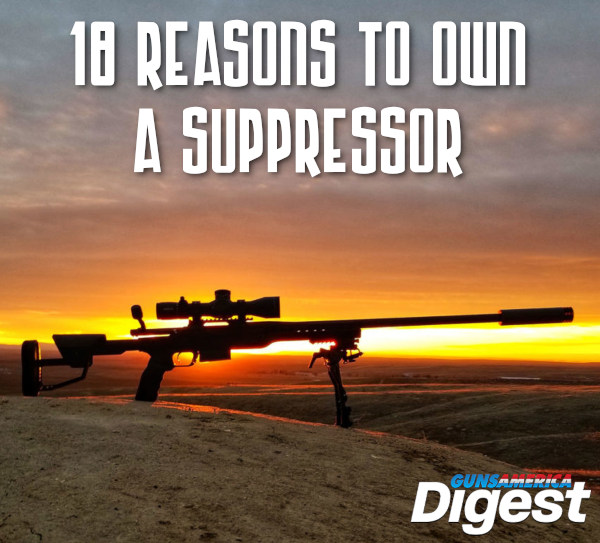
Read full story in GunsAmerica Digest for all 18 reasons to own a suppressor.
Do you own a suppressor yet? If you live in a state where silencers are allowed, there are many good reasons to get a modern suppressor. The process for acquisition has been streamlined. Vendors such as SilencerCo can now handle most of the legal paperwork required. And the choice of suppressors is greater than ever before.
Along with basic noise reduction, what are the key reasons to get a suppressor? There are actually many. True Pearce, Editor of the GunsAmerica Digest, has written an excellent article about the benefits of suppressors: Why a Silencer Might Prevent Dementia & 17 Other Reasons You Need a Suppressor. Here are FIVE of the 18 reasons outlined in the article. We recommend you read the full story to access ALL 18 reasons. That full article has worthwhile insights for anyone considering getting a suppressor.
Reason — Protect Your Hearing
Owning and using a suppressor helps prevent hearing loss. Hearing loss is a legitimate health concern that all firearms owners should be concerned about. Firearms are loud. The average firearm without a suppressor is between 140-165 dB and creates what is called an impulse noise (i.e. a noise that lasts for less than one second).
OSHA’s limit for impact/impulse noise is 140 dB…. Every time you fire a gun (including a .22 LR) without hearing protection or a suppressor, you can permanently lose hearing and it never returns. Surgery and hearing aids cannot restore the hearing you lose — it’s gone forever. Suppressors do not make your gun silent! However, they can make the impulse noise much less than 140 dB.
Reason — Reduce Muzzle Blast
A suppressor reduces or eliminates muzzle blast. Traditionally, we associate flinching with recoil, and while recoil can contribute to flinching, many shooters are finding that when using a suppressor on a caliber with no recoil they don’t suffer from the concussion, noise, and blast. As a result, they don’t close their eyes, flinch, or jerk the trigger.
Reason — Reduce Felt Recoil
A suppressor … reduces recoil or kick. Nobody that’s telling the truth enjoys getting punched in the shoulder, and that’s essentially what happens when you shoot a lightweight centerfire magnum rifle. Suppressors are very effective at slowing the recoil down or [reducing it significantly]. I personally observed a small (70-lb) 12-year-old boy shoot a 5.5-pound 6.5 PRC with a suppressor. After shooting he got up smiling and said, “That didn’t kick at all!”.
Reason — Reduce Muzzle Rise to Keep Your View on Target
Suppressors reduce muzzle rise and make it possible to stay on target through your shot [so you can watch the trace and impact]. This allows you to make your own wind calls and corrections.
Reason — Reduce Dust and Dirt Kicked Up from Muzzle Blast
Suppressors prevent snow, dust, dirt, or other debris from blowing up when you shoot prone. If you’ve shot much with muzzle brakes, you know this is a real thing.
While many AccurateShooter.com readers load their own competition centerfire rifle ammunition, we all still need factory ammo for our rimfire rifles in .17 and .22 calibers. And most of the 60+ million American handgun owners rely on factory-made ammunition for their pistols and revolvers.
Today’s video collection showcases state-of-the-art ammunition factories in Europe and the United States. You can see the extremely accurate Lapua .22 LR ammo being produced, as well as excellent centerfire ammunition being made by Norma, Remington, Sellier & Bellot and other makers.
From the creation of lead bullet cores to the final packing of ammunition, you can see it all in these videos. Watch primers being made, brass being annealed, bullets being jacketed, tips being inserted, and every phase of production. Weighing and testing procedures are also revealed.
Modern Ammo Production in Multiple Facilities
This 11.5-minute video shows highly automated bullet and ammunition production in multiple facilities in Europe and the USA. You can see bullets produced from start to finish beginning with lead smelting. Then watch pistol and rifle cartridges being made on modern, computer-controlled assembly lines. Watch from start to finish. Here are some notable highlights:
00:10 — Lead Melting Pots and Billet Caster
01:20 — Lead made into strings and then formed into bullets
01:50 — Brass alloy sheets fed into machine and then punched (2:10-2:35).
03:35 — Lead pistol cores being produced
04:15 — Pistol ammo being packaged
06:15 — Ammo loaded into belts
07:15 — Completed primers being shuttled then loaded into brass (Second factory)
07:20 — Bullets being seating into rifle ammunition
07:32 — Cartridge case-neck treatment
07:42 — Robot arm loads finishes cartridges into boxes
08:04 — Cups being pressed (Third Factory S&B)
08:45 — Cartridge case draw
09:06 — Priming pistol cases
09:20 — Bullet production and weight control (10:02)
10:08 — Cartridge assembly and cartridge sealing (10:38)
11:00 — Pistol ammo packaging
Lapua Rimfire Ammunition Production in Germany
This video shows Lapua rimfire ammo production in Schönebeck, Germany. The video shows quantities of the excellent X-ACT .22 LR ammunition being produced and packaged. Starting at the one-minute mark, you can see the ammo being inspected with advanced scanning machines. Then at 1:16 time-mark you can see the ammo accuracy-tested in a tunnel, with results displayed on a computer screen (1:27).
Norma Ammunition Production in Sweden
In this video, the RecoilTV team lead by EIC Iain Harrison ventures to Sweden to visit the Norma ammunition production plant in Huvudentré, Sweden. Demand for Norma ammo has risen dramatically. A Norma marketing manager notes that production has doubled in the last three years.
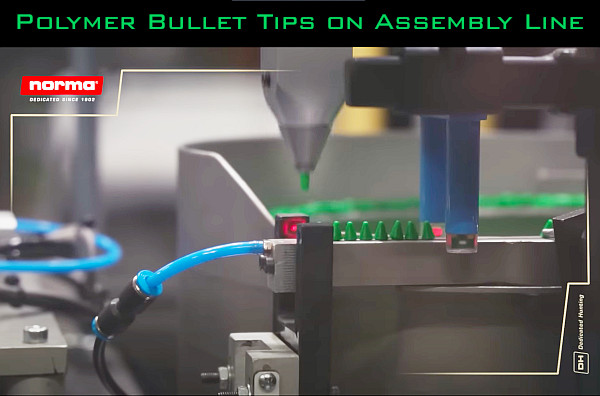
This second Norma ammunition video shows close-ups of the production process and the machinery used for centerfire ammo. This was filmed at the Norma factory in Åmotfors, Sweden, which has operated continuously for over 120 years. Among the many interesting highlight is a sequence showing how polymer bullet tips are inserted. See 6:50 time-mark.
Sellier & Bellot Ammunition Factory in Czech Republic
In this video, Larry Vickers of Vickers Tactical tours a Sellier & Bellot ammunition plant in the Czech Republic. This video shows details of primer production as well as bullet-making, brass-making, and production-line cartridge manufacturing.
Remington Ammunition Plant Re-Opened by Vista Outdoors
This video shows ammo production at the re-opened Remington ammunition plant in Lonoke, Arkansas. “This is one of the largest ammunition manufacturing plants in the world” said Mark Keefe, NRA Publications editorial director. “It was set up in 1969 by DuPont, who owned Remington at the time. They do it all here. Cases, bullets, centerfire rifle, centerfire pistol, rimfire and shotshell.” It’s great to see this plant back in production after Remington Ammunition filed for bankruptcy in 2020 and the assets of the Remington conglomerate were auctioned off. Ultimately, Vista Outdoor, owner of Federal, CCI and Speer, purchased the assets of Remington Ammunition and got the Lonoke plant running again, better than ever.
This article is Copyright 2023 AccurateShooter.com. Republication on any other site gives rise to statutory penalties and compensatory damages.
It is estimated that over 21.5 million Americans are currently licensed/permitted to carry concealed weapons.* And with the 2022 U.S. Supreme Court decision in NYSRPA v. Bruen, we can expect that number to increase significantly. That landmark case stated that the Second Amendment guarantees citizens the right to bear arms outside their homes.
There are now seven (7) major business entities which provide insurance coverage and legal services for CCW holders. These providers are listed below. We suggest, BEFORE you commit to any particular policy/membership, you comparison shop at least three different options. We also recommend you read the full 3400-word GunDigest Article that examines, in detail, the coverage offered by these seven companies:
Factors to Consider When Choosing a Gun Insurance Program:
Attorney Fees and Expert Fees
The key benefit of any CCW insurance plan is coverage for attorneys fees. If you need a lawyer for a civil case or criminal defense, the fees pile up very fast. Good lawyers can charge $400-$500 per hour, and a trial can go on for many days. GunDigest explains: “If your case goes to trial you might find a bill that runs up to six figures.” You should check to see if a policy covers lawyer retainer, hourly fees, expert fees, AND potential damages.
Bail Bond Coverage
If you are involved in an incident, and an arrest is made, you want to avoid spending time in a jail cell. That’s why it’s important to have a CCW insurance plan that will quickly provide funding for bail bonds. As GunDigest notes: “bail-bond coverage is typically part of a sound concealed carry insurance policy”.
Multi-State Coverage
Gun laws vary among states, and state insurance laws vary as well. This affects the coverage an insurance program can and will provide. When choosing a policy, ask questions to determine how coverage may vary from state to state. With some programs you can purchase additional coverage for trips outside your home state. These can be time-limited for cost savings.
Policy Limits (Dollar Amounts)
When considering a CCW insurance program you need to look at the policy limits — the amount the program might pay to provide legal assistance and potentially settle a claim. You need to read the fine print here, just as you would with an automobile or home policy.
The detailed GunDigest article on CCW Insurance Coverage, notes that there are some additional factors to consider when choosing CCW Insurance:
“You’ll find there are other areas covered by some concealed carry insurance plans worth contemplating. Many of them fall within the policies themselves, however, some cost extra. In many cases, CCW policies go well beyond legal expenses and cover some other aspects you might not have considered:”
Crime Scene Clean Up
Negligent Discharge
Spouse And Family Self-Defense
Property Damage
Firearms Replacement
Work Loss Coverage
Personal Use Of Firearm (non-defensive)
* According to a recent estimate by the Crime Prevention Research Center (CPRC), over 21.5 million Americans are now licensed to carry a firearm in the United States. And the numbers are growing — the NRA-ILA posted that the number of concealed handgun permits reached 18.66 million in 2019 – a 304% increase since 2007.
Close-up of the Tri-Way Trimmer with clear plastic chip guard removed.
Giraud Tool offers a case trimmer/chamferer device that works with a power drill (or other power source). Giraud’s patented Tri-Way Trimmer is a self-contained unit powered by your drill or motor. Using a sharp carbide blade it will trim your cases to length, deburr, and cut both inside and outside chamfers — all in one pass. That’s pretty impressive for a $110.00 tool that fits in the palm of your hand.
Product Features
1. Fully adjustable for cartridge length (and depth of chamfer).
2. Carbide blade cuts a 15° inside case mouth chamfer and 45° outside chamfer.
3. Case holder supported by sealed ball bearing raceway.
4. Tool includes removable, transparent plastic chip guard.
5. Tool can work in any orientation (vertical, horizontal, or any angle).
The Giraud Tri-Way Trimmer is designed to be powered by a portable hand drill, drill press, or other dedicated rotating power source. The tool indexes off the shoulder of your cases, but the blade adjusts so that cartridge overall length (COAL) can be controlled with precision. Constructed out of 6061-T6 aluminum and 303 stainless steel, the Tri Way tool should last a lifetime. Note: This tool is not universal. The Tri Way is dedicated to a single cartridge and “related” cartridges with similar body dimensions. Thus you need a specific tool for each cartridge family. For example, the .308 Win tool will also trim .243 Win, .260 Rem, and 7mm-08.
Cartridge Sizes Available for Giraud Tri Way Trimmer:
.223 Remington (Also trims .17 Remington, .204 Ruger, .222 Remington, .222 Remington Magnum)
7.62 x 39mm (Russian)
.300 Blackout (Also trims .17 Rem Fireball, .20 Vartarg, .221 Fireball)
.308 Winchester (Also trims .243 Winchester, .260 Remington, 7mm-08)
.30-06 Springfield (Also trims .25-06, .270 Winchester, .280 Remington)
.300 Winchester Mag (Also trims Also trims .264 Winchester Magnum, 7mm Remington Magnum, .308 Norma Magnum)
Product Tip from EdLongrange. We welcome reader submissions.
The United States Postal Service allows shipment of long-barreled rifles and shotguns via the U.S. Mail. However, regular citizens who do not possess an FFL are NOT allowed to mail handguns at all.* For handguns (all pistols and revolvers), you must use UPS or FedEX and ship FROM an FFL business in most situations.
432.1 General
Mailers must comply with the Gun Control Act of 1968, all of the provisions of postal law in 18 U.S.C. 1715, and all other all federal and state regulations and local ordinances affecting the movement of firearms. The following also applies:
a. The Postal Service may require the mailer to open parcels containing firearms or air guns or give written certification that the weapon is unloaded and not concealable (see note 1).
b. Short-barreled rifles or shotguns that can be concealed on the person are non-mailable.
c. No markings of any kind that indicate the nature of the contents may be placed on the outside wrapper or container of any mailpiece containing firearms.
d. Mailable matter must be properly and securely packaged within the general packaging requirements in DMM 601.1-7.
e. Except for shipments between licensed dealers, manufacturers, or importers, all regulated firearms must be mailed using a USPS product or Extra Service that provides tracking and signature capture at delivery (see note 2).
432.3 Rifles and Shotguns
Except under 431.2, unloaded rifles and shotguns are mailable. Mailers must comply with the rules and regulations under 27 CFR, Part 478, as well as state and local laws. The mailer may be required by the USPS to establish, by opening the parcel or by written certification, that the rifle or shotgun is unloaded and not ineligible for mailing (see note 1). The following conditions also apply:
a. Subject to state, territory, or district regulations, rifles and shotguns may be mailed without restriction when intended for delivery within the same state of mailing. These items must:
1. Bear a “Return Service Requested” endorsement.
2. Be mailed using a class of mail, product, or Extra Service that provides tracking and signature capture at delivery.
b. A rifle or shotgun owned by a non-FFL may be mailed outside the owner’s state of residence by the owner to himself or herself, in care of another person in the other state where he or she intends to hunt or engage in any other lawful activity. These mailpieces must:
1. Be addressed to the owner.
2. Include the “in the care of” endorsement immediately preceding the name of the applicable temporary custodian.
3. Be opened by the rifle or shotgun owner only.
4. Be mailed using a class of mail, product, or Extra Service that provides tracking and signature capture at delivery.
d. Mailing of rifles and shotguns between licensed FFL dealers, manufacturers, or importers are not restricted. The Postal Service recommends that these items be mailed using a class of mail, product, or Extra Service that provides tracking and signature capture at delivery.
e. Except as described in 432.3a, licensed curio and relic collectors may mail firearms meeting the definition of curios or relics under 27 CFR 478.11 domestically to licensed FFL curio and relic collectors in any state. These items must be mailed using a class of mail, product, or Extra Service that provides tracking and signature capture at delivery.
f. Firearms meeting the definition of a rifle or shotgun under 431.4 which are certified by the curator of a municipal, state, or federal museum, which exhibits firearms to be curios or relics of museum interest, may be accepted for mailing without restriction when mailed between governmental museums.
g. Air guns (see 431.6) that do not fall within the definition of firearms under 431.1a are mailable. A shipment containing an air gun with a muzzle velocity of 400 or more feet per second (fps) must include an adult signature service under DMM 503.8. Mailers must additionally comply with all applicable state and local regulations.
FOUR TIPS for Safer, More Secure USPS Firearms Shipping
Here are some other helpful suggestions when shipping long guns via USPS:
1. Bring a copy of the destination FFL holder’s license to the Post Office, just in case the staff asks for confirmation.
2. Use a Shipping Mode that Requires Signature on Delivery for confirmation.
3. Ship Priority Mail for faster delivery and BUY INSURANCE to cover complete replacement value of the firearms. Some guns may be damaged, but insurance is needed to cover full gun value with a lost/stolen shipment.
4. Double tape the ends of the box, and put plenty of padding around the muzzle and buttstock INSIDE the box.
* While ordinary (non-FFL) person may never mail handguns, there are some types of handgun mail shipments allowed by manufacturers etc. to Government and U.S. Military recipients:
432.21 Authorized Persons
Subject to 432.22, handguns may be mailed by a licensed manufacturer of firearms, a licensed dealer of firearms, a licensed importer of firearms, or an authorized agent of the federal government or the government of a state, territory, or district, only when addressed to a person in one of the following categories for use in the person’s official duties, and upon filing the required affidavit or certificate:
a. Officers of the Army, Coast Guard, Air Force, Navy, Marine Corps, or Organized Reserve Corps.
b. Officers of the National Guard or militia of a state, territory, or district.
c. Officers of the United States or of a state, territory, or district, whose official duty is to serve warrants of arrest or commitment.
d. USPS employees authorized by the Chief Postal Inspector.
e. Officers and employees of enforcement agencies of the United States.
f. Watchmen engaged in guarding the property of the United States, a state, territory, or district.
g. Purchasing agent or other designated member of agencies employing officers and employees included in 432.21c through e.
432.23 Manufacturers, Dealers, and Importers
Handguns may also be mailed between licensed manufacturers of firearms, licensed dealers of firearms, and licensed importers of firearms in customary trade shipments, or for repairing or replacing parts.
This article is Copyright 2023 AccurateShooter.com. Any entity reproducing this article without permission is liable for compensatory and punitive damages.
Kestrel wind and weather meters are often regarded as the best on the market — for good reason. Here are a series of three videos by F-Class John that show how the Kestrel 5700 with Elite Ballistics works. This article reviews the advanced Kestrel 5700 Elite Wind Meter with sophisticated ballistics capabilities. Our review features three videos by F-Class John that show how the Kestrel 5700 Elite functions with Applied Ballistics APP software and LiNK connection.
This Part I Video starts with a basic Kestrel Anemometer (blue case, 00:00-00:40) wind meter. Then reviewer F-Class John looks at the “smart” Kestrel 5700 with Elite Ballistics. John explains the many features of the Kestrel 5700 and how it holds a powerful ballistics calculator in the convenient, easy-to-tote Kestrel package. With Elite Ballistics, once you enter data about your bullets, velocity, zero, and rifle, the Kestrel can calculate come-ups and wind corrections. If you don’t yet own a Kestrel, we highly recommend you watch this series of videos that explains advanced Kestrel features in detail.
This Part II Video shows the key features of the advanced software APP used by the Kestrel 5700 unit with Elite Ballistics. The Kestrel 5700 can “talk” to a mobile device that runs the Applied Ballistics software APP that contains bullet databases and allows you to enter key information such as muzzle velocity, bullet BC, zero distance, velocity, wind, and environmental factors (altitude, temperature etc.). There are also gun-specific factors such as scope height over bore and barrel twist rate. The video also explains how “range cards” are created and how to view them with your Elite Ballistics-enabled Kestrel. John notes: “The APP is great because you don’t have to fiddle with the Kestrel’s buttons. It’s much easier to enter data and change settings with the APP.”
This Part III video shows how to determine true wind direction by aligning the SIDE of the unit into the wind. You essentially want to set the unit 90 degrees to the wind direction so the impeller runs as slowly as possible. Then, after you set your target distance (See 3:03), the unit can give you precise come-ups for your intended target (10.28 MOA for 559 yards here). The Kestrel then calculates the cross-wind correction as well (See 3:12).
DISCLAIMER: This video and description contains affiliate links, which means that if you click on one of the product links, the video author may receive a small commission. This helps support F-Class John’s YouTube channel and allows him to continue to make videos like this.
Brownells is a well-known retailer of guns, gun parts, tools, accessories, ammo, and pretty much everything gun-related. What you may not know is that Brownells has a very active video production department that releases new “how-to” and product information videos every week. These videos offer helpful advice on gun cleaning/maintenance, reloading, as well as selecting/assembling components for various kinds of rifles. And every week Brownells serves up a new products video. There now over 1000 videos on the Brownells YouTube Channel, which is truly a remarkable resource.
Here are six of our favorite videos from Brownells. There’s a helpful guide to scope installation, AR owners will find some good advice on spare parts, new reloaders can learn how to use the OAL tool, and all gun owners should watch the video on ammunition storage.
Scope-Mounting — Common Mistakes to Avoid
Always be careful when mounting a rifle scope. This isn’t a super-complex or highly technical task, but there are ways you can mess it up. This video explains common pitfalls to avoid when mounting a scope.
1. Make sure the rings don’t touch ANY part of the turret housing, objective bell, or eyepiece.
2. Be certain the scope rings are tightly clamped to the scope base. Grasp the scope with one hand and the rifle with the other, then ensure there is no play.
3. Make sure there’s clearance between the objective bell and the rifle. No part of the scope should touch the rifle itself.
4. NEVER over-tighten the scope rings. You can actually crush the scope tube and damage the optic beyond repair. Stick to the torque specs!
How to Use Hornady OAL Tool and Hornady Bullet Comparator
Gun Tech Steve Ostrem explains how to properly use Hornady’s Overall Length Gauge to determine length-to-land precisely. The OAL Gauge uses a “Modified Case” that threads onto the tool and holds a bullet. Push on the back of the gauge until you feel the bullet just touch the rifling. (We do this gently at first, tapping the rod a couple time to ensure the bullet is aligned correctly). Once you’ve got the length, then use the tool with a comparator on your calipers to get the length-to-lands. NOTE: We recommend taking the measurement 3-4 times in a row to get a reliable number. With a little practice your should be able to get repeatable measurements within .0015″.
Air Travel with Firearms — Key Regulations You Must Follow
You can travel on commercial airlines with firearms. But you must follow the TSA regulations, and your particular airline’s rules. First, make sure your guns are UNLOADED before your leave home. Guns need to be carried in proper hard-sided cases that cannot be pried open. Be prepared to unlock the case if the TSA wants to inspect what’s inside. TSA agents can cut the locks if they need to open the case but can’t locate you. If you use special TSA-approved locks, TSA agents have master keys that let them open the case without destroying your locks. You CAN transport up to 11 pounds of ammunition — with restrictions explained in the video.
How to Store Ammunition Safely and Securely
This has been one of the most popular Brownells videos — with over 1.7 million views. Here’s the deal — ammunition WILL keep for a long time if you store it properly. DO store ammunition in a cool, dry place that doesn’t have wide temperature swings. Temperature cycling will also degrade primers and powder. Put it in airtight ammo cans to keep out the moisture. Tupperware containers will work too. Brownells also recommends putting moisture-absorbing silica packs in your ammo containers. DON’T just keep ammo in factory cardboard factory boxes stacked in the basement, attic, or garage (especially on the floor). Factory ammo boxes can absorb moisture which can degrade primers and corrode the brass cases. Yes, sealed military ammo will usually handle this kind of storage for quite a while, but it’s still not wise.
Must-Have Spare Parts for AR-Platform Rifles
In this video, two knowledgeable gun techs answer the question: “What spare parts should I keep on hand for my AR-15?” On the list are: Gas Rings, Buffer Spring, Extractor Spring and Pin. NOTE: You may want to try the one-piece spiral gas ring rather than the standard rings which require alignment. The cotter pin and cam pin can also easily get lost when the Bolt Carrier Group is disassembled for cleaning. On the lower receiver you’ll want spare springs and detents for the pivot/takedown pins. If you’re using lighter-power springs, keep standard-power spares on hand. If your rifle stops working, swap in the factory-spec springs to find out if the problem is the gun or your ammo. Also, if you have upgraded your trigger, always keep the original trigger as a backup.
Cleaning Advice for .22 LR Rimfire Rifles
Gun Techs Steve Ostrem and Caleb Savant debunk some myths about cleaning .22 LR barrels. One myth is that cleaning will harm the accuracy of a .22 LR barrel. Caleb thinks this myth is the result of people cleaning a barrel from the muzzle and damaging the muzzle crown, which CAN diminish accuracy. If it’s done right, cleaning won’t damage the bore. However, you certainly do NOT have to clean your 22 LR’s bore every time you go to the range. But DO clean the action every time you shoot the rifle, especially on a semi-auto. What about shooting a lot of lead bullets? Won’t that lead up the bore? The guys give us the straight skinny on lead fouling, too. When you see your .22 LR rifle’s groups opening up, you may want to consider cleaning.
This article is Copyright 2023 AccurateShooter.com. Reproduction on any other website gives rise to monetary damages.


 Do I Need to Break-In a New Rifle Barrel?