Vortex, the large American optics company, has acquired GeoBallistics, a Texas-based business that sells mobile platform ballistics software. The GeoBallistics software is offered for both iOS (Apple) and Android platforms. This software features an advanced 3DOF solver and continuously updated bullet library. GeoBallistics software has other very sophisticated features:
1. Four Operating Modes (HUD, Map, Chart, and Comp). 2. Atmospherics Bluetooth Connectivity with Kestrel and Weatherflow. 3. Map Mode with GPS Rangefinder (use to range targets, create range cards). 4. Rifle Data and Range Cards available and synched via internet cloud servers.
Vortex Will Support Current GeoBallistics Users
For shooters already utilizing the GeoBallistics software, nothing in the software and App experience will change. And Vortex will now provide customer service and support. To learn more about GeoBallistics Apps, visit GeoBallistics.com.
Vortex plans to add GeoBallistics products to the Vortex portfolio to continue “to enhance and simplify hunting and shooting while providing critical information quickly and accurately.”
“We’re always looking for new ways to help Vortex Nation enjoy unforgettable experiences in the field”, said Joe Hamilton, Vortex CEO. “Acquiring GeoBallistics means we can offer both consistency in our product line and make long-range ballistics simpler and more accessible for everyone.”
How to Use GeoBallistics App — Informative Video
In this video, Clay Hergert, owner of ATX Precision (and former SEAL Team Sniper) demonstrates the GeoBallistics App with BallisticsARC capabilities. Clay shows how to use BallisticsARC to create rifle profiles.
This article Copyright 2023 AccurateShooter.com. No reproduction on any other website is authorized.
Just last week hundreds of F-Class shooters competed at the Southwest Nationals in Phoenix, Arizona. The vast majority of F-TR shooters had rifles chambered for the .308 Winchester cartridge (7.62×51), but F-TR rules also allow the .223 Rem (5.56×45). There are some advantages to the smaller .223 Rem round — there’s notably less recoil, bullets and brass are significantly cheaper, and a lot less powder is required. For those who are considering campaigning a .223 Rem F-TR rifle, this story explains how an accurate .223 Rem load was developed. This load development was done by a father for his daughter who was getting started in F-Class competition.
Dad builds an F-TR Rifle for his Daughter and Develops Load
Jeremy Rowland decided to put together an F-TR rifle for his eldest daughter, who enjoys competitive shooting. For his daughter, Rowland chose the .223 Rem option because it has less recoil and components are less costly than the .308 Win. Here is Rowland’s account of how he developed a .223 Rem load. For more details (with data charts), read Jeremy’s FULL STORY on Sierra Bullets Blog.
Journey to Find a .223 Rem F-Class Load
by Jeremy Rowland, Reloading Podcast
My oldest daughter has been to several matches with me, and has even competed in several, using her .243. [A few seasons back] I decided, she would compete with a .223 Rem in F-TR. Looking for a good starter rifle, I settled on the Savage Axis Heavy Barrel since it has a 1:9″ twist. This would be a great little rifle for her to learn on. The rifle was shot unmodified, as it came from the factory. A Sinclair F-Class Bipod w/micro elevation adjustment was fitted to the front.
Next came finding the components I wanted to use for her match loads. After spending hours and hours running numbers on JBM stability calculator as well as in my iPhone Ballistic AE app, the 69 gr Sierra Tipped MatchKing® (TMK) looked really good. So that’s what I decided to go with. I jumped in head first and ordered a bulk pack of the Sierra 69 gr TMKs. I had settled on Hodgdon CFE 223 powder since it shows good velocity. I decided to go with once-fired Lake City brass with CCI BR4 primers.
Next came the testing. I decided to run a ladder test (one shot per charge from min to max looking for the accuracy node). The ladder test ranged from 23.5 grains to 25.6 grains, in 0.3 grain increments.
Bullet: 69 gr Sierra Tipped MatchKing®
Case: Lake City (mixed years, sorted by case capacity)
Primer:CCI BR4
Powder: Hodgdon CFE 223 (one round each from 23.5 to 25.6 grains)
Cartridge OAL: 2.378″
Base to Ogive: 1.933″ (.020″ off lands)
After his ladder test, Rowland settled on a load of 25.2 grains of Hodgdon CFE 223. He then fine-tuned his load with different seating depths: “I loaded up 5 rounds each at .020″ off lands, .015″ off lands, .010″ off lands, and .005″ off the lands. Here are the results from the best group for OAL/Ogive fine tuning. As you can see, I think I’ve found a winner in these 69 gr Sierra Tipped MatchKings.”
NOTE: If you prefer drying your brass in an oven we recommend a temp setting no higher than 200° F. Better yet, use a dedicated case dryer that cannot possibly over-cook your cases.
Tech Tip by Craig Arnzen of Area419.com
As wet-tumbling brass has become more popular in recent years, guys have tried a LOT of ways to get their brass dry — towels, hair dryers, and even food dehydrators. (See Top Ten Brass Drying Methods). Another common method — albeit with some potential issues — is putting your wet brass in the oven to dry. Provided you monitor TEMP and TIME, this method is fast, effective, and easy (as long don’t use the wife’s favorite cooking pans — that’ll get you in trouble.)
With oven-drying, however, unexpected issues can arise, as illustrated by this worrisome story: “I put my brass in for an hour at 200° F and turned it off. Next thing I know I realize my wife has the oven pre-heating to 350° F. Is my brass ruined?”
If you search the AccurateShooter.com Shooters’ Forum, you’ll find at least three threads with stories like that (i.e. higher-than-expected oven temps when drying brass), and answers on both sides of the line. I know this, because it happened to me — I had some 6XC brass drying and the wife pre-heated the oven. Concerned about my cases, I consulted a genuine annealing expert, Andrew Rixon.
Andrew is the Director of Engineering and Manufacturing at Alpha Munitions, makers of premium-grade rifle brass. I had baked a batch of Alpha’s new 6XC brass, which is exceptionally consistent and well-made.
Before Andrew would answer my question though, he gave me a little lesson on what really happens during annealing:
“Annealing is performed by heating the brass to specific temperatures. There are three phases of annealing: recovery, recrystallization, and grain growth. All of which have specific temperatures and or exposure times related to them. It is key for cartridge brass annealing processes to hit the recrystallization phase which allows for strain-free grains to grow. The growth of strain-free grains eliminate dislocations, drastically decreasing hardness and increasing ductility. For recrystallization to occur the material temperature must be within 600-1000 degrees Fahrenheit (F).”
He then got into really answering the question, and was (fortunately) definitive in his answer: “If the temps do not exceed 450 degrees F then there is nothing to worry about as it did not exceed the critical temperature for annealing to occur.” Editor: Caution — do NOT assume that the temperature marked on the oven knob is the actual temperature INSIDE the oven, particularly near the back. Some older ovens can be off as much as 75 degrees F. Be conservative!
Well, there you have it. If you’ve baked your brass, you’re probably OK. If you got it hotter than 450° F then there can start to be some changes to the metal.
Dual-Lock Technology: Cannon offers an innovative combined digital/mechanical lock system. This dual-access lock provides the rapid access of an electronic lock backed up by the assurance of a manual (rotary dial) combination lock.
Electronic (Keypad) Lock vs. Manual (Rotary) Lock
Smart gun owners know they need a good, solid gun safe. But when choosing a gun safe, what kind of lock should you select — electronic or mechanical? Both types have their advantages and disadvantages. This article will help you make the right choice for your needs and also get the most reliable performance from either type.
Gunsafes can be fitted with either an electronic keypad-style lock, or a conventional dial lock. In our Gunsafe Buyer’s Guide, we explain the important features of both dial and electronic lock systems. Many safe-makers will tell you that consumers prefer electronic locks for convenience. On the other hand, most of the locksmiths we’ve polled believe that the “old-fashioned” dial locks, such as the Sargent & Greenleaf model 6730, will be more reliable in the long run.
Here is the opinion of RFB from Michigan. He is a professional locksmith with over two decades of experience servicing locks and safes of all brands and types:
What a Professional Locksmith Says:
For the convenience of quick opening, the electronic locks can’t be beat. However, for endurance and years of trouble-free use, the electronics can’t compare with the dial lock.
I’ve earned my living, the past 22 years, servicing locks of all types. This includes opening safes that can’t otherwise be opened. I do warranty work for several safe manufacturers (including Liberty). What I’ve learned in all those years is that manual dial locks have very few problems. The most common is a loose dial ring which can shift either left or right, which will result in the index point being in the wrong place for proper tumbler alignment. This is simple to fix.
Electronic locks, however, can have all kinds of issues, and none (except bad key-pad) are easy to fix, and when one goes bad, it must be drilled into to open it. IMO, it’s not a matter of ‘if’ an electronic lock will ultimately fail, but a matter of ‘when’ it will fail. Over the past 10 years or so, since electronics have become more and more prevalent, I’ve had to drill open bad electronic locks vs. bad manual dial locks on a ratio of about 20-1.
My professional opinion is to get the manual dial lock, unless you’ve got a good friend who is a locksmith/safecracker.
How Secure is Your Lock?
RFB tells us that both dial and electronic locks offer good security, provided it’s a good quality lock made by LaGard, Sargent & Greenleaf, Amsec, or Kaba/Ilco. However, RFB warns that “Some of the ‘cheaper’ locks (both manual and electronic) however, are very simple to bypass.
An electronic lock that’s glued or ‘stuck’ to the door with double-sided tape, and has its ‘brain’ on the outside of the lock in the same housing as the keypad, and merely sends power to an inner solenoid via a pair of wires through the door, is a thief’s best friend. The good ones have the brain inside the safe, inaccessible from the outside.
No amateur can ‘manipulate’ either a good manual or electronic lock. Both give you a theoretical one million possible combinations. I say ‘theoretical’ because there are many combinations that cannot, or should not, be used. You wouldn’t set your combo on a dial lock to 01-01-01 etc., nor would you set an electronic to 1-1-1-1-1-1, or 1-2-3-4-5-6.”
Tips for Dial Locks
RFB notes that “The speed, and ease of use, of a manual dial lock can be improved upon, simply by having your combo reset using certain guidelines. Avoid high numbers above 50. Having a 1st number in the 40s, 2nd number anywhere from 0-25, and 3rd number between 25 and 35 will cut dialing time in half, without compromising security. (For mechanical reasons I won’t get into here, the 3rd number of a good manual dial lock cannot — or should not — be set to any number between 95 & 20).”
Tips for Electronic Locks
Electronic locks can have the combination changed by the user much more easily than dial locks. That should be a good thing. However, RFB explains: “That can be a double-edged sword. More than a few times I’ve had to drill open a safe with an electronic lock that has had the combo changed incorrectly by the user, resulting in an unknown number that nobody can determine. Also, don’t forget that electronic locks have a ‘wrong-number lock-out’. I would NOT rely on the normal quickness of an electronic 6-number combo in an emergency situation. If for any reason (panic etc.) you punch in the wrong number several times, the lock will shut down for a 5-minute ‘penalty’.
Replace Electronic Lock Batteries Every Year
To get the most life out of any electronic (keypad Lock), you should change the battery at least once a year, whether it needs it or not. Low voltage won’t necessarily shut down the lock, but using it in a low voltage situation is bad for the electronics, and eventually will cause lock failure. So, If you do nothing else to maintain your digital-lock safe, replace the battery every year.
And get a fresh battery (with a release date) from the store — don’t just pull a battery out of a storage bin, even if it’s never been used. Old batteries can lost “juice” and physically degrade, even when in storage.
This article is Copyright 2023 AccurateShooter.com. No reproduction on any other website is authorized without payment of licensing fees or liquidated damages.
Need a top-notch Ballistics App for your iPhone, iPad, or iPod? Start with Ballistic: Advanced Edition (AE), the number 1 (i.e. most installed) App for iOS systems (iPhones and iPads). Ballistics AE (Advanced Edition) is the most popular iOS ballistics program for many good reasons. It offers a full feature set with Ballistic Solver, Ballistic Comparison (with up to 8 projectiles), Target Log (records group sizes), Advanced WindKit, and more. The Ballistic: Advanced Edition software is easy to use, with nice controls. Underneath it all is the proven JBM Ballistics calculator. And here’s the kicker — this excellent mobile App software is now FREE to download and install on iPhones and iPads!
This Video Explains How to Set Up and Use Ballistic: Advanced Edition
Full-featured and easy to use, Ballistics AE has been refined over many years, and it supplies rock-solid solutions derived from JBM Ballistics solver (created by James B. Millard). Unlike some other Apps, Ballistics AE is STABLE on iPhones (with various OS levels). What’s cool is that Ballistics AE is now available for FREE for both iPhones and iPads. This software is now provided by Federal Premium Ammunition, with in-App purchase functionality.
We’ve used the Ballistic: Advanced Edition program on an iPhone 5S, iPhone 6, and iPad, and it performed well. Here are some of the features we liked:
1. Mirrors output from online version of JBM Ballistics we often use for initial calculations.
2. Controls are simple to use and (mostly) intuitive.
3. Handy comparison feature lets you compare ballistics for different projectiles side by side.
4. Advanced Wind Kit allows you to account for complex wind situations.
5. Projectile and BC Databases are very comprehensive.
6. Software is regularly updated to match Apple OS changes.
This article is Copyright 2023 AccurateShooter.com. No republication is authorized. Any appearance of this story on another site obliges that site to pay liquidated damages and/or licensing fees.
Want to see new-born Pandas? No, not the furry kind — rather Stolle Panda actions produced with state-of-the-art CNC machinery. If you’ve ever wondered how precision benchrest, long-range, and tactical rifles are built, check out video from Kelbly’s. You’ll see actions finished, barrels chambered and crowned, pillars installed in stocks, barreled actions bedded, plus a host of other services performed by Kelbly’s gunsmiths and machinists.
If you’re a fan of fine machine-work, this video should be both informative and entertaining. You can see how precision gun work is done with 21st-Century technology. Tip of the hat to Ian Kelbly and crew for producing this excellent video visit to the Kelbly’s production center.
Click Volume Control to Activate Sound for Kelbly’s Video:
To optimize your loads and to generate precise ballistics tables, you need a quality chronograph. Having precise readings of bullet muzzle velocities lets you calculate ES and SD to determine the most repeatable load with least vertical dispersion. Very accurate velocity data is also essential to created a precise drop table for long range and to predict the effect of winds. There are many good chronographs on the market, ranging in price from around $100 to $1000, not counting tripods.
Today’s Saturday Movie showcase features a variety of modern chronographs. We include comparison tests, as well as video reviews of the new, small-format Bulletseeker Mach 4 and AndiScan Micro A2 Doppler Radar chronographs. If you are in the market for a new chronograph and have the resources, you should definitely consider one of these new small chronos, which are easy to set-up and can be mounted directly to your rifle. For those with a limited budget, MagnetoSpeeds still offer great performance for the price. However, you may have to conduct load tuning separately with the MagnetoSpeed removed.
Triple Chronograph Comparison Test
LabRadar, MagnetoSpeed, and Shooting Chrony Alpha Master
This video has an interesting comparison test with three chronograph devices operating at the same time. A Shooting Chrony Alpha Master unit was set up downrange, while a modern LabRadar was placed to the right side of the rifle. On the barrel of the rifle a MagnetoSpeed chrono was attached. This allowed the tester to compare shot velocity values from all three chrono systems at the same time. The video creator explained: “I was curious to see if my old [Shooting Chrony] chronograph could still give me useful velocity information compared to using the newer MagnetoSpeed and LabRadar.”
Chronograph Functions and Features — Vortex Nation Podcast
In this 78-minute video, experts from Vortex explaining how modern chronographs work. The discussion covers the technical features of various chronographs. Multi-time F-Class National Champion Ian Klemm and former sniper Tony Palzkill examine different chronograph types, explaining how they operate. Ian discusses the pros and cons of different chronograph designs, and provides many good tips for chronograph owners. This 78-minute discussion covers multiple chronograph designs, including LabRadar, MagnetoSpeed, and Caldwell Ballistic Precision. There is also extensive discussion of ballistics in the first 20 minutes.
MagnetoSpeed vs. Caldwell Ballistic Precision Chronograph
In this video the host compares a MagnetoSpeed with an older, first generation Caldwell Ballistic Precision Chronograph, mounted a few yards downrange on a tripod. The tester favored the Magnetospeed saying it was “incredibly accurate” while being much easier to set up and transport. He also says the MagnetoSpeed App was very “user-friendly”.
NOTE: Skip Forward to 5:40 to see the Bulletseeker field-tested as mounted on rifle and on tripods.
The Bulletseeker Mach 4 is a new radar chronograph that mounts directly to your rifle. The advanced Bulletseeker features 120 Ghz radar with a beam-forming lens. Developed in Europe, with made-in-Germany core components, this unit is sold in the USA for $999.00 by Longshot, trusted maker of long-range target cameras. We think this is a game-changer. You get advanced radar ON YOUR GUN, with no need to haul around a bulky LabRadar.
Comparison test with the Bulletseeker Mach 4 and LabRadar
Another Bulletseeker tester was very impressed: “Based on my experiences with the device it seems like a good product that does everything it advertises. All the benefits of a LabRadar without the drawbacks.” (SEE Product review HERE.)
In this video, our friend F-Class John tests the innovative, ultra-compact AndiScan Micro A2 Doppler radar chronograph. This unit is small enough that it can be fitted to your rifle, or attached to a front rest or mini tripod. John tested an early pre-production model. The production model is now available for 800 Euros on the SQI-AndiX eShop. The manufacturer notes: “The next large 2023 production series is expected to be ready by the end of February.”
Product Description: “The AndiScan Micro A2 is an advanced ballistic velocity Doppler radar for measuring muzzle velocity of projectiles. It operates in 24GHz frequency band. It is a highly integrated and extremely small form-factor device that is intended to be directly mounted on the rifle. This frees the user from a complicated setup alignment and it also allows to perform measurements under dynamic conditions. It is the first device [with] this form-factor on the public market.”
JKL Inertial Trigger for LabRadar
The JKL Inertial Trigger for the LabRadar is an easy-to-use, inertial-driven trigger that activates simply from the recoil of your gun. Rather than activate by sound or Doppler reading, the JKL Trigger works from the rifle’s instantaneous recoil pulse when a shot is fired. The unit consists of a small rectangular pad attached to a long audio cable. All you do is plug in the audio cable, attach the pad to your gun with the provided hook and loop (Velcro) material. Then (important), you must change the LabRadar trigger settings from “Doppler” to “Trigger”. The unit works great and is easy to set up.
The text in this article is Copyright 2023 AccurateShooter.com. No site shall reproduce this article without express authorization.
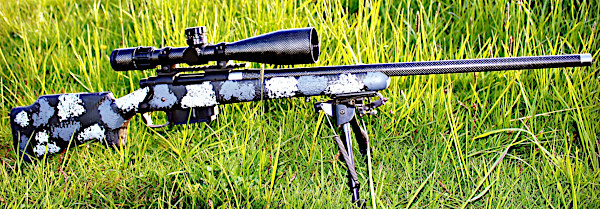
Are you looking to shave POUNDS from your hunting rig or varmint rifle? There are now multiple options for folks looking for a weight-saving, carbon fiber-wrapped barrel. You’ve probably heard about Proof Research. Yes that’s a good company that crafts good products. But now Proof Research has some noteworthy competition — Helix 6 Precision in Washington State.
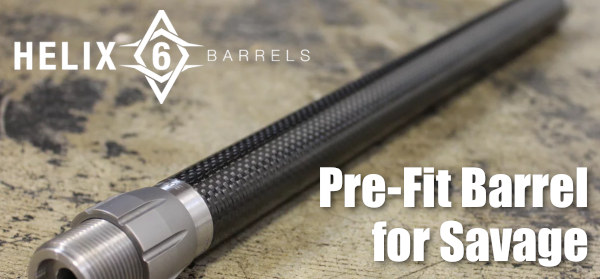
Helix 6 Precision crafts button-rifled and cut-rifled carbon-wrapped barrels in both conventional and “pre-fit” configurations. Pre-fits are offered for Savage rifles, Ruger Precision Rifle (RPR) series, and SIG Cross rifles. These pre-fit barrels are not cheap. A 6mm Creedmoor RPR pre-fit costs $1099.99, while the Savage pre-fits are also $1099.99 for most chamberings. The conventional (not pre-fit) carbon-wrapped Helix 6 barrel blanks cost $979.99 for most listed chamberings.
While Helix 6 barrels do offer significant weight savings, the founders of Helix 6 say low mass wasn’t the number one design goal: “Accuracy was paramount and weight reduction was secondary. We’ve taken the industry’s most advanced carbon fiber engineering and pushed the technology further with our proprietary … carbon fiber process.”
The founders of Helix 6 Precision say they build some of the best carbon/steel hybrid barrels on the market: “Our unique carbon fiber-layup design dampens barrel harmonics for better accuracy. Each barrel is cut from a 416R stainless steel core, and carbon fiber-wrapped using the Helix 6 Precision’s advanced process. This creates match-grade accuracy barrels with high heat dispersion that are 30% lighter than a steel barrel of the same contour. The bores are … hand-lapped for precision accuracy.” Helix 6 claims its barrels are “lighter, stronger, and faster cooling than anything else available on the market.”
Myth vs. Reality — What Carbon Can and Cannot Do
Carbon fiber is formed using thin strands of carbon bonded together with a plastic polymer resin. The resulting material is very strong and light weight. There’s a reason Formula 1 cars are crafted with carbon-fiber composites. But is a carbon-wrapped barrel the right option for you? Here are some factors to consider:
Weight Savings — There’s no doubt that a carbon-wrapped barrel will weigh less than an unfluted stainless steel barrel with identical length and contour (outside diameters). Helix 6 claims a 30% weight reduction compared to a conventional stainless steel barrel. That’s significant.
Accuracy — Carbon-wrapped barrels are NOT commonly being used for F-Class or Benchrest competition. However, Proof Research carbon-wrapped barrels have performed well in PRS competitions in the hands of top shooters. So, we can conclude that carbon accuracy is good enough for the PRS/NRL tactical game, at least at the local club level.
Heat Dispersion — Carbon-wrapped barrel-makers claim their hybrid design disperses heat better than an all-steel barrel. Some independent testers disagree, saying: “hold on now — the carbon actually acts as an insulator, so more heat is retained in the barrel”. The jury is still out. One thing that is true is that the carbon barrels seem to generate less mirage from barrel heat. Ask yourself, “if less heat is coming OFF the barrel, where is that heat retained?” But the reduced mirage could be a function of the black woven surface which may release heat differently than polished steel.
Pre-Fit, AR, and Custom Barrel Options
Helix 6 precision barrels are available as pre-fits for both Savage and the Ruger Precision Rifle in many popular long-range cartridges. Helix 6 can also thread and chamber a barrel for any precision rifle. And pre-fit AR barrels are available in a wide variety of chamberings and lengths. Helix 6 Precision also supplies carbon-wrapped barrel blanks which can be chambered and fitted by a professional gunsmith. Helix 6 barrel blanks, buttoned-rifled or cut-rifled, are sold in many calibers. Buttoned-rifled barrel calibers are: .224, .243 (6mm), .264 (6.5mm), .284 (7mm), .308 and .338. Cut-rifled barrel calibers are: .224, .243 (6mm), .257, .264 (6.5mm), .284 (7mm), .308, .338, and .375.
This article is Copyright 2023 AccurateShooter.com. No other website is allowed to publish this article in whole or in part without payment of fees.
Here are some really smart tips for hand-loaders compiled by Sierra Bullets. These suggestions were submitted by Sierra’s Facebook fans — and some are very valuable indeed. Some of these tips will help you load more accurate ammo. Other selections will help you stay SAFE — which should always be your #1 priority. For example, we concur with the advice to “Check and Double Check. Everything. Every Time”. Also definitely keep “One powder on the bench at a time” — that could be a life-saver. You may want to print these “words of wisdom” and place them on a wall in your loading room.
Reloading Safety Tips — Sound Advice
ALWAYS START LOW: “Just because a load manual says X grains of X powder with X bullet is max, your rifle could reach max pressure a grain or two before what the book says. Start low and work up.” — Walter Coats
BE SAFE and CAREFUL: “Check and double check. Everything. Every time. Only one type of powder on the bench at a time.” — Glen Lundgren
DON’T RUSH: “Be patient, don’t be in a hurry, have fun and find your rhythm. Just tell your family you’re putting yourself in ‘time-out’. They will understand.” — Erik Dyal
POWDER RULE #1: “One powder on the bench at one time, it might save your life.” — James A. Kimery
STAY FOCUSED: “Relaxed but concentrated attention. Have fun enjoying a great hobby and pastime but stay focused.” — Jim Caldwell
POLICE LOADING AREA: “Keep your reloading bench area clean and put items away ASAP.” — Eric J. Ford
BE PATIENT: “Focus, Focus, Focus — be patient — it AIN’T a race.” — William Stanley
RECORD YOUR LOADS: “Write down on a small card what you’re loading – bullet weight, powder weight, type of powder, and primer. And put it in the powder hopper. I am unloading .45 FMJ because I forgot what type powder was in the hopper.” — Michael Conniff
HAVE a PROCEDURE for INTERRUPTIONS: “If, for any reason, you have to leave the bench while in the process of dropping powder charges, turn the next case to be charged upside down in the loading block so you know where you left off.” — Bill Tinsley
LABEL EVERYTHING: “OCD is a good habit to have with your loading bench. CLEARLY label everything!” — Andy Pynckel
HAVE a GOAL: “Never start reloading or developing a load without a specific goal in mind. Second keep meticulous records.” — Peter Eick
RESEARCH THE JOB: “Read all you can about it before you start!” — Keith Shively
KEEP TRACK of the Brass: “I put all my primed brass upside down (primer up) and as I charge the casing, I (of course) flip it primer down.” — Mark Ewing
AR-platform rifles run dirty — very dirty. The gas system blows carbon and powder residues back into the action and into the bolt carrier group. That’s why you need to clean your ARs regularly, and you have to pay special attention to the nooks and crannies in the bolt and bolt carrer. The majority of AR failures we’ve witnessed have been from a combination of lube, carbon, and tiny brass shavings that collected in the ejector recess and the extractor spring recess. After that, plain carbon build-up on the bolt can be a gun-stopper too. And you need to keep the barrel extension clean too.
If you’re new to the (dirty) world of ARs, here are two helpful videos from the folks who make Froglube. That line of cleaners/lubes is pretty good stuff, though not our first choice for all AR lubrication and cleaning chores. But these videos do provide many helpful tips. They show the disassembly process and highlight the problem areas to which you must pay special attention.
How to Clean Your AR-15 Bolt Carrier Assembly
How to Clean Your AR-15 Lower Receiver Assembly
NOTE: Froglube also makes a video showing AR upper, chamber, and barrel cleaning. There are practices shown there that we do NOT recommend. Nor do we recommend Froglube products for bore cleaning. We think there are more effective cleaning products.


 Vortex, the large American optics company, has acquired GeoBallistics, a Texas-based business that sells mobile platform ballistics software. The GeoBallistics software is offered for both iOS (Apple) and Android platforms. This software features an advanced 3DOF solver and continuously updated bullet library. GeoBallistics software has other very sophisticated features:


 If you search the AccurateShooter.com


 Gunsafes can be fitted with either an electronic keypad-style lock, or a conventional dial lock. In our
  Tips for Dial Locks
 Replace Electronic Lock Batteries Every Year