CLICK HERE to see full-screen version of Wind Plot.
Team shooting is very different than individual competition. Typically a team coach makes the wind calls for the shooters. In some cases (where the rules allow), the wind coach even dials elevation and windage changes for the active shooter. For the wind coach to do his job effectively, he must follow the changes in the wind and determine what the correct wind call should have been for each shot. (In other words — what was the “right call”)
Bryan Litz, founder of Applied Ballistics and Past USA F-TR National Champion, served as wind coach for the winning 4-man F-TR Team at the 2017 Canadian F-Class Championships, which preceded the F-Class World Championships also held in Canada. Here Bryan explains how he has used a Wind Plot to make better wind calls, helping his team-mates maximize their scores.
Wind Plot Methodology by Bryan Litz
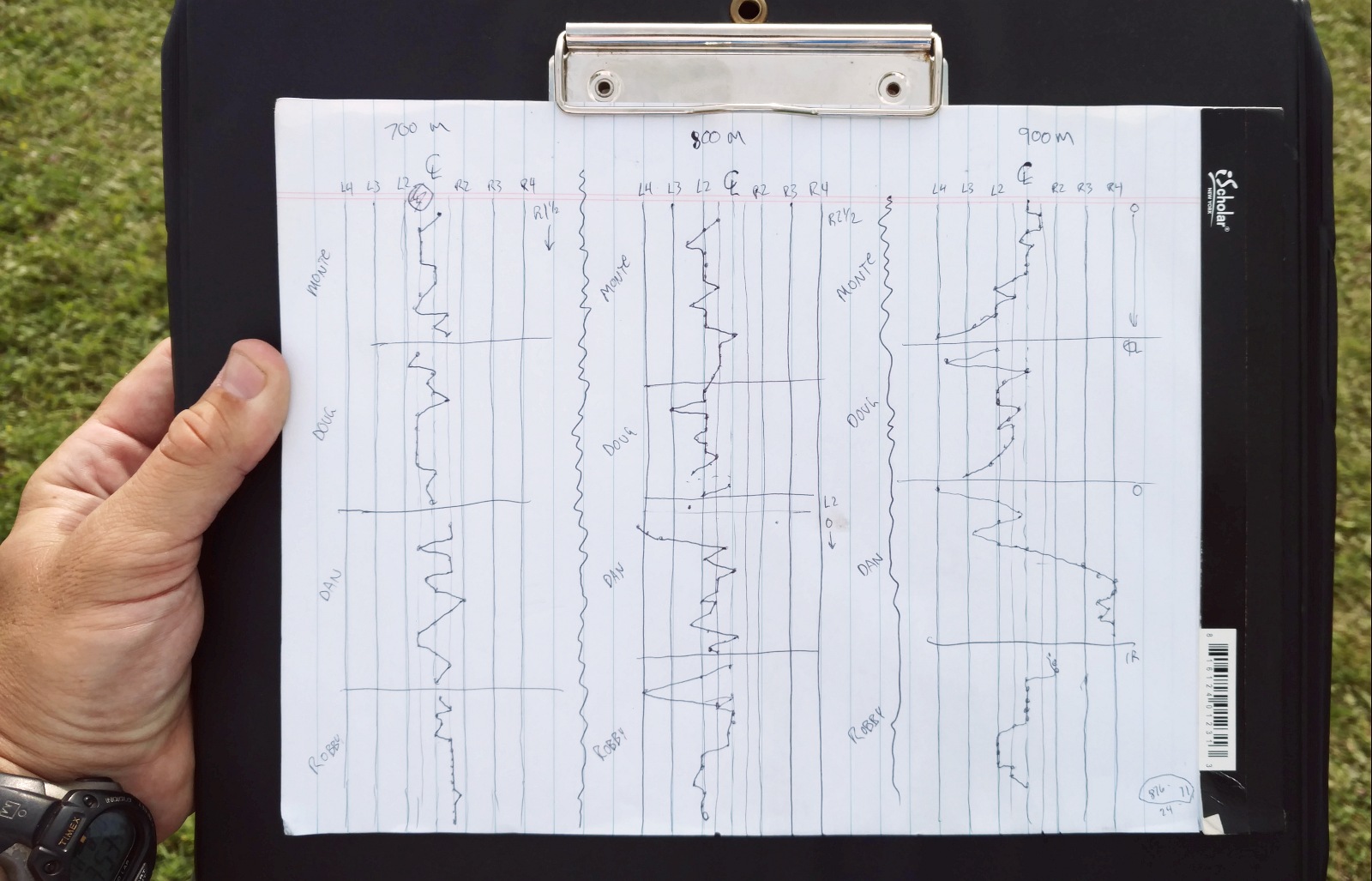
The wind plot I use is a running history of what the correct wind call was for every shot fired. The more you shoot, the more history you have in a condition, and I find that very useful information. This kind of plot IS NOT showing where the bullet hit, and is NOT showing what you held. It’s showing what you should have held to center each shot. IMO, this is the most valuable information to have when guessing where to hold next for each shot. Here are some key points:
1. I always look for blocks of stable conditions to shoot in and wait out the rest.
2. If the wind plot shows drastic changes, either I’m not picking the right time to shoot or it’s just a really unstable wind condition.
3. When you see many shots using the same hold (e.g. Robby’s 700m and 900m strings on plot), it can indicate very fast shooting and fast pit service.
Q. What are the numbers and Markings on this Wind Plot?
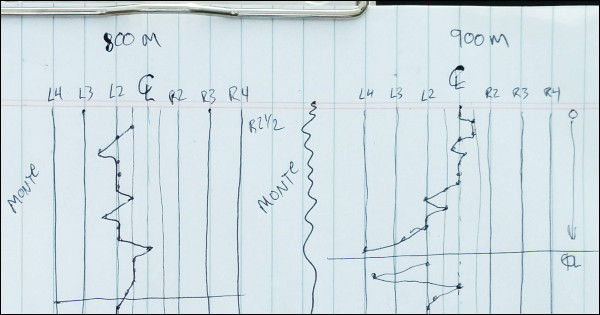
Litz: The wind plot represents the rings on the target. Left 2 for example, is the 5 line on the international target, while Left 2 is the 10 line on the USA target. F-Class shooters and coaches talk about wind holds in relation to these rings. A Left 2 hold isn’t left 2 MOA or 2 MILS, it’s the second ring from center. The vertical lines on the plot represent the rings going out from center, 4 or 5 in each direction. A left or right 5 hold is edge of black on the int’l target.
Q: What Does this Specific Plot Reveal?
Litz: Looking at the plot, from left to right is 700m, 800m, and 900m that we shot progressively through the day. Top to bottom shows each shooter in sequence (shooters names are shown by their blocks). To the right I note what was on the gun for that shooter, and note when it changes. Often times we run the same wind on the gun for several shooters but if it changes, I note what the new windage is and continue on. For example if we’re settled into a condition where we’re shooting Vs with a right 3 hold, I might adjust the scope 1 MOA right because a right 3 hold is equal to 1 MOA. So we can move the scope and start shooting with a center hold.
Q. Are you Plotting Where the Bullet Hits?
Litz: Not exactly. This kind of plot IS NOT specifically showing where the bullet hit, and IS NOT showing what the shooter held. It’s showing what the shooter should have held to center each shot. IMO, this is the most valuable information to have when guessing where to hold next for each shot.
On each shot, the shooter or coach takes a guess about where to hold, and fires the shot. If the bullet hits the center, you plot the point right where you held because it was the correct hold. However, if you miss the call, you plot what hold was required to put that shot in the center. For example if you shoot a right 3 and hit where you held, the correct call would have been “center”. In this way, you’re building a history of what you should have done, which may or may not be what you actually did. This shows you the trends, and brackets which can be used to make future decisions.
Q: Is this Type of Wind Plot Something New?
Litz: I didn’t invent this method, it’s been around a long time. Vertical can be plotted the same way. In team matches, we have a plotter who is advising on elevation trends and suggesting corrections. But, as wind coach, my job is the horizontal so I only keep the wind plot. I have learned lots of strategies from my coaches Emil Praslick and Steve Hardin.
There are many ways to plot and many standard work sheets for this. They’re all tools and the key is to find something that works for you in different situations. I don’t keep a plot when I am personally behind the trigger string firing because I lose more points when I take the time to do it vs. just shooting fast. When pair firing or coaching, I can keep the wind plot without compromising the shooting.
Here Team Australia used plots and communication gear linking coaches. This helped the Aussies win the 2013 F-Open Team World Championship held at Raton, NM.
Know Your Goal — Keep It Simple
Know your goal of plotting. The simplest plot is where you write the shot number where it hit on a target face. This kind of plotting is useful for evaluating shooter performance because it shows how big the group is (in particular the vertical dispersion). However keeping a plot like this does little to help you figure out the wind. It just shows you what shots you messed up on. It does nothing to help you find the center. [Editor: That’s a whole different matter with many variables.] The wind plot I use is a running history of what the correct wind call was for every shot fired. The more you shoot, the more history you have in a condition, and I find that very useful information.
We first ran this story a few years back. We’re republishing it today as a reminder to our readers that safety should be their paramount concern at the range. Avoid distractions and always check your barrel for obstructions before you chamber a round or pull the trigger. A moment of inattention can result in a catastrophic kaboom.
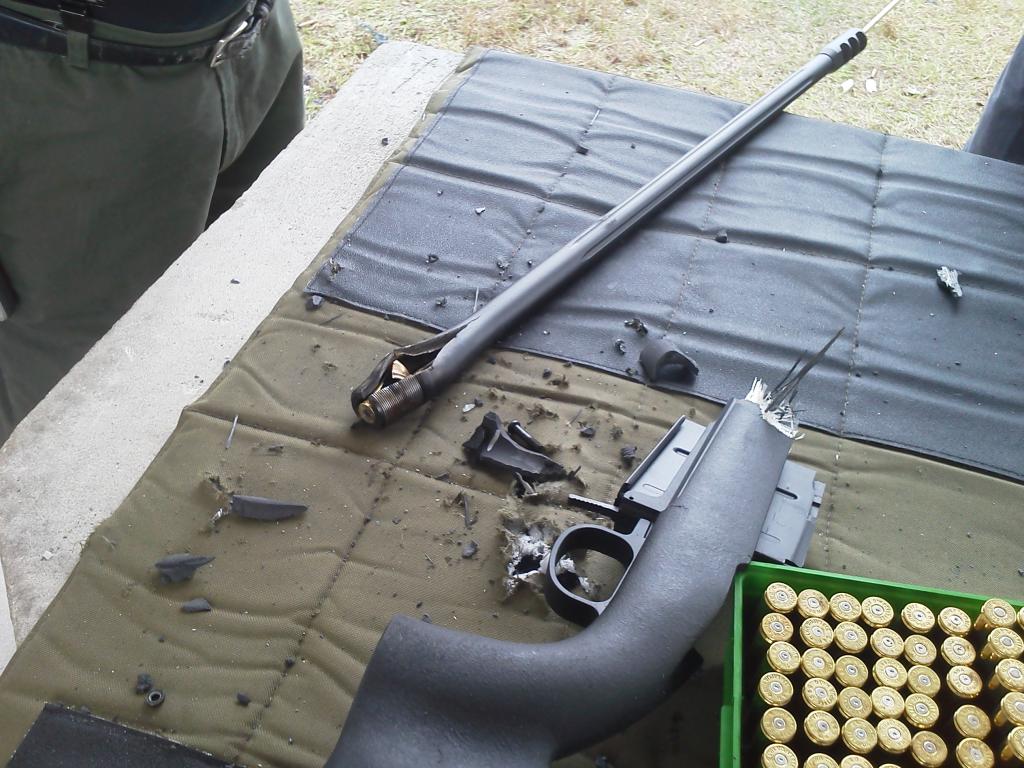
Discharging a .338 Lapua Magnum round with a cleaning rod in the barrel — that’s a recipe for disaster. What happens when a fired .338 caliber bullet and a cleaning rod try to occupy the same place at the same time? Well you get a catastrophic kaboom, with metal pieces flying all over the place, and a shooter very lucky to escape without serious injury. This incident occurred recently in Manatee, Florida, as reported by Sniper’s Hide member Queequeg. We thank SnipersHide.com for granting permission to publish these revealing images in the Daily Bulletin. CLICK HERE for more Kaboom info from the ‘Hide.
This story should serve as a chilling reminder to follow proper safety practices whenever you are at the range. Always check to make sure there is no obstruction in the bore BEFORE loading a live round.
.338 Lapua Magnum + Cleaning Rod + Inattention = Kaboom!
Kaboom at Manatee!
Sniper’s Hide member Queequeg recently published shocking photos of a catastrophic kaboom involving a .338 Lapua Magnum (Savage action). The action was blown off the rifle, shrapnel went through the roof, and the barrel split at the tenon before taking an excursion downrange. The action did crack in the front but the lugs remained engaged so the bolt did not slam to the rear (luckily for the shooter).
Here’s the report: “This happened [January 20, 2014] at the Manatee Gun and Archery Club. Al, Ren and myself were there with a couple other folks. Ren was at bench 12, I was at 13. The fellow at 11 was running a Savage .338 Lapua. He had a very bad day! He damn sure could have killed himself and quite likely Ren as well.”
Queeqeg added: “After the boom, I heard Ren ask ‘Are you alright’ and then turned to look in time to see the fellow reacting in total shock — literally stunned. Ren and I went over to him and could not see any major injuries. Ren was uninjured as well but had a lot of fiberglass splinters on him. The barrel nut is what I presume punched the two holes in the roof. The shooter is a regular there[.] He had been having a problem with sticky cases though he said he was certain the loads were mild. That’s why he was content to knock the sticky ones out with the rod. He simply forgot to remove the rod after knocking out the last stuck case. You can see what happened next.”
To learn more about this incident, go to the original Snipers Hide Forum Thread. There you’ll find more details and four pages of related discussions.
The Important Lesson Here
What did the .338 LM shooter do wrong here? You will say — “Well that’s obvious, he left a cleaning rod in the barrel and then shot a round.” Yes, that was a potentially fatal error. But that was his second mistake — one that occurred only because he made a more fundamental judgment error first.
The FIRST mistake was not acknowledging the problem with his ammo. Had he heeded the warning signs, he would still have a rifle (and an unsoiled pair of trousers). When he first observed that he was having problems with extracting cases, a warning light should have gone off in his head. Presuming his extractor was not broken (and that the chamber was cut properly) he should have been able to extract his brass if he was running safe loads. The lesson here we all need to learn is that if you observe a serious ammo-related issue, it is time to stop shooting. Don’t try to invent work-arounds just to extend your range session, when there are clear signs that something is wrong, very wrong.
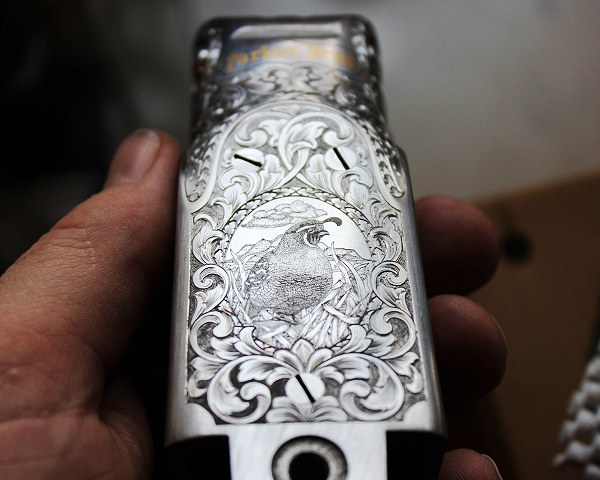
Impressive engraving by Jesse Kaufmann. Note how the scope rings have been engraved to perfectly match the engraving pattern on the Remington 547 action.
Who says fine craftsmanship is dead? There’s a modern day engraving wizard up in South Dakota, Jesse Kaufmann, who produces some of the most handsome engraving we’ve seen. Jesse, who operates Black Hills Gunstocks and Engraving LLC, is a true master at metal engraving and he also does superb stock checkering. Here are some examples of Jesse’s engraving work:
This 14-minute video showcases dozens of Jesse Kaufmann’s Engraving examples:
About Jesse Kaufmann, Master Engraver
Jesse Kaufmann was a professional stockmaker for Dakota Arms for over a decade. In 2009, he was inducted in the American Custom Gunmakers Guild as a checkering specialist. In January 2017, Jesse was awarded his Master Engraver certification by the Firearms Engravers Guild of America. With his broad skill set, Jesse is able to offer his clients a unique and complete package of stock work, finish, checkering, and engraving for a custom package that is all completed under one roof by his own hands.
Jesse Kaufmann’s work has been featured in American Rifleman, American Hunter, FEGA’s The Engraver, Sports Afield, Waidmannsheil Journal of German Gun Collectors Assn., Gun Digest 71st Edition, Modern Custom Guns Volume 2, Dangerous Game Rifles 2d. Edition. For more info, visit BlackHillsgunstocksandengraving.com, email blackhillsgunstocks [at] gmail.com, or call Jesse at (605) 499-9090 after 5:00 pm. SEE Gallery of Work.
Every Saturday we present interesting, informative videos for our Daily Bulletin readers. Here we feature five YouTube videos that offer a ton of useful information for serious shooters. We start with a great video about setting up rifle, rest, and bag on the bench. Then Hall-of-Fame benchrest shooter Speedy Gonzalez shows smart methods for cleaning barrels. Next F-Class Ace Keith Glasscock explains how to optimize your rifle after travel. In the fourth video, AutoTrickler inventor Adam MacDonald shows how to optimize the AutoTrickler V4. Next the truly outstanding 21st Century Power Neck-Turning lathe is showcased.
How to Set Up Your Rifle, Rest, and Bag on the Bench
To get the best results in benchrest shooting, you need to set up all the gear on your bench properly. That includes front rest placement, rear bag position, spotting scope set-up, and placement of cartridge holder/caddy, and possibly an elbow/forearm rest. When setting up the hardware, you need to align the front rest and rear bag properly to get optimal tracking. In addition you want to make sure the rear bag doesn’t slide or rotate a bit from shot to shot. And you also want to set your seat height/location so the shooter’s position is optimal and comfortable. This helpful video shows how to set up your rifle and gear for a benchrest match or load development/practice at the range. Credit to Boyd Allen for finding video.
Cleaning Barrels with Speedy — Smart Techniques
There are many effective methods to clean barrels. But some are more efficient that others and can help you do the job more quickly, with less effort. Here respected gunsmith and Hall-of-Fame benchrest shooter Speedy Gonzalez shows his procedures for cleaning competition barrels. He uses Sharpshoot-R Liquid Patch-Out and Wipe-Out Accelerator as primary solvents. Watch carefully — Speedy has some clever techniques for starting a patch in the rifling, and he is also careful about exiting the muzzle when brushing. Speedy also explains the importance of keeping your rods clean. And he prefers nylon brushes because, as the barrel starts to get wear in the throat, “the bronze bristles will actually start eating into that and you’ll see little grooves if you have a good borescope.” (See video 00:38-01:35)
Getting Rifle Ready After Traveling — Keith Glasscock
Keith Glasscock is one of America’s top F-Class shooters, having finished Second at the National Championships multiple times. Keith, who has an engineering background, runs the popular Winning in the Wind YouTube channel. There you’ll find great advice on wind reading, load tuning, precision reloading and many other topics. In this video, Keith offers very smart advice on how to re-assemble your rifle after you have traveled to a match or practice destination. Keith explains how to check the fasteners on the gun and set up the scope properly if you removed it while traveling.
Adjusting AutoTrickler V4 with its Inventor, Adam MacDonald
Adam MacDonald is the brilliant Canadian engineer who created the AutoTrickler series of automated powder dispensing systems. These work with advanced scales to dispense powder rapidly, but with a precise final trickle accurate to a single kernel. In this video, Adam explains how best to adjust and calibrate the AutoTrickler V4 when using powders that flow at different rates.
21st Century Power Neck-Turning Lathe — Great Tool
Turning case-necks can be tedious and tough on older hands if you’re using hand-held tools. Quite a few years ago 21st Century released a great compact, neck-turning lathe that delivers superb, consistent results. This Editor uses that original lathe with hand crank and I can affirm that it works great. It is easy to use, fast, and the turned necks come out smooth with consistent rim thickness. But you still had to turn a crank. Well, in 2018, 21st Century created an upgraded Power Neck-Turning Lathe with an electric motor and lever to advance the cases to the cutter. The power head glides on stainless steel guide rails. Power is controlled with a red button in the feed handle.
This advanced, powered mini-lathe is absolutely superb. It works brilliantly and makes the task of turning case-necks fast and VERY easy. And there is even a 3-Way trimmer upgrade that will trim cases to length at the same time as the necks are turned.
BONUS — How to Spot Fake Online Sellers of Components
With the shortage of premium reloading components, particularly powder and primers, many handloaders are desperate to find components when even big companies such as Midsouth and MidwayUSA are completely sold out. Enter the scammers. There are criminals, many based overseas, who have created entire websites designed to steal your money. You might find such a site when searching for “Varget powder in stock” or “CCI BR4 primers”. These sites look like regular business webstores, with product photos and modern shopping cart systems. But it’s all a scam.
Key giveaways are: 1) The site does NOT take Visa, Mastercard, or Discover but requires payment with Zelle, Venmo, Bitcoin, or AppleCash only; and 2) The site has hard-to-find powders, such as Varget and H4350, that nobody else has, and you can put thousands of pounds in the shopping cart.
Bottom line here — if the site allows you to order vast amounts of powder and/or primers, and does not take ANY major Credit Card types, it is almost surely a scam. If you see links to pay with Crypto-Currency (such as Bitcoin) run away!
GunsAmerica Digest has a new Suppressor Academy webpage that provides host of helpful information about suppressors (aka “silencers” and “cans”). The Suppressor Academy online resource page features in-depth articles with important information for anyone considering acquiring a suppressor. The articles explain the key benefits of suppressors, how to choose a suppressor, and how to comply with Federal and state laws regulating suppressors. Below we link to four Suppressor Academy articles. Click the title for each topic to read the full-length article.
Suppressors are now legal in 42 U.S. States. There are certain legal requirements for obtaining a suppressor, including paying a $200 Tax Stamp. To own a suppressor you must be legally eligible to purchase a firearm, pass a BATFE background check, pay a one time $200 Transfer Tax, and satisfy age requirements. (SEE ALL Requirements). In most (but not all) of those states you can use a suppressor for hunting. The eight (mostly blue) states which still prohibit civilian suppressor ownership are: California, Delaware, Hawaii, Illinois, Massachusetts, New Jersey, New York, and Rhode Island. READ FULL ARTICLE on GunsAmerica Digest.
Suppressors serve one main purposes — to reduce the sound levels produced when firing pistol or rifle rounds. But GunsAmerica Digest editor True Pearce notes there are many other reasons to own a suppressor. A suppressor can reduce muzzle blast and felt recoil. The suppressor may prevent hearing damage that occurs through bone conduction better than earplugs and muffs because it reduces the noise energy at the source. When hunting, the reduced shot noise can help avoid spooking game. Having a suppressor also makes it easier to communicate when working as a team on a hunt. And, when compared to a muzzle BRAKE, suppressors are much less likely to kick up dust, dirt, sand, and snow when you shoot prone. READ FULL ARTICLE on GunsAmerica Digest.
There is some confusion surrounding the laws concerning suppressors, which are now legal in 42 U.S. States. In most jurisdictions that allow suppressor ownership, no additional state permit or license is required. But you do have to comply with Federal requirements when acquiring the suppressor. You may wish to create a trust to own the suppressor — there are some important practical advantages to having a suppressor trust. The Traditional NFA Gun Trust allows multiple responsible parties, i.e. “trustees”, to legally have possession of the suppressor. Each trustee must be verified and for each suppressor owned by the trust there will be a $200 Tax Stamp. READ FULL ARTICLE on GunsAmerica Digest.
When shopping for a suppressor there are many factors to consider: price, build quality, materials, sound level reduction effectiveness, weight, ease of mounting, and ease of cleaning and maintenance. We recommend that all suppressor buyers research the options. Check the manufacturer’s reputation, check diagrams for disassembly and maintenance. There are always trade-offs. Shorter suppressors may save some weight, but if they don’t cut the decibels as well you may be disappointed. You also need to consider the caliber — will your suppressor be used on multiple firearms? If so then get one that fits the largest caliber you will shoot. READ FULL ARTICLE on GunsAmerica Digest.
Applied Ballistics has just launched a great, new online resource for shooters: The Science of Accuracy Academy. This subscription-based website is launching with nearly 30 podcast episodes, with many more planned, as well as video content, Zoom classes, and much more.
The main goal of this new online resource is to adapt and modernize the delivery of content coming from Applied Ballistics LLC. In past years, books, DVDs, and seminars were the primary avenues for delivering information. Modern technology has evolved, and the delivery of information can be done in more efficient ways such as streaming videos, podcast discussions of book and seminar content. In addition to being a more modern delivery platform, The Science of Accuracy Academy allows for more frequent updates than traditional books and DVDs.
Bryan Litz, owner of Applied Ballistics LLC tells us: “I’m very excited about this avenue to share what we’re learning in the Applied Ballistics lab. I think many shooters will benefit from the podcasts, which contain very insightful discussions and can be enjoyed in your car, or as you work. We look forward to publishing more of our research thru the Science of Accuracy Academy”.
About the Science of Accuracy Academy Content and Programs
Below, Bryan Litz comments about the Academy’s new podcast offerings and other interactive content. Bryan notes: “We’ve benefited a great deal from practicing the scientific method, and we want to share what we’ve learned.”
Book Content via Podcasts — Many of the podcast episodes are specific reviews of Applied Ballistics book chapters. I’ll sit with Mitch or Francis (both experienced, champion shooters) and discuss the chapter, what it was like to do the tests. We will also discuss behind the scenes problems, as well as what we’ve learned since publishing the books. This lets subscribers get knowledge from the books. And, as a podcast, you can listen while driving, working out, or whatever.
The World of Doppler Radar — In recent years we have spent considerable time visiting shooting matches with the AB Mobile Lab and running Doppler radar. Between that and some of the government contracting work, we’ve built up a lot of experiences and it’s been a long time since a book was published. This Academy is a great outlet for us to update the shooting world on what we’ve been doing and learning.
Ballistics Science and Precision Loading — We’ve been doing hardcore ballistic science for the past few years and have a lot to share. We’ve come to see some aspects of handloading and shooting in a fundamentally different way. For example, understanding the statistical nature of precision has caused us to re-shape how we make decisions in the handloading process. As a result, we now better understand cause-effect relationships and can make deliberate, reliable progress as a result.
Bryan Litz Announces the New Science of Accuracy Academy
The Lighter Side — Bryan told AccurateShooter.com: “Some of the podcast episodes are much less serious! We have fun arguing about which shooting disciplines are harder. For example, Mitch Fitzpatrick and I talk with Francis Colon and Chad Heckler about PRS vs. ELR shooting. We discuss what we like and dislike about the different sports, what we would like to see changed, and what competition shooting has meant for us as individuals. This open-ended format explores long range shooting from the technical to the personal and everything in-between.”
Are you curious about bullet stabilization? Do you understand why bullets can tumble or become unstable if the velocity gets too low or if the twist rate is inadequate. Here is an excellent video from Gunwerks that explains Bullet Stabilization.
This animated video starts by showing the design/shape differences between an older-style rifle bullet and a newer VLD-style bullet with higher BCs (Ballistic Coefficients). Generally speaking, the longer a bullet gets relative to diameter, the more RPM is required for stability. And to achieve that higher RPM you need more barrel twist and/or more RPM. The video illustrates where the Center of Gravity and the Center of Pressure are located. These are farther apart (in relative terms) for a VLD or Hybrid-style, long-nose bullet.
When the bullet is in flight there is an angle of attack. This is exaggerated in the animation for illustration purposes, but it is important to understand the the attack angle affect stability. The rotation rate (Revolutions Per Minute) is a function of bullet velocity as it leaves the muzzle and the twist rate of the barrel. Since long VLD-style bullets need more stability, the barrel twist rate needs to be higher than with shorter, fatter bullets. This is pretty much try for all calibers.
The importance of adequate barrel twist rates for bullet stabilization is further discussed in this next video featuring Bryan Litz of Applied Ballistics:
Bullet Stability and Twist Rates
In this video, Bryan Litz talks about bullet in-flight stability and how to calculate barrel twist-rate requirements for long-range bullets. Bryan explains that bullet stability (for conventional projectiles) is basically provided by the spinning of the bullet. But this spin rate is a function of BOTH the nominal twist rate of the barrel AND the velocity of the projectile. Thus, when shooting the same bullet, a very high-speed cartridge may work with a slower barrel twist rate than is required for a lower-speed (less powerful) cartridge. For match bullets, shot at ranges to 1000 yards and beyond, Bryan recommends a twist rate that offers good stability.
The United States Postal Service allows shipment of long-barreled rifles and shotguns via the U.S. Mail. However, regular citizens who do not possess an FFL are NOT allowed to mail handguns at all.* You must use UPS for handguns (or ship via an FFL). While the USPS allows rifle and shotgun mailing there ARE many rules and regulations with which long gun shippers must comply. Here are key USPS Gun Shipping Rules from the official USPS website. CLICK HERE to Read All Gun Shipping Rules.
U.S. Postal Service Rifle and Shotgun Shipping Rules
432.1 General
Mailers must comply with the Gun Control Act of 1968, all of the provisions of postal law in 18 U.S.C. 1715, and all other all federal and state regulations and local ordinances affecting the movement of firearms. The following also applies:
a. The Postal Service may require the mailer to open parcels containing firearms or air guns or give written certification that the weapon is unloaded and not concealable (see note 1).
b. Short-barreled rifles or shotguns that can be concealed on the person are nonmailable.
c. No markings of any kind that indicate the nature of the contents may be placed on the outside wrapper or container of any mailpiece containing firearms.
d. Mailable matter must be properly and securely packaged within the general packaging requirements in DMM 601.1-7.
e. Except for shipments between licensed dealers, manufacturers, or importers, all regulated firearms must be mailed using a USPS product or Extra Service that provides tracking and signature capture at delivery (see note 2).
432.3 Rifles and Shotguns
Except under 431.2, unloaded rifles and shotguns are mailable. Mailers must comply with the rules and regulations under 27 CFR, Part 478, as well as state and local laws. The mailer may be required by the USPS to establish, by opening the parcel or by written certification, that the rifle or shotgun is unloaded and not ineligible for mailing (see note 1). The following conditions also apply:
a. Subject to state, territory, or district regulations, rifles and shotguns may be mailed without restriction when intended for delivery within the same state of mailing. These items must:
1. Bear a “Return Service Requested” endorsement.
2.Be mailed using a class of mail, product, or Extra Service that provides tracking and signature capture at delivery.
b. A rifle or shotgun owned by a non-FFL may be mailed outside the owner’s state of residence by the owner to himself or herself, in care of another person in the other state where he or she intends to hunt or engage in any other lawful activity. These mailpieces must:
1. Be addressed to the owner.
2. Include the “in the care of” endorsement immediately preceding the name of the applicable temporary custodian.
3. Be opened by the rifle or shotgun owner only.
4. Be mailed using a class of mail, product, or Extra Service that provides tracking and signature capture at delivery.
d. Mailing of rifles and shotguns between licensed FFL dealers, manufacturers, or importers are not restricted. The Postal Service recommends that these items be mailed using a class of mail, product, or Extra Service that provides tracking and signature capture at delivery.
e. Except as described in 432.3a, licensed curio and relic collectors may mail firearms meeting the definition of curios or relics under 27 CFR 478.11 domestically to licensed FFL curio and relic collectors in any state. These items must be mailed using a class of mail, product, or Extra Service that provides tracking and signature capture at delivery.
f. Firearms meeting the definition of a rifle or shotgun under 431.4 which are certified by the curator of a municipal, state, or federal museum, which exhibits firearms to be curios or relics of museum interest, may be accepted for mailing without restriction when mailed between governmental museums.
g. Air guns (see 431.6) that do not fall within the definition of firearms under 431.1a are mailable. A shipment containing an air gun with a muzzle velocity of 400 or more feet per second (fps) must include an adult signature service under DMM 503.8. Mailers must additionally comply with all applicable state and local regulations.
FOUR TIPS for Safer, More Secure USPS Firearms Shipping
Here are some other helpful suggestions when shipping long guns via USPS:
1. Bring a copy of the destination FFL holder’s license to the Post Office, just in case the staff asks for confirmation.
2. Use a Shipping Mode that Requires Signature on Delivery for confirmation.
3. Ship Priority Mail for faster delivery and BUY INSURANCE to cover complete replacement value of the firearms. Some guns may be damaged, but insurance is needed to cover full gun value with a lost/stolen shipment.
4. Double tape the ends of the box, and put plenty of padding around the muzzle and buttstock INSIDE the box.
* While ordinary (non-FFL) person may never mail handguns, there are some types of handgun mail shipments allowed by manufacturers etc. to Government and U.S. Military recipients:
432.21 Authorized Persons
Subject to 432.22, handguns may be mailed by a licensed manufacturer of firearms, a licensed dealer of firearms, a licensed importer of firearms, or an authorized agent of the federal government or the government of a state, territory, or district, only when addressed to a person in one of the following categories for use in the person’s official duties, and upon filing the required affidavit or certificate:
a. Officers of the Army, Coast Guard, Air Force, Navy, Marine Corps, or Organized Reserve Corps.
b. Officers of the National Guard or militia of a state, territory, or district.
c. Officers of the United States or of a state, territory, or district, whose official duty is to serve warrants of arrest or commitment.
d. USPS employees authorized by the Chief Postal Inspector.
e. Officers and employees of enforcement agencies of the United States.
f. Watchmen engaged in guarding the property of the United States, a state, territory, or district.
g. Purchasing agent or other designated member of agencies employing officers and employees included in 432.21c through e.
432.23 Manufacturers, Dealers, and Importers
Handguns may also be mailed between licensed manufacturers of firearms, licensed dealers of firearms, and licensed importers of firearms in customary trade shipments, or for repairing or replacing parts.
Here’s something all shooters need — a smartphone App that calculates bullet-hole group sizes from your own photos. The Ballistic-X App is simple to use. Take a photo of your target, set some values (such as bullet diameter and distance to target), then use the touchscreen to place circles around each hole. The App will calculate group size (in MOA or Mils), distance to point of aim, and provide all the info in an overlay. Then click “save” to record your group for posterity!
This App works well, is relatively easy to set-up, and costs just $7.99. It is available for both Android devices and iOS (Apple) devices. There are other ways to measure group sizes from target images, such as the excellent On-Target program, which we have used for years. However On-Target requires a software installation on a Windows platform desktop or laptop. Ballistic-X is a simple, easy-to-install App with versions for both Android and iOS (Apple) Mobile devices.
The Ballistic-X App has a relatively easy-to-use interface. Of course you can choose either MOA or Milrad group values, and Inch or Metric dimensions. There are various labeling options that provide useful info for Load Development. There is even an ATZ (Adjustment To Zero) feature for adjusting your turrets.
How to Use Ballistic-X App
1. Select Photo Source — Choose Camera to take new photo or get image from Photo Library.
2. Set Reference Values — Select Bullet Diameter and enter Distance to Target.
3. Establish Scale on Image — Mark two points on target photo to set scale. For example, if the target has a 1″-square grid lines, mark two points on grid for 1″ distance.
4. Mark Point Of Aim — Put the central X on the aim point.
5. Designate Shot Locations — Place the green circles around each shot.
6. Finalize Data Display — Position Overlay, select size/color options, and export file.
Android Options — Range Buddy FREE App
Along with Ballistic-X, there is another Mobile App, Range Buddy, that also measures shot groups. Range Buddy is currently offered for Android devices only. It is FREE, but has adverts. Range Buddy isn’t bad, but users complained about the program crashing, and there are compatibility issues with newer phones. We recommend you pay $7.99 and stick with Ballistic-X.
NRA Media offers a series of informative videos about the Science of Shooting, covering a wide range of topics, from eye dominance to long-range ballistics. These videos feature high production values, with super-slow motion segments, as well as helpful computer graphics to illustrate the principles covered.
The videos are narrated by Jessie Harrison, a top action pistol shooter (and the first women ever to achieve USPSA Grand Master status). Jessie is assisted by talented shooters such as Top Shot Season 4 Champion Chris Cheng. There are 40 videos in the Firearm Science Video Series. Here are seven good NRA science videos, with links to others below.
BULLET TRAJECTORY — Factors at Play and Zeroing Strategies
Host Jessie Harrison (formerly Jessie Duff) and Veteran Air Force Sniper and Long Range Expert George Reinas help us understand the factors behind bullet trajectory. NOTE: There are some exaggerations in the graphics in the videos, and inconsistent terminology use, but it’s still a helpful basic primer on the subject of trajectories. This popular video has over 1 million YouTube views.
Olympic Gold Medalist Jamie Gray demonstrates the four positions used by competition shooters: Prone, Standing, Sitting, and Kneeling. Helpful overlay graphics show how the human skeleton aligns in each of these positions. This video should help hunters as well as competitive position shooters. If you shoot silhouette, definitely watch this video!
INTERNAL Ballistics — Cartridge Ignition and Bullet in Barrel
What happens inside the barrel of your gun when you pull the trigger? In this edition of Firearm Science, Jessie Harrison goes over internal ballistics, which studies the combustion of propellant, the pressure developed, and the motion of the bullet along the bore of the barrel. There are some good 3D animations showing how the powder charge ignites and the bullet moves through the barrel.
CHOKE TUBES and Shot Patterns — Shotgun Science
With over 2 million YouTube views, this shotgun-centric video is the most popular of all the NRA Firearms Science series videos. Here Olympic trap shooter Corey Cogdell explains how choke tubes affect a shotgun’s shot pattern in this edition of Firearm Science. We recommend that all Shotgun hunters watch this video — it explains the effect of choke tubes very well.
ZEROING RIFLES for Long Range — Tech Tips
The process of zeroing rifles for long range is covered in this Firearm Science video featuring George Reinas, a veteran Air Force sniper. George demonstrates how to adjust his scope to compensate for bullet drop at long range. Our friend Dennis Santiago was involved in the making of this video, which was filmed at the Burbank Rifle & Revolver Club in Southern California.
CHRONOGRAPHS — Calculating the Speed of a Bullet
This video shows a conventional chronograph with front and rear light sensors. The bullet first trips the front sensor and then the rear sensor as it flies over the unit. The difference in sensor time is used to calculate bullet speed. This is not the only kind of chrono in common use today. The popular MagnetoSpeed chrono works by tracking the bullet as it passes over two magnetic sensors mounted on a bayonet-style fixture on the barrel.
The high-tech LabRadar chronograph employs Doppler Radar to measure the speed of a bullet without the need to send the round directly over sensors. No need to set up tripods down-range. Just set the unit near your rifle’s muzzle, on the side. There is also an inertial trigger accessory for LabRadars. Interestingly, this video also explains how, in the days before electric lamps, digital processors, and radar, scientists used a mechanical “Ballistic Pendulum” to calculate bullet velocity using Newtonian physics. The Ballistic Pendulum (shown at right) was first used in the mid 1700s.
EYE DOMINANCE — How to Determine Which Eye is Dominant
Host Jessie Duff and longtime shooter Krystie Messenger demonstrate how eye dominance affects aim and teach you how to determine your dominant eye in this edition of Firearm Science. There are very simple tests you can do to determine your eye dominance. This Editor is right-handed but left-eye dominant. All competitive shooters should check for eye dominance. If you are cross-dominant, you can alter your head position or put a paper patch on one frame of your shooting glasses.








 About Jesse Kaufmann, Master Engraver





 This video shows a conventional chronograph with front and rear light sensors. The bullet first trips the front sensor and then the rear sensor as it flies over the unit. The difference in sensor time is used to calculate bullet speed. This is not the only kind of chrono in common use today. The popular


