|
|
July 9th, 2007
Tom Sarver has entered the ranks of the Immortals. Shooting at the Thunder Valley (Ohio) Range on July 7th, Tom nailed a truly spectacular 1.403″ 5-shot group at 1000 yards. This represents a new IBS Light Gun group-size record that edges Rich DeSimone’s 1.564″, previously thought “untouchable.” What is even more amazing is that the group was centered, producing a 50-score with 5 Xs. That will be a new IBS Score record as well.


Tom was shooting a big 30 wildcat he calls the “300 Hulk”, a shortened 338 Lapua Magnum necked down to 30 caliber, pushing 240gr Sierra MatchKings (0.711 BC) at close to 3000 fps. Tom is using about 85 grains of H1000. He anneals the Lapua brass after every firing, and the brass that set the record was on its 58th firing! After the record Group/Score target on Relay One of Match 7 in the Ohio 1000-yard series, Tom added a 6″ group that secured the Light Gun class victory according to fellow Thunder Valley shooter Dan Wassum. Dan also notes: “Tom has been very close several times to records, but this time all five were in the right spot.” (J.P. Lucas was the 2007 Ohio Overall Two-Gun Champ at Thunder Valley this year.)
Rich DeSimone offered his congratulations to Tom: “Congratulations from the guy you ‘de-throned’. It could not happen to a nicer more deserving guy. Since I have known you, when you first started shooting benchrest at Hawk’s Ridge with a bi-pod and a .308 snipers rifle, you have come a VERY long way. This August 17th would have been five years since I beat the existing record by around .040″ and now you blew mine away by about .160″ and put five X’s with it to boot. Way to go Tom!”
July 8th, 2007
Stephen Ivey has engineered an interesting set of gimbaled scope rings allowing up to 150 Minutes of Angle (MOA) of elevation. These rings have precision hinge pins front and rear allowing the entire scope to be tilted by a micrometer-controlled cam in the rear. This allows the scope to tilt upwards (in the rear) with the front ring as the axis while both rings remain parallel to prevent scope binding. The rear ring tilts to match the front while a cam pushes it up. Ivey also makes tilting +150 MOA Picatinny riser rails.

Ivey offers three scope-mounting products. First is the BR 30-50 (above). This has two, polished 30mm 6061-T6 aluminum rings with bases to fit a 1/2″ x 60 degree Stolle (Davidson) rail on top of an action. Total elevation is +50 MOA. The micrometer adjuster is graduated in true 1 MOA intervals, with 5 MOA of elevation change per rotation. This product costs $385.00 and requires at least 5-1/2″ length mounting base. Available in either “bright” or satin finish.

The newest product is the MSRR-150MOA Riser Rail, a pivoting 5.75″-long Picatinny-style rail that accepts Weaver-style clamping scope rings. This Adjusts from Zero to +150 MOA and raises the scope 1.45″ from the top of the action. The extra height provides clearance for large objectives when the unit is tilted for a full +150 MOA elevation. Cross slots are 5mm wide at 10mm (.394″) spacing. The $425 riser rail is made 6061 T6 Aluminum hard-anodized black. Clamps are heat-treated steel. The micrometer thimble is marked for 1 MOA gradations, and provides 20 MOA per revolution.

The third product, the $445 MSR 30-150, has a pair of 30mm clamping rings that fit on a Picatinny-style (1913 mil-spec) rail. Base cross-slots for two-bolt clamp can accomodate 3/4″ to 1″ slot spacing between centers. Height from top of rail to center of rings = 1.82″ at lowest setting. Note: you need a rail at least 5.625″ long.

The Ivey products are expensive, to be sure, but they are beautifully machined, and they offer unique capabilities for ultra-long-range shooters. With the +150 MOA units you have enough elevation to shoot at 2000+ yards! Even with the +50 unit you can you shoot at 1000 while keeping your scope centered in its elevation travel. We like the idea of using the micrometer to dial within 1 MOA and then just using the scope turrets for fine-tuning. To learn more, visit the Ivey Shooting website, or call Stephen Ivey at (615) 424-8855.
July 7th, 2007
AccurateShooter.com reader Birgir Saemundsson from Iceland has created some very nice Benchrest videos, which can be viewed on Google Video. Produced in association with Icelandic Television, the short videos show the whole process of shooting–in an outdoor environment that can only be described as “wild and natural”. Birgir had cameras placed close to the target, so you can actually see a 5-shot group form up, shot by shot. If you’ve never shot sub-quarter MOA before, watch these videos and see how it’s done.
Video 1 (6 min. Intro to Benchrest)
Video 2 (2 min. Shooting and Interview)
Below is an animation we’ve composed from frames in the videos showing H.S. Myndatökur shooting a 6PPC at 100m. Nice shooting, young lady!

And here is Birgir Saemundsson shooting his Heavy Gun. Note the muzzle flash:

July 7th, 2007
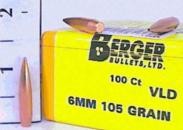 Now through the end of July, 2007, MidwayUSA has Berger 105gr VLD bullets on sale. The sale price is $19.99–that’s $6.50 under the regular $26.49 price. While MidwayUSA won’t guarantee specific lot numbers, all of the 105 VLDs (item 195087) that MidwayUSA has been shipping lately have been produced on the new die. So if it’s “new die” Bergers you want, here is a good source. Most user reports on these bullets have been very positive. NOTE: this is a secant ogive bullet that will probably work best seated into the lands.
July 6th, 2007
There has been considerable interest in an “improved” 6BR case that retains a longer neck than the Dasher. David Stripling has his 6BR-DX (shown below), with a 40° shoulder and about 2 grains extra capacity. Another wildcat in this mode is the new “6mm BRG”. On Benchrest.com, Plugger posted: “I am now shooting a 6mm BRG. This round was developed by three long range shooters and is based on the 6BR case as is the Dasher. It gives you more capacity than the straight 6BR but a longer neck than the Dasher which should give better barrel life. It is an extremely accurate round that I shoot in 600 and 1000 comp. If you have any interest in this cartridge then talk to Billy Dale of BDR Custom Rifles, (804) 314-6787. Billy was one of the developers of this round and is an excellent gunsmith to boot.”

The 6 BR-DX (0.283 Neck)
The 6BR-DX is an improved version of the 6mm BR Norma cartridge, with a 40° shoulder and a bit less body taper than a Dasher. The shoulder is .462″ (just a couple thousandths bigger than a standard case) and the diameter at the web is .470″. 6BR-DX water capacity is about 39.5 grains. That’s about 1.5-2.0 grains more than a standard 6BR case, depending on your chamber. With the extra boiler room provided by the BRDX, David Stripling can stuff 34+ grains of RL15 into the 6BR-DX, even though the neck, at 0.283″, is just .039″ shorter than a standard BR. With the added capacity, David can launch Berger 88s at nearly 3300 fps, or Berger 95s at 3200 fps.
July 6th, 2007
On July 20-22, the NBRSA 1000-yard Nationals will be held at the Palamino Range just outside Reno, Nevada. Competitors will shoot both Light Gun (17-lb max) and Heavy Gun (Unlimited) Classes. The format is SIX targets each day if you shoot two (2) classes, or THREE targets each day if you are shoot one (1) class. Friday the 20th is a sign-up, weigh-in, and practice day. If you need to shoot to practice or zero, there is a $10.00 range fee on Friday. For the match, the Entry Fee is $20 per day per gun.

You can still register and compete. However, pre-registration was required 30 days before June 20th. A $40 late fee will be applied for late registration. Match is July 21st and 22nd. Local information and Registration Form are found on the Palomino Valley Gun Club website. For more info contact Bob Hoppe at (775) 397-3358.
July 5th, 2007
Gene Davis has a new product that boosts the magnification of Leupold, Sightron, and Weaver BR scopes. A threaded ring with a Zeiss lens simply screws on to your scope behind the eyepiece, using the threads provided for lens caps. (Consider it an eyepiece extension). Both 2X and 3X models are available. The 2X version increases image size about 15% while the 3X boosts the viewed image roughly 30%. Hence, on a 36X scope, Davis’ 3X booster creates the equivalent of a 46X power scope. Starting with a 45X Leupold you can get 58X power. Many long-range BR shooters are using this product and reporting to Gene that they can see bullet holes at 600 yards and beyond for the first time. However, there is a price for the extra magnification–the reticle will appear slightly larger, and the image will appear somewhat darker. But, according to Gene: “the image darkening is almost imperceptible during prime daylight hours.” We think Gene’s invention is a winner–a great way to get more magnification at a low cost–$100.00. We also like the fact that, unlike an internal boosting job, you can simply remove the Booster if you want to return to the original magnification level.

Gene reports: “If the scope has screw-in lens caps, these Optical Boosters perform well. We started with a product for the Leupold Competition scopes. We now have Optical Boosters for Weaver T36 and Sightron 36BR as well. We are working on other brands of scopes and the earlier Leupold scopes that do not have threads for the cap. The Optical Boosters do a fantastic job for old or poor eyes. They fit any Leupold scope that has screw-in lens caps, as well as the Weaver and Sightron 36-power target scopes. The Boosters require no internal modification and will not effect the factory warranty. The Optical Boosters (either 2X or 3X) cost $100 delivered.” To purchase, contact Gene Davis at (740) 503-4486 or gdavis10 [at] columbus.rr.com.
Here are reports from two users:
Dick Wright: “Mine is on a 45X Leup…. It’s now a 60X Leup. I got it at the Super Shoot. Excellent optics. You have to re-focus the crosshair. I used it at the Oscoda match where we had lots of mirage. It was a 200 yd. score match and I could see my .22 bullet holes easily. This is totally subjective but, if anything, it made it easier to see. It’s an optical booster that really works for a mere [$100] bucks. All you have to do to reverse the process is un-screw it.”
Joe Pellegrene: “I just got back from the range using my new 3x magnifier on a 45x Leupold. Now it’s a 60x scope and I can’t imagine how I ever lived without it. If anyone’s having trouble seeing their bullet holes on the target this product is well worth the money. It’s easily the most significant piece of equipment that I bought yet.
I plan on using it on several different rifles since you just unscrew it and screw it on the next one. It that takes about 10 seconds to do that. The fine cross hairs on my Leupold were magnified, but so was the target so everything seemed proportional. It’s so much nicer seeing what you’re trying to hit. Now if only Gene would make one for the Nightforce scopes. You can put me down for one Nightforce magnifier. Gene, I wouldn’t mind shooting a 56x Nightforce!”
July 5th, 2007
Bullet-smith Victor Johnson, Johnson Precision Bullets, sent us these useful tips:
 Neck-Turning: I found that a 1/2 inch Dewalt drill with a keyless chuck will hold many caliber cases without an adapter. Just place the case in the chuck and twist it hand tight. Does the same work as a $250 case lathe. When neck-turning cases, you can hold the drill in one hand and the neck-turning tool in the other. But it’s much more efficient if you clamp the 1/2″ drill in a vise (with some carpet for padding). Then it’s very easy to control the turning speed and add/remove cartridge brass.
Powder Measures: If you’re throwing powder charges in the fall or winter and have problems with bridging or sticking powder, use a ground wire. This will help reduce static charge that causes clinging and clumping. I have a 25-foot piece of real small wire with alligator clips on each end. It’s that long so I can run it down the hall to a water pipe. Use the wire tie from a bread bag to hold it in a small roll to put in the range box. When using it at the range use a 6″ nail from the co-op or Lowe’s / Home Depot and just push it into the ground.
July 4th, 2007
On this nation’s Independence Day, we should remember the “shot heard ’round the world”. It is quite possible that there would be no United States of America (in the form we now know it), but for the courage of a small band of ordinary citizens, armed with hunting rifles. The militias of Concord and Lexington, Massachusetts were the first colonists to provide organized, armed opposition to British rule in the Americas. It is their fighting spirit that we celebrate today.

The Battles of Lexington and Concord
Having learned about arms stockpiled in Concord, on April 19, 1775, British General Gage ordered an estimated 700-800 regulars to march to Concord to seize arms, gunpowder, and cannons. (Gage also wanted to arrest John Hancock and Sam Adams, reported to be in Lexington.) Learning of the planned British action, Paul Revere rode to Lexington to alert the militia. Hancock and Adams went into hiding and the Lexington militia (120 or so men) formed up under Captain John Parker. When the British reached Lexington, they arrayed in battle formation on the Lexington Green. Parker told his men: “Stand your ground! Don’t fire unless fired upon! But if they want to have a war, let it begin here!” The British then advanced. A shot was heard, and the British regulars charged and attacked Parker’s force. When the smoke had cleared, the British suffered only one man wounded. However, eight Minutemen died, including Captain Parker’s cousin, Jonus, killed by bayonet.
The British then continued to the Concord arsenal. After securing the roads leading into Concord, the British troops proceeded to destroy powder and weapons. In the process the Concord courthouse was accidentally set on fire. The Minutemen, formed up on the hills outside Concord, saw smoke and thought the British were burning the town. The Concord Minutemen then attacked the British at Concord’s North Bridge. By most reports the Militia fire was much more accurate than the British volleys. Two Redcoat officers were killed, along with many enlisted men. Surprised by this, the British broke ranks and retreated. The Minutemen chased after them and captured the North Bridge. The British then abandoned Concord and marched back to Boston. The Minutemen hounded the Redcoats in retreat, peppering the Brits with sniper fire all the way back into Boston. John Parker lead his Lexington Militia in one ambush of the retreating British, known as “Parker’s Revenge”. Concord/Lexington Battle Map.

Who Were the Minutemen?
As early as 1645 in the Massachusetts Bay Colony, some men were selected from the general ranks of town-based “training bands” for rapid deployment. Men so selected were designated as Minutemen. The Minutemen were often 25 years old or younger, and they were chosen for their enthusiasm, political reliability, and strength. They were the first armed militia to arrive or await a battle. Officers, as in the rest of the militia, were elected by popular vote.
Most Colonial militia units were provided neither arms nor uniforms and had to equip themselves. Many simply wore their own farmers’ or workmans’ clothes, while others had buckskin hunting outfits. Some added Indian-style touches to intimidate the enemy, even including war-paint. Most used hunting rifles, which did not have bayonets but were accurate at long range. The rifled musket used by most Minutemen was also well suited to this role. The rifling gave it a much greater range than the smoothbore musket, although it took longer to load. When performing as skirmishers, the Minutemen could fire and fall back behind cover before the British could get into range. There is a popular notion that most Minutemen were “crack shots”. In reality, some (with hunting experience) were fine marksmen, while others were poorly trained. (Source: Wikipedia.org.)
July 4th, 2007
Ammunition that heats up well beyond its normal operating can display over-pressure signs. This is true even of powders that are marketed as being temperature “insensitive”. We strongly recommend that ammo be kept under 90° F, and cooler is better–if you can keep things in the 60-80° range, you’ll find your velocities will stay more consistent with nearly all powder choice. We’ve found a versatile, inexpensive new product that helps keep your ammo cool in hot summer conditions. Kryo-Paks are only about 1/4″ thick and come in pleated grids you can cut to fit your ammo box. We keep one in the bottom of a MTM-100 ammo holder and one on the underside of the box-lid. The 8″x8″ CryoPak “Ice Blanket” costs less than $2 at outlet stores like K-Mart and Walmart. Just keep these in the freezer until needed, then put a layer in the base of your ammo box. It’s also not a bad idea to keep your spare ammo in an insulated cooler, out of the sun.

|


