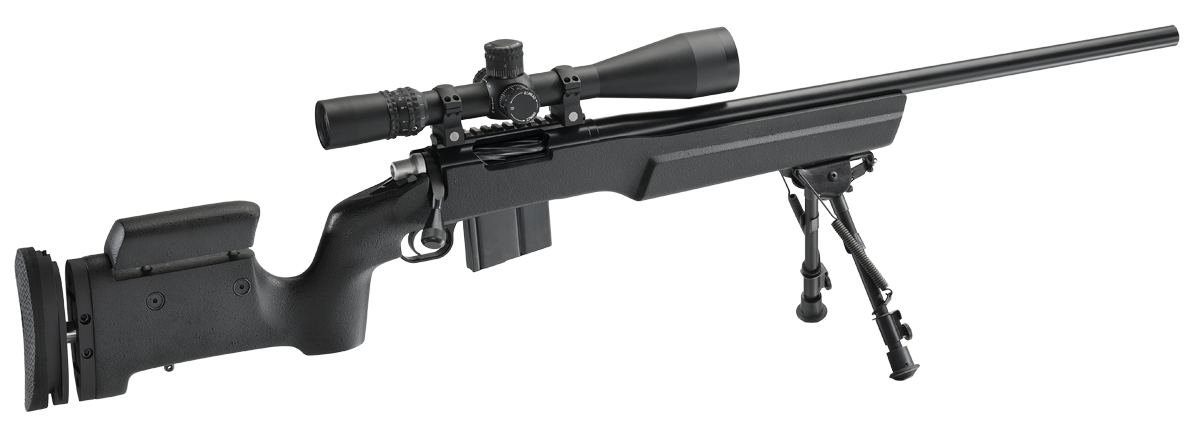
Experienced .308 shooters know that the 168gr Federal Gold Medal match ammunition often performs superbly in both factory and custom .308 Win rifles. We’ve seen this stuff shoot 1 MOA in an FN-FAL and close to half-MOA in a GAP tactical rifle. We won’t make any promises, but the reputation of this ammo speaks for itself. Right now, Champion Shooters Supply has Federal GM308M 168gr factory ammo for just $20.00 per box of 20 rounds. That’s 56% off Champion’s regular price, and way below what this ammo normally costs. Loaded with the 168gr Sierra MK BTHP bullet, this stuff is very high grade ammo at a very attractive price. NOTE: If you want it, order soon. Champion states: “Sale Supply is limited, once we run out we cannot continue this special price.”
Applied Balllistics LLC, run by Bryan Litz, has just released new .308 Winchester Tactical Ammunition. This new ammo employs a brand-new 175gr “Tactical OTM” bullet from Berger Bullets. This new projectile is unique in that it was designed to “fly right” even at transonic and subsonic speeds. The new 175gr bullets are loaded to magazine length (2.800″) in new Lapua brass, so the ammo will fit all popular detachable box magazines in tactical bolt guns and gas guns. Bryan recommends a 1:13″ (or faster) twist barrel.
New Tactical Ammo Has Individually-Weighed Charges and Low ES
Unlike most “factory ammo”, Bryan’s new Tactical Ammo features individually weighed charges. That’s right — the charge for each and every round is weighed before it goes in the case. As a result, the new ammo typically delivers Muzzle Velocity (MV) Standard Deviation (SD) under 10 FPS (for 10 shots). That’s a low number, on a par with quality handloads. Bryan has shot this ammo at 1000 yards through a LaRue OBR AR10-type rifle. The ammo shot under one MOA at 1000 yards. Another benefit of the weighed charges is that this allows the use of high-quality extruded (stick) powders. The stick powders are known to deliver great accuracy while being consistent through a wide temperature range.
Berger’s NEW .30 Caliber 175gr Tactical OTM Bullet
This bullet was designed by Berger Ballistician Bryan Litz specifically to optimize performance of the M118LR class of ammunition. The design objectives were to maximize BC while staying within the 2.800” COAL for magazine feeding, and the requirement for the bullet to remain stable through transonic speeds. All of these design objectives were achieved, according to Bryan. The bullet has a length-tolerant tangent ogive shape, so it is less sensitive to seating depth than secant-ogive bullets.
The BC of this bullet is 7% higher than the 175 grain Sierra MatchKing currently used in most M118LR ammunition, and 2% higher than the Hornady 178 grain option. The average G1 BC of the Berger 175gr Tactical bullet is 0.510 from 3000 to 1500 fps. The G7 BC is 0.259, and is a more accurate representation of this bullets performance over a wide range of speeds. (CLICK HERE to read about G1 vs. G7 BC.)
The Berger 175gr Tactical OTM bullet requires a minimum twist rate of 1:13″ to be stable from the muzzle. Transonic stability was verified from a 20″-barreled LaRue OBR with a 1:11.25″ twist.
Early Tests Show Bullet Shoots Great — Report by Robert Whitley
Robert Whitley got a box of early-run 175gr Tactical bullets. He says they shoot great in his own handloads: “I just received some of the new Berger .30 cal 175gr Tactical OTM (Open Tip Match) bullets. Wow — what great bullets for the .308 Winchester! I did some range testing and these things really shoot! As you can see below, I had a 5-shot group around 0.2″ and, then, shooting prone, I produced a 20-shot group that just tore out the X-Ring.” (NOTE: these targets were shot with Robert’s handloads, not the Applied Ballistics pre-loaded ammo.)
While the words “Open Tip Match” might lead one to believe it has a large open tip, this BTHP bullet actually has a small meplat. Robert suspects that, for this bullet’s potential tactical and military applications, it was felt the words “hollow point” should be avoided in favor of “open tip”.
Bullets Are Positioned Optimally When Loaded at 2.800″ Mag Length
These bullets were also made to be loaded at magazine feeding length in the .308 Winchester (2.800″ OAL). Robert reports: “When loaded at a 2.800″ OAL length, the bullets sit perfectly in the neck of the .308 Winchester, with the full bearing surface of the bullet up in the neck of the case, and the junction of the boat tail and bearing surface of the bullet just forward of the junction of the neck and shoulder of the case.”
If you are going to shoot these bullets and expect them to be supersonic the whole way, a 1:13″ or faster twist is recommended, and if you are going to run them at velocities where they might be subsonic/transonic, Bryan confirmed they’ll work in 1:11.25″ twist barrels. Robert notes that his company, AR-X Enterprises, carries 1:11.25″ twist Bartlein .30 Cal barrels as a regularly-stocked item in both the M24/M40/Rem Tactical contour and the Remington Heavy Varmint/Sendero contour.
Whitley concludes “This is a great offering by Berger Bullets”. While the bullets can be purchased through Berger or Berger’s dealers, the new Applied Ballistics’ loaded ammo should be ordered through Bryan’s website. The price is $40 (plus shipping) for 20 rounds.
CLICK HERE to order through the Applied Ballistics secure shopping cart.
Disclosure: Applied Ballistics LLC advertises Bryan Litz’s Ballisitics Book on this site.
Ruger has just released a new, compact .308 Win bolt-action rifle with iron sights and a front-mounted scope rail. Developed in conjunction with Gunsite instructor Ed Head, the Ruger Gunsite Scout Rifle is based on the Ruger M77 action. Designed for defensive and “tactical” use, the Scout Rifle features a 16.5″ barrel with birdcage flash suppressor (standard 5/8-24 muzzle threads allow muzzle brakes or suppressors to be installed). Rounds are fed via 5-round or 10-round AICS-sized detachable box magazines, with a Mini-14 style mag release forward of the trigger guard. Total rifle weight, without scope, is just 7.0 pounds. MSRP is $995.00 but expect the street price to be closer to $800.00.
Ruger Scout has Iron Sights and Front Picatinny Rail
The Ruger Gunsite Scout Rifle comes from the factory with good iron sights: a protected non-glare post front sight and receiver-mounted, adjustable ghost ring rear sight. A forward-mounted Picatinny rail can hold various optics — such as Burris or Leupold Scout Scopes which allow “both eyes open” sighting and fast target acquisition.
Laminated Stock with Adjustable LOP The Ruger Gunsite Scout Rifle features a gray/black laminate stock with sling swivel studs and checkered grip and forearm. A soft rubber recoil pad, with three 1/2″ spacers, allows length of pull (LOP) to be adjusted.
The rifle’s integrated trigger guard/magazine well is glass-reinforced nylon. “Gunsite Scout Rifle” is engraved on the stock’s grip cap, and the receiver is roll-marked “Ruger Gunsite Scout”. Watch the video below to see the Ruger Scout Rifle in action.
Bane Gives Thumbs-Up
Gun Jounalist Michael Bane has shot the new Ruger Gunsite Scout Rifle and he gives it high marks: “I’ve had the chance to put a lot of rounds through this rifle, both on AR platform-based courses and out to 300 yards, and IT IS SUPERB! My wish list was a gun aimed squarely at the TBD/SURVIVAL market, a gun that would deliver major caliber results for self-defense and then do double duty as an easy-to-carry hunting rifle.” Read More: The Michael Bane Blog.
Enfield No. 5 Jungle Carbine Redux? When we first saw the Ruger Scout Rifle, our first thought was “that looks familiar….” Indeed, in size and intended function, the Scout Rifle is a modern version of the famous Enfield No. 5 Jungle Carbine. “Jungle Carbine” was an informal term used for the Enfield No. 5 Mk I, which was designed for fighting in the Far East and other tropical regions where a shorter, lighter rifle was needed. The No. 5 was about 100 mm shorter and two pounds lighter than the Enfield No. 4 from which it was derived. A number of “lightening cuts” were made to the receiver body, the bolt knob was drilled out, and woodwork was cut down to reduce weight. The Jungle Carbine had other useful features like a flash suppressor and a rubber buttpad to help absorb recoil.
If you found a surplus Jungle Carbine ($270-$500 on Gunbroker.com), fitted it with a forward-mounted scope rail, you could have a nice scout rifle for hundreds of dollars less than the Ruger Gunsite Scout Rifle ($995.00 MSRP). Granted, the Ruger offers an AICS-type detachable box magazine and some other nice features not found on the Enfield*, but the practical concept is the same.
*A reader correctly points out that the Lee Enfield No. 5 magazine is removable. Lee-Enfield magazines did open, permitting rapid unloading of the magazine without having to operate the bolt repeatedly to unload the magazine. However, the rifle was not designed like modern magazine-fed weapons, for which soldiers carry loaded magazines and discard the empties. Soldiers were instructed to leave the magazine in place and feed with stripper clips. Early models of the rifle actually had a chain holding the magazine to the rifle. There were both 5-round and 10-round magazine versions of the Lee-Enfield. Since these magazines could be removed, it is technically correct to say the Lee-Enfield had a detachable box mag. But soldiers using the weapon would not normally swap magazines in and out as with a modern-day mag-fed infantry rifle.
A new web vendor for loaded ammunition has just opened its doors to the online public. BulkAmmo.com launched its new secure web-store earlier this month. To celebrate its grand opening, BulkAmmo.com is offering our readers a special promotion: $25 off their first order over $200. To take advantage of this special offer, use Coupon CODE “GrandOpening” during check-out.
Steven, one of the BulkAmmo.com principals tells us: “We have a lot of inventory available and it’s all ready to ship.” BulkAmmo.com currently stocks major brands including Aguilla, CCI, Federal, Fiocchi, PMC, Remington, Tula, Winchester, and Wolf. You’ll find a wide selection of pistol, rimfire, and centerfire rifle ammo, plus shotgun shells. Brands of .308 Win brass-cased ammo include: Hornady (Interlock), Federal (GMM), and PMC.
Applied Ballistics, run by top Palma shooter Bryan Litz, now offers extremely high-quality loaded match ammunition for .308 Fullbore (Palma) shooters. The new Applied Ballistics “FULLBORE” ammo, priced at $38.00/box, is unlike anything on the market. It features the best available components, with individually-weighed charges. Independent testing shows this ammo offers extremely low ES and SD with accuracy comparable to precision hand-loaded cartridges.
Bryan Litz tells us: “Applied Ballistics’ FULLBORE ammunition is not just another ‘factory ammo’ option. This ammo is loaded specifically for the rifles and chambers commonly used in international-style Palma and Fullbore shooting.” Bryan cited the important qualities which make his FULLBORE ammo unique:
AB FULLBORE is the only .308 Win Ammo with Individually-Weighed Charges.
AB FULLBORE is the only .308 Win Ammo with Berger Bullets AND Lapua Brass.
AB FULLBORE is the only .308 Win Ammo Optimized for Int’l Fullbore Competition.
AB FULLBORE is the only .308 Win Ammo with Independently-Verified Single-Digit SD.
What Makes Applied Ballistics’ FULLBORE Ammo Special
Unlike most factory ammo, AB FULLBORE powder charges are carefully weighed, not metered, which helps to minimize muzzle velocity variation. Velocity averages over 3000 fps from 30″ barrels with Standard Deviation (SD) typically under 10 fps. Components are the best available, according to Bryan: “The ammo is loaded with Berger 155.5 grain bullets and Lapua brass. These are the same components I’ve had success with for years. The brass preparation, loading techniques, and QC steps that I’ve implemented for larger-scale production insure this ammo is good enough to win at the highest levels.”
Applied Ballistics FULLBORE Ammo Already Proven in Competition
Can this pre-loaded FULLBORE ammo really rival handloads in competition? Yes it can, according to Bryan: “I’ve been prototyping and testing ammo this past year and have had very good results. One notable achievement was a 150-15X fired at 900 yards during a coached team match in Lodi, WI during the Midwest Palma Tournament.”
Brian adds: “This ammo is the perfect option for someone who doesn’t enjoy handloading but still wants the accuracy, consistency and performance of handloaded ammunition. It’s also a good option for beginners who haven’t learned how to reload and/or don’t yet have the equipment but want to train and compete with quality ammunition.”
Tierney Tests New FULLBORE Ammo and Rates It Highly
Jerry Tierney, past NBRSA 600-yard and 1000-yard Champion and skilled Palma shooter, has tested the new ammo extensively. In comparison tests with Jerry’s own .308 Win handloads, the Applied Ballistics FULLBORE ammo shot great. Jerry concluded: “The Applied Ballistics 155.5 grain FULLBORE loads matched the best I can do hand loading. They fit the new 2011 fullbore chamber very well. I would not hesitate to use this FULLBORE ammo in any match anywhere.”
Notably, the Applied Ballistics ammo had a lower ES and SD than Jerry’s handloads. One five-shot group of the FULLBORE ammo had an ES of 7 fps and SD of 2 fps — that’s remarkably low. Four groups shot with Tierney’s handloads at 300 yards averaged 0.449 MOA, vs. 0.498 MOA for two groups of the Applied Ballistics ammo, so the accuracy is very close to the best precision handloads.
Coming Next — Applied Ballistics Tactical .308 Win and .338 Lapua Magnum Ammo
Applied Ballistics plans to release more types of high-quality loaded ammo in the months ahead. Bryan reports: “Future plans include a .308 load optimized for tactical applications. This will be a magazine-length round probably with a 175 grain bullet with favorable transonic stability. Eventually I’d like to offer a .338 Lapua Magnum tactical/hunting round loaded with Berger’s 300 grain Hybrid bullet.”
Bryan explains that he is developing .308 Win tactical ammo, because the FULLBORE product is made specifically for Palma work: “The fact that the FULLBORE ammo is optimized for the target application means it’s not necessarily ideal for other uses. For example, the rounds are too long to feed through standard-length magazines so they’re not of much use for tactical shooters. Also the seating depth is optimized for the chambers typically used in custom target rifles so it’s not the best option for factory (SAAMI) chambers.”
To order Applied Ballistics’ .308 Win FULLBORE ammo, visit Bryan’s AppliedBallisticsLLC.com website, which features secure online ordering. Currently, .308 Win FULLBORE ammo is priced at $38.00 per 20-round box (shipping extra).
A “Dream Team” composed of four of America’s top lady shooters set a new national long-range Palma record at the Rocky Mountain Palma Championships at Raton, NM last week. The four-woman squad of Trudie Fay (Captain), Michelle Gallagher, Noma Mayo, and Nancy Tompkins shot brilliantly to establish a new National Palma record of 1796-112X, breaking the existing 1791-102X record held by the USAMU (Praslick) team.
Officially listed as “The U.S. National Team”, but dubbed “Team Estrogen” by one of the gals, this squad of four female High Masters was coached by Steve Conico, a veteran long range shooter from New Mexico. Michelle told us that Coach Conico did a great job calling the wind, and all the team members performed well: “Our strategy was simple: lay down, shoot, let Steve think for everybody. Steve’s a fantastic coach. We all just had a good day. All four trigger-pullers were on top of our game. The combination of good conditions (for Raton), great coaching, and good shooting allowed a memorable team performance. That combination is rare. It’s not going to happen again any time soon.”
SCORES: T. Fay: 448-39X | M. Gallagher: 450-35X | N. Mayo: 449-26X | N. Tompkins: 449-22X
For Michelle, competing in this match with a team of female all-stars (who are all close friends) was a dream come true: “We’ve been planning to have a womens’ team for 10 years and it finally happened. It’s fun getting everyone together. We’re all delighted it worked out so well. And I loved being able to shoot with my mom.” Michelle shot a perfect 450 in the match, not dropping a single point.
Record-Setting Equipment
All four Dream-Teamers were shooting conventional single-shot .308 Winchester Palma rifles — no tube-guns in this arsenal. Nancy Tompkins’ rifle featured a wood stock, Stolle Panda action, and 30″ Krieger barrel. Michelle’s rifle was similarly configured but she used a fiberglass McMillan stock. Nancy and Michelle shot ammo loaded with Hodgdon Varget powder, Wolf (Russian) primers, and the 155.5gr Berger Palma bullet. The other two team members, Noma and Trudie, may have been using Sierra #2156 155gr Palma bullets but that’s not confirmed.
Loading for the 155.5gr Berger Palma Bullet
Michelle observed that the 155.5gr Berger Palma bullet doesn’t require any special tuning: “With the 155.5, it’s pretty easy to swap out any load you’ve used successfully with any of the other 155s. The 155.5 doesn’t require a lot of extra load development. As far as seating depth goes, some people are successful jumping them, some people are successful jammin’ them in. Personally I’ve always soft seated. I haven’t found them to be very finicky.” Editor’s note: “Soft Seating” refers to deliberately loading the bullets long, with fairly light neck tension, and then allowing the bullet to find it’s position as one closes the bolt. The potential benefit is that the bullet ogive is always in the same position relative to the start of the rifling.
Good Conditions Aid Record-Setting Team Performance
During the July 10 team match, the weather gods smiled, providing good conditions (by Raton standards) for the female Dream Team’s record-setting performance. Michelle observed: “Have you ever shot at Raton? It can be the devil. Raton can be really nasty, but it was a pretty benign day by Raton standards. The wind was switchy but not what I’d call ‘blow you off the paper’ wind. We were all able to concentrate on the mechanics — just ‘lay down and squeeze’. Steve did all the work.”
We have a “Palma/Tactical” project gun in the works built with an Eliseo chassis, Borden action, and one of Krieger’s very first 5R barrels. Initial load testing with Hodgdon Varget showed excellent accuracy potential, but we weren’t achieving the velocity we hoped to get from the 30″ medium-Palma-contour barrel. With Lapua brass and Varget we ran short of case capacity when seating bullets to mag-length, and the best accuracy came at about 2860 fps, well under competitive Palma velocities.
Mark LaFevers with .308 Win Eliseo Tubegun on SEB NEO front coaxial rest. Mark made the wood front bag-rider.
Chris Hodgdon kindly shipped us some H4895 and some of the new IMR 8208 XBR powder, lot #1022510-4798. In beautiful 70° conditions yesterday, we did a quick pressure work-up with both powders to determine “practical max” loads with the Berger 155.5gr Fullbore bullets (#30416). The 155.5s were loaded in once-fired Lapua brass with CCI BR2 primers, to a COAL of 2.860″, which is about .010″ short of land contact.
Varget-beating Speeds from Both IMR 8208 XBR and H4895
We loaded up two rounds at each charge weight, starting with the Hodgdon’s recommended starter load for a 155gr Sierra HPBT, as found in Hodgdon’s online Reloading Data Center. (There was no load listed for the 155.5gr Berger). It’s good that we started low because we saw immediately that both the 8208 XBR and the H4895 were yielding much more velocity, grain for grain, than Varget. Though we were not shooting for groups, the 8208 XBR also seemed to have a very large accuracy load window. Moreover, the velocity spreads for each two-round 8208 charge (above 43.0 grains) were remarkably low — none were more than 6 fps, and the velocities on our two 44.0-grain shots were exactly the same — 2992 fps. (This was NOT an error — the chron registered both shots #7 and #8.)
Of course, you can’t conclude much about ES/SD from just two shots, but the speed consistency in the 8208 was notable as you can see from the chart above. By contrast, each pair of H4895 shots varied in speed much more. For example, the two-shot ES for 43.0 grains of H4895 was 14 fps, while the two-shot 8208 XBR spread (for 43.0 grains) was 4 fps. It will be interesting to see if further testing confirms the low ES/SD potential of IMR 8208 XBR in the .308 Winchester.
We dispensed charges with an RCBS ChargeMaster calibrated and leveled on a granite bed. The 8208 XBR has smaller kernels than either Varget or H4895 and, as we expected, 8208 XBR dispensed very easily. The H4895, with longer kernels, dispensed fine in the ChargeMaster, but it took the machine more time to trickle the H4895.
As noted, we didn’t shoot for groups, but the IMR 8208 looked like it would shoot really well at anywhere from 43.0 to 44.0 grains. The H4895 proved accurate as well, at least in the high pressure ranges. We need to do 5-shot testing, over flags, before drawing any real conclusions. But right now we can say that, if you’re shooting a .308 with 150-155 grain bullets, you should definitely try the IMR 8208 XBR. It looks like a near-perfect match for the Palma-class bullets. The velocity is great, it appears the ES will be very low, and 8208 XBR packs more densely than Varget so you won’t have to run compressed loads.
Our most important discovery was that both 8208 XBR and H4895 offered significant velocity gains over Varget, at least in this rifle. It looks like 8208 XBR can run 2990 fps in this gun without pressure issues, while H4895 may top 3000 fps. Varget struggled to get much past 2900 fps.
IMPORTANT WARNING: The stated max load for IMR 8208 XBR with a Sierra 155gr HPBT was 45.3 grains, while the stated max load for H4895 (same bullet) was 46.0 grains. Note that, in this rifle, which has a tight 0.298″ Palma bore, we hit pressure limits well before reaching Hodgdon’s “book max.” Read that again carefully folks. Our 44.0 grain “practical max” for 8208 XBR was a FULL GRAIN less than the stated max load with a Sierra 155-grainer. Likewise we started getting stiff bolt lift at 44.3 grains of H4895 — a long way from the 46.0 grain stated max. So, the combination of a different bullet, and a tighter-than-normal bore made a significant difference in pressures. This is why, if you change ANY component in a load recipe you MUST start low for safety. And never assume that a factory “Max Load” is safe or “conservative”.
Hornady has started shipping its new .308 Winchester Superformance™ match ammo. Loaded with a high-BC 178gr BTHP, the new ammo, which employs a proprietary blend of propellants (some of which are NOT commercially available), has shown outstanding velocities. One shooter reported 2820 fps from a 26″ barrel, while Hornady claims 2775 fps from a SAAMI-spec 24” test barrel. Hornady says this .308 match load is approximately 175 fps faster than any comparable factory .308 load.
New Projectile Developed for this Match Ammo
With a 0.530 BC bullet moving around 2800 fps, the new Superformance™ ammo offers impressive ballistic performance — better than many reloaders may be able to achieve with their handloads. Accuracy has been very good also, according to Hornady Engineer, Joe Thielen, due in no small part to bullet design: “The new 178 grain BTHP Match bullet was purpose-built, and optimized specifically for the .308 Winchester chamber. It features an aggressive ogive as well as an extremely efficient boat tail that makes this projectile highly effective aerodynamically, [with] less wind drift and … flatter trajectories. Accuracy results were excellent. We shot a .680″ group at 200 yards with our test equipment, and field tests out to 1250 yards yielded 8″ groups (8 inches at 1250 yards is 0.611 MOA).”
The 178gr Superformance .308 ammunition should stay supersonic to approximately 1,275 yards. That’s a lot farther than any other factory .308 load for 175-180gr bullets. The ability to stay supersonic well past 1000 yards is a boone to long-range .308 shooters.
Here is how Hornady has achieved high velocities with its new Superformance ammunition:
1) Superformance ammo uses advanced new Ball Powders (not yet for sale).
2) The powders are BLENDED, with different “recipes” for different cartridges.
3) The new powders maintain high-energy longer in barrel (like Reloder 17).
4) The new powders burn almost completely, reducing ejecta, for less exit pressure, and less felt recoil.
5) Superformance ball propellants pack very densely, so more grains of powder can fit inside a case, compared to typical extruded stick powders.
Can Reloaders Replicate the Superformance .308 Match Ammo?
Forum members have asked: “How can we duplicate the Superformance ammo with our handloads?” Unfortunately, this will not be an easy task. The Superformance line of loaded ammo uses special blends of propellants customized for each cartridge/bullet combination. Hornady spent a lot of time and effort “tweaking” the blends to achieve maximum velocities. In addition, Hornady “commissioned” some new propellants expressly for the Superformance ammo. Therefore there’s no easy way to replicate Superformance loads with a single, off-the-shelf powder, and we caution strongly against “blending your own”. REPEAT: do NOT attempt to blend commercial powders to try to replicate Superformance velocities with your handloads.
At the Media Day rifle venues, “Tactical” rifles were definitely the featured attraction. There were, of course, many AR-based black rifle offerings, but the purpose-built, precision bolt guns really were the stars of Media Day this year. Savage has a new .338 Lapua Magnum, its first ever. SAKO unveiled an impressive new .338 TRG with front rails and a very sophisticated folding stock (more on that later). Barrett had some thundering big boomers on display. You could feel the compression from the muzzle blast on the new .416 Barrett a dozen feet away. JP Enterprises had its handsome new MOR-07 on display. This features an aluminum chassis with either tubular or square 2×4-style fore-arm, plus a buttstock that looks like the Magpul AR stock. JP’s new MOR (Manually Operated Rifle) is offered either as a chassis to fit Rem footprint receivers, or as a $4499.00 complete rifle.
Though there were many impressive domestic tactical bolt guns, one of the nicest overall designs, in this Editor’s opinion, came from Austria’s Steyr Arms. The new Steyr SSG 08, shown below, features an advanced folding stock that is solid in the locked position while offering full adjustability of comb height and length of pull. The pistol grip was one of the most comfortable I’ve tried. The SSG 08 features a unique, 3-position triggersafety. In the “full safe” position, a positive pop-up selector locks the safety in place and actually blocks the firing pin. The detachable box magazine can be secured in two positions. In the first, the magazine is fully retained in the gun but you can cycle the bolt without picking up or extracting a round.
While the SSG 08 had all the tactical bells and whistles (such as forearm rails and 10-round magazine), it was the overall execution and competence of the weapon that impressed me. The design was well thought out — there were no “rough edges”, and everything, from the buttstock hinge to the mag release, functioned smoothly (and quietly). What separated the SSG 08 from most of the competition was the quality of the trigger. Many of the tactical rifles had very, very heavy trigger pulls with lots of over-travel. The Steyr SSG 08’s trigger was crisp and light. Shooting this gun was a pleasure. One noticed the attention to detail in every element of the rifle. We are told that Steyr received input from Austria’s Special Forces on this rifle. We aren’t surprised. With the SSG 08, one can see that real marksmen were involved in the design.
Les Baer Custom (LBC) is a highly respected maker of “semi-custom” 1911 pistols and AR platform rifles. Now Baer moves into the precision bolt-action rifle market with impressive new offerings for 2010. Baer will sell two different bolt-guns, each fitted with a Stiller custom action and a cut-rifled barrel made in-house by LBC. Available chamberings (for both models) are .243 Win, .260 Rem, or .308 Win (later this year LCB will release a .338 Lapua). Remarkably, Baer guarantees these new guns can deliver half-MOA 10-shot groups with match grade ammo.
The new Les Baer Custom bolt-action rifles all feature a Stiller Tac 30 action with Picatinny rail, Wyatt precision floor plate with Wyatt detachable box magazine (DBM), along with a “match grade” 24″ cut-rifled, 5-groove LBC barrel. A Timney match trigger with 2.5-lb pull is fitted, and both action and barrel are coated in a matte-black Dupont S finish.
Two different Bell & Carlson composite stock designs are offered. The LBC Tactical Recon Bolt Action Rifle features a tactical-style stock, similar in appearance to the SAKO TRG stock. It has a vertical pistol grip, undercut toe, plus an adjustable cheekpiece and adjustable buttplate. MSRP for the “Tactical Recon” model is $3560.00.
If you want a lighter rifle with a more conventional stock, the LBC Tactical Varmint Classic features a varmint-style composite stock with a narrower fore-arm, “standard” wrist-grip shape, and a straight comb. There is a small hook in the underside of the buttstock. Like the “Tactical Recon” model, the “Tactical Varmint” features a Stiller action, Wyatt bottom metal/magazine, and 24″ cut-rifled barrel. MSRP for the “Tactical Varmint” is $3410.00.
New Les Baer Bolt-Guns have 10-shot Half-MOA Guarantee
We talked with Les Baer yesterday, and he told us that the prototype Baer tactical rifles have show outstanding accuracy during testing, producing some 1/2″ groups at TWO hundred yards. Accordingly, Baer is offering one of the best guarantees in the business. Both LBC tactical bolt-guns “are guaranteed to shoot 10-shot groups under 1/2 MOA with match grade ammo.”
The new LBC rifles will debut next week at SHOT Show in Las Vegas. We hope to get our hands on one for field testing. It will be interesting to see if the rifles can really put 10 shots inside one-half inch (center to center) at 100 yards.


 Experienced .308 shooters know that the 168gr Federal Gold Medal match ammunition often performs superbly in both factory and custom .308 Win rifles. We’ve seen this stuff shoot 1 MOA in an FN-FAL and close to half-MOA in a GAP tactical rifle. We won’t make any promises, but the reputation of this ammo speaks for itself. Right now, Champion Shooters Supply has Federal GM308M 168gr factory ammo for just $20.00 per box of 20 rounds. That’s 56% off Champion’s regular price, and way below what this ammo normally costs. Loaded with the 168gr Sierra MK BTHP bullet, this stuff is very high grade ammo at a very attractive price. NOTE: If you want it, order soon. Champion states: “Sale Supply is limited, once we run out we cannot continue this special price.”


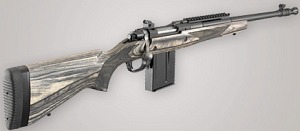 The Ruger Gunsite Scout Rifle features a gray/black laminate stock with sling swivel studs and checkered grip and forearm. A soft rubber recoil pad, with three 1/2″ spacers, allows length of pull (LOP) to be adjusted.
 When we first saw the Ruger Scout Rifle, our first thought was “that looks familiar….” Indeed, in size and intended function, the Scout Rifle is a modern version of the famous Enfield No. 5 Jungle Carbine. “Jungle Carbine” was an informal term used for the Enfield No. 5 Mk I, which was designed for fighting in the Far East and other tropical regions where a shorter, lighter rifle was needed. The No. 5 was about 100 mm shorter and two pounds lighter than the Enfield No. 4 from which it was derived. A number of “lightening cuts” were made to the receiver body, the bolt knob was drilled out, and woodwork was cut down to reduce weight. The Jungle Carbine had other useful features like a flash suppressor and a rubber buttpad to help absorb recoil.


 Record-Setting Equipment