At the request of our readers, we provide select “Deals of the Week”. Every Sunday afternoon or Monday morning we offer our Best Bargain selections. Here are some of the best deals on firearms, hardware, reloading components, optics, and shooting accessories. Be aware that sale prices are subject to change, and once clearance inventory is sold, it’s gone for good. You snooze you lose.
1. Walmart — 80th Anniversary Red Ryder BB Gun, $24.47
Who can forget the 1983 movie “The Christmas Story” which focused on young Ralphie Parker’s overwhelming desire for a Red Ryder BB gun. The year 2020 marks the 80th year in production for Daisy’s classic Red Ryder BB gun. And now it is available in an 80th Anniversary Special Edition for just $24.47 at Walmart. If you want one of these for a young shooter in the family, act soon — these are selling fast.
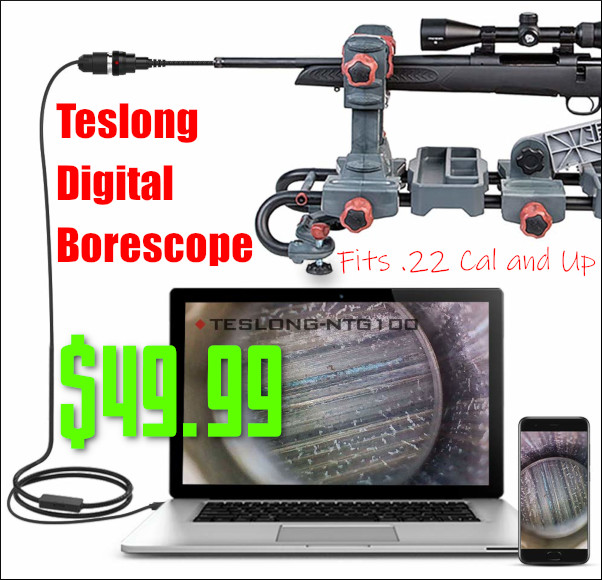
2. Amazon — Teslong Borescope $49.99 or NEW $74.99 WiFi Version (iOS Apple, Android, and Windows Capable)
Video Review of Teslong WiFi Version:
The impressive Teslong digital borescope has been a huge success. This compact, electro-optical, cable-type borescope outputs sharp, high-resolution images and VIDEO to desktop computers, laptops, as well as Android tablets and smartphones. Check out our Full Teslong Review complete with inside-the-barrel videos. NOTE: There is a NEW WiFi Version that works with Apple iPhones and iPads, as well as all other WiFi devices and tablets. Get the Wifi Teslong for $74.99.
3. Midsouth Shooters — Berger Bullets 10% Off Sale
Berger Bullets are proven winners for all forms of centerfire rifle competition and Berger hunting projectiles are also excellent. Now you can save on high-quality Berger bullets through the end of this December. Visit Midsouth Shooters this month to get 10% Off All Berger Bullets in stock. This sale covers both competition and hunting bullets.
The Ruger Precision Rifle (RPR) is hard to beat for the price among entry-level chassis rifles. And here is one of the best prices for an RPR that we’ve ever seen. If you’re in the market for an RPR, grab this .308 Win RPR for a just $783.82. If you’re looking for a 6mm version, check out this Ruger Precision Rifle in 6mm Creedmoor for $995.99.
5. Tractor Supply — Cannon 40-Gun Safe $649.99
The Cannon TS5934 40-Gun Safe, has a large 19.1-cubic foot capacity with an impressive 45-minute fire rating. This beefy 497-lb safe features 8 locking bolts and TRUlock internal hinges. This safe includes a door organizer kit and attractive interior upholstery, adjustable shelving, and a chrome 5-spoke handle. This is a great value at $649.99. On the outside, the safe is 59″ high and 34″ inches wide.
6. EuroOptic.com — HUGE Nikon Scope Close-Out Sale
EuroOptic.com is running a huge close-out sale on quality Nikon riflescopes. This sale includes the excellent Black FX1000 (FFP), and Black X1000 (SFP) tactical scopes, plus the M-Tactical and P-Tactical series optics. If you are looking for a great tactical or hunting scope at a crazy low price, head over to EuroOptic this week. For example the 4-16x50mm FX1000 MRAD is marked down from $749.95 to just $369.95, a 50% savings! And the 2-7x32mm P-Tactical and M-Tactical series scopes are just $99.95! Nikon scope mounts are also discounted.
7. Amazon — RCBS Explorer Plus Reloading Kit, $373.99
Here’s a great Reloading Kit for someone getting started in reloading, or for folks who need a compact secondary press plus accessories. Right now you can get the RCBS Plus Reloading Kit for just $373.99 on Amazon.
8. Midsouth Shooters — Lyman Case Prep Center, $114.99
Case prep is key to consistent accuracy, so a powered prep center is a good investment. Midsouth Shooters now has the 5-station Lyman Case Prep Center for $114.99 on SALE. With this Case Prep Center you can save time, and reduce repetitive hand fatigue dramatically. This is a real bargain — this unit sells for up to $150.00 elsewhere.
9. Midsouth — Frankford Arsenal Perfect Primer Seater, $56.99
As part of its Christmas Sale, Midsouth has the Frankford Perfect Primer Seater Tool for $56.99 (21% Off). This is a GREAT primer seating tool. It has good feel, plenty of leverage, and the primer feed-from-tray works well. Importantly, it has a click-adjust wheel for precise primer seating depth control. Read our Frankford Primer Seating Tool Product Review by gunsmith Jim See. The tool comes complete with 12 precision shell holders.
10. Midsouth — Tipton 13-Piece Jag Kit, $11.99
The 13-piece Tipton Brass Jag Kit includes jags sized to fit all popular calibers from .17 to .45. Priced at just $11.99 at Midsouth, this handy Jag Kit is a perfect stocking stuffer for shooters in the family.
11. Amazon — Samsung 10.1″ Tablet plus 64GB card, $156.32
Need a budget-priced tablet for your TargetCam, Ballistics Apps, and Endoscope? Check out this Samsung 10.1″ Tablet Computer. It’s just $157.64 complete with 80GB of Ram (16GB onboard plus 64GB on MicroSD card). Or, if you don’t need the extra RAM, get the same tablet with 16GB onboard for $147.99. These are 2019 production tablets with modern Android OS.
Here’s a great “stocking stuffer” gift for your wife or girlfriend who enjoys shooting. For just $4.99 you can get a combo set of “high-fashion” ear muffs and ANSI-rated safety glasses. The comfortable, zebra-print muffs provide 21 dB of noise reduction. The stylish, tortoise-shell pattern Bella Ballistica™ shooting eyewear has passed MIL-PRF-31013 ballistic tests and meets ANSI Z87+ high-velocity requirements with a chic designer appearance. The lady in your life just might appreciate the stylish eyewear and distinctive muffs, earning you “bonus points”. And she’ll never suspect you only spent five bucks!
Emil Kovan is one of the top F-Class shooters in the world. He won the 2014 United States F-Open Championship, and finished second in F-Open Division at the 2016 Canadian National F-Class Championship in Ontario. He is a great shooter and a great gun-builder as well.
“What are the best components for an F-Open class rifle, and why?” That’s a question that I get asked all the time and will try to answer in this article. Two months ago, I was contacted by Duane, a gentleman I met at the 2015 F-Class Nationals. He was interested in building a rifle with the new Master Class Low Profile F-Open Stock, created by Carl Bernosky and Alex Sitman of Master Class Stocks.
I have known Alex Sitman for many years, and use his stocks exclusively, but was not very familiar with his new Low Profile F-Open stock. After a brief conversation with Alex, I placed an order, and had the stock inletted and bedded at my shop in a month. My first impression was “Wow that’s a long stock” — the forearm is significantly longer than on the original Master Class F-Class prone stock. I bolted the barreled action in, and squeezed the end of the forearm and barrel together, the stock flexed a little bit, but not as much as other designs that I have tested. I think that’s due to having “more meat” in the receiver area. The full stock depth continues farther forward that on some other “low profile” designs. That makes the stock stiffer in the vertical plane, reducing the hinging effect forward of the action. The stock was finished in gloss black per the customer’s request. Interestingly, I found that the multiple layers of paint and clearcoat stiffened the stock up quite a bit.
CLICK IMAGE below for full-screen version
Low Center of Gravity Tames Torque
Compared to the original Master Class F-Open stock, the barrel sits about an inch lower. Lower center of gravity equals less torque, and that is very important when shooting heavy bullets in fast twist barrels. Another significant improvement is that the toe of the stock is flat and parallel to the forearm. I added a 3/4″ track rail in the rear, and milled the underside of the fore-end to create two parallel “rails” in the front to help the stock track better.
One of the biggest reasons why I like Master Class stocks, is the pistol grip. I don’t shoot “free recoil” and a comfortable pistol grip is super important to me when selecting a stock. The new Master Class Low Profile stock shares the same grip as the old model. This allows the stock to accommodate either a “hard hold” style or a more free-recoil style of shooting — whatever the rifle’s owner prefers. This design versatility is one reason I recommend Master Class stocks. Shooters may experiment with either shooting style to find what suits them best.
Cartridge Choice — A 40° .284 Win Improved
Duane decided to have the barrel chambered for my 284 KMR IMP (Improved) wildcat. What is .284 KMR IMP and why choose it over the straight .284 Winchester? Improved by definition means “made better”, I took a great cartridge, and modified it to increase capacity, reduce pressure, and increase brass life.
There are many “improved” variants of the original .284 Winchester: 7mm Walker, .284 Shehane, .284 Ackley and so on. My version, the 284 KMR IMP, shares the .010″ blown-out sidewalls of the .284 Shehane, but I have further increased the case capacity by changing the shoulder angle from 35 to 40 degrees. The 284 KMR IMP allows you to almost match magnum cartridge velocity in a standard-bolt-face action. If you want to run 180gr-class 7mm bullets over 2900 FPS, it is cheaper and more convenient to have a barrel chambered in 284 KMR IMP than to spend $650 for a magnum bolt.
Tuning Loads for the .284 Win Improved Cartridges
The 284 KMR IMP seems to have two nodes, one around 2820 fps and other at 2940 fps. My match load clocks at 2935 fps with single-digit ES. Note –I selected that load based on accuracy, NOT raw speed. A lot of novice (or hard-headed) shooters make the mistake to push their cartridges to the max, and disregard more accurate loads at lower velocity.
The sport of F-Class is rapidly growing, and the equipment used is improving constantly. I remember that only few years ago, an F-Open rifle that could shoot sub-one-inch of vertical at 300 yards was considered competitive. Now, we are pursuing sub-one-inch vertical at 600 yards! It takes a great rifle to approach that goal, but it is also up to the shooter to learn and experiment as much as possible in order to achieve success.
Dies for an Improved .284 Win Cartridge
One of the biggest challenges in campaigning a wildcat cartridge has been obtaining great dies. When searching for custom dies, it almost seems like that the odds are stacked against us. The most common problem is wait-time — custom die orders can take months to be completed. Also, most custom die makers want you to send them two or three cases, each fire-formed three times. I find that funny because if could somehow properly size the cases for three fire-forming cycles, I would not need a sizing die.
Custom-made dies should size the case just right, but sometimes the die’s internal dimensions are slightly off, and this leads to problem number two: dies sizing too much (or even worse) too little. I had a one “custom” die that would not size the bottom of the case enough. This made the extraction of fired cases very difficult. I feel that the best option (if available) for shooters interested in wildcat chambers is to have their gunsmiths make the dies. I offer that die-making service in addition to barrel chambering.
BAT Machine “M” Action
Duane decided to use a BAT M action for this rifle, and I think that he could not have made a better choice. We are blessed with many good match-quality receivers: Barnard, BAT, Borden, Kelbly, Nesika, and Stiller just to mention a few. These are all very well-made and suitable for F-Class. Among BAT Machine Co.actions, I like BAT models M, MB, and 3LL best. I prefer these because because of their size (large bedding footprint) smoothness, timing, options available, and last but not least visual appearance.
Trigger: I recommend and use Jewell triggers. Other good options are: Kelbly, CG Jackson (good 2-Stage) Anschutz (best 2-Stage for Bat and Kelbly actions), Bix’N Andy, and David Tubb.
Barrel: Duane made another good choice here. He decided to go with a Brux 1:8.5″-twist, 4-groove cut-rifled barrel. If you look at the F-Class and Long Range benchrest equipment lists, you will see that cut-rifled barrels are currently dominating. Many records have been shot with both button-rifled, and cut-rifled barrels. I have shot both, and prefer cut-rifled barrels. I am not saying that button-rifled barrels are not capable of shooting as well as cut-rifled barrels, but on average, in my experience, four out of five cut-rifled barrels (from top makers) will shoot well, vs. three out of five buttoned barrels. YMMV, but this is what I’ve observed.
Scope: Duane’s rifle was fitted with a Nightforce 15-55x52mm Competition scope with DDR-2 reticle. This optic is ultra clear, reasonably lightweight (28 oz.), super reliable, and has 1/8 MOA clicks — what you want for long range F-Class competition. In this 15-55X NF model, I like the DDR-2 reticle best, because fine cross hairs (FCH) are hard to see in heavy mirage. The DDR-2 has a heavier horizontal line, with a center dot. March scopes are also very popular and very well-made.
Thanks for reading, and keep ‘em in the middle…
Emil Kovan Competition History:
– 2014 F-Class Open National Champion
– 2016 F-Class Open Canadian Championship, Silver Medal (tied for first on score)
– 2015 F-Class Open National Championship, Silver Medal
– F-Class Open National Championship Teams, 2015, 2014, 2013, Shooting Team Member
– Over 15 wins in Regional and State Championships in Palma, F-TR, F-Open
Our friend Dennis Santiago is a talented Service Rifle shooter, who normally competes with an AR shooting the .223 Rem cartridge. Recently he decided to go over to the “dark side”, putting together a Palma (fullbore) rifle chambered for the .308 Winchester. Dennis selected a Competition Machine (Gary Eliseo) R1 Chassis for the project. Here’s Santiago’s account of his “true blue” Palma build…
Palma Rifle Report by Dennis Santiago
“Here’s my new project — a .308 Win Palma rifle with an Eliseo R1 chassis, Rem 700 action (blue-printed with PT&G upgrades), Jewell trigger, Boots Obermeyer 1:11″-twist barrel, and Phoenix sights holding Gehmann apertures. Next comes chassis and sling set-up, initial mechanical zeroing, and load development. Yup, I have a bunch of Peterson small primer .308 brass, Sierra #2156 155gr MKs, and Varget to get started with. I’m told I can drive 155gr pills to stay supersonic to 1K. Should make for an interesting 2020. My goal is to be cozy with this blue beast by the time the Berger Southwest Nationals kick off in February 2020. Hey, you gotta have goals!”
CLICK Imagefor full-screen photo with more detail.
Pinning the Picatinny — For a Super-Solid Mount
One of the key parts of the build, Dennis explains, is mounting the top rail with pins: “Once the rail is aligned using a spin-centered optic, it locks down with three 3/16″ roll pins. That way there is no reliance on screws that can come loose. Above is a photo of the top of the Eliseo tube chassis showing the three, 3/16″ roll pins that unitize the Picatinny rail. You can also see the four brass screws that just kiss the action to fully stabilize it in the tube. The recoil ring buttresses completely around the action with metal to metal contact. There are a million details hidden inside a Gary gun.”
Phoenix Sights Front and Rear
Rise of the Phoenix — Here are the sights for the Eliseo R1. There are very few manufacturers left making these kinds of ultra-precise and repeatable iron sights.
These Ray-Vin tools help set mechanical zero on the sights. Dennis notes: “Finally a reason to pull out the Ray-Vin calibration paraphernalia to set up a mechanical zero. This photo is for all of you who still remember that those barrel flats and screws in our sight towers actually had a purpose once upon a time.”
Sling ‘N Irons — Classic Palma Configuration Dennis plans to use an Eric Hollis sling with his new blue Palma rifle.
Peterson Small Primer .308 Win Brass for Santiago’s Rig
Dennis plans to use Peterson Cartridge Small Rifle primer .308 Win brass. Peterson offers a “Select” version weight-sorted and length-sorted at the factory. All Select casings (in a 50ct box) are guaranteed to be within 1 grain in weight and .001″ in OAL. Peterson Select brass is available for 20 different cartridge types, including .308 Win both small primer/small flash hole and large primer/large flash hole.
Getting the Blue Rifle Ready for the 2020 Berger SW Nationals
Dennis plans to campaign his rifle at the 2020 Berger Southwest Nationals (SWN). He may shoot iron sights, or fit a scope and shoot in the “Any Sights” category. That’s not yet decided. The week-long Berger SWN is the biggest rifle match in the Western United States. Hundreds of shooters compete in both individual and team events. The SWN begins with the Mid-Range Nationals at 600 yards. Then the Long-Range matches are held, with targets out to 1000 yards. Watch the video to see the Ben Avery facility, home of the Berger SWN:
Chassis-maker Gary Elesio at the 2017 Berger SW Nationals. Gary shoots what he sells:
This .308 Win was purpose-built for PRS/NRL tactical competition. With all the focus on the 6.5 Creedmoor, 6mm Creedmoor, and smaller 6mm cartridges, it’s easy to forget that the PRS has a Tactical Division limited to .223 Rem and .308 Winchester. This gun was built by Jim See of Elite Accuracy LLC to compete in that class, which also has a .308 bullet-weight limit of 178 grains, and a velocity limit of 2800 fps.
With those restrictions, this is truly a Tactical Tack-Driver, as you can see from those 100-yard targets in the photo above. This gun seems to shot great with everything Jim has tried. He started the season with Sierra 168gr Tipped MatchKings. Later he switched to 168gr Berger Hybrids. For both bullet types he uses Varget powder, CCI 200 primers, and Lapua large primer .308 Win brass. His current match load runs about 2765 FPS, with impressive 5-7 FPS standard deviation. The gun hammers — even at very long range. Jim told us: “That soda bottle was shot at one mile with a 168gr Berger Hybrid on top of Varget.” Jim says the 1:9″ twist rate helps deliver a “clean sub-sonic transition” at that distance.
With its heavy-contour barrel, the gun weighs in at a hefty 22 pounds, including optics and bipod. If you like this rig, Jim See can build you one just like it, or with the chambering of your choice. Visit EliteAccuracy.com to learn more about Jim’s gunsmithing services.
This rig features a RBRP Impact Precision 737 Action which was designed specifically for PRS-type tactical applications. This action features an integral lug, and built-in +20 MOA Picatinny rail. Both receiver and bolt are black-nitrided for slickness and durability. Jim loves the action: “It is really slick operating. It functions really well and doesn’t get gummed up with dirt or grit, so it has caught on for the PRS/NRL game. This action has won a major share of 2-day PRS matches this past season.”
Barrel Is a Resurrected .300 WSM
This rifle has one “resurrected” component — the barrel. The 1.25″ straight-contour, 1:9″-twist Brux was originally chambered as a .300 WSM finished at 30 inches. As acquired from Pat Scully, the barrel had 1200 WSM rounds through it. See then re-chambered the Brux as a .308 Winchester, finished it at 25 inches, and attached a 4-baffle side-discharge muzzle brake. Jim says the brake really helps control muzzle lift.
Jim See .308 Win Tactical Rifle Specifications:
Action: Impact Precision 737R
Action Finish: Black Nitride (bolt + body)
Barrel: Brux 1:9″ twist, 25″ finished
Chambering: .308 Win, PT&G Std. Match Reamer
Muzzle Brake: Custom 4 baffle, side discharge
Trigger: Trigger-Tech Diamond, straight shoe
Magazine: Accuracy International
Scope: Vortex Razor HD Gen II, 4.5-27x56mm FFP EBR reticle
Scope Base: Integral +20 MOA rail
Stock: J. Allen Enterprises (JAE) chassis
Front Rail: JAE Swiss ARCA rail
(extends bipod mount 2″ forward)
Bipod: Atlas PSR
Running the Rifle in Competition
Jim says this rifle performed well right out of the gate: “For about three years I wanted to shoot Tactical division and in 2018 it happened to work out. I decided it was a good year to test the .308 Win waters and see how the .308 could stack up competitively against the Open Class rifles.
I dug around the shop and found an 11-twist 30″ M-24 from an old F-class rifle and chopped it down to 23″ and fit it to an Impact action. [EDITOR: This barrel was later replaced with the 1:9″ Brux finished at 25 inches.] I had not received my 168gr Berger Hybrids yet so I ran the Sierra 168gr Tipped MatchKings in the first couple matches of the season. Those SMKs were used for the target and chrono pictures here.
The first spring match was ‘The Battle for Breakneck’ in Nebraska. This is a true field match with mostly prone stages with a few natural rock barricades thrown in for positional shooting. The yardages went out to a little over 1400 yards. I went in feeling good and shot very well in the windy conditions, hitting targets out to 1350 yards. I finished with a score of around 105 out of 135 points. The Open Class winner shot a 117 score I believe. I ended up being First-Place Tactical and 16th overall in a field of 100 shooters.”
Consistency and Preparation — Keys to Success in PRS/NRL Competition
Through his Elite Accuracy LLC company, Jim offers skills training for tactical shooters. When we asked Jim if he had any advice for PRS/NRL competitors, Jim replied: “Consistency is what will continually put you at the top of a match. In addition, your gear needs to be prepared (100% sorted out) and your mind needs to be prepared and ready. Don’t let your mind get in your own way. Mental preparation and confidence will be key to success.”
Competitor Warren Dean has employed a hex-end barrel to permit rapid barrel changes on his F-Class rig. Warren wrote: “I have been running what is commonly known as a switch barrel on my F-T/R rifle. Basically it allows for removal and reinstallation of the barrel with basic hand tools and with no, or very minimal, shift in zero. The two gunsmiths that I trust, Larry Racine and John Whidden, both told me that the switch barrel system would return to a very close zero with no problems. [This system] can be a great benefit to the traveling shooter and a money-saver for the shooter wanting to shoot different calibers on the same chassis.” READ Dean Switch-Barrel Report.
Larry Racine Barrel Sytem
Larry Racine is a respected gunsmith based in New Hampshire. He is also a two-time member of the U.S. Palma Team, and a five-time New Hampshire State Highpower rifle champion. Larry, who runs LPR Gunsmithing, has developed a brilliantly simple means of switching rifle barrels with an ordinary spanner or open-end wrench. With this set-up you can switch barrels in the field in seconds without the need for a barrel vise.
For most barrels, Larry mills a hex with six flats on the end of the barrel. This allows a shooter to change barrels quickly at home or on the line with a simple box-head wrench or a socket wrench. Larry says: “You don’t even have to take the barreled action out of the gun. Just set the buttstock on the ground, between your feet, put a wrench on it, hit it with the palm of your hand — and off comes the barrel.” For barrels fitted with a muzzle brake, Larry has a slightly different system. He mills two flats behind the brake so you can use an open-end wrench to do the job.
With either a hex on the end, or two flats for a brake-equipped rifle, the system works with any medium- to heavy-contour barrel with a muzzle-diameter of at least 0.700″. This will even work for high-power rigs using clamp-on sights or bloop tubes. Larry explains: “A lot of us here in New England use clamp-on front sights. The barrel will be turned to 0.750 for the sight, with the hex on the end. A bloop tube can go right over the end, no problem.”
Larry has used this system over the past few years to win a number of matches. In one 600-yard 3 by 20 prone match, Larry used three different barrels, with three different chamberings, on the same Savage rifle. Larry changed the barrels on the line.
Larry was able to do this because the system has little to no loss of zero from one installation of a given barrel to the next installation of that barrel. This lets the shooter start the match with confidence that the first sighter will be on paper. Larry reports that the simple system works great: “To date we have used this system on Savage, Remington, Winchester, RPA, and Nesika actions.”
Varminters Take Note — This Is Great in the Field
If you are a varminter shooting hundreds of rounds in a day, consider this system. We know some guys who bring 3 or 4 rifles into the field because their barrels get hot during long days of prarie dog hunting. With this smart system, you can easily swap barrels in a couple minutes. And no special equipment or barrel vises are required.
Modifying Barrels is Affordable
Racine’s system for rapid barrel removal/changing is very affordable. If Larry does the chamber work on your barrel he charges $45.00 extra to mill a hex or two flats on your barrel. The customer chooses the configuration.
If you only want the hex or flats done, Larry may charge a higher fee — call for current rates. Note this can also work for barrels with muzzle brakes or threads for suppressors. For more info, visit LPRGunsmith.com or call Larry at (603) 357-0055.
Peterson now offers 6mm Creedmoor, 6.5 Creedmoor, .308 Win, and .300 Norma Mag loaded ammo.
Peterson Cartridge, a leading USA-based cartridge brass maker, is expanding its product line. Peterson recently announced that it will produce loaded ammunition. This new Peterson Precision Ammunition, of course, features Peterson brass, along with bullets from Berger, Hornady, and Sierra. There will be four (4) ammo types initially: 6mm Creedmoor, 6.5 Creedmoor, .308 Win Match, and .300 Norma Mag. (NOTE: We’ve also seen a photo labeled “7mm” so perhaps a .284 Win is on its way, or maybe a 7mm SAUM?)
The ammo is reasonably priced. For example, the 6.5 Creedmoor ammo costs $35.00 for 20 cartridges, or $1.75 per round. Here are the product specs for the four cartridge types currently offered. You can access Full DROP CHARTS by clicking each photo below.
This ammo is all assembled in the USA, using Peterson brass and American components: “The entire manufacturing process, from creating the brass to loading the full rounds of precision ammunition takes place in our manufacturing facility located in Warrendale, Pennsylvania. Peterson Cartridge is dedicated to producing the best American-Made ammunition possible.”
Peterson Cartridge
761 Commonwealth Drive, Suite 201
Warrendale, PA 15086
Phone: (724) 940-7552
Email: info@petersoncartridge.com
Peterson ammo tip from EdLongrange. We welcome reader submissions.
Do you shoot a Springfield M1A rifle chambered for the .308 Win/7.62×51? Or maybe you have a rugged, semi-auto FN-FAL in 7.62×51 NATO? Are you looking for very strong, durable brass you can shoot in these semi-auto battle rifles, without breaking the bank?
Photo of 2009 M1A Match at Camp Perry. Shooter is Nick Till, 2007 Service Rifle Champion.
Semi-autos such as the M1A are tough on brass. You want brass that isn’t too costly, but at the same time is very strong and durable. For decades, USA-made Lake City brass have been a solid choice for 7.62×51 semis, and now you can get quality, unfired 7.62×51 Lake City brass for just $49.99 for 250 cases at Midsouth. That’s just $0.20 (twenty cents) per case! That’s a fourth what you’ll pay for premium, virgin .308 Winchester brass. These cases are never-fired brass, with CCI #34 primers seated in crimped, military-style primer pockets.
This 7.62×51 Lake City brass comes from disassembled “pull-down” ammunition. It has NOT been fired, but it has been previously assembled. So, there may be some cosmetic issues with the brass. Note that these are primed cases. If you choose to neck-size or FL-size the brass before loading for the first time, REMOVE the decapping rod in your sizing die. This brass has LIVE PRIMERS!! Do NOT use a die with a decapping rod for the first loading of this brass. Got that guys? This is important!!
We have shot FN-FAL-type rifles built on DS Arms semi-auto lowers with European uppers. Those beasts were tough on brass, so we relied on Lake City brass when available. If you have a FN-FAL or STG-58, you should give this Lake City primed, pull-down brass a try. (Federal Gold Medal Match ammo shot great in our DSA/STG-58 but the brass was toast after a few firings).
Three factory ammo types shot 0.53″, 0.55″, and 0.57″ respectively. That’s impressive.
Chassis rifles are hugely popular for PRS/NRL practical rifle competition. There are many good options for Production Class. You may not know that Weatherby, a company that built its reputation on hunting rifles, offers a great-shooting chassis rifle for PRS comps and other tactical disciplines.
Called the Vanguard® Modular Chassis (VMC), this rig has shown remarkable accuracy. Vanguard’s VMC features a Modular Driven Technologies (MDT) aluminum stock, Luth AR MBA-1 buttstock, and 22″ heavy barrel. The Weatherby Vanguard action is fitted with an adjustable 2-stage trigger. Priced at $1519.00 MSRP, this rifle can be campaigned in the PRS “Production Class”, which limits complete rifles to $2000.00 without optics. The rifle is offered in three chamberings: .223 Rem, 6.5 Creedmoor, and .308 Winchester.
Weatherby says its Vanguard Modular Chassis tactical rifle is very accurate. To back that claim, Weatherby offers a SUB-MOA accuracy guarantee — Weatherby guarantees the rifle will shoot .99” or smaller 3-shot groups at 100 yards when used with Weatherby® factory or premium ammunition.
Near Half-MOA Accuracy with Factory Ammo (5-Shot Groups)
It turns out Weatherby’s accuracy claims are conservative. This tactical rifle is closer to a half-MOA rig than a 1-MOA gun. American Rifleman tested a .308 Win version of this rifle and recorded really stellar accuracy — close to half-MOA. What’s more, this rifle is not fussy — with a 1:10″-twist barrel it proved very accurate with six types of factory ammo, with three of types registering 0.57″ or better.
The rifle delivered near-half-inch 5-shot groups with two types of Hornady ammo along with Black Hills 168gr. The worst group of six ammo types tested, Black Hills 175gr, was 0.76″, still very impressive for factory fodder. With good hand-loads this gun could go well under half-MOA (for five shots).
Vanguard Modular Chassis FIVE-SHOT Factory Ammo Test Groups:
0.53 inches | Hornady 168gr Match BTHP (2718 fps)
0.55 inches | Hornady 155gr Steel Match (2612 fps)
0.57 inches | Black Hills 168gr BTHP (2608 fps)
0.66 inches | Federal Premium 168gr MatchKing BTHP (2659 fps)
0.70 inches | Hornady 155gr American Gunner (2697 fps)
0.76 inches | Black Hills 175gr BTHP (2603 fps)
NOTE: Group sizes are for 5-shot groups shot from bench at 100 yards with Caldwell pedestal rest and rear sandbag. Pentax Lightseeker 6-24x50mm scope. Velocities in FPS from PACT Chronograph.
The accuracy testing was done by gunwriter Mike Detty, who notes: “My single best group was fired with Hornady’s Match 168-gr. BTHP ammunition. Five shots measured just slightly more than a half-inch. Hornady’s 155-gr. Steel Match ammo wasn’t far behind with a group of .55″. Also accounting for the small groups is the VMC’s wonderful trigger. It is a two-stage affair and the first stage has about 3/8” take up with about a pound of pressure until it reaches the second stage where another 1 ¾ lbs. was required to break the shot.”
Vanguard Modular Chassis FEATURES:
Action with Fully Enclosed Bolt Sleeve, Integral Recoil Lug
CNC-machined, hard-anodized, 6061 aluminum chassis
Fully adjustable LUTH-AR MBA-1 buttstock
Adjustable 2-stage trigger with 3-Position Safety
PRS Production Class Cost Limits
Production Division combined rifle and scope MSRP as listed on the company’s website shall not exceed $3,000 USD, the rifle shall not exceed $2,000 USD and the optic not exceed $2,000 USD. [Editor: For example, you could have a $2,000 rifle with a $1000.00 scope or vice-versa. The total system cannot exceed $3000. Rifle alone cannot exceed $2000.00 retail sale price.]
Production Division rifles are not permitted to be altered or improved in any way from the original factory configuration.
First there was F-Class, and now there will be E-Class, the “E” standing for “Economy”. The NRA Competitive Shooting Division has just approved a new form of rifle competition starting in 2020: E-Class. Unlike F-Class, E-Class will have tight rifle and gear cost controls. This is a clear response to rising F-Class costs, which have spiraled out of control. The first major E-Class National event will be a preview match held this summer at Camp Atterbury in Indiana.
The NRA’s sanctioning of E-Class competition makes sense. Let’s face it, top-level F-Class competition, both F-TR and F-Open, has become just too expensive. A modern F-Open rifle capable of winning a championship can now cost $9000.00 or more, including rest, premium trigger, and optics. Under the NRA’s new E-Class Rules, rifles can cost no more than $2000.00 total, including optics and rest (E-Open) or bipod (E-TR). In addition, new E-Class rules will recognize a special division, called E-Factory, that is limited to factory rifles, such as the Savage F-Class rig and Ruger Precision Rifle. Factory Class will be restricted to .223 Remington to keep costs down.
E-Class Factory Division
Complete Rifle RPR: $1200
Barrel: Included
Stock: Included
Optics: $400
Trigger: Included
Bipod: $100
Rear Bag: $50 Total: $1750.00
Under the new E-Class rules, TOTAL Cost for an E-Open or E-TR Rifle is limited to $2000.00, including optics, front rest or bipod, and rear bag. There are specific gear limits. Scope maximum is $500.00. Front rest or bipod is limited to $200.00. In the chart above you see how an E-Open rifle could be built for under $1800 with a factory action (such as Howa or Savage) and a $400.00 optic. In the third column we’ve priced out an E-Factory rifle, based on a Ruger Precision Rifle, at $1750.00.
A top-of-the-line F-Open set-up like this can cost more than $8000.00 with custom stock, high-end optic, and coax front rest. All new E-Class rifles must cost less than $2000 including rests and scope.
Either way these E-Class rigs cost ONE-FIFTH of the Top-of-the-line $8750.00 F-Open Rig. That’s a huge savings, that will allow more shooters to enjoy competitive shooting. E-Class combines the fun challenge of the F-Class course of fire, with a vastly lower investment. With the rising costs of taxes, food, fuel, and everything else, it’s high time we get serious about the money we throw away on competition rifles. We know the wives will approve!
Keeping on Lid on Expenses
In the Wings — Controls on Ammo Costs as Well
Shooters know that the price of the rifle, optics, and rests is only part of the cost equation. The price of ammunition is also significant. Currently, in F-Open, competitors can easily pay $1.00 per round just for the expendables — bullets, powder, and primer. Add in the cost of premium .284 Win brass and the cost per shot goes up significantly. One competitor lamented “Shooting a match these days really empties your wallet. I cringe every time I pull the trigger, knowing what it costs.”
Therefore, the NRA is considering E-Class ammo restrictions. Starting in 2021, E-Factory class competitors would be required to shoot recycled bulk brass and blem bullets. Bulk Lake City 5.56 brass will be offered by ARMorAlly.com, and blem bullets will be offered by Midsouth Shooters Supply. Purists may complain about using surplus brass, but it only costs $93 for 500 cases! That’s a huge savings.
The Final Step — Claiming Rules for E-Class
As in every competitive endeavor, there may be temptation to bend or even break the rules. Predictably, some E-Class competitors may try to substitute more expensive components, such as high-cost triggers, or modified actions. To prevent this, the NRA plans to impose claiming rules for E-Class matches. This means that any rifle that captures first or second place in a major match can be claimed by another competitor for the fee of $2000.00. This procedure may seem radical but it is used in other sports to ensure parity among the competitors. If a shooter wins with a “cheater” $5000.00 rifle, he can be forced to sell it to a competitor for $2000.00.
With barrels, one wonders “Can a little more length provide a meaningful velocity gain?” To answer that question, Rifleshooter.com performed an interesting test, cutting a .308 Win barrel from 28″ all the way down to 16.5″. The cuts were made in one-inch intervals with a rotary saw. At each cut length, velocity was measured with a Magnetospeed chronograph. To make the test even more interesting, four different types of .308 Win factory ammunition were chronographed at each barrel length.
Test Barrel Lost 22.7 FPS Per Inch (.308 Win Chambering)
How much velocity do you think was lost, on average, for each 1″ reduction in barrel length? The answer may surprise you. With a barrel reduction from 28″ to 16.5″, the average speed loss of the four types of .308 ammo was 261 fps total. That works out to an average loss of 22.7 fps per inch. This chart shows velocity changes for all four ammo varieties:
Summary of Findings: The average velocity loss per inch, for all four ammo types combined, was 22.7 FPS. By ammo type, the average loss per inch was: 24.6 (Win 147 FMJ), 22.8 (IMI 150 FMJ), 20.9 (Fed GMM 168gr), and 22.5 (Win 180PP).
Interestingly, these numbers jive pretty well with estimates found in reloading manuals. The testers observed: “The Berger Reloading manual says for the 308 Winchester, ‘muzzle velocity will increase (or decrease) by approximately 20 fps per inch from a standard 24″ barrel’.”
How the Test Was Done
The testers described their procedure as follows: “Ballistic data was gathered using a Magnetospeed barrel mounted ballistic chronograph. At each barrel length, the rifle was fired from a front rest with rear bags, with five rounds of each type of ammunition. Average velocity and standard deviation were logged for each round. Since we would be gathering data on 52 different barrel length and ammunition combinations and would not be crowning the barrel after each cut, we decided to eliminate gathering data on group sizes. Once data was gathered for each cartridge at a given barrel length, the rifle was cleared and the bolt was removed. The barrel was cut off using a cold saw. The test protocol was repeated for the next length. Temperature was 47° F.”
CLICK HERE to Read the Rifleshooter.com Test. This includes detailed charts with inch-by-inch velocity numbers, multiple line charts, and complete data sets for each type of ammo. Rifleshooter.com also offers ballistics graphs showing trajectories with different barrel lengths. All in all, this was a very thorough test by the folks at RifleShooter.com.
Much Different Results with 6mmBR and a Longer Barrel
The results from Rifleshooter.com’s .308 barrel cut-down test are quite different than the results we recorded some years ago with a barrel chambered for the 6mmBR cartridge. When we cut our 6mmBR barrel down from 33″ to 28″, we only lost about 8 FPS per inch. Obviously this is a different cartridge type, but also our 6mmBR barrel end length was 5″ longer than Rifleshooter.com’s .308 Win start length. Velocity loss can be more extreme with shorter barrel lengths (and bigger cartridges). Powder burn rates can also make a difference.




 Emil Kovan Competition History:




 Larry Racine Barrel Sytem
 Modifying Barrels is Affordable


