|
|
January 29th, 2015
Each Wednesday, the U.S. Army Marksmanship Unit publishes a reloading “how-to” article on the USAMU Facebook page. Yesterday’s “Handloading Hump Day” post covered preparation of once-fired 5.56x45mm brass. This article, the first in a 3-part series, has many useful tips. If you shoot a rifle chambered in .223 Rem or 5.56x45mm, this article is worth reading. And visit the USAMU Facebook page next Wednesday for the next installment.

This week, Handloading Hump-Day will answer a special request from several competitive shooters in Alaska. They asked about procedures for morphing once-fired GI 5.56mm brass into accurate match brass for NRA High Power Rifle use. The USAMU has used virgin Lake City (LC) 5.56 brass to win National Championships and set National Records for many years. In this 3-part series, we’ll share techniques proven to wring match-winning accuracy from combat-grade brass.
 Preparing Once-Fired GI 5.56 Brass for Reloading (Part 1 of 3) Preparing Once-Fired GI 5.56 Brass for Reloading (Part 1 of 3)
Assuming our readers will be getting brass once-fired as received from surplus dealers, the following steps can help process the low-cost raw material into reliably accurate components.
1. Clean the Brass
First, clean the brass of any dirt/mud/debris, if applicable. Depending on the brass’s condition, washing it in a soap solution followed by a thorough rinsing may help. [This step also extends the life of the tumbling media.] Approaches range from low-tech, using gallon jugs 1/2 full of water/dish soap plus brass and shaking vigorously, to more high-tech, expensive and time-consuming methods.
2. Wet-Tumbling Options (Be Sure to Dry the Brass)
When applying the final cleaning/polish, some use tumblers with liquid cleaning media and stainless steel pins for a brilliant shine inside and out, while others take the traditional vibratory tumbler/ground media approach. Degree of case shine is purely personal preference, but the key issue is simple cleanliness to avoid scratching ones’ dies.
If a liquid cleaner is used, be SURE to dry the cases thoroughly to preclude corrosion inside. One method is to dump the wet brass into an old pillow case, then tilt it left/right so the cases re-orient themselves while shifting from corner to corner. Several repetitions, pausing at each corner until water stops draining, will remove most water. They can then be left to air-dry on a towel, or can be dried in a warm (150° F-200° F max) oven for a few minutes to speed evaporation.
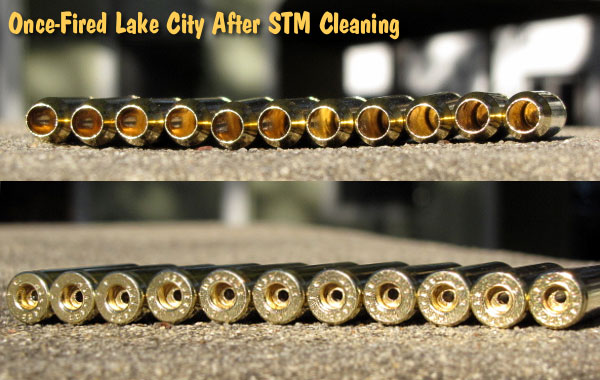
Shown below are Lake City cases after cleaning with Stainless Media (STM). Note: STM Case cleaning was done by a third party, not the USAMU, which does not endorse any particular cleaning method.
3. Inspect Every Case
Once dry, inspect each case for significant deformation (i.e., someone stepped on it), damaged mouths/necks and case head/rim damage. Some rifles’ ejectors actually dig small chunks of brass out of the case head — obviously, not ideal for precision shooting. Similarly, some extractors can bend the case rims so badly that distortion is visible when spinning them in one’s fingers. These can be used for plinking, but our match brass should have straight, undamaged rims.
Dented case mouths are common, and these can easily be rounded using a conical, tapered tool, [such as a .223 expander mandrel. A dummy 7.62 or .30-06 cartridge with a FMJ spitzer can also work.] If most of your brass is of one headstamp, this is a good time to cull out any odd cases.
4. Check the Primers Before Decapping
Your clean, dry and inspected brass is now ready for full-length sizing, decapping and re-priming. Historically, primer crimps on GI brass have caused some head-scratching (and vile language) among handloaders. Our next installment will detail efficient, easy and practical methods to remove primer crimp, plus other useful handloading tips. Until next week, Good Shooting!
NOTE: The USAMU Handloading (HL) Shop does not RE-load fired 5.56 brass. We use virgin LC brass with our chosen primer already staked in place. However, our staff has extensive personal experience reloading GI brass for competition, which will supplement the Shop’s customary steps. In handloading, as in life, there are many ways to accomplish any given task. Our suggestions are note presented as the “only way,” by any means. Time for loading/practicing is always at a premium. Readers who have more efficient, alternative methods that maintain top accuracy are invited to share them here.
May 9th, 2014
Lake City vs. Lapua — which brass is harder? And how about Remington vs. Winchester? Is the widely-held belief that Win brass is harder than Rem brass really true? To help settle these burning questions (raised in a Forum thread), Forum member Catshooter recently sampled the base hardness of four brands of .223/5.56 brass. He employed a very impressive tool for the task — a $2,500 Ames Hardness Gauge. Catshooter explained that his Ames Guage “is FAA certified and approved for testing aircraft engine parts — it does NOT get any better than that!”
Catshooter measured four cases picked at random from batches of Lake City (LC) 2008 (5.56x45mm), Lapua .223 Rem Match, Winchester .223 Rem, and Remington R-P .223 Rem.
 |
 |
 |
 |
| Lake City |
Lapua Match |
Winchester |
Remington |
Photo Shows Ames Gauge Base Hardness Measurement on Lake City Brass

Photo Show Ames Gauge Base Hardness Measurement on Winchester Brass

 TEST RESULTS TEST RESULTS
Using Rockwell hardness standards (.062″x100kg, Rockwell “B”), the brass measured as follows:
LC 2008 = 96
Lapua 223 Match = 86
Winchester 223 = 69
Remington “R-P” = 49
Summary of Test Results
Catshooter writes: “For all you guys that have believed that Winchester cases were tougher than Remington — you are vindicated, they are a lot tougher! However, Lake City and Lapua are ‘the pick of the litter'”. Catshooter notes that both Lake City and Lapua are significantly harder than either Winchester and Remington .223 brass. That’s something that we’ve observed empirically (Lapua and LC stand up better to stout loads), but now we have some hard numbers to back that up. Hats off to Catshooter for settling the hardness debate with his Ames Hardness Gauge.
March 5th, 2011
 Winchester recently issued an important product safety notice, recalling certain lots of Winchester 64gr Power-Point .223 Rem ammo. According to The Firearm Blog, “catastrophic failures destroyed a number of law enforcement AR15 type rifles.” That Blog cited LEO agency notices describing guns that suffered cracked uppers and bowed lowers after firing Winchester’s 64gr Power-Point .223 Rem ammo. Rifles built by three different manufacturers (Colt, Bushmaster, and Stag Arms), all sustained similar damage. Below is Winchester’s Recall Notice dated 3/1/2011: Winchester recently issued an important product safety notice, recalling certain lots of Winchester 64gr Power-Point .223 Rem ammo. According to The Firearm Blog, “catastrophic failures destroyed a number of law enforcement AR15 type rifles.” That Blog cited LEO agency notices describing guns that suffered cracked uppers and bowed lowers after firing Winchester’s 64gr Power-Point .223 Rem ammo. Rifles built by three different manufacturers (Colt, Bushmaster, and Stag Arms), all sustained similar damage. Below is Winchester’s Recall Notice dated 3/1/2011:
|
PRODUCT WARNING AND RECALL NOTICE
WINCHESTER® RANGER® LAW ENFORCEMENT 223 Remington 64 Grain Power-Point®
Olin Corporation, through its Winchester Division, is recalling six (6) lots of its RANGER® 223 Remington 64 Grain Power-Point® (PP) centerfire rifle ammunition (Symbol Number RA223R2).
Lot Numbers (last four characters): DK01, DK11, DK21, DK31, DK41, and DK51
Through extensive evaluation Winchester has determined the above lots of RANGER® Law Enforcement ammunition may contain incorrect propellant. Incorrect propellant in this ammunition may cause firearm damage, rendering the firearm inoperable, and subject the shooter or bystanders to a risk of serious personal injury when fired.
 DO NOT USE WINCHESTER® RANGER® 223 REMINGTON 64 GRAIN POWER-POINT® AMMUNITION THAT HAS A LOT NUMBER ENDING IN DK01, DK11, DK21, DK31, DK41 or DK51. The ammunition Lot Number is ink stamped inside the right tuck flap of the 20-round carton, as indicated here: DO NOT USE WINCHESTER® RANGER® 223 REMINGTON 64 GRAIN POWER-POINT® AMMUNITION THAT HAS A LOT NUMBER ENDING IN DK01, DK11, DK21, DK31, DK41 or DK51. The ammunition Lot Number is ink stamped inside the right tuck flap of the 20-round carton, as indicated here:
To determine if your ammunition is subject to this notice, review the Lot Number. If the last four characters of the Lot Number are DK01, DK11, DK21, DK31, DK41 or DK51 immediately discontinue use and contact Winchester toll-free at 866-423-5224 to arrange for replacement ammunition and free UPS pick-up of the recalled ammunition.
This notice applies only to RANGER® 223 Remington 64 Grain Power-Point® centerfire rifle ammunition with lot numbers ending in DK01, DK11, DK21, DK31, DK41, and DK51. Other Symbol Numbers or Lot Numbers are not subject to this recall.
If you have any questions concerning this RANGER® Law Enforcement ammunition recall please call toll-free 866-423-5224, write to Winchester (600 Powder Mill Road, East Alton, IL 62024 Attn: RA223R2 Recall), or visit our website at www.winchester.com.
|
April 20th, 2010
Need “value-priced” .223 Rem Brass? Then give Graf & Sons a call. Graf’s has NEW Lake City Mil-Spec .223 Rem (5.56) unprimed brass on sale for just $19.99 per 100 cases. That’s right… just twenty bucks per hundred. But this sale price expires Friday 4/23/2010 at midnight. Large quantities of sale brass were on hand at this price as of 12:00 noon CST on 4/21. To order, visit Grafs.com, or call 1-800-531-2666.

Many shooters feel that Lake City makes some of the best .223 Rem (5.56×45) brass available. And it’s hard to beat Graf’s price for this LC 2009 headstamp brass (item FDU223). This is a good opportunity for varminters and service rifle shooters to lay in a large supply of quality brass.
August 31st, 2009
The Indian Army has introduced a new Modern Sub-Machinegun Carbine (MSMC) that shoots an interesting new round, a shortened version of the 5.56×45 (.223 Remington). According to The Firearm Blog, “The [MSMC] chambers a round developed in India called the 5.56×30mm. This round is sometimes referred to as the ‘5.56×30mm INSAS’ after the first gun to chambered the round, the INSAS Carbine.”
This is an interesting cartridge, reminiscent of the 5.56×30 MARS cartridge originally developed by COLT for its Mini Assault Rifle System (MARS) project (see below). The MARS gun never went into full production, and the 5.56×30 cartridge remained an orphan. But it was an interesting cartridge. As designed, using just 16.8 grains of commercial ball powder, Colt’s 5.56×30 cartridge could launch a 55gr FMJ bullet at 2600 fps.

We are intrigued by the new Indian 5.56x30mm cartridge because it would seem very well-suited for varminting, either in .22-caliber form, or necked down to .20 caliber or even .17 caliber. We already have a similar cartridge, of course, the 221 Fireball, but right now there is only one manufacturer of 17 and 221 Fireball brass, namely Remington.

If the Indian 5.56x30mm cartridge is produced in large quantities, perhaps we could see budget-priced 5.56x30mm brass exported for sale in the American market. That would be a boon for high-volume varminters. Also, if the Indian 5.56x30mm is standardized internationally, perhaps one of the European brass manufacturers (Lapua, Norma, RUAG, Wolf?) would consider producing it as an alternative to the 221 Fireball. We can only wish that a 20-cal or 17-cal version of the Indian 5.56x30mm cartridge might be produced some day as inexpensive factory ammo. Many varminters are now looking at centerfire options to the 17 HMR cartridge, as 17 HMR ammo prices continue to climb. A 50-round box of 17 HMR can now cost $14.00 or more.
August 11th, 2009
Grafs.com is currently offering Prvi Partisan .223 Remington brass at very attractive prices. 100 cases cost just $22.99, and that includes shipping (but not the $4.50/order handling charge). Bulk orders of 500 or 1000 cases are even less. This is boxer brass, fully reloadable. The PRVI brass is very good brass for the price. We have tried it in the Prvi Partison loaded ammo as well as in reloads. The brass holds pressure well and is more weight-consistent than some brands of domestic .223 brass. This is a good choice for large-quantity varmint loads.

NOTE: Some lots of Prvi Partisan milsurp 5.56×45 loaded ammo have arrived in the US with crimped primer pockets. When reloaded, those cases may require prep with a primer pocket swager to ease primer seating. The unloaded, new .223 Rem brass sold by Graf & Sons is UNPRIMED and has not been crimped, so you should have no difficulty seating primers.
|


