Eurooptic vortex burris nightforce sale


teslong borescope digital camera barrel monitor


As an Amazon Associate, this site earns a commission from Amazon sales.


August 15th, 2026

Saturday Movies: Seven Smart Videos from F-Class John
f-class john masek video collection bulletin reloading gear reviews

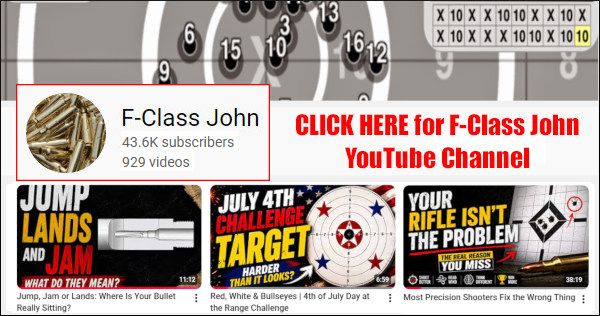
Today we showcase seven videos from video producer, skilled marksman, and Forum Member F-Class John. A talented F-Class competitor (and past Mid-Range National Champion), John analyzes product features with a smart, technically-focused mind. John has created hundreds of videos about reloading and precision tools, along with rifle and shooting accessories. And John also has created many videos showing how to improve your rifle handling and wind-calling. Many of John’s product review videos are very detailed and thorough. You’ll find over 920 informative videos on F-Class John’s popular YouTube Channel.

SEE ALL F-Class John YouTube Videos HERE »
f-class john videos

Basics of Bullet Seating Lengths — Jump vs. Jam

Many folks getting started in the cartridge reloading game are not fully familiar with seating depth options. They may only be looking to achieve a listed Overall Length (OAL) from base to bullet tip. But, for optimal accuracy and safe functionality, you need to look at the position of the bullet’s ogive relative to the start of the barrel’s rifling (i.e. the point where bullet jacket contacts the barrel rifling). Before you start reloading you want to measure the distance to the lands. Then, for most applications you want to start with the ogive’s contact point at least .010″ or more back away from the lands — that is called “jumping”.

For some benchrest applications you may want to actually have the bullets seated longer so the bullet actually contacts the lands. That is called “jam” seating. But there are variations in that. There is both a “mild” jam — a few thousands into the lands — as well as a full jam where the bullet is seated very long (and may even push back if case neck tension is light). Be very cautious with a full jam as this can significantly increase case pressure.

How to Improve Accuracy

In this video, F-Class John explains some key techniques on optimizing match ammo. He explains how to get very precise powder loads. In the video he respond to multiple questions from his Patreon subscribers. One topic is how to avoid the outliers in a 10-shot group. If those “flyers” are consistently coming at the end of a long string, John explains the problem is not likely the ammunition. Rather it could be a variety of factors such as “driver fatigue”, wind changes, barrel heating or other issues. For competitive shooters, this video is worth watching start to finish.

Patriotic July 4 Accuracy Target

The USA’s 250th birthday is behind us, having been celebrated on July 4, 2026. In this video F-Class John shows a fun 5-star red, white, and blue patriotic target and explains some of the challenges in getting an optimal score. There is a black bull inside the center star. Another feature of this target is that you can use the points on the stars to precisely aim your cross-hairs. This is a good target for centerfire at 100 yards, rimfire at 50 yards, and handguns at closer ranges.

Rear Bag Filling — Tips for Best Results

In benchrest and F-Class disciplines, you need a good rear bag to optimize accuracy and scores. A quality rear bag both supports and stabilizes the rifle and helps the rifle track properly during recoil. To get the best, most consistent performance from rear bags, you need to optimize the fill. In this video F-Class John discusses fill options and shows the process to fill your rear bag properly. He also talks about notable bag features including bag weight, footprint, and ear height/material.

Budget-Priced Arken EPL-4 Scope That Performs Well

Top competitors may spend $2500 or more on a top-quality, high-magnification rifle scope. But for those on a tighter budget, the Arken EPL-4 offers pretty impressive performance for under $350.00. In this video John tests this optic from the bench and shows that it has good glass and functions well. The EPL-4 combines Japanese ED glass with illuminated VPR or VHR FFP reticles. The Arken EPL-4 is offered in two sizes: 4-16x44mm ($299.99 at MidwayUSA) and 6-24x50mm ($329.99 at MidwayUSA).

Advanced AMP Press for Precision Bullet Seating

The AMP Electronic Bullet Seating Press is a state-of-the-art bullet seating press that tracks seating force round by round. The AMP Press combines a motor driven ram, a distance sensor, and a load cell to deliver extremely accurate and precise bullet seating measurements. It is designed for use with inline bullet seating dies. With this press you can quickly and easily change seating depths, which is useful during load development. In addition, the AMP press outputs data from the seating process to a linked computer. This allows you to see if there is an unusual seating value. You can mark those “outlyer” rounds and use them for fouling or warm-up shots.

F-Class Front Rests Reviewed

This is a great summary of multiple quality front rests. This is a must-watch video for all F-Open and Benchrest shooters! If you are shopping for a front rest, definitely watch this comprehensive 42-minute video from start to finish. This is probably the most informative video about premium shooting rests available on YouTube. Top F-Class shooter and video-maker F-Class John covers a wide selection of front rests, with some observations about coaxial bipods as well. John covers the impressive new SEB NEO-X, the easy-to-transport SEB Mini-X, the excellent Rodzilla Rest, the innovative 21st Century Hybrid Rest, the sleek Italian Lenzi Rest. At the end of the video John reviews the very affordable Caldwell Fire Control Rest ($289.99 at MidwayUSA), explaining how it can be a decent choice for shooters on a limited budget.

F-class john videos

Permalink - Videos, Bullets, Brass, Ammo, Gear Review, Reloading, Shooting Skills No Comments »
August 15th, 2026

Quarter-MOA, Half-MOA? How Much Precision Is Really Enough?

Jim See Elite Accuracy
This impressive 15-round group was shot by Jim See of Elite Accuracy LLC.

Different shooting disciplines demand different levels of precision/accuracy. In the rapid-fire 3-Gun game, you could probably “clean” most stages with a 2-MOA rifle. By contrast, in the short-range group benchrest game, to compete with the best, you’ll need a rifle that shoots in the “ones” (i.e. 0.1-0.19 MOA) in perfect conditions. In 1000-yard F-Class competition, the top shooters want a rifle that will hold one-third-MOA of vertical at that distance.

What is your standard of accuracy? How good is “good enough”. Jim See, a skilled gunsmith and successful PRS competitor, has answered that question for his tactical discipline. For the kind of matches Jim shoots, he likes to have a rifle that will hold half-MOA for five (5) shots, 3/4-MOA for 15 shots, and 1 MOA for twenty shots. Remarkably, Jim’s rifle can do that with factory ammo. Above is an impressive 15-shot group shot with .260 Remington Federal Premium Ammo.

Jim See Elite Accuracy

“I say it all the time, my loads need to print 5 under 1/2″, 10 under 3/4″, and 20 under 1″. It’s simple, if a hot barrel will keep 20 rounds fired in succession under my standard it will be a good barrel and load for Precision Match Shooting. Federal Premium Gold Metal Match .260 with Sierra bullets made the cut for me today. 15 consecutive shots under 3/4 MOA.” –Jim See

It’s said that you “can never have too much accuracy”, but there are acceptable standards for each discipline, and they’re not the same. A 100/200 yard Benchrest shooter will be sorely disappointed with a rifle/ammo set-up that can only deliver half-MOA. On the other hand, a PRS competitor like Jim See can achieve great success with a lesser degree of precision. This means you can save time and money. You can run your barrels longer between cleanings, and you don’t have to go “full OCD” when loading your ammo. The PRS shooter does not need to weigh-sort primers, or load powder to single-kernel standards. Proof is the performance. Proof is the performance. Jim See has been a podium finisher at many PRS and tactical events. Learn more about Jim’s gunsmithing and training operations at Jim’s Facebook Page and watch his Accuracy Standard VIDEO.

Download This Load Development Target

Jim’s target seemed a bit familiar. AccurateShooter.com created this Diamond and Dot Target a few years back. On each aiming point, there are high-contrast black horizontal and vertical lines for aligning your cross-hairs. The gray circle lets you see the bullet impacts above, without obliterating the red diamond, which is quite useful for precise aiming (we put fine cross-hairs on the points of the diamond). This target sheet includes data entry tables below each of the three aim points. There are many other free targets out there, but this format is very popular. We’re pleased to see Jim using it. You can download this and dozens of other FREE Targets from the AccurateShooter.com Target Page.

AccurateShooter precision load development free target

Permalink Competition, Reloading, Shooting Skills 4 Comments »
August 15th, 2026

You Still Need Hearing Protection Even When Using Suppressors

suppressor silencer moderator facts fiction sound levels noise decibles dB
Silencer-equipped AR photo courtesy The Silencer Shop.

OK, you’ve paid the tax stamp and acquired your new suppressor (aka “silencer” or “moderator”). Do you still need to wear earplugs or muffs? Absolutely. Even with that expensive new “can”, your rifle could be generating over 140 decibels (dB) of noise — about the same as as an unmuffled 9mm pistol shot. That’s loud enough to create permanent hearing loss with repeated exposure.

Firearms Are Loud: 140 dB to 175 dB

Audiology group ASHA explains: “Exposure to noise greater than 140 dB can permanently damage hearing. Almost all firearms create noise that is over the 140-dB level. A small .22-caliber rifle can produce noise around 140 dB, while big-bore rifles and pistols can produce sound over 175 dB. Firing guns in a place where sounds can reverberate, or bounce off walls and other structures, can make noises louder and increase the risk of hearing loss. Also, adding muzzle brakes or other modifications can make the firearm louder. People who do not wear hearing protection while shooting can suffer a severe hearing loss with as little as one shot[.] Audiologists see this often, especially during hunting season when hunters and bystanders may be exposed to rapid fire from big-bore rifles, shotguns, or pistols.” Source: ASHA, Recreational Firearm Noise Exposure.

suppressor silencer moderator facts fiction sound levels noise decibles dB

Suppressors, On Average, Reduce Noise Levels about 30 Decibels
In an article for Ammoland, gunwriter Sam Hoober says that you can expect about 30 decibels (dB) of noise reduction from the average suppressor: “Looking at a few different products, SilencerCo attests their suppressors reduce the sound pressure of a 9mm gunshot to anywhere from 125.7 dB to 131.5 dB, depending on the model. Advanced Armament Co, another popular supplier, attests a 23 dB to 33 dB reduction or down to 127 dB. Liberty Suppressors, another manufacturer, attests a reduction of 24 dB to 38 dB, depending on model and other factors. In short, we can presume something on the order of 30 dB of attenuation as an average.”

Using that 30 dB number you can quickly discern that you’ll still need hearing protection — good hearing protection — when shooting any suppressed firearm (even a .22 LR). “Spikes of 130 dB and more can result in permanent hearing damage instantly”. Source: NRA Blog.

The Myth of the “Quiet” .22 LR
The NRA Blog notes that “many rimfire shooters, particularly those using the beloved .22 Long Rifle cartridge, argue that the small .22 LR caliber doesn’t produce enough sound to damage your hearing”. So, is that really true. or is it a myth?

In fact, a .22 LR can be much louder than you think — a .22 LR pistol can produce sound levels of 134 dB. That’s well above the normal human pain threshhold.

Sound Levels for Common Noises:

9mm Luger pistol: 160 dB

Jet aircraft engine (near): 140 dB

.22 LR pistol: 134 dB

Normal human pain threshold: 120 dB

Noisy Nightclub: 110 db

Riding Motorcycle at 65 mph: 103 db

Power Lawnmower: 95 dB

Hearing damage possible: 85 dB (sustained for 8+ hours)

Ringing Telephone: 80 dB

Normal conversation: 60 dB


The Risk of Hearing Loss
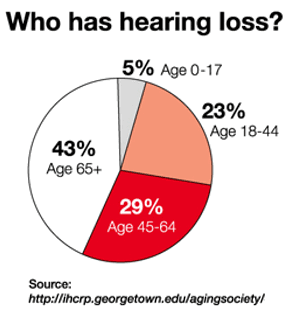
Hearing loss can be progressive and irreversible. If you are a shooter, this is serious business. As the NRA Blog cautions: “You may not even realize you’re harming your hearing. Hearing loss occurs gradually, and can go effectively unnoticed until symptoms become severe. By then, the damage is done.”

Nobody wants to go deaf. But we often see shooters without effective hearing protection when they are walking around a few yards behind the firing line. That’s bad — even if you are away from the firing line, gunshot noises can damage your hearing. You MUST use effective hearing protection every time you go to the range. Good foam earplugs costs mere pennies but they can prevent deafness in your later years. Many folks also wear muffs over plugs.

Permalink - Articles, Shooting Skills, Tech Tip No Comments »