|
|
February 2nd, 2016
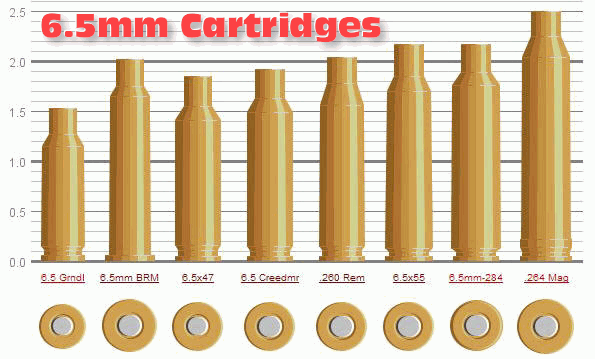
Chart created with Ammoguide’s Visual Comparison Tool. Visit Ammoguide.com to learn more.
One of our forum members was looking for a very accurate, mid-sized 6.5mm cartridge for target working and coyote hunting. There are many great options including the 6.5 Grendel, 6.5×47 Lapua, 6.5 Creedmoor, and Remington .260 (a 6.5-08). If you are considering the 6.5×47 you should read our 6.5×57 Cartridge Guide authored by the 6.5 Guys. This and other 6.5mm cartridges are covered in this introduction to 6.5 mm cartridges prepared by Eben Brown, President of Eabco.com.
Guide to 6.5mm Cartridges
by Eben Brown, EABCO.com, (E. Arthur Brown Co. Inc.)
The current popularity of 6.5mm cartridges in the USA has been a long time in coming. I won’t go into my opinions on why it took so long to catch on. The important thing is that it finally HAS caught on and we’re now so fortunate to have a wide selection of 6.5mm cartridges to choose from!
6.5mm Grendel – Developed by Alexander Arms for the AR15 and military M4 family of rifles. The Grendel fits the dimensional and functional requirements of these rifles while delivering better lethality and downrange performance. There are now similar cartridges from other rifle companies. We chamber for the Les Baer “264 LBC-AR”. Designed for velocities of 2400-2500 fps with 123gr bullets, it shoots the 140-grainers at about 2000 fps (for comparison purposes).
6.5mm BRM – Developed by E. Arthur Brown Company to give “Big Game Performance to Small Framed Rifles” — namely our Model 97D Rifle, TC Contender, and TC Encore. Velocities of 2400-2500 fps with 140gr bullets puts it just under the original 6.5×55 Swede performance.

6.5mm x 47 Lapua – Developed by Lapua specifically for international 300m shooting competitions (with some interest in long-range benchrest as well). Case capacity, body taper, shoulder angle, and small rifle primer are all features requested by top international shooters. You can expect velocities of 2500-2600+ with 140 gr bullets.
 6.5mm Creedmoor – Developed by Hornady and Creedmoor Sports, the 6.5mm Creedmoor is designed for efficiency and function. Its shape reaches high velocities while maintaining standard .308 Winchester pressures and its overall length fits well with .308 Win length magazines. You can expect velocities of 2600-2700+ fps with 140gr bullets. 6.5mm Creedmoor – Developed by Hornady and Creedmoor Sports, the 6.5mm Creedmoor is designed for efficiency and function. Its shape reaches high velocities while maintaining standard .308 Winchester pressures and its overall length fits well with .308 Win length magazines. You can expect velocities of 2600-2700+ fps with 140gr bullets.
.260 Remington – Developed by Remington to compete with the 6.5mmx55 Swedish Mauser that was (finally) gaining popularity in 1996. By necking down the 7mm-08 Remington to 6.5mm (.264 cal), the .260 Remington was created. It fit the same short-action [receivers] that fit .308 Win, .243 Win, 7mm-08 Rem, etc. You can expect velocities of 2600-2700 fps with 140gr bullets in the 260 .Remington.
[Editor’s Note: In the .260 Rem, try the Lapua 120gr Scenar-Ls and/or Berger 130gr VLDs for great accuracy and impressive speeds well over 2900 fps.]
6.5mm x 55 Swedish Mauser – This was the cartridge that started the 6.5mm craze in the USA. It is famous for having mild recoil, deadly lethality on even the biggest game animals, and superb accuracy potential. Original ballistics were in the 2500 fps range with 140gr bullets. Nowadays handloaders get 2600-2700+ fps.
[Editor’s Note: Tor from Scandinavia offers this bit of 6.5x55mm history: “Contrary to common belief, the 6.5×55 was not developed by Mauser, but was constructed by a joint Norwegian and Swedish military commission in 1891 and introduced as the standard military cartridge in both countries in 1894. Sweden chose to use the cartridge in a Mauser-based rifle, while Norway used the cartridge in the Krag rifles. This led to two different cartridges the 6.5×55 Krag and 6.5×55 Mauser — the only real difference being safe operating pressure.”]
6.5-284 Norma — This comes from necking the .284 Winchester down to .264 caliber. Norma standardized it for commercial ammo sales. The 6.5mm-284 was very popular for F-Class competition and High Power at 1,000 yards. However, many F-Class competitors have switched to the straight .284 Win for improved barrel life. 6.5-284 velocities run 3000-3100+ fps with 140gr bullets.
.264 Winchester Magnum – Developed by Winchester back in 1959, the .264 Win Mag never really caught on and may have delayed the ultimate acceptance of 6.5mm cartridges by US shooters (in my opinion). It missed the whole point and original advantage of 6.5 mm cartridges.
The Original 6.5mm Advantage
The special needs of long-range competition have skewed things a little. However the original advantages of 6.5mm cartridges — how deadly the 6.5mms are on game animals, how little recoil they produce, and how easy they are to shoot well — still hold true today.

October 4th, 2015

This article first appeared in 2014. We are reprising it at the request of many readers who are fans of the .30-06 cartridge.
The “Old Warhorse” .30-06 Springfield cartridge is not dead. That’s the conclusion of Forum member Rick M., who has compared the 1000-yard performance of his .30-06 rifle with that of a rig chambered for the more modern, mid-sized 6.4×47 Lapua cartridge. In 12-16 mph full-value winds, the “inefficient and antiquated” .30-06 ruled. Rick reports:
“I was shooting my .30-06 this past Sunday afternoon from 1000 yards. The wind was hitting 12-16 mph with a steady 9 O’clock (full value) wind direction. My shooting buddy Jeff was shooting his 6.5×47 Lapua with 123gr Scenar bullets pushed by Varget. Jeff needed 13 MOA left windage to keep his 6.5x47L rounds inside the Palma 10 Ring. By contrast I only needed 11.5 MOA left windage with my .30-06. I was shooting my ’06 using the 185gr Berger VLD target bullet with H4350. I managed the same POI yet the .30-caliber bullet only needed 11.5 MOA windage. That’s significant. From this experience I’ve concluded that the Old Warhorse ain’t quite dead yet!”

Rick likes his “outdated” .30-06 rifle. He says it can deliver surprisingly good performance at long range:
“To many of the younger generation, the Old Warhorse .30-06 is ‘outdated’ but I can guarantee that the .30-06 Springfield is a VERY ACCURATE cartridge for 1000-yard shooting (and even out further if need be). With some of the advanced powders that we have today, the .30-06 will surprise many shooters with what it’s capable of doing in a good rifle with the right rate of twist. My rifle has a 1:10″ twist rate and I had it short-throated so that, as the throat erodes with time, I could just seat the bullets out further and keep right on shooting. My recent load is Berger 185gr Target VLDs pushed by IMR 4350. This is a very accurate load that moves this bullet along at 2825 fps.”

September 13th, 2015

In response to our Bulletin story about the availability of Norma powders at Midsouth Shooters Supply, one of our Forum members asked: “I’m having trouble finding Reloder 15 for my 6.5×47 Lapua — should I consider running Norma 203B instead?” As we’ve explained before, these two powders, both made by Bofors in Europe, are very, very similar. Here are some hard numbers that should demonstrate how virtually identical these powders really are.
Target Shooter Magazine writer Laurie Holland compared Norma 203B and Reloder 15 using data from QuickLOAD. Laurie also checked load manuals to see how listed charge weights varied for the two propellants. Laurie concluded there was very little difference between Norma 203B and Reloder 15.
 Norma 203B vs. Alliant Reloder 15 Norma 203B vs. Alliant Reloder 15
Commentary by Laurie Holland
Running [203B and RL15] through QuickLOAD doing a ‘charge table’ run for a 130gn Berger VLD at 2.700 COAL in 6.5X47 Lapua, gives very similar positions in the table [for both powders]. The charge required to achieve 62,000 psi estimated pressure varies by a mere 0.2 grains between the pair, Norma 203B being the heavier of the two. The estimated Muzzle Velocity (MV) also varies by a mere 2 fps, RL15 estimated to produce 2,946 fps MV compared to 2,944 fps for N203B at 62,000 psi (with the parameters I used).
If they aren’t the same thing, they’re so close as to make no difference and as Forum Boss points out, they’re made by the same people (Bofors) in the same plant.
[The Berger Reloading Manual includes data for both powders] for the .308 Winchester and heavier bullets (185 to 230 grains). Maximum charges and claimed MVs are not always identical, but are so close as to be marginally different production lots of the same thing, or maybe the result of minor testing variations.
.308 Win Max Charge Weights in Grains (RL15 / N203B) (Berger Manual)

MVs [for the four bullet types] are close but not identical, the largest difference being for the 210s which shows RL15 producing 2,428 fps MV v 2,383 for Norma 203B.
Norma 203B Chemistry
According to the Norma Reloading Handbook #1, Norma 203B has the following composition:
85% Nitrocellulose
7.5% Nitroglycerin
2.0% surface coating
4.6% Various chemicals
0.9% Water
3,957 J/g specific energy
890 g/l specific density
For comparison, the 7.5% NG component compares to 15% in Viht N500 series powders and 10% in Ramshot TAC / Big Game / Hunter.
August 25th, 2015

With so much action going on at Camp Perry, Ohio this August (including the Fullbore Worlds), you might not realize that another NRA rifle championship was taking place simultaneously in Pennsylvania. The NRA High Power Hunter Rifle Silhouette Championship was held 6-8 August at the Ridgway Rifle Club, in Ridgway, Pennsylvania. This event attracted the nation’s top silhouette shooters.
 At this year’s Silhouette Championship, Team Lapua shooters Cathy Winstead-Severin and Mark Pharr finished first and second overall. The match went down to the wire, with Cathy edging out Mark in a shoot-off for the overall title. Earlier in the competition, Cathy set a new Woman’s National Record in a 120-shot course with a stunning 97/120, breaking the previous record of 90 by seven points. Another record was broken by the Hunter Rifle Team of Cathy Winstead-Severin, Mark Pharr, and Mallory Nichols. This talented Team Lapua threesome set a new national record of 295, besting the mark set in 2004. Team Lapua also took second place in the Standard Rifle Team Division. At this year’s Silhouette Championship, Team Lapua shooters Cathy Winstead-Severin and Mark Pharr finished first and second overall. The match went down to the wire, with Cathy edging out Mark in a shoot-off for the overall title. Earlier in the competition, Cathy set a new Woman’s National Record in a 120-shot course with a stunning 97/120, breaking the previous record of 90 by seven points. Another record was broken by the Hunter Rifle Team of Cathy Winstead-Severin, Mark Pharr, and Mallory Nichols. This talented Team Lapua threesome set a new national record of 295, besting the mark set in 2004. Team Lapua also took second place in the Standard Rifle Team Division.
16-Year-Old Girl Finishes Fourth in Hunter Class
Team Lapua’s youngest member, 16-year old Mallory Nichols, was incredibly impressive as she entered the competition as an AA shooter and blasted her way through AAA into Master class in finishing fourth overall in Hunter Rifle. (She was in the running for third place overall, until a shoot-off with Eric Boos of Washington, who finished third). Nichols also set new national records for Long Run for Women and Intermediate-Junior hitting 18 pigs in a row. The previous Intermediate-Junior record was 14 set by Luke Johnson in 2011.

Winning Silhouette Loads
2015 Overall Silhouette Champion Cathy Winstead-Severin was shooting a 6-6.5×47 Lapua with 90-grain and 105-grain OTM Scenar bullets, pushed by Vihtavuori N135 powder. Mark Pharr and young Mallory Nichols were both shooting the regular 6.5×47 Lapua cartridge with 108-grain and 139-grain OTM Scenar bullets and Vihtavouri N140 powder.

July 11th, 2015

Article by Bill, Editor of Rifleshooter.com
A few years ago I built a custom switch-barrel Remington 700 on an AICS Chassis chambered in .243 Winchester and .308 Winchester. I found the .243 Win finicky during load development and started looking at other options for the 6mm Bartlein 1:8″-twist HV barrel.
 Initially drawn to the 6mmBR and 6mm Dasher, I realized these cartridges wouldn’t feed from an AICS magazine system without extensive modification. I took a look at the 6mm Creedmoor, 6XC, and 6mm-6.5×47 Lapua (aka 6×47 Lapua), all of which feed well from a detachable magazine. At right you can see the 6×47 Lapua in an AICS magazine. It has the “Goldilocks factor” — not too long, not too short. Initially drawn to the 6mmBR and 6mm Dasher, I realized these cartridges wouldn’t feed from an AICS magazine system without extensive modification. I took a look at the 6mm Creedmoor, 6XC, and 6mm-6.5×47 Lapua (aka 6×47 Lapua), all of which feed well from a detachable magazine. At right you can see the 6×47 Lapua in an AICS magazine. It has the “Goldilocks factor” — not too long, not too short.
The ability to simply convert 6.5×47 Lapua brass to 6×47 brass by running the parent 6.5mm brass through a full-length Forster sizing die in a single step was what made me choose the 6×47 Lapua over the 6mm Creedmoor and 6XC (both excellent cartridges in their own right). I also own a 6.5×47 Lapua rifle, so I had a supply of 6.5×47 brass ready to neck-down. Being able to create 6×47 brass easily (one pass and done) was very appealing.
Left to right, below: 6mmBR, 6-6.5×47 Lapua, 6.5×47 Lapua, and .243 Winchester.
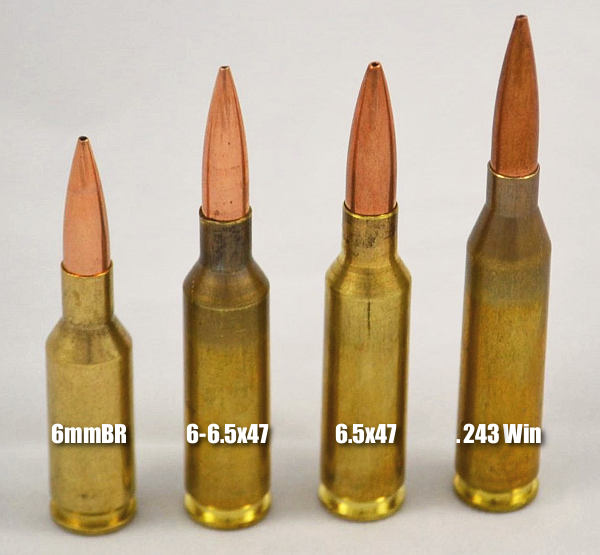
I cut the chamber end off my .243 Win barrel, threaded and chambered my rifle for the 6×47 Lapua cartridge. I have written a lengthy article on this cutting and re-chambering process. Home gunsmiths interested in this process can READ MORE HERE.
When the re-chambering was complete, I headed to the range and worked up a set of eight loads using Berger 108 BTHPs, H4350, Lapua brass, and CCI 450 primers.

Load development was a little trickier than with the 6.5×47 Lapua parent cartridge. The accuracy nodes were smaller. However, once I dialed in a load with Hodgdon H4350 and the 108-grain Berger BTHP, the rest was history. The 6×47 rig is now one of the most consistent rifles I own, holding just above 0.3 MOA for 5-round groups. Below is a 100-yard test target with 108-grain Berger BT in the 6×47 Lapua. Five-shot group sizes are (L to R): .369″, .289″, and .405″. The average size was .354″ or .338 MOA. [Editor: We think that is excellent accuracy for a tactical-type rifle shot from bipod.]

Learn More about this 6×47 Lapua Project
I’ve written more about this 6×47 rifle on my Rifleshooter.com website. To learn more about my experience with the 6×47 Lapua, click this link: 6-6.5X47 Lapua Review.
About the author: Bill has been a serious shooter for over 20 years. A former Marine Corps Sergeant, he’s competed and placed in High Power Rifle, ISPC, USPSA, IDPA, 3-Gun, F-Class, and precision rifle disciplines. In addition to being an NRA-certified firearms instructor and range officer, Bill has hunted big game in North America, South America, and Africa. Bill writes extensively about gunsmithing, precision rifles, and the shooting sports on his blog, Rifleshooter.com.
June 22nd, 2015

AccurateShooter.com has released the most complete discussion of the 6.5×47 Lapua cartridge ever published. Our new 6.5×47 Cartridge Guide is packed with information. If you own a 6.5×47 rifle, or are thinking of building a rifle with this chambering, definitely read this Cartridge Guide from start to finish. Our comprehensive, 5000-word article was researched and written by the 6.5 Guys, Ed Mobley and Steve Lawrence. Both Ed and Steve shoot the 6.5×47 Lapua in competition and they are experts on this accurate and efficient mid-sized cartridge.
You’ll find everything you need to know about the 6.5×47 Lapua in our new Cartridge Guide. We cover ballistics, reloading, die selection, and we provide an extensive list of recommended loads, for bullets from 120 to 140 grains. You can read interviews with respected experts who’ve built and tested many 6.5×47 rifles. The Guide includes helpful tech tips such as how to maximize the powder fill in your cases. This Cartridge Guide can put you on the “fast track” — helping you develop accurate, reliable loads with minimal development time.
 6.5×47 Lapua Cartridge Guide Highlights: 6.5×47 Lapua Cartridge Guide Highlights:
- Cartridge Specifications
- Comprehensive Load Data
- Best Bullets and Primers for 6.5×47
- Ballistics Comparison Charts
- Sizing and Seating Die Options
- 6mm-6.5×47 (Necked-Down) Options
- Ask the Experts Section
- Tips for Accurate Reloading
- Brass Life and Annealing
- Chambering and Gunsmithing Tips
- 6.5×47 Lapua for Hunting
- 6.5×47 Lapua for Tactical Competition
- 6.5×47 Factory-Loaded Ammo

Here is a sample from the 6.5×47 Cartridge Guide’s Ask the Experts Section. This is an interview with Rich Emmons, one of the founders of the Precision Rifle Series:


June 14th, 2015

The .260 Remington and the 6.5×55 Swedish (aka 6,5x55mm SE) are both very popular cartridges with hunters and target shooters. The 6.5×55 has a long military heritage and a great record as a hunting round. The .260 Rem, essentially a .308 Win necked down to .264 caliber, is a more recent cartridge, but it grows in popularity every year, being one of the top cartridges for tactical/practical competitions. It offers better ballistics and less recoil than the parent .308 Win cartridge. In our Shooter’s Forum, respected UK gun writer Laurie Holland provided a good summary of the differences between the two chamberings. Laurie writes:
 The 6.5×55 case has 6 or 7% more capacity than the .260s, even more in practice when both are loaded to standard COALs with heavy bullets, which sees them having to seated very deep in the .260 Rem using up quite a lot of powder capacity. So loaded up for reasonable pressures in modern actions, the 6.5×55 will give a bit more performance. The 6.5×55 case has 6 or 7% more capacity than the .260s, even more in practice when both are loaded to standard COALs with heavy bullets, which sees them having to seated very deep in the .260 Rem using up quite a lot of powder capacity. So loaded up for reasonable pressures in modern actions, the 6.5×55 will give a bit more performance.
The issue for many is what action length is available or wanted, the 6.5×55 requiring a long action. So sniper rifle / tactical rifle competitors will go for the .260 Rem with the option of the many good short-bolt-throw designs around with detachable box magazines (DBMs). If a bit more performance is needed, the .260 AI (photo right) can yield another 100-150 fps velocity, depending on bullet weight.
June 1st, 2015

On some internet shooting forums, self-declared “experts” advise new rifle shooters to stick to low-end factory rifles. These “experts” (many of whom don’t own a single really accurate rifle), claim that it will take years for a new shooter to learn how to shoot a rifle accurately. So, the argument goes, the accuracy offered by a precision-chambered rifle, with a custom barrel, is “wasted” on a new shooter.
We disagree with that viewpoint, at least when it comes to rifles shot from a rest. Certainly it takes time for a complete novice to learn how to handle the gun and to work the trigger smoothly. However, we’ve seen relatively new shooters, with help from a skilled mentor, do remarkably well with precision rifles right from the start. With a good bench gun, many new shooters can shoot well under 1 MOA on the first day. This editor has personally seen some inexperienced ladies try their hand at benchrest shooting, and within a month or two they are shooting on a par with the “good old boys” in serious competition.
April 19th, 2015
Forum member Scott S. (Sunbuilder) has built a sweet long-range varminter based on the 6.5×47 Lapua cartridge necked down to 6mm and then improved to 40 degrees, with slightly less body taper. Scott tells us that “improving the case adds about 2.0 grains to the case capacity”. This allows Scott to run the 103-108gr bullets at well over 3100 fps, with no pressure issues. Scott calls his Improved case a “Long Dasher”, a name suggested by Dave Kiff of Pacific Tool & Gauge.

6-6.5×47 Improved Works Well with Many Powders
Scott’s 6-6.5×47 Lapua Improved varmint rifle features a Stiller Diamondback action, Lilja 30″ 8-twist barrel, Richard Franklin stock, and a NightForce 8-32×56 NXS. Scott has had excellent success — his two longest groundhog hits were at 778 and 810 yards. Scott has tested many powders with his 6-6.5×47 wildcat: “I tried several powders (H4350, N160, N560, H4831sc), and primers (CCI 450, BR4, Rem 7 1/2, Fed 205Ms). I got better velocity with H4350, but my barrel likes the N160. I did find a [high-speed] node with H4350. The increased velocity potential of this cartridge is partially due to the slightly increased case capacity. The load I am shooting now is 40.5gr N160, Berger 105gr Match BT, .010″ jam, CCI BR4, .002″ neck tension at 3115 fps. This has an ES under 15 fps, and it will group under 2″ at 500 yards if conditions hold. This ‘Long Dasher’ (6-6.5×47) seems to have a lot of potential (and that’s an understatement).”

A Better Mount for the Spotter and Rangefinder
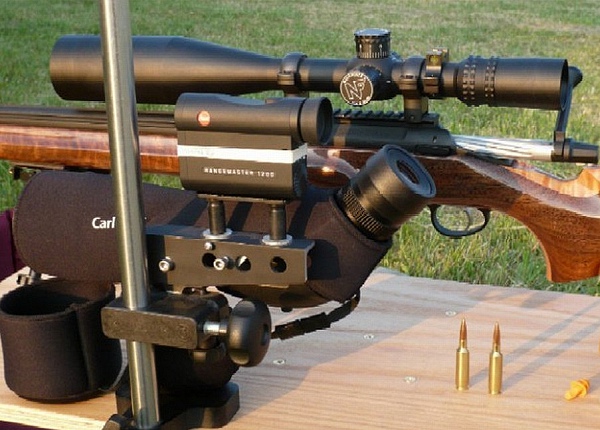
Scott designed and fabricated a very slick set-up to hold his Zeiss spotting scope and Leica CRF RangeFinder. He’s built a combo bracket that holds both units rock steady, with a parallel line of sight (same axis and elevation). Smart. Very smart. Scott explains: “I built a mount to connect my rangefinder to my spotting scope. The mount can be adjusted, so the spotting scope and rangefinder are both centered on the same object. The only way I have found to get repeatable long-range readings is to make them from a stable base.” Scott, we think you’ve got a winner here with your innovative and clever design.
September 27th, 2014
We are often asked “what’s the difference between the 6×47 Swiss Match, the 6XC, and the 6.5×47 Lapua necked down to 6mm?” All three cartridges have 30° shoulders and fit a .308-sized boltface. However, alone among the three, the 6mm-6.5×47 has a small primer pocket and small flash hole. The 6×47 Swiss Match (made by RUAG), and the 6XC (produced by Norma), have a large primer pocket and large flash hole, just like a .308 Winchester.

Forum member DesertLefty has provided a line-up photo, with 6mmBR and .260 Rem cases provided for comparison. As you can see, the three mid-sized cases (6x47SM, 6.5×47 Lapua, and 6XC) are very similar.

The Swiss Match has the longest neck, while the 6XC enjoys the highest capacity. But performance is very similar among the three cartridges (with the 6.5×47 necked down to 6mm), and the same powders, particularly H4350, IMR 4007SSC, and N160 work well in the 6×47 SM, the 6XC, and the 6-6.5×47 Lapua. Alliant Reloder 17, slightly faster than H4350 but with a flatter (less “peaky”) burn curve, could also prove a good choice for both the 6XC and 6mm-6.5×47.
6XC vs. 6-6.5×47
Often the question is posed “Which is better, the 6XC or 6mm-6.5×47″. The correct answer seems to be “it depends”. Current batches of Norma-made 6XC brass are very good, while certain lots of 6.5×47 Lapua brass have somewhat disappointing neckwall uniformity, demanding neck-turning for best accuracy. Overall, however, the two cases (6mm-6.5×47 and 6XC) are nearly identical in performance. Some shooters believe the Lapua brass holds up better under full-power loads. On the other hand, Norma 6XC brass from DavidTubb.com is a bit less expensive than 6.5×47 brass.
The parent 6.5×47 Lapua case is rated at 63,090 psi, while the new CIP rating for the 6XC is 63,844 psi (4400 BAR). Though the 6mm-6.5×47 has slightly less powder capacity than the 6XC, max velocities with 105-108gr bullets are quite similar. However, you should not substitute loads from the 6XC directly to the 6mm-6.5×47 or vice-versa. Because of the different case capacities and primer sizes, you should work up loads separately for each cartridge.
|