As the United States approaches its historic 250th Anniversary (July 4, 2026), the National Rifle Association invites Americans to celebrate freedom by competing in the NRA America’s Rifle Challenge (ARC). The expanded 2026 ARC Across America National Challenge is a nationwide competitive shooting event. From Memorial Day through Labor Day, gun owners across the country can compete in ARC matches at participating clubs and ranges with opportunities to win prizes from ARC partners and sponsors.
To learn more about participating in NRA America’s Rifle Challenge events, visit ARC.NRA.org.
The heart of the program is the ARC Level 1 format, the foundation of the USA250 national event and the entry point for gun owners of all experience levels.
Built around practical rifle skills across four stages of fire, the Level 1 course challenges participants to demonstrate accuracy, control, and safe firearms handling.
Every ARC match is more than a competition — it’s a training opportunity. Each run on the course helps shooters grow more capable with their rifles. Participants can:
— Develop new rifle skills through structured competition
— Challenge friends and family in a fun and exciting environment
— Compete multiple times in a “Re-entry Match” format, allowing competitors to improve their score.
And, at the end of each ARC match, participants can see where they rank nationally across the country with other ARC competitors. And Veterans can meet other former service members.
How Clubs Can Host ARC Matches
The NRA’s goal is to have more than 250 clubs and ranges host ARC matches between Memorial Day and Labor Day. The program was built so clubs can run an organized, safe, and engaging event without requiring complex stages or extensive infrastructure. Clubs interested in hosting NRA America’s Rifle Challenge events can sign up on the ARC.NRA.org website.
ARC Competition Format Options
Clubs can host ARC matches using one of two range configurations:
Full Level 1 Course Format – designed for ranges with 100-yard capability Reduced Course Format – designed for ranges with 25-yard capability
Note: Both formats provide the same structured experience and competitive opportunity, ensuring that nearly any club can participate regardless of range size.
The NRA America’s Rifle Challenge (ARC) is a national rifle competition program designed to help firearm owners develop safe gun-handling skills, practical marksmanship, and confidence through structured competition. ARC events are hosted by local clubs and ranges across the country and welcome participants of all experience levels. Clubs willing to host an event will join a growing network of ranges across the country helping bring this celebration to life.
NRA America’s Rifle Challenge
The National Rifle Association, as part of NRA 2.0 in 2025, is launching an AR-based competition called the America’s Rifle Challenge (ARC). This is a competitive shooting program designed to encourage the “every day responsible rifle owner” to do more than just target practice at the range. ARC can provide a fun, exhilarating introduction to action shooting sports for AR owners.
Shooting Sports USA features the new ARC program in the March 2025 issue, available for FREE online: READ Full Article HERE.
ARC Competition Levels
The NRA America’s Rifle Challenge (ARC) is a unique AR-based competition shooting program designed as a way for “everyday responsible rifle owners” to go beyond typical target practice. Millions of gun owners have purchased ARs over the past few years, and this program will help them sharpen their skills. Featuring two levels of competition, NRA America’s Rifle Challenge can accommodate everyone from AR novices to seasoned competitors. And there will be an optional Two-Gun component in the NRA America’s Rifle Challenge program that adds handgun shooting to the courses of fire. Not only that, pistol-caliber carbines chambered in 9mm Luger, .40 S&W, or .45 ACP are permitted in all NRA ARC Level 1 matches and special Level 2 and Two-Gun events.
NOTE: The NRA plans to release the full NRA America’s Rifle Challenge rulebook as well as NRA ARC requirements for clubs/ranges no later than August 1, 2025. You will be able to download the rulebook at: Arc.nra.org/nra-arc-rulebook.
America’s Rifle Challenge Event Levels:
Level 1: The Level 1 course of fire is conducted from 10 out to 100 yards with competitors firing from different positions under time constraints. Level 1 is intended for AR owners new to competitive shooting. This event focuses on building skills to improve accuracy, speed, and mechanics. L1 matches are conducted from 100 yards and inward, with a balance of both time and accuracy being measured in every event. There are currently five total stages of fire in this match, with more in development. NOTE: Level 1 is limited to the first 32 competitors (4 squads). Space in level 1 is limited, so sign up quickly.
Level 2: The Level 2 course of fire covers the full spectrum of what is possible with an AR. L2 matches are conducted from 500 yards inward. Competitors will face a variety of stages designed to test skills — shooting and moving, positional shooting skills, long-range precision, speed, stage planning, and use of barricades, as well as close-quarters exercises. Level 2 offers a higher round count and more dynamics to the stages. NOTE: Level 2 is limited to the first 60 competitors (6 squads).
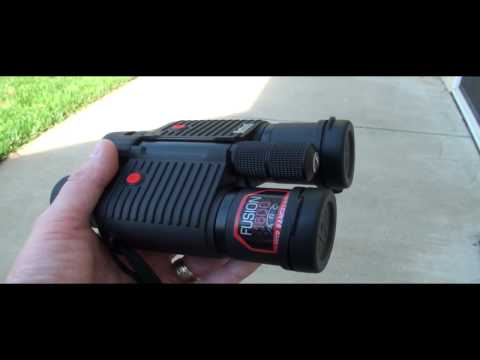
Bushnell recently released its new Fusion 1600 ARC range-finding binoculars. With a “low street price” under $799.00, Bushnell’s 1600 ARC binoculars are less than one third the price of Leica Geovids (10×42, $2399.00) or Zeiss Victory RF Binoculars (10×45, $2,799.00).
That huge price advantage makes the Fusion very tempting — but can Bushnell’s 1600 ARC binos perform as advertised?
Forum Member Reviews Fusion 1600 ARC
Forum Member Stan (aka BigBamBoom) acquired the Fusion 1600 ARC RF binoculars and has posted a video review. Stan was favorably impressed with the quality of the glass and the exterior ruggedness of the unit. He was able to range very large objects (water-tower, trees) beyond 1200 yards. He also praised the speed of the unit, saying it ranged faster than his Leica CRF 1200. Consider however, that the very small CRF1200 is harder to aim precisely, simply because it is so small and light and held in a vertical orientation. Most people can aim the larger, heavier LRFs with more steadiness using a normal two-handed horizontal grip. In the real world, if you can hold the LRF more steady, you can get a true range on a small object more quickly.
Don’t Expect to Range a WhiteTail at 1600 yards
We also caution that, in our Laser rangefinder comparison tests, we learned that there is BIG difference between ranging a water tower, and ranging a deer-sized animal. We found that some units that could range a water tower at 1300+ yards could NOT reliably range an actual deer (stuffed by taxidermist) at 700 yards. Note that Bushnell lists three different effective ranging distances for the Fusion 1600, and Bushnell claims only 500-yard effectiveness on deer-sized objects. This is fairly consistent with our LRF comparison tests:
It can be fun to range buildings at a mile, but for the hunter, that may not have much practical utility. You want to be able to range deer-sized game at all practical distances. For the tactical shooter, you need a narrowly focused beam (with minimal beam divergence) that can range a gong or metallic silhouette reliably at 1000 yards. If an LRF can’t do that, it may not be all that useful, even if it the sales price is attractive. Fusion 1600 ARC Features
The 10×42 roof prism binoculars feature built-in battery life indicator, twist-up eye pieces, and multi-coated optics with RainGuard. The Fusion 1600 is fully waterproof and submersible, meeting IPX7 “waterproof” specification. As Stan observed, the Fusion 1600 has good glass, and the red readouts are easy to see. Bushnell employs Vivid Display Technology™ (with four display brightness settings) to enhance display readability in all lighting conditions.
The built-in laser rangefinder features ARC (Angle Range Compensating) technology, which calculates the angle to the target (-90 to +90 degrees). ARC also and gives the hold-over range for the rifle shooter, and true horizontal distance for bow hunters. We like the fact that you can choose between Inches and MOA for holdover. There is a brush mode for measuring distances in heavy cover and a bullseye mode for ranging in open areas. The brush mode can filter out false returns from closer objects. This IS a useful feature that actually does work.
The Fusion 1600 ARC laser rangefinder binoculars come with battery, neck-strap, and carrying case. MSRP is $899.00. It pays to shop around as we’ve seen advertised prices from $789.00 to $899.00. For more info, visit www.bushnell.com or call 800-423-3537 for consumer inquiries.
Bushnell Inc. and Leupold & Stevens have settled their respective lawsuits relating to the Leupold True Ballistic Range® (TBR) technology, and the Bushnell Angle Range Compensation (ARC) technology. So ends the legal battle of competing angle-compensation indication systems. In February, Leupold & Stevens sued Burris, Bushnell, and Zeiss for patent infringement in federal court for the District of Oregon. Then, in a separate action in the District of Kansas, Bushnell sued Leupold & Stevens for patent infringement. This week, after months of negotiations, the two companies dismissed their claims against each other, the two sides having reached an amicable settlement. The terms of the settlement were not disclosed, but neither company will be required to discontinue selling any of its products.
“We are pleased with the settlement, because it allows our customers to go on using and enjoying Bushnell laser rangefinders with our patented ARC technology, and we can focus our resources and energy on further developing and marketing new and innovative products,” said Phil Gyori, Executive Vice President of Marketing at Bushnell.
Previously, in March, Leupold removed Carl Zeiss Optical from Leupold’s patent suit. Though originally named as a defendant, Zeiss was dismissed from the suit because its products do NOT incorporate an inclinometer to compensate for angled shots. The inclinometer is a key element of Leupold’s patent.


 The heart of the program is the ARC Level 1 format, the foundation of the USA250 national event and the entry point for gun owners of all experience levels.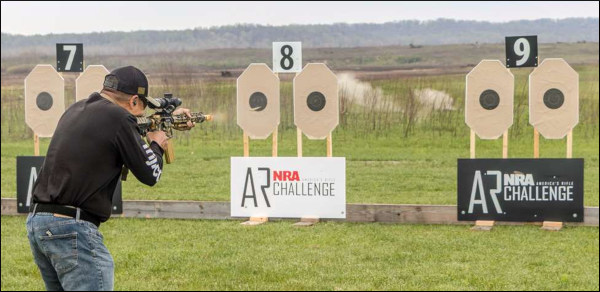


 Bushnell recently released its new