Under the current administration in Washington, Second Amendment rights are under attack. President Biden wants to restrict handguns and ban modern semi-automatic rifles such as the AR-15. And the ATF continues to digitize millions of sales records, effectively creating a national Firearms Registry, in direct violation of Federal law.
To help fight these trends, Brownells encourages all gun owners to take collective action to help defend the Second Amendment. For this purpose Brownells has declared the first-ever Second Amendment Day (2A Day) on February 2, 2022 — 2-22-2022.
FREE Range Sessions, FREE Ammo, and FREE Food
On 2A Day you can shoot for free — on Brownells’ nickel — at affiliated gun ranges. On 2-22-2022, Brownells has partnered with a few gun ranges to host 2nd Amendment Day range sessions. The range sessions will include free range time, limited free ammo, and free food for those who attend.
Post your Second Amendment Day Range Sessions
Brownells encourages Second Amendment supporters unable to attend a participating range to shoot at a nearby, local range and post photos of their 2A Day activities on social media with hashtag #2ADay.
Join a Second Amendment Organization
Brownells recommends that gun owners join a national and/or state-level gun rights organization. Brownells will promote the Firearms Policy Coalition (FPC), Second Amendment Foundation (SAF), and American Suppressor Association (ASA) on its website. Brownells will also feature a clickable USA map which visitors can use to find a state organization to join.
Brownells states: “The most important thing you can do is join with us to help preserve, protect and expand your 2nd Amendment rights. Join a state level organization promoting gun rights where you live. Join a national organization to help protect freedom for the whole country. In the spirit of joining, Brownells will purchase FPC memberships for its employees, and donate $22,222 each to FPC, SAF, the ASA, and the Iowa Firearms Coalition.”
Advocate for Your Rights — Contact Your Legislators
Brownells encourages all gun owners to advocate for the 2nd Amendment by contacting their state and federal lawmakers and communicating citizen support for gun rights. The National 2nd Amendment Day webpage includes tips on how to how to effectively communicate with politicians.
“The spirit of this event is to designate a day that we, as a nation, recognize, celebrate and do our part to secure one of the most important rights guaranteed by our Constitution – the right to keep and bear arms,” said Pete Brownell, Chairman of the Board. “This event, which we hope continues to grow in size, scale and scope, is aimed at bringing all freedom-loving Americans together on one day – 2/22 – this year and every year going forward to show support for our beloved 2nd Amendment.”
With inflation and rising prices, it’s more important than ever to take advantage of discounts and promotions. We’ve located the latest Discount Codes for Brownells Purchases that can save you 10% (or more) on your purchases. These Brownells Discount Codes qualify you for significant savings on guns, ammo, parts, and reloading components at Brownells. Use these Codes during check-out and the savings will reduce your net cost. For example, save $60 on a $600+ purchase, $40 off $400, or $25 off $250 — getting 10% savings. NOTE: Some of these discount codes expire today, while others may expire at any time, so don’t hesitate. If one Code doesn’t work, try another.
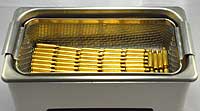
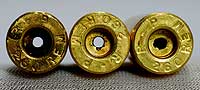
If you read our lengthy article on Ultrasonic Cleaning by Jason Baney, you’ve seen the remarkable results that can be achieved with this method, as shown by the photo above. Ultrasonic cleaning has many advantages over traditional tumbling methods of case cleaning. There is no dust or media residue to remove from the brass, and when done right, the cases come out clean and shiny, inside and out, even the primer pockets.
In its Benchtalk Archives, Brownell’s has an excellent article discussing Ultrasonic Case Cleaning. Brownell’s staff compares results, with measured dwell times from 5 to 75 minutes, using both Mpro-7 and HCS 200 cleaning solutions. Tests are performed with once-fired and 5X-fired Tactical 20 (Tac20) cases, as well as once-fired .260 Rem Cases. The article also compares the results from ultrasonic cleaning vs. tumbling in walnut media. Below are Brownell’s results for Tac20 cases with the HCS 200 (non-acidic solution). Go to Brownell’s article for MPro7 results and Rem 260 results.
HCS 200 Cleaning Solution Test
Procedure — Solution was de-gassed for 15 minutes, then 63 Tac20 cases were placed in a single layer, in stainless steel mesh basket. The temperature of the starting solution was 102° F. When the cases were removed the temperature was 110° F.
Once-Fired Tactical Twenty Cases (HCS 200) — Observations 5 minutes: The exterior of the cases are not significantly brighter/cleaner. The primer pockets and case interiors are still dirty. 10 minutes: Exterior of the cases are brighter. 70% of the cases show some degree of cleaning of the primer pockets. Little difference seen inside the case, but case mouths are cleaner. 15 minutes: Case brightness is about the same. Still only 70% of the primer pockets are clean, but a larger portion of each is cleaner. A Q-tip swabbed inside the cases shows that carbon/powder residues are loosening up. 20 minutes: Case exteriors are brightening up. 80-85% of the primer pockets are about 90% clean. The insides of the cases and case mouths are cleaner. 25 minutes: Cases are brighter/cleaner than even new brass. 80-85% of the cases have almost completely clean primer pockets. The inside of the cases are 80-90% clean. 30 minutes: The insides of the cases and case mouths appear to be completely clean. 87% of the primer pockets are virtually 100% clean. 13% of the cases had stubborn primer pocket residue that could not be completely removed. 60 minutes: Eight cases (13%) were placed in the tank for another 30 minutes to try to remove the remaining residue in their primer pockets. Six out of the eight cases were completely clean.
Five-Times Fired Tac20 Cases — Observations 30 minutes: Based on the above observations, I didn’t begin to observe these 5-time fired cases until after 30 minutes: The exterior cases are bright/clean. Brighter than new cases. The primer pockets on 75% of the cases are 75% clean. The remaining cases had primer pockets that were only 25% clean. The inside of the cases appear to be clean. 65 minutes: 25% of the primer pockets were 95% clean, 25% of the primer pockets were 90% clean, 25% of the primer pockets were 85% clean; and 25% were 80% clean. 75 minutes: 75% of the primer pockets were 90% clean.
How Does Ultrasonic Cleaning Work? The Brownell’s article explains: “Ultrasonic cleaning uses high-frequency sound waves (generally between 20-80 kHz) to remove a variety of contaminants from objects immersed in a liquid. The result of these high-frequency sound waves is a process called cavitation. These high frequency bursts of ultrasonic energy produce a three-dimensional wave of alternating positive and negative pressure areas as the sound wave passes through the solution. During negative pressure, microscopic cavitation bubbles form and will continue to grown until they reach resonant size. As the positive sound wave passes, the pressure rises rapidly and implodes these tiny bubbles. Before these minuscule bubbles implode they store a tremendous amount of energy. These bubbles can be as hot as 10,000 degrees and have as much as 50,000 lbs per square inch of pressure. This sounds alarming, but you have to remember that these bubbles are microscopic in nature and pose no harm to anything, unless you are a carbon /powder residue deposit on a cartridge case!
When this cavitation bubble implodes near your brass case, it transforms the bubble into a jet about 1/10th of its size. This jet of energy can travel as fast as 400 km/hour. At 43 kHz, as is the frequency for our L & R HCS 200 ultrasonic cleaner, this is happening 43,000 times per second. This micro-burst of extreme energy is responsible for removing contaminants from the surface of your cartridge brass. Ultrasonic cleaning can reach into crevices and inaccessible areas and remove surface debris that can’t be cleaned by any other process.”
Reloading components are in short supply these days, particularly powder and primers. But primers may be the biggest challenge these days — finding them may seem like a Quest for the Holy Grail. That’s a big problem for handloaders. You may be able to find substitutes for your favorite powder and bullets, but if you don’t have primers, you can’t even get started.
To locate primers these days, you must consider ALL possible sources: local gunshops, local private sales, sale tables at shooting club meetings, gun/hunting forum classifieds, large outdoor stores, and mail-order vendors. Then yes, worst case scenario, look at the auction sites such as GunBroker.
You need to be looking at multiple places — local vendors, gun clubs, big retailers such as Cabela’s and Sportsman’s Warehouse. And get creative — talk to shooting buddies, check for estate sales.
Consider all Possible Sources — Not Just Online Vendors
The guys who are scoring primers these days are resorting to old-fashioned methods — visiting small, mom-and-pop gunstores, checking local estate sales, and “networking” with local shooting club members. First, if you are not a member of a local shooting club, you should join for a multitude of reasons. We recently acquired some powder at a local shooting club meeting, exchanging some H4198 for Hodgdon Varget straight across. A Forum member recently scored both powders and primers at the estate sale of a shooting club member.
For the best chance of success, regularly check 6-10 brick-and-mortar locations in your region. One good way to do this is by combining forces with shooting buddies. Get together with 3 or 4 guys and collectively scout ALL the local gunshops and outdoor stores with shooting supplies. You CAN get lucky. For example, we regularly check a small gunstore in a nearby mall. Just last week we were able to find CCI pistol primers! Yes, deliveries are happening, you just need to check. And check often.
How to Find Primers — SEVEN STRATEGIES
1. Make a list of ALL local gunshops and outdoor supply stores within a 70-mile radius. Call them on a regular basis.
2. Join a local shooting club. Attend meetings where you can sell/exchange products. (We recently exchanged pistol primers for rifle primers we needed).
3. Join local/regional gun forums. You may find listings for “face-to-face” transactions where you can buy/exchange primers. Our AccurateShooter Forum also has a thread on Where to Find Primers.
4. Bookmark multiple vendor websites and check daily (we provide a list below).
5. Combine resources with some shooting buddies. Get together with 3 or 4 guys and collectively scout ALL the local gunshops and outdoor stores with shooting supplies. Assign each guy a different “territory” (perhaps close to his work locations).
6. Search your garage and storage areas. This Editor recently found 5000 Winchester Small Pistol Primers in an unopened box. These were left over from his IDPA and 3-gun days, years ago.
7. Consider APS Primers. CCI sells APS primers pre-loaded in plastic strips. These can still be found gathering dust in some shops. You can remove the primers from the strips, or simply buy an APS priming tool and use them as intended.
Online Vendors for Primers
Here are leading online retailers that sell primers (along with other reloading components). NOTE: Most of these vendors’ primer inventories sell out quickly. So you need to check regularly. Persistence will pay off, eventually. Primer shipments DO arrive, they just sell out fast.
Best Strategy for Online Primer Purchasing (Not Auctions)
With these (and other) online vendors, you need to check “early and often”. Primers may arrive and sell out in a matter of minutes. You should bookmark multiple sources and check them multiple times each week.
The primer shortage has been worsened by dramatically reduced imports of Russian primers.
WARNING — SCAM Websites Want to Steal Your Money
BEWARE of websites that list unlimited quantities of hard-to-find primers. In recent weeks we have seen five criminal scam websites selling reloading products including powder and primers. Here a quick tip — if the website does not take regular credit cards (MC/Visa/Amex/Discover) it is likely a scam site. And if you can order 200 8-lb jugs of Varget it is definitely a scam site! Bottom Line — beware of ANY seller without an established history, and be very wary of sites that only take Zelle, Venmo, and Bitcoin.
Last Word — About Online Auctions for Primers
We are seeing persons selling primers at crazy high prices ($200/1000!) via online auctions at Gunbroker and elsewhere. Be careful… very careful. Primers are a HAZMAT product. They may ONLY be shipped legally by Hazmat-certified businesses. Some of the Auction sellers are not HAZMAT-certified. If your primer shipment is seized or not delivered because the seller was not properly certified, don’t expect to get your money back.
Brownells is continuing its popular Black Rifle Friday promotion through this entire weekend. Now through midnight on Sunday 11/28/21, enjoy big savings on uppers, lowers, barrels, buttstocks, rimfire conversion kits, AR optics, magazines and much more. Along with the attractive sale prices, you can save on nearly all Brownells products with special Black Friday weekend Discount Codes. NOTE: These codes are NOT limited to AR stuff — you can save on most products in stock.* But don’t delay, the codes expire soon.
Code RFA: 11% Off $200 | Code RFB: 12% Off $300 | Code RFC: 13% Off $700
Most Sale Prices Good Through 11/28/2021 at 11:59 pm CST. The special Discount Codes expire on 11/29/2021 at 11:59 pm CST.
*Promo Code Exceptions
Promo Codes are NOT valid on these brands: B&T, Bighorn Arms (Zermatt Arms), Crimson Trace, FN USA, Franklin Armory, Galco Int’l, Glock, Holosun, Kahles, LabRadar, Leica, Leupold, Nightforce, Raven Concealment, Ruger, SIG Sauer, Swarovski, Trijicon, and Zenith Firearms. Also Promo Codes are NOT valid on these product types (and more): barrel blanks, barrels (chambered), barreled receivers, bullets, case tumblers, cleaning rods, progressive presses, reloading kits, rifle stocks, shot, shotshell presses, ultrasonic case cleaners. See ALL Exceptions.
Popular Powders In Stock at Brownells at Reasonable Prices
We all know that reloading powders have been hard to find. And when you do find an appropriate powder, some vendors are asking crazy high prices. Well we’re pleased to report that Brownells has a number of popular powders IN STOCK today (11/20/2021), and the prices are quite fair, starting at $24.99 per pound for Ramshot Competition. Grab some excellent Hodgdon H380 for $33.99 per pound, or IMR 4198 for $38.99 per pound. CLICK HERE to see all available in-stock powders at Brownells today.
Save Money with Brownells Discount Codes
While you’re shopping at Brownells, don’t forget to use one of the current Discount Codes to save money. There are many current codes that can save you up to 10% on your purchase. And with special Pre-Black Friday Code RTC you get $30 off $300 PLUS FREE Shipping and handling through November 23rd at midnight. Fill in the applicable Code during checkout.
Current Brownells Discount Codes:
Code FR6: $85 off $875
Expiration date November 30, 2021
Code FR5: $55 off $575
Expiration date November 30, 2021
Code RTC: $30 off $300 and FREE Shipping/Handling
Expiration Date November 23, 2021 at 11:59pm
Code FR4: $25 off $275
Expiration Date November 30, 2021
Code TAG: $15 off $150
Expiration Date Unknown
Code SAE: $15 off $150
Expiration Date Unknown
Code PTT: $10 off $100
Expiration Date Unknown
Code Q63: Free Shipping/Handling over $99
Expiration Date Unknown
Brownells will donate a percentage of sales during Veterans Day week to Special Operations Wounded Warriors (SOWW), a 501(c)3 charity dedicated to helping Purple Heart recipients of the Special Operations community. Donations to the SOWW organization will be generated by virtually all purchases this week from Brownells, including Current Sale Items.
Starting Monday, November 8, and lasting through Sunday, November 14 (11:59 pm CST), Brownells will track purchases made at www.Brownells.com and give 4% of those sales to the veterans’ charity, up to a total donation amount of $175,000.
How SOWW Benefits Wounded Veterans and Active Duty Personnel
SOWW’s main mission is to provide therapeutic outdoor experiences to wounded veterans from the various Special Operations forces of the United States military. SOWW also offers other services and counseling to both Special Operations veterans and their families. SOWW is a not-for-profit group that provides outdoor experiences and therapeutic retreats, as well as assistance with medical, physical, and mental therapies for both veterans and active-duty members of the U.S. Special Operations Forces who have been wounded in action. SOWW is funded by donations and is run and operated by unpaid volunteers. Its low operating costs mean over 93% of all donations directly support the veterans and active duty personnel SOWW serves.
“SOWW does great work to help people who have put everything on the line for us and our country,” said Vice President of Marketing Ryan Repp. “Brownells has supported SOWW for a long time, and we are proud to keep finding ways to help them help our Special Operations veterans.”
To learn more, and see short video interviews with veterans who have benefited from SOWW’s efforts, visit the Brownells SOWW page.
About Special Operations Wounded Warriors (SOWW)
SOWW (Special Operations Wounded Warriors), a 501(c)(3) charity, was formed in August of 2012 for the distinct purpose of providing outdoor experiences to a select group of both active duty and veteran U.S. Military Special Operations Forces, that have received wounds in battle, and have received our country’s prestigious Purple Heart Medal. To donate or to get more information, visit www.sowwcharity.org.
SOWW President Jud Kuhn Talks about His Organization:
In the face of growing online censorship across many popular social media sites (such as YouTube), Brownells has launched a new online resource to help customers build their own AR-15 rifles at home. Hosted at Brownells.com/HowToBuild, the new web page features step-by-step, interactive videos. Featuring Brownells Gun Tech Caleb Savant, the videos show the AR-15 build process with easy-to-follow directions and expert advice. There are currently four AR Build videos: Introduction, How to Build Your Lower, How to Build Your Upper, and Troubleshooting Guide. See all videos at: Brownells.com/HowToBuild.
Each of the videos have an easy search button on the upper left-hand corner, allowing viewers to navigate to specific parts of the video. This will help viewers access key parts of each video and find the information they need. For example, the Lower Video has specific sections on trigger and buttstock installation. There is also a video on how to properly test fire and troubleshoot an AR-15 once it’s built.
In addition to the instructional videos, Brownells’ AR Builder Site also provides links to all the parts, tools, and accessories required to build an AR-15 rifle. There are specific links to uppers, lowers, triggers, grips, buttstocks, bolt carrier groups, handguards, barrels, gas blocks, muzzle brakes and more.
“Several social media platforms have banned videos and other content showing how to build firearms,” said Brownells V.P. of Marketing Ryan Repp. “Because of Brownells’ long-time support of the Second Amendment and individual freedom, it made sense for us to create a professionally-produced video and resource center to assist rifle builders of all skill levels make the rifle of their dreams in the comfort of their own home or workshop.”
You can never be too safe when hand-loading your own ammunition. This helpful Brownells video outlines the Seven Fundamental Reloading Safety Tips. This is important information for novice hand-loaders and a good refresher for those with reloading experience!
Summary of the Seven Safety Tips:
1. Store your reloading supplies in a safe and dry location, away from children and away from any possible source of ignition. It is also smart to keep your powder and primers separate.
2. Get and use respected reloading manuals, especially for new cartridges. Start low and work up slowly while watching for warning signs of pressure and/or case fatigue.
3. Locate your reloading activity where you will not be distracted. If you get interrupted, stop. (Distractions will eventually lead to mistakes.)
4. Do NOT mix powders. Keep your powders clearly marked and dated. You can use masking tape to write the date on the container.
5. If you load the same cartridge type for different firearms, make sure your ammo headspaces properly in each gun.
6. Check cases frequently. Look for split necks, case head separation or other signs of fatigue and excessive pressure.
7. If reloading military brass, be aware that case capacity is usually reduced, and initial loads should be at least 10-15% lower than published data.
Here are some other tips that will help your avoid making costly mistakes (such as using the wrong powder, or undercharging a case):
Powder Type — Always double-check the label on your powder containers. After placing powder in the powder measure, put a piece of tape on the measure with the powder type written on it. Some guys write the powder type on a card and place that right in the hopper.
Scale Drift — Electronic balances can drift. If you are using a digital powder scale, calibrate the scale with a test weight every 50 rounds or so.
Case Fill — If you throw more than one charge at a time, look INSIDE every case before seating a bullet. Squib charges can be dangerous if you don’t notice them before firing the next round.
Progressive Presses — When using a progressive press, consider using an RCBS Lock-Out Die. This will detect a low charge and stop the machine. These dies will work with RCBS, Hornady, and Dillon progressives.
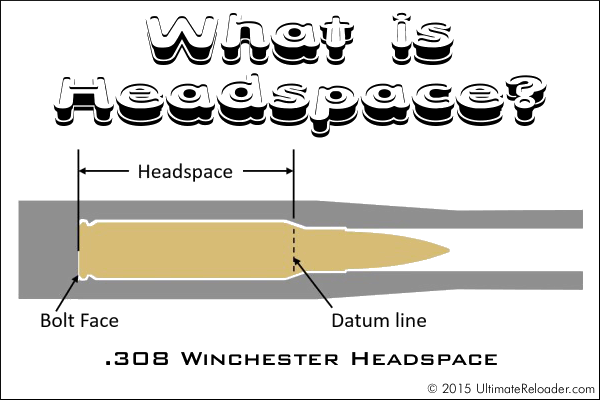
This illustration shows headspace measurement for the popular .308 Winchester cartridge, which headspaces on the shoulder. Image copyright 2015 Ultimate Reloader.
In this Brownells Tech Tip Video, Brownells gun tech Steve Ostrem explains what headspace is and why it’s one of the most critical measurements for nearly all firearms. Even if you’re an experienced rifle shooter, it’s worth watching this video to refresh your understanding of headspace measurements, and the correct use of “GO” and “NO-GO” gauges.
Headspace Definition
In firearms, headspace is the distance measured from the part of the chamber that stops forward motion of the cartridge (the datum reference) to the face of the bolt. Different cartridges have their datum lines in different positions in relation to the cartridge. For example, 5.56x45mm NATO ammunition headspaces off the shoulder of the cartridge, whereas .303 British headspaces off the forward rim of the cartridge. If the headspace is too short, ammunition that is in specification may not chamber correctly. If headspace is too large, the ammunition may not fit as intended or designed and the cartridge case may rupture, possibly damaging the firearm and injuring the shooter. (Source: Wikipedia)
Problems Caused by Too Much Headspace
Excessive headspace issues can include: light primer strikes, failure to fire, bulged/blown cases, case separations, split shoulders, or unseated primers after firing. Case ruptures caused by excessive headspace can lead to catastrophic failures causing serious injury. That is why headspace is such an important measurement.
Problems Cause by Too Little Headspace
Insufficent (or excessively tight) headspace can prevent the firearm from going into battery, resulting in failure to fire or deformation of the cartridge case. Various feeding and functioning problems can be caused by cases with too little headspace, even if a round can be chambered (with effort).
Headspace Gauges
Headspace is measured with a set of two headspace gauges: a “Go” gauge, and a “No-Go” gauge. Headspace gauges resemble the cartridges for the chambers they are designed to headspace, and are typically made of heat-treated tool steel. Both a “Go” and a “No-Go” gauge are required for a gunsmith to headspace a firearm properly. A third gauge, the “Field” gauge, is used (as the name implies) in the field to indicate the absolute maximum safe headspace. This gauge is used because, over time, the bolt and receiver will wear, the bolt and lugs compress, and the receiver may stretch, all causing the headspace to gradually increase from the “factory specs” measured by the “Go” and “No-Go” gauges. A bolt that closes on “No-Go” but not on “Field” is close to being unsafe to fire, and may malfunction on cartridges that are slightly out of spec. (Source: Wikipedia)
To learn more, read Brownell’s article Headspace Gauges and How to Use Them. Among other things, this explains the relative lengths of “Go”, “No-Go”, and “Field” gauges. The “Field” is actually the longest: “The GO gauge corresponds to the SAAMI minimum chamber length, while the FIELD gauge usually matches the maximum chamber depth, or slightly less. NO-GO gauges are an intermediate length between minimum and maximum, that, technically, is a voluntary dimension. A firearm that closes on a NO-GO gauge and does not close on a FIELD gauge may not give good accuracy and may have very short cartridge case life from the ammunition re-loader’s standpoint.”


 If you read our lengthy article on
  The Brownell’s article explains: “Ultrasonic cleaning uses high-frequency sound waves (generally between 20-80 kHz) to remove a variety of contaminants from objects immersed in a liquid. The result of these high-frequency sound waves is a process called cavitation. These high frequency bursts of ultrasonic energy produce a three-dimensional wave of alternating positive and negative pressure areas as the sound wave passes through the solution. During negative pressure, microscopic cavitation bubbles form and will continue to grown until they reach resonant size. As the positive sound wave passes, the pressure rises rapidly and implodes these tiny bubbles. Before these minuscule bubbles implode they store a tremendous amount of energy. These bubbles can be as hot as 10,000 degrees and have as much as 50,000 lbs per square inch of pressure. This sounds alarming, but you have to remember that these bubbles are microscopic in nature and pose no harm to anything, unless you are a carbon /powder residue deposit on a cartridge case!
 When this cavitation bubble implodes near your brass case, it transforms the bubble into a jet about 1/10th of its size. This jet of energy can travel as fast as 400 km/hour. At 43 kHz, as is the frequency for our L & R HCS 200 ultrasonic cleaner, this is happening 43,000 times per second. This micro-burst of extreme energy is responsible for removing contaminants from the surface of your cartridge brass. Ultrasonic cleaning can reach into crevices and inaccessible areas and remove surface debris that can’t be cleaned by any other process.”






 Headspace Gauges


