There’s a new home on the web for Extreme Long Range (ELR) shooters. Bryan Litz and Applied Ballistics recently launched ELR Central, a new website dedicated to ultra-long-range shooting*. This new site will offer a wide variety of information. Bryan Litz explains: “The most visible element of ELR Central will be a website which will serve to publish and promote all ELR shooting events going on across the country. Although owned and operated by Applied Ballistics, ELR Central will rely heavily on input from the community in order to best serve the sport as a whole.” Along with the ELR Central website, Applied Ballistics has launched a new ELR Central Facebook page.
Content Available on ELR Central
The ELR Central website will eventually offer a comprehensive library of information and activity reports. Bryan and his team plans to build out the website to include all the following:
1. Map of ELR ranges across the USA.
2. List of ELR events with links to the Match Directors’ pages.
3. Technical information and articles for the ELR community.
4. Match results/reports, including equipment lists where available.
5. Analysis of what equipment and shooters are doing well in ELR.
6. Links to other ELR shooting resources such as forums and websites.
On 5/13/17, the Applied Ballistics ELR Team had a successful practice at 3161 Yards (1.8 miles). Bryan Litz reports: “The main goal … was to test how the Berger and Cutting Edge bullets traveled through transonic and subsonic speeds. We all made several hits on target and several within 1 MOA of center.”
Standardized ELR Targets
Another goal of ELR Central is to develop standardized ELR targetry. Bryan explains: “In competitive rifle shooting, standardization of targetry is important. Applied Ballistics, through ELR Central, will provide steel targets to organizations wishing to run ELR matches and/or record-setting events. No one would be required to use these standard targets, we’re simply providing resources to help promote promote some consistency.” The initial standard target, produced by MGM Targets, will be a steel square, 3 feet (36″) per side.
ELR Central is Not A Rule-Making Entity
Bryan was quick to explain that ELR Central is not a governing body, but rather it was created to help advance the sport (and science) of shooting at very long distances, one mile and beyond: “The concept of ELR Central is a result of the ongoing discussions about standardizing ELR matches, records, targets, and more. Although ELR Central will not be enforcing these details, there is a measure of organization which we feel is appropriate, would benefit the sport, and that we are willing to provide. ELR Central is NOT a governing or sanctioning body. We do not have nor seek the authority to dictate how matches are run. For anyone who asks, we can advise on best practices, and what’s generally working, but we’re not here to tell anyone what to do nor how to do it.”
More Information on ELR Competition, per ELR Researcher:
(1) By consensus of the parties involved in the ELR meetings held at SHOT this year, and notwithstanding the names and descriptions of certain “ELR” web sub-forums, “ELR” has been defined as “beyond 1500 yards”.
(2) ELR Central-recognized “ELR” events require that more than one-half of targets must be beyond 1500 yards. Where all criteria are not met an event may be promoted as having “ELR components”.
(3) “ELR Central has published a set of guidelines and standards by which official world records can be established.” CLICK HERE for guidelines/standards.
Story tip from EdLongrange. We welcome reader submissions.
Need a top-notch Ballistics App for your iPhone, iPad, or iPod? Start with Ballistic AE, the number 1 (i.e. most installed) App for iOS systems. Ballistics AE (Advanced Edition) is the most popular iOS ballistics program for many good reasons. Full-featured and easy to use, Ballistics AE has been refined over many years, and it supplies rock-solid solutions derived from JBM Ballistics solver (created by James B. Millard). Unlike some other Apps, Ballistics AE is STABLE on iPhones (with various OS levels). What’s cool is that Ballistics AE is now on sale for $12.99.
We’ve used the Ballistic AE program on an iPhone 5S, iPhone 6, and iPad, and it performed well. Here are some of the features we liked:
1. Mirrors output from online version of JBM Ballistics we often use for initial calculations.
2. Controls are simple to use and (mostly) intuitive.
3. Handy comparison feature lets you compare ballistics for different projectiles side by side.
4. Advanced Wind Kit allows you to account for complex wind situations.
5. Projectile and BC Database is very comprehensive.
6. Software is regularly updated to match Apple OS changes.
Comprehensive Projectile Info and BCs
Ballistics AE has very complete data libraries. The program includes 5,000 projectiles, factory loads, military loads, and performance data points from leading manufacturers, military testing, and performance testing.
Ballistic Coefficient libraries include the latest commercial BC data, plus Applied Ballistics’ (Bryan Litz) custom G7 BCs, plus G7 military coefficients from Aberdeen Proving Grounds.
These Videos Explain How to Set Up and Use Ballistic AE:
There’s a great interview with Bryan Litz of Applied Ballistics on Mia Rhode’s Life Of A Shooter’s Wife Blog. We recommend you read the full interview. Bryan offers many important insights that can benefit any precision shooter. It’s fascinating to learn about Bryan’s background and how he progressed in competitive shooting, starting with very basic equipment. As a “broke high school kid”, he got started on the cheap, paying for gear with wages from McDonald’s. Now he’s a globally-recognized expert in Ballistics and Long Range precision. You’ll enjoy reading the Full Interview. Here are some highlights…
LOASW: When did you first become interested in shooting?
Bryan: My first memories of shooting were at the age of about 9 or 10. Pellet rifle in the back yard. My Dad taught me to shoot, stressing the importance of accuracy. I was driven to hit targets, mostly small targets at long distance. My grandfather was on the All-Army shooting team back in the ‘50s, and was distinguished in both rifle and pistol. Shooting is part of my family’s DNA and I benefited from that from a young age.
LOASW: What sparked your interest in Competitive Shooting and how old were you when you started competing?
Bryan: Hunting groundhogs in the farm-fields of Pennsylvania through high school is where I truly connected with long-range shooting. My Dad heard of a competition range (The Original Pennsylvania 1000 Yard Benchrest Club in Williamsport, PA). So we visited there one summer and I immediately found my trusty 22-250 inadequate for the job of 1000-yard benchrest shooting. So I saved my McDonald’s wages until I could afford a 7mm Remington Magnum and began competing in my first matches at the age of 15.
Learning with Limited Resources…
… It was a huge mis-match to my situation because benchrest is a highly gear-driven sport, and the winners typically have many $1000s of dollars wrapped up in equipment. I was a broke high school kid who needed my parents to drive me to the range my first year, and my second year, I had to rely on fellow competitors to jump start my old pick-up truck that was always breaking down. Nevertheless I enjoyed the hell out of shooting 1000 yards. I can honestly say that I don’t have any more FUN shooting these days with all the best equipment as compared to those bad ‘ol days when I had maybe $900 total wrapped up in all my gear. Those who remember me from those early days might recall the home-made shooting rest and McDonalds French fry box that I carried all my gear in. Later when I picked up prone/sling shooting, my shooting mat was a piece of carpet (pink, no less), and my shooting coat was a military field jacket with belts sewn in it.
Money was probably my biggest challenge when I started out. I had plenty of fun with my budget kit, but was certainly constrained by lack of access to quality gear. I overcame this with hard work and making the most of what I had. Learning how to mitigate the deficiencies of my equipment was an important stepping stone which has been highly valuable even now when I’ve got better stuff. It’s a good skill to have, to be able to spot something about to come unraveled.
LOASW: What advice would you give to someone new to competitive shooting?
Bryan: Find a mentor, someone who lives near you who has experience and is willing to share it. You will cut years off your learning curve if you can get someone to share their experience with you who’s “been there done that”.
You may not realize it… but to get the optimum BC from your bullets (i.e. the lowest aerodynamic drag), you must spin the bullets fast enough. Bullet drag increases (as expressed by lower BC) if the bullet spins too slowly. Bryan Litz of Applied Ballistics explains how BC changes with twist rates…
More Spin, Less Drag
In this article, we look at how twist rate and stability affect the Ballistic Coefficient (BC) of a bullet. Again, this topic is covered in detail in the Modern Advancements book. Through our testing, we’ve learned that adequate spin-stabilization is important to achieving the best BC (and lowest drag). In other words, if you don’t spin your bullets fast enough (with sufficient twist rate), the BC of your bullets may be less than optimal. That means, in practical terms, that your bullets drop more quickly and deflect more in the wind (other factors being equal). Spin your bullets faster, and you can optimize your BC for best performance.
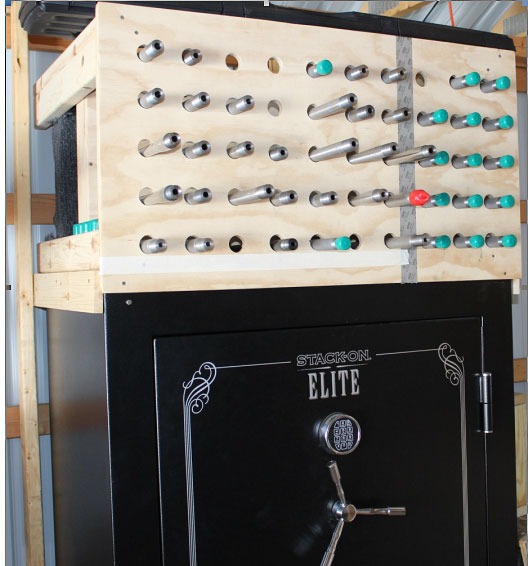
Any test that’s designed to study BC effects has to be carefully controlled in the sense that the variables are isolated. To this end, barrels were ordered from a single barrel smith, chambered and headspaced to the same rifle, with the only difference being the twist rate of the barrels. In this test, 3 pairs of barrels were used. In .224 caliber, 1:9” and 1:7” twist. In .243 caliber it was 1:10” and 1:8”, and in .30 caliber it was 1:12” and 1:10”. Other than the twist rates, each pair of barrels was identical in length, contour, and had similar round counts. Here is a barrel rack at the Applied Ballistics Lab:
Applied Ballistics used multiple barrels to study how twist rate affects BC.
“The Modern Advancements series is basically a journal of the ongoing R&D efforts of the Applied Ballistics Laboratory. The goal of the series is to share what we’re learning about ballistics so others can benefit.” –Bryan Litz
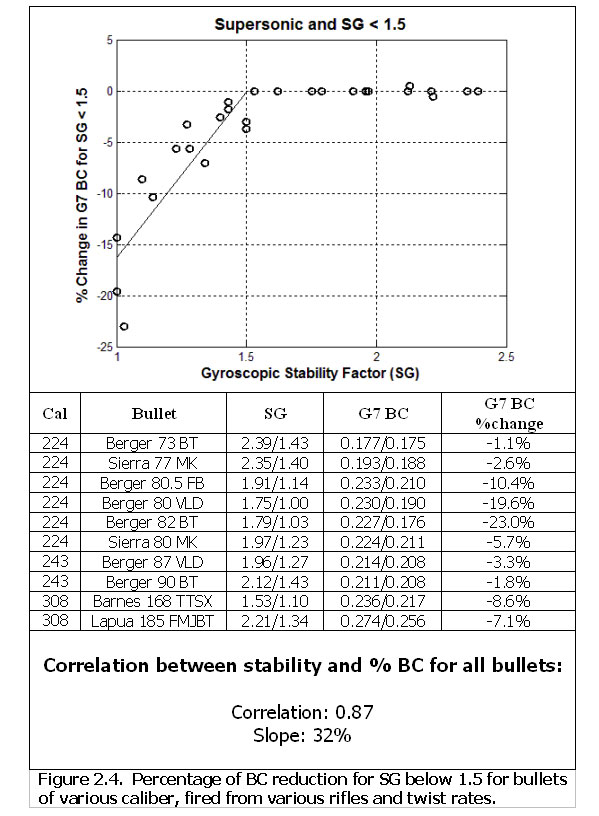
Barrel twist rate along with velocity, atmospherics, and bullet design all combine to result in a Gyroscopic Stability Factor (SG). It’s the SG that actually correlates to BC. The testing revealed that if you get SG above 1.5, the BC may improve slightly with faster twist (higher SG), but it’s very difficult to see. However, BC drops off very quickly for SGs below 1.5. This can be seen in the figure below from Modern Advancements in Long Range Shooting.
The chart shows that when the Gyroscopic Stability Factor (SG) is above 1.5, BC is mostly constant. But if SG falls below 1.5, BC drops off dramatically.
Note that the BC drops by about 3% for every 0.1 that SG falls below 1.5. The data supports a correlation coefficient of 0.87 for this relationship. That means the 3% per 0.1 unit of SG is an accurate trend, but isn’t necessarily exact for every scenario.
It’s a common assumption that if a shooter is seeing great groups and round holes, that he’s seeing the full potential BC of the bullets. These tests did not support that assumption. It’s quite common to shoot very tight groups and have round bullet holes while your BC is compromised by as much as 10% or more. This is probably the most practical and important take-away from this test.
To calculate the SG of your bullets in your rifle, visit the Berger Bullets online stability calculator. This FREE calculator will show you the SG of your bullets, as well as indicate if your BC will be compromised (and by how much) if the SG is below 1.5. With the stated twist rate of your barrel, if your selected bullet shows an SG of 1.5 (or less), the calculator will suggest alternate bullets that will fully stabilize in your rifle. This valuable online resource is based directly on live fire testing. You can use the SG Calculator for free on the web — you don’t need to download software.
Learn More About SG and BC This article is just a brief overview of the interrelated subjects of twist rate, Gyroscopic Stability, and BC. The coverage of twist rates in Modern Advancements in Long-Range Shooting is more detailed, with multiple live fire tests.
Other chapters in the book’s twist rate section include: · Stability and Drag – Supersonic
· Stability and Drag – Transonic
· Spin Rate Decay
· Effect of Twist rate on Precision
Other sections of the book include: Modern Rifles, Scopes, and Bullets as well as Advancements in Predictive Modeling. This book is sold through the Applied Ballistics online store. Modern Advancements in Long Range Shooting is also available in eBook format in the Amazon Kindle store.
In this video Bryan Litz of Applied Ballistics offers tips on Big Bore shooting (i.e. .338 caliber and above). Bryan offers advice on bullet selection and he explains the challenge of handling the blast, noise, concussion, and recoil of big boomers such as the .416 Barrett and .50 BMG.
Bryan goes big … very big, shooting a monster .50 BMG bullpup.
Watch the recoil pulse shove Bryan backwards at 1:40 time-mark:
Big Bore Basics — Tips for Shooting Big Boomersby Bryan Litz
There are some unique things to consider with big-bore shooting. One is bullet design. For long-range shooting you want high-BC bullets. You get high BC from heavy bullets and bullets that have low drag. The interesting trade-off in big calibers is that there are a lot more lathe-turned solid bullets in copper and brass available than there are in the smaller calibers. You’ve got bullets that have slightly lower drag profiles but they are made of materials that are slightly less dense (than lead) so they are relatively light for their caliber. With that trade-off, the BCs might not be as high as you think for big calibers, although the bullets are heavy enough that they carry a lot of energy.
Energy really has a lot to do with shooting these big-caliber rifles. As with any kind of shooting, the fundamentals of marksmanship are the most important thing. However, it can be hard to maintain good fundamentals (e.g. trigger control and sight alignment) when you’re burning 100 grains of powder. There’s a lot of concussion (you want a muzzle brake no matter what your cartridge is above .338). It certainly can be challenging with all the muzzle blast and all the energy coming out of the barrel.
For long-range shooting with big bore rifles, you are still looking for the same things that you want with smaller-caliber rigs. You want a high-performance bullet, you want consistent ammunition, and you want a good fire solution to be able to center your group at long range. Basically you’re just dealing with the challenges that the high energy brings, and being smart about your bullet selection.
In the video above, Bryan is shooting the DesertTech HTI bullpup. This rifle can shoot four (4) big bore chamberings, with barrel conversion kits for: .375 CheyTac, .408 CheyTac, .416 Barrett, and .50 BMG. These can be quickly swapped in the HTI chassis, which employs an internal barrel-clamp system.
Have you recently purchased a new scope? Then you should verify the actual click value of the turrets before you use the optic in competition (or on a long-range hunt). While a scope may have listed click values of 1/4-MOA, 1/8-MOA or 0.1 Mils, the reality may be slightly different. Many scopes have actual click values that are slightly higher or lower than the value claimed by the manufacturer. The small variance adds up when you click through a wide range of elevation.
In this video, Bryan Litz of Applied Ballistics shows how to verify your true click values using a “Tall Target Test”. The idea is to start at the bottom end of a vertical line, and then click up 30 MOA or so. Multiply the number of clicked MOA by 1.047 to get the claimed value in inches. For example, at 100 yards, 30 MOA is exactly 31.41 inches. Then measure the difference in your actual point of impact. If, for example, your point of impact is 33 inches, then you are getting more than the stated MOA with each click (assuming the target is positioned at exactly 100 yards).
How to Perform the Tall Target Test
The objective of the tall target test is to insure that your scope is giving you the proper amount of adjustment. For example, when you dial 30 MOA, are you really getting 30 MOA, or are you getting 28.5 or 31.2 MOA? The only way to be sure is to verify, don’t take it for granted! Knowing your scopes true click values insures that you can accurately apply a ballistic solution. In fact, many perceived inaccuracies of long range ballistics solutions are actually caused by the scopes not applying the intended adjustment. In order to verify your scope’s true movement and calculate a correction factor, follow the steps in the Tall Target Worksheet. This worksheet takes you thru the ‘calibration process’ including measuring true range to target and actual POI shift for a given scope adjustment. The goal is to calculate a correction factor that you can apply to a ballistic solution which accounts for the tracking error of your scope. For example, if you find your scope moves 7% more than it should, then you have to apply 7% less than the ballistic solution calls for to hit your target.
NOTE: When doing this test, don’t go for the maximum possible elevation. You don’t want to max out the elevation knob, running it to the top stop. Bryan Litz explains: “It’s good to avoid the extremes of adjustment when doing the tall target test.I don’t know how much different the clicks would be at the edges, but they’re not the same.”
Should You Perform a WIDE Target Test Too?
What about testing your windage clicks the same way, with a WIDE target test? Bryan Litz says that’s not really necessary: “The wide target test isn’t as important for a couple reasons. First, you typically don’t dial nearly as much wind as you do elevation. Second, your dialed windage is a guess to begin with; a moving average that’s different for every shot. Whereas you stand to gain a lot by nailing vertical down to the click, the same is not true of windage. If there’s a 5% error in your scope’s windage tracking, you’d never know it.”
Verifying Scope Level With Tall Target Test
Bryan says: “While setting up your Tall Target Test, you should also verify that your scope level is mounted and aligned properly. This is critical to insuring that you’ll have a long range horizontal zero when you dial on a bunch of elevation for long range shots. This is a requirement for all kinds of long range shooting. Without a properly-mounted scope level (verified on a Tall Target), you really can’t guarantee your horizontal zero at long range.”
NOTE: For ‘known-distance’ competition, this is the only mandatory part of the tall target test, since slight variations in elevation click-values are not that important once you’re centered “on target” at a known distance.
Applied Ballistics has produced a series of YouTube videos about precision long range shooting. Featuring ace long-range shooter and professional ballistician Bryan Litz, these videos address various topics of interest to long-range marksmen. This featured video looks at Long Range mistakes — Bryan Litz reveals the most common ballistics-related shooting errors at Long Range. And then Bryan explains how to improve your shooting (and wind reading) to eliminate those common errors.
Watch Applied Ballistics Video about Common Mistakes in Long Range Shooting:
Bryan Litz of Applied Ballistics often hears the question: “What are the main reasons people miss their target at long range?” To answer that question, in this video, Bryan explains the most important variables in Long Range shooting. Bryan says: “Probably the number one thing is range — you have to have a [precise] range to your target because your bullet is dropping, and to hit the target you need to correct for bullet drop.” Distance may be indicated on the target bay (or berm), but for open ranges you should ascertain distance-to-target with a quality laser rangefinder. Even when the distance to target is shown with a sign or marker, you may want to confirm the distance with your rangefinder. (You may be surprised — we’ve seen marked target distances at commercial ranges off by 25+ yards!) Bryan says: “Get a good laser range to the target and you’ll be within a couple yards”.
After distance to target, the most important variable is the wind. This is the most challenging factor because the wind is constantly changing. Bryan explains: “After 300 or 400 yards, the wind [will] move your shots off the target if you don’t correct for it. The best way to account for the wind is to measure it at your location with a Kestrel. The Kestrel can give you the speed and direction of the wind at your location, which can baseline your wind call for your long-range shot.” Bryan acknowledges that there will still be variables: “The wind isn’t always blowing the same downrange as at your location… and the wind is always changing”. Bryan notes that you need to account for variances in wind between the time you gauge the wind angle and velocity and the time you actually you take your shot.
At the Berger SW Nationals this week in Phoenix, the nation’s top long-range shooters will try to put all their shots in the 10-Ring at 800, 900, and 1000 yards. A good foundation in ballistics is vital if you want to succeed in the long-range game.
How much do you know about BCs, Bullet Shapes, Trajectories, Wind Drift, and other things in the realm of External Ballistics? You can test your knowledge of basic Ballistics principles with this interactive quiz. The questions and answers were provided by Ballistics Guru Bryan Litz of Applied Ballistics LLC. Bryan is the author of Applied Ballistics for Long-Range Shooting and other popular resources in print, DVD, and eBook format. Have fun with our Quiz.
The Quiz contains ten (10) questions. When you complete all ten questions, you can see your results, along with the correct answers.
Applied Ballistics has created a series of YouTube videos about precision long range shooting. Featuring ace long-range shooter and professional ballistician Bryan Litz, these videos will address various topics of interest to long-range marksmen. In this video, the first in the series, Bryan Litz answers the question, “Just What Is Long Range Shooting?” Bryan discusses how we define “long range” and the key factors shooters need to consider.
Applied Ballistics Video — What Is Long Range Shooting?
Bryan states: “I don’t think there is a clear definition of where Long Range starts.” But he offers this practical guideline: “The way I think of it, any time you’re making major adjustments to your zero in order to hit a target, due to gravity drop and wind deflection, THEN you’re getting into ‘Long Range’. For example, if you are zeroed at 100 yards and need to shoot to 600 yards, you have many feet of elevation [drop] to account for, and to me, that’s where it becomes Long Range.”
Extended Long Range and the Transonic Zone
Bryan adds a second concept, namely “Extended Long Range”. Litz says that: “Extended Long Range starts whenever the bullet slows to its transonic range. As the bullet slows down to approach Mach 1, it starts to encounter transonic effects, which are more complex and difficult to account for, compared to the supersonic range where the bullet is relatively well-behaved.” Bryan notes that bullets start to encounter transonic effects at about 1340 fps, quite a bit faster than the speed of sound, which is about 1116 fps at sea level in normal conditions (59° F).
With the Berger Southwest Nationals coming up soon (Feb. 6-12), we thought we would share some tips from a past Champion who really knows the Ben Avery range in Phoenix. In 2015, Bryan won the F-TR Mid-Range AND Long-Range National Championships hosted at Ben Avery. And at the 2014 Berger SW Nationals (SWN), Bryan took top honors among all sling shooters. If you only know Bryan Litz from his Applied Ballistics Books and DVDs, you may not realize that this guy is a great marksman (along with being an actual rocket scientist). This guy can shoot.
Given his impressive track record at Ben Avery, we asked Bryan if he had any advice for other long-range competitors. First Bryan provided three tips concerning Ballistics, his special area of expertise. Next Bryan offered three more general tips about long-range competition — how to analyze your shooting, how to choose your ‘wind strategy’, and how to avoid the most costly mistakes, i.e. how to avoid the “train-wrecks”.
Here is the sleek F-TR Rig Bryan Litz used to win the 2015 F-TR Mid-Range and Long-Range Championships at Ben Avery:
Litz Ballistics Tips
Ballistics TIP ONE. If you’re having trouble getting your ballistic software to match actual drops, you need to look at a number of possible reasons. Here are some common issues that can cause problems.
Click Values Are Not Exact. Scopes and iron sights don’t always produce accurate adjustments. In other words, if your ballistics program predicts 30 MOA of drop, and you dial 30 MOA but hit low, it might be that your sight actually only moved 28 MOA (for example). To see if your sight is adjusting accurately, shoot a tall target at 100 yards and measure group separation when dialing your sight.
Barometric vs. Station Pressure. This is a commonly misunderstood input to ballistics programs. You can avoid this pitfall by remembering the following: station pressure is the actual measured pressure at your location, and you don’t need to tell the program your altitude when using station pressure. Barometric pressure is corrected for sea level. If you’re using barometric pressure, you also have to input your altitude.
Muzzle Velocity. Chronographs are not always as accurate as shooters think they are — your true MV may be off by 10-20 fps (or more). If your drop is different than predicted at long range, it might be because your muzzle velocity input is wrong.
Mixing Up BC (G1 vs. G7). Knowledgeable long range shooters know that the G7 standard is a more representative standard for modern LR bullets. However, using G7 BCs isn’t just a matter of clicking the ‘G7′ option in the program. The numeric value of the BC is different for G1 and G7. For example, the G1 BC of the Berger 155.5 grain Fullbore bullet is .464 but the G7 BC is .237. If you were to enter .464 but click on G7, the results would be way off.
Ballistics TIP TWO. A properly installed level is absolutely essential for long range shooting. Without a good level reference, your long range wind zero will be off due to minor canting of the rifle from side to side. You can verify that your level is installed correctly on a 100-yard ‘tall target’. Draw a plumb line straight up the target and verify that your groups track straight up this line as you go up in elevation.
Ballistics TIP THREE. If your long range ballistic predictions aren’t tracking, always come back and verify your 100-yard zero. Sometimes a simple zero shift can be misconstrued as errors in long range ballistics predictions.
Litz Competition Shooting Tips
Competition TIP ONE. Improving your scores in long range competition is a constant process of self-assessment. After each match, carefully analyze how you lost points and make a plan to improve. Beginning shooters will lose a lot of points to fundamental things like sight alignment and trigger control. Veteran shooters will lose far fewer points to a smaller list of mistakes. At every step along the way, always ask yourself why you’re losing points and address the issues. Sometimes the weak links that you need to work on aren’t your favorite thing to do, and success will take work in these areas as well.
Competition TIP TWO. Select your wind shooting strategy carefully. For beginners and veterans, most points are typically lost to wind. Successful shooters put a lot of thought into their approach to wind shooting. Sometimes it’s best to shoot fast and minimize the changes you’ll have to navigate. Other times it’s best to wait out a condition which may take several minutes. Develop a comfortable rest position so you have an easier time waiting when you should be waiting.
Competition TIP THREE. Actively avoid major train wrecks. Sounds obvious but it happens a lot. Select equipment that is reliable, get comfortable with it and have back-ups for important things. Don’t load on the verge of max pressure, don’t go to an important match with a barrel that’s near shot out, physically check tightness of all important screws prior to shooting each string. Observe what train wrecks you and others experience, and put measures in place to avoid them.
“Must-Watch” SWN Video has aerial view of Ben Avery plus highlights from Saturday


 Standardized ELR Targets


 LOASW: When did you first become interested in shooting?



 Verifying Scope Level With Tall Target Test


 With the


