In this video, Bryan Litz of Applied Ballistics talks about Density Altitude and the effect of atmospheric conditions on bullet flight. Bryan explains why you must accurately account for Density Altitude when figuring long-range trajectories.
Bryan tells us: “One of the important elements in calculating a fire solution for long-range shooting is understanding the effect of atmospherics. Temperature, pressure, and humidity all affect the air density that the bullet’s flying through. You can combine all those effects into one number (value) called ‘Density Altitude’. That means that you just have one number to track instead of three. But, ultimately, what you are doing is that you are describing to your ballistics solver the characteristics of the atmosphere that your bullet’s flying through so that the software can make the necessary adjustments and account for it in its calculations for drop and wind drift.”
Bryan adds: “Once you get past 500 or 600 yards you really need to start paying careful attention to atmospherics and account for them in your ballistic solutions”. You can learn more about Density Altitude in Bryan’s book, Applied Ballistics for Long Range Shooting (Third Edition).
General Scientific Definition of Density Altitude
Density altitude is the altitude relative to the standard atmosphere conditions (ISA) at which the air density would be equal to the indicated air density at the place of observation. Density altitude can be calculated from atmospheric pressure and temperature (assuming dry air). Here is the formula:
Air is more dense at lower elevations primarily because of gravity: “As gravity pulls the air towards the ground, [lower] molecules are subject to the additional weight of all the molecules above. This additional weight means the air pressure is highest at sea level, and diminishes with increases in elevation”.*
Both an increase in temperature, decrease in atmospheric pressure, and, to a much lesser degree, increase in humidity will cause an increase in density altitude. In hot and humid conditions, the density altitude at a particular location may be significantly higher than the true altitude.
In this video, Bryan Litz of Applied Ballistics explains how to choose a bullet for long-range shooting and explains what you should be looking for when developing a long-range load. Bryan notes that, with a new rifle build, the bullet you select may actually dictate your gun components. When starting from a “clean slate”, once you select a bullet, you will then pick a barrel, twist rate, and cartridge that are appropriate for that bullet. In choosing a long-range projectile, Bryan recommends you choose a high-BC bullet “that is known for precision”. Then you need to find an ultra-consistent, reliable load.
This video is worth watching. Bryan Litz makes some very good points.
Load Development — Why Consistency is Key (and Half-MOA May Be Good Enough)
After choosing a bullet for your long-range project, then you need to develop a load through testing. Bryan explains: “Once you’ve selected a bullet … and you have selected the components around that bullet, the most important thing to remember in hand-loading is consistency. You’re going to do some testing to see what combination of powder charge, powder type, and seating depth give you the best groups and lowest standard deviations in muzzle velocity.”
Bryan says that if you develop a load that can shoot consistent, half-minute groups in all conditions, you should be satisfied. Bryan says that many long-range shooters “spin their wheels” trying to achieve a quarter-MOA load. Often they give up and start all over with a new bullet, new powder, and even a new cartridge type. That wastes time, money, and energy.
Bryan cautions: “My advice for hand-loaders who are long-range shooters, is this: If you can get a load that is reliable and can shoot consistent, half-minute groups with low MV variation and you can shoot that load in any condition and it will work well, then STICK with THAT LOAD. Then focus on practicing, focus on the fundamentals of marksmanship. The consistency you develop over time by using the same ammunition will mean more to your success in long range shooting than refining a half-minute load down to a quarter-minute load.”
Bryan notes that, at very long range, shooting skills and wind-calling abilities count most: “Your ability to hit a 10″ target at 1000 yards doesn’t improve very much if you can make your rifle group a quarter-minute vs. a half a minute. What’s going to determine your hit percentage on a target like that is how well you can calculate an accurate firing solution and center your group on that target. A lot of people would be more effective if they focused on the fire solution and accurately centering the group on the target [rather than attempting to achieve smaller groups through continuous load development].”
Editor’s Note: We agree 100% with the points Bryan makes in this video. However, for certain disciplines, such as 600-yard benchrest, you WILL need a sub-half-MOA rifle to be competitive at major matches. Well-tuned, modern 600-yard benchrest rigs can shoot 1/4-MOA or better at 100 yards. Thankfully, with the powder, bullets, and barrels available now, 1/4-MOA precision (in good, stable conditions) is achievable with a 17-lb benchgun built by a good smith with premium components.
Berger Twist-Rate Stability Calculator
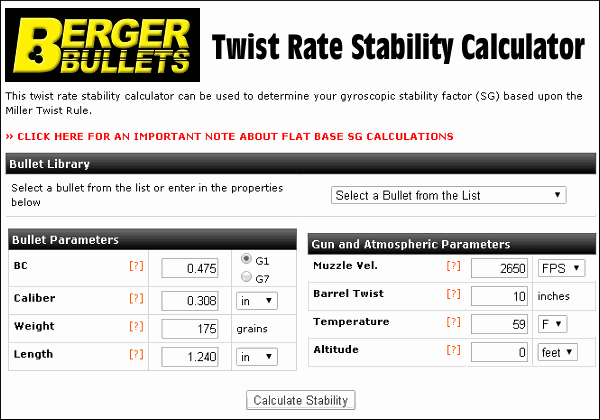
On the Berger Bullets website you’ll find a handy Twist-Rate Stability Calculator that predicts your gyroscopic stability factor (SG) based on mulitiple variables: velocity, bullet length, bullet weight, barrel twist rate, ambient temperature, and altitude. This cool tool tells you if your chosen bullet will really stabilize in your barrel.
How to Use Berger’s Twist Rate Calculator
Using the Twist Rate Calculator is simple. Just enter the bullet DIAMETER (e.g. .264), bullet WEIGHT (in grains), and bullet overall LENGTH (in inches). On its website, Berger conveniently provides this info for all its bullet types. For other brands, we suggest you weigh three examples of your chosen bullet, and also measure the length on three samples. Then use the average weight and length of the three. To calculate bullet stability, simply enter your bullet data (along with observed Muzzle Velocity, outside Temperature, and Altitude) and click “Calculate SG”. Try different twist rate numbers (and recalculate) until you get an SG value of 1.4 (or higher).
Gyroscopic Stability (SG) and Twist Rate
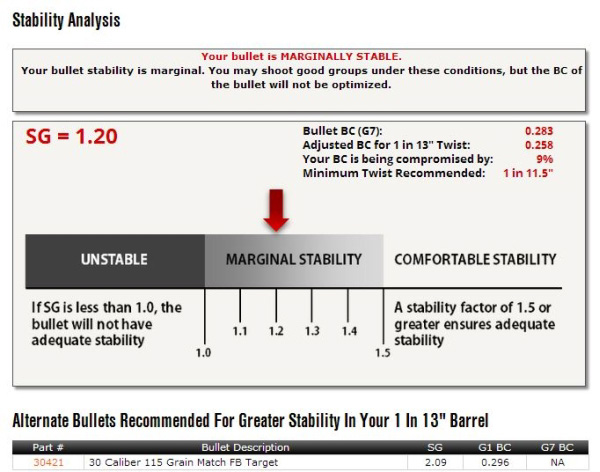
Berger’s Twist Rate Calculator provides a predicted stability value called “SG” (for “Gyroscopic Stability”). This indicates the Gyroscopic Stability applied to the bullet by spin. This number is derived from the basic equation: SG = (rigidity of the spinning mass)/(overturning aerodynamic torque).
If you have an SG under 1.0, your bullet is predicted not to stabilize. If you have between 1.0 and 1.1 SG, your bullet may or may not stabilize. If you have an SG greater than 1.1, your bullet should stabilize under optimal conditions, but stabilization might not be adequate when temperature, altitude, or other variables are less-than-optimal. That’s why Berger normally recommends at least 1.5 SG to get out of the “Marginal Stability” zone.
In his book Applied Ballistics For Long-Range Shooting, Bryan Litz (Berger Ballistician) recommends at least a 1.4 SG rating when selecting a barrel twist for a particular bullet. This gives you a safety margin for shooting under various conditions, such as higher or lower altitudes or temperatures.
Story idea from EdLongrange. We welcome reader submissions.
Extreme Long Range — 2477 Yards
Notably, two Applied Ballistics team shooters made hits at 2477 yards. Just how far is that? Take a look at the photo above — that shows the location of the 2477-yard target with the firing line in the far distance. Now THAT is truly long range!
By Paul Phillips
I wanted to share a video that I made. This was from the King of 2 Miles event held recently in Raton, New Mexico. I was fortunate enough to be apart of an amazing team with Bryan Litz and Mitchell Fitzpatrick. We had some awesome sponsors: Berger Bullets, Nightforce Optics, McMillan Group International, Lethal Precision Arms LLC and Applied Ballistics LLC. Team Applied Ballistics took First, Second, and Fourth places out of 38 teams in this competition. Our Team highlight was working together to make first-round hits on a 24×36 inch plate at 1.4 miles. With me as coach, both Mitchell and Bryan made their first-round hits at 1.4 miles (2477 yards to be exact).
Video Shows Team Accomplishing Hits at 2477 Yards in Raton, NM
This event has been a personal goal of mine for a long time and I wanted to thank Bryan Litz and Mitchell Fitzpatrick for having me on the team. I call them quiet professionals. I also wanted to thank Kelly McMillan for sponsoring our team and being involved. Kelly has been an amazing sponsor and advocate for shooting sports and providing stocks and rifles for our military snipers for the past 40 years. I can’t forget to thank Ian Klemm for loaning me his Vortex Spotting scope with the MOA milling reticle. It worked great and was very fast to make corrections along with good glass.
Mitchell Fitzpatrick won the KO2M finals to earn the title “King of Two Miles”. He had a dominant performance shooting a .375 Lethal Precision Arms LLC rifle loaded with prototype solid 400gr Berger bullets. Mitchell built this rifle himself using a McMillan A5 Super Mag stock. Note: Berger has no current plans to market this .375-caliber bullet — it is still in the prototype stage.
Editor: Paul Phillips asked to make a special dedication, remembering a family member: “My brother Daniel Phillips passed away with brain cancer last year and this event was one that he wanted to video for me. I know he is smiling in heaven.”
Applied Ballistics team dominates the King of 2 Miles match: Mitchell Fitzpatrick (1st Place), Bryan Litz (2nd Place), and Paul Phillips (4th Place).
The King of 2 Miles event has come to an end, the scores have been tallied, and Team Applied Ballistics finished first, second, and fourth. That’s dominance. The “Top Gun” was young Mitchell Fitzpatrick, who blitzed the field with his impressive .375 Lethal Precision Arms LLC rifle shooting prototype solid 400gr Berger bullets. Mitchell built this rifle himself using a McMillan A5 Super Mag stock. Remarkably, Mitchell nailed first- and second-shot hits at the 2477-yard target, a full 1.4 miles away. That’s amazing shooting. The photo below illustrates the vast distance from firing line to target.
Mitchell gave credit to his team-mates: “We had the best ballistic solutions possible thanks to the work done at Applied Ballistics LLC by the one and only Bryan Litz. Bryan is also a world-class wind coach and world champion shooter. Paul Phillips, also a world-class wind coach, world champion shooter, and just an all-around class act. Paul was invaluable to making the wind calls we needed to win this match. One of the most important parts of any rifle system is the projectile… Berger’s new prototype .375-cal 400gr projectile we have been developing gave us a monumental ballistic advantage. [It was] without a doubt, a key to our success.”
Berger Ballistician Bryan Litz took second place shooting a .338 Edge (the only .338 rifle in the Finals). Durvin Wick finished third, while Paul Phillips, shooting Bryan’s rifle, placed fourth overall.
Report by Bryan Litz, Team Applied Ballistics
The 2016 King of 2 Miles event is in the books. Today the Top 10 teams engaged targets at 2011 yards, 2477 yards, and 3375 yards. All three Applied Ballistics teams had hits at 2011 yards, and two out of three of us scored first-round hits at 2477 yards! Note that no competitor (from any team) hit the two-mile (3375-yard) target, but that gives us a goal to shoot for next year. Many factors contributed to the success of the Applied Ballistics shooters in this event:
1. Teamwork. We shoot together on the U.S. Rifle Team. The standardized communication protocols between coaches and shooters was a big advantage in this timed event. We had excellent team-work, and are already discussing ways to improve and adapt our approach to ELR events.
2. Science. Applied Ballistics specializes in the science of accuracy. First round hits in this event are scored highly and you can get more first round hits if you know your ballistics. The top two shooters in this event both had first round hits at 2477 yards today which was key, and is not possible without highly accurate ballistic solutions.
3. Ballistic Performance. The performance of Mitchell Fitzpatrick’s .375 Lethal Precision Arms LLC rifle with the prototype 400 grain Berger Bullets solid is unmatched (G7 BC of 0.56 at over 3000 fps). This performance helped Mitch win the match by a sizable margin. The other two Applied Ballistics teams were shooting Bryan Litz’s .338 Edge with the Berger Bullets 300 grain Hybrid. Despite being a smaller caliber (compared to the .375s, .416s, and .50-calibers), the .338 Cal 300 grain Berger Hybrid proved to be a great performer.
There were quite a few big .50 Cals on the line, but a .375 topped the field. Sheri Judd photo.
Thanks to Eduardo Abril De Fontcuberta, Founder of the KO2M Event
We would like to thank all those who worked hard to make this event happen especially Eduardo Abril De Fontcuberta (shown below with Mitchell Fitzpatrick and Paul Phillips). Eduardo has worked hard to organize a great event that pushes the limits of ELR shooting in a fun and competitive way. We’re very grateful for the chance to participate and look forward to competing in the King of 2 Miles event next year. Also, thanks to Kelly McMillan for his support of our team. Kelly has been an awesome sponsor of our efforts here, as well as the U.S. Rifle Team, and the shooting community in general.
The King of 2 Miles Extreme Long Range (ELR) competition is underway at the NRA Whittington Center in Raton, New Mexico. Many of the nation’s top shooters are competing — aiming for hits on targets as far out as 3500 yards.
Day One went well. I was the third shooter this morning. Started out good with 4/5 hits at 1454 yards including a first-round hit which is worth a lot of points. The second target was only 100 yards further, but the wind cycled and I missed the first two shots. If you miss three shots on any target after the first, you’re out! So cautiously, and with help from my teammates/spotters Paul Phillips and Mitchell Fitzpatrick, I scored a third round hit at 1550 and was able to advance to the 1720-yard target. I manage to hit that 1720-yard target three out of three times.
The final target on Day One was at 2011 yards. Unfortunately I had three close misses. (Editor: Close only counts in horseshoes and hand grenades, Bryan…)
Twenty teams shot today and about 15 more will shoot the qualifying stage tomorrow then the top 10 from the two days will shoot on Thursday at over 3300 yards for the crown. My score of about 29,000 points is good. But I won’t know for certain if I’ve made the Top 10 until all tomorrow’s teams fire.
Mitchell Fitzpatrick hit every target on his first two shots and finished with 40,000 points on Day One. His farthest shots were just over 2000 yards.
So that’s my story so far, but that’s not THE story. Teammate Mitchell Fitzpatrick (with rifle above) topped the field today with a monster score, hitting all targets and racking up over 40,000 points! The prototype Berger .375-caliber, 400gr bullets and Mitch’s .375 Wildcat from Lethal Precision Arms LLC are a super high-performance combination that made short work of the ELR course.
Also, teammate Paul Phillips, who originally was only here to spot, has entered the competition. He’ll be shooting my .338 Edge tomorrow. Luckily I brought plenty of ammo!
Picture below is the full Applied Ballistics team with sponsor Kelly McMillan. Kelly has been great to our team and we’re looking forward to some future projects with him in ELR.
In all the King of 2 Miles event is very enjoyable. It’s a great place to come and learn from fellow ELR shooters what works and what doesn’t work at these ranges. The spirit of the match is education and growing the knowledge base and I think it’s doing a great job at that. We’re thrilled to be a part of it!
DAY 2 UPDATE: Top TEN Shooters
Results of King of 2 Miles After Day Two
The Top 10 listed below continue to Day Three. On this final day, the ten remaining competitors will engage targets from 1-2 miles. Paul Phillips reports: “I managed to finish today with the highest score of the day. That placed me 7th overall and allows me into the shoot-off tomorrow. Team Applied Ballistics place three shooters in the 10 Final: Michael Fitzpatrick, Bryan Litz, Paul Phillips.”
Berger Ballistician Bryan Litz has been preparing for the King of Two Miles match next week. He’s been out testing a VERY high-BC bullet — Berger’s new prototype .375 caliber 400-grainer. In the photo above, you can see Applied Ballistics intern Mitch Fitzpatrick (flanked by twin LabRadar chronos) shooting at a target set at 2400 yards. Next week, at the King of Two Miles event, the challenge will be even greater — Bryan and his team will be shooting out to roughly 3600 yards.
Bryan reports: “We’ve been preparing for the King of Two Miles match next week. Last Friday we shot 2400 yards at Thunder Valley Precision in Ohio, measuring time of flight and refining the custom drag model for our bullet. We are logging flight times over three seconds and the bullet is still supersonic at 2400 yards! Tomorrow we’re shooting 1800 yards as a final verification before we load up and begin traveling out west.”
OPTICS for Extreme Long Range Bryan is running Nightforce ATACR scopes on his .375 rifles. These ATACRs offer 120 MOA (or 35 Mils) of elevation. That’s impressive, but you still need more “up” for these extreme distances.
Bryan notes: “No scope has enough elevation to dial direct to two miles even with these large-caliber, high-performance rifles. You need some kind of external adjustment, or use a steep rail (e.g. +80 MOA). This works but can sacrifice your ability to zero under 1000 yards.”
This video shows a hit at 2400 yards with the .375-caliber bullet. The target is 8’x8′ square. The targets Bryan will shoot at next week’s King of Two Miles competition will be up to 1200 yards further than this. (Two miles is 3520 yards).
If you’re interested in this kind of Extreme Long Range shooting, consider attending the Applied Ballistics Seminar. The next seminar will be held July 18-19 in Michigan. Bryan says: “We’ll be sharing our experiences and lessons learned in the Two Mile shooting match among many other things we’re working on.” CLICK HERE for Seminar INFO and Registration.
Any long range shooter knows that wind is our ultimate nemesis. The best ways of overcoming wind are to measure what we can and use computers to calculate deflection. The Applied Ballistics Kestrel is a great tool for this. As good as our tools may be, we don’t always have them at our fingertips, or they break, batteries go dead, and so on. In these cases, it’s nice to have a simple way of estimating wind based on known variables. There are numerous wind formulas of various complexity.
The Applied Ballistics (AB) Wind Hack is about the simplest way to get a rough wind solution. Here it is: You simply add 2 to the first digit of your G7 BC, and divide your drop by this number to get the 10 mph crosswind deflection. For example, suppose you’re shooting a .308 caliber 175-grain bullet with a G7 BC of 0.260 at 1000 yards, and your drop is 37 MOA. For a G7 BC of 0.260, your “wind number” is 2+2=4. So your 10 mph wind deflection is your drop (37 MOA) divided by your “wind number” (4) = 9.25 MOA. This is really close to the actual 9.37 MOA calculated by the ballistic software.
WIND HACK Formula
10 mph Cross Wind Deflection = Drop (in MOA) divided by (G7 BC 1st Digit + 2)
Give the AB wind hack a try to see how it works with your ballistics!
Some Caveats: Your drop number has to be from a 100-yard zero. This wind hack is most accurate for supersonic flight. Within supersonic range, accuracy is typically better than +/-6″. You can easily scale the 10 mph crosswind deflection by the actual wind speed. Wind direction has to be scaled by the cosine of the angle.
After the success of its winter Ballistics seminar in Michigan, Applied Ballistics has taken its show on the road. Right now Bryan Litz and his team are running a seminar in Texas, and there will be two (2) more seminars this year — one in Michigan and one in North Carolina. These seminars cover a wide range of topics, with the primary focus on basic to advanced ballistics principles as applied to long-range shooting. Bryan uses a multi-media approach: “Everyone learns in different ways — some by reading, others process graphics better. The Applied Ballistics seminars offer a chance to engage industry professionals directly in person, and to ask your questions directly, in live conversation. This format is the best way for many shooters to learn the science of accuracy.”
AUDIO FILE: Bryan Litz Reports from the Ballistics Seminar in Texas on May 23rd. (Sound file loads when you click button).
To learn about upcoming seminars, watch a preview video, or get more information, CLICK THIS LINK. NOTE: If you want to get involved, places still remain for the summer and fall seminars. SEE Registration links below:
Full House in Texas — Ballistics Seminar is a Big Success
As you can see, this week’s seminar has been hugely popular, with over 130 shooters in attendence. Bryan Litz tells us: “Engagement at the Dallas seminar is great. With so many participants (130+), there’s a lot to discuss! Our content covers a lot of the aspects of long range ballistics, and the guys take the conversation into various applications such as hunting, competition shooting, and Military/LE applications as well. On Day One we covered basic and advanced trajectory features, Ballistic Coefficients, and laser rangefinder performance — all before lunch. In the afternoon we discussed wind from academic and practical standpoints. The afternoon session included a briefing by former USAMU team coach Emil Praslick, one of the best wind coaches in the world. After dinner there were informal break-out sessions with myself and guest speakers. Day Two (Tuesday) will be just as full — we’ll cover a lot of ground.”
There’s an all-new book from Applied Ballistics. Modern Advancements in Long Range Shooting – Volume II, is now available for pre-order from the Applied Ballistics eStore. This 356-page hardcover resource is chock full of information, much of it derived through sophisticated field testing. The pre-order price is $34.95, $5.00 off the regular $39.95 price. The books are expected to ship in July, 2016.
AUDIO FILE: Bryan Litz Talks about Modern Advancements in Long Range Shooting, Volume 2. (Sound file loads when you click button).
Volume II of Modern Advancements in Long Range Shooting contains all-new content derived from research by Applied Ballistics. Author Bryan Litz along with contributing authors Nick Vitalbo and Cal Zant use the scientific method and careful testing to answer important questions faced by long range shooters. In particular, this volume explores the subject of bullet dispersion including group convergence. Advanced hand-loading subjects are covered such as: bullet pointing and trimming, powder measurement, flash hole deburring, neck tension, and fill ratio. Each topic is explored with extensive live fire testing, and the resulting information helps to guide hand loaders in a deliberate path to success. The current bullet library of measured G1 and G7 ballistic coefficients is included as an appendix. This library currently has data on 533 bullets in common use by long range shooters.
Bryan tells us that one purpose of this book is to dispel myths and correct commonly-held misconceptions: “Modern Advancements in Long Range Shooting aims to end the misinformation which is so prevalent in long range shooting. By applying the scientific method and taking a Myth Buster approach, the state of the art is advanced….”
Bullet Dispersion and Group Convergence
Part 1 of this Volume is focused on the details of rifle bullet dispersion. Chapter 1 builds a discussion of dispersion and precision that every shooter will benefit from in terms of understanding how it impacts their particular shooting application. How many shots should you shoot in a group? What kind of 5-shot 100 yard groups correlate to average or winning precision levels in 1000 yard F-Class shooting?
Chapter 2 presents a very detailed investigation of the mysterious concept of group convergence, which is the common idea that some guns can shoot smaller (MOA) groups at longer ranges. This concept is thoroughly tested with extensive live fire, and the results answer a very important question that has baffled shooters for many generations.
Part 2 of this Volume is focused on various aspects of advanced hand-loading. Modern Advancements (Vol. II) employs live fire testing to answer the important questions that precision hand loaders are asking. What are the best ways to achieve MVs with low ES and SD? Do flash hole deburring, neck tension, primer selection, and fill ratio and powder scales sensitivity make a difference and how much? All of these questions are explored in detail with a clear explanation of test results.
One of the important chapters of Part 2 examines bullet pointing and trimming. Applied Ballistics tested 39 different bullet types from .224 through .338 caliber. Ten samples of each bullet were tested for BC in each of the following configurations: original out of the box, pointed, trimmed, pointed and trimmed. The effect on the average BC as well as the uniformity in BC was measured and tabulated, revealing what works best.
Part 3 covers a variety of general research topics. Contributing author Nick Vitalbo, a laser technology expert, tested 22 different laser rangefinders. Nick’s material on rangefinder performance is a landmark piece of work. Nick shows how shooters can determine the performance of a rangefinder under various lighting conditions, target sizes, and reflectivities.
Chapter 9 is a thorough analysis of rimfire ammunition. Ballistic Performance of Rifle Bullets, 2nd Edition presented live fire data on 95 different types of .22 rimfire ammunition, each tested in five different barrels having various lengths and twist rates. Where that book just presented the data, Chapter 9 of this book offers detailed analysis of all the test results and shows what properties of rimfire ammunition are favorable, and how the BCs, muzzle velocities and consistency of the ammo are affected by the different barrels.
Chapter 10 is a discussion of aerodynamic drag as it relates to ballistic trajectory modeling. You will learn from the ground up: what an aerodynamic drag model is, how it’s measure and used to predict trajectories. Analysis is presented which shows how the best trajectory models compare to actual measured drop in the real world.
Finally, contributing author Cal Zant of the Precision Rifle Blog presents a study of modern carbon fiber-wrapped barrels in Chapter 11. The science and technology of these modern rifle barrels is discussed, and then everything from point of impact shift to group sizes are compared for several samples of each type of barrel including standard steel barrels.





 Bryan Litz of


 Berger Ballistician Bryan Litz has been preparing for the
  Bryan is running


 Part 2 of this Volume is focused on various aspects of advanced hand-loading. Modern Advancements (Vol. II) employs live fire testing to answer the important questions that precision hand loaders are asking. What are the best ways to achieve MVs with low ES and SD? Do flash hole deburring, neck tension, primer selection, and fill ratio and powder scales sensitivity make a difference and how much? All of these questions are explored in detail with a clear explanation of test results.


