Some folks say you haven’t really mastered marksmanship unless you can hit a target when standing tall ‘on your own hind legs’. Of all the shooting positions, standing can be the most challenging because you have no horizontally-solid resting point for your forward arm/elbow. Here 10-time National High Power Champ Carl Bernosky explains how to make the standing shot.
Carl Bernosky is one of the greatest marksmen in history. A multi-time National High Power Champion, Carl has won ten (10) National High Power Championships in his storied shooting career, most recently in 2012. In this article, Carl provides step-by-step strategies to help High Power shooters improve their standing scores. When Carl talks about standing techniques, shooters should listen. Among his peers, Carl is regard as one of the very best standing shooters in the history of High Power shooting. Carl rarely puts pen to paper, but he was kind enough to share his techniques with AccurateShooter.com’s readers.
If you are position shooter, or aspire to be one some day, read this article word for word, and then read it again. We guarantee you’ll learn some techniques (and strategies) that can improve your shooting and boost your scores. This stuff is gold folks, read and learn…
How to Shoot Standing by Carl Bernosky
Shooting consistently good standing stages is a matter of getting rounds down range, with thoughtfully-executed goals. But first, your hold will determine the success you will have.
1. Your hold has to be 10 Ring to shoot 10s. This means that there should be a reasonable amount of time (enough to get a shot off) that your sights are within your best hold. No attention should be paid to the sights when they are not in the middle — that’s wasted energy. My best hold is within 5 seconds after I first look though my sights. I’m ready to shoot the shot at that time. If the gun doesn’t stop, I don’t shoot. I start over.
2. The shot has to be executed with the gun sitting still within your hold. If the gun is moving, it’s most likely moving out, and you’ve missed the best part of your hold.
3. Recognizing that the gun is sitting still and within your hold will initiate you firing the shot. Lots of dry fire or live fire training will help you acquire awareness of the gun sitting still. It’s not subconscious to me, but it’s close.
4. Don’t disturb the gun when you shoot the shot. That being said, I don’t believe in using ball or dummy rounds with the object of being surprised when the shot goes off. I consciously shoot every shot. Sometimes there is a mistake and I over-hold. But the more I train the less of these I get. If I get a dud round my gun will dip.* I don’t believe you can learn to ignore recoil. You must be consistent in your reaction to it.
5. Know your hold and shoot within it. The best part of my hold is about 4 inches. When I get things rolling, I recognize a still gun within my hold and execute the shot. I train to do this every shot. Close 10s are acceptable. Mid-ring 10s are not. If my hold was 8 inches I would train the same way. Shoot the shot when it is still within the hold, and accept the occasional 9. But don’t accept the shots out of the hold.
6. Practice makes perfect. The number of rounds you put down range matter. I shudder to think the amount of rounds I’ve fired standing in my life, and it still takes a month of shooting standing before Perry to be in my comfort zone. That month before Perry I shoot about 2000 rounds standing, 22 shots at a time. It peaks me at just about the right time.
This summarizes what I believe it takes to shoot good standing stages. I hope it provides some insight, understanding, and a roadmap to your own success shooting standing.
— Good Shooting, Carl
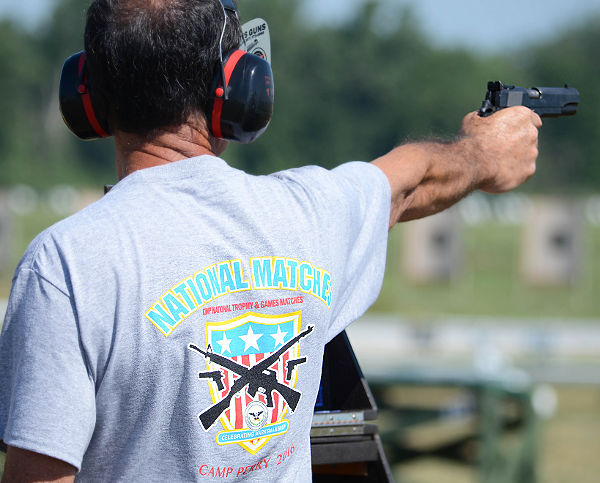
* This is very noticeable to me when shooting pistol. I can shoot bullet holes at 25 yards, but if I’ve miscounted the rounds I’ve fired out of my magazine, my pistol will dip noticeably. So do the pistols of the best pistol shooters I’ve watched and shot with. One might call this a “jerk”, I call it “controlled aggressive execution”, executed consistently.
CMP Advanced Highpower Clinic Trainers: Dan Arnold, James Fox, Sara Rozanski, Brian Williams, Nick Till.
The Civilian Marksmanship Program’s (CMP) Advanced Highpower Clinic, held each year at the annual Camp Perry National Matches in Ohio, is a great place to learn shooting technique, wind reading, equipment optimization, and mental management. One participant sates “This clinic is an excellent opportunity for Highpower shooters who really want to advance to the national level in the sport. I learned more in two days than I have in 10 years!”
The Advanced Highpower Rifle Clinic is designed to improve participants’ shooting techniques and range skills. This could involve trying a different hand position, moving the sling up or down the arm, tightening jacket straps, or a myriad of other subtle changes. “Highpower is a game of points — gaining a point here and there means moving up a classification, winning your class, or winning an entire match,” said Dan Arnold, one of the instructors.
“While highpower hasn’t changed all that much over the years, we as shooters continually evolve,” Arnold explained. “We age, our bodies change, we buy a new glove or a sling – all these little changes mean that the process of firing a shot has to change too. Trying to use the same shot process that you’ve been using for years while ignoring all of the changes that have happened will result in score stagnation, at best. At worst, your scores will decrease.”
In the summer 2022 Clinic, during the classroom portion, instructors discussed wind reading methods, demonstrated shooting positions, explained how to adjust for uneven firing points and deal with high winds. The classroom sessions also covered mental management as well as rifle maintenance.
The CMP Advanced Highpower clinic included two days of live-fire practice.
For the first time, the clinic included two days of live-fire training on the range. Day Two was spent on the range with firing points at the 200-yard line. Each instructor was paired with two students. For 30 minutes, students could dry-fire, then live-fire 10 to 15 rounds while their instructor evaluated their standing positions and suggested changes.
Then, students worked on their sitting positions. After sighting shots, students fired two 5-shot groups — two shots followed by a magazine change and then three shots fired in 30 seconds. Once their two groups were fired, the students fired a standard 10-shot group in 60 seconds.
The clinic provides specialized training, including wind reading with spotting scopes.
Day Three found the students and their instructors at the 600-yard line for prone slow-fire. The instructor checked the the students’ shooting positions and gave them tips on reading the wind conditions. After firing was completed, the students set up their spotting scopes and watched the mirage and wind flags while instructors called out the changes in velocity and direction.
If you missed the 2022 Clinic, don’t worry. The 2023 Advanced Highpower Clinic will be held July 21-23, 2023. The course is open to those who have attended the Advanced Small Arms Firing School at least once and have an “Expert” classification. Participants must bring their own ammunition and equipment for the live-fire portion of the 2023 Clinic. The entry fee is $40.00 for adults and $20.00 for juniors. All participants will receive a Clinic t-shirt and certificate.
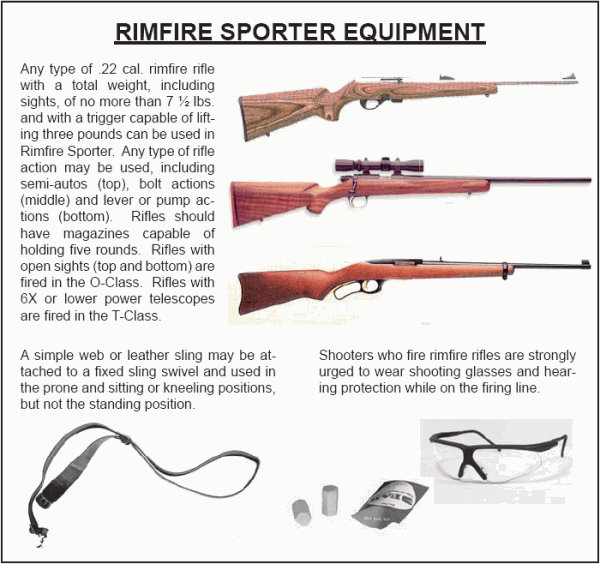
Readers often ask us: “Is there an inexpensive way I can get started in position shooting?” The answer is “yes” — across the country CMP-affiliated clubs host Rimfire Sporter matches. You can use a wide variety of .22 LR rimfire rifles — manual actions (such as a Winchester model 52) or semi-automatics (such as a Ruger 10/22). There are prone, sitting/kneeling, and standing stages. CMP rules provide separate classifications for scoped rifles, open-sighted rifles, and aperture-sighted rifles. The matches are fun, the ammo is inexpensive, and everyone has a good time while improving their marksmanship.
Rimfire Sporter Match Basics
The CMP Rimfire Sporter Rifle Match is an inexpensive, fun-oriented competition using .22 caliber sporter rifles (plinking and small game rifles) commonly owned by most gun enthusiasts. To compete, all you need is a basic rifle, safety gear, and ammunition. No fancy, high-dollar rifles are required.
The event is shot with standard sporter-type, rimfire rifles weighing no more than 7.5 pounds, with sights and sling. Rifles may be manually-operated or semi-automatic. Rifles may be manually operated or semi-automatic, with three classes.
The three classes of competition are: 1) standard “O Class” for open-sighted rifles; 2) “T-Class” for telescope-sighted and rear aperture-sighted rifles; and 3) “Tactical Rimfire” class, which is a .22 caliber A4 or AR15 style rifle.
Firing for all classes is done at 25 and 50 yards on a target with a 1.78″ ten-ring and an 18″ outer one-ring. Even new shooters can get hits on this target, but it’s still challenging.
Rimfire Sporter Excellence
Above, young Samuel Payne won the inaugural Talladega 600 Rimfire Sporter event. In 2015, Payne became the first-ever Rimfire Sporter competitor to fire a perfect 600 x 600 score (600-50X) in a CMP-sponsored competition. Payne shot the perfect score at the CMP Eastern Games at Camp Butner, NC.
Rimfire Sporter Competition is fun for all ages — including senior shooters.
Rimfire Sporter Course of Fire
In a CMP Rimfire Sporter match, competitors will complete slow fire prone, rapid fire prone, slow fire sitting or kneeling, rapid fire sitting or kneeling, slow fire standing, and rapid fire standing shot sequences.
The CMP has adaptive Rimfire Sporter programs for shooters with physical impairments.
Rimfire Sporter Local Matches with Modified Rules
One great thing about the rimfire shooting discipline is that you can start with a very inexpensive rifle and still be competitive and have fun. The matches involve multiple stages including standing, kneeling/sitting, and prone. There are classes for both scoped rifles and iron-sights rifles.
Our friend Dennis Santiago helps run CMP Rimfire Sporter Matches in Southern California. Dennis observes: “You want something challenging? Well that X-Ring 50 yards away is the diameter of a 50 cent piece, and there are people out there that can womp that thing with iron sights.”
Dennis notes: “There are six (6) stages of fire on a tough little target. Notice the rifles that can be used run the gamut from pump and bolt actions to variations on the semi-auto theme. All still require a good eye and a steady hold to earn one’s bragging rights for the day. A match takes about an hour and a half per relay. The slowest part of the match is initial sighting in. It’ll take longer than the allocated 5 minutes for the typical first timer coming to a club match.”
At Dennis’s Burbank Rifle & Revolver Club (BRRC), procedures are modified a little bit: “What we typically do at BRRC is run two relays. Experienced competitors shoot per the full rulebook. New shooters are afforded a bit more relaxed environment to make the experience more fun and inviting. We do the same thing in our M-1 Garand Clinic/Match series.”
Official CMP Guide to Rimfire Sporter Competition
The Civilian Marksmanship Program (CMP) has a CMP Guide to Rimfire Sporter Shooting. This FREE, 50-page digital publication covers equipment, positions, course of fire, rules, scoring and much more. You’ll find helpful “how-to” sections on aiming, sight picture, hold control, and trigger control. Reading these instructional sections can benefit any prone or three-position competitive shooter.
Rimfire Sporter competitors should read Gary Anderson’s Rimfire Sporter Guide Part II. This well-illustrated, 8-page, 2014 publication covers shooting positions, sling use, sight picture, trigger technique and more.
Highlights from the 2016 National Rimfire Sporter Match at Camp Perry:
* Shooting Sports USA notes: “Samuel Payne had an unforgettable 2015. At just 16, he dominated the Rimfire Sporter events at the Civilian Marksmanship Program’s (CMP) Eastern Games, National Matches, Western Games and the Talladega 600, while also setting two new National Records during the year. Sam’s photo also graced the cover of the 10th Edition of the CMP Guide to Rimfire Sporter Shooting — and rightfully so. He proved his undeniable talent at every event he entered, not only winning the matches, but also setting the bar high for competitors in the future.”
Article based on report by Ashley Dugan, CMP Staff Writer
Harry Gaunt turned 91 on October 2, 2022. This year Harry decided to spend his latest birthday along the shores of Lake Erie in Ohio. Harry visited the Civilian Marksmanship Program’s (CMP) Headquarters at the Camp Perry National Guard Facility in Ohio, and, on his 91st birthday, shot at Camp Perry’s Petrarca Range.
Harry had never been to Camp Perry before but had heard about it from CMP publications and other marksmanship organizations. It became a destination during a family road trip when his daughter, Stephanie Vanderwilt, and her husband Stewart drove from their Colorado home to pick up Harry at his home in Indianapolis. The trio then made the trek to Camp Perry. “We stayed in a townhouse on base, and it was perfect,” Stephanie said. “We plan to come back!”
During the trip, Harry, Stephanie, and Stewart fired their M1 Garands on the Petrarca Range at Camp Perry. This features a modern outdoor electronic target line. While at Camp Perry, Harry also browsed the assorted merchandise at the CMP North Store.
Petrarca Range is home to 10 electronic rifle targets, enhanced by Kongsberg Target System (KTS) technology and set up at 100 yards. The targets work through the power of acoustics — “hearing” the shot and accurately determining its location. The range also holds five cardboard pistol targets capable of being set up at 50 feet or 25/50 yards. The range is open to the public every Monday through November 14, when it closes for the season. It will return to a regular schedule in the spring.
Born in a small town called Dunkirk, Indiana, in 1931, Harry always loved guns. His grandfather taught him how to use a firearm when he was eight years old using a .22, and he grew up shooting with his dad, Ralph. Harry eventually gifted the original .22 rifle he used with his grandfather to his own grandson, Alex, who became a Cavalry Scout 19 Delta after he was inspired by Harry’s service and the tragedy of 9/11.
Harry joined the Marines in 1951, during the Korean War, and was deployed three times. He wanted to be a Scout Sniper and could have qualified but was assigned to computers instead. Though he was placed in a technological specialty, he has personally never owned a computer! After his career in the Marines, the jeweler and watchmaker (trained by his father who was also a jeweler) started his own line of successful stores around 1956, designing his own custom pieces.
Previous Visit to Talladega in 2020 Harry Gaunt also visited the Talladega Marksmanship Park in September 2020.
In September 2020, Harry, daughter Stephanie, and her husband Stewart headed south to the CMP’s Talladega Marksmanship Park in Alabama. There the trio shot long distance on Talladega’s 600-yard range. And during that trip Harry bought his own M1 at Talladega’s Pro Shop. He used that M1 rifle on his 2022 trip to Ohio.
Now “91 Years Young”, Harry Enjoys Shooting Every Sunday
At age 85, Harry retired. He now spends his days enjoying his favorite hobbies, like going to Camp Atterbury in Indiana every Sunday to shoot on the 100-yard range. He mostly uses rifles and .45s, though he’s been known to shoot a Thompson machine gun as well. No matter how he fills him time, he’ll remain, as Stephanie refers to him, “91 years young” – full of spunk, a little quirkiness and a zest for life.
Start the planning for next summer, folks — the CMP and the NRA have both released their preliminary National Matches Calendars for 2023. These calendars cover rimfire and centerfire rifle and pistol events at Camp Perry, Ohio (CMP) and at Camp Atterbury, Indiana (NRA). NOTE: These are first-generation calendars — they may later be revised or modified, but these can be used for initial planning.
Here are the current CMP and NRA 2023 calendars. Click each image to load a larger file that is easier to read. The CMP calendar will actually load as on online spreadsheet.
CMP 2023 National Matches Calendar
The 2023 CMP National Matches at Camp Perry commence Friday, July 7, 2023 with Smallbore check-in/practice. The schedule concludes Saturday, August 5 with the Palma Match and awards. Here is the full CMP schedule (click to zoom):
NOTE: This CMP Calendar is hosted online in spreadsheet format. This allows you to increase display size, and also to search for specific words. CLICK HERE to view full spreadsheet calendar.
NRA 2023 National Matches Calendar
The 2023 NRA National Matches at Camp Atterbury commence Saturday, July 8, 2023 with OTC opening ceremony. The schedule concludes Sunday, August 6 with the final smallbore competitions. Here is the full NRA schedule (click to zoom):
Here are some recent comments by Facebook readers:
“Looks like there is a very serious overlap between CMP and NRA next year. Hopefully both calenders are only drafts and will change several times like they have in the past.” — Joe Bakies
“I was hoping to shoot Long Range next year, but it conflicts with the Civilian Marksmanship Program National Matches.” — Joseph Hayes
“Lines up perfect for us smallbore competitors.” — Shane Barnhart
CMP Records 580+ Entries During 2022 National Air Gun Events at Camp Perry
The 2022 National Air Gun events, held this summer as part of the Civilian Marksmanship Program’s National Matches, welcomed over 580 air rifle and air pistol entries throughout July and August. The events were held at the Gary Anderson CMP Competition Center at Camp Perry, Ohio.
This modern Gary Anderson Competition Center boasts a long row of indoor electronic targets, which can provide multiple target distances from fixed firing points.
Story based on Report by Ashley Dugan, CMP Staff Writer
The 2022 CMP National Air Gun events hosted both seasoned competitors and novice shooters. New to the schedule in 2022 was the 100 Shot Challenge, which consisted of 100 record shots. Winning the Air Pistol competition was Daniel Miller, of Mineola, Texas, with a score of 912-7X.
An AiR-15 Challenge Match was also on the schedule, featuring air guns that resemble AR-15 rifles and a simulated 100-yard target. Leading the event for the second consecutive year was SFC Brandon Green who finished with an impressive score of 396-19X. One of the nation’s greatest marksmen, the USAMU’s Brandon Green has won multiple High Power Rifle National Championships.
The CMP’s Bench League allows participants of any age to compete in a national-level event, even if he or she has never competed before. During the League, competitors fire air sporter, precision or AiR-15 rifles off a bench with sandbag support. Claiming the overall win in the 60 Shot Bench Air Rifle Match was Philip Edwards, of Marblehead, Ohio, with a score of 632.3.
A Center Shot contest, where participants who fire closest to target center have the chance to win money, also challenged air gun competitors in rifle and pistol categories. Leading the Rifle Center Shot contest was Scott Braun of Belvidere, Illinois, who fired the only 10.9 shot.
For a complete list of results of the 2022 National Matches Air Gun Events, visit the CMP’s Air Events Competition Tracker page. The National Match Air Gun Events will return next Summer for the 2023 CMP National Matches at Camp Perry.
Gary Anderson CMP Competition Center at Camp Perry.
About the Gary Anderson CMP Competition Center
The Gary Anderson CMP Competition Center in Ohio, is open to the public, year-round. This modern facility features an 80-point range equipped with the CMP’s own electronic targets. The facility also includes a retail center for equipment and memorabilia sales.
Team Berger shooter John Whidden of Whidden Gunworks topped the field to win this year’s Civilian Marksmanship Program (CMP) Smallbore Prone National Championship at Camp Perry. Whidden, who hails from Nashville, Georgia, was named the Prone 6400 Aggregate Champion after firing a score of 6379-449X. During his route to the Aggregate win, Whidden also earned third overall in the Iron (Metallic) Sight Championship and second in the Any Sight match.
The National Prone Championships featured two days of both Iron Sight and Any Sight events (four days overall) for adults and juniors. Each day included four stages of fire at 50 yards, 50 meters, and 100 yards.
The 2022 CMP National Smallbore Matches were held at prestigious Camp Perry National Guard training facility on the shores of Lake Erie near Port Clinton, Ohio. The matches started July 19th with a Small Arms Firing School for new competitors, and concluded after eight days of competition from July 20-27. These Smallbore disciplines were fired over the eight days of competition:
July 20 – Three Position Iron Sight Championship
July 21 – Three Position Any Sight Championship
July 22 – Junior Team Match, Three Position Team Championship
July 23 – Prone Metallic Sight Championship Day 1
July 24 – Prone Metallic Sight Championship Day 2
July 25 – Prone Elimination Final & Prone Team Championship
July 26 – Prone Any Sight Championship Day 1
July 27 – Prone Any Sight Championship Day 2
The Smallbore Prone National Championship is decided over four days of firing 160 rounds per day for a possible 6,400 score. Whidden finished first with a 6,379-449X, followed by Antonio Gross in 2nd scoring a 6,371-412X, and Larry Parker medaling 3rd with 6,362-413X.
Whidden stated, “The CMP ran a great match as they always do. The wind and the elements were enough to keep us on our toes. I was really pleased with the performance of the Lapua Midas+ rimfire ammunition throughout the match!”
About Lapua Ammunition and Berger Bullets
Lapua manufactures high-quality rimfire ammunition and Berger manufactures precision projectiles and match-grade ammunition for Target, Hunting and Tactical applications. Berger is part of the Capstone Precision Group, the exclusive U.S. distributor for Berger, Lapua, Vihtavuori and SK-Rimfire products. For more information, visit Bergerbullets.com.
Jeff Hansen of Utah now holds Distinguished Rifleman Badge #2561. Jeff’s journey to Distinguished status began with a box filled with his grandfather’s old shooting medals, which led him to the Camp Perry National Matches in Ohio.
Though he had no intention of shooting competitively, only arriving to see the ghosts of his grandfather and uncles, he was so moved by the ambiance of Perry that he began his own marksmanship career — eventually leading him to a prestigious Distinguished Badge.
At the 2022 National Matches, Jeff fired his best scores yet. In the National Trophy Individual (NTI) Match, he reached an overall score of 487-9X for 52nd overall out of nearly 790 competitors. And at the 600-yard line he shot an outstanding 199-5X out of a 200 possible.
“He was on the range with me shooting that 199″, Jeff said of his grandfather. “I felt like he was right there when I finished up. I just hope other people see this and see what I’ve tried to do – if I can do this, they can do this”, he said. “Chase that dream”.
Left to Right: Alvin Hansen, Ray Hansen, and Jeff’s Grandfather Lou Hansen at Camp Perry.
Inspired by My Grandfather to Become a Distinguished Marksman
Jeff Hansen earned his Distinguished Rifleman Badge in 2022 – a journey which began with his Grandpa’s own marksmanship tales from the 1920s and 1930s.
As early as I can remember, my grandfather, Lou, was a huge influence in my life. He was a great marksman. My dad, Ed Hansen, would tell me about the hunting trips they would go on and how Grandpa would make incredibly long shots to get an amazing bull elk or mule deer, only taking one shot to do so. He was always taking me hunting and fishing and shooting – lots of sleepovers where I didn’t actually sleep much, if any, because I would be so excited for the adventures that were going to happen with him the next day.
Whether it was hunting ducks, pheasants, chukars or just shooting, it didn’t matter. It was always an awesome experience with him. Life was great. Then, we got some tough news – my grandfather had leukemia. He fought a courageous battle with it for a couple of years, then in 1978, when I was 8, he passed away. Needless to say, I was devastated.
Inspired by Grandfather’s Shooting Medals
Not too long after he passed away, my dad brought home a box from Grandpa’s. It was full of medals. He carefully removed them and told me they were from when my grandfather competed in rifle matches with his brothers (Alvin Hansen, a U.S. Army veteran of World War I in France, Ray Hansen, and Oscar Hansen) at Camp Perry, Ohio, in the late 1920s to 1937.
Shooting medals from 1920s and 1930s with picture of Lou Hansen and his brothers.
My Grandpa was really humble – never said much about his trips to Camp Perry or his accomplishments there. Seeing the contents of the box, my grandfather became an even bigger hero to me. The medals he earned that impressed me the most were the three President’s Hundred brassards from 1935, 1936 and 1937 – along with many others.
I grew up looking at those medals thinking I wish I could do that maybe, someday. My life moved forward. My dad, a U.S Air Force veteran, and I both loved hunting, fishing, and shooting and still went as often as we could. Later, I got married and now have three daughters and one son. As my family grew up, we also enjoyed hunting, fishing, and shooting together.
Then, life threw some blows. My dad passed away suddenly in November 2014, and my mom fought a fierce battle with cancer for a few years before passing away in March 2018. Not long after she passed away, I found myself hanging [my grandpa’s] medals on the wall in my own home. Seeing them there got me thinking about how awesome it would be to go to Ohio and watch the President’s Match – not shoot, just watch.
In July 2018, I went. I’ve got to admit there were a few tears in my eyes driving between the two iconic lighthouses at the entrance to Camp Perry. I loved it.
The year I came happened to be the year SFC Brandon Green of the U.S. Army Marksmanship Unit cleaned the President’s Match — a record that still holds today. I got to talking to one of the Army Reserve team guys, asking him questions about competing, and he couldn’t believe I was there just to watch. I showed him some pictures of my grandfather’s medals, scorebook, and of Camp Perry in the 1930s. Matt Goad and Jon Arcularius of the Army Reserve team came over to look at them.
They said, “Hey, you can’t come all the way out here with a family history like that and not shoot here!”
They offered to sign me up for the NTI match the following day and even said they would get a rifle, ammo, and anything else I would need. That was so awesome, but I couldn’t make it work – I was flying back home the next day. Although I didn’t shoot, they did get me all the information I needed to get started.
I loved every minute of my first Camp Perry trip. It was because of the people there, showing me such kindness and taking me under their wings, that I thought, “I’ve shot all my life and hunted, and I’ve always liked marksmanship. This is something I can do.”
When I got home, I ordered a White Oak upper and started changing parts on my AR-15 to make it ready for matches. I was ready in the spring of 2019 and started shooting mostly small matches.
Grandpa Lou was humble and never talked about his achievements at Camp Perry.
At first, all I wanted to do with my rifling career was get a President’s Medal — following in my Grandpa’s footsteps. I didn’t know what “going Distinguished” was all about. I got a Silver Achievement Medal in the first match I went to, then started to go to more matches. Through that, I caught wind that winning President’s is one thing, but you’ll get to President’s if you excel your skills and go Distinguished. So, that became the new goal.
By summer, I was traveling to EIC matches and earned my first points at Nampa, Idaho, on July 21, 2019. After that, it was time to head back to Perry for the President’s and the NTI.
I didn’t do as well as I wanted, but it was an amazing experience to be competing where my grandfather had. I struggled the rest of the year and didn’t earn any more points until 2020. It was tough trying to find matches during COVID, but I ended up earning 12 more points by the end of the year. I missed a hard leg at Twentynine Palms, California, by X-Count, and things got tough after that.
I figured I needed to step up the way I was practicing, so I got a Shot Marker electronic target system and some wind flags so I could practice full distance. I’m very lucky that I can practice 30 minutes from home any time I want on public land.
At the 2022 National Matches, Jeff fired a superb 199-5X at the 600-yard line.
Starting in the first part of December, I had some extremely hard things going on in my personal life, and I didn’t feel like practicing. I didn’t even pick up my rifle for two months. I missed the first EIC in Phoenix in January, and before I knew it, February was half gone. Then, one of my friends talked me into going to the Western CMP Games in Phoenix in March.
Practice was tough, and sometimes I wondered why I was even trying. Tons of things were going wrong, and I was about DONE. I wanted to quit, many times. [But then] Western Games was fun, and I did well, but gained no points.
Navy Matches were coming around at the end of April, so I practiced as much as I could and made the trip. With several friends going, it would be great getting together after the matches and have a good time. I shot well the first day as well as on that Saturday. I even shot my personal best National Match Course score. Then Sunday, May 1, was the real test – the EIC match.
I struggled in standing and dropped a few more points than usual. Sitting was the same – rapid prone was good. Slow prone went well. The wind had some fairly big changes, but I worked through it and ended up with 477-11X. I figured there’s no way I’m making the cut for a hard leg this time and headed to the pits to finish out the match. We finished and waited for the results.
When the results were posted, I couldn’t believe it – I FINALLY GOT THAT HARD LEG! I did it. On top of earning my goal at last, it’s awesome to have my friend Jeff Lovat (#2383) be the one to present me with my Distinguished pin. (That President’s Hundred medal is still out there – maybe next year!)
The Honor of Earning the Distinguished Marksman Badge
Though I certainly enjoy earning my Distinguished Badge, the greatest thing I have gained from accomplishing this is without a doubt all the friends and people I have gotten to know along the way. To all my shooting friends, thanks for not letting me quit – part of this accomplishment is yours too.
To all of you that are working toward that goal, don’t ever quit. Keep practicing, and your day will come. Never quit until you reach your goals.
No matter what, I do know one thing. When I walk that stage at Perry at the 2022 National Matches and get my Distinguished Badge officially presented to me — well my father, my grandfather and his brothers will be walking it with me.
About the Distinguished Badge Program
To earn a Distinguished Badge, a competitor must earn 30 Excellence-In-Competition (EIC) points or more in a qualifying competition. Individuals earn the 6, 8 or 10 “leg” points based on score and a percentage of match participation, with at least one “hard” leg, worth 8 or 10 points. Currently, the CMP administers Distinguished Badges for:
Service Rifle
Service Pistol
.22 Rimfire Pistol
Junior Air Rifle
Smallbore Rifle
International Shooter
Distinguished Marksman Badge
Distinguished Air Rifle and Air Pistol
Distinguished Service Revolver Badge
After the Opening Ceremony, the 2022 National Matches at Camp Perry officially commence on July 12th with the handgun Small Arms Firing School (SAFS) followed by M9 Pistol Excellence-In-Competition (EIC) pistol matches. The SAFS will be led by USAMU, Military Team, and CMP instructors. Following classroom instruction and practice on the range, SAFS participants will fire an M9 EIC Match with the goal of earning points towards the prestigious Distinguished Badge.
On July 13th, the .22 Rimfire 900 Aggregate, Team Matches, and Rimfire EIC matches will be held. In the past, these matches have been hugely popular — with 480+ Rimfire competitors from novices to experts.
Following the rimfire pistol matches, there will be centerfire Pistol Aggregate and Team Matches on July 14, followed by .45 Pistol Aggregate and Team matches the July 15. Then, on Saturday the 16th, the big President’s 100 Pistol Match, National Trophy Individual Match, National Trophy Pistol Team Matches, and GSSF Glock National Challenge will be held. There will be plenty of talent on the firing line. In recent years, over 90% of the top 50 Service Pistol shooters were Distinguished. The last pistol matches run on Sunday the 17th, with Pistol Games Awards at the end of the day.
How’d you like a memorable shooting experience at America’s most famous shooting range? Then register now to compete at the CMP National Matches, held at Camp Perry, on the shores of Lake Erie near Port Clinton, Ohio. Registration is still open for popular centerfire and rimfire competitions. While many of America’s best marksmen will be at Perry this summer, there are programs, such as the Rimfire Sporter series, for shooters of all experience levels. There is still time to register for pistol and rifle matches.
The CMP National Matches will run from July 10 to August 13, 2022 at Camp Perry, Ohio. This major event attracts thousands of shooters over the course of the summer. The 2022 National Matches start with pistol competition and conclude with Long Range Rifle. The Full 2022 Nat’l Matches Calendar is available online.
Held annually at Camp Perry, the CMP National Matches include the CMP National Trophy Pistol and Rifle Matches, the Pistol and Rifle Small Arms Firing Schools, the National Games Rifle Matches, the National Smallbore Matches, and the National Long Range Matches. These matches are conducted by a partnership of the CMP and Ohio National Guard. Since their inception, the National Matches have become a huge, national shooting sports festival with well over 4,500 annual participants. Competitors range from beginners to many of the world’s best.
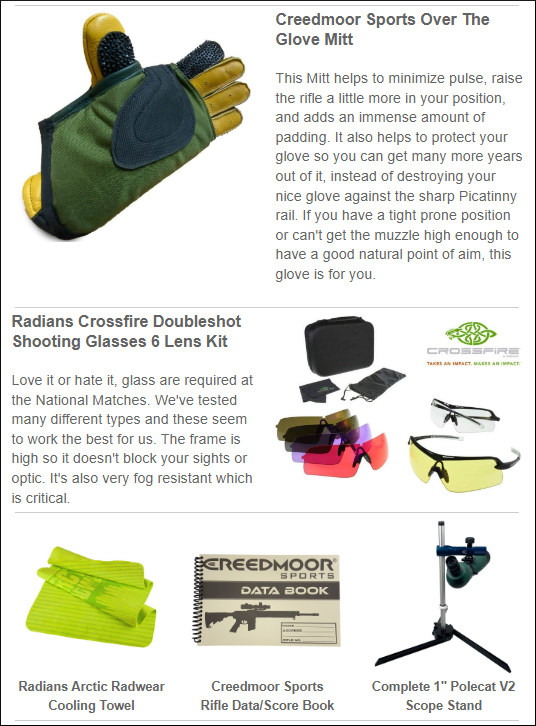
Good Gear for Camp Perry Competition — High Power and Smallbore
Here are some items that can benefit High Power and Smallbore shooters at the National Matches. All these items are available from Creedmoor Sports, which also sells excellent, customizable shooting coats. Through 11:59 pm on June 20th, FREE Shipping is available for $149+ orders with code DAD22.


 How to Shoot Standing
 5. Know your hold and shoot within it. The best part of my hold is about 4 inches. When I get things rolling, I recognize a still gun within my hold and execute the shot. I train to do this every shot. Close 10s are acceptable. Mid-ring 10s are not. If my hold was 8 inches I would train the same way. Shoot the shot when it is still within the hold, and accept the occasional 9. But don’t accept the shots out of the hold.