Sniper’s Hide offers a training class for novice shooters getting started in the PRS/NRL precision rifle game. This Precision Rifle Fundamentals course covers equipment selection, using shooting supports, rifle handling, SFP scope basics, and much more. The Precision Rifle Network video below covers a Sniper’s Hide class offered at the Sure Shot Range, near Vinton, Iowa. This video covers the class both in the field and in the classroom, and has interviews with participants.
One participant praised the course: “As a novice shooter, this [Sniper’s Hide Class] was probably the best money I have spent. It helped me learn all my equipment, how to use rear bags, how to figure out dope… and for the dollar, it’s the best money I’ve spent so far.”
Another student concurred: “I’ve been through all kinds of training, including the military and law enforcement, and I have to say the is one of the best, if not THE best class I’ve ever been in.”
Joel from the Precision Rifle Network stated: “At the end of four days, from two back-to-back precision rifle courses, we sent approximately 4500 rounds down-range. All in all, I would say this is some of the finest precision rifle training you can find ANYwhere.”
Another Video from Frank Galli of Sniper’s Hide
Frank Galli, aka “Lowlight”, is the head honcho of Sniper’s Hide. In the video below, Galli offers a series of shooting tips he calls the “Long Range Shooting W.T.F”. No that’s not what you think it is — no cuss words are involved. “W.T.F.” stands for Wind, Trajectory, and Fundamentals of Marksmanship. To shoot well, Frank says, you first must gauge the wind correctly. Second, you must know the trajectory of your load in your rifle — i.e. know your ballistics. If you want to hit a target at long range, you must start with a rock-solid zero, determine an accurate muzzle velocity, and know the Ballistic Coefficient of the bullet. Plug all that into a good ballistic program (along with elevation, temp, and air pressure) and you should have your point of impact (within a click or two) out to 1000 yards.
Watch Video for Tips about Wind-Reading, Ballistics, and Shooting Fundamentals:
The third element of “W.T.F” is “F” for “Fundamentals of Marksmanship”. This actually involves multiple factors — body position (relative to the rifle), finding your natural point of aim, proper head alignment behind the scope, pre-loading the bipod, breathing modulation, trigger control, follow through, recoil management and more. Frank addresses all these “fundamentals” in the second half of the video, starting at the 3:40 time-mark.
Books for Precision Rifle Training
Along with the Videos above, here are two recommended print publications. These both offer a wealth of useful information for PRS competitors and those interested in tactical/practical style shooting. In addition these books will also benefit hunters. They provide good tips on shooting positions, ranging, supports (bipod, tripod, bags) and more.
Practical Shooter’s Guide
Thinking of getting started in the Practical/Tactical shooting game? Looking for ways to be more stable when shooting from unconventional positions? Then you may want to read Marcus Blanchard’s Practical Shooter’s Guide (A How-To Approach for Unconventional Firing Positions and Training). Unlike almost every “how to shoot” book on the market, Blanchard’s work focuses on the shooting skills and positions you need to succeed in PRS matches and similar tactical competitions. Blanchard provides clear advice on shooting from barricades, from roof-tops, from steep angles. Blanchard says you need to train for these types of challenges: “I believe the largest factor in the improvement of the average shooter isn’t necessarily the gear; it’s the way the shooter approaches obstacles and how they properly train for them.”
Long Range Shooting Handbook
Ryan Cleckner’s Long Range Shooting Handbook is the best-selling modern book on practical rifle skills. A former U.S. Army sniper instructor, Cleckner is knowledgeable, and his text is well-organized and chock full of good information. You can view Sample Chapters on Amazon.com.
Ryan Cleckner’s highly-regarded Long Range Shooting Handbook is designed as an intro to important fundamental concepts such as MOA vs. Mils, External Ballistics, and Environmental Effects. Included are personal tips and advice based on Cleckner’s years of experience as a sniper instructor and special operations sniper.
The Long Range Shooting Handbook is divided into three main categories: What It Is/How It Works, Fundamentals, and How to Use It. “What It Is/How It Works” covers equipment, terminology, and basic principles. “Fundamentals” covers the theory of long range shooting. “How to Use It” gives practical advice on implementing what you’ve learned, so you can progress as a skilled, long range shooter. This book will benefit any long-range shooter, not just PRS/NRL competitors.
If you like PRS/NRL competition or just want to learn about this fast-growing practical shooting discipline, then definitely watch Shooting USA today (8/12/20). This week Shooting USA offers a special FULL-HOUR edition devoted to the inaugural Armageddon Gear AG Cup Invitational. The first-ever AG Cup showcased an all-star line-up of tactical talent. Twenty of the nation’s top PRS/NRL marksmen were invited to a two-day event at the Arena Training Facility in Georgia. $41,000 in prize money was up for grabs, with the overall match winner guaranteed twenty thousand ($20,000) in cash!
This AG CUP episode airs Wednesday 8/12/2020 on the Outdoor Channel at 9:00 PM Eastern and Pacific, 8:00 PM Central. After that it will be streamed on Vimeo for $0.99 per episode or $3.99 per month.
In this hour-long Shooting USA special, John Scoutten and Armageddon Gear’s Tom Fuller report the action and interview top precision rifle shooters. The Grand Prize of $20,000 was awarded for the best overall score, based on accuracy and time. In addition, the winner of each of the 20 stages received a $1000 cash prize. During the show, you can watch the competitors adapt to challenging stage set-ups and weather conditions. With $1000 at stake for each stage, a single miss can cost serious money!
Side Match with TN Twister Target
At the inaugural AG Cup, there was a side match with a $500 prize for the competitor who hit all five TN Twister Target plates in the shortest time. The side-match employed a modular target system from Innovative Target. This system can mount TN Twister or TN Revolver multi-plate rigs, which bolt on to the IRT Head. This provides interesting challenges quite different from a typical static PRS plate target.
Arena Training Facility — 2300 Acres
The 2300-acre Arena Training Facility is a premier shooting facility with multiple shooting ranges from 50m to 2100m. Arena’s 1000-yard covered Known Distance range offers multiple benches, steel and paper targets out to 1000 yards. On Arena’s UKD (unknown distance) range shooters can engage steel out to 2300 yards. This 2100m UKD range boasts a 3-Story Shooting Tower, Air-Conditioned Shoot House, and multiple Positional Challenges.space.
Armaggedon Gear — Tactical Accessories Armageddon Gear, founded by former U.S. Army Ranger Tom Fuller, sells support bags, gun cases, slings, suppressor covers, scope covers, and a wide variety of other accessories popular with the PRS/NRL crowd. Armageddon Gear now provides products to the U.S. Military, Law Enforcement, as well as PRS/NRL competitors.
Armageddon Gear Game-Changer Bag
Shooting USA is available On Demand via Vimeo.com. Watch a single episode for $0.99, or get a full-month subscription for $3.99 and watch as many shows as you like with limited commercial interruptions.
The Sniper’s Hide Cup competition went forward this year, despite challenges presented by the COVID-19 pandemic. The event took place June 20-21, 2020 in Colville, WA. This was a backcountry match, set in beautiful green mountain scenery. Here are images from the 2020 SH Cup as posted on the Sniper’s Hide Facebook Page. Congrats to Frank Galli (aka “Lowlight”), founder of Sniper’s Hide, and all the participants in the event. Looks like a great two days of shooting.
The Everyday Sniper Episode 260: Sniper’s Hide Cup 2020
After the 2020 SH Cup event, Frank Galli hosted an informative podcast:
Topics include: Stages, Targets, Equipment, Mindset, First-Time Competitors
Frank: “I’m back from the Sniper’s Hide Cup in Colville, Washington. I’ll be breaking down some lessons learned and give you my observations from the field and competitors with whom I spoke. [We cover] the experience of attending a match and helping new shooters — the juniors, the first time competitors, and how you work with them. Thanks for listening, sharing, and commenting on the Everyday Sniper Podcast.”
Are you looking to get started in PRS and NRL practical precision rifle competition? Or perhaps you’d like to advance your skill set so you can place higher in big matches (and get your hands on some of those prize table items)? Of course there is no substitute for trigger time in the field, but there ARE some great print resources. These four books can help you select the right equipment, improve your shooting skills, make better wind calls, increase your fitness level, and develop a more efficient between-match training program.
1. IMPACT! — Training and Preparing for Precision Rifle Matches
Rodney Maze, $19.99 Paperback, $4.99 Kindle
Impact!, by PRS competitor Rodney Maze, is an entry/intermediate level guide to preparing yourself and your equipment to compete in precision rifle type matches. It will also benefit anyone looking to learn about practical-style long range and precision shooting. We recommend you check it out for yourself — there are 20 Pages of free sample content on Amazon. Topics covered include:
— Rifle, optic, and equipment selection
— Setting up your rifle, bags, tripods for PRS/NRL matches
— Understanding ballistics and how to record and use ballistic data
— Techniques for using holdovers for multi-target stages
— Gun skills, rapid fire techniques, clearing malfunctions
— Shooting off of barricades, and specialty stages
— Effects of wind and how to improve your wind calls
— Tips for live fire and dry fire practice
— Preparing yourself and your equipment for a match
— Mental strategies and techniques
Impact! is illustrated with plenty of photographs. Topics are divided logically, and concepts are explained in clear language. Also included is an extensive glossary of terms used in precision shooting and a list of additional resources you can use to further pursue your precision shooting knowledge. This book also includes a handy Appendix with formatted pages for recording data about your rifle, scope, and ammunition. There is also a Wind table for recording your rifle “dope” and wind hold-offs. Lastly, Impact! has a useful table of unit conversions.
2. Practical Shooter’s Guide
Marcus Blanchard, $19.99 Paperback, $9.99 Kindle
Thinking of getting started in the Practical/Tactical shooting game? Looking for ways to be more stable when shooting from unconventional positions? Then you may want to read Marcus Blanchard’s Practical Shooter’s Guide (A How-To Approach for Unconventional Firing Positions and Training). Unlike almost every “how to shoot” book on the market, Blanchard’s work focuses on the shooting skills and positions you need to succeed in PRS matches and similar tactical competitions. Blanchard provides clear advice on shooting from barricades, from roof-tops, from steep angles. Blanchard says you need to train for these types of challenges: “I believe the largest factor in the improvement of the average shooter isn’t necessarily the gear; it’s the way the shooter approaches obstacles and how they properly train for them.”
3. Long Range Shooting Handbook
Ryan Cleckner, $19.85 Paperback, $9.99 Kindle
Ryan Cleckner’s Long Range Shooting Handbook is the best-selling modern book on practical rifle skills. A former U.S. Army sniper instructor, Cleckner is knowledgeable, and his text is well-organized and chock full of good information. You can view Sample Chapters on Amazon.com.
Ryan Cleckner’s highly-regarded Long Range Shooting Handbook is designed as an intro to important fundamental concepts such as MOA vs. Mils, External Ballistics, and Environmental Effects. Included are personal tips and advice based on Cleckner’s years of experience as a sniper instructor and special operations sniper.
The Long Range Shooting Handbook is divided into three main categories: What It Is/How It Works, Fundamentals, and How to Use It. “What It Is/How It Works” covers equipment, terminology, and basic principles. “Fundamentals” covers the theory of long range shooting. “How to Use It” gives practical advice on implementing what you’ve learned, so you can progress as a skilled, long range shooter. This book will benefit any long-range shooter, not just PRS/NRL competitors.
4. Official U.S. Army Sniper Training and Operations Manual
From U.S. Army Sources, $17.59 paperback.
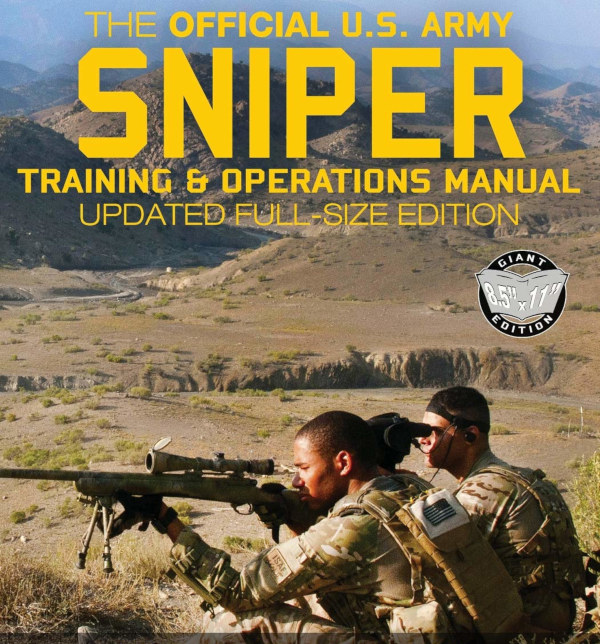
This U.S. Army Sniper Training Manual is a very comprehensive resource, with over 450 pages of information in a large 8.5″x11″ format. NOTE: Unlike other editions on Amazon, this is NOT the basic, outdated FM 23-10. This is the completely-overhauled 450+ page edition (FM 3-22.10). Heavily illustrated, this is a very useful resource for tactical/practical precision shooter. Employed as the “textbook” for the U.S. Army Sniper School at Fort Benning, GA, this big manual explains ranging methods, rifle handling, optics selection and operation, and rifle maintenance.
There is also extensive discussion of ballistics, wind reading, and weather effects. Practical competitors will appreciate the discussions of moving targets, range estimation, and range safety procedures. One reviewer explains: “This book contains the distilled wisdom of the Sniper School’s instructors and expert marksmen, giving you over 450 pages of unique insight into the long range combat shooter’s art.”
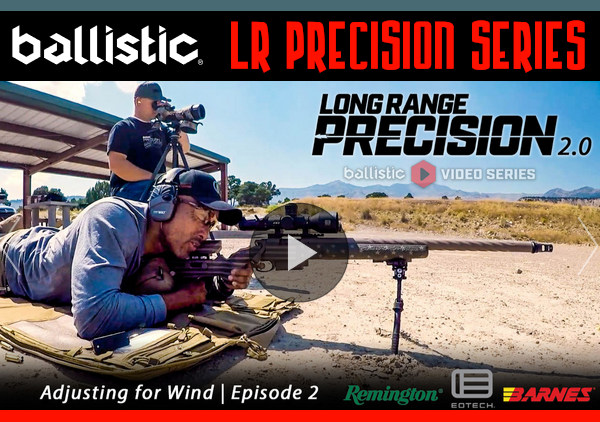
Long Range Precision (LRP) is a useful series of videos product by Ballistic Magazine and sponsored by Remington, Barnes Bullets, and Eotech. All six of the Season 1 LRP videos are embedded below for easy “binge watching”. In addition, all seven Season 2 episodes can be watched online on BallisticMag.com.
In this video series host Sean Utley covers many gear-related topics including rifle configuration, scope selection, chambering choices, ammunition options, bipods/tripods, and chronographs. In addition, the series covers training methods, bullet ballistics, wind reading, and rifle handling.
Most of this is pretty basic stuff, but it can be helpful for newcomers to long range shooting. For example, Season 1 Episode 4 covers chambering options including 6.5 Creedmoor and .308 Winchester.
Season 1, Episode 1: Anatomy of a Long Range Precision Rifle
Season 1, Episode 2: Foundations of Long Range Shooting
Season 1, Episode 3: Mechanics of Long Range Shooting
Season 1, Episode 4: Best Calibers for Long Range Shooting
Season 1, Episode 5: Anatomy of Bullet Flight
Season 1, Episode 6: Critical Equipment for Long Range Shooting
Watch Latest Long Range Precision Season 2 Videos
Along with all these Season 1 videos, there are seven Season 2 videos available on BallisticMag.com. Season 2, Episode 2 is a good video on Adjusting for Wind. And if you are interested in learning how Doppler Radar is used to develop bullet designs, we recommend Episode 7 from Season 2. This 7-minute video covers the latest technology in ballistics radar. CLICK HERE to watch video.
Look for a lighter barrel for your latest hunting or PRS/NRL rifle? Well there’s a new option on the market. Bartlein Barrels, makers of premium benchrest, F-Class, tactical, ELR and hunting barrels, is now offering carbon fiber-wrapped barrels. These will be available in a variety of lengths/contours, and multiple carbon colors. Bartlein posted on Facebook: “We are thrilled to announce that Bartlein Barrels is now offering carbon fiber-wrapped barrels! With the help of Mission Specific Worldwide LLC, another Wisconsin-based company, we will be offering these barrels in limited contours and calibers.
Bartlein’s Matt Buettgen told our Forum: “Bartlein Barrels is proud to introduce its new line of Carbon Fiber-wrapped barrels. We will start off with three (3) contours, the #4 Bull Sporter, #13 Rem Varmint, and the #14 M24/M40. Lengths will be 20″, 22″, 24″, and 26″ finished lengths in any twist you like including Gain Twist and Left-Hand Twists. And just to make it a little more interesting, there are four colors: Black, Red, Green, and white/black marble. For more information give us a call at the shop or check out our Facebook Page.”
Here is more information from George Gardner of GA Precision:
It’s been a hard thing to keep under wraps, no pun intended. But Bartlein Barrels is now offering carbon-wrapped barrels! We have been helping test these for a few months now and all I can say is they are very impressive. Same Bartlein accuracy and no point of impact shift at all as the barrel warms. Plus as a bonus, GA Precision will be offering colors: Red/Brown, Green and White. These colors really pop against the sunlight and accent various colors offered by composite and painted chassis stocks (see below). These color-wrap barrels are special order for 4-month delivery.
GA Precision already has good inventory of Standard Black Carbon barrels in all four contours in popular calibers and twists. See GA Precision website for details. These are available for immediate delivery.
NOTE: GA Precision currently offers FOUR (4) contours:
Bartlein #4 B Sporter | Bartlein #13 Remington Varmint
Bartlein #14 M/24-M40 | Bartlein 1.200″ Straight
Price is $700 + shipping for standard black carbon wrap, or $750 + shipping for colored carbon wraps.
With all the buzz about the 6.5 Creedmoor and its 6mm Creedmoor little brother, some folks forget that we’ve had an outstanding mid-sized, Across-the-Course cartridge for a long time — the 6XC. Pioneered by 11-time National High Power champion David Tubb, the 6XC has won national High Power championships, excelled in mid-range prone matches, and performed great in the varmint fields. It has also been used successfully by many Precision Rifle Series competitors. It’s no wonder — the 6XC has less recoil than a 6.5mm Creedmoor, there is a great selection of superb 6mm bullets, and Peterson 6XC brass is high-quality and reasonably priced ($69/100) from DavidTubb.com. Fine Norma 6XC brass is available from Grafs.com.
PRS Rifle with Modern 6XC II Chamber
Forum member Grimstod posted this new 6XC II rifle in our long-running Pride and Joy Rifle Thread. Grimstod notes: “These 6XC Gen IIs seam to be a hot commodity lately. This one is for PRS. It features a Premier Accuracy Atlas action made by Kelbly. The bolt and heavy-taper, fluted barrel are Cerakoted to match. I really like the ejectors on these Atlas actions. The stock is a KRG X-Ray painted in Premier Accuracy exclusive colors. The Kelbly Atlas action does not have any modifications. So far every Kelbly action we have tried has had perfect timing and trigger fall. We have been supper pleased with them. I look forward to using a lot more of these excellent actions.”
What is the 6XC II you may ask? That designates a 6XC with a chamber dimension optimized for Norma brass. It turns out that Norma brass is a bit bigger at the bottom than the 22-250 brass from which the 6XC originated. Robert Whitley of 6mmAR.com has created two new JGS reamer specs that fit the Norma brass perfectly, improving feeding and extraction. Here is Robert’s Report:
The 6XC II Chamber — Upgraded for Today’s Norma 6XC Brass
by Robert Whitley of 6mmAR.com
The 6XC II Chamber works perfectly with the Norma 6XC brass and resolves the “sticky bolt lift” issue. The original 6XC chambering was designed based off the usage of 22-250 brass which typically has a web diameter in the range of .461″-.463″. The area of the chamber just forward of the web on the original 6XC chambering was .4695″ which left plenty of clearance.
When Norma 6XC brass became available Norma appears to have developed the base of the case from the .308 Winchester line of cases which have a larger web diameter. The web diameter of the Norma brass typically measures right around .4685″ which leaves almost no diameter clearance.
As shooters would use Norma 6XC brass in an original 6XC chamber they typically would experience “sticky bolt lift” due to the lack of clearance and the fact that the large web diameter of the brass prohibited the re-size dies (no matter how small the base diameter was) from squeezing the brass down enough to create sufficient clearance. The 6XC II chamber resolves this issue. You can order 6XC II sizing dies from 6mmAR.com that work perfectly with this re-designed chambering. 6XC II die sets are in stock now — call (215) 348-8789 to order.
6XC II Long Range Reamer (Throated long for 105-115gr Bullets):
The 6XC II-LT reamer below is throated long to keep the full bearing surface of 110-115gr bullets forward of the neck/shoulder junction of the case. Note, 6mmAR.com has also developed a shorter-freebore version for 6mm bullets with shorter bearing surface. SEE shorter 6XC II Reamer Print.
6XC II Chamber and Sizing Die Combo:
- Resolves the “sticky bolt lift” problem shooters experienced using the Norma 6XC Brass in the original 6XC chambers.
– Chamber accepts all 6XC brass or ammo with no modification. Take your existing 6XC brass or ammo and use it without issues.
– Works well with existing Norma 6XC brass, or 6XC brass made from re-formed Winchester and Remington 22-250 brass.
– 6XC II Sizing dies and die sets are available from 6mmAR.com and in stock.
If you are looking for someone to chamber your rifle or re-barrel an existing rifle in the 6XC II chamber, Fred at Sabreco, Inc. in Skippack, PA, (610) 584-8228 can help you. He has the reamers for the cartridge as well as the head space gauges for the cartridge, and has had extensive experience chambering many barrels and rifles.
Bushnell has introduced an impressive new riflescope, the Match Pro. Designed for PRS, NRL, and NRL22 competition, this new 6-24x50mm FFP scope promises great performance for a very affordable, under-$500 price that fits within NRL22 “base rifle” price limits.
The new Match Pro series promises high-end features at entry-level price points: $499.99 (Illuminated) and $449.99 (Non-Illuminated). Standard features include: Parallax Down to 10 Yards, Etched Glass FFP MIL “Christmas Tree” Reticle, Locking Turrets, Tool-less Zero Reset,and Fully Multi-Coated Lenses.
“As more and more people enter into the world of precision matches, be it through the NRL22 or PRS, the need for a budget-minded scope… has never been greater,” said Greg Palkowitsh, Bushnell scope product manager. “The Match Pro riflescope [gives] shooters all of the features they need while still qualifying for base class and open class competition.” The Match Pro’s sub-$500 price point works with many of today’s top rimfire rifles to fall under the $1050 limitation for NRL22’s Base Class.
Bushnell Match Pro Standard Features:
First Focal Plane (FFP) Design
6-24 Power for 4X Zoom Ratio
30mm Main Tube
Locking Turrets with Tool-less Zero Reset
Side Parallax from 10 Yards to Infinity
10 MIL Locking Turrets with Tactile Clicks
18 MIL of Windage and Elevation Travel
Deploy MIL FFP Etched Glass Reticle
Fully-Multi Coated Optics
EXO Barrier™(weather protection)
Both the illuminated and non-illuminated Match Pro models will be available early May, 2020. CLICK HERE to visit the Match Pro product page which has detailed information and hi-rez photos. NOTE: First production will be limited, so Bushnell encourages consumers to sign up to be notified when the Match Pros are available.
Precision Rifle fans should watch Shooting USA this week. On Wednesday, January 29th, Shooting USA offers a special full-hour edition devoted to the inaugural Armageddon Gear AG Cup Invitational. The first-ever AG Cup showcased an all-star line-up of tactical talent. Twenty of the nation’s top PRS/NRL marksmen were invited to a two-day event at the Arena Training Facility in Georgia. $41,000 in prize money was up for grabs, with the overall match winner guaranteed twenty thousand ($20,000) in cash!
Shooting USA runs on the Outdoor Channel Wednesdays 9:00 PM Eastern and Pacific, 8:00 PM Central.
No Outdoor Channel on cable? Then you can subscribe to Stream the Broadcast on the internet.
During this week’s Shooting USA special, John Scoutten and Armageddon Gear’s Tom Fuller report the action and interview top precision rifle shooters. The Grand Prize of $20,000 was awarded for the best overall score, based on accuracy and time. In addition, the winner of each of the 20 stages received a $1000 cash prize — serious money. During the show, you can watch the competitors adapt to challenging stage set-ups and weather conditions. With $1000 at stake for each stage, a single miss can cost big money on the firing line.
Side Match with TN Twister Target
At the inaugural AG Cup, there was a side match with a $500 prize for the competitor who hit all five TN Twister Target plates in the shortest time. The side-match employed a modular target system from Innovative Target. This system can mount TN Twister or TN Revolver multi-plate rigs, which bolt on to the IRT Head. This provides interesting challenges quite different from a static PRS plate target.
Arena Training Facility — 2300 Acres
The 2300-acre Arena Training Facility is a premier shooting facility with multiple shooting ranges from 50m to 2100m. Arena’s 1000-yard covered Known Distance range offers multiple benches, steel and paper targets out to 1000 yards. On Arena’s UKD (unknown distance) range shooters can engage steel out to 2300 yards. This 2100m UKD range boasts a 3-Story Shooting Tower, Air-Conditioned Shoot House, and multiple Positional Challenges.space.
Armaggedon Gear — Tactical Accessories Armageddon Gear, founded by former U.S. Army Ranger Tom Fuller, sells support bags, gun cases, slings, suppressor covers, scope covers, and a wide variety of other accessories popular with the PRS/NRL crowd. Armageddon Gear now provides products to the U.S. Military, Law Enforcement, as well as PRS/NRL competitors.
SIG Sauer has released the new Cross Rifle, a “crossover” rifle for hunting, competition, and long-range shooting. The Cross bolt-action rifle, built for precision, will be offered in .308 Winchester and 6.5mm Creedmoor with .277 SIG Fury Hybrid to follow. The design features a one-piece receiver with free-floating modular handguard and side-folding adjustable stock. Choose Black or First Lite Camo finish.
The Cross has some interesting design features:
— Two-stage Match Trigger adjusts from 2.5-4 lbs.
— Interchangeable flattop system that fits 0-MOA or +20-MOA rails.
— 3-Lug Bolt with 60° throw and interchangeable bolt handle. AI Mags.
— Light-weight 16″ barrel .308 Win version weighs just 6.2 pounds.
SIG designed the Cross series rifles for both hunters and PRS/NRL shooters: “Hunting rifles are typically focused on less weight, and accuracy is secondary. Precision rifles are designed for extreme accuracy, with no weight limitations. What was missing from the market was a true crossover. Our engineers took the best of both worlds and developed the CROSS featuring the characteristics of a hunting rifle, with the accuracy of a precision rifle”, said SIG Executive VP Tom Taylor.
Our hunting Editor Colton Reid, has been looking for a modular light-weight hunting rig with a folding stock for easy carry. SIG’s new Cross rifle could fit the bill. In .308 Win with 16″ barrel, the rifle weighs just 6.2 pounds (without optics), and is just 25″ overall with stock folded. That’s short enough to fit easily in a small day-pack. We’ll see if we can get one of these new Cross rifles for testing.
MSRP is $1779 and Gun Is Made in USA
The SIG Cross rifle retails for $1779.00, so it qualifies for PRS Factory Class. (We expect “street price” to be about $1550). SIG’s Tom Taylor noted that this is truly an “All-American” rifle: “Everything about the Cross from concept to completion… comes directly from our U.S. operations here in New Hampshire.” The Cross rifle was designed and built entirely at SIG Sauer’s New Hampshire facilities.
Factory Product Description
The CROSS Precision Bolt-Action Hunting Rifle is a lightweight precision rifle with a push button, foldable SIG precision stock, a one-piece aluminum receiver that eliminates the need for bedding the action, and AI magazines for creating the most accurate precision hunting platform.
The CROSS features a stainless-steel barrel with a free-float M-LOK handguard, a 2-stage match-grade trigger externally adjustable from 2.5 – 4 lbs., ambi-safety, a three-lug bolt design with a 60-degree throw and interchangeable bolt handle. The precision stock is spring-loaded for one-handed operation and can be fully adjusted in the field for length of pull and comb height with no tools. The rifle has a full-length replaceable Picatinny rail that allows for direct optics mounts, 20 MOA, and O MOA. The CROSS is available in 6.5 Creedmoor, 308 WIN, and the soon-to-be-released .277 SIG Fury Hybrid.