Guest Article By Michelle Gallagher, Berger Bullets
Let’s face it. In the world of firearms, there is something for everyone. Do you like to compete? Are you a hunter? Are you more of a shotgun shooter or rifle shooter? Do you enjoy running around between stages of a timed course, or does the thought of shooting one-hole groups appeal to you more? Even though many of us shoot several different firearms and disciplines, chances are very good that we all have a favorite. Are we spreading ourselves too thin by shooting different disciplines, or is it actually beneficial? I have found that participating in multiple disciplines can actually improve your performance. Every style of shooting is different; therefore, they each develop different skills that benefit each other.
How can cross-training in other disciplines help you? For example, I am most familiar with long-range prone shooting, so let’s start there. To be a successful long-range shooter, you must have a stable position, accurate ammunition, and good wind-reading skills. You can improve all of these areas through time and effort, but there are other ways to improve more efficiently. Spend some time practicing smallbore. Smallbore rifles and targets are much less forgiving when it comes to position and shot execution. Long-range targets are very large, so you can get away with accepting less than perfect shots. Shooting smallbore will make you focus more on shooting perfectly center shots every time. Another way to do this with your High Power rifle is to shoot on reduced targets at long ranges. This will also force you to accept nothing less than perfect. Shoot at an F-Class target with your iron sights. At 1000 yards, the X-Ring on a long range target is 10 inches; it is 5 inches on an F-Class target. Because of this, you will have to focus harder on sight alignment to hit a center shot. When you go back to the conventional target, you will be amazed at how large the ten ring looks.
Also, most prone rifles can be fitted with a bipod. Put a bipod and scope on your rifle, and shoot F-TR. Shooting with a scope and bipod eliminates position and eyesight factors, and will allow you to concentrate on learning how to more accurately read the wind. The smaller target will force you to be more aggressive on your wind calls. It will also help encourage you to use better loading techniques. Nothing is more frustrating than making a correct wind call on that tiny target, only to lose the point out the top or bottom due to inferior ammunition. If you put in the effort to shoot good scores on the F-Class target, you will be amazed how much easier the long-range target looks when you return to your sling and iron sights. By the same token, F-Class shooters sometimes prefer to shoot fast and chase the spotter. Shooting prone can help teach patience in choosing a wind condition to shoot in, and waiting for that condition to return if it changes.
Benchrest shooters are arguably among the most knowledgeable about reloading. If you want to learn better techniques about loading ammunition, you might want to spend some time at benchrest matches. You might not be in contention to win, but you will certainly learn a lot about reloading and gun handling. Shooting F-Open can also teach you these skills, as it is closely related to benchrest. Benchrest shooters may learn new wind-reading techniques by shooting mid- or long-range F-Class matches.
Position shooters can also improve their skills by shooting different disciplines. High Power Across-the-Course shooters benefit from shooting smallbore and air rifle. Again, these targets are very small, which will encourage competitors to be more critical of their shot placement. Hunters may benefit from shooting silhouette matches, which will give them practice when shooting standing with a scoped rifle. Tactical matches may also be good, as tactical matches involve improvising shots from various positions and distances. [Editor: Many tactical matches also involve hiking or moving from position to position — this can motivate a shooter to maintain a good level of general fitness.]
These are just a few ways that you can benefit from branching out into other shooting disciplines. Talk to the other shooters. There is a wealth of knowledge in every discipline, and the other shooters will be more than happy to share what they have learned. Try something new. You may be surprised what you get out of it. You will certainly learn new skills and improve the ones you already have. You might develop a deeper appreciation for the discipline you started off with, or you may just discover a new passion.
This article originally appeared in the Berger Blog. The Berger Blog contains the latest info on Berger products, along with informative articles on target shooting and hunting.
.223 Rem for Long Range Palma, by John Whidden (5-Time Nat’l LR Champion)
We’ve seen quite an amount of interest in recent years in .223s for Long Range Palma shooting. Yes, the .223 Remington is a pretty light cartridge for long range use, but the specific rules of Palma shooting make it a choice worth considering.
Back in 2019, the Int’l Confederation of Fullbore Rifle Associations (ICFRA), the international governing body for Palma shooting, made a rule change allowing .223 Rem rifles to use bullets of less than 91 grains. Previously the rule allowed the use of bullets less than 81 grains in the .223 Rem, and we have long had the popular option of .308s shooting bullets less than 156 grains. These heavier bullets such as the 85.5gr Berger LR Hybrid and 90gr Berger VLD make the .223s quite competitive in the wind with the old standby .308 Winchester. The .223 does hold the obvious advantage of much lower recoil than the .308. [Editor: The reduced recoil is quite noticeable in the video below where John is shooting his .223 Rem rifle.]
John Whidden Shoots .223 Rem Palma Rifle with 90gr Berger VLDs
Watch video at 00:25 and you’ll see the recoil of Whidden’s .223 Rem Palma rifle is significantly less than a .308 Win Palma rig. John joked: “With the .223 Rem there is just a pop and a wiggle after the shot.”
.223 Rem Palma Rifle — Barnard Action, Tec-Hro Stock
The Barnard P action imported by Whidden Gunworks is the foundation for many winning Palma rifles. As soon as our USA shooters returned from the New Zealand Palma match in 2019 they were immediately requesting bolts to convert their actions to .223 Remington.
Given all of this interest in the .223 Rem, I decided to build one myself and see if all of these theories about wind performance held water. Starting with my Barnard P action, I worked with Tec-Hro in Germany to use one of their Fanatic stocks for the project. The Fanatic is a modern aluminum stock suitable for prone or Three Position use. The stock uses adapter blocks to work with a wide variety of rimfire actions such as Anschutz, Walther, and Feinwerkbau. As far as I know we were the first to test it out for centerfire use. After shooting the stock with my .308 Win barreled action installed to refine a few details and ensure the stock would stand up to recoil, I then mounted my .223 Rem barreled action and went to the range.
Prior to my range visit a decision was made concerning bullets and twist rate. After discussion with Mark Buettgen at Bartlein Barrels I ordered two barrels — a 1:7″-twist and also a 1:6.25″-twist. Mark was looking for some data using the Sierra 90gr MatchKing bullet and we expected that the faster twist rate might give the best success with that MatchKing bullet. When the barrels arrived they were chambered and installed on the rifle.
John uses a Warner rear adjustable sight with a Centra front sight.
Fast Twist-Rate Barrels for Long .223-Caliber Bullet
First up the 1:6.25″-twist barrel was installed and testing commenced. The barrel shot extremely well right out of the gate. All loads used Lapua brass and Vihtavuori N140 powder. I tested the Berger 85.5gr and 90gr bullets as well as Sierra 90gr and 95gr bullets. Testing with the 6.25-twist barrel went well with both of the Berger bullets looking especially good. Later the 1:7″-twist barrel was mounted and tested.
While both barrels were very accurate we decided that the 1:6.25″-twist barrel outshined the 1:7″-twist tube. Now we all know that some barrels are just a little more accurate than others. With such a small sample of data here (just two barrels) I’m not saying that a 1:6.25″-twist is decidedly better. In fact we have a number of customers shooting 7-twist barrels who are shooting them very well. With this particular rifle however, the 6.25-twist seems to be the more accurate of the two.
.223 Rem Load Development for Palma Competition
The load I settled on is Lapua brass, Vihtavuori N140 powder, and Berger 90 grain VLDs which I moly-coat. I soft-seat the bullets into the lands with only .001″ neck tension or a little less.
Why the Berger 90gr VLD? The secret sauce is that the 90gr VLD is much superior in the wind after we point it up with the Whidden Pointing Die. The 85.5gr Hybrid bullet comes from Berger with this treatment already done while the 90gr VLD does not. When the 90-grainer is pointed up, the wind drift is a few percent better than the 85.5, given the velocities that I feel comfortable achieving with the rifle.
I settled on 2840 fps for the 90gr VLD and 2880 fps for the 85.5gr Hybrid from a 32″ barrel. When pointed up, the 90-grainer shoots flatter to 1000 yards by 1 MOA which indicates a G7 BC of .289 in my combination. Wind Drift in a 10 mph direct crosswind at 1000 yards is 70.8″ with this 90gr combination compared to 76.8″ for the 85.5gr load.
Testing in Competition — at Camp Perry
This past August 2021 at the CMP Long Range National Championships at Camp Perry I finally had the chance to shoot the rifle on a big stage. Winds that day were from almost directly 12:00 to about 1:30 switching headwinds. Velocity was around 8-10 mph meaning not the easiest or the hardest of conditions. I managed a third place finish in the Palma match. That proves the .223 Rem is definitely competitive in elite Palma events.
.223 Rem Performance in the Wind
My sense of the .223 Rem’s wind performance was that it was in line with the performance I’d expect from my .308 Win Palma gun. Of course the lack of recoil made the .223 Rem much easier to shoot well.
How to Order a Rifle Like This Whidden Gunworks can build a rifle like this for Palma competitors who want to move to .223 Rem. John tells us: “We’ve built a number of these combinations of the Barnard P action, Tec-Hro Fanatic stock, and Bartlein barrel. They all shoot incredibly well and the ergonomics are top notch. One of the good points is that the current price of $3875.00 (without sights) makes it a bargain for a top-tier Palma rifle.”
About John Whidden
5-Time National Long Range Champion
John Whidden is founder and owner of Whidden Gunworks and a lifelong competitive shooter. Major shooting accomplishments include being a 5-Time U.S. National Long Range Champion, winner of the Australia National Queen’s Prize, and member of three USA Palma Teams. John is currently active in Long Range Highpower, 300 Meter Prone, and Smallbore prone events. John tells us that one secret of his success is having top equipment: “The mental component of Long Range competitive shooting is always challenging but having tremendous confidence in the accuracy of your equipment is a huge benefit. There’s nothing to start your Palma match off well like knowing that you are shooting the most accurate Palma rifle you’ve ever owned.”
Whidden Gunworks stands ready to help with your shooting and reloading needs. Whidden Gunworks specializes in custom bolt action rifles, reloading dies, other reloading tools, and reloading components. Well known for match-grade custom rifles and high-quality reloading dies, Whidden Gunworks’ growing lineup includes components from Berger, Lapua, Vihtavuori, and SK rimfire ammunition. Learn more by visiting www.WhiddenGunworks.com.
NRA Competitive Shooting has released the Official Calendar for the 2021 NRA National Championships at Camp Atterbury. The 2021 NRA Nationals at Camp Atterbury start with registration for the Smallbore Championships on Tuesday, July 6. The Smallbore Nationals continue through Sunday, July 18. The Precision Pistol National Championships begin on Tuesday, July 20, with the F-Class Mid-Range Nationals starting July 22 (registration/practice), with F-Class Long-Range commencing on July 27. Moving on to High Power Rifle, the Fullbore event runs August 1-7, while the Mid-Range Nationals begin on Tuesday, August 9, followed by the Long-Range Nationals starting on August 14, 2021. Finally, the NRA Extreme Long-Range (ELR) Championship begins on Friday, August 20 and concludes Saturday, August 21. The last week of the month, August 22-27 is slated for OTC competition.
Smallbore Rifle Championship: 6-18 July, 2021
Precision Pistol Championship: 20-25 July, 2021
F-Class Mid-Range Championship: 21-25 July, 2021
F-Class Long Range Championship: 27-30 July, 2021
Fullbore Championship: 1-7 August, 2021
High Power Mid-Range Championship: 9-13 August, 2021
High Power Long Range Championship: 14-19 August, 2021
ELR 1-Mile Championship: 20-21 August, 2021
OTC Competition: 22-28 August, 2021
NOTE: Listed dates include registration/sign-up and/or practice day, and award ceremony.
See full 2021 Camp Atterbury NRA National Championships calendar below. CLICK to view larger, full-screen printable image that is easier to read. ENLARGE (+ with mouse) after loading to read small print.
CLICK CALENDAR to VIEW Full-screen PDF then click Enlarge (+)
To learn more about the 2021 NRA Nationals, visit compete.nra.org. And for the latest updates, subscribe to the free Shooting Sports USA Insider newsletter.
NRA Media offers a series of 40 informative videos about the Science of Shooting, covering a wide range of topics, from eye dominance to long-range ballistics. These videos feature high production values, with super-slow motion segments, as well as helpful computer graphics to illustrate the principles covered.
The videos are narrated by Jessie Duff, a top action pistol shooter (and the first women ever to achieve USPSA Grand Master status). Jessie is assisted by talented shooters such as Top Shot Season 4 Champion Chris Cheng. There are forty videos in the Firearm Science Video Series. Here are five NRA videos, with links to others below. You’ll find all 40 NRA Firearm Science Videos HERE.
Eye Dominance — How to Determine Which Eye is Dominant
Host Jessie Duff and longtime shooter Krystie Messenger demonstrate how eye dominance affects aim and teach you how to determine your dominant eye in this edition of Firearm Science. There are very simple tests you can do to determine your eye dominance. This Editor is right-handed but left-eye dominant. All competitive shooters should check for eye dominance. If you are cross-dominant, you can alter your head position or put a paper patch on one frame of your shooting glasses.
Eye Protection — Effect of Different Color Lenses
No matter what you’re shooting, eye protection should always be worn. But with so many choices, what should you wear? In this edition of Firearm Science, two-time Olympic trap shooter Corey Cogdell explains lens color options for protective eyewear. Different colors may be selected according to the light conditions and the sport. For most rifle shooters using magnified scopes, clear lenses are probably the best choice, except on very bright summer days.
Iron Sights vs. Optics
Host Jessie Duff and shooter Krystie Messenger demonstrate the benefits and drawbacks of using iron sights and optics in this edition of Firearm Science. For AR-type rifles, choosing the right option depends on the intended use of the rifle and the rules of competition. For example, a “Standard military Rifle” for CMP competition must have iron sights. But current NRA service rifle competition (and CMP unlimited military rifle class) allows scopes. Olympic smallbore shooters and Palma shooters have shown that extreme accuracy IS possible with sophisticated target sights. Below is the iron-sights Palma rifle with which John Whidden (Whidden Gunworks) won NRA Long-Range National Championships.
Creedmoor Sports has long been an important gear source for serious sling shooters, including Service Rifle and Palma competitors. Creedmoor has a wide variety of slings available, with features to suit particular disciplines as well as personal preferences. Chose leather, webbing, or synthetic materials. Here are some popular competition slings sold by Creedmoor Sports, along with some helpful videos that cover sling selection, set-up, and adjustment.
If you want to learn more about setting up your sling properly for position shooting, here are some tips from Dennis DeMille, a past Service Rifle Champion (and former Creedmoor Sports Gen’l Manager). Dennis explains how to choose a sling, and then how to adjust it to fit properly (second video).
Looking at Sling Types — Comparing the Features
In this video Dennis showcases a large variety of shooting slings. He explains the strong points of each type so you can choose the sling best suited to your discipline and shooting style.
SFC Brandon Green, 2018 Nat’l High Power Champion. Brandon, one of the nation’s best “hard-holders”, demonstrates proper use of sling in prone position.
Setting-Up a Leather Service Rifle Sling for Competition
So you made the mistake of disassembling your leather service rifle sling, or are intimidated about how to use one? In this Creedmoor Sports InfoZone video, former Creedmoor G.M. Dennis DeMille explains how to set up and use a sling. The covers the basics — Dennis starts with a totally disassembled leather service rifle sling and shows you how to set it up properly.
Tip: “Many shooters shy away from using a leather sling because they have never been taught how to use one. That’s unfortunate. In my opinion a leather sling offers more support than a web sling, which is important when competing with the heavier-than-normal rifles.”
Tip: “Putting the Frogs in different hole will change the amount of added elevation a sling provides.”
And Here Are Two Good Guidebooks for Sling Shooters:
The conquering Heroine! Trudie Fay poses with Fullbore Runner-up Oliver Milanovic (on ground).
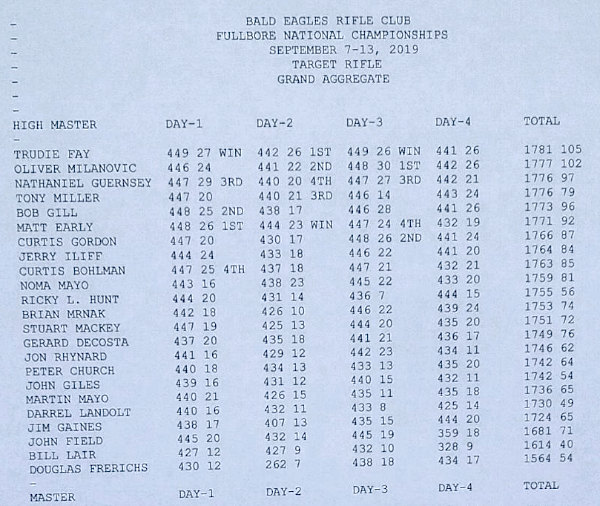
Congratulations to Trudie Fay, the Fullbore (Target Rifle) Champion at the 2019 Spirit of America Match. Trudie won yet another major title competing at the challenging NRA Whittington Range in Raton, New Mexico. With her great hard-holding skills and superior wind-reading abilities, Trudie shot brilliantly to finish at the top of a very strong field of competitors. SEE Spirit of America Fullbore Top 20 Results.
Trudie had a very impressive performance at Raton this past week. In her Fullbore (sling and irons) Division, she finished at 1781-105X, four points ahead of runner-up Oliver Milanovic (1777-102X). Trudie also had the highest score on two of the Four Days, and was the only shooter to record a 449 single-day score, which she managed on both Day 1 and Day 3. And as you’d expect, Trudie had the high X-Count for the match. This was another brilliant display of marksmanship by Trudie, who is also one of the best wind coaches in the country.
Trudie’s .308 Win Palma-type rifle was built by gunsmith and stock-maker Doan Trevor in Arizona. Doan commented: “I have had the privilege of building Trudie’s rifles for the last few years. Congratulations, my friend… You did it again!”
Blast from the Past — Trudie on All-Ladies Team at Camp Perry
Trudie is one of America’s greatest female shooters. A few years ago, she teamed up with four other legendary lady shooters for an all-female team at Camp Perry. Left to Right are: Michelle Gallagher, Trudie Fay, Nancy Tompkins (coach), Anette Wachter, and Sherri Jo Gallagher. Nancy was the first female National High Power Champion. And Sherri Jo was the second.
Shooting Sports USA has a fascinating article about the Perpetual Trophies awarded in national-level NRA matches. The story recounts the history behind the elaborate trophies, some from the 1870s. SSUSA’s Jennifer Pearsall writes: “The pieces of wood, stone and precious metal … are more than just instant recognition of achievement. They are the link of the American shooter’s present to his or her patriotic past. As you read this legacy of the NRA ranges, their founders, and the long list of cups, bowls, and plaques, realize that the history of competitive shooting is undeniably a significant part of the foundation of this country”. Read Full Trophy Story HERE.
Stunners in silver. Above are the NRA Leech Cup (left) and Wimbledon Cup (right).
The NRA was co-founded by Col. William Church and Gen. George Wood Wingate (ranked Captain at the time). Both Church and Wingate hoped to improved the marksmanship skills of American soldiers. One of the newly-formed NRA’s first actions was to issue: “An Act to Establish a Rifle Range and Promote Skill in Marksmanship”. That led to the opening of the famed Creedmoor Range, with a special inaugural match in June of 1873.
Many of the awards presented in the first NRA matches were cash or firearms. Some of these firearms were heavily embellished works of art. In the very first match, a member of the 22nd New York Regiment took home a gold-mounted Winchester Model 1866 valued at $100 — big money for the time.
In the 1870s shooting competitions were social as well as sporting events. Ladies and gentlemen came to watch and cheer the winners. This illustration, originally from Harpers Weekly, portrays the shooters and the viewing gallery at the 1876 Grand Centennial Championship—the “Palma” Match.
The Leech Cup — A Gift from Ireland
The Leech Cup was created for the first meeting of the American and Irish shooting teams. The elaborate cup was presented by Major Arthur Leech, captain of the the Irish team, to the Amateur Rifle Club of New York. This masterpiece of Irish silver-smithing was later given to the NRA in 1901 by the New York Club. Today, the Leech Cup is the oldest trophy offered in overall NRA competitive target shooting, awarded through the National High Power Long Range Championships.
The Wimbledon Cup
The Wimbledon Trophy was a gift from the NRA of Great Britain. It was given, as a gesture of sportsmanship, after the the U.S. Team was denied the ability to compete in England’s Elcho Shield match, then limited to Britain, Scotland, and Ireland. To maintain friendly competitive relations, the British presented the Americans with a large, engraved, lion-footed tankard trophy to be awarded each year to the Champion U.S. long-distance rifleman.
The Palma Team Trophy
Originally named the Centennial Trophy, in honor of the Centennial celebration of the independence of the United States of America, the Palma Trophy was commissioned from Tiffany’s at a cost of $1,500. The trophy was a full-sized replica of a Roman Legion standard, executed in bronze with silver and gold inlay. On the banner of the standard was the legend, “In the name of the United States of America to the Riflemen of the world”. Above the banner was an eagle, bearing in its talons a wreath of palm leaves and a plaque on which was the single word, “PALMA”, the Latin word for palm tree, which was used by the Romans to signify victory, or the ultimate in excellence.
Because the word Palma was so easily seen, the trophy soon became known as the “Palma Trophy”, and by 1878 was referred to officially by that name. The original seven and one-half foot trophy is now lost, having not been seen since at least 1954. Serving in its place is a copy which was commissioned by Dr. Herbert M. Aitken of Eau Claire, WI. The copy was made from the original Tiffany blue-prints at a cost of $32,500. Dr. Aitken has given this copy of the Palma Trophy to the NRA for use in the Palma Match. The trophy is retained by the winning team until the next Palma Match.
In 2008, the Palma Trophy was returned to the NRA, and it was decided that the trophy, once refurbished, will travel to the host nation for the match every four years, then returned to the NRA for safekeeping.
The first competition for the Palma Team was a challenge match for which the British Commonwealth nations were invited. The match was fired in 1876 at the old Creedmoor Range on Long Island as part of the Centennial celebration of the United States. Teams representing Scotland, Ireland, Canada, Australia, and the United States took part. The match is currently fired on a four-year interval.
“I have molested that rifle on several different occasions over the years. It is more beautiful in person if that is possible. Fine craftsmanship in every aspect.” — Forum Member Matt K.
Today’s Sunday GunDay feature is a “blast from the past”, part of our big Guns of the Week archive. Some years back, Forum member Corbin Shell told us he had a new, full-custom 1000-yard prone rifle. When he sent some photos of the maple-stocked masterpiece, our collective jaws dropped. Check it out — this is truly a “Maple Marvel”.
Corbin’s GunDay rig is an eye-catcher for sure. This is one handsome rifle, built with all-premium components and a stunning Curly Maple thumbhole stock with adjustable cheekpiece. The rifle is chambered in .243 Winchester. It features a custom stainless RBRP action Nesika R action, with keycuts in the bottom instead of recoil lug. A Grünig & Elmiger trigger has been specially modified (milled and pinned) to work with the Nesika action. The primary barrel is a 30″ Broughton 5R Palma-contour tube. Interestingly, Corbin has a second 30″ Broughton barrel chambered in 6mmBR for use at shorter ranges.
The trigger guard, fore-arm rail, cheek adjuster, and 4-way adjustable butt assembly are all custom metal, designed by Dan Gleason. The stock is cut from exhibition-grade fiddleback maple (from Cecil Fredi Gunstocks in Las Vegas) with a Gaboon Ebony tip wood and butt-plate spacer.
Fast and Accurate
Corbin tells us the gun will put five shots into the size of a quarter at 300 yards “when he does his part.” Corbin shoots pointed Berger 105gr VLDs and 45.5 grains of H4831SC. That load runs 3180 fps. He can push it faster, but “that’s where the node was and where it shoots best”, according to Corbin.
Forum member Jim Hardy has seen (and shot against) this beautiful rifle. Jim reports: “A casual observer might think that the trigger guard, cheek plate and butt plate hardware are Anschutz — as the stock takes on the Anschutz prone pattern. However, this is ALL custom metal. The G&E trigger breaks like a glass rod and will makes my BR triggers feel inferior at best. I had the pleasure of holding, shouldering, and lusting over this gun at Camp Perry last year, and it is even more impressive in person. The killer is that there is yet ANOTHER one in a beautiful, dark figured walnut owned by Corbin’s shooting partner. BTW, both guns will hammer at 1000 yards prone.”
Long Range Prone Shooting with the .243 Winchester
Is the .243 Winchester capable at 1000 yards? Absolutely. John Whidden has used the .243 Win to capture multiple NRA National Long-Range Championships. John selected the .243 Win because it offers excellent ballistics with manageable recoil. John says that, at least for a sling shooter, the .243 Win is hard to beat at long range. John explains that, while you CAN get somewhat better ballistics with a .284 Win or .300 WSM, you’ll pay a heavy price in increased recoil with those bigger cartridges.
Running at an impressive 3275 FPS from his .243 Win, Berger 6mm 105 grain Hybrids are hard to beat, according to Whidden: “My .243 Win shoots inside a 6.5-284 with 142-grainers. Nothing out there is really ahead of [the .243], in 1000-yard ballistics unless you get into the short magnums or .284s and those carry a very significant recoil penalty.” John has tried bigger cases: “In the past I did shoot the 6.5-284. I went to the .243 Win because it had similar ballistics but had much less recoil. It doesn’t beat me up as much and is not as fatiguing.” READ Whidden .243 Winchester Report.
Today is Day One of the Berger Southwest Nationals, at the Ben Avery Range outside Phoenix, AZ. There will be a 600-yard mid-range match. Many of the nation’s most talented F-Class and sling shooters will be there. But no matter what your skill level, it is still possible to make major mistakes, that can spoil the day and/or put you out of the running for the entire match.
Photo by Sherri Jo Gallagher.
In any shooting competition, you must try to avoid major screw-ups that can ruin your day (or your match). In this article, past F-TR National Mid-Range and Long Range Champion Bryan Litz talks about “Train Wrecks”, i.e. those big disasters (such as equipment failures) that can ruin a whole match. Bryan illustrates the types of “train wrecks” that commonly befall competitors, and he explains how to avoid these “unmitigated disasters”.
Urban Dictionary “Train Wreck” Definition: “A total @#$&! disaster … the kind that makes you want to shake your head.”
Success in long range competition depends on many things. Those who aspire to be competitive are usually detail-oriented, and focused on all the small things that might give them an edge. Unfortunately it’s common for shooters lose sight of the big picture — missing the forest for the trees, so to speak.
Consistency is one of the universal principles of successful shooting. The tournament champion is the shooter with the highest average performance over several days, often times not winning a single match. While you can win tournaments without an isolated stellar performance, you cannot win tournaments if you have a single train wreck performance. And this is why it’s important for the detail-oriented shooter to keep an eye out for potential “big picture” problems that can derail the train of success!
Train wrecks can be defined differently by shooters of various skill levels and categories. Anything from problems causing a miss, to problems causing a 3/4-MOA shift in wind zero can manifest as a train wreck, depending on the kind of shooting you’re doing.
Photo by Sherri Jo Gallagher.
Below is a list of common Shooting Match Train Wrecks, and suggestions for avoiding them.
1. Cross-Firing. The fastest and most common way to destroy your score (and any hopes of winning a tournament) is to cross-fire. The cure is obviously basic awareness of your target number on each shot, but you can stack the odds in your favor if you’re smart. For sling shooters, establish your Natural Point of Aim (NPA) and monitor that it doesn’t shift during your course of fire. If you’re doing this right, you’ll always come back on your target naturally, without deliberately checking each time. You should be doing this anyway, but avoiding cross-fires is another incentive for monitoring this important fundamental. In F-Class shooting, pay attention to how the rifle recoils, and where the crosshairs settle. If the crosshairs always settle to the right, either make an adjustment to your bipod, hold, or simply make sure to move back each shot. Also consider your scope. Running super high magnification can leave the number board out of the scope’s field view. That can really increase the risk of cross-firing.
2. Equipment Failure. There are a wide variety of equipment failures you may encounter at a match, from loose sight fasteners, to broken bipods, to high-round-count barrels that that suddenly “go south” (just to mention a few possibilities). Mechanical components can and do fail. The best policy is to put some thought into what the critical failure points are, monitor wear of these parts, and have spares ready. This is where an ounce of prevention can prevent a ton of train wreck. On this note, if you like running hot loads, consider whether that extra 20 fps is worth blowing up a bullet (10 points), sticking a bolt (DNF), or worse yet, causing injury to yourself or someone nearby.
[Editor’s Note: The 2016 F-Class Nationals will employ electronic targets so conventional pit duties won’t be required. However, the following advice does apply for matches with conventional targets.]
3. Scoring/Pit Malfunction. Although not related to your shooting technique, doing things to insure you get at least fair treatment from your scorer and pit puller is a good idea. Try to meet the others on your target so they can associate a face with the shooter for whom they’re pulling. If you learn your scorer is a Democrat, it’s probably best not to tell Obama jokes before you go for record. If your pit puller is elderly, it may be unwise to shoot very rapidly and risk a shot being missed (by the pit worker), or having to call for a mark. Slowing down a second or two between shots might prevent a 5-minute delay and possibly an undeserved miss.
4. Wind Issues. Tricky winds derail many trains. A lot can be written about wind strategies, but here’s a simple tip about how to take the edge off a worse case scenario. You don’t have to start blazing away on the command of “Commence fire”. If the wind is blowing like a bastard when your time starts, just wait! You’re allotted 30 minutes to fire your string in long range slow fire. With average pit service, it might take you 10 minutes if you hustle, less in F-Class. Point being, you have about three times longer than you need. So let everyone else shoot through the storm and look for a window (or windows) of time which are not so adverse. Of course this is a risk, conditions might get worse if you wait. This is where judgment comes in. Just know you have options for managing time and keep an eye on the clock. Saving rounds in a slow fire match is a costly and embarrassing train wreck.
5. Mind Your Physical Health. While traveling for shooting matches, most shooters break their normal patterns of diet, sleep, alcohol consumption, etc. These disruptions to the norm can have detrimental effects on your body and your ability to shoot and even think clearly. If you’re used to an indoor job and eating salads in air-conditioned break rooms and you travel to a week-long rifle match which keeps you on your feet all day in 90-degree heat and high humidity, while eating greasy restaurant food, drinking beer and getting little sleep, then you might as well plan on daily train wrecks. If the match is four hours away, rather than leaving at 3:00 am and drinking five cups of coffee on the morning drive, arrive the night before and get a good night’s sleep.”
Keep focused on the important stuff. You never want to lose sight of the big picture. Keep the important, common sense things in mind as well as the minutia of meplat trimming, weighing powder to the kernel, and cleaning your barrel ’til it’s squeaky clean. Remember, all the little enhancements can’t make up for one big train wreck!
2018 National Matches photo from NRA Competitive Shooting Facebook Page.
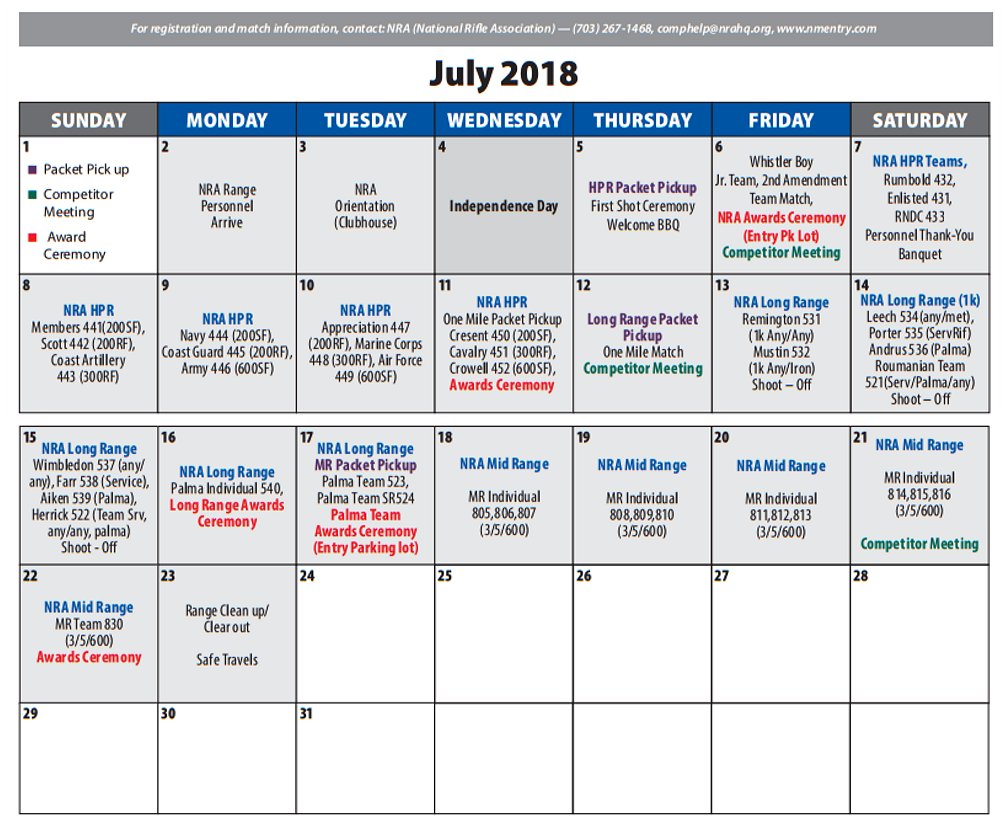
National High Power Matches, July 5-24, 2018 at Camp Atterbury Indiana
The NRA National High Power Matches are now underway at Camp Atterbury in Indiana. The Rifle National Matches, running July 5-24, will include the High Power Championship, the Long Range Championship, and the Mid-Range Championship, along with other special events. We are now in the thick of the NRA High Power Rifle Championship, which runs through Wednesday, July 11. Good luck to all the competitors! The Long Range Individual Championship runs the 16th through the 19th, followed by Long Range Palma, and Mid-Range individual and Team Matches.
National Matches at Camp Atterbury, Indiana, 2018 Schedule:
Friday, July 6: Whistler Boy JR. Team, 2nd Amend. Team Match, Awards Ceremony, Competitor Meeting
Saturday, July 7 – Wednesday, July 11: NRA High Power Rifle (awards ceremony on concluding day)
Thursday, July 12: Long Range Packet Pickup and Competitor Meeting
Friday, July 13 – Monday, July 16: NRA Long Range (awards ceremony on concluding day)
Tuesday, July 17: NRA Long Range Palma, Palma Team Awards Ceremony
Wednesday, July 18 – Saturday, July 21: NRA Mid Range Individual
Sunday, July 22: NRA Mid Range Teams, Mid Range Awards Ceremony
Monday, July 23: Range Clean Up/Clear Out
Click Calendar to See Large, Full-Screen Version.
Lodging at Camp Atterbury and Nearby
There is on-base lodging — rooms and cabins will be available to all competitors 18 and over. To book a room, or for any questions about lodging, please call (812) 526-1128. Camp Atterbury lodging includes suites and standard rooms as well as the MWR Campground and the MWR Cabins. Lodging is controlled by the Camp Atterbury Lodging Office, not by the NRA. Entry fees DO NOT include lodging costs. There are also a number of hotels nearby, including Charwood Suites. Nearby campground Johnson County Park also offers special rates for High Power competitors.
With the CMP hosting important matches this year at Camp Perry, many rifle competitors will be “commuting” between the two venues this summers, driving 4.5 hours from Indiana to Ohio.


 Position shooters can also improve their skills by shooting different disciplines. High Power Across-the-Course shooters benefit from shooting smallbore and air rifle. Again, these targets are very small, which will encourage competitors to be more critical of their shot placement. Hunters may benefit from shooting silhouette matches, which will give them practice when shooting standing with a scoped rifle. Tactical matches may also be good, as tactical matches involve improvising shots from various positions and distances. [Editor: Many tactical matches also involve hiking or moving from position to position — this can motivate a shooter to maintain a good level of general fitness.]


 Testing in Competition — at Camp Perry
 About John Whidden


 Congratulations to Trudie Fay, the Fullbore (Target Rifle) Champion at the 2019


 The Palma Team Trophy
 Today’s Sunday GunDay feature is a “blast from the past”, part of our big


 Train Wrecks (and How to Avoid Them)

 4. Wind Issues. Tricky winds derail many trains. A lot can be written about wind strategies, but here’s a simple tip about how to take the edge off a worse case scenario. You don’t have to start blazing away on the command of “Commence fire”. If the wind is blowing like a bastard when your time starts, just wait! You’re allotted 30 minutes to fire your string in long range slow fire. With average pit service, it might take you 10 minutes if you hustle, less in F-Class. Point being, you have about three times longer than you need. So let everyone else shoot through the storm and look for a window (or windows) of time which are not so adverse. Of course this is a risk, conditions might get worse if you wait. This is where judgment comes in. Just know you have options for managing time and keep an eye on the clock. Saving rounds in a slow fire match is a costly and embarrassing train wreck.