Multi-time National High Power champion David Tubb has developed an impressive two-stage trigger for Remington 700 rifles, the Model T7T. Priced at $385.00, the T7T Trigger is a true two-stage design: first and second stages are independently adjustable for both weight and feel. Overall (combined stage) trigger pull weight can be adjusted from just under 1 pound to slightly over 3.5 pounds.
The new T7T is a quality product. We’ve used the T7T and it proved crisp, repeatable, and reliable. If you are looking for a two-stage trigger for a precision rifle, this is a good option. We like a two-stage trigger for PRS applications, and the T7T can be adjusted high enough for that role. Or, it can go all the way down to under a pound — low enough to suit most F-Class shooters.
If you are interested in the T7T, watch these two videos. The first shows how to adjust pull-weights for both stages. The second video shows how to modify your stock to provide clearance for the T7T.
This video shows how to adjust the new Tubb T7T two-stage trigger for Remington 700s:
T7T Trigger Installation Tips
While installation of the T7T may require minor modifications to your action, most gun owners with basic mechanical skills can install the T7T by themselves. Note: As installed, the T7T trigger (either Right-Hand or Left-Hand) also requires a companion T7T bolt release, which you can get from DavidTubb.com for $10.00.
This video shows how to modify your stock to fit the T7T trigger:
The Precision Rifle Series (PRS) has introduced a new, price-capped Production Class in an effort to boost participation by making competition more affordable. Under recently-issued PRS rules, Production Class rifles may cost no more than $2000.00. The rules state:
“Production Division combined rifle and scope MSRP as listed on the company’s website shall not exceed $3,000 USD, the rifle shall not exceed $2,000 USD and the optic not exceed $2,000 USD.
Production Division rifles are not permitted to be altered or improved in any way from the original factory configuration.
In an effort to prevent exorbitant costs for beginning shooters, Production Division round count will not exceed 80 rounds.”
To fit the new Production Class Rules, MasterPiece Arms (MPA) has developed the new BA Lite PCR Competition Rifle built around a Savage Model 12 short action. Designed specifically for the new PRS Production Class, MPA’s PCR Competition Rifle offers many premium features yet stays under the $2,000 Class limit. The Savage action is upgraded with a Rifle Basix 2-lb trigger, and the adjustable, modular chassis offers a bag rider, barricade stop, and even a built-in bubble level. Bipods can be attached up front to a rail, with optional spigot mount. MPA PCR Rifles come with stainless Bergara barrels, 22-26 inches in length, fitted with MPA muzzle brakes (muzzle thread is 5/8-24 TPI).
MPA BA Lite PCR Competition Rifle Specifications:
Chamberings: 6mm Creedmoor, 243 Win, 6.5 Creedmoor, 308 Win, 6.5 x 47 Lapua, 6mm x 47 Lapua
Action: Savage Model 12 Short Action
Trigger: Rifle Basix Savage Trigger Set to 2 lbs.
Barrel: Bergara 416R Stainless Premium Barrel Blank
Chassis: MPA BA Lite Chassis
Muzzle Brake: MPA High Performance Muzzle Brake
Magazine: AICS Type (10 Round Accurate/AICS Type Magazine Included)
Chassis Weight: 2.9 lbs. (Overall rifle weight depends on barrel length and contour.) MSRP: $1,999.99
Left-Hand and Right-Hand Models in Choice of Five Cerakote Colors
The MPA BA Lite PCR Competition Rifle is available in black, burnt bronze, flat dark earth, gunmetal, and tungsten in both left- and right-handed set ups. All chassis and barrels are Cerakoted® in a multitude of colors and patterns. (Custom patterns are $150.00 extra). Barrel lengths available include 22 inches through 26 inches. The barrel twist is caliber-specific and the barrel muzzle thread is 5/8-24 TPI.
Editor’s Note: While the MPA PCR Competition rifle has nice features, it’s hard not to compare it to the Ruger Precision Rifle costing hundreds less. The latest Gen 2 Ruger Precision Rifle, with a sleeker handguard and factory muzzle brake, is available for under $1500.00 “street price”. Ruger lists a $1599.00 MSRP for the Gen 2 RPR versus $1399.00 for Gen 1 models.
There are two segments on Shooting USA this week that are well worth watching. On Wednesday (May 18, 2016), Shooting USA features a lengthy segment on the Bushnell Brawl tactical match. This is followed by an “Impossible Shoots” episode featuring top USAMU shooter SSG Daniel Horner.
This Wednesday, May 18th, Shooting USA TV features the Bushnell Brawl, a tactical competition that draws top long-range shooters from the military, law enforcement and the civilian shooting communities. The match is held at the famed Rifles Only range in Kingsville, Texas. The Brawl is a one-of-a-kind physical and mental challenge that tests each shooter’s ability to read wind, figure ballistics, and adapt to difficult shooting scenarios. There is even a helicopter stage.
Shooting from a helicopter, shooting off of a wire, and shooting from the physically demanding maze called the Mouse Trap. These are just a few of the unique courses of fire at the Bushnell Brawl, part of the PRS series. Over the course of two days, competitors tackle more than a dozen stages, and this year Bushnell hosted a special one-day event for the new PRS Production Class. This new division should attract new shooters by limiting the cost of equipment — making PRS competition affordable.
New PRS Production Division — Lowering the Cost of Entry
The Production Division is a new PRS classification. Under Production Division rules, the rifle and scope must cost under $3,000, combined. All other accessories, such as bipod, rear bag, and the sling, can be added at the shooter’s own discretion. By lowering the cost of entry, PRS organizers hope to get more shooters involved: “There’s a lot of gear out there that’s not that expensive that you can use to get into this and start to play the game,” says Production Division Match Director Jacob Bynum.
Shooting USA’s Impossible Shots — Threading the Needle
This time, SSG Daniel Horner has combined with the Army Marksmanship Unit Gunsmiths to set up the ultimate Impossible Shot. Horner attempts to send one bullet through two barrels to pop a balloon.
This challenge is definitely demands the ability to “thread the needle”. In other trick shot challenges this week, Randy Oitker switches to a crossbow to set up his Annie Oakley-style, over the shoulder challenge. Julie Golob is your guide to some of the most amazing exhibition shots ever seen.
Shooting USA Hour on Wednesday Nights
Eastern Time – 3:00 PM, 9:00 PM, 12:30 AM Th
Central Time – 2:00 PM, 8:00 PM, 11:30 PM
Mountain Time – 1:00 PM, 7:00 PM, 10:30 PM
Pacific Time – 12:00 Noon, 6:00 PM, 9:30 PM
Also on Saturdays Prime Time:
Eastern Time – 12:30 AM
Central Time – 11:30 PM
Mountain Time – 10:30 PM
Pacific Time – 9:30 PM
The Ruger Precision Rifle (RPR) has been a huge sales success. Nearly a year after its introduction, the RPR remains in very high demand. The first production run by Ruger essentially sold out, so it is very hard to find one for sale, in any caliber.
Though it has a big winner on its hands, Ruger has made some upgrades to its popular RPR. An “enhanced” RPR will be offered with a new handguard, bolt shroud, and muzzle brake. Two new models have been added to the RPR line-up, the model 18004 in .308 Win, and the model 18008 in 6.5 Creedmoor. These models, priced at $1599.00 MSRP, feature a new, low-profile handguard, a new aluminum bolt shroud, and a muzzle brake. The new handguard will work better for scopes with large front objectives. The muzzle brake should reduce felt recoil, but we do wonder whether accuracy might suffer. The brakeless, first-generation RPRs exhibited very good accuracy most of the time.
For the time being, the original model RPRs will be offered along with the new enhanced RPRs: “Both the original and enhanced configurations will be available from Ruger for a time, with the initial pattern being phased out as supplies are depleted.” (Source: American Rifleman). But there is a catch. The new models cost $200.00 more than Gen 1 RPRs. Ruger lists a $1599.00 MSRP for the enhanced RPRs versus $1399.00 for Gen 1 models.
To See NEW FEATURES, click the image below, then SCROLL down the page on the Ruger web page that loads. Yes, the VIDEO is there — you just have to scroll down.
According to American Rifleman, the new handguard has multiple benefits: “Still free-floating and KeyMod-compatible, the new design omits the original’s top-mounted Picatinny rail in order to increase scope clearance. Given the larger objective lenses utilized by long-range optics, this enhancement makes a lot of sense. The bottom surface of the new handguard is also contoured with a flatter surface, providing for a more stable foundation for the mounting of bipods than the original model.” Current RPR owners can purchase the new-style 15″ aluminum handguard for $249.95 from ShopRuger.com.
Ruger RPR Hybrid Muzzle Brake
The original, Gen 1 Ruger Precision Rifle had a threaded muzzle covered by a thread cap. The new “enhanced model” features a factory-installed “hybrid” brake fitted to the barrel. This brake combines radial holes in the rear half with large, angled side ports in the front. Ruger claims the brake reduces recoil almost 40% on a 6.5 Creedmoor. This brake can be purchased separately for $99.95 from ShopRuger.com.
What do you get when you cut a 6.5 Creedmoor-chambered barrel down to just over 16 inches? A lot more velocity than you might think. Our friends at Rifleshooter.com recently did a barrel cut-down test with 6.5 Creedmoor test rifle, shortening the barrel from 27 to 16.1 inches in one-inch increments. Surprisingly, with a 142gr Sierra MK, the total velocity loss (as measured with a Magnetospeed) was just 158 FPS, an average of 14.4 FPS per inch of barrel length. With the lighter 120gr A-Max bullet, the total velocity loss was 233 FPS, or 21.8 FPS average loss per inch of barrel.
Test Procedure
Five (5) rounds of each type of cartridge were fired at each barrel length and the velocity data was recorded with a MagnetoSpeed V3 barrel-mounted chronograph. The rifle was then cleared and the barrel was cut back one inch at a time from 27″ to just over 16″. NOTE: During this winter test, the air temperature was a very chilly 23° F. One would expect higher velocities across the board had the outside temperature been higher.
The photo below shows how the barrel was cut down, inch-by-inch, using a rotary saw. The barrel was pre-scored at inch intervals. As the main purpose of the test was to measure velocity (not accuracy) the testers did not attempt to create perfect crowns.
6.5 Creedmoor vs. Other Mid-Sized 6.5mm Cartridges
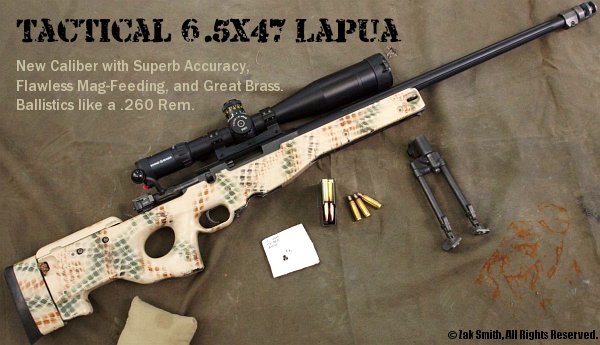
The 6.5 Creedmoor is a very popular cartridge with the tactical and PRS crowd. This mid-size cartridge offers good ballistics, with less recoil than a .308 Winchester. There’s an excellent selection of 6.5mm bullets, and many powder choices for this cartridge. When compared to the very accurate 6.5×47 Lapua cartridge, the 6.5 Creedmoor offers similar performance with less expensive brass. For a tactical shooter who must sometimes leave brass on the ground, brass cost is a factor to consider. Here’s a selection of various 6.5 mm mid-sized cartridges. Left to right are: 6.5 Grendel, 6.5×47 Lapua, 6.5 Creedmoor with 120gr A-Max, 6.5 Creedmoor with 142gr Sierra MK, and .260 Remington.
When asked to compare the 6.5 Creedmoor to the 6.5×47 Lapua, Rifleshooter.com’s editor stated: “If you don’t hand load, or are new to precision rifle shooting, get a 6.5 Creedmoor. If you shoot a lot, reload, have more disposable income, and like more esoteric cartridges, get a 6.5×47 Lapua. I am a big fan of the 6.5×47 Lapua. In my personal experience, the 6.5×47 Lapua seems to be slightly more accurate than the 6.5 Creedmoor. I attribute this to the quality of Lapua brass.”
We often get questions about the 6.5 Creedmoor Cartridge — folks ask where they can find good resources for this cartridge, which is popular with Across-The-Course, High Power, and tactical shooters. We did some searching and found that the August 2011 digital edition of Shooting Sports USA has a good article for all fans of the 6.5 Creedmoor.
Development of the 6.5 Creedmoor Cartridge
In the August 2011 Edition of Shooting Sports USA you’ll find a lengthy feature on the 6.5 Creedmoor cartridge. This story covers the origin of the cartridge and its performance both as a match cartridge and as a hunting round. Hornady Chief Ballistician Dave Emary explained: “the original intent of the cartridge was as an across-the-course match cartridge. We envisioned it as an off-the-shelf round that would produced the accuracy and ballistics to compete in all match disciplines right out of the box. At the same time we realized that the same characteristics would make an exceptional hunting cartridge with the right bullets.”
6.5 Creedmoor Brass No Longer Washed After Annealing
Here’s an interesting update on Hornady 6.5 Creedmoor brass and loaded ammo. In a move to improve case quality and neck uniformity, Hornady recently changed the 6.5 Creedmoor production process, eliminating the case-washing step after annealing. So now you will see annealing coloration on 6.5 Creedmoor brass, just like on Lapua brass. Dennis DeMille of Creedmoor Sports wanted to improve the consistency/uniformity of 6.5 Creedmoor case-necks. At Dennis’ suggestion, Hornady conducted tests which showed that the “standard industry practice” of washing brass could potentially alter the necks in undesirable ways. Bottom line, unwashed annealed brass was determined to have an accuracy edge over washed brass. Looking at these results, Hornady decided to forgo the post-anneal washing process. As a result, the latest 6.5 Creedmoor brass now displays the distinctive coloration left by neck/shoulder annealing. Learn something new every day, eh?
Sierra has released two new Tipped MatchKing (TMK®) bullets that should find favor with PRS competitors and tactical shooters*. Sierra is producing a new 95 grain 6mm projectile and a new 130 grain 6.5mm bullet. Both feature acetal resin tips that lower drag by improving the ballistic coefficient (BC) and making the BC more uniform from bullet to bullet. The 95-grainer should work well as a higher-speed option in the .243 Win, 6mm Creedmoor, 6mm Dasher, and 6mmBR. We were able to push other 95gr bullets nearly 100 fps faster than 105gr bullets from a 6mmBR. For those shooting the 6.5×47 Lapua and 6.5 Creedmoor, the new 130gr TMK should be a near-ideal bullet weight. We know that Berger’s 6.5mm 130gr VLD works great in those mid-sized cartridges, so Sierra’s new 130-grainer should be in the “sweet spot”. Also, in the .260 Remington the 130gr TMK should be capable of velocities that hit predicted accuracy nodes with ease. The 6mm 95 grain TMK requires a twist rate of 1:9″ or faster to stabilize while the 6.5mm 130 grain TMK requires a twist rate of 1:8″ or faster to stabilize.
We expect the 130gr 6.5mm TMK to find favor with Tactical Shooters
* In addition, Sierra plans to add a 7mm 160gr TMK to the line-up, product #7660, but we don’t expect this to be used for tactical games because of the heavier recoil.
The prestigious GAP Grind tactical match took place 16-18 October, at the K&M Shooting Complex in Finger, Tennessee. Here’s a “sizzle reel” video showing highlights from this year’s match, which drew talented competitors from across the nation. Held in association with the Precision Rifle Series (PRS), this year’s Grind features a Pro/Am format with professional and amateur competitors aiming for individual and team honors.
Watch GAP Grind 2015 Video (Loud Soundtrack):
Lots of Action, with 20+ Stages
The GAP Grind is a challenging, “high tempo” match with minimal down-time between stages. This year, over the course of 20+ stages, competitors each fired 200+ shots at a variety of steel, paper, moving, and reactive targets out to 1,200 yards. Targets varied in size and difficulty based on distance and time allotted. Most stages included “stressors” — i.e. time limits or required movement(s).
The prestigious GAP Grind tactical match runs this weekend, 16-18 October, at the K&M Shooting Complex in Finger, Tennessee. The 2014 GAP Grind drew a huge turn-out, and this year’s Grind promises to top that — with more competitors and even tougher challenges. Held in association with the Precision Rifle Series (PRS), this year’s Grind features a Pro/Am format with professional and amateur competitors aiming for individual and team honors.
Lots of Action, with 20+ Stages
The GAP Grind is a notoriously challenging, “high tempo” match with minimal down time between stages. Over the course of 20+ stages, competitors will fire 200+ shots at a variety of steel, paper, moving, and reactive targets out to 1,200 yards. Target vary in size/difficulty based on the shooter’s position, distance, and time allotted. Most stages include “stressors” — i.e. time limits or required movement(s).
2014 GAP Grind Highlights Video:
Want to see what a “GAP Grind Experience” is all about? Then watch this video from the 2014 Grind. You’ll see a lot of movement through a wide variety of shooting positions. This ain’t no benchrest match, that’s for sure…
GAP Grind Guns by Giddings
Shelley Giddings, a skilled shooter of both firearms and cameras, attended the 2014 GAP Grind last week. While there, Shelley snapped some cool images of state-of-the-art tactical rifles. Here is a Giddings Gallery of Grind Guns. You can find more GAP Grind pix on Shelly’s Facebook Page.
Click any photo below to see a full-screen version.
It seems like every manufacturer has a new “tactical precision” rifle these days, and Mossberg is no exception. Mossberg offers the MVP-LC, which combines the Mossberg MVP receiver with a sleek, modern MDT LSS metal chassis with an AR-type buttstock that adjusts for length (11.25″ – 14.5″ LOP). The light-weight, tan-finished aluminum chassis features a V-shapped bedding area for the Mossberg MVP action. The MVP-LC’s LBA trigger is user-adjustable from 3 to 7 pounds pull weight.
GunTalk TV Video Review of Mossberg MVP LC:
The new rifle features the MDT LSS chassis system, Magpul furniture and magazine and Silencerco Saker muzzlebrake/QD mount. The rifle is available with optional Vortex HS-T 4-16X rifle scope.
Available in either .223 Rem or .308 Win, the MVP LC rifle will accept standard AR-15 and AR-10 magazines. The barrels are pretty short, 16.25″ for .223 Rem, or 18.5″ for .308 Win, but they do come with threaded SilencerCo Muzzle Brakes installed. Weight, without optics, is 8 lbs. for the .223 Rem version, 8.5 lbs. for the .308 version. We think the lighter .223 Rem model would make a nice “carry-around” varmint rifle. The current “street price” is $1099.99.
MVP-LC Featured in Shooting Illustrated
If you want to learn more about this rifle, check out Shooting Illustrated this month. Mossberg’s MVP-LC is the “cover girl” of the October issue; you’ll find a full report on this new tactical rifle with complete specs and lots of big photos.
FEATURES: Mossberg MVP bolt-action design compatible with standard AR magazines (AR15, LR308/SR25). MDT LSS light chassis aluminum stock. Magpul CTR Adjustable LOP Stock with A-frame profile to reduce snagging for height adjustment. Either a 16.25″ (.223 Rem) or 18.5″ (.308 Win) barrel threaded with SilcencerCo Saker Muzzle Brake (thread cap included). Includes LBA adjustable trigger system (3-7 lbs.), oversized bolt handle, Picatinny rail, adjustable bipod.


 This Wednesday, May 18th, Shooting USA TV features the Bushnell Brawl, a tactical competition that draws top long-range shooters from the military, law enforcement and the civilian shooting communities. The match is held at the famed Rifles Only range in Kingsville, Texas. The Brawl is a one-of-a-kind physical and mental challenge that tests each shooter’s ability to read wind, figure ballistics, and adapt to difficult shooting scenarios. There is even a helicopter stage.


 Ruger RPR Hybrid Muzzle Brake


 6.5 Creedmoor Brass No Longer Washed After Annealing


 MVP-LC Featured in Shooting Illustrated


