|
|
June 5th, 2008

Sierra Bullets offers a vast, FREE online library, derived from the 4th and 5th Editions of The Sierra Loading Manual. On Sierra’s ExteriorBallistics.com website, you’ll fine dozens of technical articles, plus useful reference charts for powder burn rates, bullet BCs, and measurement conversions. There’s even a comprehensive Glossary of Shooting Terminology. Overall, ExteriorBallistics.com offers hundreds of pages of great, FREE information.

Tech articles from Sierra’s 5th Ed. Manual that are available online include:
Section 2-2.1 The Ballistic Coefficient Explained
Section 2.3 How the Ballistic Coefficient is Measured
Section 2.3.2 Initial Velocity and Time of Flight Method
Section 2.3.3 Doppler Radar Method
Section 2.4 Lessons Learned from Ballistic Coefficient Testing
Section 3.0 Exterior Ballistic Effects on Bullet Flight
Section 3.1 Effects of Altitude and Atmospheric Conditions
Section 3.2 Effects of Wind
Section 3.3 Effects of Shooting Uphill or Downhill
Section 3.4-3.4.1 Trajectory Considerations for Sighting-In
Section 3.4.2 Determining Zero Range from Firing Test
Section 3.4.3 Sighting in for a Change in Shooting Location
Section 3.5 Point Blank Range
Section 4.2 Yaw of Repose and Resulting Crossrange Deflection
and much, much more….
In addition to the ballistics articles listed above, ExteriorBallistics.com offers a detailed Reloading Section covering equipment and loading methods. Some of the more useful reloading articles include:
Scale and Measures
Case Inspection
Neck- and Full-length Sizing
Bullet Seating.
May 29th, 2008
Here’s an inexpensive tip that can help you load straighter ammo, with slightly better measured concentricity (i.e. less run-out) on the case necks and bullets. Simply use a rubber O-Ring on the underside of the die locking ring. This allows the die to self-align itself (slightly) to the case that is being sized. Without the O-Ring, if the flat surface on the top of your press is not perfectly square with the thread axis, your die can end up slightly off-angle. This happens when the bottom of the locking ring butts up tight against the top of the press.
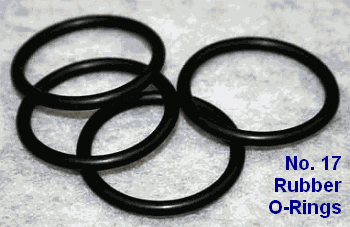
Top prone shooter German Salazar has tried this trick and he says it works: “Go to your local hardware store and get a #17 O-Ring (that’s the designation at Ace Hardware, don’t know if its universal). Slip the O-Ring on the die and re-adjust the lock ring so that the O-Ring is slightly compressed when the die is at the correct height. Size and measure a few more cases. You will probably see a slight improvement in neck concentricity as the die can now float a bit as the case enters and leaves it. This isn’t going to be a dramatic improvement, but it’s a positive one.”
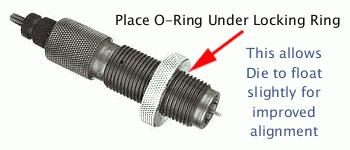
Lee Precision makes die lock rings with built-in O-Rings. Lee’s distinctive lock ring design allows the same kind of self-alignment, which is good. However, Lee lock rings don’t clamp in place on the die threads, so they can move when you insert or remove the dies — and that can throw off your die setting. By using an O-Ring under a conventional die lock ring, you get the advantages of the Lee design, without the risk of the lock ring moving.
May 28th, 2008
Because of increased raw material and fuel costs, prices of bullets and brass have gone up dramatically in recent months. We are hearing from active shooters that cost considerations are influencing their decisions about what calibers and chamberings to shoot. There is a definite trend to smaller cartridges and lighter bullets.
One prominent match shooter told us: “I’ve been debating between a 6.5×47 Lapua and a 6-6.5×47. After comparing the cost of 6.5mm vs. 6mm bullets, I decided on the 6mm. If I save $7 bucks a box, and shoot 4000 rounds a year (40 boxes of bullets), that’s $280.00 in savings–enough to buy a new barrel.”
Here are some comparative bullet prices for 6mm, 6.5mm, 7mm, and 30-caliber bullets at Midsouth Shooters Supply. Prices are for a 100-count box. Note that the 6.5mm match bullets cost 25% more than the 6mms. For active shooters, the price difference adds up quickly.

| Brand |
6mm |
6.5mm |
7mm |
.308 |
| Berger |
105gr VLD
$27.57 |
140gr VLD
$34.25 |
168gr VLD
$39.15 |
190gr VLD
$41.53 |
| Sierra |
107gr MK
$24.61 |
142gr MK
$30.53 |
175gr MK
$29.16 |
200gr MK
$31.64 |

Here are brass costs for Lapua brass from Grafs.com. Prices are for 100-count boxes. Generally speaking, the bigger the case, the higher the price (except for the .308 Win).
| .223 Rem |
6mmBR |
6.5×47 Lapua |
.308 Win |
6.5-284 |
.338 Lapua Mag |
| $44.79 |
$62.39 |
$82.79 |
$54.99 |
$92.99 |
$211.99 |
Consider Barrel Life Also
Certainly, moving to a smaller caliber can often reduce what you have to pay for brass and bullets. On the other hand, you need to consider barrel life. Hot-loaded 6mms, such as a .243 Ackley, can burn up a barrel much more quickly than a .308 Winchester. In comparing the “operating costs” of various cartridges, you need to factor in barrel replacement costs as well as component prices.
April 29th, 2008
Forum member Ron Tilley finished fourth overall at the recent NBRSA 600-Yard Nationals. This was an impressive performance for a relative newcomer to the 600-yard game without “local knowledge” of the Sacramento range. The top 3 finishers, Jerry Tierney, Peter White, and Craig St. Claire, all have extensive experience shooting at Sacramento.

While many of the top shooters were using a 6mm in Light Gun (such as a 6 Dasher or 6-6.5×47), Ron campaigned a 260 Ackley Improved. This is based on a 260 Rem case, with the shoulder blown forward to 40 degrees. Improving the 260 Rem case adds just enough extra capacity to get the 140gr-class bullets into the 2900+ fps velocity window where they seem to perform best.
Ron starts with Lapua 243 cases, necked up to 6.5 mm. He was shooting 140gr Berger VLD bullets, pushed by Hodgdon H4831sc powder and Russian primers. Ron says this combination has been “very accurate right out of the gate.” Ron’s 2920 fps load delivers 5-shot groups in the high teens and low twos, with very low ES and SD. In the video interview below, Ron explains the merits of the 260 AI cartridge, and offers tips on case prep and loading for accuracy.

CLICK HERE to WATCH TILLEY VIDEO
Ron was shooting an eye-catching rifle. It featured a carbon fiber and wood Terry Leonard stock, BAT Action, and Nightforce scope. With all-premium components, Terry’s 260AI is a beautiful rig that shoots as good as it looks.


April 20th, 2008
Readers often ask: “What priming tool should I use?” There is no simple, clear-cut answer. Different tools have different advantages and disadvantages. Many short-range benchresters like the Sinclair one-at-a-time priming tool. They believe this unit has the best “feel” for seating primers.
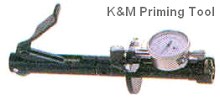 Others prefer the K&M tool, another “single-loader”, because it can be fitted with a seating depth gauge, for the ultimate in precision. On the other hand, one top shooter with a couple National Championships under his belt favors the modest $19.00 Lee Autoprime tool: “It’s simple, efficient and has served me well for years–I’m not convinced the fancy, expensive tools do a better job.” Others prefer the K&M tool, another “single-loader”, because it can be fitted with a seating depth gauge, for the ultimate in precision. On the other hand, one top shooter with a couple National Championships under his belt favors the modest $19.00 Lee Autoprime tool: “It’s simple, efficient and has served me well for years–I’m not convinced the fancy, expensive tools do a better job.”
This editor has tried all of these tools, and personally I favor the RCBS APS hand priming tool. It has two important advantages. Number one, primers are held in color-coded plastic strips so you never have to touch the primers. If you buy the pre-loaded strips, there is no chance of getting an upside-down primer, and you never have to fool with flipping primers in a tray. Second, the APS tool has a “universal” shell-holder. This employs spring-loaded jaws so it can fit any size cartridge, from a 17 Fireball to large magnums. The unit has a comfortable grip and plenty of leverage. Each time you seat a primer, the strip automatically advances.

Currently, only CCI primers can be purchased pre-loaded into strips. But there is an inexpensive tool that allows you to load Federal, Winchester, or Wolf primers into the strips. The strips come in a variety of colors (Red, White, Blue, Orange, Yellow, and Black), so you can sort your primers by color.

The RCBS APS hand primer is ideal when doing primer comparison testing. You can slide one strip of 25 primers in the tool, seat 5 or 10, then easily remove the strip with the remaining primers, and slide in a second strip with another primer type. You can slip the first strip back in a storage box and the primers remain ready to use.
As contained in the strips, primers can also be used in an RCBS 2000 progressive press, a bench-mounted priming unit, and a special device that fits into the top of a Rockchucker or similar press. I have loaded over 20,000 pistol rounds with an RCBS progressive press and I have had not a single flipped primer. Not one. The strip-priming system also makes it easy to switch from small to large primers on the progressive–this can literally be done in under 20 seconds.

The bench-mounted unit is ideal for priming large quantities of cases. The long handle provides plenty of leverage, and you can work fast, as the primers automatically feed through the system. When I load large quantities of varmint rounds, I use the bench-mounted APS system.
February 12th, 2008
 Alliant Powder, a division of Alliant Tech Systems Inc., (ATK), will be shipping new Reloder 17 powder in mid-March, 2008. This is an all-new, double-base powder produced in Switzerland by NitroChemie for Alliant. It is a high-energy powder with a burn rate close to IMR 4350, and “midway between Reloder 15 and Reloder 19.” The powder density is optimized for the short magnum cases such as the 7mm WSM and 300 WSM, but it also will work very well with cartridges such as .243 Win, .270 Win, 6XC, and 6mm Remington, according to Alliant Product Manager Dick Quesenberry. Alliant Powder, a division of Alliant Tech Systems Inc., (ATK), will be shipping new Reloder 17 powder in mid-March, 2008. This is an all-new, double-base powder produced in Switzerland by NitroChemie for Alliant. It is a high-energy powder with a burn rate close to IMR 4350, and “midway between Reloder 15 and Reloder 19.” The powder density is optimized for the short magnum cases such as the 7mm WSM and 300 WSM, but it also will work very well with cartridges such as .243 Win, .270 Win, 6XC, and 6mm Remington, according to Alliant Product Manager Dick Quesenberry.
Reloder 17, a state-of-the-art propellant, promises to deliver higher velocities than competitive powders for many popular calibers. If you have the “need for speed”, Reloder 17 is worth trying if you’re shooting IMR4350, H4350, N550 or similar powders right now. The new RL17 will be offered in 1-lb. and 5-lb. containers and will cost about the same as other Alliant Reloder powders, such as RL15 and RL19.
Mr. Quesenberry noted that Alliant tested many formulations, from a variety of makers, before choosing the Swiss-made Reloder 17. Alliant’s new RL17 is NOT the same as Norma URP, produced by Bofors in Europe. According to Alliant, the new Reloder 17 tested superior to URP (and most other powders in that burn range) in all major criteria: Velocity, Accuracy, ES/SD, material consistency, and resistance to ambient temperature-induced pressure changes.
Reloder 17 features an advanced, penetrant-type kernel coating. Alliant believes this is superior to typical surface powder coatings because it provides a more consistent, progressive burn. The powder pressures do not spike as sharply as with surface-coated powders, but remain more consistent throughout the burning process.
Testing has shown that Reloder 17 offers big velocity gains in many cartridges compared to other powders in the same burn range. For example, in the 6mm Remington, using an 85gr BTSP, Reloder 17 delivered a +156 fps gain over all other powders listed in the current Speer Reloading manual. Likewise, in the 300 WSM with a 180gr BTSP, Reloder 17 offered +104 fps edge in velocity over all powders listed in the Speer Manual. Below is a chart showing projected velocity gains compared to other Speer Manual-listed powders.
VELOCITY GAINS with RELOADER 17 POWDER
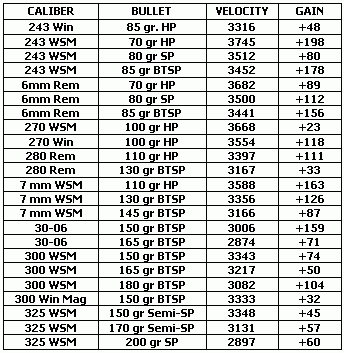
Alliant has already done extensive load testing in its ballistics laboratories and has load data available for 20 popular cartridges, including .243 Win, 6mm Rem, 6.5×55, .260 Rem, .270 Win, .308 Win, 30-06, 7mm WSM, 300 WSM, and 300 Win Magnum.
CLICK HERE for ALLIANT RELODER® 17 LOAD DATA
NOTE CONCERNING LOAD DATA:
Reloder® 17 was created with new technology to provide velocity greater than the competition in the most popular standard rifle calibers and the new short magnums. For the recipes developed in Alliant’s Ballistics Laboratory, all loads used Speer bullets and list the correct Overall Length — DO NOT SEAT THE BULLETS TO A LESS OVERALL LENGTH. These recipes are maximum loads and shall not be exceeded. Always start at least 5% low and work up.
November 30th, 2007
In July 2007, eBay announced a policy banning the listing and sales of “any firearm part that is required for the firing of a gun”. This wholesale ban created an immediate vacuum in the auction market for bullets, barrels, slides, magazines and other firearm components.

There’s now a new auction site that hopes to replace eBay for sellers and buyers of gun parts and reloading components. ReloadersAuction.com launched in August 2007, just a few weeks after eBay announced its anti-gun policy. The creators of the new site, who are avid reloaders themselves, explain: “We started this auction site because eBay has stopped the sale of most all reloading supplies, gun parts, and most knives. We wanted to always have a place to buy reloading and hunting supplies at a great deal….” The site combines an eBay-style auction experience with enhanced features including “Want to Buy” ads and barter (“Swap”) offerings.

Because ReloadersAuction.com is so new, there were only 400 or so active auctions as of November 30th. But that should change quickly. There are some very nice navigation features which make the site easy to use. Right on the front page, “Ending Soon” and “Most Popular” auctions are listed in convenient table style format, so you can scan dozens of auctions in one glance. The “Most Viewed Items” also appear on the home page, highlighting good deals that you might not find via a word search.
We wish ReloadersAuction.com well. It is based in North Carolina, an area where gun rights are respected, and where there is a strong tradition of hunting and shooting sports. So, next time you need bullets, brass, or reloading accessories, check out this new site. There are some good deals to be had.
|


