|
|
September 15th, 2010
 Beretta U.S.A. Corp. has discovered a potential condition with Beretta .22 caliber NEOS semiautomatic pistols in which the pistol will fire even if the safety is activated and, in some cases, the pistols may fire if the safety is moved from the OFF to the ON position. Because of safety concerns relating to this situation, Beretta U.S.A. Corp. is immediately implementing a recall of Beretta .22 caliber NEOS semiautomatic pistols. Beretta U.S.A. Corp. has discovered a potential condition with Beretta .22 caliber NEOS semiautomatic pistols in which the pistol will fire even if the safety is activated and, in some cases, the pistols may fire if the safety is moved from the OFF to the ON position. Because of safety concerns relating to this situation, Beretta U.S.A. Corp. is immediately implementing a recall of Beretta .22 caliber NEOS semiautomatic pistols.
If you have a Beretta NEOS pistol, send it to Beretta’s Accocreek, MD Service Center for repair. Instructions on how to send your Neos to Beretta are available at www.berettasupport.com/neos or by calling 1-800-BERETTA.

Note: Some pistols are not subject to recall. Please visit www.berettasupport.com/neos to see if your NEOS has already been repaired. If the firing pin for your NEOS looks like New Version 1 or 2 above, you do not need to return it. Returned NEOs pistols will be retrofitted, at no cost to the owner, with a replacement firing pin assembly. The new firing pin assembly can be identified either by a circle on the back of the firing pin that includes a red dot in the center, or by a vertical line as shown in the photos. Please make sure that your Beretta NEOS pistol is unloaded before delivery to the service center. Do not experiment with your Neos pistol to see if it has the potential safety issue.
May 10th, 2010
The National Shooting Sports Foundation (NSSF) now offers FREE educational video DVDs about firearm safety and wildlife conservation to teachers and school administrators. Already, more than 4,500 DVDs have been ordered by educators. Teachers can order the DVDs (and download related PDF brochures) via the NSSF website. In addition to the videos, each DVD contains guides and activity planners to assist teachers. For more information, visit the NSSF Education Videos webpage.

The Firearms Safety DVD contains three video segments, two designed for viewing by students and one for a general audience. These videos show students how to make correct decisions when encountering a firearm in an unsupervised situation at school, at home or at a friend’s home. The Wildlife Conservation DVD features three videos that teach students about America’s wildlife management system and explain how hunters contribute funding for conservation. Teachers can preview both the Firearms Safety Videos and the Conservation Videos on the NSSF Website.
“We believe teachers and school administrators should teach students how to correctly respond if they encounter an unattended firearm. Students who understand what to do in such situations can potentially save lives,” said Steve Sanetti, NSSF President. Regarding conservation education, Sanetti said, “We have a generation of children who spend less time outdoors and who see more wildlife on television than in the wild. It’s important that students today understand how once-endangered species such as white-tailed deer and wild turkey have been brought back to abundance through efforts funded by hunters.”
April 9th, 2010
.223 WSSM and 6mmBR Disaster — Report by Dr. Jim Clary
Under most circumstances, shooters don’t have to worry about chambering the wrong cartridge into the wrong rifle. After all, the cartridges are well marked and we all know which rifle we are shooting on any given day. In many cases, incorrect cartridges cannot be chambered — larger cases will not fit in smaller chambers, for example. No problem! That being said, I can tell you that even an experienced, careful and normally safe shooter can make a mistake.
The following is an account of just such a mistake that could have resulted in death or dismemberment. Fortunately, the shooter was not hurt, but the rifle was completely destroyed.
Last year, a friend purchased a Savage Precision right bolt, left port, single shot bolt action in 6mmBR Norma. It was an incredible prairie dog gun and he spent the summer burning powder and busting dogs. In October, he purchased a stainless steel Browning A-Bolt Varmint in .223 WSSM. The weather in the upper Midwest turned sour by the time he got the brass tuned up and he only got to fire it a few times before he was “socked in” for the winter. Thus, he spent his evenings loading ammo for the spring thaw.
During a break in the weather, he grabbed both rifles and a couple of bags of .223 WSSM and 6mmBR cartridges and headed to the range to check out his new loads. In case you are not familiar, the 6mmBR is smaller in diameter and a mite shorter than the .223 WSSM. Because of this, it will chamber in a .223 WSSM, but the .24 caliber bullet is too big for the .22 caliber bore. That is what happened to my friend.
The rest is history; when he squeezed the trigger, all hell broke loose. The entire bottom of the rifle blew out, including the magazine assembly. The explosion actually cut the stock into two pieces. However, the bolt held and amazing as it may seem, the .243 bullet was “swaged” right out of the .223 barrel.

6mmBR (left) and .223 WSSM (right) cartridges above the remains of Browning A-Bolt rifle.
One Small Mistake Is All It Takes
Now, realize that my friend has been shooting all manner of firearms, safely, for over half a century. He is meticulous, thorough and conscientious in his approach to reloading and shooting. However, he made one mistake. He put some lose 6BR cartridges in a baggie as he packed up from a prairie dog hunt last summer, without noticing that the baggie was marked .223 WSSM in black marker. Then, when the break in his winter weather came, he grabbed the bag, believing it to be the WSSM cartridges and didn’t check the head stamp.
Couldn’t happen to you? How many times have we emptied our pockets of cartridges and dropped them into a plastic container on the shooting bench? How many times have we set down to a marathon reloading session, loading several calibers in a row? How many times have we put the wrong bullets, cases or primers into the incorrect container? My point is that even the safest of us can make a mistake. So, look at the picture above and take a bit more time when you reload your ammunition at home or chamber a round in the field. It might save your life.
Story and photo © Dr. Jim Clary, All Rights Reserved.
COMMENT: In a thread inspired by the above story, the moderator of another gun forum wrote:
“There was a rifle (or what was left of it) mounted above the door of a range I used to go to. The story behind it was of a guy who was shooting a .30-06 and set it aside to shoot his .25-06 instead. He didn’t bother putting the larger cartridges away first and of course one found its way into his gun. The explosion took three fingers off his left hand, two off his right and stuck a piece of the bolt in his face. He recovered but was never the same again. The pieces of the gun were gathered and mounted to show others why it pays to be mindful of what you’re doing. It was effective as there was never another such accident at that range.”
October 17th, 2009
LINK: Shocking Video of Catastrophic Barrel Failure
Sweet Mother of Mercy, watch the barrel of this hunter’s Browning A-Bolt rifle peel back like a banana skin. Obstructed barrel? Probably… but whatever the cause, this is an amazing and profoundingly frightening video.

August 21st, 2009
Here is an important notice for anyone who owns a Remington model 597 rifle chambered in 17 HMR or who shoots Remington 17 HMR ammunition. Remington has learned that safety problems can arise when its 17 HMR ammo is used in semi-autos, including the model 597-17 HMR. Accordingly, Remington is recalling both the ammo and the gun.

The Firearm Blog reports: “Problems with the Model 597 and 17 HMR [are] not uncommon. Gun manufacturers seem to have a very hard time in trying to convert .22 blow-back actions to the more powerful .22 Magnum and … the 17 HMR.” Prompted by safety concerns, Remington has instituted a buy-back program for its model 597 17 HMR rifle. Remington will also provide $10.00 coupons for each box of Rem-brand 17 HMR ammo returned by customers. This ammo must be returned directly to Remington, not to the dealer where it was purchased. Remington’s Safety Recall Notice reads as follows:
| DO NOT USE REMINGTON 17 HMR AMMUNITION IN SEMI-AUTOMATIC FIREARMS.
DO NOT USE THE REMINGTON MODEL 597 HMR SEMI-AUTOMATIC RIFLE.
Remington has been notified by its supplier of 17 HMR ammunition that 17 HMR ammunition is not suitable for use in semi-automatic firearms. The use of this ammunition in a semi-automatic firearm could result in property damage or serious personal injury.
 If you have a semi-automatic firearm chambered for 17 HMR ammunition, immediately discontinue use of Remington 17 HMR ammunition. If you have any Remington 17 HMR ammunition that you wish to return to Remington contact the Remington Consumer Service number below. If you have a semi-automatic firearm chambered for 17 HMR ammunition, immediately discontinue use of Remington 17 HMR ammunition. If you have any Remington 17 HMR ammunition that you wish to return to Remington contact the Remington Consumer Service number below.
Do not return the ammunition to the dealer. Remington will provide you with a $10.00 coupon for each complete box of 50 rounds of Remington branded 17 HMR ammunition you return to Remington. This coupon will be good for the purchase of any Remington ammunition at your local dealer.
In light of the ammunition manufacturer’s notice, it is very important that you immediately stop using your Remington Model 597 17 HMR semi-automatic rifle. If you own a Remington Model 597 17 HMR semi-automatic rifle and wish to return it to Remington please contact the below Remington Consumer Service Number. In return for your Remington Model 597 17 HMR synthetic stock semi-automatic rifle, Remington will provide you a coupon valued at $200.00 good for the purchase of a replacement Remington firearm. If you have a laminate stock Remington Model 597 17 HMR semi-automatic rifle, Remington will provide you a coupon valued at $250.00 good for the purchase of a replacement Remington firearm. Remington will also reimburse you for the actual postage to return your Model 597 17 HMR semi-automatic rifle to Remington.
Please allow up to 6 weeks after Remington receives your Model 597 17 HMR semi-automatic rifle or your Remington branded 17 HMR ammunition for the appropriate coupons to arrive. Instructions for redemption of the coupons will be contained on the coupon.
For any consumer questions or instructions on how to return of your Model 597 17 HMR semi-automatic rifle or your Remington branded 17 HMR ammunition, please contact the Remington Consumer Service Department at 1-800-243-9700, Prompt #3. |
April 29th, 2009
 Shooting Sports USA is the NRA’s dedicated journal for competition shooters of all disciplines. Shooting Sports USA offers feature stories, news briefs, and a comprehensive schedule of events, organized by discipline. You can now read the latest May 2009 issue in digital format on the web–at no cost. In fact, online subscriptions are free. You can sign up to receive a reminder in your inbox every time a new issue is available. Shooting Sports USA is the NRA’s dedicated journal for competition shooters of all disciplines. Shooting Sports USA offers feature stories, news briefs, and a comprehensive schedule of events, organized by discipline. You can now read the latest May 2009 issue in digital format on the web–at no cost. In fact, online subscriptions are free. You can sign up to receive a reminder in your inbox every time a new issue is available.
This month’s cover story, “Winning Vision: A Guide for the Eye Care Professional,” is a must-read. It’s written by Dr. Norman H. Wong, O.D., a professional eye doctor and competitive shooter.
 The article is written to help shooters and eye doctors find the best solutions for vision problems. We know many shooters, particularly as they hit “middle age” and beyond, experience a variety of vision issues. However, it’s common for shooters to ignore their eye problems, at the same time spending buckets of money on expensive optics. Pay attention to what Dr. Wong writes and you can benefit. Remember that the last element in the sighting system is the human eye — and no scope, no matter how sophisticated, can overcome serious failings in a shooters’ vision that remain uncorrected. The article is written to help shooters and eye doctors find the best solutions for vision problems. We know many shooters, particularly as they hit “middle age” and beyond, experience a variety of vision issues. However, it’s common for shooters to ignore their eye problems, at the same time spending buckets of money on expensive optics. Pay attention to what Dr. Wong writes and you can benefit. Remember that the last element in the sighting system is the human eye — and no scope, no matter how sophisticated, can overcome serious failings in a shooters’ vision that remain uncorrected.
CLICK HERE for an archive of 24 more vision-related articles by Dr. Wong. Forum Member Jim Hardy comments: “[The] 24 articles by Dr. Norman Wong address many of the ocular issues confronting the competitive shooter. I downloaded all 55 pages and consider it mandatory reading for anyone associated with the shooting sports, whether you shoot iron sights or scope — handgun or rifle. The information is absolutely invaluable.
If you are not seeing your best, you cannot shoot your best. If you don’t know the questions to ask your eye professional, you are not likely to get the answers your need — starting with the selection of your eye care professional. The Rx that works for reading, work, and driving may not be close to what you need on the range. These articles will give you the basic education you need to address the vision issues in your shooting game.”

This item is provided courtesy the NRA Blog.
April 10th, 2009
 On the eve of the new competitive shooting season, the rulemakers of the International Benchrest Shooters (IBS) issued two decisions that will affect the short-range benchrest game. On the eve of the new competitive shooting season, the rulemakers of the International Benchrest Shooters (IBS) issued two decisions that will affect the short-range benchrest game.
On March 31st, the IBS Executive Board took the following actions:
Modification of Bolts-Out Rule
In order to safely allow competitors to check seating depth, et. al. in the loading area, the E-Board voted to allow the allow insertion of bolts in the loading areas. However, placing the bolt in the gun while in the loading area is permitted ONLY under the following circumstances (read carefully).
1. Competitor strips the bolt of the fire control system.
2. Competitor uses a dummy round without primer or powder.
3. Competitor inserts a NRA “chamber flag” or other IBS-approved indicator inside the bare bolt.
4. Competitor displays all of these items to those around him.
NOTE: Violation of the above rules will result in an immediate disqualification from the tournament. According to the IBS Executive Board: “The change in the bolts-out rule will not take effect until we establish the exact type of bare bolt indicator that will be readily available to competitors. A likely date of inception is June 1, 2009. Until that time, the existing ‘bolts-out rule’ applies.”
Approval of Current Beggs Stock
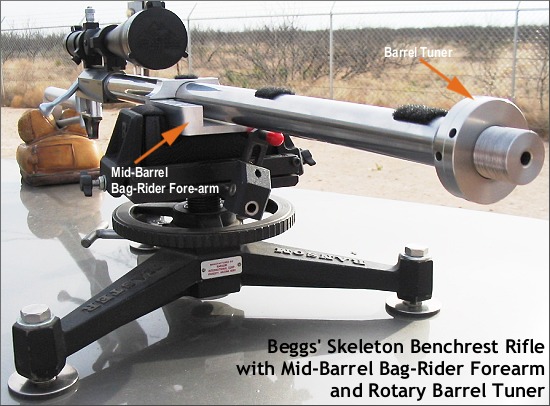
An IBS member asked the Executive Board to rule on the legality of the Gene Beggs’ modular stock for competition. This stock (shown below) features a separate, clamped bag-riding forearm rather than a conventional one-piece stock. The Excutive Board determined: “After consulting the Group and Score Committees there was a consensus among board members that the rules really did not envision a stock of this type. In the interest of not inhibiting innovation, the E-Board approved the Beggs Stock as currently configured, for HV, LV, SP, and VFS (as appropriate) competition in 2009. So that similar innovations can be more readily assessed, the Executive board will do a comprehensive review of the stock configuration rules prior to the July 1 deadline for agenda item submission.”
February 14th, 2009
The editors of the NRA’s American Hunter magazine recently tested 10 brands of shooting glasses, determining how well the eyewear could shield users from shotgun birdshot. Eyewear samples were tested at 25, 15, 10, 8, and 5 yards, using #8 shot. One ANSI Z87.1-certified polycarbonate sample was then repeat-tested with #6 shot, #4 shot, #2 steel and buckshot. Read Full Test Report.
 The tests provided some very important conclusions: The tests provided some very important conclusions:
1. The glasses marked Z87.1+ (“plus” is a high-impact rating) performed the best. Overall, Z87.1-rated polycarbonate lenses provided excellent protection from birdshot at 10-15 yards and beyond. Some Z87.1+ eyewear even blocked birdshot at 8 yards.
2. You can’t necessarily rely on price as an indicator of quality. The $12 Bollé VX and the $5.95 Pyramex Rendezvous both worked better than some much more expensive brands. The $5.95 Pyramex, in fact, was one of only three products that stood up to the #8 birdshot at 8 yards. The Pyramex does carry a Z87.1+ rating.
3. Avoid no-name, un-rated plastic eyewear. American Hunter Editor Jeff Johnston writes: “It’s a mistake to assume that any plastic-lens sunglasses off the rack at the local 7-11 are made of polycarbonate and therefore are effective as shooting glasses—cheap plastics are not polycarbonates; in fact, wearing them could be worse than wearing nothing, as they can introduce sharp shards of plastic to your eyes in addition to the projectile(s) that caused them to break.”
To learn more about safety standards for shooting glasses, read our comprehensive Guide to Eye Protection for Shooters.
December 16th, 2008
We recently shopped the web to find a new pair of protective shooting glasses. Expecting to pay $20 or more per pair, we were surprised to find high-quality UVEX safety glasses for under $9.00! Available from CooperSafety.com, UVEX glasses feature wrap-around lenses and comfortable padded temples and nose bridges. The UVEX line of safety eyewear passes ANSI Z87+ and CSA Z94.3 standards and meets the MIL VO ballistic test for impact protection. UVEX offers a lifetime frame guarantee–something you won’t get with many $100.00 sunglasses. Among the UVEX product line, we liked the UVEX Skyper ($7.80) with its extended side-shields, the UVEX Genesis ($7.75 -$9.92), and the lightweight UVEX XC ($9.07-$10.55). All three come in a variety of lens shades, and replacement lenses are available for under $5.00 per set.

For more information on protective eyewear, read our comprehensive Guide to Shooting Glasses. It explains the various safety standards which apply and gives the pros and cons of the various preferred lens materials: Polycarbonate, Trivex, and SR-91.
CLICK HERE to learn more ….
EDITORIAL — Zero Tolerance Needed on Protective Eyewear
I’ve noticed a disturbing percentage of shooters, novice and expert alike, who fail to wear proper eye protection when shooting from the bench. You’ve probably seen this yourself — experienced shooters who’ll grudgingly wear protective glasses in a match (only because they are required), but who won’t wear glasses while practicing. Or, you may have noticed young shooters who shun protective eyewear because they think safety glasses “look dorky”.
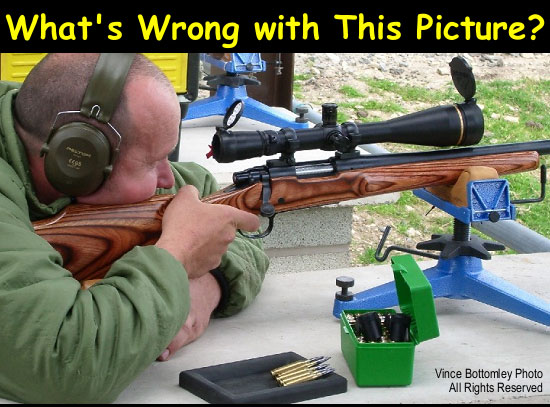
To be honest, guys, I think we need to exercise “ZERO Tolerance” when it comes to eye safety. “Mandatory eye protection” rules need to be enforced… no safety glasses = no shooting, period. Rangemasters must INSIST that ALL shooters on the line wear protective glasses. And when you’re out practicing on your own, wear your safety glasses… always… no matter whether you’re shooting centerfire, rimfire, or even air rifles. One little shard of brass or a popped primer and you could be blinded. Your eyesight is precious. Take care of it!
August 29th, 2008
 Today, millions of Americans will hit the road to begin a long, Labor Day weekend. We urge you all to drive safely. Don’t try to cover too many miles, or drive long distances at the wee hours of the morning. Fatigue can be a killer. An average of 115 persons die each day in motor vehicle crashes in the United States — one every 13 minutes. Every year over 43,000 Americans die in auto accidents and there are roughly 2.9 million injury cases. The cost of these accidents exceeds 230+ Billion dollars. Today, millions of Americans will hit the road to begin a long, Labor Day weekend. We urge you all to drive safely. Don’t try to cover too many miles, or drive long distances at the wee hours of the morning. Fatigue can be a killer. An average of 115 persons die each day in motor vehicle crashes in the United States — one every 13 minutes. Every year over 43,000 Americans die in auto accidents and there are roughly 2.9 million injury cases. The cost of these accidents exceeds 230+ Billion dollars.
 Famed Shooters in Recent Road Accident Famed Shooters in Recent Road Accident
Think an accident can’t happen to you? Consider this… Just a few days ago, when returning from the Camp Perry National Championships, Mid Tompkins and Nancy Tompkins (at left) were involved in an accident in Kansas. Mid and Nancy are both legendary long-range shooters, and Nancy is the author of the excellent book, Prone and Long-Range Shooting. Mid was driving a van, pulling a trailer. It was late at night, and (for reasons unknown) the van and trailer went off the road and rolled over. Mid suffered cartilage and rib damage. Nancy was trapped in the van for 20 minutes before rescue workers cut her free. She was then air-lifted to a Topeka hospital and treated for leg, knee, and shoulder injuries. Fellow shooters Bob Jones and Steve McGee were following on the same highway and helped the rescue effort. Thankfully, neither Mid nor Nancy sustained life-threatening injuries, and we send them our prayers for a full recovery.
Nancy recently posted on Long-Range.com: “Mid is doing well, but is very sore. His ribs — front and back — are bothering him and he has a nasty cut on this left elbow with some lacerations. I have a broken right tibia (leg bone), right patella (knee) left shoulder, and a tear on my left rotator cuff, a broken nose and very sore ribs and face. No matter what, we feel very blessed to have survived this. We made it as did our three cats that we absolutely love and adore.”
Drowsiness Degrades Driving Skills
A driver who is very fatigued will suffer impairment in his driving skills similar to being intoxicated. Even if you don’t nod off or blank out, drowsiness impairs your reaction time, degrades your peripheral vision, and dulls your ability to concentrate on the road. Remember that when traveling at 60 miles per hour, you’ll cover 90 feet in just one second. Nodding off for just an instant could be fatal, as the following video explains:

Night Driving — A Special Warning for Older Drivers
A significant percentage of competitive shooters (if not the majority) are over 45 years of age. As we reach “middle age” and beyond, our night-vision degrades significantly. This is a progressive process, and most individuals don’t notice a change from year to year. Scientific studies have shown that a 50-year-old driver needs twice as much light at night as does a 30-year old driver. Older eyes also do not recover from glare as well as young eyes. Pupils shrink and don’t dilate as much in the dark as we age. Various reports indicate that the retina of a senior citizen receives far less light than the retina of a 20-year-old. This can make older drivers function as though they are wearing dark sunglasses at night.
CLICK HERE for National Safety Council Tips on Night Driving.
|


