The NRA Metric Smallbore Championships were held in Bristol, Indiana from July 17-20th. Team Lapua shooters performed well in this prestigious match. Team Lapua member Kevin Nevius shot superbly, earning the title of 2010 Metric National Champion. Nevius also won the Metallic Sight Aggregate Trophy, the Metallic Sight Team Trophy with Eitan Barazani, and the Overall Metric National team title with Barazani. Both Nevius and Barazani shot Lapua ammo.
Team Lapua member Nancy Tompkins, shooting Lapua Midas+ ammo, was the 1st Master and Top Woman competitor. The First-place Junior competitor, Elijah Ellis, also shot Lapua ammunition. Most of these top competitors are now competing in the 2010 NRA Smallbore Prone National Championships held at Camp Perry, Ohio, this week, July 25-28th.
At the Metric Championships, conditions were mild and partly cloudy both days. Day 2 (any sights day) saw slightly higher wind velocities. Both days saw winds from the south (from behind the firing line) that would switch quickly from left to right.
Nevius’ Championship Rifle and Winning Ammo
Kevin Nevius used Lapua X-ACT and Midas+ ammunition in the Walther-based prone rifle he built last winter specifically for Lapua ammunition. The gun features a Walther KK300 action (won at the 2008 National Matches) and a 1:17″-twist Hart barrel. NOTE:The above photo, taken at the 2008 National Championships, show Nevius with a different rifle.
The 2010 National Rifle and Pistol Championships kick off July 12 at Camp Perry in Port Clinton, Ohio. Conducted by the National Rifle Association (NRA) and the Civilian Marksmanship Program (CMP) with assistance from the Ohio National Guard, these matches have long been considered the “World Series of the Shooting Sports.” A tradition at Camp Perry since 1907, the event is divided into five separate phases: Pistol, Smallbore 3-Position, Smallbore Prone, High Power, and Long Range. The popular CMP clinics and matches will be held from July 30 through August 7. MidwayUSA is the Title Sponsor for the 2010 National Championships. (FYI: MidwayUSA is also currently offering special discounts to AccurateShooter.com readers: $10 off $50 – Coupon Code 2437210.)
The National Matches begin each year in early July with the National Pistol Championships and conclude in August with the Long Range High Power Championship. Competitors represent a vast array of experience including novice shooters, Olympic medalists, law enforcement officers, military personnel, and international competitors.
2010 Nat’l Matches Schedule:
July 12: First Shot Ceremony
July 13-17: Pistol Championships
July 21-24: Smallbore Rifle Position
July 25-29: Smallbore Rifle Prone
July 30-Aug 1: CMP SAFS & Clinics
August 2-7: CMP Rifle Matches
August 8: Springfield M1A Match
August 10-13: High Power Rifle
August 14-17: Long Range Rifle
The NRA Blog will provide timely reports and the latest match results during the Championships. For more on the Camp Perry National Championships, or other competitive shooting events or programs, visit www.nrahq.org/compete or call (703) 267-1450. Go to the CMP Website for information on CMP Clinics and Trophy Matches.
We recently tested some interesting “club benchrest” rifles created by MT Guns. Recognizing the demand for highly accurate “club-level” smallbore BR guns, Mac Tilton and his crew at MT Guns have started producing two new types of affordable rimfire benchrest rifles. One line of rifles employs Anschütz actions refitted with modern SS barrels and benchrest stocks. As its second line of rimfire BR guns, MT Guns is offering highly-modified BSA Martinis, tricked out with bag-riders and premium barrels fitted with tuners. With the hot-rod Anschütz running about $2000.00 and the modified BSA costing about $1500.00, these guns should provide an affordable alternative for club-level rimfire benchrest shooters. Plus you won’t have to wait months or years to get a “big-name” smith to build you a rifle.
Anschütz Modified for Serious Accuracy
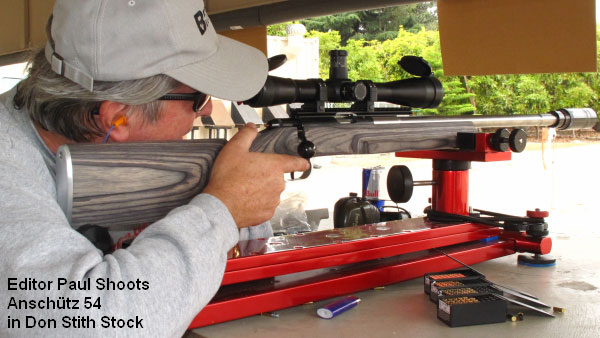
For Anschütz fans, MT Guns has fitted high grade Benchmark barrels to the legendary Model 54-type action. These re-barreled Anschütz actions are placed in Don Stith laminated benchrest stocks. With a modern low-profile, wide-forearm stock, MT Gun’s Anschütz BR guns track beautifully. So far, MT Guns has created two of these Anschütz-based bench guns, both built from model 19XX donor rifles — which also provided superb 5018 triggers. Barrels on both guns are Benchmark — one a 2-groove, the other a 3-groove. In the Stith stocks, complete with aluminum butt plates and weighted tuners, both rifles tip the scales at about 10 pounds. Price for the Anschütz bench guns is $1995.00 with unfinished Stith stock. A fitted Hoehn barrel tuner adds $200 to the price, while a Picatinny rail is a $125.00 option.
BSA Martini — Classic Design with 21st Century Upgrades
If you want to get noticed at your club’s next smallbore rimfire match, then a modified BSA Martini may be the gun for you. These rifles, originally built for prone target shooting, earned a well-deserved reputation for accuracy. MT Guns has done some basic modifications allowing the unique BSA Martinis to be surprisingly competitive in the benchrest game. The factory barrels were “retired” in favor of a 2-groove or 3-groove reverse taper Benchmark barrel — the type of tube that has won big matches and set records. To improve the rifle’s “bench manners” MT Guns fits a custom-made low-friction polymer sled in the front. Fitted with this 3″-wide bag-rider, the gun is extremely stable. An optional Hoehn tuner allows you to tune barrel harmonics for maximum accuracy.
Speaking of which, readers may be asking “How accurate can this BSA Frankengun really be?” Amazingly accurate. Watch the slide show below. In the last frame you’ll see two very impressive 5-shot groups shot by the BSA Martini Int’l Mark III at 50 yards. The ammo was Lapua X-Act.
In the video below, Bruce Duncan of MT Guns explains the distinctive mechanical design of the lever-activated, tilting-block BSA Martini. Bruce also discusses the history of the BSA Martini marque, reviewing the many BSA Martini models produced in the last century. The BSA Martini International MK III is perhaps the most desirable in the long evolution of target Martinis built by BSA from the Great War era to the early 80s. These MK IIIs, dating from the 1960s, feature Benchmark 28 3/4″ reverse-taper barrels, Hoehn barrel tuners, and special bolt-on Picatinny rails fabricated by MT Guns. Bruce noted: “The MT Guns bag rider attaches to the rifle’s fore-end rail. During testing, we noted that the fore-and-aft position of the bag rider on the rail affected the rifle’s tune.” For more info, visit MTGuns.com or call the shop at (805) 720-7720.
We are just three weeks from the start of the 2010 National Rifle and Pistol Championships at Camp Perry, Ohio. The National Championships, which have been held since 1907, draw more rifle and pistol competitors than any other shooting match in the Americas. The physical “playing field” is impressive — Camp Perry, situated on the southern shore of Lake Erie, boasts the largest outdoor rifle range in the world.
The NRA’s Competitive Shooting Division has just released a “Welcome to Camp Perry” video, which covers the history of the National Championships along with pistol, smallbore rifle, and highpower rifle disciplines. This entertaining, professionally-made video shows the diversity of the competitions and the overall scale of this big, annual event. If you watch carefully, you’ll see cameos by champions such as Carl Bernosky. The video is highly recommended….
Registration, Programs and Entry Cards
If you want to compete at Camp Perry, it’s easy to register. Simply CLICK HERE to REGISTER ONLINE.
Note: Programs and entry cards for 2010 will only be mailed to those individuals who did not register online in 2009. Those who registered online may again do so for 2010 or they may request that a program and entry packet be sent to them. All others must request a copy of the National Matches Program by writing to:
The most recent ISSF World Cup competition ended over the weekend. The Chinese shooting team won 10 medals, placing first in ISSF World Cup medal count for third consecutive time this year. Team USA finished second with 6 medals, including 2 Golds, both in rifle events. Russia took third place with 1 Gold and 5 total medals.
The Fort Benning, Georgia venue seemed to be comfortable for members of the USA Shooting team. “We were in every final. We are contending everywhere,” said Rifle National Coach Dave Johnson. Among the American standouts were Matt Emmons, who took gold in the Men’s 50m Rifle 3-Position and a bronze in Men’s 50m Rifle Prone; Jamie Beyerle, the gold medalist in Women’s 50m Rifle 3-Position; Jason Parker, who captured third place in the Men’s 50m Rifle 3-Postion; Eric Uptagrafft, who earned silver in the Men’s 50m Rifle Prone; and Daryl Szarenski, who captured silver in Men’s 50m Pistol. For Parker, it was his first international event since returning from deployment in Afghanistan. Learn more about the ISSF World Cup at the USA Shooting and Int’l Shooting Sports Federation (ISSF) websites.
Jamie Beyerle (above) won Gold in Women’s 50m 3-Position Final.
If you want to see some of the very best smallbore and air gun shooters in the world, including many multi-time Olympians, head down to Fort Benning, GA later this month. The U.S. Army Marksmanship Unit, in conjunction with USA Shooting, will host the ISSF 2010 World Cup USA May 22-31.
This major event is the third of four World Cups being held this year by the International Shooting Sport Federation (ISSF). So far, more than 400 of the world’s top-level shooters from 49 countries have committed to the event. There will be many Olympians (including medal winners) in the competition. CLICK HERE for Entry List by Nation.
Shooters will compete for medals and world records in the Olympic disciplines of Air Pistol, Air Rifle, Smallbore Pistol, and Smallbore Rifle. The ranges are located on the military installation at Fort Benning, Georgia, approximately 150 km (90) miles south of the Atlanta Int’l Airport. Fort Benning has some of the most advanced target systems in the United States. Sius Ascor electronic targets will be used for all elimination, qualification, and finals competitions. Seventy-two (72) targets are available for both 50 meters and 10 meters, while there are 40 targets for 25-meter events.
Bookmark ISSF World-Cup Website
USAShooting has created a full-featured website dedicated to the 2010 World Cup. There you can find travel and lodging info, match schedules, registration info, and much more. Once the competition starts, the USAShooting World Cup website will provide photos and videos, and updated match results. Visit the official match website at www.usashooting.sports.officelive.com.
Texas Christian University (TCU) won its first-ever NCAA Rifle Championship, on its home floor at Daniel-Meyer Coliseum. In this coed sport, the all-female TCU team triumphed over the all-male Alaska-Fairbanks squad. In the 31-year-old history of NCAA rifle shooting, this is the first time an all-women squad has captured the National title. Way to go girls!
The men from Alaska-Fairbanks did win the .22LR segment of the competition, but the TCU ladies’ superior air rifle shooting secured the overall team title. TCU’s Sara Scherer also won the Individual NCAA Smallbore Championship. (CLICK HERE for team profiles.) TCU (4,675 points) won in its fourth NCAA appearance after previous finishes of third, fifth and fifth. Alaska-Fairbanks was second with 4,653 points, followed by 14-time NCAA champion West Virginia at 4,641.
TCU alumni nationwide are celebrating this NCAA championship, TCU’s first NCAA team title since 1983 (women’s golf). TCU won football national titles in 1935 and 1938, but those years are distant memories.
The TCU “Horned Frogs” all-female rifle team is coached by Karen Monez, a former world and national champion air rifle shooter. In a few short years Monez built a championship-level squad, five members of which were named All-Americans this week. Sarah Scherer, Sarah Beard and Lorenzen were honored as both smallbore and air rifle All-Americans, while Simone Riford and Caitlin Morrissey garnered All-American honors in air rifle. Senior Erin Lorenzen was honored as the MVP of the championships by the Collegiate Rifle Coaches Association.
In team competition, shooting powerhouses West Virginia and Alaska-Fairbanks are favored to win team championships, but one of the other six schools could pull off an upset. The eight teams who qualified for this year’s team championship are:
Murray State University
Texas Christian University
University of Alaska-Fairbanks
University of Kentucky
University of Nebraska, Lincoln
U.S. Military Academy
U.S. Naval Academy
West Virginia University
If you want to follow the action, the NRAblog.com will have reporters in Fort Worth providing updates, photos and interviews from the championships.
It was “Ladies First” at the 2009 NRA National Smallbore Silhouette Championships. Cathy Winstead-Severin shot brilliantly to win both the Rifle AND Hunting Rifle titles, as well as the High Woman title for both classes. We’ve always said women can compete head to head with male shooters and win. Cathy proved that convincingly.
This wasn’t Cathy’s first big victory. She won her first National Smallbore Silhouette title in 1998. Along with husband James Severin, Cathy operates Good Shooting Sales & Service in Joplin, Missouri, a shooting supply business specializing in rimfire and silhouette products.
Smallbore Rifle Championship Top Finishers:
First Place (and High Woman): Cathy Winstead-Severin: 111
Second Place: William Motl: 108
Third Place: Derek Greenaway: 107
High Junior: Tyler Kamp: 104
High Senior: Loren Peter: 96
Team Champions: Texas State Gold: 214
Smallbore Hunting Rifle Championship Top Finishers:
First Place (and High Woman): Cathy Winstead-Severin: 108
Second Place: William Zander: 105
Third Place: Laura Goetsch: 104
High Junior: Tyler Kamp: 98
High Senior: Bob Snyder: 85
Team Champions: Belgrade Air Shooting Sports: 205
The Smallbore Prone Championship matches have concluded at Camp Perry, and we have a new National Champion, Spc. Joseph Hine from the U.S. Army.
As the Smallbore prone champ and winner of the Critchfield Trophy, Specialist Joseph Hein was awarded the Critchfield trophy plaque, a gold tone national champion, a medallion, a Chiappa blackpowder muzzleloading rifle, and a $500 Visa gift card. Here are the top finishers and their final scores.
1. SPC Joseph Hein – 4790×354 | National Champion
2. Richard Fowke – 4790×355 | Civilian Champion
3. Reya Kempley – 4789×374 | Woman Champion
Runner-up Richard Fowke was crowned the Civilian Champion. Fowke actually outscored Hein by one “X”. But as a British citizen, Fowke wasn’t eligible for the U.S. National Championship. Third-Place finisher Reya Kempley also received an award as Top Female Shooter. Reya also shoots a 6mmBR centerfire rifle in international 300m competition.
This story was provided by the NRA Blog. You’ll find many more photos of the Camp Perry Smallbore competition and awards ceremonies on the NRA Media Relations Public Gallery. On that page, click on any thumbnail to view a slideshow of related photos.


 The NRA Metric Smallbore Championships were held in Bristol, Indiana from July 17-20th. Team Lapua shooters performed well in this prestigious match. Team Lapua member Kevin Nevius shot superbly, earning the title of 2010 Metric National Champion. Nevius also won the Metallic Sight Aggregate Trophy, the Metallic Sight Team Trophy with Eitan Barazani, and the Overall Metric National team title with Barazani. Both Nevius and Barazani shot Lapua ammo.
 The 2010 National Rifle and Pistol Championships kick off July 12 at Camp Perry in Port Clinton, Ohio. Conducted by the National Rifle Association (NRA) and the Civilian Marksmanship Program (CMP) with assistance from the Ohio National Guard, these matches have long been considered the “World Series of the Shooting Sports.” A tradition at Camp Perry since 1907, the event is divided into five separate phases: Pistol, Smallbore 3-Position, Smallbore Prone, High Power, and Long Range. The popular CMP clinics and matches will be held from July 30 through August 7.
  2010 Nat’l Matches Schedule:

 BSA Martini — Classic Design with 21st Century Upgrades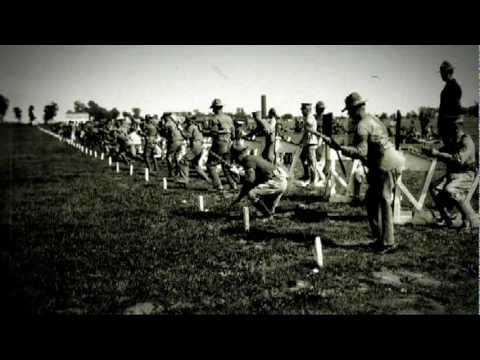
 Registration, Programs and Entry Cards
 The most recent ISSF World Cup competition ended over the weekend. The Chinese shooting team won 10 medals, placing first in ISSF World Cup medal count for third consecutive time this year. Team USA finished second with 6 medals, including 2 Golds, both in rifle events. Russia took third place with 1 Gold and 5 total medals.


 TCU alumni nationwide are celebrating this NCAA championship, TCU’s first NCAA team title since 1983 (women’s golf). TCU won football national titles in 1935 and 1938, but those years are distant memories.


