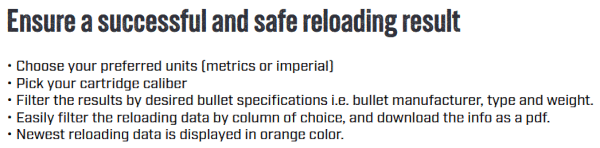
Vihtavuori offers an updated, user-friendly reloading data center on its website. This data page works well with all formats — smartphones, tablets, and desktop computers. On this page you can find recommended loads for 80+ cartridge types all in one place. You don’t have to click through multiple web pages.
In addition, the Vihtavuori reloading website has a very handy Burn Rate Chart (see below). While you can get all the load info you need through the website, Vihtavuori also offers a very good FREE reloading Mobile App. Vihtavuori’s online Reloading Center has links to the handy Vihtavuori Reloading App for both Apple and Android devices.
Burn Rate Chart is Online
CLICK HERE to view full-screen Vihtavuori Burn Rate Table.
Vihtavuori offers a comprehensive burn rate chart that lists all Vihtavuori powders for rifles and pistols. This includes Vihtavuori powders in the left column and ranks them with powders from other brands: Norma, RWS, VECTAN, Reload Swiss, IMR, Hodgdon, Accurate, W-W Alliant, and Ramshot. CLICK HERE to see the full-size chart, which can be downloaded in PDF format.
NOTE: The listed powders are displayed in order of approximate burning rate. Vihtavuori cautions: “This list is for reference only and NOT to be used for developing loads.”
Find Optimal Loads with Reloading Data Tool
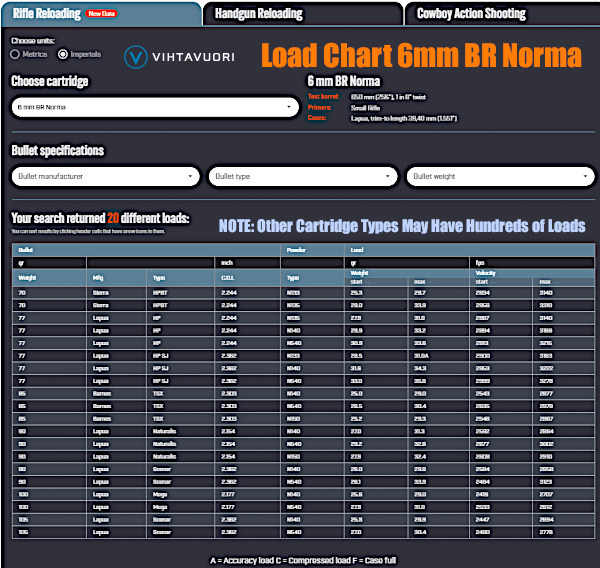
Example of Vihtavuori Load Data for Popular Cartridge
Here are the load results for the 6mm BR Norma (aka “6BR”) cartridge. Vihtavuori has full PDF tables like this for over 80 cartridge types. With the most popular cartridge types, such as .223 Rem, 6.5 Creedmoor, and .308 Winchester, the PDF tables have over 350 entries. In fact the .308 Win table has 641 loads!
Vihtavuori Procedures and Methods for Generating Load Data
Vihtavuori generates hundreds of new reloading data entries every year. But how is the load data actually produced? This video provides insight into how Vihtavuori professionals work with advanced equipment to provide reliable load data for handloaders.
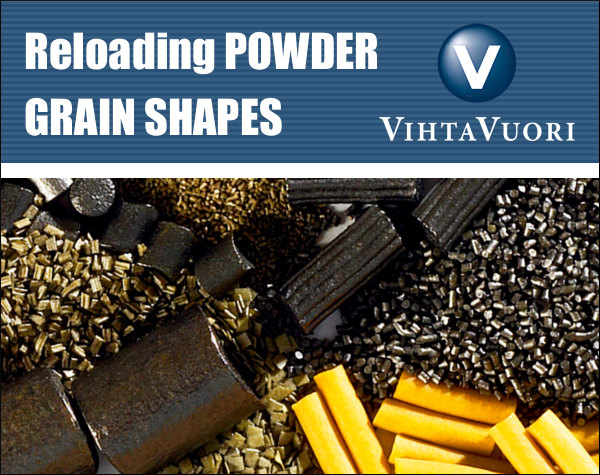
The shape of powder grains has a profound effect on the performance of the powder charge, as it concerns both pressure and velocity. There are multiple powder shapes including flake, ball, and extruded or “stick” (both solid and perforated).
So how does powder grain shape affect pressure and muzzle velocity?
In general, it can be said that powder that burns progressively achieves a desired muzzle velocity at lower maximum pressure than a powder that burns neutrally, not to mention a degressive powder. As grain size increases, the maximum pressure moves towards the muzzle, also increasing muzzle blast. Muzzle velocity and pressure can be adjusted by means of the amount of powder or loading density, i.e. the relationship between the powder mass and the volume available to it. As the loading density increases, maximum pressure grows.
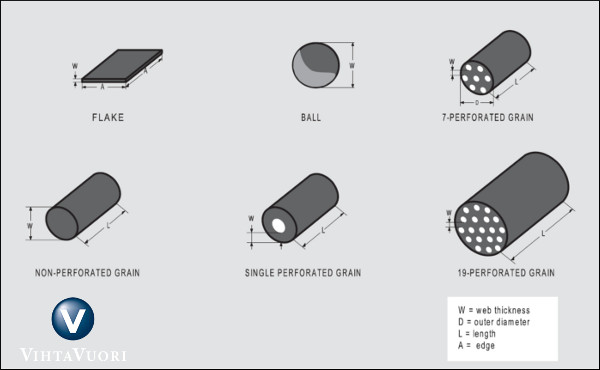
All Vihtavuori reloading powders are of the cylindrical, single-perforated extruded stick type. The differences in burning rate between the powders depend on the size of the grain, the wall thickness of the cylinder, the surface coating and the composition. Cylindrical extruded powders can also have multi-perforated grains. The most common types are the 7- and 19-perforated varieties. A multi-perforated powder grain is naturally of a much larger size than one with a single perforation, and is typically used for large caliber ammunition.
Other types of powder grain shapes include sphere or ball, and flake. The ball grains are typically used in automatic firearms but also in rifles and handguns. The ball grain is less costly to produce, as it is not pressed into shape like cylindrical grains. Flake shaped grains are typically used in shotgun loadings.
Web thickness in gunpowder terminology means the minimum distance that the combustion zones can travel within the powder grain without encountering each other. In spherical powders, this distance is the diameter of the “ball”; in flake powder it is the thickness of the flake; and in multi-perforated extruded powders it is the minimum distance (i.e. wall thickness) between the perforations.
The burning rate of powder composed of grains without any perforations or surface treatment is related to the surface area of the grain available for burning at any given pressure level. The change in the surface area that is burning during combustion is described by a so-called form function. If the surface area increases, the form function does likewise and its behavior is termed progressive. If the form function decreases, its behavior is said to be degressive. If the flame area remains constant throughout the combustion process, we describe it as “neutral” behavior.
The cylindrical, perforated powders are progressive; the burning rate increases as the surface area increases, and the pressure builds up slower, increasing until it reaches its peak and then collapses. Flake and ball grains are degressive; the total powder surface area and pressure are at their peak at ignition, decreasing as the combustion progresses.
The shape of powder grains has a profound effect on the performance of the powder charge, as it concerns both pressure and velocity. There are multiple powder shapes including flake, ball, and extruded or “stick” (both solid and perforated).
So how does powder grain shape affect pressure and muzzle velocity?
In general, it can be said that powder that burns progressively achieves a desired muzzle velocity at lower maximum pressure than a powder that burns neutrally, not to mention a degressive powder. As grain size increases, the maximum pressure moves towards the muzzle, also increasing muzzle blast. Muzzle velocity and pressure can be adjusted by means of the amount of powder or loading density, i.e. the relationship between the powder mass and the volume available to it. As the loading density increases, maximum pressure grows.
All Vihtavuori reloading powders are of the cylindrical, single-perforated extruded stick type. The differences in burning rate between the powders depend on the size of the grain, the wall thickness of the cylinder, the surface coating and the composition. Cylindrical extruded powders can also have multi-perforated grains. The most common types are the 7- and 19-perforated varieties. A multi-perforated powder grain is naturally of a much larger size than one with a single perforation, and is typically used for large caliber ammunition.
Other types of powder grain shapes include sphere or ball, and flake. The ball grains are typically used in automatic firearms but also in rifles and handguns. The ball grain is less costly to produce, as it is not pressed into shape like cylindrical grains. Flake shaped grains are typically used in shotgun loadings.
Web thickness in gunpowder terminology means the minimum distance that the combustion zones can travel within the powder grain without encountering each other. In spherical powders, this distance is the diameter of the “ball”; in flake powder it is the thickness of the flake; and in multi-perforated extruded powders it is the minimum distance (i.e. wall thickness) between the perforations.
The burning rate of powder composed of grains without any perforations or surface treatment is related to the surface area of the grain available for burning at any given pressure level. The change in the surface area that is burning during combustion is described by a so-called form function. If the surface area increases, the form function does likewise and its behavior is termed progressive. If the form function decreases, its behavior is said to be degressive. If the flame area remains constant throughout the combustion process, we describe it as “neutral” behavior.
The cylindrical, perforated powders are progressive; the burning rate increases as the surface area increases, and the pressure builds up slower, increasing until it reaches its peak and then collapses. Flake and ball grains are degressive; the total powder surface area and pressure are at their peak at ignition, decreasing as the combustion progresses.
The shape of powder grains has a profound effect on the performance of the powder charge, as it concerns both pressure and velocity. There are multiple powder shapes including flake, ball, and extruded or “stick” (both solid and perforated).
So how does powder grain shape affect pressure and muzzle velocity?
In general, it can be said that powder that burns progressively achieves a desired muzzle velocity at lower maximum pressure than a powder that burns neutrally, not to mention a degressive powder. As grain size increases, the maximum pressure moves towards the muzzle, also increasing muzzle blast. Muzzle velocity and pressure can be adjusted by means of the amount of powder or loading density, i.e. the relationship between the powder mass and the volume available to it. As the loading density increases, maximum pressure grows.
All Vihtavuori reloading powders are of the cylindrical, single-perforated extruded stick type. The differences in burning rate between the powders depend on the size of the grain, the wall thickness of the cylinder, the surface coating and the composition. Cylindrical extruded powders can also have multi-perforated grains. The most common types are the 7- and 19-perforated varieties. A multi-perforated powder grain is naturally of a much larger size than one with a single perforation, and is typically used for large caliber ammunition.
Other types of powder grain shapes include sphere or ball, and flake. The ball grains are typically used in automatic firearms but also in rifles and handguns. The ball grain is less costly to produce, as it is not pressed into shape like cylindrical grains. Flake shaped grains are typically used in shotgun loadings.
Web thickness in gunpowder terminology means the minimum distance that the combustion zones can travel within the powder grain without encountering each other. In spherical powders, this distance is the diameter of the “ball”; in flake powder it is the thickness of the flake; and in multi-perforated extruded powders it is the minimum distance (i.e. wall thickness) between the perforations.
The burning rate of powder composed of grains without any perforations or surface treatment is related to the surface area of the grain available for burning at any given pressure level. The change in the surface area that is burning during combustion is described by a so-called form function. If the surface area increases, the form function does likewise and its behavior is termed progressive. If the form function decreases, its behavior is said to be degressive. If the flame area remains constant throughout the combustion process, we describe it as “neutral” behavior.
The cylindrical, perforated powders are progressive; the burning rate increases as the surface area increases, and the pressure builds up slower, increasing until it reaches its peak and then collapses. Flake and ball grains are degressive; the total powder surface area and pressure are at their peak at ignition, decreasing as the combustion progresses.
Need high-quality reloading powder for your rifle or pistol? Now is a great time to order VihtaVuori powder from Midsouth Shooters Supply. If you purchase in-stock VihtaVuori powders, you will receive, at no charge, TWO VihtaVurori print reloading manuals. That’s right you get both VihtaVuori 2023 & 2024 Reloading Guides for FREE while supplies last. This deal is limited to one set of two VV manuals per order.
Receive both 2023 & 2024 Reloading Guides for FREE with purchase of any In-Stock VihtaVuori Powders! Offer is valid on qualifying purchases while supplies last! Start Date: 2/14/2024 End Date: 12/31/2024
Learn About VihtaVuori Powders with Informative Videos
This video shows how VihtaVuori powders are produced. The video covers the multiple production phases and the sophisticated testing procedures.
VihtaVuori marked its 100th Anniversary in 2022. Today, VihtaVuori Powders is stronger than ever and is respected by serious competitive shooters, accuracy enthusiasts, and hunters. In this video, Team VihtaVuori shooter Ian Klemm shows how he loads with VihtaVuori powder. One of the best F-TR shooters on the planet, Ian is a 4-time F-class National Champion.
The 151st NRA Annual Meetings and Exhibits in Houston, Texas, runs for three days this upcoming weekend. Visitor will enjoy 14 acres of exhibitors, along with informative seminars, appearances from political leaders, and performances from major musical talents. The Exhibit Hall will be open 9:00 AM to 6:00 PM, Friday and Saturday and 10:00 AM to 5:00 PM on Sunday.
Vihtavuori Powders will be celebrate its 100th Anniversary during the 2022 NRA Annual Meetings & Exhibits. Attendees can visit Vihtavuori in Booth #3816 to receive a FREE Vihtavuori reloading guide, technical advice, and more.
Vihtavuori is recognized around the globe as a top-tier powder maker respected serious competitive shooters and hunters. Vihtavuori powders deliver clean-burning results, superior consistency, excellent temperature stability, and great accuracy shot-after-shot.
Vihtavuori is a part of the Capstone Precision Group, exclusive U.S. distributor for Berger, Lapua, Vihtavuori and SK-Rimfire products. For more information, visit Vihtavuori.com.
“Capstone Precision Group is proud to bring Vihtavuori powders to the USA. The N100, N300, and N500 series powders offer something for all metallic reloaders,” said Adam Braverman, VP of Sales & Marketing. “Vihtavuori’s strict quality control and lot-to-lot consistency ensure that every customer’s experience exceeds expectations. With 100 Years of experience, the Power of Accuracy is in every shot.”
The Vihtavuori Rifle Reloading Data page covers over 70 cartridge types. Vihtavuori notes: “We provide our reloading data in [both] metric and imperial dimension systems, i.e. charge weight in grams and grains as well as muzzle velocity in meters and feet per second. All the rifle loads… are pressure tested according to the C.I.P. method. The listed maximum loads should never be exceeded. Please note that due to safety regulations, we can’t suggest or recommend loads or bullets that are not available on this site.”
The shape of powder grains has a profound effect on the performance of the powder charge, as it concerns both pressure and velocity. There are multiple powder shapes including flake, ball, and extruded or “stick” (both solid and perforated).
So how does powder grain shape affect pressure and muzzle velocity?
In general, it can be said that powder that burns progressively achieves a desired muzzle velocity at lower maximum pressure than a powder that burns neutrally, not to mention a degressive powder. As grain size increases, the maximum pressure moves towards the muzzle, also increasing muzzle blast. Muzzle velocity and pressure can be adjusted by means of the amount of powder or loading density, i.e. the relationship between the powder mass and the volume available to it. As the loading density increases, maximum pressure grows.
All Vihtavuori reloading powders are of the cylindrical, single-perforated extruded stick type. The differences in burning rate between the powders depend on the size of the grain, the wall thickness of the cylinder, the surface coating and the composition. Cylindrical extruded powders can also have multi-perforated grains. The most common types are the 7- and 19-perforated varieties. A multi-perforated powder grain is naturally of a much larger size than one with a single perforation, and is typically used for large caliber ammunition.
Other types of powder grain shapes include sphere or ball, and flake. The ball grains are typically used in automatic firearms but also in rifles and handguns. The ball grain is less costly to produce, as it is not pressed into shape like cylindrical grains. Flake shaped grains are typically used in shotgun loadings.
Web thickness in gunpowder terminology means the minimum distance that the combustion zones can travel within the powder grain without encountering each other. In spherical powders, this distance is the diameter of the “ball”; in flake powder it is the thickness of the flake; and in multi-perforated extruded powders it is the minimum distance (i.e. wall thickness) between the perforations.
The burning rate of powder composed of grains without any perforations or surface treatment is related to the surface area of the grain available for burning at any given pressure level. The change in the surface area that is burning during combustion is described by a so-called form function. If the surface area increases, the form function does likewise and its behavior is termed progressive. If the form function decreases, its behavior is said to be degressive. If the flame area remains constant throughout the combustion process, we describe it as “neutral” behavior.
The cylindrical, perforated powders are progressive; the burning rate increases as the surface area increases, and the pressure builds up slower, increasing until it reaches its peak and then collapses. Flake and ball grains are degressive; the total powder surface area and pressure are at their peak at ignition, decreasing as the combustion progresses.
The shape of powder grains has a profound effect on the performance of the powder charge, as it concerns both pressure and velocity. There are multiple powder shapes including flake, ball, and extruded or “stick” (both solid and perforated).
All Vihtavuori reloading powders are of the cylindrical, single-perforated extruded stick type. The differences in burning rate between the powders depend on the size of the grain, the wall thickness of the cylinder, the surface coating and the composition. Cylindrical extruded powders can also have multi-perforated grains. The most common types are the 7- and 19-perforated varieties. A multi-perforated powder grain is naturally of a much larger size than one with a single perforation, and is typically used for large caliber ammunition.
Other types of powder grain shapes include sphere or ball, and flake. The ball grains are typically used in automatic firearms but also in rifles and handguns. The ball grain is less costly to produce, as it is not pressed into shape like cylindrical grains. Flake shaped grains are typically used in shotgun loadings.
Web thickness in gunpowder terminology means the minimum distance that the combustion zones can travel within the powder grain without encountering each other. In spherical powders, this distance is the diameter of the “ball”; in flake powder it is the thickness of the flake; and in multi-perforated extruded powders it is the minimum distance (i.e. wall thickness) between the perforations.
The burning rate of powder composed of grains without any perforations or surface treatment is related to the surface area of the grain available for burning at any given pressure level. The change in the surface area that is burning during combustion is described by a so-called form function. If the surface area increases, the form function does likewise and its behavior is termed progressive. If the form function decreases, its behavior is said to be degressive. If the flame area remains constant throughout the combustion process, we describe it as “neutral” behavior.
The cylindrical, perforated powders are progressive; the burning rate increases as the surface area increases, and the pressure builds up slower, increasing until it reaches its peak and then collapses. Flake and ball grains are degressive; the total powder surface area and pressure are at their peak at ignition, decreasing as the combustion progresses.
So how does the shape affect pressure and muzzle velocity? In general, it can be said that powder that burns progressively achieves a desired muzzle velocity at lower maximum pressure than a powder that burns neutrally, not to mention a degressive powder. As grain size increases, the maximum pressure moves towards the muzzle, also increasing muzzle blast. Muzzle velocity and pressure can be adjusted by means of the amount of powder or loading density, i.e. the relationship between the powder mass and the volume available to it. As the loading density increases, maximum pressure grows.
Powder Moisture Content — Did You Know?
Variations in moisture content change the burning rate of a powder and thereby chamber pressures and muzzle velocity. The moisture content of the Vihtavuori N100 and N300 series powders is usually around 1%, while the N500-series’ normal moisture content is 0.6% because of the added nitroglycerine.
So what difference does moisture content make? Here’s an example. In a test, a [Vihtavuori] powder sample was dried by heating it, losing about 0.5 % of its weight. Cartridges were then loaded with the dried powder and fired using a pressure gun. Chamber pressures and muzzle velocities produced by these special cartridges were compared to those produced by cartridges loaded with untreated powder. (The powder charge and bullet were of course the same in both sets of cartridges.)
After Powder Drying:
Pressure Increased 11% from 320 MPa to 355 MPa
Velocity Increased 2.6% from 2526 to 2592 FPS
Comparing results showed chamber pressures increased from 320 MPa to 355 MPa with the dried powder, and the muzzle velocity increased accordingly from 770 m/s to 790 m/s (2526 to 2592 FPS). And note, this is only one example, of one caliber and loading. The difference might be much higher depending on the cartridge and loading combinations.
Recommendation: Store powder below 68°F in 55-65% humidity.
What does this tell us? Well, it seems we need to forget the old saying “Keep your powder dry”! Instead, focus on proper powder storage, at a temperature below 20°C/68°F and humidity between 55 and 65%. Safe reloading everybody!
Tech Tip sourced by EdLongrange. We welcome reader submissions.
Breaking News: Just hours ago the Nammo Group announced that it has acquired the Finnish company Eurenco Vihtavuori OY, which produces Vihtavuori powders. This deal was finalized through the signing of a Share Purchase Agreement today, December 19, 2013.
The official press release adds that: “The agreement is subject to approval by French authorities. Filing is done and approval is expected to be granted within short time.” CLICK HERE to read Nammo/Eurenco Press Release PDF.



 Vihtavuori offers an updated, user-friendly reloading data center on its website. This data page works well with all formats — smartphones, tablets, and desktop computers. On this page you can find recommended loads for 80+ cartridge types all in one place. You don’t have to click through multiple web pages.




 Breaking News: Just hours ago the


