|
|
November 20th, 2007
The CZ 452 is one of the more popular bolt-action .22LR rifles, and justifiably so. It offers class-leading accuracy, a strong action, and a good, adjustable trigger that can be made even better with inexpensive mods. Right now, CDNN Investments is offering the CZ452 “American” model for just $279.99. That’s a great price for a .22 bolt action that can provide years of fun and accurate shooting (MSRP is $409.00). This rifle features a 5-round detachable magazine, 22.5-inch barrel, and a 3/8″-wide dovetail on the receiver for mounting rings. The stock is Turkish walnut. To compare the CZ 452 “American” with other models, visit CZUSA.com. (Note, the CZ 452 “American” does NOT include the single-set trigger found on the model 453 “American”.)

CLICK HERE for LARGE PHOTO of CZ 452.
To order, call CDNN Investments, (800) 588-9500. You won’t find this deal on CDNN’s webpage. Details are found in CDNN’s current downloadable .pdf catalog (43 megabytes).
November 20th, 2007
If you are looking for a very solid, beautifully fabricated, loading press that can do double-duty at home as well as the range, consider the Harrell’s Combo Press. Though it is very compact, it has plenty of leverage to full-length size cases. As you can see in the photo, the Harrell’s combo works BOTH as an arbor press and as a standard press that functions with shell-holder and conventional screw-in dies. The arbor section on the left is tall enough to hold a Wilson micrometer-top seater. The threaded die section on the right has enough clearance for .308-sized cases.

One of the best features of the Combo Press from Harrell’s Precision is its sturdy clamp. This mounts solidly to a wood loading bench or table top. It also has enough vertical clearance between the jaws to work with most range benches. Forum member Boyd Allen has written a detailed review of the Harrell’s press, with additional photos by Paal Erik Jensen of Norway.
CLICK HERE to read COMBO PRESS REVIEW

November 19th, 2007
Visitors to this site often ask, “Just what is F-Class, and how are the matches run?” Monte Milanuk, a regular on our Forum, has provided a practical explanation that is far more illuminating than the technical definition of F-Class found in the RuleBooks.

Monte explained: “Since ‘TR’ may not mean much to you if you’ve never shot iron sights competitively, specifically in a Commonwealth country… lets try it like this. F-Class matches are all shot prone. No benches, no sitting, no standing, nothing but prone, as in laying on the ground.
The matches are shot in a manner referred to as ‘slow fire’ (as opposed to ‘rapid fire’). Basically only one round in the gun at a time. Got a 30 round magazine? Fine, but you can only load one round at a time.
The general idea is you shoot at a target on a fairly large frame, suspended in a sliding carrier, sticking up from behind a protective berm. After the shot goes thru the target, someone in the ‘pits’ pulls the target down, puts a shot spotter (plastic or cardboard disk w/ a spindle) in the hole, puts a paster over any previous shot holes, marks the value of the shot, and runs it back up.
The reason for the value marker is because at distances of 600-1000yds, it’s very difficult, even with the best of optics, to tell if a shot is on one side of a scoring line or another. The spotter disk tells you where the shot went, the value marker tells you what the actual score for that shot was.

At this point is where we run into the difference between ‘pair fire’, which is what they do in Canada, Britain, and other countries, and ‘string fire’, which is what we predominately shoot here in the U.S.A. In pair fire, you have two (or more) shooters to a firing point, alternately shooting and scoring for one another. This makes it functionally almost impossible to ‘machine gun’ a string and get off a large number of shots in one wind condition — you simply have to learn to read the wind, take your best calculated guess, and let fly. In string fire, you can shoot again as soon as the target comes back up, over and over and over. You have a ‘block’ of time, say 22 minutes for 2 sighters and 20 record shots, and you can use 3 minutes, or you can use 21 minutes 59 seconds.
At any rate, you shoot usually three or four ‘strings’ of 15-20 shots. They might all be at one distance (say, 600yds), or you may have to change yard lines between each string (800, 900, 1000yds).
The targets are fairly challenging. The X-ring is 1/2 minute across, and the 10-Ring is 1 minute across. It’s just a little over a 1/4 minute from the edge of the X ring to the 9 ring… not a lot of room for error. [Editor’s Note: There are four specific targets, for distances 300, 500, 600, and 800/900/1000 yards. Exact Target dimensions (plus distance-specific courses of fire) are found at F-ClassInfo.com.]
There are two basic classes or categories in F-Class. There is ‘Open’ class, which is fairly wide-open still. 10kg (22 lbs.) weight limit, max .35 caliber, 3″ wide fore-end, and no one-piece rests or rear mechanical rests. And then there is ‘Target Rifle’ class, aka F/TR. A slightly lower weight limit (8.25kg, roughly 18.15 lbs.), caliber restricted to .223 Rem or .308 Winchester, and you have to use either a bipod or a sling, both of which are included in the overall weight limit! The majority of shooters seem to be migrating initially to F/Open (about 75-80%), and the remainder are in F/TR. Unfortunately, this means that at a lot of smaller local matches a lone F/TR shooter will likely get lumped in w/ the F/Open shooters.
Long-range.com is probably the de-facto place to go for F-Class info, but there is a fair amount of [cross-over] in terms of accuracy, loading techniques, etc. from 600/1000yd BR. The U.S. F-Class team has a website, USFClass.com, that covers most of the basics, and there are a number of other websites with introductory articles on the sport.”
Here are Web Resources with useful info on F-Class Gear, Competition, and Rules:
F-ClassInfo.com
F-Class FAQ
F-Class Shooting Basics
F-Class Nationals Report
November 19th, 2007
This should interest varminters looking for a harder-hitting rimfire round with better ballistics and accuracy. The most common .22 Winchester Magnum Rimfire (WMR) ammunition features a 40gr round nose or flat point bullet with a Muzzle Velocity of about 1910 fps. All the major makers — CCI, Federal, Remington, and Winchester — sell 40gr ammo loaded to this specification.
Hornady’s new 22 WMR offers a more accurate bullet traveling faster — roughly 300 fps faster to be precise. The new Hornady round features a 30gr V-MAX™ bullet leaving the muzzle at 2,200 fps. The new 30gr Hornady 22 WMR ammo should be available in “early February” according to Hornady.

While the new Hornady 22 WMR offers significantly better ballistics than a typical 40gr, 22 WMR load, other ammo makers do offer similar high-speed 22 WMR loadings. Both CCI Maxi-Mag +V and Federal V-Shok ammunition push a 30gr HP bullet at a claimed 2200 fps. But the Hornady round, with its higher-BC, V-MAX™ bullet, should maintain a velocity edge downrange, as less speed is lost to aerodynamic drag.
Excellent Accuracy
Hornady claims the new 22 WMR loaded with the 30gr V-MAX™ is “significantly more accurate” than any other 22 WMR ammo they’ve tested. According to Hornady’s Dave Emary, “we started with a better bullet, and the added velocity provides a flatter trajectory.” Even out of old, inexpensive rifles, the new ammo is delivering 1.5 MOA or better groups at 100 yards. That’s exceptional for a 22 WMR according to noted gun writer Chuck Hawks: “I have also owned and used enough .22 WMR rifles to know that they will seldom match that level of performance. I used to have a rather accurate Mossberg bolt action varmint rifle that would consistently shoot into about 1.5″ at 100 yards if I did my part. That is as accurate as any .22 WMR rifle I have ever tested.”

We think the potential is there for even better accuracy, perhaps even half-MOA in a match barrel, but unfortunately Hornady decided to short-load the ammo, pushing the 30gr bullets well inside the case. Bad move. As a result the case crimp is right on the ogive (and with production variances, the crimp may actually be forward of max bullet diameter). Given the shape of the bullet, which curves aggressively away from the case mouth, there’s no way you can get the seated bullet to touch the rifling, even with a zero-freebore match chamber. This was a deliberate decision on Hornady’s part, but we still wish the ammo was loaded longer — even just a little bit, to ensure that the ammo is crimped on the full-diameter bearing surface. We have seen examples of 17 Mach 2 and 17 HMR rounds with crimps forward of max bullet diameter and this kills accuracy while causing problems such as mangled case mouths and canted bullets with extreme run-out.

Compare the CCI Maxi-Mag +V shown above. It has a distinct driving band. This ensures that the crimp is on the full diameter of the bullet. We would like to see Hornady load its new 30gr 22 WMR longer to ensure that the crimps are ALWAYS on the bearing surface, and NEVER on the ogive. If Hornady is already at SAMMI max Cartridge OAL of 1.350″, it could modify the plastic bullet-tip to allow the bullet to be moved further out of the case.
November 18th, 2007
You’ll get a kick out of this varminting sampler video from Velocity Films, producers of the popular “Dog Be Gone” videos. Titled the “Prairie Dog Olympics”, this 5-minute video showcases spectacular acrobatics by Prairie Dogs hit by high-velocity varmint rounds. Watch for the “judges” scores after each sequence. Beyond the somewhat hokey humor, you’ll see some pretty good shooting (and excellent camera-work) in this sample, produced on hunts in the varmint fields of the American West.
CLICK HERE to WATCH VIDEO

 The latest video from Velocity Films is “Dog Be Gone and Beyond (Volume 2)”. It features footage from multiple locations, while hunting Ground Squirrels, Rock Chucks, and Prairie Dogs. The video includes field tests of the .17 HMR & .204 Ruger, handgun hunting, plus reviews of the latest varmint hunting gear. This video is offered on DVD only for $17.95. The original “Dog Be Gone (Volume 1)” video is offered on VHS tape for $7.95 or DVD for $14.95. CLICK HERE to order online, or call 800-272-3000 to order by phone from Midsouth Shooters Supply. The latest video from Velocity Films is “Dog Be Gone and Beyond (Volume 2)”. It features footage from multiple locations, while hunting Ground Squirrels, Rock Chucks, and Prairie Dogs. The video includes field tests of the .17 HMR & .204 Ruger, handgun hunting, plus reviews of the latest varmint hunting gear. This video is offered on DVD only for $17.95. The original “Dog Be Gone (Volume 1)” video is offered on VHS tape for $7.95 or DVD for $14.95. CLICK HERE to order online, or call 800-272-3000 to order by phone from Midsouth Shooters Supply.
November 18th, 2007
Without question, Germany’s RWS produces some of the finest cartridge brass in the world. RWS cases are drawn in three stages, and after each draw they are annealed, pickled, rinsed and subjected to further quality improvement measures. This achieves specific hardening of the brass cases and increases their resistance to high pressures. Every lot is pressure-tested before release. Excellence doesn’t come cheap however–RWS brass is among the most expensive you can buy. Right now though, Natchez Shooters Supplies is offering big savings on RWS brass. Most calibers are discounted at least 30%. Here are some examples (prices for 20-case box):
RWS 6.5×68, RW2144697, $21.10/20 (reg. $30.01)
RWS .280 Rem, RW2144514, $22.22/20 (reg. $31.59)
RWS 7×57, RW2144484, $17.10/20 (reg. $24.31)
RWS 7mm Rem Mag, RW2144875, $22.22/20 (reg. $31.59)
RWS 30-06, RW2144433, $21.66/20 (reg. $30.79)
RWS 300 Win Mag, RW2144778, $20.52/20 (reg. $29.18)
RWS 375 H&H Mag, RW2145162, $19.38 (reg. $27.57)

Many of the top 1000-yard shooters use RWS brass for their big 30-caliber rifles, starting with a cartridge such as the 8×68, or 375 H&H magnum. Legendary long-range shooter Dave Tooley reports: “As far as brass goes, for my 30 BooBoo, I use the RWS 8×68 brass. Quality is as good as it gets, and it lasts forever.” RWS also offers premium brass for many of the big game and hunting calibers such as the 380 Blaser, 7mm Rem Mag, and 8×57.

November 17th, 2007
 In the current edition of The First Shot (the CMP’s Online Magazine), Sgt. Walter E. Craig of the USAMU discusses physical conditioning for competitive shooters, particularly Highpower competitors. In the article, Craig advocates: 1) weight training to strengthen the Skeletal Muscle System; 2) exercises to build endurance and stamina; and 3) cardiovascular conditioning programs to allow the shooter to remain relaxed with a controlled heart beat. Sgt. Craig explains: “An individual would not enter a long distance race without first spending many hours conditioning his/her body. One should apply the same conditioning philosophy to the sport of shooting. Physical conditioning to improve shooting skills will result in better shooting performance…. The objective of an individual physical training program is to condition the muscles, heart, and lungs thereby increasing the shooter’s capability of controlling the body and rifle for sustained periods without experiencing fatigue.” In the current edition of The First Shot (the CMP’s Online Magazine), Sgt. Walter E. Craig of the USAMU discusses physical conditioning for competitive shooters, particularly Highpower competitors. In the article, Craig advocates: 1) weight training to strengthen the Skeletal Muscle System; 2) exercises to build endurance and stamina; and 3) cardiovascular conditioning programs to allow the shooter to remain relaxed with a controlled heart beat. Sgt. Craig explains: “An individual would not enter a long distance race without first spending many hours conditioning his/her body. One should apply the same conditioning philosophy to the sport of shooting. Physical conditioning to improve shooting skills will result in better shooting performance…. The objective of an individual physical training program is to condition the muscles, heart, and lungs thereby increasing the shooter’s capability of controlling the body and rifle for sustained periods without experiencing fatigue.”
CLICK HERE to READ FULL ARTICLE
November 16th, 2007
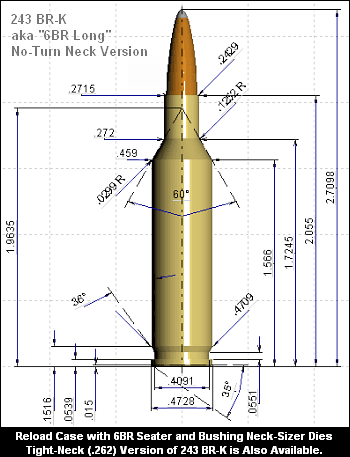
Gunsmith Mike Sosenko and long-time 6mmBR.com supporter John Adams have been using a modified .243 Winchester case with great success in California Varmint Silhouette matches. Officially called the “243 BR-K” (and informally dubbed the “6BR Long”), the wildcat is basically a .243 Winchester with less body taper and a 30-degree shoulder. The design essentially grafts a 6mmBR Norma “top end” to the .243 Winchester case. After fire-forming, Mike and John can reload this case using normal, unmodified 6BR neck-sizing and seater dies.
Compared to a .243 Winchester, the 243 BR-K’s body length is about .006″ longer, and the shoulder is about .0055″ wider. The main difference is the shoulder angle (30° vs. 20°), and the location of the neck-shoulder junction (“NSJ”). Based on reamer prints, the base to NSJ dimension is 1.718″ on the 6BR Long, compared to 1.804″ for the .243 Winchester. Neck length is a bit shorter because “the neck shrinks a little when the shoulder blows out” according to Sosenko. We’ve provided a mock-up diagram of the 243 BR-K, but you should check with Dave Kiff of Pacific Tool & Gauge for exact dimensions. Dave created the reamers for both the 6mm and 22-caliber versions of this wildcat. Ask for the “22 BR-K” or “243 BR-K” reamer designs.
Wicked Velocity with Stable Brass
The main advantage of the 243 BR-K is serious velocity in a case that is very stable. Mike’s favorite load is the 95gr Berger VLD pushed by Reloader 22. With a stout load of RL22 and Federal 210m Primers, Sosenko is getting 3450 fps with the 95-grainer, with no bullet blow-ups. This is with a 1:8.5″ twist Broughton 5R barrel finished at 28.5″. The cases are holding up very well. Mike has a half-dozen loads on his brass and he hasn’t had to full-length size yet. Mike runs a .262″ tight neck, but there is also a no-turn version of the case (see illustration). Accuracy is excellent. Mike says the round delivers repeatable 1/4 MOA groups at 100 yards in testing. He has also experimented with N160, but, thus far, Reloader 22 has delivered smaller groups with better ES and SD.
VIEW 243 BR-K REAMER PRINT (No-Turn Neck)

John Adams shoots a no-turn (.274″) neck 243 BR-K with 105gr Berger VLDs. He’s getting about 3230 fps using Reloader 22. John says he can push the 105s faster, but 3220-3240 fps “seems to be the sweet spot.” John notes that “after about 5 reloadings on a case, it gets a little tight”. John then full-length sizes with a custom Hornady FL bushing die. “The Hornady custom shop dies work great” according to John. Adams also shoots a version of this wildcat necked down to 22-caliber. It has demonstrated outstanding velocity and good accuracy in initial testing with a 9-twist barrel. Using the 80gr Amax bullets, John is getting 3570+ fps speeds. John feels that his 22 BR-K needs some more development work. “The 243 BR-K is proven. We know what works. With the 22 I want to try different seating depths, experiment with a few different bullets, and fine-tune the velocity.”

243 BR-K in Competition
John Adams and Mike Sosenko developed the 243 BR-K Wildcat for use in monthly varmint silhouette matches at the Pala range in Southern California. Shooting prone with front rest (as in F-Class), participants engage metal targets at multiple distances out to 600 yards. It can get very windy at Pala, so you need a cartridge with great inherent accuracy, plus good wind-bucking ability. With its capacity to drive the .514 BC Berger 95s at 3450 fps, the 243 BR-K has what it takes to win at Pala. Shooting his 243 BR-K wildcat, Mike Sosenko has won many relays at Pala, and he is the only shooter to have shot a perfect 50 score, knocking down every target. Interestingly though, John tells us that “Mike’s five best scores this year, including his perfect 50, were shot using my guns with no-turn necks.”
How good are the ballistics for the 243 BR-K? Consider this… launched at 3450 fps, the 95 Bergers drift just 18.57″ in a 10 mph crosswind at 600 yards. By contrast, a 105gr Scenar shot from a standard 6BR at 2900 fps will drift 22.95″ at the same distance. The 243 BR-K exhibits nearly 20% LESS DRIFT at 600 yards–clearly enough to make the difference between a hit and a miss. (Ballistics calculated with Point Blank software for 70° temp, 1000 feet elevation, using manufacturers’ BCs.)
Click HERE for GIANT SIZE Range Photo.
November 15th, 2007
As we predicted some months ago in the Daily Bulletin, Remington Arms has released an AR-15 platform rifle. The new gun, called the R-15 VTR™ Modular Repeating Rifle, is based on Bushmaster parts and engineering. Remington Arms and Bushmaster Firearms are both owned by parent Cerberus, a large holding company. We felt it was only a matter of time before Bushmasters were rebranded with the Remington name. Well that time has come.
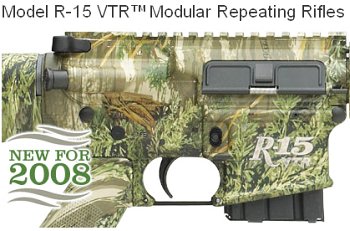
The new R-15 VTR™ is available in two calibers, .223 Rem and .204 Ruger. Three models will be offered, all flat-tops. There is a 22″-barrel rifle, plus two shorter-barreled carbines, one with collapsible stock. It appears that the carbines have 18″ barrels, but specs won’t be released until December 1st. Perhaps to avoid the “politically incorrect” black rifle image, all three models come draped in Advantage MAX-1 HD camouflage. From a technical standpoint, the R-15 VTR™ is hardly innovative, though these “RemMaster” AR-clones feature a new trigger assembly engineered by Remington. Remington’s R-15s ship with a 5-round magazine, but all AR15 mags, including 20- and 30-rounders, will fit the new rifles. MSRP is $999 for the 22″ R-15, and we expect the first units to ship before the end of January.

CLICK HERE for LARGE PHOTO
CLICK HERE for Remington’s R-15 VTR™ SNEAK PREVIEW
November 15th, 2007
We’ve used this Lyman gauge, and believe that it is the best product of its kind on the market currently. It is accurate and repeatable, and easy to use (with a bit of practice). Using modern electronic strain gauge technology, the Lyman tool measures pull weights from 0 to 12 pounds, with accuracy of ± 0.10 ounces (one-tenth of an ounce.). The battery-powered gauge is equipped with a large, easy-to-read LCD display and is push-button operated for zero, clear, and averaging functions. We’ve tested this gauge back to back with conventional coil spring trigger scales made by other manufacturers. The Lyman electronic gauge is faster, and in our opinion, significantly more repeatable. Some of the metal spring gauges tend to “stick” in a position, which requires multiple attempts to avoid a reading that is slightly high or low. The Lyman is more fool-proof to operate by contrast.

Now through the end of November, MidwayUSA has the Lyman Electronic Digital Trigger Pull Gauge on sale for $41.99, item 220725, Lyman product #7832248. This includes a vinyl storage case, but you have to purchase the required 9-volt battery separately.
|


