|
|
December 25th, 2009
Sam Hall of Boonville, North Carolina is “King of the Hill” when it comes to the 600-yard benchrest game. He is the 2009 IBS 600-yard Shooter of the Year, and he won the IBS 600-yard Nationals two years in a row. When Sam talks, people listen… if they’re smart. Sam was recently asked to compare the performance of Berger’s 6mm 108gr boattail vs. Berger’s 105gr VLD bullet. As Sam explains, both bullets have the potential to shoot really well, so your barrel and the conditions may dictate which projectile works best.
Berger 105gr VLDs vs. Berger 108gr BT by Sam Hall
I shot the 108gr Bergers (and 108 BT BIBs for a few matches) all last year in my Light Gun (LG) and Heavy Gun (HG) in 600-yard IBS competition, but switched to Berger VLDs during the Nationals because of the extreme winds in South Dakota.

When I started loading for the 108s, I quickly learned they are much easier to tune than VLDs. In the two barrels in which I shot the 108s, they did not seem to be sensitive to seating depth or powder charge like the 105 VLDs. I could not see much difference in groups at 600 yards during tuning. But, with the 108s, you will need to drop about one grain in powder compared to the VLDs due to longer bearing surface and extra weight. It seemed that the 108s show a consistent round-pattern group, where the VLDs many times have flyers. By this I mean, if both the 108s and 105 VLDs shoot a two-inch, 5-shot group at 600, the 108s will be evenly distributed in the two-inch circle. Conversely, the time the VLD’s will often have 3 or 4 shots in one inch but 1 or 2 flyers expanding the group to two inches. But when the VLDs don’t have a flyer, look out! That’s when most of the World Records have been set and VLD shooters have come from behind and won the match. (Yes, I am talking to you Mike Davis).
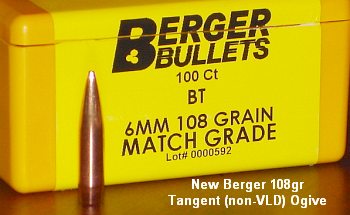 Mike Davis and I talked about the Berger 108s vs. 105s last year. The 108gr BTs are great until the wind gets up. They seem to get blown around more than the VLDs. A half-inch extra at 600 yards these days means the difference between winning or ending up middle of the pack. So, ideally, a shooter would have two loads. One would use the 108s for mild days, and the second would use the 105gr VLDs for those windy days. Mike Davis and I talked about the Berger 108s vs. 105s last year. The 108gr BTs are great until the wind gets up. They seem to get blown around more than the VLDs. A half-inch extra at 600 yards these days means the difference between winning or ending up middle of the pack. So, ideally, a shooter would have two loads. One would use the 108s for mild days, and the second would use the 105gr VLDs for those windy days.
If you don’t have time to tune the 105gr VLDs (tuning them can be difficult and time-consuming), I suggest you stick to the 108s. They will save you a lot of headaches and will stick close to the VLDs in most conditions.
How Temp and Humidity Affect Performance
I almost forgot to mention. As the temperature and humidity got up in the summertime last year in North Carolina, the 108s did not perform for me as well as they did during the cooler, less humid months. I tried developing a new, hot-weather load for the 108s, but I never got the 108s to perform as well in the summer as I did in the winter and spring — even when there was no wind. I don’t know why the 108s prefer cooler, less humid conditions, except maybe because they have more drag than the 105gr VLDs. High humidity may have had more of an effect on the 108s than we’d expect from the slight BC difference between the two bullets. The VLDs seem to drill through the wind and humidity better than the 108gr Bergers. NOTE: These findings are my own opinion based on many, many groups shot tuning and in competiton, while using several barrels of various manufacturers.
I hope this helps and does not further complicate your load development process. Try both bullets before you buy a large quantity of bullets. Your rifle will let you know which projectile it prefers. We have often found that a particular barrel will shoot one bullet design well but not the other. A few barrels will shoot BOTH bullet types really well.”
December 24th, 2009
 Medal of Honor winner Col. Robert L. Howard passed away yesterday in Waco, Texas. Prior to his death, historians believed Howard was the most highly-decorated then-living American soldier. He was part of the Army Special Forces and ran cross-border operations in Laos, Cambodia and North Vietnam. He was wounded 14 times in Vietnam and was awarded eight Purple Hearts. Medal of Honor winner Col. Robert L. Howard passed away yesterday in Waco, Texas. Prior to his death, historians believed Howard was the most highly-decorated then-living American soldier. He was part of the Army Special Forces and ran cross-border operations in Laos, Cambodia and North Vietnam. He was wounded 14 times in Vietnam and was awarded eight Purple Hearts.
He was nominated three separate times for the Medal of Honor, finally receiving the nation’s highest award in 1971. President Richard M. Nixon presented him with the honor for his bravery in Vietnam during a mission to rescue a missing soldier in enemy territory.
In addition to the MOH, Col. Howard held the following major decorations: Distinguished Service Cross (with one oak leaf cluster); Silver Star; Defense Superior Service Medal; Legion of Merit (with three oak leaf clusters); Bronze Star (with three oak leaf clusters and “V” device); Purple Heart (multiple with a silver and two bronze oak leaf clusters); Meritorious Service Medal (with two oak leaf clusters); Air Medal (with “V” Device and numeral 3. One award for heroism and two for aerial achievement); Joint Service Commendation; Army Commendation Medal (with “V” device and one each silver and bronze oak leaf clusters. 4 awards for valor and 3 for achievement); Presidential Unit Citation (for Studies and Observations Group–SOG).
Howard also held many other U.S. service medals and Foreign Decorations, including the Vietnamese Cross of Gallantry (with Gold, Silver, and Bronze citations).
After retiring from the Army, Col. Howard spent much of his free time working with veterans. He also took periodic trips to Iraq to visit active duty troops. Howard died of pancreatic cancer at a hospice in Waco, Texas on December 23, 2009.
CLICK HERE to learn more about Col. Howard and to read his Medal of Honor citation. As a staff sergeant of the highly-classified Military Assistance Command, Vietnam – Studies and Observations Group (MACV-SOG), Howard was recommended for the Medal of Honor on three separate occasions during thirteen months spanning 1967–1968. The first two nominations were downgraded to the award of the Distinguished Service Cross due to the covert nature of the operations in which Howard participated.
December 24th, 2009
From Ivy League to smaller schools, the National Shooting Sports Foundation has provided 16 colleges and universities with early Christmas presents — grants to help more students get involved in the shooting sports. Among the grant recipients are Harvard University, Clemson University, the University of Vermont, and Hillsdale College. “NSSF is making these grants available in response to a growing interest in the shooting sports on campuses across the country,” said Zach Snow, NSSF’s senior shooting promotions coordinator. “Graduates of scholastic shooting programs like the NSSF-developed Scholastic Clay Target Program want to continue participating in their favorite sport when they go off to college, and once there, they’re eager to introduce new friends, classmates and faculty to this lifetime activity. At the same time, collegiate shooting programs help create a positive image for the shooting sports and firearms ownership.”

A total of $109,500 in grant money was awarded for new and existing shooting programs at the schools. Harvard University, for example, will use its grant to revive the Harvard Shooting Club, founded in 1883, and which has been dormant since 2003; raise awareness of the shooting sports within Harvard community and general public; and host firearms education events on campus. READ MORE about the 16 schools and their plans for their grant awards. Find more information on NSSF’s College Shooting Sports Initiative at www.nssf.org/college.
December 24th, 2009
Ed’s Public Safety, a gunshop in Georgia, has published photos of the New “Gen 4″ Glock handguns. The much-ballyhooed design changes for the Gen 4 Glocks are interesting, but hardly revolutionary. As expected, the new Glocks will have interchangeable backstraps. That’s probably a good thing.
CLICK HERE for more Gen 4 Glock photos
Other noteworthy changes in the Gen 4 Glocks are a dual recoil spring, and an interchangeable magazine release that can be moved from right to left. The dual spring is a more modern design that may reduce perceived recoil somewhat. The mag release change is smart and makes the gun more user-friendly for southpaws. Glock is making new magazines for the Gen 4 Glocks that work with the interchangeable mag release. Older magazines can still be used with the new Gen 4 Glocks, but only when the mag release button is positioned on the left.
Design Change — Too Little, Too Late?
Unfortunately, with either of the two provided backstraps, Glock’s Gen 4 grip is still fat and blocky compared to many other pistols. Also the Gen 4 Glocks retain the prominent “backstrap bulge” or flare in the bottom 1/3 of the grip’s back edge. For many shooters this “Glock bulge” causes the gun to point poorly, and for this Editor, that bulge also causes the gun to twist more on recoil (since it pushes against one side of the base of the shooting hand). The first thing done by companies that modify Glock grips is to reduce the flare or bulge in the bottom of the grip. That makes the grip much more user-friendly for smaller hands. In this Editor’s opinion the bottom rear section of the Glock grip was an ergonomic mistake when it came out in 1982 and the Gen 4 redesign really does nothing to correct the flaw. The interchangeable backstraps are just a poor “band-aid fix” when a more fundamental redesign was needed.


Overall, we think that most of the Gen 4 design changes are positive, or at worst “neutral”, but this may be a case of “too little, too late”. We doubt if the redesigned Glock is sufficiently improved to grab much market share back from the Smith & Wesson M&P series and other handguns whose sales have cut into Glock’s lucrative police contracts and civilian sales. The Gen 4 Glocks offer a modest ergonomic improvement over previous models, but they still not as well-designed ergonomically as Smith’s M&P. We doubt that police agencies which have switched to M&Ps will find reason to go back to Glocks anytime soon — unless, of course, Glock radically drops its prices, which is unlikely.
December 24th, 2009
The NRA’s NRA Women On Target Hunting Progam organizes a popular series of women-only outdoor adventures every season. Currently, there are 11 Women on Target hunts planned for 2010. For a woman looking for a “no-stress” hunting holiday guided by skilled outfitters, this is an excellent choice. Starting as $276 for a two-day duck hunt, many of these events are quite affordable, so they would make a unique Christmas present for a female family member or your favorite lady shooter. CLICK HERE for Women on Target hunt details and pricing.
NOTE: One spot is still available for the combo hunt at Addisson Ranch in Oklahoma. Ladies will have a chance to stalk and shoot Whitetail Doe, Wild Hog, Coyote, and Bobcat.

| 2010-2011 Hunting Excursion Schedule |
| Whitetail Doe, Wild Hog, Coyote & Bobcat |
Oklahoma |
January 1-3, 2010 |
| Feral Hog Hunt and Bass Fishing |
Texas |
January 22-24, 2010 |
| European Pheasant and Walk up Hunt |
Michigan |
March 5-6, 2010 |
| Rio Grande Tom Turkey |
Texas |
April 9-11, 2010 |
| Alaskan Black Bear, Wolf |
Alaska |
August 17-23, 2010 |
| Pheasant & Chukar |
Nebraska |
October 22-24, 2010 |
| Mallard & Wood Duck |
Michigan |
October 22-24, 2010 |
| Whitetail Doe/Spike, Axis Doe, and Hogs |
Texas |
October 22-24, 2010 |
| Whitetail Doe/Spike, Axis Doe, Rio Grande Turkey (Tom/Hen), Hog |
Texas |
November 12-14, 2010 |
| Whitetail Doe/Spike, Axis Doe, Rio Grande Turkey (Tom/Hen), Hog |
Texas |
December 10-12, 2010 |
| Whitetail Doe, Hog, Coyote & Bobcat |
Oklahoma |
December 31, 2010 and January 2, 2011 |
December 23rd, 2009
 At the current Biathlon World Cup event in Slovenia, American Tim Burke earned the yellow bib signifying that he is the current leader in the Biathlon World Cup. This is the first time an American has EVER been the overall leader in this prestigious Biathlon series. Tim now ranks among the elite biathletes who could win Gold at the upcoming Vanouver Olympic games. Tim Burke is a remarkable athlete who has overcome serious medical issues: “It wasn’t at all an easy way for me. But I think those down times were important as well for taking step by step forward to where I am now. I had a major hip surgery in 2002 and I wasn’t sure if I would continue to be a biathlete after that and [mononucleosis] took me out the whole 2004 season.” At the current Biathlon World Cup event in Slovenia, American Tim Burke earned the yellow bib signifying that he is the current leader in the Biathlon World Cup. This is the first time an American has EVER been the overall leader in this prestigious Biathlon series. Tim now ranks among the elite biathletes who could win Gold at the upcoming Vanouver Olympic games. Tim Burke is a remarkable athlete who has overcome serious medical issues: “It wasn’t at all an easy way for me. But I think those down times were important as well for taking step by step forward to where I am now. I had a major hip surgery in 2002 and I wasn’t sure if I would continue to be a biathlete after that and [mononucleosis] took me out the whole 2004 season.”

CLICK HERE to learn more about the U.S. Biathlon team at biathlon.teamusa.org
Before Slovenia, Tim Burke made history twice at the previous World Cup event in Ostersund, Sweden. His silver medal performance in the 20km Individual competition tied the best World Cup finish ever for a U.S. Biathlete and Tim followed that performance by capturing the bronze medal in the Men’s 10km sprint event. Burke’s bronze medal marked the first time a U.S. Biathlete has ever reached the podium in the sprint competition — and the first time that Americans have won silver and bronze medals in the same competition.
In the major World Cup competition leading up to the 2010 Winter Olympics in Vancouver, British Columbia, Team USA has gained world attention. The U.S. Biathlon team has been called the most improved team in the world by Olympic and Biathlon experts. Michael Dixon, Eurosport TV Biathlon Commentator, reports: “The United States Biathlon Team is the most improved in the world. It won’t be long before a moment of brilliance brings them to the podium for their first Olympic medal.” The YouTube slideshow below shows the USA Biathlon Team in action. NOTE: If you’re at work, you may want to turn down the speaker volume before playback.

“Biathlon is a sport that captivates and fascinates nearly all who see it”, commented Max Cobb, Executive Director of the U.S. Biathlon Association. “The world-class Biathlete attempts to combine the physically demanding sport of cross-country skiing with the intense precision of rifle marksmanship. The opposing disciplines collide with unique drama at the shooting range. With hearts pounding nearly three times a second, athletes struggle to control their breathing as they attempt to hold their rifles steady and squeeze off a successful shot, knowing that each shot, and the number of seconds it takes to make it, will determine who stands on the podium.”
December 23rd, 2009
 A new digital powder dispenser just hit the market. Priced at just $205.99 (at Grafs.com), the new Smartreloader iSD Digital Powder Scale & Dispenser, is about $100.00 less expensive than RCBS’s popular ChargeMaster. Designed in Italy, the Smartreloader iSD dispenser has the ability to work with either 110 volt (American) or 220 volt (European) power supplies. A new digital powder dispenser just hit the market. Priced at just $205.99 (at Grafs.com), the new Smartreloader iSD Digital Powder Scale & Dispenser, is about $100.00 less expensive than RCBS’s popular ChargeMaster. Designed in Italy, the Smartreloader iSD dispenser has the ability to work with either 110 volt (American) or 220 volt (European) power supplies.
The new Smartreloader iSD has some impressive features, such as fast calibration and a selectable trickle function. We hope to get our hands on one soon so we can comparison-test it against an RCBS Chargemaster. You can learn more about this new powder dispenser at Smartreloadermfg.com. General specs are very similar to the Chargemaster: the iSD scale has a maximum capacity of 1,500 grains and has claimed accuracy of ±0.1 grains. You can store up to 50 loads in internal memory, and users can select four (4) different measurement units: grams, grains, carats, or ounces.
Where can you find this new powder dispenser? Supplies are very limited right now, but in the USA, Smartreloader-branded products will be carried by Cabelas.com, Grafs.com, Midsouth Shooters Supply, and Cabelas.com. The worldwide distributor of Smartreloader products is H.T. Helvetica Trading, a Swiss-based company. CLICK HERE for a list of Smartreloader vendors in other countries.

December 22nd, 2009
 The National Sporting Goods Association (NSGA) has issued an interesting report charting gun sales by region. Southerners like handguns, and those in the Great Lakes states purchase the most shotguns by far. In 2008, southern Atlantic states led per capita in handgun purchases and also accounted for 31.4 % of all handguns bought in the United States. East north central states led per capita in shotgun purchases and accounted for 33.4 % of shotguns sold. The National Sporting Goods Association (NSGA) has issued an interesting report charting gun sales by region. Southerners like handguns, and those in the Great Lakes states purchase the most shotguns by far. In 2008, southern Atlantic states led per capita in handgun purchases and also accounted for 31.4 % of all handguns bought in the United States. East north central states led per capita in shotgun purchases and accounted for 33.4 % of shotguns sold.
The Mountain states led per capita in rifle purchases and accounted for 10.7 percent of rifles sold. But the South Atlantic states’ residents buy the most rifles overall — 22% of the nationwide total. It is interesting that the Pacific states (California, Oregon, Washington) encompass 14.7% of the U.S. population, but that region accounts for only 10% of rifles and shotguns sold. On the other hand, Pacific states’ residents buy 14.2% of all handguns, the second highest figure among regions. Maybe all those crazy gun control laws in California haven’t made things any safer, and people feel the need to arm themselves.
Download Full Report on Firearm Sales by Region (PDF File)
December 22nd, 2009
The Garmin Nüvi 855 GPS Navigator is Amazon’s gold box “Deal of the Day” for December 22, 2009. This is a highly-rated unit with Lane Assist, and speech recognition for commands. Today only, the price has been slashed from $189.99 to $159.99 with FREE Shipping. You can’t touch that price elsewhere for a Garmin with speech recognition. As this is the lowest price I’ve ever seen (by far), your Editor went ahead and bought one.
CLICK HERE for Best Price
Garmin nüvi 855 4.3-Inch Widescreen Portable GPS Navigator with Speech Recognition
The video below shows how the voice-activated navigation works on the Garmin 880, the predecessor to the model 885. It’s pretty cool. NOTE: To use the voice command feature, you need to have a small wireless control (included in the kit) clipped on your steering wheel.

December 21st, 2009
 Grafs.com has received a large shipment of the new IMR 8208 XBR powder. This is good news as Powder Valley recently sold out. Grafs.com has both 8-lb jugs for $149.99 (item IMR82088) as well as smaller 1-lb containers for $21.99 (item IMR82081). Grafs.com has received a large shipment of the new IMR 8208 XBR powder. This is good news as Powder Valley recently sold out. Grafs.com has both 8-lb jugs for $149.99 (item IMR82088) as well as smaller 1-lb containers for $21.99 (item IMR82081).
If you haven’t heard about IMR 8208 XBR, this is a very promising new powder that is very accurate, meters well, and is much less temp sensitive than other powders of similar burn rate. This powder should be ideal for many applications including .223 Rem, .204 Ruger, 6 PPC, and .308 Winchester. Will 8208 XBR work in a 6BR or Dasher with heavy bullets? We’ll let you know soon — we’re planning to test it ourselves with an 8-twist 6mm BR.
|


