|
|
June 14th, 2014
 Here’s a smart new product that monitors the temperature and humidity inside your gun safe — with a convenient LCD display unit located on the outside of the safe. You don’t need to string wires or cut a small hole in your safe — there are two separate components, one inside and one outside. The sensor unit (on the inside) communicates wirelessly with the display unit (on the outside). Here’s a smart new product that monitors the temperature and humidity inside your gun safe — with a convenient LCD display unit located on the outside of the safe. You don’t need to string wires or cut a small hole in your safe — there are two separate components, one inside and one outside. The sensor unit (on the inside) communicates wirelessly with the display unit (on the outside).
The new GoldenRod Wireless Hygrometer was designed to display the temp/humidity in your safe without the need to open the safe. NOTE: the wireless LCD display can show BOTH in-vault AND in-room humidity and temperature levels. You can attach the display to the vault door with its built-in magnet, or simply place the display unit on top of the safe using the handy flip-out kickstand. The unit costs just $20.89 at Amazon.com.


GoldenRod Wireless Hygrometer Specifications and Features:
- Measures In-Vault and In-Room humidity from 20% to 95%.
- Measures In-Vault temperature range from 14°F to 122°F.
- Measures In-Room temperature range from -4°F to 158°F.
- Records Min/Max temperature and humidity history.
Product Tip from EdLongrange. We welcome reader submissions.
June 13th, 2014
This month Ruger is introducing a new varmint version of its popular Ruger American Rifle (RAR). The RAR “Predator” model is offered in six (6) different chamberings: .204 Ruger, .223 Remington, .22-250 Remington, .243 Winchester, 6.5 Creedmoor, and .308 Winchester. All have 22″ free-floated, medium-contour barrels except the .308 Win, which has an 18″ tube, making it a very handy truck gun.

Gun writer Ed Head got his hands on one of the new RAR Predator rifles, chambered in .223 Remington. He reviewed the Predator for the DownRange.TV blog. The reviewer liked the compact 6.62-pound rifle, which features a molded polymer stock and hammer-forged 1:8″ twist barrel. Ed Head liked the short-throw bolt, and he praised the crisp trigger. Accuracy, as tested, was not that impressive — 1.224″ on average at 100 yards. But the tester noted that some types of ammo shot much better than others. So, conceivably, with handloads, this gun could shoot well under 1 MOA. Shooting at steel targets, the tester “managed to shoot 1.5-inch groups at 100 yards, 2.5-inch groups at 200 yards, and 7-inch groups at 300 yards, all with the Lake City ammunition.”
 CLICK HERE To Read Full Review of Ruger American Rifle Predator
Overall, reviewer Ed Head liked the Predator enough that he decided to purchase his test rifle: “I like this rifle and I’m going to buy it from Ruger. It will shoot ‘minute of squirrel’ at reasonable ranges and should do well on bigger critters — predators — out to 400 yards or more.”
Rifle Features
- One-piece, 3-Lug 70° bolt with full-diameter bolt body and dual cocking cams.
- Integral bedding block system that positively locates the receiver.
- Action comes with factory-installed aluminum Weaver-style scope rail.
- Two-position safety can lock trigger (but not bolt) to allow safe unloading.
- Adjustable 3.5-lb Ruger Marksman trigger with Savage-style inner safety blade.
- Barrel factory-threaded at muzzle for muzzle brakes, flash hiders, and/or suppressors.
- Rotary magazines with 4- or 5-round capacity (depending on caliber). These magazines are a little tough to load correctly.

June 12th, 2014
One of our Shooters’ Forum readers, Trent from Louisiana, asked for help deciding between a .260 Remington and a 6.5×55 for his latest gun project. In the Forum thread, respected UK gun writer Laurie Holland provided a good summary of the differences between the two chamberings. Laurie writes:
 “The 6.5×55 case has 6 or 7% more capacity than the .260s, even more in practice when both are loaded to standard COALs with heavy bullets, which sees them having to seated very deep in the .260 Rem using up quite a lot of powder capacity. So loaded up for reasonable pressures in modern actions, the 6.5×55 will give a bit more performance. “The 6.5×55 case has 6 or 7% more capacity than the .260s, even more in practice when both are loaded to standard COALs with heavy bullets, which sees them having to seated very deep in the .260 Rem using up quite a lot of powder capacity. So loaded up for reasonable pressures in modern actions, the 6.5×55 will give a bit more performance.
The issue for many is what action length is available or wanted, the 6.5 requiring a long action. So sniper rifle / tactical rifle competitors will go for the .260 Rem with the option of the many good short-bolt-throw designs around with detachable box magazines. If a bit more performance is needed, the .260AI gives another 100-150 fps depending on bullet weight.
Brass-wise, you’ve got really good Lapua 6.5×55 off the shelf that needs minimum preparation, and it’s strong and long-lived. There is an Ackley version too that was popular in F-Class in Europe for a while that isn’t too far short of 6.5-284 performance. If you go for .260 Rem, the American brass isn’t as good but you can neck-up Lapua or Norma .243 Win and trim them (or neck-down .308 Win or 7mm-08). This has the downside that doing so usually creates a noticeable ‘doughnut’ at the case-shoulder junction, that may cause problems depending on how deep bullets are seated. [Editor’s Note: After Laurie wrote this, Lapua began producing high-quality .260 Remington brass.]
 For purely target shooting, I think I’d go with 6.5×55 if I was making the choice again today for performance and brass-preparation reasons. In fact, I’ve considered going back to the gunsmith to have the barrel rechambered. For purely target shooting, I think I’d go with 6.5×55 if I was making the choice again today for performance and brass-preparation reasons. In fact, I’ve considered going back to the gunsmith to have the barrel rechambered.
You want a multi-purpose rifle though and that makes things trickier depending on the bullet weight(s) you want to use. The [typical] 6.5×55 and 6.5-08 throats are really designed for 140s, so 90-120s make a long jump into the rifling. If you’re always going to use 130s and up, it’s less of an issue. If you want to use the lighter stuff, I’d say go for .260 Rem and discuss the reamer with the gunsmith to come up with as good a compromise as you can depending on the mix of shooting. 1:8.5″ twist is the norm and handles all the usual sporting and match bullets; you can go for a little slower twist if you won’t use the heavies.
Over here in the UK, in Scotland to be precise, we have a top sporting rifle builder (Callum Ferguson of Precision Rifle Services) who almost specializes in .260 Rem usually built on Borden actions. He throats the barrel ‘short’ so it’s suited to varmint bullets, but will still handle the 100gr Nosler Partition which he says is more than adequate for any British deer species including Scottish red stags.
Accuracy-wise, I don’t think there’s anything between them if everything else is equal. The 6.5 has a reputation for superlative accuracy, but that was high-quality Swedish military rifles and ammunition matched against often not-so-high-quality military stuff from elsewhere. Put the pair in custom rifles and use equally good brass and bullets and you’ll be hard pressed to tell them apart.” – Laurie Holland
 After Laurie’s helpful comments, some other Forum members added their insights on the .260 Rem vs. 6.5×55 question: After Laurie’s helpful comments, some other Forum members added their insights on the .260 Rem vs. 6.5×55 question:
“To me, the .260 Remington has no advantage over the 6.5×55 if one is going to use a long action. Likewise, the only advantage the .260 has in a modern rifle is it can be used in a short-action. There is more powder capacity in the 6.5×55 so you have the potential to get more velocity plus there is a lot of reloading data available to you for loading at lower velocity/pressure if you choose. The Lapua brass is great and Winchester brass is pretty good at low pressures. Having loaded a good bit for both, the 6.5×55 would always get the nod from me. To me, if someone wants to use a short-action, the 6.5×47 Lapua is even a better option than the .260 for a target rifle.” — Olympian
“There is just one small item that has been missing from this conversation — the 6.5×55 has a non-standard rim diameter of .479″ vs. the standard .473″ of a .308 and all of its variants. Depending on your bolt this may be an issue, or it may not.” — Neil L.
June 12th, 2014
Creedmoor Sports has hired ace marksman Tyrel Cooper “as the newest addition to the Creedmoor Sports family”. Ty brings with him a wealth of knowledge and experience as a service rifle shooter, match rifle shooter, and long range shooter. Cooper’s shooting resume includes five national championships (one each in 2008, 2011, 2012, and two in 2013). He is the current (2013) NRA National Long Range Champion, and reigning (2013) NRA National Service Rifle Champion.

Creedmoor’s General Manager, Dennis DeMille, states: “I’ve known Ty and watched him progress from the time he was 14 years old attending matches with this parents, Lonnie and Lupe, and his sister Sam. Even at that young age his maturity and potential was obvious. His 10 years as a member of the elite USAMU squad allowed him to realize that true potential, becoming one of best service rifle shooters of all time…and he’s not done. Customers who call Creedmoor Sports to get advice on shooting equipment, or shooting in general, will be able to get that advice from either Ty or myself. His quiet, polite and humble demeanor make him a perfect champion and representative for Creedmoor. When we heard Ty might be available we couldn’t risk missing an opportunity to get him on board.”

Below is a 2012 file photo of SSG Ty Cooper shooting a service rifle. Cooper won the 2013 NRA National High Power Rifle Long Range Championships with a final score of 1243-71X. In the Long Range Championships, Cooper used a Nesika-actioned bolt gun with long barrel chambered in 7mm SAUM.

June 12th, 2014
 It is an iconic American firearm design — the Thompson submachine gun, or “Tommy Gun”. Here’s your chance to add the real thing to your firearms collection. The St. Louis Metropolitan Police Department (SLPD) plans to auction off twenty-nine (29) historic Tommy Guns. These 1920s-era .45-caliber weapons have been stored in a vault for decades. The SLPD is selling the highly-collectible submachine guns to raise money for new service pistols for its officers. The auction will take place later this year, but no exact auction date has yet been set. It is an iconic American firearm design — the Thompson submachine gun, or “Tommy Gun”. Here’s your chance to add the real thing to your firearms collection. The St. Louis Metropolitan Police Department (SLPD) plans to auction off twenty-nine (29) historic Tommy Guns. These 1920s-era .45-caliber weapons have been stored in a vault for decades. The SLPD is selling the highly-collectible submachine guns to raise money for new service pistols for its officers. The auction will take place later this year, but no exact auction date has yet been set.
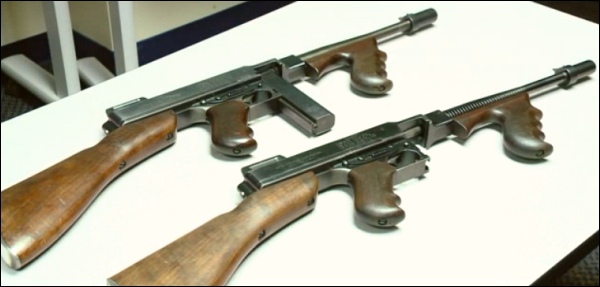
A Million Dollars Worth of Full-Auto Firepower
The Tommy guns are expected to fetch from $15,000 to $40,000 each, putting a estimated value of the whole collection at as much as $1,000,000. According to the Washington Times: “The collection was appraised by a local dealer in 2012 at $770,000, but police and some collectors believe it could sell for much more. The collection includes rare 1921 and 1927 Colts and a model made in 1942.”
SLPD chief Sam Dotson stated: “We’re told [that] outside of the military and federal government we have the largest cache of Thompson machine guns.”
Because these are fully-automatic “Class III” weapons, subject to the National Firearms Act (NFA), purchasers much fill out the proper paperwork, pass background checks, and obtain a Federal Tax stamp for each Tommy gun purchased. The SLPD expects the majority of the firearms will be purchased by wealthy collectors or museums.
June 11th, 2014
Forum Member John V.S. (aka BPD459) has a special story to tell — about rifle craftsmanship and a life-long friend. What you see below is John’s new .243 Win prone rifle. It sports a beautiful Zebrawood stock crafted by Mr. James Cloward. Here’s the story of Jim Cloward and John’s new gun:
James Cloward of Lake Stevens, Washington did the stock in just a month. The stock is African Zebrawood, with an Ebony grip cap and a WTC rail. Jim had the Zebrawood in stock. I wanted a lighter-colored stock and this blank called my name and did not eat my wallet either! Photos do not do it justice! The rifle features a Barnard action, and 30″, 1:7.5″-twist Krieger chambered in .243 Win by Randy Gregory. Sights are Warner rear and RightSight front.
CLICK Photo to See Full-Screen Version

Jim Cloward surveys the original blank.

Jim’s stock work is above reproach. His hand-cut checkering is better than a couple custom 1911s I had done by “big name” builders! When Jim refined the original Roy Dunlap stock, he created history. There is no better feeling / handling stock on the world than a Cloward Dunlap stock. I wanted him to do a Dunlap for my Barnards and we could not get it to work due to the size and trigger placement on the Barnard action. So, I just had to make due with his prone stocks — life is rough sometimes.
Respect for a Master Craftsman
I am honored to have known Jim since I was 12, and even more honored to call him a friend. Growing up, it was always “Sir” or “Mr. Cloward” when I would ask him something. When I was 35, Mr. Cloward told me “You can call me Jim now”. I felt like I was a grown-up adult that day!

I have several Cloward-built XC rifles and two other prone rifles that Jim stocked. It still amazes me how Jim can take a big piece of rough-sawn firewood and turn into artwork that’s functional and better looking than anyone else’s stocks!
June 11th, 2014
The NRA now offers an online training course for its Range Safety Officer (RSO) program. The online course teaches the skills needs to conduct and supervise safe shooting activities and range operations. Online RSO Course students can access the electronic course materials for 90 days. You can complete the course in multiple sessions. The program will save your progress so you can return later.
 The Online RSO Course consists of SIX LESSONS: The Online RSO Course consists of SIX LESSONS:
• Introduction to the NRA Basic Range Safety Officer Course
• The Role of the NRA Range Safety Officer and
Range Standard Operating Procedures
• Range Inspection and Range Rules
• Range Safety Briefing
• Emergency Procedures
• Firearm Stoppages and Malfunctions
Who Can Take the Course?: The Online RSO Course is available to anyone who currently possess a valid NRA Firearms Instructor certification or NRA Coach appointment. Course cost is $125.00. Individuals without a trainer rating must attend the in-person Range Safety Officer course consisting of both classroom time and practical exercises on a range.
 Certification Procedure: Students must complete all six lessons and a short electronically administered test in order to become a certified Range Safety Officer. Once the test has been passed, newly certified Range Safety Officers will receive an electronic completion certificate that can be printed or saved to a computer. Certification Procedure: Students must complete all six lessons and a short electronically administered test in order to become a certified Range Safety Officer. Once the test has been passed, newly certified Range Safety Officers will receive an electronic completion certificate that can be printed or saved to a computer.
The NRA RSO program was developed in response to the demand for a nationally-recognized range safety officer certification. More than 54,000 NRA Range Safety Officers are involved in aspects of target shooting, training, and range supervision around the USA.
June 10th, 2014
Father’s Day (Sunday, June 15) is right around the corner. If dad enjoys hunting, here’s a way to save fifty bucks on a nice gift for the old man. Now through June 15, 2014, Zeiss is offering a $50.00 rebate on the TERRA 3X series rifle-scopes or TERRA ED Binoculars. The scopes offer 1/4-MOA clicks with a choice of standard Z-Plex or RZ6 or RZ8 ballistic reticles. Pick your power: 2-7x32mm, 3-9x42mm, 4-12x42mm, 3-9x50mm, and 4-12x50mm. CLICK Here for more details.
If you’re wondering about these binoculars, trust us, they are high quality. TERRA ED Binoculars feature SCHOTT ED glass — just about the best you can get. These binocs, in 8x42mm or 10x42mm versions, offer great low-light performance and a wide-angle field of view.


June 9th, 2014
 Ballistics books have gone digital. Bryan Litz’s Applied Ballistics For Long-Range Shooting (2nd Edition), the leading treatise on the subject, is now available in digital eBook format. This new eBook version contains all the text of the print version, all the charts, all the diagrams, and all the photos. You get all this in an easy-to-read, easy-to-search format that can be viewed on a variety of devices*. You can access the book on your home computer, on your laptop, on a tablet, on a smartphone, or on a lightweight, portable Kindle e-Reader. And yes, iPad users can use the Kindle app to read the book on an iPad. Ballistics books have gone digital. Bryan Litz’s Applied Ballistics For Long-Range Shooting (2nd Edition), the leading treatise on the subject, is now available in digital eBook format. This new eBook version contains all the text of the print version, all the charts, all the diagrams, and all the photos. You get all this in an easy-to-read, easy-to-search format that can be viewed on a variety of devices*. You can access the book on your home computer, on your laptop, on a tablet, on a smartphone, or on a lightweight, portable Kindle e-Reader. And yes, iPad users can use the Kindle app to read the book on an iPad.
CLICK for FREE Sample of Applied Ballistics
for Long-Range Shooting (2d Ed.) eBook
NOTE: After clicking this link to go to Amazon.com, click on the blue book image labeled “Look Inside”. This will launch a preview window. Alternatively, Kindle users can click the “Send Sample Now” button.
|
Advantages of the eBook Edition
The eBook release of Bryan Litz’s most popular and comprehensive ballistics book is a big deal, in our opinion. There are many advantages to the digital format. First you can quickly search for any term or reference, or click from table of content entries to desired chapters. Second, you can highlight text and bookmark pages for future review. Third, you can easily change the font size to enhance reading for older eyes. Fourth, you can zoom in the charts, diagrams, and photos for a better view. Last but not least, you can easily carry the entire text in the field on the same digital device that holds your ballistics solver software.
The new eBook version of Applied Ballistics for Long-Range Shooting (2d. Ed.) is available now on Amazon.com for $39.95. |
Highlights of eBook Edition
The eBook version of Applied Ballistics for Long-Range Shooting (2d Ed.) is available now on Amazon.com. Since its release in 2011, the second edition (hardcopy) of Applied Ballistics for Long Range Shooting has sold over 10,000 copies. It’s the modern ‘go to’ book on the subject of ballistics for long range shooters. The Second Edition of the book includes two additional chapters covering extended long-range shooting and monolithic bullets.
200 Bullet Types Tested. In this eBook edition, Bryan Litz includes data from his own personal field tests with over 200 bullet types. Performance data (G1 and G7 BCs confirmed by live-fire testing) is presented along with 2-D drawings for hundreds of long range bullets.
Ballistic Program Included. eBook buyers can receive the Point Mass Ballistics Solver 2.0 for no extra charge. The software comes on a CD with the hardcopy. With the eBook, there are two ways to access the ballistics program. First, you can access the free AB online ballistics solver through embedded links in the eBook and run directly from your eReader. Alternatively, you can request the PM Solver program to be emailed to you for running on a PC.
“Our mission at Applied Ballistics is to be the complete and unbiased source of external ballistics information for long range shooters,” stated Bryan Litz, author and owner of Applied Ballistics, LLC. “We’re constantly testing new claims, products and ideas and dispensing the marketing hype which can make it difficult for shooters to master the challenging discipline of long range shooting. We developed the original hard copy of the book in order to provide shooters of all capabilities with this knowledge. The release of the eBook will not only provide readers with the same knowledge, but do so in a more accessible and mobile way.”
Sample Page from eBook

* Installation of FREE eReader software may be required for viewing on desktop computers, laptops, tablets, and smartphones. This only takes a minute or so.
June 9th, 2014
 Editor: Our friend Shawn McKenna is a talented High Power competitor. A few years back Shawn ordered a Monard custom-fitted shooting coat. He found the jacket helped him shoot higher scores with less fatigue. He liked Monard coats so much he decided to sell them. Here is his report. Editor: Our friend Shawn McKenna is a talented High Power competitor. A few years back Shawn ordered a Monard custom-fitted shooting coat. He found the jacket helped him shoot higher scores with less fatigue. He liked Monard coats so much he decided to sell them. Here is his report.
By Shawn McKenna
For years and years, like most High Power shooters, I used an “off the rack” shooting jacket and thought I was happy with it. There may have been one or two adjustments the supplier would accommodate during ordering, but by and large it was like wearing a suit that you bought without the benefit of having it tailored.
I’m always looking to improve my scores, and in 2008 I set out to find a better shooting jacket. I happened across Monard during a web search and was surprised to learn that they took an astounding 19 different measurements during the fitting process. I thought, “This has to be much better than an off the rack coat.”
The custom coat that Monard offers to High Power shooters is called the “HP Ultimate” coat. Consisting of 29 different sections or panels, it offers customization of the composition, thickness and type of material used in each panel. And the 19 different measurements include separate right and left shoulder profiles and separate front and back profiles.

The measurements are entered into a computer program where the ratios between various points are checked against a historical database of similar measurements. Any ratios that fall outside these typical ranges are double-checked or re-measured before confirming the order to insure the fit is right the first time. This measuring process produces a custom-fit coat with the right balance of support and comfort in each position, be it for across the course, long range, or Palma shooting.
How to Get a Monard HP Ultimate Shooting Coat
Order Monard High Power Ultimate shooting jackets from McKenna Shooting Sports. Call Shawn McKenna personally at (719) 322-3127 to talk about options, measurements, and pricing.
Shawn says: “At first glance, the order form seems daunting. But don’t worry, I can guide you through each part of the order form and explain the many different options. I’m not just the owner of McKenna Shooting Sports and a Monard-trained rep, but an experienced rifle competitor who can explain the features desirable for across the course vs. prone shooting coats (i.e. higher arm orientation, shorter torso options for prone) as well as the many different choices within those two basic options.”
|
McKenna Shooting Sports, LLC
1826 E Platte Ave, Suite 110
Colorado Springs, CO 80909
Ph: 719-322-3127
shawn [at] mckennasports.com |
GET 10% OFF
Mention this Accurateshooter.com article and get 10% off of your order placed by June 30th. Also, see Shawn on Commercial Row at Camp Perry for 10% off Camp Perry orders. |

 Testimonials from Monard Customers: Testimonials from Monard Customers:
“The level of support, fit and comfort of my Monard is far superior to anything else available. My old coat feels like a sweatshirt by comparison. Shooters have to try one to fully appreciate the difference. All the Monard shooters with whom I talk agree – there’s no going back once you get one.”
–Jeff Lindblom, 2013 Missouri State Champ (in photo)
“Shooting offhand in a Monard is a much-needed upgrade; the support in the lower back you get with a profile matching your lower back is great! While shooting prone it is comfortable and easy to buckle all the way down.”
–Laura Monturi, Colorado State Rifle team
|


