Semi-auto 17 HMR — could this be the perfect light-recoiling fun gun and squirrel slayer? With its new A17, Savage has created a gun that should be hugely popular. If you like the Ruger 10/22, you’ll love the A17. It shoots a more powerful cartridge, and has a stronger action and a better trigger. With a beefy steel action that looks like it belongs on a centerfire, this gun is strong. With quality barrels (fitted, as you’d expect, with a barrel nut), the A17 is accurate. And with the capability to launch 17 HMR rounds as fast as you can pull the trigger this gun is a hoot to shoot. The ability to get a quick second shot (without disturbing the rifle by working the bolt) will be a game-changer in the varmint fields.
Watch Us Shoot the New A17 (Rapid-Fire at 1:50):
Star of the Show
Jason and I both felt that the star of this 2015 Industry Range Day was this modestly-priced little Savage A17 in 17 HMR. MSRP is $469.00 we were told. No one knows the “street price” yet but we expect that to be about $370.00. Both of us wanted to own one of these compact new rifles (Jason tried to buy one on the spot) — what does that tell you? With a strong steel action, the A17 is accurate, fun, and ultra-reliable.
Jason put the gun through three rapid fire drills — firing as fast as he could pull the trigger. We could not get the A17 to malfunction in any way. It just ripped through magazines like a sewing machine. Flawless operation. Bill Dermody of ATK says “this is one of the most thoroughly tested Savage rifles ever. We put over half a million test rounds through the rifle during development. That’s why it’s so reliable.”
The Magic Chicklet
Look below at the A17 bolt. The little black hardened metal piece (called a “chicklet” by the Savage engineers) is the secret ingredient. It works like a retracting lug, allowing the A17 to operate in delayed blow-back mode. That permits the A17 to function flawlessly with the energetic 17 HMR cartridge.
Optimized 17 HMR Ammo That’s 100 FPS Faster
CCI has developed new, higher-velocity 17 HMR ammo for the A17. Because Savage is now part of the ATK conglomerate, CCI is now Savage’s sister company. So, CCI and Savage cooperated during the development of the A17. CCI found a way to get more speed from the 17 HMR and Savage engineered an action and bolt that are strong enough to handle the new 17 HMR ammo, which runs 100 fps faster than other 17 HMR ammo on the market.
SHOT Show kicks off tomorrow, January 20th. As a sneak preview, here are some new (or newly marketed) products that will be on display in Las Vegas. We’ve reviewed nearly 500 featured products and here are some cool items that caught our eye. The AMP annealing machine is a break-through technology, and we’d love to have one of those AG Composites Carbon stocks for an M1A. The Bix’N Andy trigger isn’t really new, though most American’s haven’t seen one yet. It really is a gem. Enjoy these product snapshots. We’ll provide more “hands-on” reporting over the coming week.
AMP Induction Annealing Machine
Source: Bullet Proof Samples LLC, AmpAnnealing.com
Annealing Made Perfect (“AMP”) is a pre-programmed, fully-calibrated induction annealer. Extensive metallurgy testing has laboratory verified the temperature/time program settings, allowing precise and repeatable neck hardness every time. The AMP can handle cases from .17 to .338 caliber. Change from one cartridge size to another in seconds. The sophisticated calibration eliminates guesswork, so you don’t have to just “burn-off” lacquers and a stop-watch. Just select the correct program, set the pilot, and start annealing. Proper annealing provides more consistent neck tension and that translates to lower ES/SD and better accuracy, particularly at long range.
X-15 Side Charged Upper (SCU)
Source: X Products
The standard AR rear-pull charging handle is annoying, particularly when shooting prone. The folks as X-Products have a smart solution, an upper with a side-charging handle. We’ve seen side-charge uppers before, but these were custom mods. The $299.00 X-15 Side Charged Upper is a turnkey solution that works with a standard AR-15 bolt and carrier. No machining or modification is needed. The elevated charging position allows the bolt carrier to be operated with a proprietary cam pin that is included with the upper. The manufacture claims its X-15 upper offers “Increased performance with a gas slide that covers the charging port preventing gas and debris from hitting the operator when suppressed”.
Bargain-Priced Composite Stock with Bedding Block
Source: Stocky’s Stocks
This $199.00 stock combines the latest glass-filled nylon composite technology with Stocky’s proven AccuBlock aluminum bedding technology for Remington 700 barreled actions. These stocks are offered in varmint, target, tactical, and hunting rifle models. All variants offer a “drop-in” solution for Rem 700 actions. The $199.00 price is makes this a bargain solution for hunters and varminters who want to upgrade from a flexy “tupperware” stock.
Bix’N Andy Match-Grade Triggers
Source: BulletCentral.com
Bix’n Andy is an Austrian company that crafts some of the best triggers on the planet. Gunsmith Andy Atzl uses a unique ball bearing mechanism that allows for incredibly precise trigger pull weight adjustments. BulletCentral’s owners says: “Andy’s work is consistently top quality and we are lucky to be the exclusive North American importer and distributor for his products.”
Peterson Cartridge Brass
Source: Peterson Cartridge Co.
We welcome any company that’s jumping into the brass marketplace. Competition among brass-makers is always a good thing. For 2015, Pennsylvania-based Peterson Cartridge Co. will offer “match-grade” rifle brass for four (4) cartridge types: .308 Winchester, 7mm Remington Magnum, 300 Winchester Magnum, and 338 Lapua Magnum. On Peterson’s website, you’ll find a page that illustrates each stage in the brass-making process, from cupping to final trim and annealing. If you’ve ever been curious about how brass is made, check out Peterson’s Cartridge Manufacturing Process Page.
AG Composites Carbon Fiber Components
Source: AG Composites LLC
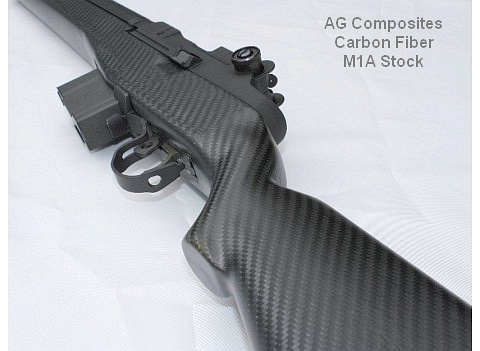
AG Composites specializes in the design, development and production of high performance composite components. AG makes carbon fiber rifle stocks, handguards and buttstocks, and AG can also provide carbon fiber OEM components for manufacturers. Check this handsome AG carbon fiber stock on an M1A. That brings an old Battle Rifle design into the 21st Century.
Bulletproof Safari Vest
Source: Miguel Caballero
This “discrete” bulletproof Safari Vest was originally created for celebrities, VIP clients, and business executives. However, this product could also benefit those involved in firearms training or range operations. (It only takes one Accidental Discharge by a newbie to spoil your whole day.) This vest features light, flexible, yet strong ballistic materials that meet NIJ 0101.06 standards. The Safari Vest features a front overlap that functions as an anti-trauma plate protecting the thorax. For increased comfort, the vest is engineered to distribute the weight evenly front to back.
Smith & Wesson Ported M&P Pistols
Source: Smith & Wesson
New from the Smith & Wesson Performance Center are four new Ported M&P pistols. What makes these pistols unique is the fact that they have ported barrels for reduced muzzle flip, as well as an adjustable trigger stop. Stop by S&W SHOT Show Booth #13729 to have closer look at all the features.
Swab-Its 17-Caliber and 22-Caliber Bore-Whips
Source: Super Brush
The Swab-its folks have just made it even easier to clean .177 air rifles, .17 caliber rimfire or centerfire rifles, and .22 caliber lever action and semi-auto rifles. Bore-Whips feature a 45″ polypropylene cord tipped with a durable, reusable swab. This handy, pull-through design allows for cleaning the proper way, from breech to muzzle. The bright-colored Neon Orange (.17 cal) and Neon Green (.22 Cal) plastic cords do double-duty, acting as Empty Chamber Indicators (ECI) at the range. Swab-its Bore-whips are available in 3-packs for both .17 and .22 calibers. Check out samples at SHOT Show Booth #1241.
Over the past few years, interest in F-Class competition has grown dramatically. SHOT Show opens tomorrow, so we thought we’d reprise an interesting interview captured two years back. At the 2013 SHOT Show we had a chance to talk about F-TR competition with U.S. National F-TR Team members Mike Miller and Stan Pate, two of America’s top F-TR shooters. We are reprising this interview for readers who may have missed it the first time around. If you shoot F-TR (even if you’re a High Master), we think you’ll learn a few things from this interview.
In this interview, Mike and Stan agreed to share their vast store of knowledge about long-range shooting. In a wide-ranging dialog, we discussed many topics of interest to F-Class shooters: position set-up, bipod shooting techniques (and hardware), gun-handling, and bullet selection. In addition, Mike and Stan offer some great advice on wind reading and precision reloading. These general tips will benefit all competitors, no matter what their discipline.
If you shoot F-TR or you are considering getting involved in this fast-growing shooting sport, definitely watch this 14-minute video interview from start to finish. Mike and Stan are true F-TR gurus whose knowledge of the F-TR game has been gleaned from years of top-level competition. If you shoot a .308 from a bipod, we guarantee you can learn much from Mike and Stan. If you follow their advice, we bet you’ll see your scores improve in future matches.
Watch Video for Tips from U.S. National F-TR Team Members Mike Miller and Stan Pate
ELEY .22 LR ammunition has certainly been the choice of champions in high-level international smallbore competition. But ELEY is not resting on its laurels. ELEY’s engineers have worked hard to develop two new types of rimfire ammo — one fast (“force” high-velocity), one slow (“contact” subsonic). ELEY force and ELEY contact, the latest additions to ELEY’s product line, will be officially launched at SHOT Show in Las Vegas next week.
Black Casings — Not Just for Looks
Designed for power, ELEY force is a new, high-velocity .22LR round that delivers both superior energy AND accuracy. ELEY force features a new propellant with a distributed pressure curve. This provides more energy during the in-barrel “burn time”, accelerating the bullet to a high velocity. Force is optimized for semi-auto rimfire rifles.
The cartridge brass for ELEY force is matte black, the result of a patented oxidisation process, first used with Eley edge (introduced in 2013). ELEY force is now the second type of ammo with black cases, which are dark for a good reason. According to ELEY’s engineers: “The black oxidized case finish increases friction between the case and projectile. This regulates and controls the force required to release the bullet, stabilizing the projectile and increasing ballistic consistency and accuracy.”
ELEY Contact — The Subsonic Solution
ELEY contact is a subsonic semi-automatic .22LR round designed for extreme accuracy, reduced noise, and minimal recoil. The reduced recoil allows the shooter to recover his sight picture more quickly. This is especially important for rapid-fire shooting with semi-automatic rimfire rifles.
Both ELEY force and ELEY contact are engineered with a heavier 42 grain bullet for high energy and are coated in a specially-formulated paraffin wax to minimize build-up in actions and magazines.
ELEY’s History — A Success Story Spanning Two Centuries
A company with a rich heritage, ELEY has been making ammunition for 187 years. The company was first established in 1828 in London and was later moved to Birmingham, beginning a long and proud tradition. (Learn about ELEY’s history.) Over the years, ELEY has pioneered many technical innovations. ELEY now specializes in .22 LR caliber cartridges, and ELEY’s match ammo has a remarkable track record in competition. At the 2012 Olympics, 14 out of 18 smallbore shooting medals were won by shooters using ELEY ammunition.
ELEY Test Facilities in USA, UK, and Germany
ELEY tells us the “every current ISSF Smallbore World Champion uses ELEY Tenex ammo”. That success can be attributed (at least in part) to ELEY’s technical testing facilities in the UK, Germany, and the USA. At these test centers, competitive shooters can test ammo lots in their particular match rifle to ensure the best match of barrel and ammunition. To learn more about the ammunition testing facilities and ELEY products, visit www.Eley.co.uk.
Can you fill a 30-round AR15 magazine in the blink of an eye — less than half a second? Well watch this video to see how it’s done, using the Israeli-designed Maglula Range BenchLoader™. In fairness, it takes about 20 seconds to fill the cleverly-designed device with thirty 5.56x45mm cartridges, but once they’re in place, a quick swipe of the hand is all it takes. Thirty rounds are zipped into the mag in 0.3 seconds (by our stopwatch). Don’t believe us? Watch the video. The magic happens at 0:42 and again at 1:17. Don’t blink — you’ll miss it.
Maglula Benchloaders are rugged CNC-machined tools designed to load 5.56/.223 Rem magazines in a single hand stroke. In the video below, a manufacturer’s rep demonstrates the speedloader, along with the “Lula” lever-action plastic loader/unloader.
Frankly, we prefer using the original straight 10-round and 20-round magazines in our ARs since they extract easier and feed flawlessly. But, if you use 30-round mags for 3-Gun matches or other tactical disciplines, these Benchloaders look like they can really speed up the loading process.
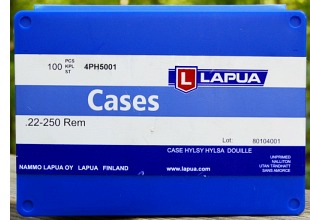
Editor’s Note: We originally ran this story in 2010. Since then we have had many reader inquiries about using .22-250 Lapua brass for a 6mm cartridge. Well our friend Robert Whitley worked hard on that concept a few years back, when Lapua .22-250 brass first became available. He came up with a nice 30°-shoulder wildcat that matches the accuracy of the best mid-sized 6mm cartridges. Read all about Whitley’s 6mm-250 Imp 30 below.
Our friend Robert Whitley of 6mmAR.com has come up with a new, accurate 6mm wildcat based on the new Lapua .22-250 brass that has just started arriving. Robert provides this report:
“I just received a box of the new Lapua .22-250 cases — beautiful brass! My real desire with it was to make it into a 6mm version, preferably something that was ‘no neck-turn’ with a .308 Win-type body taper that would work well in bolt gun and semi-auto magazines and would have a capacity to allow superior velocities. I considered the 6XC, but since you have to bring a whole lot of the shoulder of the brass up into the neck (when you re-form the brass from .22-250 to 6XC) that would necessitate neck-turning it because with Lapua brass the shoulder metal is thicker than neck metal of the brass.
I wanted a simple ‘neck it up and shoot it’ approach so I made up a 6mm-250 Improved 30 cartridge (i.e. 6mm-250 Improved with a 30 degree shoulder) and this thing works great — just neck up the brass, load it and shoot it! The case is like a 6XC with a .030″ longer body and a .030″ shorter neck, which works out fine if you are going to be shooting mainly the 105-108 gr bullets (which it will do very well shooting 2950 – 3000 fps). If you want to hot-rod things, which I do not, I am certain the case can push the 105-108 gr bullets a fair amount faster.
I set it up and throated the reamer for the Sierra 107s and the Berger or JLK 105 VLDs (i.e. a .090″ free bore on the reamer) and it works great with them. If I was going to use it with the Lapua 105s or the Berger 108s I would add about .025″ – .030″ to the freebore of the reamer (i.e. make the freebore around .115″ to .120″).
The great thing is you can use a 6XC die set for it without modification, and all you need to do is keep the dies about .030″ up off the shell holder from their normal position and use them as is. You can make a spacer washer about .030″ thick that you can put on and take off the 6XC dies and use the dies for both cartridges (i.e. 6XC and 6mm-250 Imp 30).
6mm-250 Imp 30 Shows Great Accuracy
Fire-forming loads are real accurate. Here is a 10-shot group I shot prone at 100 yards shooting fire-forming loads with it — the group is the size of a dime. For fire-forming I use a milder, but still very accurate load: 32.0 grains of N140 with a Sierra 107 and a BR2 primer. For fire-formed cases you can jump up to N160 (around 38-40 grains — depending on lot) and it will push the 105-108 gr bullets real accurately in the 2950-3000 fps range, with low ES and SD. This cartridge has a neck length of .268″ which is plenty long for a 6mm shooting bullets with varying bearing surface lengths. The reamer diagram (link below) leaves about a .003″ neck clearance over a loaded round, which seems to work out very well for a ‘no-turn neck’ set-up.
So there you have it … the 6mm-250 Imp 30 is simple, easy to make, accurate as all get out, there are available factory die sets you can use, and it uses great new Lapua brass — what’s not to like!”
Gear Report by Kip Staton Magpul jumped feet-first into the bolt-action precision rifle market by dropping a teaser video of their Hunter 700 chassis/stock system. Feast your eyes on this video that shows Magpul’s new chassis system in action:
The Hunter 700 (MSRP $259.95) is built around a ruggedly anodized aluminum bedding block, and utilizes a standard Magpul SGA cheek riser and spacers (from the shotgun line). It also features forward M-LOK slots, as well as multiple points to mount swivel studs and QD sockets. Weight is a svelte 2.9 pounds, and the system is compatible with factory Remington 700 bottom metal. And that’s not all.
By removing a spacer in the stock, end-users can convert the rifle to feed from the company’s new steel/polymer Bolt Action Magazine Well, which accepts standard AICS pattern magazines. MSRP for the conversion is an impressive $69.95, and that price even includes a mag. But — hold on — it gets even better (look at the photo carefully).
Yup. It feeds from PMAGs. New, AICS-compatible PMAGs. The PMAG-5 7.62 AC is a fully-featured polymer magazine, with an anti-tilt follower and MSRP of $34.95. Interestingly, the magazine holds five (5) rounds to comply with hunting regulations, but the follower features a trimmable, pre-scored stop that allows users to increase capacity by a single round for other purposes.
Magpul promises that this is just the beginning for their precision rifle accessory line, hinting at a larger-capacity PMAG-10 7.62 AC in the future, as well as other calibers. Anybody running AICS pattern mags (and that’s quite a few serious precision rifle guys) should be stoked about these new products.
About the Writer
Kip Staton is a freelance gun writer based in North Texas, and loves to blog about news within the firearms industry and his perceptions on marksmanship at KipStaton.com. He served as the weekend range manager of the North Texas Shooter’s Association from 2010-2012, at which point he began performing sales consultations for a major online firearms retailer. Currently, Kip is a content marketer, copywriter and digital strategist for an award-winning Dallas marketing agency.
To read more gear reviews by Kip, visit KipStaton.com.
Magnified Optic + Laser RF + Ballistics Computer. What if you could combine all that in a single, compact package. Impressive eh? Well Steiner-Optik (a Beretta-owned company), has done that. Steiner just announced its new “Intelligent” Combat Sight (ICS). The 6x40mm ICS, a true electro-optical aiming device, provides trajectory compensation by automatically calculating the point of aim based on ammunition ballistics, measured distance, and angle to the target out to 800 meters. The ICS combines a 6X optic with a laser rangefinder and a microprocessor-controlled ballistics solver.
Function Similar to Burris Eliminator
Steiner’s ICS is not the first integrated scope/LRF/ballistics calculator. The Burris Eliminator has been around for a few seasons, and it works much the same way. A laser senses the distance to the target, the required hold-over is calculated, and a red dot appears in the scope view. Put the dot on your target and pull the trigger. So Steiner isn’t bringing us something really new, it is just providing this technology in a smaller, ruggedized, waterproof package. (Steiner claims the ICS is waterproof down to 1 ATM – 10 m, which is actually pretty impressive.)
Ballistics Profiles for 7.62x51mm, 5.56x45mm, .300 BLK, .300 WinMag
While the magnification is optimized for the 7.62X51mm (.308 Win), the ICS’s internal ballistic calculator offers settings for other popular chamberings: 5.56x45mm, 300 Blackout, and .300 Win Mag.
The new ICS is easy to use according to Steiner VP Tom Frane: “Just feed the ICS your cartridge’s ballistic info and the scope’s computer and inclinometer instantly calculate perfect hold-over at your exact distance and gives you a bright red dot in seconds — all at the push of a button.” The 6x40mm ICS offers 120 MOA of total elevation. The illuminated reticle adjusts from dim to bright for daylight conditions. A Picatinny base on top of the ICS allows for the addition of a CQB sight, and there is a back-up iron sight on the right side of the unit.
It may be cold and wintry in Camp Perry, Ohio. But it’s warm inside — inside the Gary Anderson CMP Competition Center that is. And dozens of competitors will be there for the next three days (Jan. 16-18) at the Ninth Annual Camp Perry Open Air Gun Tournament.
The Camp Perry Open is one of the biggest mid-winter air gun events in the nation. This year’s match will include a three-position air rifle competition, a 60-shot standing air rifle event, a 60-shot Air Pistol event as well as a Clinic. The 3X20 plus final three-position air rifle competition will take place on Friday, 16 January 2015. A clinic for interested junior shooters will be held on Saturday afternoon. The 60-shot international events will be fired on Saturday and Sunday (January 17th and 18th).
Electronic Targets with Results Streamed Online
The Gary Anderson Center boasts state-of-the-art electronic targets that record scores the instant each shot is fired. Shot-by-shot feeds are then displayed online through as Live Target Images that can be viewed anywhere there is an Internet connection. CLICK HERE to See Live Target Feeds
How Electronic Targets Work
Each electronic target is equipped with four microphones — one in each corner of the target. As the pellet strikes the target, it generates a sound wave that propagates to the microphones. The sound waves are used to determine the shot location by calculating the amount of time it takes for the sound to reach the microphones. That’s physics so the results are precise — machine-calculated shot locations are accurate to one hundredth of a millimeter.
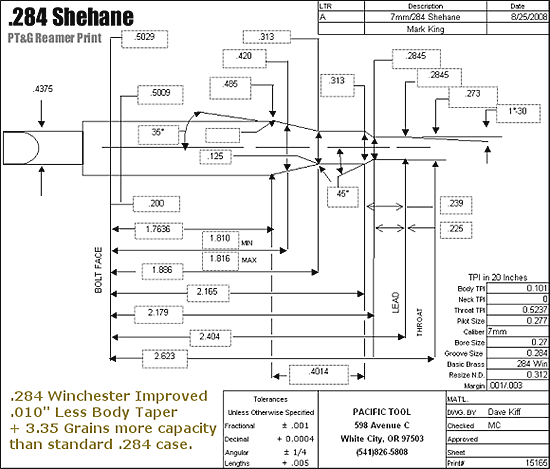
After we posted Erik Cortina’s video featuring the trimming of 7mm Shehane cartridges with a Giraud Power Trimmer, many of our readers asked: “What’s a 7mm Shehane? How does it differ from a standard .284 Winchester?” To answer that question, we’re reprising a “cartridge profile” we ran a couple seasons back. This talks about the qualities of the 7mm Shehane, and includes a reamer print. The 7mm Shehane is an excellent “upgrade” to the .284 Win. The added capacity may not seem like much, but it allows some Shehane shooters to reach a higher, optimal velocity node.
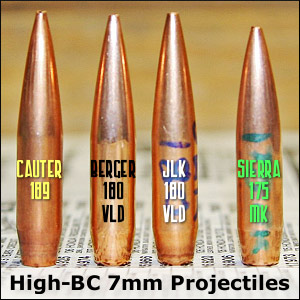
7mm is the caliber to beat in F-Class Open Division (though many guys are looking hard at the big 30s.) With a standard .284 Winchester, or better yet, a .284 Improved, you can drive the high-BC Berger 180gr bullets to competitive velocities. A .284 Improved will shoot well inside a 6.5-284, and you’ll probably get significantly longer barrel life (at least 1800 rounds vs. as little as 1200 for the 6.5mm).
The straight .284 Win is a good cartridge, but in most barrels, it can’t push the 180s at 2900-2950 fps velocity levels*. A lot of barrels will top out at about 2850. That’s where the .284 Shehane comes into play. The .284 Shehane is a slightly modified wildcat that retains the same 35° shoulder as the parent case. However, by blowing the sidewalls out 0.010″, the .284 Shehane picks up about 3.3 grains of extra case capacity. That enhancement makes a BIG difference. The extra boiler room is enough to drive the 180s at 2900-2950 fps with H4831sc. With N560 or Reloder 17 you can go even faster.
Scotland’s Grant Taylor used the .284 Shehane to finish 3rd overall in the 2009 individual F-Class World Championships at Bisley, England. Grant reports: “I have a .284 Shehane and it’s very accurate with superb vertical spreads at 1000 yards. I have to thank Jim Hardy for putting me onto the caliber, it has awesome accuracy. I’m getting 2930-2950 fps with spreads in the 3-5 fps range. I use Hodgdon H4831sc powder, CCI BR2 primers, and pointed 180gr Bergers.”
Forum member Jim Hardy has shot the .284 with great success. He tells us: “In my humble opinion, the .284 Shehane is the best balanced long range round there is — bar none. I (perhaps_ have shot more of this chambering than anyone else, and it has proven better than I ever expected. Here is why:
You have to shoot a 30 Cal magnum with a 240gr bullet to equal the performance of most 7mm chamberings with the 180 Berger VLD. With the .284 Shehane, you have a .308 bolt face, medium action, and Lapua brass. You use less powder than the 7 mags, and have great accuracy and ballistics even while fire-forming. The .284 Shehane shoots inside the 6.5 AND the straight 284, the 300 WSM, and the 300 Win Mag with less recoil. The .284 Shehane offers twice the competitive barrel life of the 6.5-284, an easy 2950 fps with H4831 SC, [and it] can run 3000+ with N560 and Reloder 17, which is right there with the 7mm WSM. What is not to love about the 284 Shehane? It is a no-brainer for long range — F-Class or Prone or 1000-yard Benchrest.”
*Some exceptional barrels chambered in straight .284 Win can reach 2900 fps with the 180s. Ryan Pierce, who recently set a 450-24X Pending F-Open record, has a 32″ Brux barrel that is delivering 2900 fps with the straight .284. However, Ryan acknowledges that his velocities are not typical: “A lot of .284 Win barrels top out at around 2850 fps with the 180s.”




 Over the past few years, interest in F-Class competition has grown dramatically. SHOT Show opens tomorrow, so we thought we’d reprise an interesting interview captured two years back. At the 2013 SHOT Show we had a chance to talk about F-TR competition with U.S. National F-TR Team members Mike Miller and Stan Pate, two of America’s top F-TR shooters. We are reprising this interview for readers who may have missed it the first time around. If you shoot F-TR (even if you’re a High Master), we think you’ll learn a few things from this interview.


 Our friend Robert Whitley of
 6mm-250 Imp 30 Shows Great Accuracy


 About the Writer


 7mm is the caliber to beat in F-Class Open Division (though many guys are looking hard at the big 30s.) With a standard .284 Winchester, or better yet, a .284 Improved, you can drive the high-BC Berger 180gr bullets to competitive velocities. A .284 Improved will shoot well inside a 6.5-284, and you’ll probably get significantly longer barrel life (at least 1800 rounds vs. as little as 1200 for the 6.5mm).