We first ran this article in 2012, and it was very well received. Since then, many Forum members have requested an explanation of MILS and mildots, so we decided to run this feature again…
In this NSSF Video, Ryan Cleckner, a former Sniper Instructor for the 1st Ranger Battalion, defines the term “MilliRadian” (Milrad) and explains how you can use a mildot-type scope to range the distance to your target. It’s pretty simple, once you understand the angular subtension for the reticle stadia dots/lines. Cleckner also explains how you can use the milrad-based reticle markings in your scope for elevation hold-overs and windage hold-offs.
Even if you normally shoot at known distances, the hold-off capability of milrad-reticle scopes can help you shoot more accurately in rapidly-changing wind conditions. And, when you must engage multiple targets quickly, you can use the reticle’s mil markings to move quickly from one target distance to another without having to spin your elevation turrets up and down.
WEB RESOURCES: If you want to learn more about using Milliradians and Mildot scopes, we suggest the excellent Mil-dot.com User Guide. This covers the basics you need to know, with clear illustrations. Also informative is The Truth about Mil Dots by Michael Haugen. Mr. Haugen begins with basic definitions: 1 radian = 2 PI; 1 Milliradian (Milrad or ‘Mil’) = 1/1000th of a radian; 1 Milliradian = .0573 degrees.
Earlier this year, CZ introduced a new .22 LR rifle for shooters looking for a PRS/NRL rimfire cross-trainer or a bolt gun for NRL22 competition. This new CZ 457 Long Range Precision (LRP) model features a 20″ fluted barrel with factory-installed muzzle brake. The stock adjusts for length-of-pull and has an adjustable cheekpiece. On top of the action is a +25 MOA Weaver-type rail so you have enough elevation to shoot out to 300 yards and beyond with most scopes. The single-stage trigger is also adjustable. MSRP is over $1200.00 but this rifle is now available for $899.99 at KYGunCo.com.
CZ factory video shows features of CZ 457 LRP:
The LRP’s target stock boast textured grip surfaces and a near-vertical pistol grip. The rear has a “hook” for positions where the shooter will use his non-shooting “off” hand to steady the rear of the rifle when the front is on a bag or support. The rear rail allows quick installation of monopod or bag-rider. There is a very fat, oversized bolt knob. A five-round magazine is standard with 10-rounders availalble.
The height of both the comb (cheekpiece) and buttpad are adjustable. Also the length-of-pull can be adjusted with the four included spacers (351-382 mm).
Trigger: Adjustable
Cheekpiece: Adjustable for Height
Buttpad: Adjustable for Height
LOP: Adjustable with Spacers
Stock: Beech with Soft-touch Finish
Muzzle Brake: Standard
Click Image to see full-screen photo of CZ 457 LRP
We created the above target a decade ago. Since then it has been used by tens of thousands of shooters. It has proven very popular as a load development target, since all your load data fits neatly in the boxes under each target. In fact this target is being employed by both rifle-makers and barrel-makers (including Criterion) to test their products. The target was designed for aiming efficiency. The diamonds have 1/2″ sides and you can align your reticle cross-hairs on the horizontal and vertical lines. It is a clean design that is easy to see even at 200 yards with a 20X scope. When we test, we usually crank in a little elevation, setting the point-of-impact higher, so that our shots fall in the gray circles. That way you leave the red diamonds intact for precise aiming. CLICK HERE to download Load Dev target.
We also use these two targets for load development and precision practice. The circle dot target can also be used for informal rimfire competition at 50 yards.
Right-Click Each Target to Download Printable PDFs.
How to Print Your Targets
Most of us have access to a printer at home or at work. That means you can print your own targets. You’ll find hundreds of free target designs online, including dozens of downloadable targets on our AccurateShooter.com Target Page. If you’re feeling creative, you can design your own target with a computer drawing program such as MS Paint.
Paper Stock Is Important
If you want your self-printed targets to show shots cleanly (and not rip when it gets windy), you should use quality paper stock. We recommend card stock — the kind of thick paper used for business cards. Card stock is available in both 65-lb and 110-lb weights in a variety of colors. We generally print black on white. But you might experiment with bright orange or yellow sheets. Forum Member ShootDots report: “They sell cardstock at Fed-Ex Kinko! I use either Orange or Yellow. That makes it easy to see the bullet holes clearly.” NOTE: Test before you use the 110-lb Cardstock. On some printers, with the heavier 110-lb card stock, you will need to have the paper exit through the rear for a straighter run.
Here are some Target-Printing Tips from our Forum members:
“Staples sells a 67-lb heavy stock that I have settled on. I use the light grey or light blue, either of these are easy on the eyes on bright days. I have used the 110-lb card stock as well and it works fine. It’s just a little easier to print the lighter stuff.” (JBarnwell)
“Cardstock, as mentioned, works great for showing bullet holes as it doesn’t tear or rip like the thin, lightweight 20-lb paper. I’ve never had a problem with cardstock feeding in the printer, just don’t stick too many sheets in there. If I need three targets, I load only three card stock sheets”. (MEMilanuk)
“20-lb bond works pretty well for me if I use a spray adhesive and stick the entire back of the paper’s surface to the backer board.” (Lapua40X)
At the request of our readers, we provide select “Deals of the Week”. Every Sunday afternoon or Monday morning we offer our Best Bargain selections. Here are some of the best deals on firearms, hardware, reloading components, optics, and shooting accessories. Be aware that sale prices are subject to change, and once clearance inventory is sold, it’s gone for good. You snooze you lose.
1. Sportsman’s Warehouse — Winchester .22 LR Wildcat, $219.99
⏺ Removable lower receiver, Picatinny rails, good trigger, great price
Here is a fun little semi-auto .22 LR rifle at a crazy low price — $219.99 at Sportsman’s Warehouse. The Winchester Wildcat takes Ruger 10/22 mags, and has some great features, such as field-removable lower receiver, ambidextrous controls, integral Picatinny rails and rear barrel access. Here’s a good video that shows this rifle in action. We think you’ll be impressed. It has a good trigger and shoots well. In many respect the Wildcat beats the Ruger 10/22 while costing considerably less.
The Wildcat comes with a Picatinny top rail for optics or electronic sights. A Picatinny rail on the forearm lets you attach an optional bipod, sling mount or other accessory. The lower receiver assembly is easily removed from the upper assembly by pushing a single button located at the rear of the upper assembly with your finger. No tools are required. The Wildcat accepts a wide range of aftermarket magazines that are compatible with the 10/22.
2. Natchez — Leupold Black Friday Optics Sale, Save up to 30%
⏺ Save Big on Regular and Blemished Leupold Scopes and Optics
The annual Black Friday Sale started early at Natchez Shooter’s Supplies with HUGE savings on regular and blemished Leupold scopes, rangefinders, spotting scopes, and binoculars. You can save 30% or more on blemished items, which still have full factory warranties. For example a “blem” Leupold SX-2 25-60x80mm HD spotter is now $769.99 marked down from $1099.99 — a 30% savings!
3. Sportsman’s Warehouse — AR-15 Rifles from $599.99
⏺ Get your Black Rifle now while you still can
Now that it looks like we will have a new President who has declared his clear intention of banning mag-fed, semi-auto rifles, maybe it’s time to get that AR-15 while you still can. While ARs are flying off the shelves right now, thankfully Sportsman’s Warehouse still has a large inventory of complete .223 Rem/5.56×45 AR-platform rifles in a variety of configurations. Prices start at $599.99.
4. Midsouth Shooters — RCBS Explorer 2 Reloading Kit, $359.99
⏺ Good starter kit, with nice press, powder measure and primer tool
With the shortage of factory ammo in many calibers, more folks than ever are turning to hand-loading. Here is a good RCBS Explorer 2 Kit that will get you started. Along with the Reloader Special 5 Press, you get an excellent Uniflow-III Powder Measure, a digital pocket scale, hand priming tool, Powder Funnel, fold-up hex key set, deburring tool, case loading block and spray case lube. And the kit even includes a Speer #15 Reloading manual, with loading procedures and load data.
5. Brownells — KRG Bravo Chassis Rem 700, $329.99 with Code
⏺ Versatile internal frame stock for PRS or hunting — tan, black, or green
The Kinetic Research Group (KRG) Rem 700 Bravo Chassis is a good dual-purpose choice for PRS and hunting. There is an internal aluminum frame with polymer exterior in Flat Dark Earth, Sako Green, or Black. The stock fits Rem 700 and Rem clone actions, accepts AICS-pattern mags, and is M-LOK compatible. The 2.9-lb KRG Bravo chassis features adjustable cheek riser and length-of-pull, built-in thumb shelf, plus quick-detach sling-swivel and bipod mounts. The KRG Bravo stock costs $349.99 at Brownells. You can also get $20 Off with Brownells code VTJ, lowering the net cost to $329.99.
6. Amazon — Teslong Borescope $39.99 or Rigid Version $79.99
⏺ Teslong borescopes are game-changers — true “must-have” tool
The Teslong digital borescope has been a huge success. This compact, electro-optical, cable-type borescope outputs sharp, high-resolution images and VIDEO to desktop computers and laptops, and many tablets. Check out our Full Teslong Review complete with inside-the-barrel videos. Get the basic version for $39.99 on Amazon or the rigid version Teslong Borescope for $79.99. If you scope your barrels often, you may prefer the rigid version which is easy to insert and rotate.
7. Sportsman’s Warehouse — RCBS Products on Sale
⏺ Great Prices on RCBS tools and products — but act soon
Take advantage of Black Friday early at Sportsman’s Warehouse. A wide selection of RCBS products is on sale now, with significant discounts. Save on presses, powder dispensers, case prep centers, dies, priming tools and more. But act fast — items are selling out quickly. For example the RCBS Rock Chucker press, discounted from $179.99 to $143.99 ($36 off) sold out early this morning.
8. Amazon — Frankford Arsenal Perfect Seat Priming Tool, $69.79
⏺ Precise Depth Control, 12 Shell Holders, Quick-Change, Carry Case
Seating primers to a consistent depth helps deliver enhanced accuracy and low ES/SD. However, most priming systems don’t allow precise depth control. If you’re looking for a priming tool that allows you to adjust primer seating depth, check out the Frankford Arsenal Perfect Seat Hand Primer. This tool comes in a protective case along with a full set of case holders and primer flip tray. A quick thumb release system allows you to switch from small to large primers quickly.
9. Precision Reloading — Bullet Sample Kits, $4.17 and Up
⏺ Good way to test bullets or get a few for your hunt
With these Barnes and Nosler Bullet sample kits, you can try a dozen bullets before you make a big investment. And for hunters, a 12-pack of bullets may be all you need for an annual deer hunt. Use our method to zero your hunting rig in 4 rounds, and you have 8 bullets left for game. Precision Reloading offers a variety of Barnes and Nosler Bullet 12-packs, starting at just $4.17. Calibers on sale include .204, .270, .284 (7mm), and .338.
10. Amazon — Howard Leight MAX Earplugs, $8.40/50 Pairs
20 Pairs
50 Pairs
⏺ Best NRR (33 dB), Very Comfortable, Great Value
These Howard Leight NRR 33 Max Plugs are your Editor’s favorite foam earplugs. Between shooting, motorcycling, and mowing lawns, I probably have Max plugs in my ears 2-3 days a week. This is a very good price for a bulk pack of 50 pairs. NRR 33 is the best Noise Reduction Rating you’ll find for plugs alone. And if you act soon, you can get free shipping to boot.
We support Hunters for the Hungry, a program that feeds needy families in the USA. Hunters for the Hungry (HFH) is a nationwide program that gives back to communities by supplying meals throughout the country. The NRA works closely with state agencies that supervise meat donations. Since the program’s inception, Hunters for the Hungry has brought millions of pounds of game meat to homeless shelters, soup kitchens, and food banks across the United States. This program has been in place for 27 years. In recent years, HFH affiliates donated 2.1 million pounds of meat on average, supplying over 10 million meals.
Hunt and Help Others
Many American hunters are able to harvest more than they can eat or share with friends and family. Through Hunters for the Hungry you can help share your bounty with those in need. All donated game must be field dressed and legally harvested. Note that each state has different rules and regulations for donations, please check with your local drop off location prior to donating.
Big Horn Armory Gives 5% of Sales Proceeds to Wyoming Hunters for the Hungry Program
To help support H4H efforts, Big Horn Armory has partnered with the Wyoming Wildlife Federation (WWF) for a special Pay it Forward H4H program. Throughout November 2020, five percent (5%) of all net proceeds from sales made from the Big Horn Armory website will be donated to the WWF’s H4H program. This donation will help offset the costs of processing donated game meat, which will be distributed to local food banks, pantries, and other food services within Wyoming.
“We are excited to partner with Big Horn Armory, a Wyoming company… to help bring healthy wild game to those in need. We cannot thank them enough for their support of this crucial program” commented Dwayne Meadows, executive director of WWF.
CMP COMPETITION RULES FOR 2020-2021 Are Now Available
CMP Rule Changes are now available as Addenda to 2020 Rules or as complete 2020-21 PDFs (links below). There were not a lot of changes that were approved for 2021. However, most notably, eyewear rules will be more strictly enforced. NOTE: When you open the downloadable PDF files linked below, you will see the new-for-2021 changes displayed in red underlined text. The changes made in 2020 are shown in black underlined text.
Story based on Report by Gary Anderson, DCM Emeritus
CMP Competition Rules for the 2021 competition season have now been approved by the CMP Rules Committee and are posted on the CPM Website. The 2020 competition season was severely impacted by the Covid-19 pandemic and many 2020 events were cancelled, so the CMP still has a substantial inventory of printed 2020 rulebooks. In addition [there were] only a small number of changes for 2021. As a result, the CMP decided not to publish new rulebooks for 2021. 2020 Rulebooks will continue to be used and Errata (Update) sheets are being provided for each rulebook. The rulebooks posted on the CMP website have been updated with 2021 changes are labeled as “2020-2021″ rulebooks. These Rulebooks posted on the CMP website include all 2021 changes. Use the links above to get the latest rules for each discipline.
How to UPDATE Your CMP Rules:
1. If you already have a 2020 rulebook, download the Changes/Updates for that rulebook and note in your 2020 rulebook where those changes apply. (Or use the links above).
2. If you keep your rulebooks on your computer, notebook or cell phone, or want to print your own rulebook, download the Updated 2020-2021 rulebooks from the CMP Website. (Or use the links above).
2020-2021 rulebooks include a diagram showing proper use of eye protection.
When reading the 2020-2021 editions of the rulebooks, note that 2020 rule changes are displayed in black underlined text. 2021 changes are displayed in red underlined text. Those changes do, however, include the addition of a new CMP Service Revolver Match in the Pistol Rules and the addition of F-Class and AR-Tactical Mid- and Long-Range Matches in the Highpower Rifle Rules. The CMP plans to offer competitions in both of these new disciplines in the 2021 National Matches. Another significant change, which has already been announced because it applies this year, is the authorization that competitors may fire a sixth EIC match in years like 2020 when the National Trophy Individual Match is not held.
The 2020 rule requiring Highpower Rifle and Pistol competitors to wear eye and hearing protection while on the firing line has been clarified and strengthened in the 2020-2021 rules.
MANDATORY EYE PROTECTION RULE
One of the most important 2020 rule changes was a requirement that Highpower rifle and pistol competitors must wear eye and hearing protection when they are on firing lines. A big majority of experienced, knowledgeable competitors now agree that protective eyewear is a must for Highpower rifle and pistol shooting, but unfortunately this safety precaution has not been as universally accepted. Incidents involving Highpower rifle and pistol shooting where eye injuries occurred or could have occurred are more common than many realize.
Non-Compliance Results in “No Exceptions” Eye Protection Standards
The CMP Board and staff have carefully evaluated the pros and cons of this safety requirement and have concluded that mandating the wearing of eye and hearing protection is a wise policy. After this rule was introduced, a vast majority of competitors complied with its letter and spirit. Unfortunately, there were a few competitors who did not comply. Some wore shooting glasses to the line and then lowered or removed them while firing. A really strange attempt to evade this rule involved cutting a hole in the part of the shooting glasses lens where the competitor looked while aiming. A few simply refused to comply.
After evaluating experiences with this new safety requirement in 2020, the CMP is taking these additional steps to facilitate compliance in 2021:
— Rule 3.6.2 (both Highpower Rifle and Pistol) has been clarified to clearly require that “two complete lenses” be worn in front of both eyes while firing. Obtaining shooting glasses or prescription eyewear that complies with the ANSI Z87.1 safety standard is “strongly recommended”.
— Pre-match safety briefings in 2021 will include specific instructions about the requirement to wear eye and hearing protection while on the firing line.
— Match officials will give warnings to any competitor who is not in compliance. Refusal to comply with a warning is grounds for disqualification.
— Match sponsors are advised that their match officials need to monitor and enforce this rule and that results from EIC or other matches where this rule was not enforced may not be accepted.
Whether you should from the bench, or from prone, it’s great to have your cartridges in a convenient, easy-to-reach position. This article explains how you can build your own height-adjustable ammo caddy for under ten bucks. Credit Martin Tardif for this great Do-It-Yourself (DIY) project. Martin’s flex-arm caddy design works great for F-Open competitors as well as anyone who shoots with a pedestal front rest, either on the ground or from a bench. The ammo caddy attaches, via a flexible arm, to your front rest. The flexy arm allows you to position your ammunition close to your rifle’s feeding port. That makes it easy to grab cartridges and load them into the chamber without shifting your shooting position.
Kudos to Martin Tardif for his clever use of inexpensive materials. The total cost of the whole project, according to Martin, was just $8.00!
Martin Explains How to Build the Ammo Caddy
Here are some pics of my DIY P.L.A.B. (Port Level Ammo Block). I cannibalized the goose neck from a Craftsman bendy-style utility light and bought a 3.5″x 1″ Acetal disk on eBay. I then drilled out the disk to accept twenty .284 Winchester rounds and screwed the disk to the bendy arm. The arm, by itself, wasn’t sturdy enough to support my fully loaded ammo block, so I inserted a 1/8″-diameter steel rod cut to length into the arm before I screwed it to the disk. On this Bald Eagle rest, I wasn’t using the windage adjustment cable. That allowed me to secure the bottom end of the arm to the unused 5/16″ x 18 bolt hole for the cable. [Editor’s Note: For other pedestal rest types/brands you may need to drill a hole for the base of the flexy arm.]
Rifleshooter.com built this tactical rifle (top image) with a Howa 1500 action, Shilen barrel, and MDT chassis. Below is a factory Howa 1500 Multi-Cam rifle.
Many of our readers are thinking of purchasing a Howa rifle or barreled action. These feature smooth-running actions with a good two-stage HACT trigger. But some folks have heard that it may be difficult to find stocks, or to fit an after-market barrel. That’s not true. There are many stock options available, and in this article, Bill of RifleShooter.com shows that it is easy to remove the factory-installed barrel with the right tools. We think a Howa makes a fine basis for a varmint rig or field rifle. Or you can build a tactical rifle as Bill did. You can start with the factory barrel and when you want/need more accuracy, then have a gunsmith install a custom barrel from Krieger, Shilen, or other quality brand.
What You Need to Know About Howa 1500-series Rifles
Tech Feature by RifleShooter.com
Consider this article the “Howa 1500 Overview”. AccurateShooter.com’s editor mentioned there’s been a lot of interest in Howa rifles and barreled actions imported by Legacy Sports International. In addition to being able to buy a complete rifle from a dealer, Brownells sells barreled actions in a wide variety of calibers and configurations. In this post we are going to take a look at the Howa 1500 series.
Howa Rifles — General Background
Howa is a Japanese heavy machinery company. One of its product lines are firearms, which, are imported into the United States of America by two different companies, Legacy Sports International and Weatherby. Legacy sells the 1500 under the manufacturers name while Weatherby re-brands the guns as the Weatherby Vanguard. In general, the finishes on the Weatherby rifles are more refined than the LSI-imported 1500s.
General Evaluation of Howa 1500 Rifles
I’ve found Howa 1500s to be solid, entry-level rifles that are capable of sub-MOA accuracy out of the box. I’ve actually purchased two Howa rifles I’ve tested because I like them so much. The gun below, a Howa Mini-Action in 7.62×39 Russian, is one of my favorite factory guns to shoot. I’m running a Tract Optics Toric on it, these are solid little rifle scopes that offer great performance for the money.
Check out this three-shot group I drilled at 100 yards with the rifle above and 125-grain Sierras. It took a lot of work and load development to get there, but when it did, it worked well.
Howa 1500 HACT 2-Stage Trigger
Howa 1500s feature the very nice Howa HACT trigger. This is an adjustable, two-stage trigger, set for about 3 pounds (combined stages). Crisp and repeatable, this is an excellent trigger for a factory gun. There is no annoying Glock-style safety lever in the middle of the trigger blade. The 2-stage design and pull weight range works well for a hunting rifle or a rig for PRS competition. Rifleshooter.com says the Howa trigger is “one of the best factory triggers, along with Tikka. I’ve found the Howa trigger superior to a Remington 700 — the Howas doesn’t need to be replaced.”
Writing for the Western Outdoor News, WONews.com, Steve Comus has field-tested the new HACT Trigger. Steve writes: “I always liked two-stage triggers, because of the way I could take-up the slack and then actually know when the rifle was going to go off. The take-up on the [HACT] trigger was fast and easy. The crisp, positive release when pressure was put on during the second stage [reminded me] of some of the target rifles I shot through the years.”
Howa Actions — Three Options
Howa offers three action lengths: Mini, Short, and Long. You can see the bolts for the three action lengths in the image below. The Mini-Action has similar external dimensions to the Remington Model Seven, however, the Mini-Action’s bolt does not travel as far to the rear. This is a mixed bag. The upside is you have a quicker action (shorter bolt throw). The downside is you are limited to shorter rounds such as the .223 Remington, 7.62×39mm Russian, and 6.5 Grendel. But if you need a bigger cartridge, just choose the standard or long action Howa variant.
Howa 1500 vs. Remington 700 — Important Differences
Is the Howa 1500 a Remington 700 clone, or some kind of improved Remington 700? No, not really. While the top radius of the Howa 1500 does match the Model 700, and they can both use the same two-piece scope bases, there are a number of differences.
If you look at the Howa 1500 alongside the Remington 700 you’ll note the M700 is a round action, while the Howa is a flat-bottom action. In many ways the Howa’s bottom half reminds me of a push-feed Winchester. This means the chassis and stocks that support a Howa 1500 are not V-block based like you’ll find on a 700, instead they have a flat bottom. While the bolt of the Howa is similar in external appearance to the Model 700, it does offer some improvements, notably an M16-style extractor and a firing pin assembly that can be easily removed without tools.
Howa 1500 action screws are metric and are in a different location from the 700. The Howa 1500 has an integral recoil lug that accepts the front action screw, this means you have more of the front action screw engaging the action. WARNING: If you install it into a poorly-fitted stock or action you may bind it.
Can a Howa Action Be Used for a Custom Rifle Project?
Absolutely! You can either buy a barreled action from Brownells and throw it in a chassis system/stock of your choice or you can use a stripped action to build a custom rifle. If you are in the chassis market, MDT offers a wide variety of chassis in different price ranges. All have worked well for me.
How to Remove Howa Factory Barrel from Action
You may have heard internet grumblings about removing Howa barrels. Some keyboard commandos say they are extremely difficult to remove without a relief cut. Well Bill at Rifleshooter.com demonstrates that Howa barrels can be removed without trouble, provided you have the right tools. Watch this video:
Watch Howa Barrel Removal Video — Quick and Easy (Click Speaker Icon for Audio)
Q: Is it difficult to remove a barrel from a Howa 1500?
A: Not very. I’ve heard from some smiths that worked on Howas (years ago) that the factory barrels are difficult to remove. However of the half dozen or so Howa barrels that I’ve pulled, they’ve been very easy. I use a Brownells action wrench with the top piece for a Rem Model 700 and the flat bottom resting against the flat on the wrench.
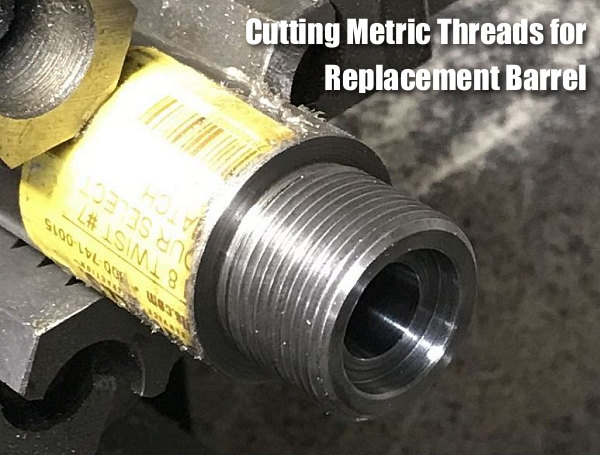
Howa Actions Require Metric Barrel Threads
It’s easy to thread a barrel for a Howa Action. You just have to cut metric threads — most lathes out there can cut them. I cut the threads below on a manual lathe using change gears. [Editor: John Whidden cuts metric tenon threads with a CNC lathe. “It’s easy,” John tells us, “No issue whatsoever.”]
Ruger Super GP100 Revolver in 9mm Luger (9x19mm)
Wouldn’t it be cool if you could shoot your 9mm semi-auto pistol ammo in an ultra-accurate revolver? Well you can. Ruger adapted its existing Super Redhawk frame to create the Super GP100 9mm Luger (9x19mm) revolver. As you can see, the Super GP100 9mm features a stubby 8-round PVD-coated cylinder to better fit the 9x19mm round. According to Guns.com the 9mm GP100 “uses a cylinder and extractor cut for moon clips to speed up reloading [and] sports a 6-inch half-lug sleeved and shrouded barrel with an 11-degree target crown[.]”
Watch this GunBlast video review to see how this unique Ruger 9x19mm wheelgun performs. Reviewer Boge Quinn said this a “competition grade gun” with nice fit and finish. Out of the box the Super GP100 9mm had a 9.5-lb double-action pull and a 4.5-lb single action trigger pull. It took a while for the pull to smooth out Quinn noted. Also, he said that if you do NOT use the supplied moon-clips it is awkward to remove the spent cartridges: “You don’t have to use a moon clip, but I don’t know why you wouldn’t… it just works great that way.”
The 9×19mm Parabellum (aka 9mm Luger) cartridge was introduced in 1902 by German weapons manufacturer Deutsche Waffen und Munitionsfabriken (DWM) for the Luger semi-auto pistol. Now 118 years later, Ruger brings us a sturdy, 6″-barrel revolver for this popular cartridge. Ruger adapted its existing Super Redhawk frame for this Super GP100 9mm revolver. In this video, Ruger engineer Mark Gurney explains the features of the Super GP100 9mm revolver:
Super GP100 9x19mm Features
1. Triple-locking cylinder locked into the frame at front, rear and bottom for more positive alignment and dependable operation.
2. High-strength stainless steel cylinder is fluted and shortened to reduce overall mass and increase rotational speed. Cylinder has PVD finish for durability and ease of extraction.
3. Polished and optimized internals, a centering boss on the trigger, and centering shims on hammer deliver a smooth double-action trigger pull with crisp/consistent let-off.
4. Cylinder and extractor are cut for moon clips to speed reloading during intense competition. Ships with three full moon clips and moon clip tool. The ejector and chamber mouths have a light chamfer to aid loading with moon clips.
5. Hogue hardwood grip is hand-finished for a smooth, polished feel. Grip frame accommodates a wide variety of custom grips.
6. Transfer bar mechanism provides security against accidental discharge.
7. Cold hammer-forged barrel has precise rifling for accuracy and longevity.
8. Barrel features 11° target crown for competitive-level accuracy.
Story by Lars Dalseide forNRAblog.
Back in 2012, the National Firearms Museum received a shipment from Sagamore Hill — the ancestral home of President Theodore Roosevelt. While Sagamore Hill undergoes renovation, the National Parks Service was kind enough to lend a portion of the estate’s collection to the NRA Museum. For quite some time, that collection was displayed at the NRA Museum as an exhibit named “Trappings of an Icon”.
“Basically it tells you about the life of Theodore Roosevelt,” explains Senior Curator Phil Schreier (in photo above in coat). “Hunter, Statesman, Soldier. In the first case we had two firearms from his hunting career. First an 1886 Winchester rifle known as the tennis match gun because he used winnings from a tennis match to purchase the gun.”
The second firearm on display was a suppressed Winchester model 1894 rifle. This was favorite of the President’s when clearing the grounds of the local, pesky critters. Schreier explains: “Archie Roosevelt wrote that his father liked to shoot varmints around Oyster Bay with this gun so he wouldn’t disturb the Tiffany and Du Pont families that lived near by.”
President Theodore Roosevelt was a strong supporter of marksmanship competitions. In fact President Theodore Roosevelt could be called a “founding father” of the NRA National Matches*. Teddy Roosevelt believed that, to assure peace, America needed to be prepared to fight. At the 2011 NRA National Championships, Dr. Joseph W. Westphal, Under Secretary of the U.S. Army, echoed the views of Roosevelt: “The first step in the direction of preparation to avert war, if possible, and to be fit for war, if it should come, is to teach men to shoot.”
Theodore Roosevelt also has a strong connection to the “President’s Match” fired every summer at Camp Perry. The President’s Match was patterned after an event for British Volunteers called the Queen’s Match started in 1860 by Queen Victoria and the NRA of Great Britain. The tradition of making a letter from the President of the United States the first prize began in 1904 when President Roosevelt personally wrote a letter of congratulations to the winner, Private Howard Gensch of the New Jersey National Guard.
*In February 1903, an amendment to the War Department Appropriations Bill established the National Board for the Promotion of Rifle Practice (NBPRP). This government advisory board became the predecessor to today’s Corporation for the Promotion of Rifle Practice and Firearms Safety, Inc. that now governs the Civilian Marksmanship Program (CMP). The 1903 legislation also established the National Matches, commissioned the National Trophy and provided funding to support the Matches. This historic legislation grew out of a desire to improve military marksmanship and national defense preparedness. President Theodore Roosevelt, Secretary of War Elihu Root and NRA President General Bird Spencer were among the most important supporters of this act.


 In this NSSF Video, Ryan Cleckner, a former Sniper Instructor for the 1st Ranger Battalion, defines the term “MilliRadian” (Milrad) and explains how you can use a mildot-type scope to range the distance to your target. It’s pretty simple, once you understand the angular subtension for the reticle stadia dots/lines. Cleckner also explains how you can use the milrad-based reticle markings in your scope for elevation hold-overs and windage hold-offs.


 How to Print Your Targets


 When reading the 2020-2021 editions of the rulebooks, note that 2020 rule changes are displayed in black underlined text. 2021 changes are displayed in red underlined text. Those changes do, however, include the addition of a new CMP Service Revolver Match in the Pistol Rules and the addition of F-Class and AR-Tactical Mid- and Long-Range Matches in the Highpower Rifle Rules. The CMP plans to offer competitions in both of these new disciplines in the 2021 National Matches. Another significant change, which has already been announced because it applies this year, is the authorization that competitors may fire a sixth EIC match in years like 2020 when the National Trophy Individual Match is not held.


 Howa 1500 HACT 2-Stage Trigger




 Story by Lars Dalseide for

 President Theodore Roosevelt was a strong supporter of marksmanship competitions. In fact President Theodore Roosevelt could be called a “founding father” of the NRA National Matches*. Teddy Roosevelt believed that, to assure peace, America needed to be prepared to fight. At the 2011 NRA National Championships, Dr. Joseph W. Westphal, Under Secretary of the U.S. Army, echoed the views of Roosevelt: “The first step in the direction of preparation to avert war, if possible, and to be fit for war, if it should come, is to teach men to shoot.”


