There is an informative article on the NRA’s American Hunter website regarding suppressor use for hunting. The article, What Hunters Need to Know About Suppressors, answers common questions about licensing, tax stamps, and suppressor types. The article explains the history of the $200 tax stamp which must be paid when acquiring a suppressor:
“Why the Tax? In 1934 … the federal government, while battling gangsters such as Al Capone, heavily restricted silencers with passage of the first National Firearms Act. Hoping to gain an advantage on criminals that often had better weapons than cops, the Feds placed a mandatory ‘sin’ tax on silencers that was so high it would effectively ban their purchase by all but the wealthiest individuals. In 1934, $200 was the equivalent of $3,500 today. The $200 tax still stands despite no evidence that a simple metal tube is capable of causing crime.” — American Hunter
The American Hunter article also discusses how well suppressors actually reduce noise. User should be aware that the sound level of a large, centerfire hunting cartridge will still exceed 130 decibels (dB) on average, even with a typical suppressor (silencer) in place. For that reason, we recommend that hunters continue to wear ear protection even when they shoot suppressed.
For example, Thunder Beast Arms says its latest Ultra 9 Suppressor will reduce the report of a .308 Win to 132-134 dB: “The ULTRA 9 will suppress a typical .308 bolt-action rifle down to approx. 132-134 dB. It also has very little or no ‘first round pop’ (FRP) in most applications.” NOTE: These dB levels are measured in accordance with MIL-STD-1474D using BK 2209 SLM offset one meter from muzzle.
How Loud Are Unsuppressed Rifles?
Firearms Are Loud — 140 dB to 175 dB. Audiology group ASHA explains: “Almost all firearms create noise that is over the 140-dB level. Exposure to noise greater than 140 dB can permanently damage hearing. A small .22-caliber rifle can produce noise around 140 dB, while big-bore rifles and pistols can produce sound over 175 dB. Firing guns in a place where sounds can reverberate, or bounce off walls and other structures, can make noises louder and increase the risk of hearing loss. Also, adding muzzle brakes or other modifications can make the firearm louder. People who do not wear hearing protection while shooting can suffer a severe hearing loss with as little as one shot[.] Audiologists see this often, especially during hunting season when hunters and bystanders may be exposed to rapid fire from big-bore rifles, shotguns, or pistols.” Source: ASHA, Recreational Firearm Noise Exposure.
How Much Does a Good Suppressor Really Reduce Firearm Sound Levels?
That depends on the rifle, the cartridge, and the effectiveness of the suppressor. The American Hunter article explains: “Suppressors retard the speed of propellant gases from the cartridge that rapidly expand and rush out of the barrel. It’s these gases that produce the loud boom that’s heard for miles. A suppressor’s series of internal baffles slows these gases so they are not all released at once, thereby muffling the sound.” Many good commercial suppressors can achieve 30-35 dB sound suppression. However, Zak Smith of Thunder Beast Arms says: “There are a bunch of manufacturers who publish values that are not reproducible, or use an ad-hoc test instead of a mil-spec test. In many cases we’ve tested the exact same suppressors they’ve advertised with 30-40 dB reductions and found they are actually in the high 20s instead.”
Again, for this reason, we recommend that hunters use ear protection, such as electronic muffs, even when shooting suppressed.
Choosing a Suppressor for Hunting Use
The American Hunter article explains that there are many types of suppressors on the market. Bigger suppressors are heavier, but they normally are more effective. You also have a choice in muzzle attachments:
“For most hunting applications, direct thread is the best choice. If you intend to buy only one suppressor yet you have multiple guns, it’s advantageous to buy a model sized and rated for the largest caliber you intend to use. While a suppressor made specifically for a .223 Rem. will reduce the sound of that round slightly better than a model made for .30 caliber, for example, you can use a .30-caliber can for smaller calibers — but not vice-versa. In general, the bigger the can, the more it reduces sound. Smaller suppressors, however, are easier to carry in the woods.” — American Hunter
States Where Suppressor Ownership is Allowed
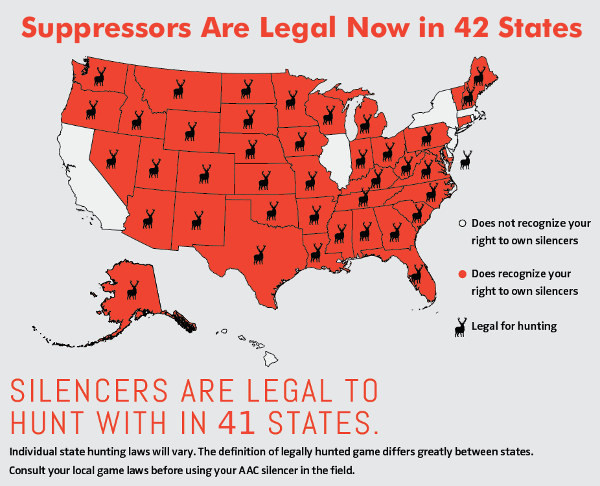
Currently, the following 42 states allow private ownership of suppressors: AL, AK, AZ, AR, CO, CT, FL, GA, ID, IN, IA, KS, KY, LA, ME, MD, MI, MN, MS, MO, MT, NE, NV, NH, NM, NC, ND, OH, OK, OR, PA, SC, SD, TN, TX, UT, VT, VA, WA, WV, WI, WY. NOTE: Suppressors are legal in Connecticut, but hunting with silencers is not allowed in Connecticut.
How to Apply for a Suppressor
To acquire a quality suppressor, you’ll first need to shop around, comparing verified performance. Unfortunately some manufacturer’s dB claims are exaggerated. Give due consideration to size, weight, and durability. When you’ve selected a brand and model, find a Class 3 dealer authorized by the ATF to sell suppressors. You must fill out ATF Form 4, get fingerprinted, and pass a background check. Along with two completed copies of Form 4, submit your fingerprint card, passport photo and a check for $200 to the ATF. Then you wait for the ATF to process your application. American Hunter says the average ATF suppressor processing wait time is now nine months.
BENEFITS OF SILENCERS
NOISE REDUCTION
According to OSHA, the threshold for a hearing safe impulse noise is 140 dB. Without hearing protection, exposure to any impulse noise over 140 dB causes varying degrees of permanent noise-induced hearing loss, which can also lead to tinnitus. Most well-engineered silencers take the dB level of their host firearm well below 140 dB, making those silencers effective primary hearing safety devices. You should always still wear hearing protection (muffs or plugs) when using suppressors.
RECOIL REDUCTION
By containing the explosion at the muzzle, suppressors significantly reduce perceived recoil energy, reduce the rifle’s rearward movement on recoil, and reduce rifle torquing and muzzle flip. The reduction of recoil (and rifle torquing/hopping) lessens shooter fatigue and helps the shooter get his sight picture back on target rapidly after firing. With smaller calibers, a suppressor may enable the shooter to maintain a nearly-continuous sight picture, following the shot into the target. In addition, by reducing felt recoil (and muzzle blast), a suppressor can help inexperienced shooters avoid flinching.
At the request of our readers, we provide select “Deals of the Week”. Every Sunday afternoon or Monday morning we offer our Best Bargain selections. Here are some of the best deals on firearms, hardware, reloading components, optics, and shooting accessories. Be aware that sale prices are subject to change, and once clearance inventory is sold, it’s gone for good. You snooze you lose.
NOTE: All listed products are for sale to persons 18 years of age or older. No products are intended for use by minors.
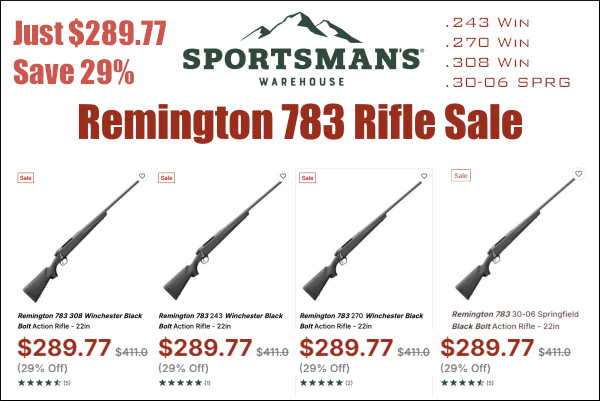
1. Sportsman’s WH — Rem 783 Rifle (Many Calibers), $289.77
⏺️ » Good quality hunting rifles under $300!
It’s hunting season. Here’s an amazing deal on a good Remington hunting rig. The Remington 783 rifle is available in a variety of popular chamberings for just $289.77 at Sportsman’s Warehouse. This modern rifle has a pillar-bedded action, free-floating button-rifled barrel, steel detachable magazine, and modern polymer stock. There are both 22″ and 20″ barrel options. The Rem 783 features Remington’s new user-adjustable Cross Fire trigger system.
2. Precision Reloading — FREE Hazmat On Purchases of $199+
⏺️ » Save $30-$45 with FREE Hazmat through 10/2/2025
When you purchase powder and/or primers, you normally must may the vendor a Hazmat fee of up to $45 per order. But right now Precision Reloading is offering FREE Hazmat on Powder and/or Primer Orders of $199 or More. To get FREE Hazmat use Coupon Code FREEHAZ at checkout. That can save you $30-$45 compared to other online retailers.
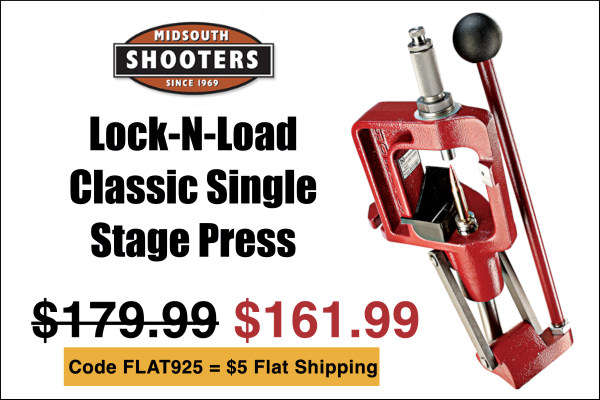
3. Midsouth — Hornady LNL Classic Press, $161.99
⏺️ » Good, strong single-stage press $38 less than elsewhere
The Hornady Lock-N-Load Classic Single-Stage Press is a very good press for loading pistol and rifle rounds. The Lock-N-Load Classic has a strong solid cast frame. The frame front is angled, allowing easier placement and recovery of cartridges. This press also works with Hornady’s Quick Change bushing system to allow rapid die changes. An optional Primer Feed tube system that holds up to 70 primers is available. NOTE: Midsouth is selling this press for just $161.99 — a great deal. This same press sells for $199.97 elsewhere.
4. Midsouth — ELEY .22 LR Rimfire Ammo Sale
⏺️ » Ultra high-quality .22 LR rimfire ammo with big discounts
ELEY .22 LR Rimfire Ammunition is favored by top rimfire shooters in multiple disciplines — Silhouette, Benchrest, Smallbore 3P/Prone, Field Target, NRL22 tactical, Steel Challenge, Biathlon, and Pistol. ELEY offers a wide range of ammo types starting at about $7.40 per box. Right now Midsouth has 14 types of ELEY rimfire ammo on sale including: Target, Ultra, TENEX EPS, Club, Match, Team, Semi-Auto BR Precision, High Velocity, Benchrest Outlaw, Bullseye, Subsonic, TENEX Pistol and more.
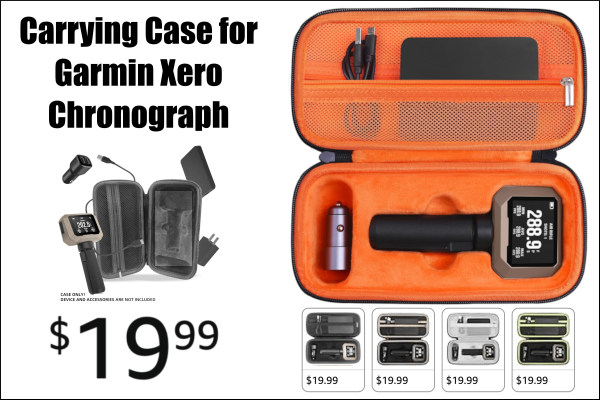
5. Amazon — Carry Case for Garmin Xero C1 Chronograph, $19.99
⏺️ » Handy, quality case for popular Garmin Radar Chronograph
This handy carry case is designed specifically for the Garmin Xero C1 Pro Chronograph. The nicely-padded, waster-resistant case holds the chrono mounted on its tripod, with a zippered compartment above for power cords and accessories. Three different inside colors are offered: Orange (as shown), Black, and Gray. And there are two other black interior versions with contrasting tan or green highlights. This kind of case is a “must-have” for transporting your $599 Garmin Chrono. There is also a smaller $9.99 Garmin Compact Travel Case that just holds the unit and a cord (not the power adapter). Both large and small cases provide protection from scratches, impacts, and everyday wear and tear.
6. Graf & Sons — Hornady Ammo Sale
⏺️ » Large selection of hunting and target ammo at good prices
Graf & Sons is currently running a major sale on Hornady Ammunition for both hunting and target shooting. Hornady Superformance ammo features polymer-tipped Hornady NTX bullets which are accurate and very effective on big game. Hornady’s Superformance ammo works in all action types, including semi‑autos. Along with Superformance ammo, many other ammo types are on sale, including .17 HMR rimfire.
7. Midsouth — Frankford Arsenal Perfect Primer Seater, $62.11
⏺️ » Excellent Primer Seating Tool with very positive user reviews
Amazon has the Frankford Perfect Primer Seater Tool for $62.11 (22% Off). This is a GREAT primer seating tool. It has good feel, plenty of leverage, and the primer tray works well. Importantly, it has a click-adjust wheel for precise primer seating depth control. Read our Frankford Primer Seating Tool Product Review. The tool comes complete with 12 precision shell holders. A quick thumb release system allows you to switch from small to large primers easily. Plus there is a hard stop so you won’t over-crush a primer.
8. Natchez — Federal .223 Rem, 500 Rounds, $199.99
⏺️ » Get 500rds of good .223 Rem ammo for just 40 cents each
Here’s great deal on quality Federal .223 Rem 55gr FMJ American Eagle Ammunition. A 500-round pack is now just $199.99, which works out to just 40 cents per round. American Eagle rifle ammunition offers consistent, accurate, affordable performance for the range. The loads feature quality bullets, reloadable brass cases and dependable primers.
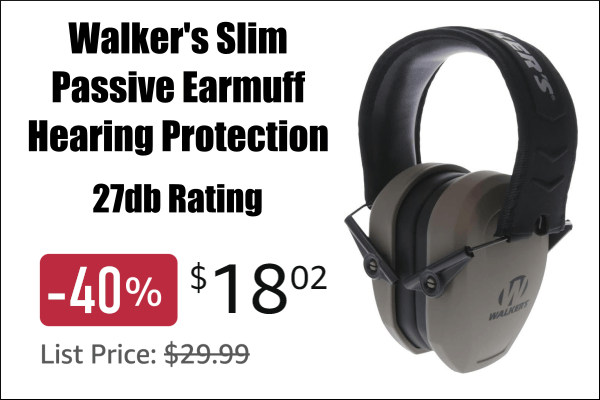
Designed for the smaller heads of youth and women shooters, these Walker’s Slim Passive Earmuffs (#ad) feature a slim profile for comfort and convenience. Lightweight, foldable, and adjustable, these earmuffs are well-suited for female and younger shooters. The $18.02 price is a fantastic deal on good muffs with impressive 27dB Noise Reduction Rating (NRR). These are available in a variety of colors, including Flat Dark Earth (FDE) or Black for $18.02, Olive Green for $18.97, Coral for $20.16, and Teal for $22.53.
As an Amazon affiliate, this site can earn revenues through sales commissions.
You can spend thousands on a rifle, but that expensive hardware won’t perform at its best if you have poor trigger technique. One key element of precision shooting is trigger control. Our friend Kirsten Joy Weiss has produced a good video that shows how to refine your trigger technique for better accuracy. In this video, Kirsten talks about the actual placement of a shooter’s index finger on the trigger. It is important to have the finger positioned optimally. Otherwise you can pull the shot slightly left or slightly right.
Kirsten tells us: “Finger placement on the trigger might not seem like a big deal, but it actually is. The reason for this is because, depending on where your index finger is placed on the trigger, [this] translates to different muscle interactions with the gun.” Watch this video to see Kirsten demonstrate proper finger placement (and explain problems caused by improper finger positioning).
When you pull the trigger, you only want to engage the last section of your finger, in order to avoid unwanted muscle engagement and to achieve a smooth shot. Remember there is a “sweet spot” between the crease (first joint) and the tip of the finger. If you position the trigger in that “sweet spot”, you should see an increase in your accuracy. Don’t make the mistake of putting the trigger in the crease of your finger, as shown below.
Effects of Incorrect Finger Placements
You want to place the trigger shoe between the end of your finger and the first joint. If you place the trigger on the very tip of you finger you’ll tend to push the rear of the rifle to the left when engaging the trigger, causing shots to go right (for a right-handed shooter). On the other hand, if you put the trigger in the crease (first joint), you’ll tend to bring the rear of the rifle to the right, causing shots to fall left. This is illustrated below for a right-handed shooter.
For hunters in a tree stand, SFC McPhail recommends a position with your weakside leg pulled up and firmly braced on the front rail of the treestand. You can then rest your support arm on your leg. This provides a rock-solid position when shooting from a stand.
Team USA Olympian and ISSF World Cup Winner SFC Michael McPhail is one of the world’s best smallbore rifle shooters. He is also an avid hunter, who enjoys harvesting game with centerfire rifles. In a USAMU video, McPhail shows how competition shooting positions can be adapted for hunters. McPhail shows how well-established positions can provide a more stable platform for hunters in the field. That can help ensure a successful hunt. McPhail demonstrates three positions: kneeling, supported prone, and sitting in a tree-stand.
Watch SFC McPhail Demonstrate Positions for Hunters (Good Video):
McPhail first demonstrates the kneeling position. Michael notes: “I like kneeling. It’s a little bit of an under-utilized position, but it’s almost as stable as prone. It allows you get up off the ground a little bit higher to [compensate for] vegetation. For kneeling start by taking your non-dominant foot and put that towards the target, while at the same time dropping down to a knee on the dominant leg. At the same time … wrap the sling around wrist and fore-arm, lean slightly into the target and take the shot.”
McPhail shows a nice “field expedient” use of your backpack. He shows how the basic prone position can be adapted, using the pack as a front rifle support. McPhail recommends pulling your dominant (strongside) leg forward, bent at the knee. According to Michael, this takes pressure off the abdomen, helps minimizes heart beat effects, and helps with breathing.
Hunting season is here. We know that many hunters would like to carry less weight in the field, but still want an accurate and rugged rifle. In our Shooters’ Forum, there’s an interesting thread about a very light hunting rifle. Featuring a Defiance ultra-light all-steel action, this 6.5×57 Lapua lightweight tips the scales at just 4.93 pounds including scope and rings! For reference, a half-gallon of milk weighs 4.3 pounds, so this rifle is LIGHT! Here’s a report from the proud owner who built the rifle for a future Kodiak Island Alaska mountain goat hunt.
Ultralight Rifle Report by Forum Member Dave
I decided I wanted the challenge of a Mountain Goat hunt after I turn 60. It was the perfect excuse to put together an ultralight, something I had wanted to do for years. I wanted to see how light a bolt action rifle could actually be. My goal was to stay under 5 pounds, without going to a Titanium action, including rings and scope. I knew this would be difficult but I did manage to achieve the goal.
I started with a Defiance anTi model Rem Model 7 short action. This is an extremely smooth action that weighs just 19.2 ounces in this size. I had Carson Lilja of Lilja Barrels program a barrel taper to my dimensions for a 6.5mm 1:8″-twist stainless, 3-groove 22″ barrel. As fitted in the rifle, the barrel is free-floated except for the first inch or so forward of the action.
Other rifle components are: Bix n Andy Dakota trigger, aluminum trigger guard, blind magazine with an aluminum follower, titanium action screws, and a Leupold 3-9X lightweight optic in Talley rings. I also had an aluminum adapter installed in the for-end to accept a magnetic mount Javelin carbon fiber bipod.
The rifle was chambered up in 6.5×47 Lapua by my friends at Sportsman’s Outfitters in Knox, Pennsylvania. Then I sent the barreled action to Wayne at Oregunsmithing (Pendleton, OR) to have a Kevlar stock built. The stock weighs a whopping 14 ounces! When it came back I had everything Cerakoted (see bottom photo before coating). This stock was a full custom, built around my barreled action. Wayne’s work was reasonably priced with a 3-month turn around.
Excellent Accuracy — 5/8″ Three-Shot Groups at 100 Yards
Now it was time to shoot the rifle and I was not disappointed. It shoots both Barnes TTSX 100s or Swift Scirocco II 130s into 5/8″ at 100 yards. Off a bipod at 400 yards, three go into 3″ or so. This thing is crazy light even though it wears a 22″ barrel.
Without scope and rings, before Cerakoting the action and barrel, this 6.5×47 rifle tipped the scales at a mere 4.20 pounds (67.2 ounces). Check it out:
KEY FEATURES: Ballistics Solver, GPS Tagging, Weather Forecast, Field Notes with Photos
ZEISS offers a FREE mobile Hunting APP for both Apple and Android systems. The ZEISS Hunting App offers many practical functions: full-featured ballistics calculator, field notes with photo archive, compass function, GPS tagging for documentation of hunting experiences, and a detailed weather forecast service. The Hunting App is offered as a FREE download for Android and iOS (iPhone/iPad) mobile devices.
Hunt Log and Photos
The Field Notes function can do many things. You can log all your shots and hits, and you can plot game sightings during the hunt. Events can be augmented with photos and GPS data. With the Field Notes mapping function, you can even locate game populations in the hunting territory. A compass and automatic night mode round off the list of smart features.
NOTE: The rifle featured in this story was built for an Alaska Mountain Goat Hunt. The ZEISS Hunting App can provide info by species type, including deer, elk, and yes, Mountain Goats.
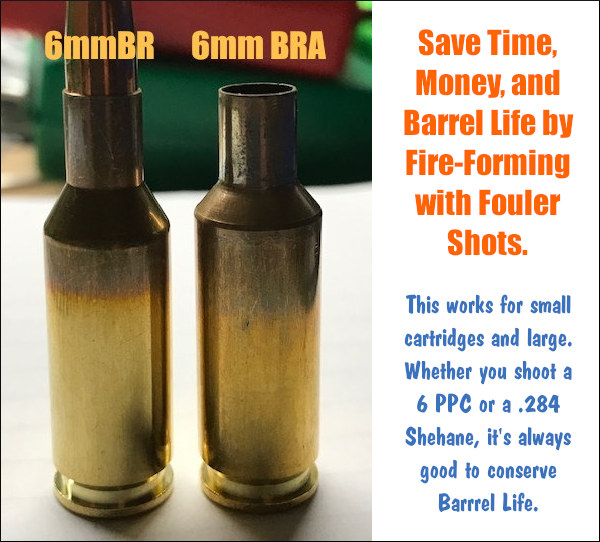
Here’s a tip for guys who shoot the 6 PPC, 6 Dasher, 6 BRA, .284 Shehane, or other wildcat cartridges that require fire-forming. Use your fouler shots to fire-form new cases. That way your fouler shots do “double-duty” and you get your brass fire-formed without putting extra rounds through your expensive barrel.
This procedure is recommended by Joel Kendrick, the 2004 IBS 600-yard Shooter of the Year. After he cleans his barrel, Joel knows it takes two or three shots to foul in the bore before accuracy returns. When shooting his PPC, Joel uses those fouler shots to fire-form his new brass. Joel explains: “I like to have relatively new brass always ready. By fire-forming a couple cases after each barrel-cleaning during a match, by the end of the weekend I’ve got a dozen or more freshly fire-formed cases to put into the rotation. If you do this with your fouler shots you get your fire-forming accomplished without using up any extra barrel life.”
This not only saves barrel wear, but it saves you trips to the range for the purpose of fire-forming. We thank Joel for this smart suggestion. For those who do not have a dedicated barrel for fire-forming, this should help keep your round-count down. Note: With this fouler fire-forming routine, you should ALWAYS do the fire-forming with the SAME POWDER you load for your match ammo. Joel currently works as the Supplier Quality Process Engineer for MMI-TruTec, a company that offers barrel surface coatings that can further extend your barrel life.
PMA Tool offers lightweight yet sturdy cleaning cradles that are handy, affordable, and easy to transport. PMA’s popular single-gun cradle, priced at $119.95, is ideal for benchrest and F-Class rigs. It measures about 17″ in length and weighs about one pound. You can choose among 2.25″, 3″, 4″, 5″, and 6″-wide saddles (U-shaped padded supports) to match your forearm width.
PMA also offers an excellent double cradles for $174.95. These twin cradles have 2.5″, 3″, or 4″ saddles, or a combo of 3″ / 2.25″ front saddles. All these cradle types secure your rifle(s) in a muzzle-down position that allows easy cleaning and prevents solvents from running back into the action. The front saddles and all contact surfaces are covered by thick silicone rubber padding which grips the rifle securely yet protects the stock and components from scratches.
These cradles are most commonly sold with a 3″-wide front saddle for Benchrest and F-Open style stocks, or a 2.25″-wide front saddle for rifles with narrower fore-ends such as those found on F-TR, Hunter Class, and varmint stocks. In addition, you can get 4″-wide cradle for the big, long range benchrest rifles.
Double Rifle Cradle is a Smart, Versatile Design
PMA’s double rifle cleaning cradle was was designed from the ground up to work perfectly for two rifles side-by-side. Using the same tie bar and protective saddles found on the single cradel, PMA widened the base and created new uprights to support the saddles, making the cradle as narrow and light as possible, while retaining all the protective and non-slip features from our single unit.
This PMA Tool double cradle unit is available with twin 3″ front saddles, double 2.5″ front saddles or combination 3″ / 2.25″ front saddle configurations to accommodate different classes of benchrest rifles.
Today — September 27, 2025 — is National Hunting and Fishing Day (NHFD). We’re proud to recognize how important hunting is for millions of Americans — as a source of food for families and as an important connection with nature and the outdoors. The NFHD website has helpful resources for hunters, and in this article we provide links for Where to Hunt, How to get Hunting Licenses, and Hunter Education.
NHFD was first established by President Nixon in 1972. According to NationalToday.com, NHFD’s “roots go back more than 100 years to President Theodore Roosevelt, who introduced the first laws regulating the hunting of wildlife in the United States.”
This month we hope some of our readers can take new shooters afield and introduce them to hunting. Many hunters receive their first introduction to hunting from family or friends as a tradition passed down from generation to generation. There are over 9.2 million hunters in the United States.
To have a successful hunt you must first get to areas where game thrives. Finding the right places to hunt is essential. The NSSF offers a nationwide Where-to-Hunt database of hunting areas. You can click on a particular state, then specify the specicies you wish to hunt. This is a very useful resource.
In most states, when hunting game animals, you’ll need a hunting license and/or zone permit. The Federal Fish & Wildlife Service has state-by-state listing for hunting licenses on FWS.gov. Click the box below to learn how to get hunting licenses in your region.
For all hunters, whether they have mentors to guide them or not, the most important first step into the woods begins with a state-certified hunter education course. Click the box below to see hunting education opportunities around the nation.
Game Resources — To learn more about different game species, click these NSSF links:
To help you prepare for a fall hunt, here is a free, printable Deer Practice target. Hone your skills on a trio of bucks with a red bullseye centered on the animals. You can print the targets in black and white, but they look best in color. Right-click the image below to download a FREE printable target PDF file.
Hunting season has started in many parts of the country. And today, Saturday, September 27, 2025, is National Hunting and Fishing Day. Every year, this event is held on the 4th Saturday of September. First recognized by President Nixon in 1972, this is now the 52nd year the event has been celebrated across the USA. To help mark this day, we are offering six informative videos for hunters. These cover planning your hunt, selecting good optics, and optimizing your rifle.
This video and related article offer good basic advice for sighting-in a hunting rifle. There are a series of six points covered. Here’s Tip #1: “Find a safe place to shoot your rifle with a backstop. If possible, use a bench and a rock-solid shooting rest. Sighting-in is all about consistency, so the less human error you have, the better. For safety, be sure to also bring ear and eye protection.” READ FULL ARTICLE on NRAWomen.com.
Prepare For Your Hunt — Get Fit and Practice Positions
As part of the NRA’s Tips & Tactics video series, Kristy Titus explains how to prepare for a hunt. Titus, co-host of the Team Elk TV show has hunted around the globe. She grew up in the outdoors, running pack mules in Oregon with her father. In this video, Kristy discusses fitness training and demonstrates field positions that can be employed during a hunt.
Kristy explains: “Hunting can lead you into some steep, rough country. It’s really important that you train both your body and your mind to handle the elements and the rigors of hunting So, if you plan on going on a mountain hunt, get out and train your body. Train with your firearm. Get off the bench and have some fun with this. Do some positional shooting or, if you want to add a stress dynamic… have someone put you under a time parameter.”
Elk Hunting — Great North American Adventures
A North American elk hunt represents the adventure of a lifetime for many. Before heading out on an elk hunt, you want to maximize your chances of success by having the right equipment, and by doing your homework before the hunt. This National Shooting Sport Foundation (NSSF) video offers good advice on planning your first elk hunt.
Success! Elk hunt photo from West Canyon Ranch, a private hunting ranch in Utah.
Photo courtesy Rocky Mountain Elk Foundation (RMEF).
Deer Hunting in Norway’s Fjord Mountains
Here’s a video with some truly stunning scenery. Watching this video is like taking a virtual vacation to Norway, where you can explore the scenic mountains in the Fjord region. Forum member Kenneth Skorpen (aka “Sal”) has created a cool video of a deer-hunting trip he took in Norway. He didn’t bag a buck on this trip, but the walk in the Fjordland mountains took Kenneth through some spectacular scenery. (At the 11:25 time mark you’ll see an amazing sunset over the Fjord.)
Kenneth did encounter a doe that had fallen down the mountain, and apparently broken its neck (14:35 time mark). The terrain is very steep, and Kenneth observed that: “I feel fortunate to be able to do this, but I also feel very tired in my legs. Did you know that the hares around here have shorter left legs due to the steep hills?”
Load Development for .308 Win Hunting Rifle
In this video, F-Class ace Keith Glasscock shows load development with a .308 Winchester hunting rifle. Here Keith uses a large X-type sandbag for a front support. He is shooting a Remington 700 bolt-action rifle, with Barnes TSX solid copper bullets, PPU Brass, Federal 210m primers, and AR Comp powder. Keith said the Barnes bullets were excellent — he commented that these bullets were “match quality in terms of precision”. Keith achieved some very small three-shot groups with AR Comp and the TSX projectiles. Keith did note that point-of-impact shifted up significantly with increases in charge weight (see 6:20-7:10). With thinner-contour hunting barrels, this is not unexpected. But POI change should be observed carefully during load development, as you may need to adjust your zero after completing testing.
Hunting season is here. For many of us, Fall hunting season involves liberating a rifle that sits in a safe most of the year, grabbing a box of cartridges, and heading to the wilds. But this “once a year thing” carries with it potential risks.
It is all to easy to grab some rounds that may look right, but which are, in fact, a slightly different chambering. Likewise it is possible some hunting rounds got put in the wrong box after last year’s hunting trip. Be very careful when you get ready for a hunting trip — check the headstamp, cartridge dimensions, and bullet diameter of all your rounds. If you make an ammo selection mistake, the consequences can be disasterous, as this story reveals.
The .223 WSSM and 6mmBR Disaster Report by Dr. Jim Clary
Under most circumstances, shooters don’t have to worry about chambering the wrong cartridge into the wrong rifle. After all, the cartridges are well marked and we all know which rifle we are shooting on any given day. In many cases, incorrect cartridges cannot be chambered — larger cases will not fit in smaller chambers, for example. No problem! That being said, I can tell you that even an experienced, careful and normally safe shooter can make a mistake.
The following is an account of just such a mistake that could have resulted in death or dismemberment. Fortunately, the shooter was not hurt, but the rifle was completely destroyed.
Last year, a friend purchased a Savage Precision right bolt, left port, single shot bolt action in 6mmBR Norma. It was an incredible prairie dog gun and he spent the summer burning powder and busting dogs. In October, he purchased a stainless steel Browning A-Bolt Varmint in .223 WSSM. The weather in the upper Midwest turned sour by the time he got the brass tuned up and he only got to fire it a few times before he was “socked in” for the winter. Thus, he spent his evenings loading ammo for the spring thaw.
During a break in the weather, he grabbed both rifles and a couple of bags of .223 WSSM and 6mmBR cartridges and headed to the range to check out his new loads. In case you are not familiar, the 6mmBR is smaller in diameter and a mite shorter than the .223 WSSM. Because of this, it will chamber in a .223 WSSM, but the .243 caliber (6mm) bullet is too big for the .22 caliber bore. That is what happened to my friend.
The rest is history — when he squeezed the trigger, all hell broke loose. The entire bottom of the rifle blew out, including the magazine assembly. The explosion actually cut the stock into two pieces. However, the bolt held and amazing as it may seem, the .243 bullet was “swaged” right out of the .223 barrel.
6mmBR (left) and .223 WSSM (right) cartridges above the remains of Browning A-Bolt rifle.
One Small Mistake Is All It Takes
Now, realize that my friend has been shooting all manner of firearms, safely, for over half a century. He is meticulous, thorough and conscientious in his approach to reloading and shooting. However, he made one mistake. He put some lose 6BR cartridges in a baggie as he packed up from a prairie dog hunt last summer, without noticing that the baggie was marked .223 WSSM in black marker. Then, when the break in his winter weather came, he grabbed the bag, believing it to be the WSSM cartridges and didn’t check the head stamp.
Couldn’t happen to you? How many times have we emptied our pockets of cartridges and dropped them into a plastic container on the shooting bench? How many times have we set down to a marathon reloading session, loading several calibers in a row? How many times have we put the wrong bullets, cases or primers into the incorrect container? My point is that even the safest of us can make a mistake. So, look at the picture above and take a bit more time when you reload your ammunition at home or chamber a round in the field. It might save your life.









 Team USA Olympian and




 Here’s a tip for guys who shoot the 6 PPC, 6 Dasher, 6 BRA, .284 Shehane, or other wildcat cartridges that require fire-forming. Use your fouler shots to fire-form new cases. That way your fouler shots do “double-duty” and you get your brass fire-formed without putting extra rounds through your expensive barrel.


 Here’s a video with some truly stunning scenery. Watching this video is like taking a virtual vacation to Norway, where you can explore the scenic mountains in the Fjord region. Forum member Kenneth Skorpen (aka “Sal”) has created a cool video of a deer-hunting trip he took in Norway. He didn’t bag a buck on this trip, but the walk in the Fjordland mountains took Kenneth through some spectacular scenery. (At the 11:25 time mark you’ll see an amazing sunset over the Fjord.)

 Hunting season is here. For many of us, Fall hunting season involves liberating a rifle that sits in a safe most of the year, grabbing a box of cartridges, and heading to the wilds. But this “once a year thing” carries with it potential risks.


