Do you have .20-Cal fever? Do you yearn to see what a 4200+ fps projectile can do to an unsuspecting prairie dog? Well you could go out and purchase a 204 Ruger rifle, fork over the money for a new, complete die set, and hope that the brass is in stock. Warren B (aka “Fireball”) has a more cost-effective solution. If you have .223 Rem dies and brass, all you need to shoot the 20 Practical is a new barrel and a .230″ bushing to neck down your .223 cases. Warren’s wildcat is simple, easy, and economical. And the 20 Practical matches the performance of the highly-publicized 20 Tactical with less money invested and no need to buy forming dies or fire-form cases. Warren’s cartridge was aptly named. Practical it is.
20 Practical Tikka Bolt Action for Varminting
by Warren B (aka “Fireball”) and Kevin Weaver
After building my 20 PPC, I wanted to do another .20 caliber, this time a repeater for predator hunting that could also serve as a gopher/prairie dog rifle. I wanted to use a Tikka M595 stainless sporter I had. This rifle is the ultimate repeater with an extremely smooth-feeding cycle from its single-column magazine. Since the Tikka was a .223 Remington from the factory, I first looked at possible case designs that would fit the magazine. The 204 Ruger was a very new round at the time and brass was scarce. I also didn’t care for the overly long case design or the standard throat dimensions of the cartridge. I then looked at the 20 Tactical. It was a nice cartridge but I didn’t like the fact that (at the time) an ordinary two-die Tac 20 set with just a plain full-length die and standard seater were $150. Not only did the costs bother me, but I was accustomed to using a Redding die set featuring a body die, a Type-S bushing neck die, and a Competition seater. To be honest, I also didn’t care for the 20 Tactical’s name–there is absolutely nothing tactical about the cartridge. I didn’t want to adopt a new cartridge based on what I perceived to be a marketing gimmick (that “tactical” title).
Warren B, aka “Fireball”, with his Tikka 595. With its smooth action and phenolic single-column mag, it cycles perfectly in rapid fire.
Simply Neck Down .223 Rem to Make a 20-223 Wildcat
I decided the best thing to do for my purposes was to simply neck down the .223 Rem case and make a 20-223. I already had the dies, the brass, and a rifle that would feed it perfectly. I decided to call the cartridge the 20 Practical because as you will see in this article, it truly is a very practical cartridge. In addition to the generous and inexpensive availability of brass and dies, the 20 Practical is an easy case to create, requiring no fire forming as a final step. Simply neck your .223 Rem cases down, load and shoot.
[Editor’s Note: Over the years, other shooters have experimented with .223 Remington cases necked down to .20 caliber, some with longer necks, some with different shoulder angles. Warren doesn’t claim to be the first fellow to fit a .20-caliber bullet in the .223 case. He gives credit to others who did pioneering work years ago. But he has come up with a modern 20-223 wildcat that involves no special case-forming, and minimal investment in dies and tooling. He commissioned the original PTG 20 Practical reamer design, and he and Kevin did the field testing to demonstrate the performance of this particular version.]
I chose Kevin Weaver at Weaver Rifles to fit and chamber the barrel to my rifle. Kevin does excellent work and is great to work with. Kevin liked the idea of the 20 Practical so much he agreed to purchase the project reamer. (BTW Kevin didn’t even need to purchase a Go/No-Go gauge, he just used an existing .223 Rem gauge.)
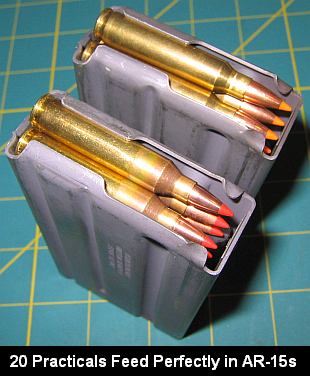
Before Kevin ordered the reamer, I talked over the reamer specs with him. My priorities were tolerances on the tight end of the .223 Rem SAAMI specification, a semi-fitted neck with no need for neck-turning, and a short throat so that we could have plenty of the 32gr V-Max in the case and still touch the lands. I also wanted this short throat in case [anyone] wanted to chamber an AR-15 for the 20 Practical. A loaded 20 Practical round will easily touch the lands on an AR-15 while fitting into the magazine with no problem. With its standard 23-degree shoulder, the 20 Practical case also feeds flawlessly through an AR-15.
As for the barrel, I only use Liljas on my rifles. I have had great luck with them. They have always shot well and they clean up the easiest of any barrels that I have tried. I had previously sent my Tikka barreled action to Dan Lilja so that he could program a custom contour into his equipment and turn out a barrel that would perfectly fit the factory M595 sporter stock. There isn’t much material on an M595 sporter stock so the contour had to match perfectly and it did. Dan Lilja now has this custom contour available to anyone who would like to rebarrel their M595 sporter with one of his barrels.
There Are Plenty of Good .204-Caliber Varmint Bullet Options
How to Form 20 Practical Cases — Simple and Easy
Forming 20 Practical cases is very easy. No fire-forming is required. Start with any quality .223 Rem brass. Then simply run the case into your bushing die with the appropriate bushing and call it done.
Project Componentry
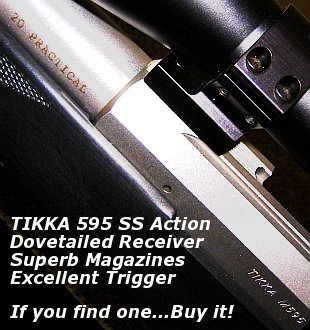
My 20 Practical rifle started out as a Tikka Model 595 Stainless Sporter in .223 Remington. Though the M595 is no longer imported, if you shop around you can find M595 Sporters for bargain prices. Mine cost under $500. I think the action alone is worth that! The receiver has a milled dovetail for scope rings plus a side bolt release like expensive BR actions. The bolt cycles very smoothly. Ammo is handled with super-reliable 3- or 5-round detachable single-column magazines (FYI, Tikka’s M595 22-250 mags will feed a 6BR case flawlessly.) We kept the standard Tikka trigger but fitted it with a light-weight spring. Now the trigger pull is a crisp 1.8 pounds–about as good as it gets in a factory rifle. We replaced the factory tube with a custom, 24″, 3-groove Lilja 12-twist barrel. Dan Lilja created a special M595 sporter contour to allow a perfect “drop-in” fit with the factory stock. For optics, I’ve fitted a Leupold 4.5-14x40mm zoom in low Talley light-weight aluminum mounts. All up, including optics and sling, my 20 Practical weighs just under 8.5 pounds.
Test Report–How’s It Shoot?
I sent the barrel and barreled action to Kevin and in a very short time it was returned. Kevin did a perfect job on the rifle. I had asked him to try to match the bead blasted finish of the Tikka when he finished the new barrel. It came out perfect and the only way one can tell it is a custom is the extra two inches of length and the “20 Practical” cartridge designation.
So, no doubt you’re asking “how does she shoot?” Is my “prototype”, first-ever 20 Practical an accurate rig? In a word, yes. Even with the standard factory stock, and light contour barrel, it can shoot 3/8″ groups. Take a look at the typical target from this rifle. This is from an 8.5-pound sporter with a very skinny fore-end and a factory trigger.
Gunsmith’s Report from Kevin Weaver The 20 Practical: Origins and Development
Editor’s NOTE: We can’t say for sure who first necked down the .223 Rem to .20 caliber and chambered a rifle for that wildcat (as opposed to the .20 Tactical). But here is an account from way back in 2006 when the Warren B first came up with the idea of a .20 Practical cartridge, complete with reamer specs.
A year ago I received a call from Warren with a great idea. Warren asked “Why couldn’t we simply neck down the .223 Remington case to 20 caliber and get basically the same performance as the 20 Tactical? This way you can forgo the expensive forming dies that are needed for the 20 Tactical.” The idea made perfect sense to me, and I saw no major technical issues, so we got started on the project. I ordered a reamer from Dave Kiff at Pacific Tool & Gauge (PTG) with a .233″ neck. The .233″ neck should allow for a simple necking-down of the 223 Remington case to produce the 20 Practical in just one step. No fire-forming necessary! Furthermore, the PTG 20 Practical reamer Dave created should work with any available .223 Rem brass, commercial or military.
The first 20 Practical round was launched down range (through Warren’s Tikka) just a few months later. The brass formed as easily as expected. All one needs is a Redding type “S” bushing die with a .230 bushing and with just one step I had a .20 caliber case ready to shoot. Warren is brilliant. [Editor’s Note: We concur. For more details on Warren’s case-forming methods and his tips for adapting .223 Rem dies, read the technical sections further down the page.]
It would be almost six months later until I got around to building a dedicated test rifle chambered for the 20 Practical. I used a Remington 722 action, Remington synthetic semi-varmint stock, and a 24″ Douglas stainless steel XX 12-twist barrel. I formed and loaded about 30 cases using Remington brass in about 20 minutes. I used a .223 Rem seating die to seat the 20 Practical bullets. The .223 seating stem seated the small 20-Cal bullets just fine. The first loads sent the 40gr Hornady V-Max bullets down range at a modest 3500 FPS. I did not shoot for groups. I just wanted to use this load to sight in the rifle and break in the barrel. Load development was painless–I used reduced .223 Rem loads for 40gr bullets and worked up from there. In the table below are some of my preferred loads as well as Warren’s favorite recipes for his 20 Practical.
Bullet Wt.
Powder
Charge Wt.
Velocity FPS
Comments
32GR
H4198
24.1
4025
Warren’s lighter gopher load
32GR
AA2460
27.8
4154
Warren’s coyote/prairie dog load
32GR
N133
26.0
4183
Coyote/PD load, clean burn
33GR
H4198
26.0
4322
Hot Load. Use with Caution!
33GR
N133
27.0
4255
Kevin: 0.388” 5 shot group
40GR
H335
25.0
3583
Kevin’s barrel break-in load
40GR
H4198
24.0
3907
Hodgdon “Extreme” Powder
40GR
IMR4895
26.0
3883
Kevin: 0.288″ 5-shot group
40GR
N133
25.0
3959
Kevin: 0.227″ 5-shot group
Warren’s Load Notes: My pet loads are all with IMI cases, 32gr Hornady V-Maxs, and Fed 205 primers (not match). These are the most accurate loads in my rifle so far. I haven’t even bothered with the 40s as I have the 20 PPC and 20 BR for those heavier bullets. I prefer the lighter bullets in the 20 Practical because I wanted to keep speed up and recoil down in this sporter-weight predator rifle. Also, the 32gr V-Max is exceptionally accurate and explosive. I like N133 the best as it burns so clean. IMI cases are tough and well-made.
Kevin’s Load Notes: I used Remington 223 cases, Hornady V-Max bullets, and Remington 6 1/2 primers to develop the above loads. CAUTION: all loads, both Warren’s and mine, should be reduced 20% when starting load development in your rifle. All load data should be used with caution. Always start with reduced loads first and make sure they are safe in each of your guns before proceeding to the high test loads listed. Since Weaver Rifles has no control over your choice of components, guns, or actual loadings, neither Weaver Rifles nor the various firearms and components manufacturers assume any responsibility for the use of this data.
Comparing the 20 Practical and 20 Tactical
Kevin tells us: “The 20 Practical and the 20 Tactical are almost identical cartridges. There are only slight differences in case Outside Diameter, shoulder angle, and case body length. The neck length on the 20 Tactical is a bit longer, but there is still plenty of neck on the 20 Practical to grip the popular bullets, such as the 32gr V-Max. Here are some specs:
Cartridge
Bolt face to shoulder
Shoulder O.D.
Shoulder Angle
Total length
20 Tactical
1.5232″
.360
30°
1.755″
20 Practical
1.5778″
.3553
23°
1.760″
Both the 20 Tactical and the 20 Practical are fine .20 caliber cartridges. At present, the 20 Tactical is the more popular of the two because it has had more publicity. However, my favorite would be the 20 Practical. Warren’s 20 Practical gives the SAME performance as the 20 Tactical without fire-forming, or having to buy expensive forming dies. So with the 20 Practical you do less work, you shell out a lot less money, yet you give up nothing in performance. What’s not to like? To create 20 Practical cases, just buy a .223 Rem Redding Type “S” Bushing Die set with a .230 or .228 bushing and have fun with this great little cartridge.”
Shoot 101 Quiz
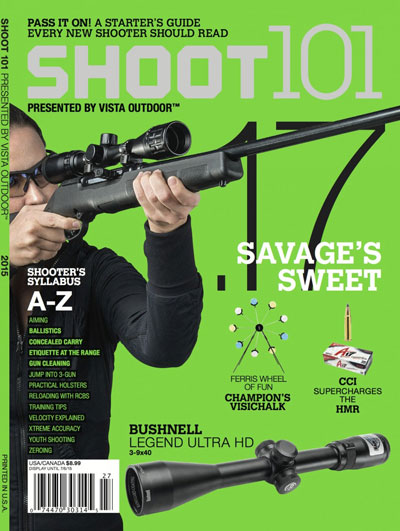
How much of an expert are you when it comes to firearms and ballistics? Test your knowledge with this interactive test. Vista Outdoor, parent of CCI, Federal, Bushnell, RCBS and other brands, has a media campaign called Shoot 101, which provides “how to” information about shooting, optics, and outdoor gear. There were a variety of interactive offerings that let you test your knowledge.
On the Shoot 101 website, you’ll find a Ballistics Quiz. The questions are pretty basic, but it’s still fun to see if you get all the answers correct.
You don’t need a lot of technical knowledge. Roughly a third of the questions are about projectile types and bullet construction. Note, on some platforms the layout doesn’t show all FOUR possible answers. So, for each question, be sure to scroll down to see all FOUR choices. REPEAT: Scroll down to see ALL answers!
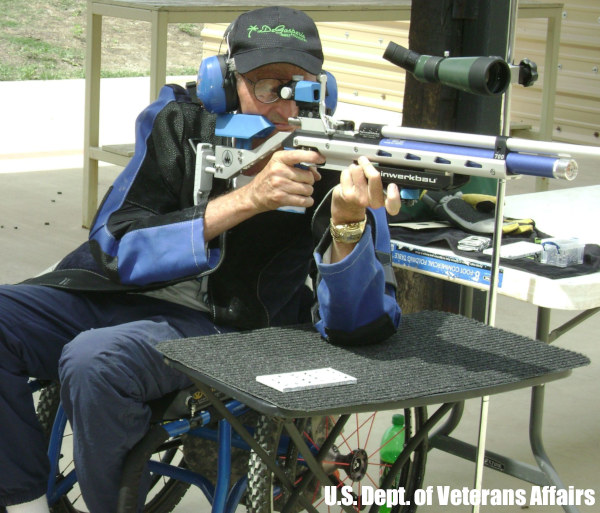
One of the great thing about shooting is that marksmanship is one of the few sports where physically-challenged persons can compete at the highest level — with some provisions for wheelchair access and mobility. For example, in the world of F-Class competition, Matt Schwartzkopf is one of the best in the nation. Matt, a rangemaster at Ben Avery in Arizona, is a double amputee (below the knee). He hasn’t let that challenge stop him. He has been a Top-10 finisher at major F-Class matches, and was chosen to shoot with F-TR Team USA.
F-TR Team USA member Matt Schwartzkopf is a double amputee below the knee, having had his lower legs removed due to a birth defect. That hasn’t held him back. Matt is an inspiration to us all. He told us: “This condition has not held me back from anything.” Jokingly, he added, “I may not have ‘a leg to stand on’, but that doesn’t mean I can’t still shoot 10s and Xs at 1000.” Matt is living proof that competitive shooting is a sport for all individuals — young and old, able-bodied and physically challenged.
Matt isn’t just a talented shooter — he runs range operations at Ben Avery in Arizona. During a major match, Matt can be seen supervising the firing line, organizing pit crews, and posting match results.
New USA Nationwide Adventure Database for Adaptive Shooters
Here’s a great new opportunity for shooters and sportsmen with physical limitations. The NRA has created a nationwide database of hunting and fishing adventures for individuals with disabilities. There are programs throughout the country with 45+ organizations such as Buckmasters, Freedom Hunters, Hope Outdoors, Hunting with Heroes, and Safari Club International.
“Venturing into the outdoors has long been acknowledged as healing for the body and soul”, said NRA National Adaptive Shooting Programs Manager Dr. Joe Logar, PT, DPT. “These benefits can be even more profound for someone experiencing an illness, injury, or disability.”
NRA’s Hunter Services and Adaptive Shooting Programs have maintained a list of organizations offering people with disabilities outdoor opportunities. Now available in a searchable database, any adaptive shooter can easily choose from adventures such as guided whitetail hunts, chartered fishing trips, and accessible hiking trails anywhere across the country. To find a program, visit the NRA Adaptive Shooting Program’s Hunting/Fishing Trip Database.
NRA Resources for Adaptive Shooting Events
The NRA Adaptive Shooting Program also provides information for organizations planning an event to include person with disabilities. Events may be organized by veterans’ groups, rehabilitation facilities, and gun clubs. For more information visit AdaptiveShooting.NRA.org.
Adaptive Shooting Programs in the United Kingdom
Across the pond, the National Rifle Association of the United Kingdom (NRAUK) also has adaptive shooting programs. The NRA.ORG.UK website has a wealth of information for disabled shooters.
The NRAUK states: “There are many different types of target shooting available for people to try in Great Britain. Some of them are readily accessible to disabled people, others less so. Also, shooting clubs and facilities do not all cater for every discipline; some only offer one, whilst larger complexes can cater for many of them. The only place in the country where almost all disciplines can be tried is Bisley Camp in Surrey. Access to the outdoor ranges is being improved all the time, although most are already accessible.
If the disciplines that you particularly fancy are not suitable for your type of disability at the moment, or are not currently available in your area, do not give up hope! The key skills for target shooting are very similar for all disciplines, so you could start with a different but similar option, learn those key skills, and take up your first choice when it is available to you.”
Making Ranges Suitable for Disabled Shooters
The Summer 2019 issue of NRA Club Connections magazine has a feature on Adaptive Shooting. This article explains how range owners can make their lines of fire more accessible with the addition of a simple mat.
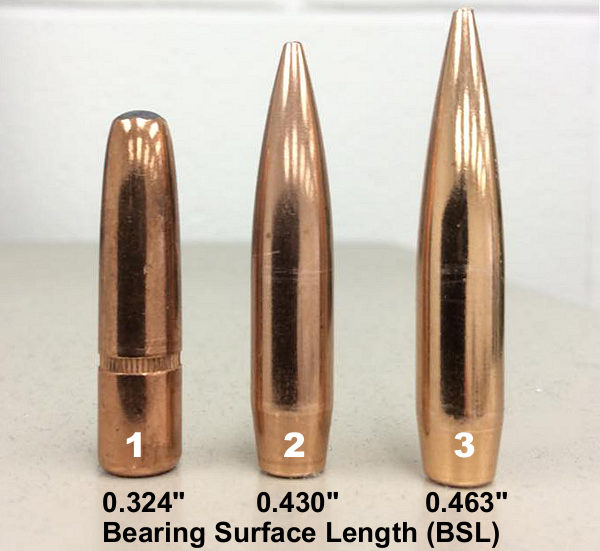
Three near-equal-weight 7mm bullets with different shapes and bearing surface.
This article, from the USAMU Facebook Page, concerns reloading safety. In the relentless quest for more speed and flatter ballistics, some hand-loaders load way too hot, running charges that exceed safe pressure levels. Hint: If you need a mallet to open your bolt, chances are your load is too hot. Stay within safe margins — your equipment will last longer, and you won’t risk an injury caused by over-pressure. In this article, the USAMU explains that you need to account for bullet shape, diameter, and bearing surface when working up a load. Don’t assume that a load which is safe for one bullet will be safe for another even if both bullets are exactly the same weight.
Today, we continue our handloading safety theme, focusing on not inadvertently exceeding the boundaries of known, safe data. Bullet manufacturers’ loading manuals often display three, four, or more similar-weight bullets grouped together with one set of load recipes. The manufacturer has tested these bullets and developed safe data for that group. However, seeing data in this format can tempt loaders — especially new ones — to think that ALL bullets of a given weight and caliber can interchangeably use the same load data. Actually, not so much.
The researchers ensure their data is safe with the bullet yielding the highest pressure. Thus, all others in that group should produce equal or less pressure, and they are safe using this data.
However, bullet designs include many variables such as different bearing surface lengths, hardness, and even slight variations in diameter. In fact, diameters can occasionally range up to 0.001″ by design. Thus, choosing untested bullets of the same weight and caliber, and using them with data not developed for them can yield excess pressures.
This is only one of the countless reasons not to begin at or very near the highest pressure loads during load development. Always begin at the starting load and look for pressure signs as one increases powder charges.
Bullet Bearing Surface and Pressure
Bullet bearing surface length (BSL) is often overlooked when considering maximum safe powder charges and pressures. In Photo 1, note the differences in the bullets’ appearance. All three are 7 mm, and their maximum weight difference is just five grains. Yet, the traditional round nose, flat base design on the left appears to have much more BSL than the sleeker match bullets. All things being equal, based on appearance, the RN/FB bullet seems likely to reach maximum pressure with significantly less powder than the other two designs.
TECH TIP: Bullets of the same weight (and caliber) can generate very different pressure levels due to variances in Bearing Surface Length (BSL).
Bullet 1 (L-R), the RN/FB, has a very slight taper and only reaches its full diameter (0.284 inch) very near the cannelure. This taper is often seen on similar bullets; it helps reduce pressures with good accuracy. The calculated BSL of Bullet 1 was ~0.324″. The BSL of Bullet 2, in the center, was ~0.430″, and Bullet 3’s was ~ 0.463″. Obviously, bullets can be visually deceiving as to BSL!
Some might be tempted to use a bullet ogive comparator (or two) to measure bullets’ true BSL for comparison’s sake. Unfortunately, comparators don’t typically measure maximum bullet diameter and this approach can be deluding.
Note: Due to time constraints, the writer used an approximate, direct measurement approach to assess the bullets’ different BSLs. While fairly repeatable, the results were far from ballistics engineer-grade. Still, they are adequate for this example.
Photo 2: The Perils of Measuring Bearing Surface Length with Comparators
In Photo 2, two 7mm comparators have been installed on a dial caliper in an attempt to measure BSL. Using this approach, the BSLs differed sharply from the original [measurements]. The comparator-measured Bullet 1 BSL was 0.694” vs. 0.324” (original), Bullet 2 was 0.601” (comparator) vs. 0.430” (original), and Bullet 3 (shown in Photo 2) was 0.602” (comparator) vs. 0.463” (original). [Editor’s comment — Note the very large difference for Bullet 1, masking the fact that the true full diameter on this bullet starts very far back. You can use comparators on calipers, but be aware that this method may give you deceptive reading — we’ve seen variances just by reversing the comparators on the calipers, because the comparators, typically, are not perfectly round, nor are they machined to precision tolerances.]
Thanks to the U.S. Army Marksmanship Unit for allowing the reprint of this article.
A while back, Cal Zant at PrecisionRifleBlog.com did a big muzzle brake comparison test. Along with measuring recoil reduction, Cal’s team recorded sound levels in PRB’s exhaustive muzzle brake field test. In the PRB archives you’ll find comprehensive muzzle brake sound test results, with hard data on 20 different muzzle brakes.
Sound can be a tricky subject, but Cal Zant, the editor of PrecisionRifleBlog.com, presents everything an informed shooter should know about muzzle brake noise in a straightforward and practical way. Most sound tests are measured from the side of the muzzle, in accordance with mil-spec standards, and Cal did that. But he also measured the sound level of each brake from behind the rifle, closer to the shooter’s position. This provides a more accurate indicator of the actual sound levels firearms operators will encounter while shooting.
Muzzle brakes ARE really loud — that’s something most active shooters have observed. But this study finally gives us some hard data and makes objective comparisons. The difference between brakes was quite significant. Some brakes were ear-splitting — more than twice as loud as other brakes tested.
As a bonus, Cal also provides data on how the new Ultra series suppressors from Thunder Beast Arms Corp (TBAC) compare in terms of sound level behind the rifle.
Is The Challenge Of Big Bore Extreme Range Shooting Right For You? By James Patterson
This article originally written for the Sinclair Reloading Press
Handling a .50 BMG Rig
Is a .50 BMG caliber rifle difficult to shoot? Not at all. The relatively heavy weight of a standard rifle at 30 pounds or more combined with a very efficient muzzle brake makes it a pleasure to shoot. The typical recoil can be compared to a .243 rifle or a 12 gauge trap load. On the other hand, the burning of a typical load of 230 grains of powder combined with that muzzle brake makes the muzzle blast experience exhilarating. A first time shooter will fire, pause for a moment in awe at the muzzle blast, and then break out into what has become known as “The 50 Caliber Grin”, almost impossible to wipe from ones face. My daughter started competing with the .50 BMG at 18 (115 lbs of tall skinny girl) and happily shoots 100+ rounds in the course of a match, her grin on the last round is as wide as on the first! Many members and competitors in the FCSA are women and many have distinguished themselves as excellent marksman having set world records on numerous occasions.
Cost of Big-Bore Shooting
Is owning and shooting a .50 BMG caliber rifle expensive? Relatively speaking yes, but one must put it into perspective. Rifles may run from $2500 to $7000, maybe even more for a top of the line custom rifle. A good scope will set you back $1000 to $3500. And while excellent commercial ammo is made, it is hard to find these days and runs from $4 to $6 a round. Most serious shooters start reloading for the rifle as soon as practical, not only for the economics of reloading but also for the ability to fine tune custom ammo for their specific rifle. It’s a very rare match that is won shooting commercial ammo. I recently compared the cost of my hobby — owning, shooting, and competing with the 50 BMG — with a friend whose hobby is snowmobiling. Factoring in the cost of equipment, licensing, gasoline, clothing, etc. it was soon obvious that my hobby was significantly less expensive than his.
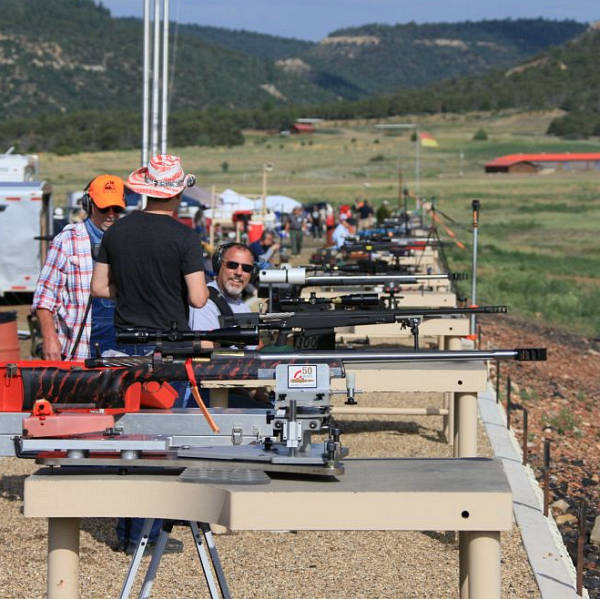
Getting Started So how does one get started? You could do as I did, purchase a rifle not knowing what you were really getting into; or you could come out to a FCSA-sponsored event, shoot a number of different rifles, rub shoulders with those who have already taken the plunge, and see if this sport is right for you. While membership in the Fifty Caliber Shooters Association (FSCA) is required to compete at a FSCA event, membership is not required to come and experience first hand what is going on. If you have any inclination that you are interested in the extreme sport of long rang, big bore shooting then a year’s membership in the FCSA is only $60 ($20 for active duty military) a significant bargain if it helps you make just one well-informed equipment choice. In addition one of the primary functions of the FCSA is helping to identify active members near you who can help you understand just what is involved and help you ‘get your feet wet’ in this challenging sport.
The National Matches at Camp Perry are a great American tradition. Over the past 114 years, hundreds of thousands of competitors have enjoyed the rifle and pistol matches at Perry on the shores of Lake Erie. Today’s story, from an avid shooter now in his 80s, recounts the halcyon days of pistol competition at Camp Perry, when thousands of shooters competed on the pistol firing lines each summer.
My Camp Perry Experience…
More than 40 National Pistol Matches since 1963
by Don Weihl, 83, Swansea, Illinois
Shooting at Camp Perry has been the experience of a lifetime….
Best Camp Perry times were in the Sixties
The 1963 through 1967 years were the best…
There were more than 2,000 competitors each year. There were 600 targets — numbered 1 through 600, from left to right — across the ranges and grouped into six ranges, 100 targets wide. The matches ran like a well-oiled machine. There was a print shop on the base. All competitors could get a printed match report for each match, not too long after scores were in.
Most nights in those years, there were movies for the competitors and their families in the base theater. The mess hall in those years served three meals a day to over 3,000 hungry mouths – every day.
Favorite memory of Camp Perry — A Record Performance
My favorite memory of Camp Perry [was] in 1966. I was on the line firing next to the Army Team when MSGT Ralph O. Thompson (shown above) fired a 100 on the first .22 cal. pistol target. R.O. then fired another 100 on the second target, setting a National Record of 200×8. That is still unforgettable.
What I like Best about Camp Perry…
Each morning, the day begins with the roar of the cannon and colors. The National Anthem is played as the smoke clears and all stand at attention. Only first relay shooters are on the line, but many second and third relay shooters are there, as well as the match support community – all to observe the colors. Other matches begin with the National Anthem, but at Camp Perry, it is better.
What Was My Favorite Perry Pistol Match?
Actually, There is no favorite match in bullseye shooting. At Camp Perry, you are there to compete against yourself and everybody else. You also compete against the elements, where a slight breeze can turn into a gale, while the grass beneath your feet turns into a muddy obstacle.
What have I Learned on the Firing Line with Other Competitors over the Years?
Everyone learns they are among friends. If there is a problem, the shooter next to you or the shooter next to him will help. If your pistol breaks, the back-up pistol of a nearby competitor will be offered quickly, and the match will proceed.
Advice for First Time Camp Perry Competitors?
Learn to concentrate on something unique to YOUR target. With so many targets so close together, cross-fires are common. Don’t let it be you.
National Matches at Camp Perry Returns in 2021
The National Trophy Pistol and Rifle Matches have been an honored American tradition for generations. The National Trophy Matches have been held at Camp Perry, Ohio, since 1907, 114 years ago. Participants in the 2021 National Pistol Matches can choose from a number of competitions, as well as attend the Pistol Small Arms Firing School. There, trainees will receive classroom instruction before heading to the range for live firing and one-on-one match training.
Civilians and military shooters competed together at the 2019 NTT Pistol Match.
The 2021 National Matches will feature multiple pistol competitions, including a Centerfire Pistol 900 Aggregate, a .45 Pistol 900 Aggregate, and a CMP Revolver Match. To learn more about the CMP’s scheduled events at the upcoming 2021 National Matches at Camp Perry, visit the CMP Nat’l Matches Website. Registration is NOW OPEN.
It took decades of competition to acquire all those patches — that’s dedication to the sport.
Sinclair International has a good article on Case Lubrication which shows the various products and application methods available. Part of Sinclair’s Step-By-Step Reloading series, the article shows how to apply Spray Lube, Die Wax, or conventional lube from a Pad. The story also explains how to use dry lube to slick up the inside of your case necks.
Spray Lubes
High-volume reloaders often turn to spray-on lubricants such as the RCBS Case Slick (#749-001-341WB) or the Hornady One Shot (#749-016-818WB) to quickly lubricate large numbers of cases at once. An indispensable piece of gear that helps make spray lubing easy is a polymer lube rack that holds cases upright and arranged to maximize their exposure to the spray.
Editor’s Note: Ballistol Aerosol is other good spray product for regular full-length sizing (not heavy case-forming). It goes on clear (no chalky residue), it is ultra-slippery, and it will remove the carbon from your case necks as you apply Ballistol with a patch. This is my primary spray lube — but many folks dislike the distinctive Ballistol smell. Try before you buy.
Sizing Die Wax
Over the years, many benchrest shooters have come to trust Imperial Sizing Die Wax (#749-001-052) for their case lube needs. It offers high lubricity and easily wipes off with a paper towel. In fact, its lubricity makes it a popular choice for case forming, for those wildcat folks who need to form their own unique or obsolete cartridges. Unlike lube pads or spray lubes, sizing wax is applied more naturally. You just put a little on your fingers and transfer it to the cases by handling them. As simple and easy as Imperial Sizing Die Wax is to use, it’s probably best for low-volume applications.
Dry Lubricant
Redding’s Imperial Application Media (#749-001-166) is a dry neck lube used to lube the inside of the neck, whether you’re full-length sizing or neck-sizing only. It consists of ceramic spheres coated with a fine graphite-based powder. You simply dip the neck into the container for a second to pick up the right amount of lube. This lube lets the expander ball move smoothly throughout the case neck instead of “grabbing” or “chattering”. That minimizes case neck stretching.
Editor’s Note: Dry Lube is also very useful if you ultrasonically clean your cases. After the ultrasound process, the inside of the case neck can be so “squeaky clean” that bullets don’t seat smoothly. A quick application of dry lube on the insisde of the necks will help bullets slide into the neck easier. As a result, the neck “grip” on the bullets should be more consistent from round-to-round. Consistent neck tension is key to accuracy and uniform velocities.
Tired of spending $15-$25 for a can of spray lube that doesn’t last very long? For about the same price as a single 10 oz. can you can make your own effective spray lube that should last for multiple seasons and lube thousands of cases quickly and easily.
In the YouTube video above Gavin Gear of UltimateReloader.com shows how to make your own case lube using simple, inexpensive ingredients. First recommended by the 6.5 Guys, this Liquid Lanolin + Isopropyl Alcohol mix works well and is very cost-effective. Here’s what you need:
Bushnell offers a good FREE new Ballistics App powered by the Applied Ballistics Ultralite Engine. The new Bushnell Ballistics App easily calculates ballistic solutions for any popular cartridge type once you input velocity, BC, and atmospherics. The App features trusty Applied Ballistics bullet data, and it can even pull in atmospheric data from web weather sources. This allows you to calculate hold-overs and make precise wind corrections. The App is offered in both iOS (Apple) and Android OS versions.
“The Bushnell Ballistics App is powered by the Applied Ballistics Ultralite engine, the most trusted ballistics data-cruncher in the industry,” said Bushnell Marketing Manager Matt Rice. “This App allows users to easily build and modify gun profiles and build range cards to calculate firing solutions based on their specific scope and ammunition choices. All of our Bushnell scopes and reticles have been pre-loaded [in the App].”
The Bushnell App features AB Connect, a live library of G1/G7 data, plus the Applied Ballistics Bullet Library with 740+ pre-loaded bullet profiles. The Bushnell scope library features 150+ scopes and 30 reticle options. Atmospheric data can be updated manually or directly from the internet (when connected). Angle range compensation is also calculated. Gun profile management provides up to five saved profiles with reticle-based firing solutions. A multiple target feature saves up to five targets. Range cards can be shared or printed using the Email Range Card Function.
The FREE App works on both Android and iOS operating systems, and is available on Google Play and the Apple App Store. It is optimized for Bushnell riflescopes and reticles, but is compatible with all optics. Once downloaded, the App functions off the grid — no cell service required.
“The new Bushnell Ballistic App puts the power of long-range, first-shot accuracy into the hands of any shooter,” Rice said. “it was designed to perform in any condition and to offer our consumers true value, with features that far exceed the price — which, in this case, is free!”
This story features a unique, American-designed rimfire rifle, chambered for the potent .17 HMR round. The current generation T-Bolt has a tang-mounted ambidextrous safety, a choice of barrel contours, lengths, and finishes, and a variety of stock options. What sets the T-Bolt apart from other rimfire rifles is the way the action cycles. There is not a conventional bolt that requires four distinct motions (lift bolt handle up/pull back/move forward/rotate handle down). With the T-Bolt you simply pull the handle straight back to extract a round, then return it forward to chamber a new round from the Double Helix magazine. The cocking effort is divided between back pull and forward movement so the effort is relatively light and easy.
Among current rimfire rifles, the Browning T-Bolt ranks high for fit and finish. The bluing is very nice and the T-Bolt even boasts a gold-plated trigger shoe. Many different stock types have been offered in recent years including some very nice AA Maple stock models as shown below (click to zoom). These T-Bolt rifles exhibit very fine craftmanship. Current models are made in Japan under license to Browning.
Click image for full-screen T-Bolt photo with detail.
Browning T-Bolt Sporter AA Maple Model
RECEIVER – Steel; High polished finish; Drilled and tapped for scope mounts
BARREL – Medium Sporter; Blued finish; Free-floating; Semi-match chamber; Recessed crown
ACTION – Straight pull bolt action; Top-tang safety; Adjustable trigger
STOCK – AA Maple; Gloss finish; Checkered
FEATURES – Sling swivel studs installed
PRODUCTION – Limited quantities
T-Bolt Owner Talks about Function and Accuracy
“I have a Browning T-bolt in .17 HMR, but with the maple stock. It is probably my favorite .17 HMR rifle (also the most expensive). The rifle feels smaller than some of my other .17 HMR rifles. I think the length of pull is a little shorter. I do like the light weight and trim handling of the rifle and the straight-pull bolt can be cycled really quickly. Mine is quite accurate and will shoot one-inch groups at 100 yards with both Hornady ammo and the CCI A17 ammo.” — RexRay, Varminter.com Forum member.
Pros and Cons of the Browning T-Bolt
The T-Bolt has a reputation for good accuracy, provided you have a good lot of .17 HMR ammo (we recommend checking for bullet run-out before you shoot for groups). The straight-pull action works as advertised — it is fast, smooth, and easy-to-operate. The Double Helix magazine (covered below) is excellent. It is very compact yet ultra-reliable. Another plus is that the T-Bolt has been produced in many different versions, with a variety of stocks, and even a stainless action version.
What are the negatives? Some of the stocks have a somewhat short length-of-pull, but this is easily solved with spacers. The main complaint is the factory trigger — some owners say it is too heavy at about 4 pounds, though the break is clean. For varmint work, we could live with the stock trigger and put money saved into optics.
If you prefer a very light trigger, JARD makes a T-Bolt replacement trigger. Featuring an aluminum housing, the JARD T-Bolt trigger can be ordered with 12-, 16-, or 20-ounce pull weights. The JARD trigger offers a crisp, clean break significantly lighter than stock. But at $249.99 the JARD trigger is fairly expensive. Additionally there have been a couple complaints about slam fires at the lowest weights so we recommend the 20-ounce. Here is one owner review, from a Rimfire Central thread: “The new Browning T-Bolt is a great rifle in all aspects except for the trigger. In my case when I received my JARD trigger it was an almost drop-in installation with very little adjusting or fooling around. For me it made a decent little rifle a great little rifle.”
Browning Double Helix 10-Round Magazine
The T-Bolt’s patented 10-round rotary Double Helix™ magazine is a unique design that feeds very reliably and is easy to load. The Double Helix magazine uses a torsion drive spring and interlocking gear design to maintain correct timing and exact cartridge alignment for smooth, reliable feeding. The translucent gray body allows for easy verification of the number of remaining cartridges. We like the fact that the Double Helix provides TEN-round capacity while fitting nearly flush with the bottom of the action.
The Browning Double Helix rotary box magazine system is easy to load, easy to carry, and easy to use. The smooth, rounded exterior contours of the Double Helix, along with twin gripping grooves, tapered shape and a slightly extended baseplate design make insertion positive, while the spring-assisted drop-free magazine ejection feature allows for rapid magazine changes. T-bolt owners confirm that feeding and reliability is excellent — the magazine design puts cartridges in perfect alignment with the chamber.
Other Browning T-Bolt Variants
In recent years, Browning has produced T-Bolt rifles in a variety of models, with many different stock types and various barrel lengths/contours. Most of the photos above showcase the AA Maple Sporter T-Bolt, which is currently out of production, though still available from some dealers (if you search). We like the looks of the AA Maple T-Bolt, but there many other stock options including dark brown, Black, Green, and various camouflage finishes. Use the links below to see all the T-Bolt configurations.
Here are 4 other T-Bolt variants, first the new-for-2021 T-Bolt Target with muzzle brake, then the Limited Edition Cerakote T-Bolt Speed model, and two discontinued T-Bolts, a composite-stocked carbon finish model and a Varmint Special with stainless action and thumbhole laminated stock. Current production T-Bolts are offered in three rimfire chamberings: .17 HMR, .22 LR, and .22 WMR. Barrel contours and lengths (from 16.5″ to 22″) vary from model to model.
Do you like the T-Bolt? Well there is a 5% Off Rebate Program available right now that covers the T-Bolt and all other Browning firearms.
.17 HMR Cartridge — Fast and Deadly on Small Varmints
We are big fans of the .17 HMR round. It’s just about perfect for ground squirrels, and is effective on prairie dogs out to about 200 yards. The three main .17 HMR producers have been CCI, Federal, and Hornady. Choose from 17gr or 20gr bullets — both work well in the varmint fields. Norma also makes .17 HMR ammo with 17gr V-Max bullets. This Norma .17 HMR ammo has shown very good accuracy.
CCI .17 HMR TNT offers 2650 FPS Velocity
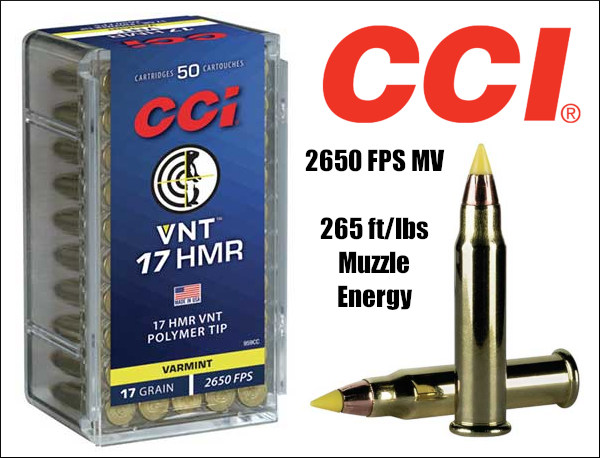
For varmint work we like CCI’s latest .17 HMR VNT ammo. This boasts class-leading 2650 FPS muzzle velocity. Engineered to combine good accuracy with high impact energy, this CCI TNT ammo features a 17gr polymer-tipped bullet designed for rapid expansion. We also like the Norma .17 HMR ammo. “With outstanding accuracy and excellent energy transfer… The .17 HMR has a very loyal following among hunters and target shooters alike”, said Paul Lemke, G.M. for Norma/RUAG.


 After building my 20 PPC, I wanted to do another .20 caliber, this time a repeater for predator hunting that could also serve as a gopher/prairie dog rifle. I wanted to use a Tikka M595 stainless sporter I had. This rifle is the ultimate repeater with an extremely smooth-feeding cycle from its single-column magazine. Since the Tikka was a .223 Remington from the factory, I first looked at possible case designs that would fit the magazine. The 204 Ruger was a very new round at the time and brass was scarce. I also didn’t care for the overly long case design or the standard throat dimensions of the cartridge. I then looked at the 20 Tactical. It was a nice cartridge but I didn’t like the fact that (at the time) an ordinary two-die Tac 20 set with just a plain full-length die and standard seater were $150. Not only did the costs bother me, but I was accustomed to using a Redding die set featuring a body die, a Type-S bushing neck die, and a Competition seater. To be honest, I also didn’t care for the 20 Tactical’s name–there is absolutely nothing tactical about the cartridge. I didn’t want to adopt a new cartridge based on what I perceived to be a marketing gimmick (that “tactical” title).
 Simply Neck Down .223 Rem to Make a 20-223 Wildcat
 I chose Kevin Weaver at Weaver Rifles to fit and chamber the barrel to my rifle. Kevin does excellent work and is great to work with. Kevin liked the idea of the 20 Practical so much he agreed to purchase the project reamer. (BTW Kevin didn’t even need to purchase a Go/No-Go gauge, he just used an existing .223 Rem gauge.)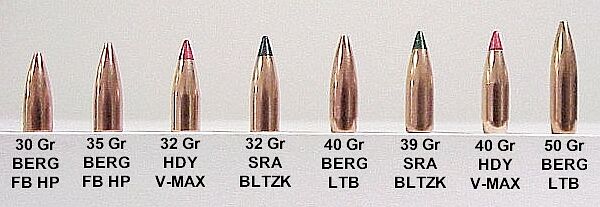
 Project Componentry
 Test Report–How’s It Shoot?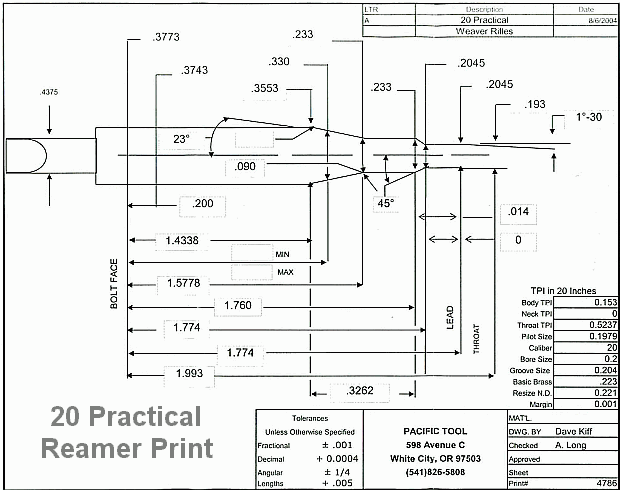
 Comparing the 20 Practical and 20 Tactical
 Shoot 101 Quiz


 F-TR Team USA member Matt Schwartzkopf is a double amputee below the knee, having had his lower legs removed due to a birth defect. That hasn’t held him back. Matt is an inspiration to us all. He told us: “This condition has not held me back from anything.” Jokingly, he added, “I may not have ‘a leg to stand on’, but that doesn’t mean I can’t still shoot 10s and Xs at 1000.” Matt is living proof that competitive shooting is a sport for all individuals — young and old, able-bodied and physically challenged.








 So how does one get started? You could do as I did, purchase a rifle not knowing what you were really getting into; or you could come out to a FCSA-sponsored event, shoot a number of different rifles, rub shoulders with those who have already taken the plunge, and see if this sport is right for you. While membership in the


 What have I Learned on the Firing Line with Other Competitors over the Years?


 Sizing Die Wax


 In recent years, Browning has produced T-Bolt rifles in a variety of models, with many different stock types and various barrel lengths/contours. Most of the photos above showcase the AA Maple Sporter T-Bolt, which is currently out of production, though still available from some dealers (if you search). We like the looks of the AA Maple T-Bolt, but there many other stock options including dark brown, Black, Green, and various camouflage finishes. Use the links below to see all the T-Bolt configurations.