Each year, on the last Monday in May, Americans honor the sacrifices of military men and women who paid the ultimate price in their service to our nation. More than one million American men and women have died in military service during wartime, including more than 666,000 battle deaths. On May 27, 2019, we again pay tribute to these men and women and remember their service to their country.
This is what Memorial Day symbolizes — a time Americans take a clear look at both our past and our future. One day each year, when we acknowledge the debt we owe to those men and women who — because they so cherished peace — chose to live as warriors.
Could anything be more contradictory than the lives of our soldiers? They love America, so they spend long years in foreign lands far from her shores. They revere freedom, so they sacrifice their own that we may be free. They defend our right to live as individuals, yet yield their individuality in that cause. Perhaps most paradoxically of all, they value life, and so bravely ready themselves to die in the service of our country. — Deborah Y. Parker
Moment of Remembrance
Memorial Day Observances will range from parades to memorial ceremonies and organized moments of silence. The Memorial Day National Moment of Remembrance honors America’s fallen warrriors. Established by Congress in 2000, the “Moment” asks Americans, wherever they are at 3:00 p.m. local time on Memorial Day, to pause for one minute, in an act of national unity and respect for the fallen.
What Is Memorial Day?
Memorial Day is a federal holiday in the United States for remembering the men and women who died while serving in the country’s armed forces. The holiday, which is celebrated every year on the last Monday of May, was formerly known as Decoration Day and originated after the American Civil War to commemorate the Union and Confederate soldiers who died in the war. By the 20th century, Memorial Day had been extended to honor all Americans who have died while in the military service.
On Memorial Day, the United States flag is traditionally raised to the top of the staff, then solemnly lowered to half-staff position until noon, when it is raised again to full-staff for the rest of the day. The half-staff position is to remember the more than one million men and women who have given their lives for this country.
Flags and flower leis adorn each grave in the National Memorial Cemetery of the Pacific in observance of Memorial Day, 1991. (U.S. Navy photo by OS2 John Bouvia, released).
Many people visit cemeteries and memorials, particularly to honor those who have died in military service. Many volunteers place an American flag on each grave in national cemeteries.
“The fallen warriors we honor on Memorial Day cherished liberty and freedom enough to lay down their lives to preserve our way of life,” said past Secretary of Veterans Affairs Eric K. Shinseki. “We owe them eternal gratitude and we must pass those sentiments on to future generations.”
Editor: This story by Tommy C. (aka “dc.fireman”) comes from our Shooters’ Forum. It’s fascinating to see how a relatively inexpensive Savage M12 BVSS varmint rig was transformed into a sophisticated 300M match rifle with a modern chassis, Shilen barrel, and top-of-line sights. With some ingenuity, and careful parts selection, Tommy created a rifle that can compete with match rifles costing many thousands of dollars more. American ingenuity at work!
Savage Reborn — Old BVSS Transformed into 300M Match Rifle
by Tommy C. (aka “dc.fireman”)
So, I began the project of building a 300M International competition gun, about a year ago, intending to compete at the 300M Nationals this year in Minnesota at the Minneapolis Rifle Club. Realistically, I didn’t want to pay the price-tag demanded of the Bleikers, Grunig & Elmigers, Hammerlis, or Tanners that (infrequently) pop-up for sale from time to time. So I decided to build my own 300M Match rifle with an American action, barrel, chassis, and trigger.
Here is Tommy’s completed 300M Match rifle with Savage action in PDC Custom chassis.
I had decided on the .260 Remington (aka 6.5-08) as the caliber choice. This beat out 6.5×47 Lapua simply due to the cost/availability of brass. The .260 Rem cartridge is based on the .308 Win parent. I made my first batch of brass by necking down some Federal .308, and it worked great. [Editor: We do recommend Lapua .260 Remington brass for match purposes for those who don’t have a supply of good .308 brass.]
I had an older Savage M12 stagger-feed action, originally from an old .22-250 BVSS. I contacted James at Northland Shooter Supply, and he walked me through the game plan and equipment I needed: Shilen Select Match 26″ barrel, NSS Stainless recoil lug and nut, a set of Forster headspace gauges, and the NSS action wrench.
Catalog photo of current Savage M12 BVSS in .22-250 Rem.
A few months later, I replaced the original Accu-trigger with a Rifle Basix SAV-II trigger, and immediately wondered why I waited so long to do that. The Rifle Basix is perfect for my application. Mind you the he safety DOES NOT work now, but, I don’t need it for my application.
Another member on the AccurateShooter Forum sold me a BVSS stock that has been re-worked by Alex Sitman of Masterclass Stocks, and it served as a placeholder, until I could find a maker who could nearly replicate my Feinwerkbau 2700 Alu stock in my smallbore match gun.
After scouring the AccurateShooter Forum, and multiple internet searches, I found PDC Custom in Michigan. I spoke with Craig Kierstadt a few times, before finally deciding to pull the proverbial trigger on his chassis. He had a few of the older chassis stocks with spacing for the Savage stagger-feed action. He machined an Anschutz rail into the fore-end for my hand stop and sling. Then he powder-coated the chassis black, and sent it to me sans grip and butt plate.
Photo of action/chassis. Tommy says: “It locks up really tightly, and you can tell Craig spent some time on the CNC work need to make this all fit.”
There are a few minor issues with the PDC chassis, but overall, I would rate this a 9.5 out of a possible 10. The price, and the features built into it, plus the ease of which everything fit together, far outweigh any minor issues. And two of the issues I quickly corrected with Teflon tape. I will need to make a walnut cheek piece — a curved one isn’t conducive to aperture iron sight shooting.
Savage Action .260 Rem 300M Match Rifle Components:
Action, Barrel, Stock, Grip
Savage M12 stagger-feed action, 4.27″ spacing
Shilen Select Match Barrel, 26″
Rifle Basix SAV-II Trigger
PDC Custom Chassis — tool-less adjustments
Bobsled SLED for single loading (required)
MEC Contact III Butt plate (German)
MEC handstop/sling swivel (German)
Walnut Target grip for AR-15 (eBay sourced)
Sight Components and Hardware
MEC Spy Long rear sight (German)
Centra front sight tunnel (German)
Centra adjustable aperture (German)
Medesha sight extension tube + collar
Champion’s Choice front sight base
Champion’s Choice mirage band
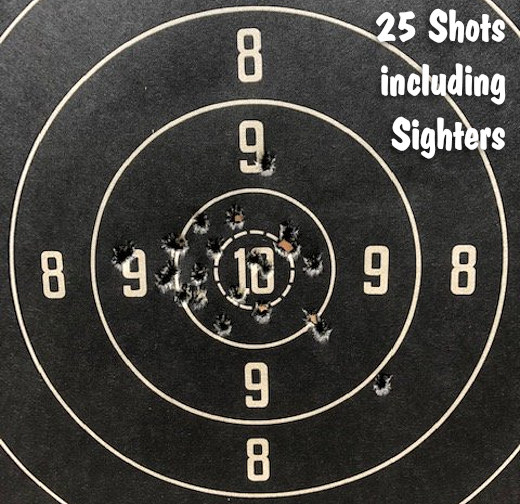
For his practice load, Tommy shot 123gr Hornady ELD-M bullets with H4831 powder and CCI BR2 primers. This load performed well — Tommy posted: “My 25-shot initial prone test today shows promise. There are five sighter shots, and 20 record shots. One of the 9s at 9 o’clock is my first sighter, the other one I own. The 8 out at 4 O’clock was a round that was difficult to chamber. My initial scoring puts me somewhere in the vicinity of 193-7X.”
The target used is the NRA C2, “300M International Rifle Target, reduced for 200 yards”. The 10 Ring is 2.40″ in diameter, while the Inner 10 (X-Ring) is 1.24″.
Match Load — Varget and Nosler Bullets
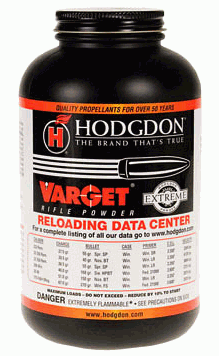
For his match load, Tommy switched to Varget and Nosler bullets: “My match load uses 37.9 grains Hodgdon Varget with a Nosler 123gr bullet. This was a recommendation by a gentleman with a lot of experience in 300M shooting.”
Tommy adds: “The amount of knowledge gained via the AccurateShooter Forum has made this all a reality, instead of just a passing thought.”
Savage Arms has completed a major overhaul of the Savage website. Now the SavageArms.com site is more mobile-friendly and easier to navigate. Savage has expanded information on its rifle products, and also updated the Expert Advice area. This section of the website offers informative technical articles/videos, as well as numerous helpful tips for hunters.
You’ll find 30 informative topics in the Expert Advice section of the updated Savage Arms website. Below are FIVE of our favorites. Click each item to view the full text and linked VIDEOS. Even if you don’t own a Savage, these features are useful. And all new shooters should definitely check out the Advanced Optics selection. This features a good video covering mirage and light refraction.
1. Advanced Optics — Stan Pate
Light refraction can wreak havoc on your ability to connect with a target at extreme long range. Stan Pate offers some good advice concerning mirage and refraction.
How often does this happen — a teen-aged girl helps build her own long-range benchrest competition rifle. And then she wins her first 1000-yard match with that new pink rifle! And yes, she hand-loaded her own 6mmBR ammo (naturally). Here is the remarkable story of 15-year-old Bexi from Britain, courtesy TargetShooter Magazine.
Brit Teen Competes with Rifle She Helped Build
Bexi is a talented young British lady who was introduced to shooting by her father Nick. As part of a UK skills honors program, 15-year-old Bexi decided to help build a new Savage-action benchrest rifle.
Our friend Vince Bottomley reports: “The first time Bexi actually shot her rifle I also happened to be present and I couldn’t believe how well she adapted to the bench to shoot the 6BR cartridges she had loaded. It was time for her first competition with the rifle — the UKBRA’s opening 600-yard benchrest shoot. At the end of the day she actually finished in third place in Light Gun Class, beating a host of experienced guys — including me. It was an astonishing performance and one that she would repeat throughout the season. In fact, Bexi finished second place in the UKBRA Championship.”
Bexi shoots her new rifle at 600 yards at the Diggle Ranges.
Bexi proved a “natural” at long range benchrest competition. At Bexi’s first 1000-yard match she beat all competitors, taking first place in Light Gun Class. Vince Bottomley reported from the range: “It’s a beautiful spring day, but the mirage is seriously blurring the target. Again I’m wondering — will she cope. Cope? I can’t believe it — Bexi lays down four sub-MOA groups and beats all of the Light Gun shooters with a superb 7-inch Agg at 1000! Wow!”
Bexi Helps Build 6mmBR Benchrest Rifle
Young Bexi helped build her great-shooting pink Light Gun as part of an honors program effort. In the UK, young persons age 14-24 can pursue special honors — the Duke of Edinburgh (DofE) Awards in three levels (Bronze, Silver, and Gold). See www.DOFE.org.*
A few years ago, Bexi started working towards her Bronze DofE award and opted to use shooting as a skill. She joined the Young Rascals Shooting Academy at the Diggle Ranges, progressing through rimfire to .223 centerfire, taking in a couple of adult F-Class shoots along the way.
Gunsmith Pete Walker spins up Bexi’s barrel in the lathe, showing her how to chamber a barrel.
To help Bexi earn her Silver DofE Award, gunsmith friend Pete Walker WalkerRifles.co.uk offered to sponsor Bexi and help her build her own rifle. Bexi wanted to further her involvement with shooting and help construct her own rifle to shoot in benchrest competition with her father. Ambitious? Yes, but that is exactly what the DofE Award is all about — achieving something you wouldn’t think possible. Benchrest appealed to Bexi — because of the precision involved. And yes she earned her Silver DofE Medal!
In total, Bexi spent 58 hours in Pete’s workshop over several Saturdays. Clearly, the machining work required in building a rifle was beyond Bexi’s skill level but she was present at every stage and Pete made sure that she actually did get to cut metal on the lathe. Bexi also polished the barrel and helped with assembly as the barreled action was bedded into the benchrest stock.
Rifle Specs: Savage Model 12 twin-port action, Benchmark 30″ barrel, Rifle Basics trigger, pink-painted laminated stock, Vortex Golden Eagle scope, and a custom butt-plate (hand-polished by Bexi).
Whilst the rifle was in its final stages of the build, it was time for Bexi to learn the art of reloading — under the close supervision of Dad Nick. Yes Bexi reloads all her ammunition. She preps her own brass, seats her own bullets, carries out a final weight check, make the entries in the reloading log, and enters the results and velocities from testing.
Vince comments: “When Bexi starts college and begins her Gold DofE Award efforts, she will continue shooting but now has ambitious plans to build a full custom rifle. Yes, Bexi wants a BAT but honestly, she’s doing pretty well with that Savage!”
*The Duke of Edinburgh’s Award (commonly abbreviated DofE), is a youth awards program with three progressive levels: Bronze, Silver, and Gold. With assistance from adult Leaders, participants select and set objectives in the following areas: Skills, Volunteering, Sport/Fitness, and Expedition. The DofE Award program was started in 1956, and now operates in over 140 countries along with the UK. As of 2017, over 6 million young people in the UK have taken part in the DofE programs, and 8 million worldwide. To achieve an award, the participant must work on each section for a minimum period of time, and must be monitored and assessed by qualified supervisors. Each progressive level demands more time and commitment from participants: Bronze 3–6 months; Silver: 6–9 months; Gold: 12–18 months.
Firing an “off-the-rack” M1903 Springfield, using GI-issue “tin-plate” ammunition, George Farr shot 71 consecutive bullseyes at 1000 yards (70 for record), a record that has never been broken.
Today’s Sunday GunDay story is, literally, a blast from the past — 1921 to be precise. We feature a “magic rifle” that set one of the most impressive records in history — one that has never been broken. Here is George Farr’s legendary .30-06 M1903 Springfield. This story is provided courtesy the NRA Blog with photos supplied by the NRA Museums.
An Old Man at the National Matches:
‘Dad’ Farr’s Golden Afternoon at Camp Perry by Doug Wicklund, NRA Museums Senior Curator
It was 1921. Warren Harding was President of the United States, and “The War to End All Wars” was less than three years past. The nation was getting back to a normal routine, and for competitive shooters, that meant an annual pilgrimage through the state of Ohio to the shores of Lake Erie, where the National Matches had been held since 1907 at Camp Perry. In those lighter days of the “Roaring Twenties”, marksmen from states banded together to make the journey, housing together in tent clusters on green lawns well behind the firing points.
The silver plate affixed to George Farr’s M1903 Springfield states: “With this rifle and using issued ammunition Mr. G.R. Farr of Seattle Wash in the Wimbleton Match, 1921, Camp Perry O., made 71 consecutive bulls eyes at 1000 yards”.
But one man at the 1921 National Matches stood out amongst the rest. George “Dad” Farr was a 62-year-old man from the state of Washington, and this was his first time heading east to shoot in the “big leagues”, as some of his fellow Evergreen State friends termed the annual competitions.
Aptly nicknamed, “Dad” was a good bit older than the average shooter during that late summer season, striding forward hesitantly clad in a khaki shirt and dungarees. He wasn’t a practiced High Power shooter — he showed up at Camp Perry without a rifle, and relied on a crude monocular for a spotting scope that he had fashioned from a pair of French opera glasses.
Counting his second sighting shot, George Farr fired 71 consecutive bullseyes at 1,000 yards using an unfamiliar rifle plucked from an ordnance rack earlier that day. It was an amazing feat.
At the previous day’s shooting, he had experienced issues with the initial .30-06 rifle he had chosen from the rack, a Model 1903 Springfield that didn’t seem to hold a consistent zero. This day, he chose a different gun, just another off-the-rack rifle no different from the one next to it. Though he didn’t realize it, George Farr had just made the best selection of his life.
Farr readied his bolt-action and prepared a clip of five rounds of Government Issue ammunition, then went to his position. He was ready to fire on a 1,000-yard target with a rifle he had never shot before.
Perhaps he had resigned himself somewhat to the outcome — after all, it was the last relay of the day on September 9. Off to the west, the sun was beginning its slow trip down to the horizon. But Farr shouldered his Springfield and prepared to fire. The time was 4:30 p.m. Shooters nearby were puzzled by this shooter who squirmed and shifted repeatedly, but were amazed as he made his first hits on paper. Farr was shooting Frankford Arsenal tin-plate ammunition, the standard G.I. .30-06 rounds. More experienced marksmen, like Marine Sgt. John Adkins — who had just won the Wimbledon Cup — were using commercial Remington match ammunition and had spurned the government ammo.
The Historic String of Bullseyes
At that distant 36-inch target, Farr scored two hits for his two sighters, with the last sighter being a bullseye. He then prepared to fire 20 shots for record. Each of those 20 shots went into the center. Each scored as a “5”. At the end of this amazing string, Farr gathered up his monocular and prepared to depart. His fellow shooters quickly advised that match rules required him to continue firing until he missed “the black”, the inner 5-Ring bullseye at the center of the target. Farr had only brought one box of ammunition with him to the firing line, and had run out. As he waited for more of the tin-plate ammo he had been using, the sun continued its retreat. Farr continued his shooting, racking up growing strings of bullseyes – 30, 40 50, 60 – each impact on target being carefully recorded on his scorecard in the growing darkness.
Then, at the 71st shot with daylight completely gone, the bullet strayed outside the target center, and Farr’s incredible string came to its conclusion. But counting his second sighting shot, George Farr had fired 71 consecutive bullseyes at 1,000 yards using an unfamiliar rifle plucked from an ordnance rack earlier that day. It was an amazing feat, one immediately recognized by those in attendance. His fellow shooters quickly took up a generous collection, contributing in recognition of Farr’s natural skill and enabling him to purchase that bolt-action Springfield he had worked magic with on that distant target. Enough funds remained that a silver presentation plate, inscribed with the names of the states whose competitors had contributed, was ordered and mounted on the side of the rifle’s buttstock.
The next year, the Civilian Team Trophy was re-designated as the Farr Trophy, and George Farr’s record, fired on the old target system, was never beaten. Farr’s rifle went home with him to Washington and remained there, never again traveling eastward to Camp Perry. In 2011, The Farr family donated this legendary piece of shooting history to the NRA National Firearms Museum collection.
In 2013, as NRA Museums curators began assembling the collection for display at the NRA National Sporting Arms Museum at Bass Pro Shops in Springfield, Missouri, the museum staff created a unique exhibit featuring George Farr’s Model 1903 Springfield rifle and its special place in competitive shooting history. Alongside the rifle rests Farr’s simple monocular, another mute witness to Camp Perry history made on that September evening in 1921.
Farr’s Springfield… is one of thousands of historically significant firearms found in the NRA Museums collections on display across three locations. To view the collection and learn more about the incredible stories behind each gun, visit the NRA Museums in person or browse the NRA Museums website.
Shooting Industry Magazine has released a helpful blog article concerning airline travel and firearms. Written by well-known shooting instructor, gun writer (and part-time police officer) Massad Ayoob, the article covers key points travelers must understand before carrying firearms into an airport zone. In his article Flying with Firearms, Ayoob warns travelers that “State gun laws change frequently” and that “our country is a 50-piece patchwork quilt of gun laws”.
Here are some of the recommended resources gun-toting travelers should consult before they head to any airport in the United States:
Flying with Firearms — Familiarize Yourself With The Laws by Massad Ayoob
State gun laws change frequently, including reciprocity on concealed-carry permits even in the gun-friendly “red states.” Here are a few sources I recommend for you and your customers.
Online, the best and most up-to-date source of gun laws I’ve found is www.Handgunlaws.us. For smart phones, the best app I can recommend is Legal Heat (www.mylegalheat.com).
The Transportation Security Administration (TSA) and the Federal Aviation Administration (FAA) are the authoritative sources on flying with firearms.
The controlling TSA regulation can be found at www.tsa.gov, search “Firearms.” The FAA’s controlling regulation is 108.11. To view the FAA’s controlling regulation, visit www.govinfo.gov, click “Advanced Search” and enter “14 CFR 108.11” — the first result contains the report.
Story based on Report by NRA-ILA
The U.S. Supreme Court has taken up a challenge by an NRA state affiliate to a New York City gun control scheme that effectively prohibits lawfully-licensed handgun owners from leaving the city with their own firearms. In the New York State Rifle and Pistol Association v. City of New York, NY case, the plaintiffs raise objections to the N.Y. City law, particularly that it violates the Second Amendment.
Few laws in the history of our nation, or even in contemporary times, have come close to such a sweeping prohibition on the transportation of arms. — U.S. DOJ Brief challenging N.Y. City law
Given the uniquely oppressive and bizarre nature of the challenged restrictions, many observers believe the real question in the case isn’t whether New York City will lose but on what grounds and how badly. The City itself, in fact, recently made a desperate attempt to avoid a ruling on its laws by claiming to the court that it was in the process of revising the regulations to address the issues raised in the case. The court rejected that gambit, and proceedings in the case have continued.
The Trump administration, through the U.S. Department of Justice (DOJ), has filed a brief in support of the plaintiffs. The DOJ argues that the New York City regulation is unconstitutional, because the “transport ban infringes the right to keep and bear arms guaranteed by the Second and Fourteenth Amendments.” The DOJ’s brief states the Second Amendment does not end at the property line of one’s own home.
“The Second Amendment guarantees both the right to ‘keep’ and the right to ‘bear’ firearms”, the brief states. “Read naturally, the right to ‘bear’ firearms includes the right to transport firearms outside the home; otherwise, the right to ‘bear’ would add nothing to the right to ‘keep’.”
What we now know as the “6mm Remington” was originally called the .244 Remington. The cartridge was renamed because it was not a commercial success initially, being eclipsed by the .243 Winchester. The .244 Remington and the 6mm Remington are identical — only the name was changed. Why was the .244 Remington an “also-ran” to the .243 Win? Sierra Bullets Ballistics Technician Paul Box provides some answers…
The year was 1955. A time of carhops, drive-in movies, and Buffalo Bob. It was also the year that Winchester introduced the .243 Win and Remington counter-punched with the .244 Remington (now more commonly known as the 6mm Remington). The .243 Win was based off the time-proven .308 Win case while Remington chose the old war horse, the 7×57.
We’ve all read countless times how Winchester chose the 1:10″ twist, while Remington adopted the 1:12″ twist for their .244 Rem rifles. The first complaint in the gun magazines of that era was how the faster twist Winchester could handle 100 grain bullets, while Remington’s [12-twist factory rifles were supposedly limited to 90 grain bullets].
The first complaint I remember reading was that the 100-grainer was better suited for deer-sized game and the 1:12″-twist wouldn’t stabilize bullets in this weight range. Now, let’s look at this a little closer. Anybody that thinks a 100-grainer is a deer bullet and a 95-grainer isn’t, has been drinking too much Kool-aid. In all honesty, it’s all about bullet construction and Remington had constructed the [90s] with light game in mind. In other words, Remington got it right, but due to a lack of knowledge at the time on both bullet construction and stability, the .244 never gained the popularity it deserved. At that time, Sierra had the 100gr SMP and Hornady offered a 100gr RN that would both stabilize in the slower 1-12″ twist. The .244 Remington provides another classic example of how the popularity of a cartridge suffered due to a lack of knowledge.
.244 Rem vs. .243 Win — What the Experts Say
Respected gun writer Chuck Hawks says the .244 Remington deserved greater acceptance: “The superb 6mm Remington started life in 1955, the same year as the .243 Winchester. It was originally named the .244 Remington. Although the 6mm lost the popularity contest to the .243, it is one of my favorite rifle cartridges, and much appreciated by reloaders generally. The .244 Rem and 6mm Rem cartridges are completely interchangable, and anyone with a .244 Rem rifle can shoot [6mm Rem] ammunition in complete safety (or vice-versa). Remington .244 rifles made from 1958 on can stabilize all 6mm bullets, while those made in 1955 through 1957 are limited to loads using spitzer bullets not heavier than 90 grains for best accuracy.”
Nathan Foster, author of The Practical Guide to Long Range Hunting Cartridges, states: “In 1963 Remington attempted to regain ground by releasing .244 rifles with a new 1:9″ twist to handle heavier bullets. The cartridge was renamed the 6mm Remington and new ammunition was loaded giving the hunter the choice of either an 80gr bullet for varmints or a 100gr bullet for deer. In comparison to the .243 Win, factory loads for the .244/6mm Remington are slightly more powerful while hand loads increase this margin further.”
Was the .244 Remington Actually Better than the .243 Winchester?
The .244 Remington (aka “6mm Remington”) has a velocity advantage over the .243 Winchester due to a slightly larger case capacity. The longer case neck of the .244 Remington is considered desirable by handloaders. We like the added capacity and long neck of the original .244 Remington. As renamed the “6mm Remington”, the cartridge HAS developed a following, particularly with varmint hunters looking for a high-velocity 6mm option. But it never achieved the success of the .243 Winchester for many reasons. As a member of the .308 family of cartridges, the .243 Winchester has certain obvious advantages. First, you can simply neck down .308 Win brass, which was available at low cost from many sources. Moreover, a .308 Win or 7mm-08 full-length sizing die could be used for body sizing. Still the .244 Remington (6mm Remington) presents an interesting “what if?” story…
To help the shooting sports thrive, we need to introduce new participants. And now is a great time to bring a new shooter to the range — the NRA promotes May as Mentor Month. This month, make a commitment to enlist a new shooter. You’ll be helping the fight for the Second Amendment, PLUS you can get a chance to win valuable prizes in the NRA Mentor Sweepstakes.
Tips for First-Time Range Sessions with New Shooters:
1. Start with rimfire — bring a .22 LR rimfire pistol and rifle if possible.
2. Shoot a variety of targets, both paper and steel. The satisfying “clang” and movement of a hit on steel provides “instant gratification” that can make shooting more fun.
3. Invite a buddy AND his spouse. It’s great to get couples involved in the shooting sports — we need more lady shooters. And there’s evidence that women learn faster than guys!
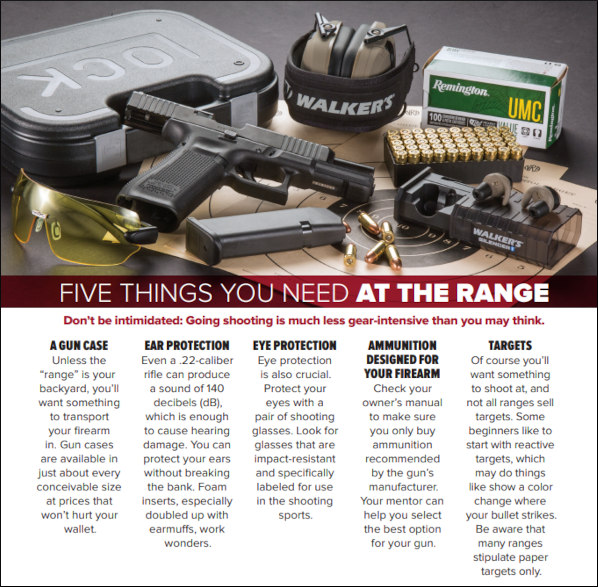
4. Be sure to bring good ear and eye protection for yourself and all guests. We recommend ear-plugs under muffs for maximum sound protection.
The NRA Mentor Initiative is designed to bring new participants, of all ages, into the shooting sports. The aim is to expand interest in firearms, and foster hunting, competitive shooting, and support for Second Amendment rights. CLICK HERE to find a range near you. On that page click the “Places to Shoot” button and type in your Zip Code.
Former NRA President Pete Brownell states: “May has been designated NRA Mentor Initiative month. We are calling on … NRA Members [and] the firearm community, to find someone who has never fired a firearm before, take them to the range and help them put their first rounds on target. It’s been my experience that within minutes of the safety briefing, a lesson on marksmanship and the first pull of the trigger, all of the preconceived notions and media-fueled biases melt away…”
The NRA has a good resource for mentors (and their students). The NRA’s A Guide for New Shooters contains essential safety information and range etiquette instructions. You’ll want to download this PDF to share with your trainee(s).
Click photo to download PDF Guide for New Shooters.
The NRA offers helpful, short videos for new shooters. This video covers safety basics, with a focus on indoor pistol shooting. We actually prefer to start novices at an outdoor range, shooting .22 LR rimfire rifles. Indoor ranges tend to be dark and noisy. The outdoor experience is more like a day at the park.
Mother’s Day is Sunday, May 12th, and Father’s Day is just a month away. Perhaps you’re thinking about giving your parent(s) a firearm for sporting use or self-protection. While gifting a gun is allowed in most jurisdictions, there are important state and Federal laws with which you must comply. And while Federal laws cover the whole country, the rules on firearms gift transfers vary significantly from state to state.
Bottom line here — you need to know the law BEFORE you deliver that shiny new firearm to a family member, close friend, or relative.
Image Courtesy NSSF. This story is based on an NSSF Article.
The first thing to remember if you’re thinking about giving someone a gun is that … it’s a gun! You already know that ownership of a firearm brings with it some serious legal and ethical obligations that other consumer products don’t. So let’s look at some questions you may have about giving a firearm as a gift.
The first question you have to ask is whether the intended recipient can legally own the firearm where he or she lives. With more than 20,000 different gun laws on the books, even the kinds of firearms that law-abiding citizens can own vary from place to place. For example, juveniles (under age 18) generally speaking are precluded by law from possessing a handgun. Check out the Bureau of Alcohol, Tobacco, Firearms and Explosives (ATF) website for an overview of local laws and, whatever you do, don’t forget that you can never under any circumstances transfer a firearm to someone you know — or have reasonable cause to believe — legally can’t own one. That’s a federal felony, so be careful.
There’s no federal law that prohibits a gift of a firearm to a relative or friend who lives in your home state. Abramski v. United States, a recent Supreme Court decision involving a “straw purchase” of a firearm did not change the law regarding firearms as gifts. The following states (California, Colorado, Connecticut, Delaware, New York, Oregon, Rhode Island, Washington State) and the District of Columbia require you to transfer a firearm through a local firearms retailer so an instant background check will be performed to make sure the recipient is not legally prohibited from owning the gun. Maryland and Pennsylvania require a background check for private party transfer of a handgun. There are exceptions, so it’s important to check the law of your state or ask your local firearms retailer.
Consider a Gift Card Instead of Direct Gift
The ATF recommends that if you want to give someone a new firearm, rather than going to a gun store and buying the gun on your own, consider instead purchasing a gift certificate/card from your favorite gun retailer. Then give that gift card as the present. That way the recipient can choose the exact gun he or she wants, and there’s no question about who is “the actual buyer of the firearm,” which is a question any purchaser must certify on the Federal Form 4473 at the time of purchase. The Gift Card option avoids any “straw purchaser” issues.


 Match Load — Varget and Nosler Bullets




 The first question you have to ask is whether the intended recipient can legally own the firearm where he or she lives. With more than 20,000 different gun laws on the books, even the kinds of firearms that law-abiding citizens can own vary from place to place. For example, juveniles (under age 18) generally speaking are precluded by law from possessing a handgun. Check out the
  Consider a Gift Card Instead of Direct Gift


